
"User interface design services" means something different at every agency. This guide breaks down what's actually included, what providers charge in 2026, a ranked shortlist worth knowing, and how to choose based on fit, not reputation.
What UI design services really include, cost, and which providers are worth a call.
Hiring for user interface design services usually starts with a Google search and ends with a spreadsheet full of quotes that don't line up. One agency's proposal covers research, prototyping, and a full design system. Another covers screen styling and nothing else. Both call themselves "UI design services," both hand you a number, and neither number means much until you know exactly what it buys. This guide exists to close that gap before you get on a call with anyone.
"UI design services" is a phrase that hides a lot of variation. One provider means a full product design partnership: research, prototyping, a design system, and post-launch optimization. Another means a freelancer who'll style your screens. They can cost $300 a screen or $250,000 for a full product, and both use the same label. So before you shortlist anyone, it helps to know exactly what these services include, what they should cost, and which providers are actually good at the kind of work you need.
This guide covers all of that. It's built for SaaS, AI, and startup teams shopping for UI design services, alongside our broader look at UX design companies for SaaS if you want the wider field too, and instead of a bare list of agency names, it explains:
What UI design services actually include
What they cost in 2026
A five-point way to evaluate any agency before you sign
A ranked shortlist of providers worth knowing, from premium studios to SaaS specialists, with real project examples
How to choose based on fit rather than reputation
Whether you end up working with Groto or someone else, you'll leave this able to evaluate any UI/UX design provider with clear eyes.
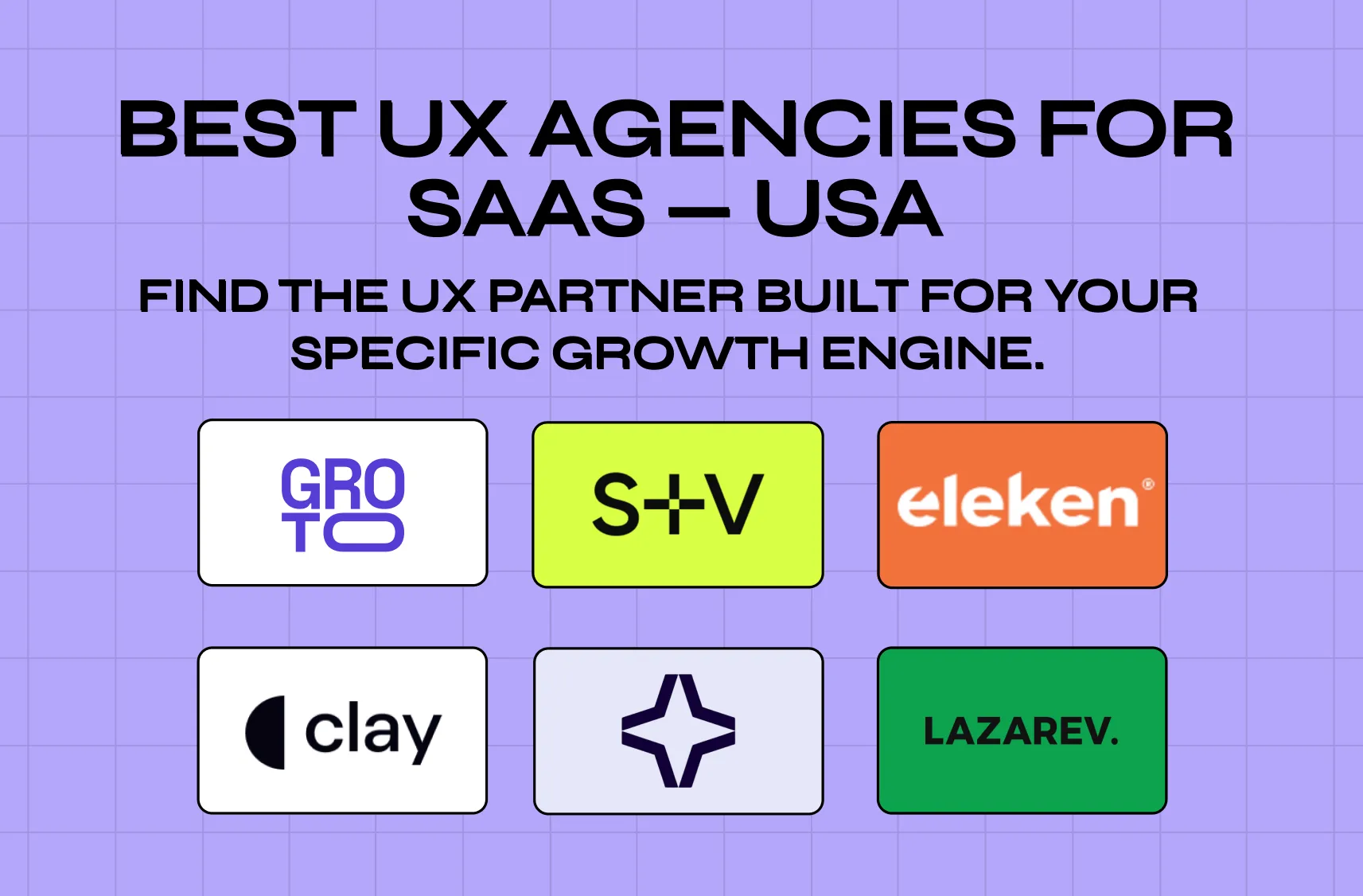
TL;DR: The shortlist at a glance
Provider | Best For | Starting Range | Notable Work |
Groto | AI-first and SaaS product teams wanting design and build in one loop | Screen or fixed-scope, quarterly retainers from ~$2,199/mo | Fortune 500 clients including Colgate and ABInBev |
MetaLab | Well-funded companies wanting a marquee product-design partner | Premium, project-based | Recognizable consumer and SaaS products |
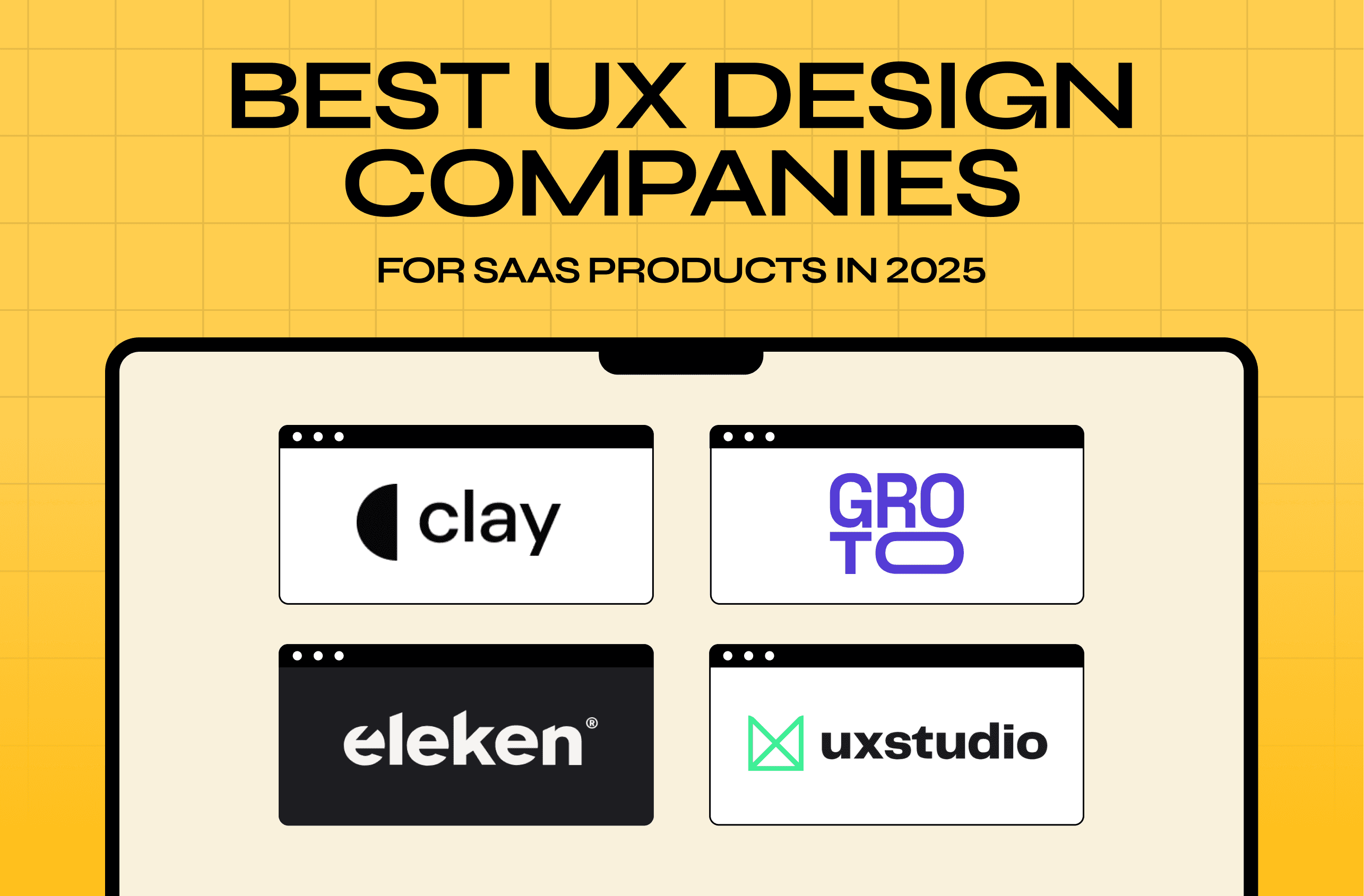
Clay | Teams wanting standout, brand-led visual craft | Premium, project-based | Recognizable consumer and SaaS products |
Fantasy | Enterprises wanting bold, ambitious interface work | Premium, project-based | High-craft digital experiences |
UX Studio | Redesigns needing an embedded team that learns your workflows first | Embedded/retainer | High-end product and interface design |
Eleken | SaaS teams wanting ongoing embedded design capacity | Subscription | 200+ SaaS products |
Ramotion | Teams wanting brand plus product UI from one studio | Project-based | Brand, product, and web design |
Phenomenon Studio | B2B SaaS teams wanting well-rounded UI/UX delivery | Project-based | B2B SaaS portfolio |
Work & Co | Large orgs with complex, data-heavy systems | Enterprise | Enterprise system redesigns |
IDEO | Enterprises where problem-framing matters as much as UI | Enterprise | Human-centered design thinking |
Fireart Studio | Startups wanting quality design without enterprise pricing | Project-based | Full-service startup work |
Goji Labs | Startups wanting design and build under one roof | Project-based | Full-service product design and development |
What UI design services actually include
At a minimum, UI/UX design services include user research, information architecture, wireframing, prototyping, usability testing, visual (UI) design, and design-handoff documentation. If you want the fuller breakdown of what UI/UX design is before comparing scopes, start there. Full-service providers add design-system development, post-launch UX measurement, and iterative optimization. Knowing this scope is the first step, because it tells you whether a quote covers the whole job or just the pretty part.
The baseline deliverables move from understanding to execution:
User research to learn who you're actually designing for
Information architecture to structure the product logically before anything gets styled
Wireframing to lay out screens before visual design begins
Prototyping, usually in Figma, Sketch, or Adobe XD, to make the flows testable with real users
Usability testing to validate those flows before they're built
Visual design to establish look and feel for the graphical user interface itself, meaning color, type, and components
Handoff documentation so engineering can build it accurately
A provider offering only "visual design" is doing one slice of this list. That's fine if you already have the rest covered internally, and a problem if you assumed the phrase meant end-to-end work.
Full-service providers go further, and for most product teams these extras matter more than the baseline:
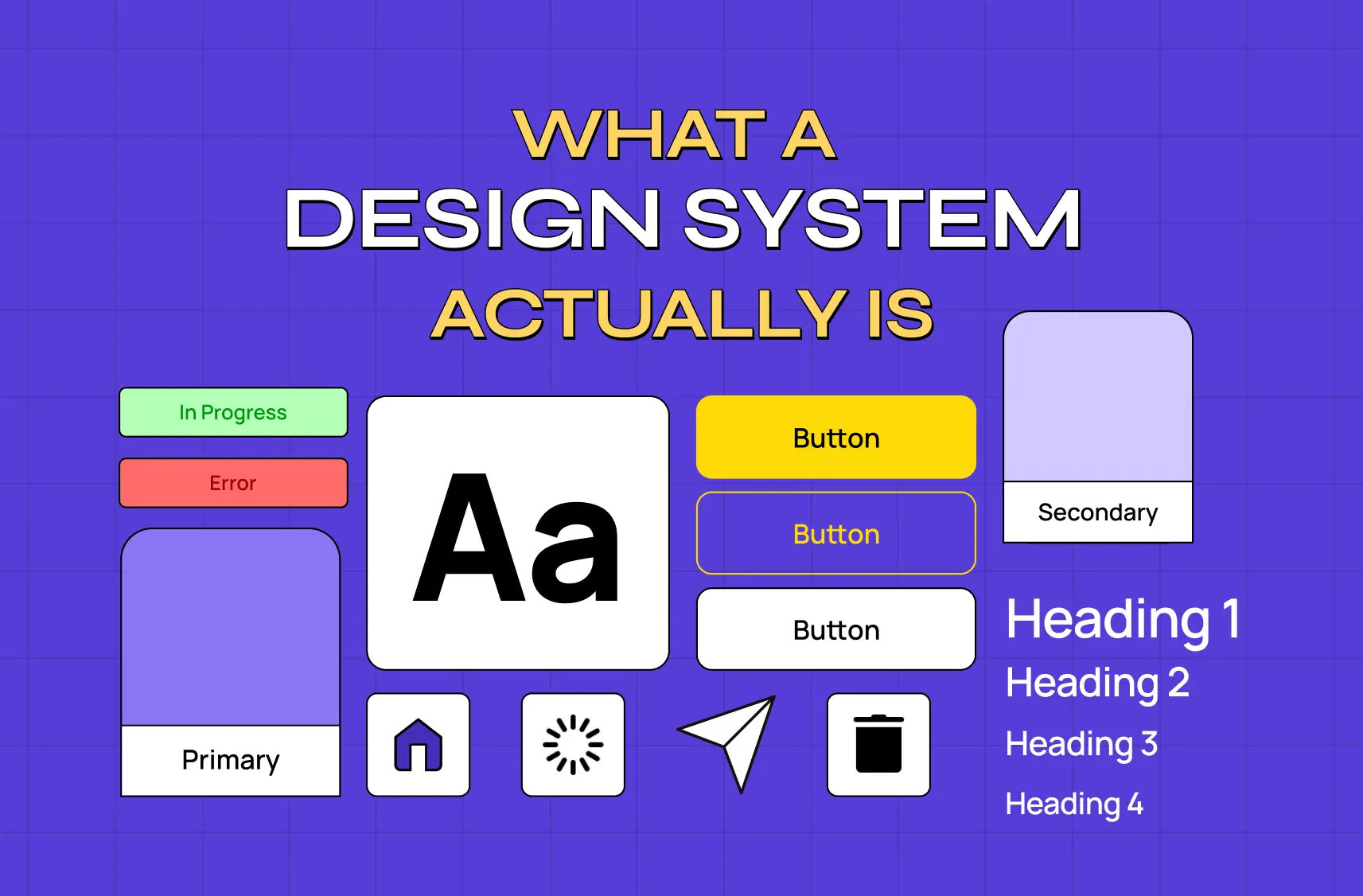
Design-system development: a reusable component library so your UI stays consistent and your team can move faster on new features
Post-launch UX measurement: tracking whether the design actually works once it ships, not just whether it looks finished
Iterative optimization: improving the product based on real usage data rather than a one-time handoff
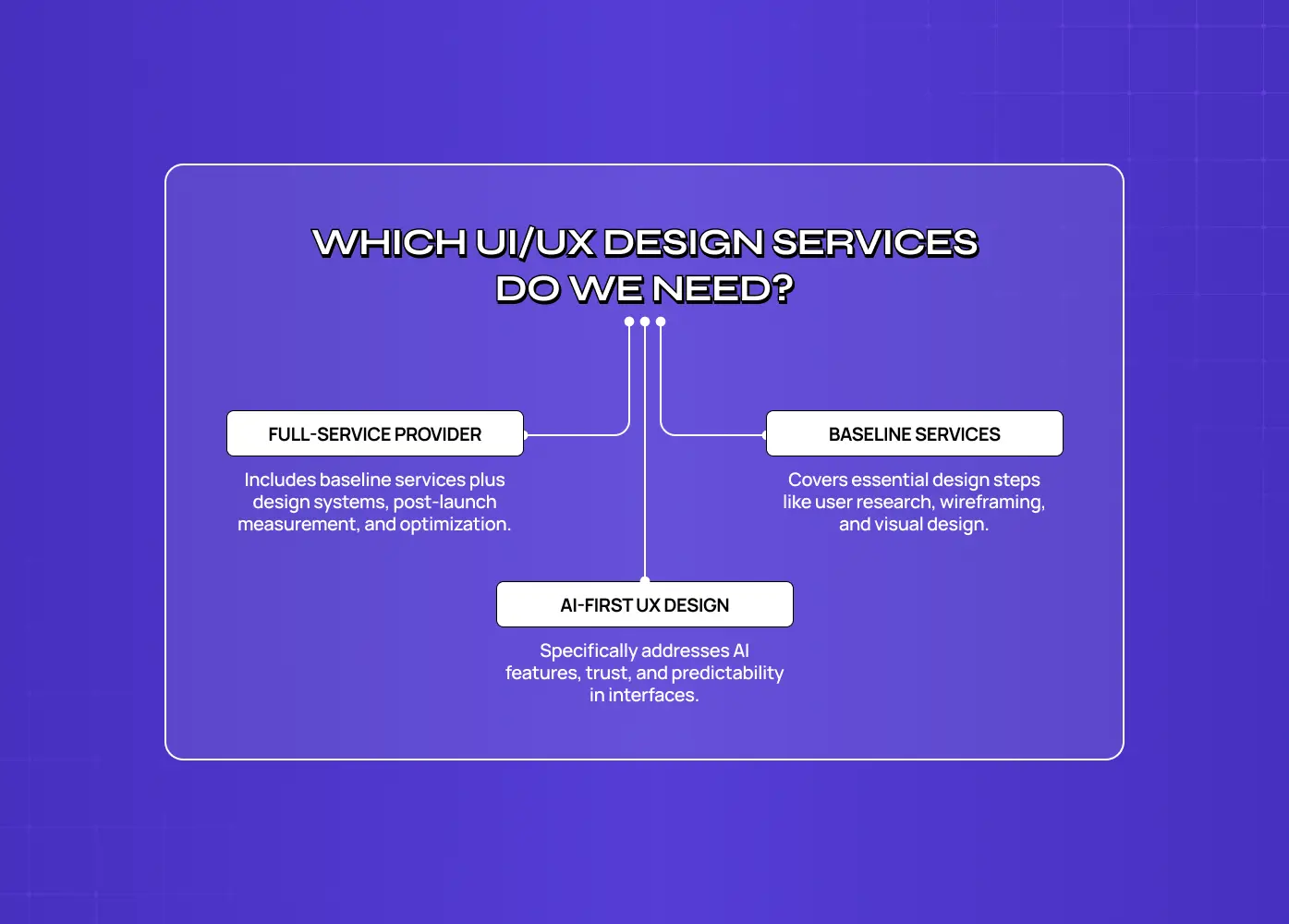
When you compare quotes, compare scope first. A cheaper engagement that stops at visual design isn't actually cheaper if you still need research, prototyping, testing, and handoff from somewhere else. If your product involves AI features, non-deterministic outputs, or copilot-style interactions, it's also worth checking whether a provider's process accounts for AI-first UX design specifically, since designing trust and predictability into an AI interface is a different problem than designing a standard SaaS flow.
What UI/UX design services cost in 2026
UI/UX design services in 2026 typically run about $300 to $1,500+ per screen, or $25 to $200 per hour, with fixed-price engagements landing in a few common bands. Pricing varies enormously with scope, seniority, and provider tier, so treat these as directional ranges rather than quotes.
By pricing model:
Per screen: roughly $300 to $1,500+, useful for smaller, well-defined work
Hourly: roughly $25 to $200, reflecting the wide gap between offshore freelancers and senior specialist studios
Fixed-price, small projects: roughly $10,000 to $30,000
Fixed-price, mid-tier: roughly $30,000 to $80,000
Fixed-price, enterprise scale: roughly $80,000 to $250,000+
Standalone design systems: roughly $40,000 to $120,000
Most mid-size product-design engagements fall somewhere between $15,000 and $100,000, while a full product design build can exceed $200,000 at the high end. The spread is real, and it mostly reflects who is doing the work and how much of the full scope it covers.
The practical takeaway: a price only means something next to a defined scope and a seniority level. A $15,000 quote and a $90,000 quote can both be reasonable, just for different scopes handled by different-caliber teams. Ask every provider for a detailed proposal with timeline, deliverables, and pricing, and compare those on equal footing before you compare the numbers themselves.
How to evaluate a UI design agency: a 5-point test
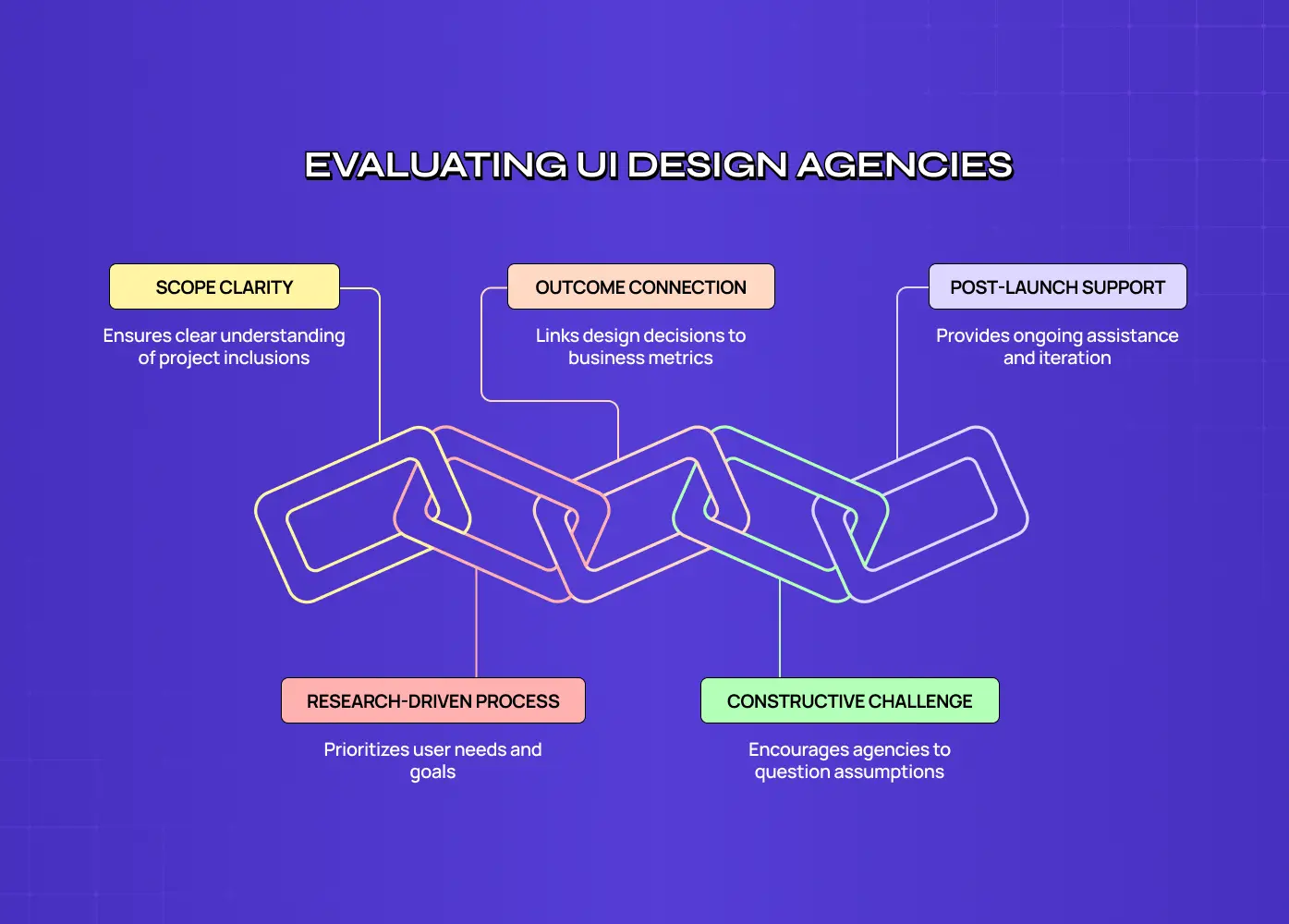
Before you shortlist anyone, run their pitch through these five questions. They surface more about fit than a portfolio ever will.
1. Do they tell you what's actually included?
Scope is where most engagements get messy. Ask what's core to the proposal and what falls outside it. If the project touches a full product, not just a handful of screens, ask whether research, IA, and testing are included or billed separately.
2. Does their process start with research or with visuals?
A process grounded in user research and information architecture looks very different from one that opens with a mood board. A B2B fintech dashboard serving compliance officers, sales reps, and executives all at once is not a problem you solve by jumping straight to color palettes. The stronger processes map user journeys and business goals before any screen gets designed.
3. Can they connect design decisions to product outcomes?
Good UI design should move a number: activation, retention, conversion, or support-ticket volume. Ask what metric past projects were trying to move and what actually happened. Vague answers here are a signal.
4. Will they push back on your brief?
Ask for a specific example of a time they challenged a client's assumption and what happened next. Agencies that only execute what they're told tend to produce work that looks fine and performs unremarkably.
5. What happens after launch?
A shipped UI is the start of the relationship, not the end of it. Ask how they measure success once the product is live, whether they offer a support window, and how iteration gets handled. Teams that treat launch as the finish line tend to leave usability gaps for you to discover on your own. This is also where UX strategy work matters most, since a data-driven approach to what happens after launch is what turns a one-time design project into a compounding advantage.
The best UI/UX design agencies in 2026
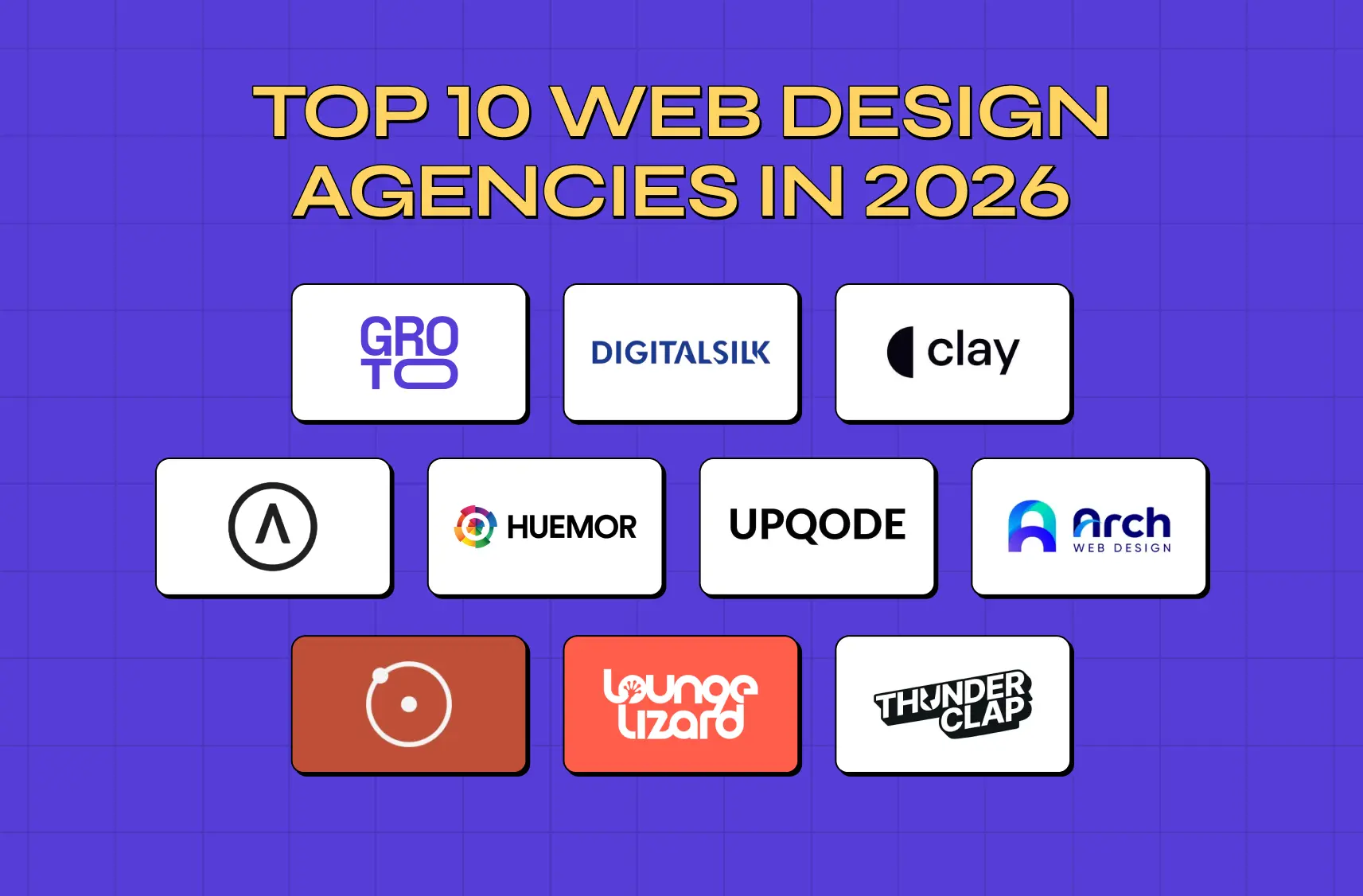
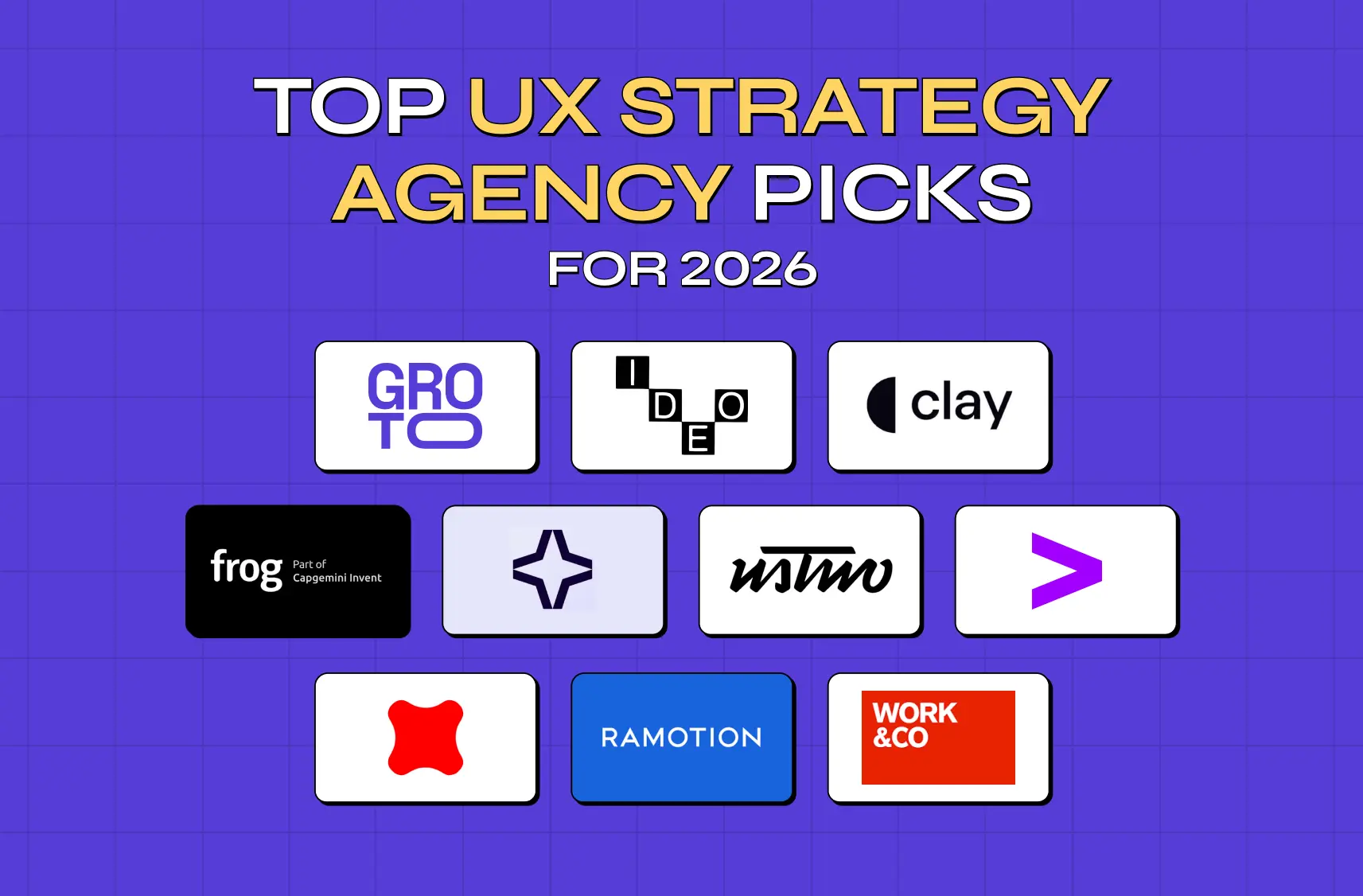
Here are twelve providers worth knowing, evaluated against the five-point test above and grouped loosely by strength. The right one depends on your product's complexity, your stage, and your budget, which the next section maps out directly.
1. Groto
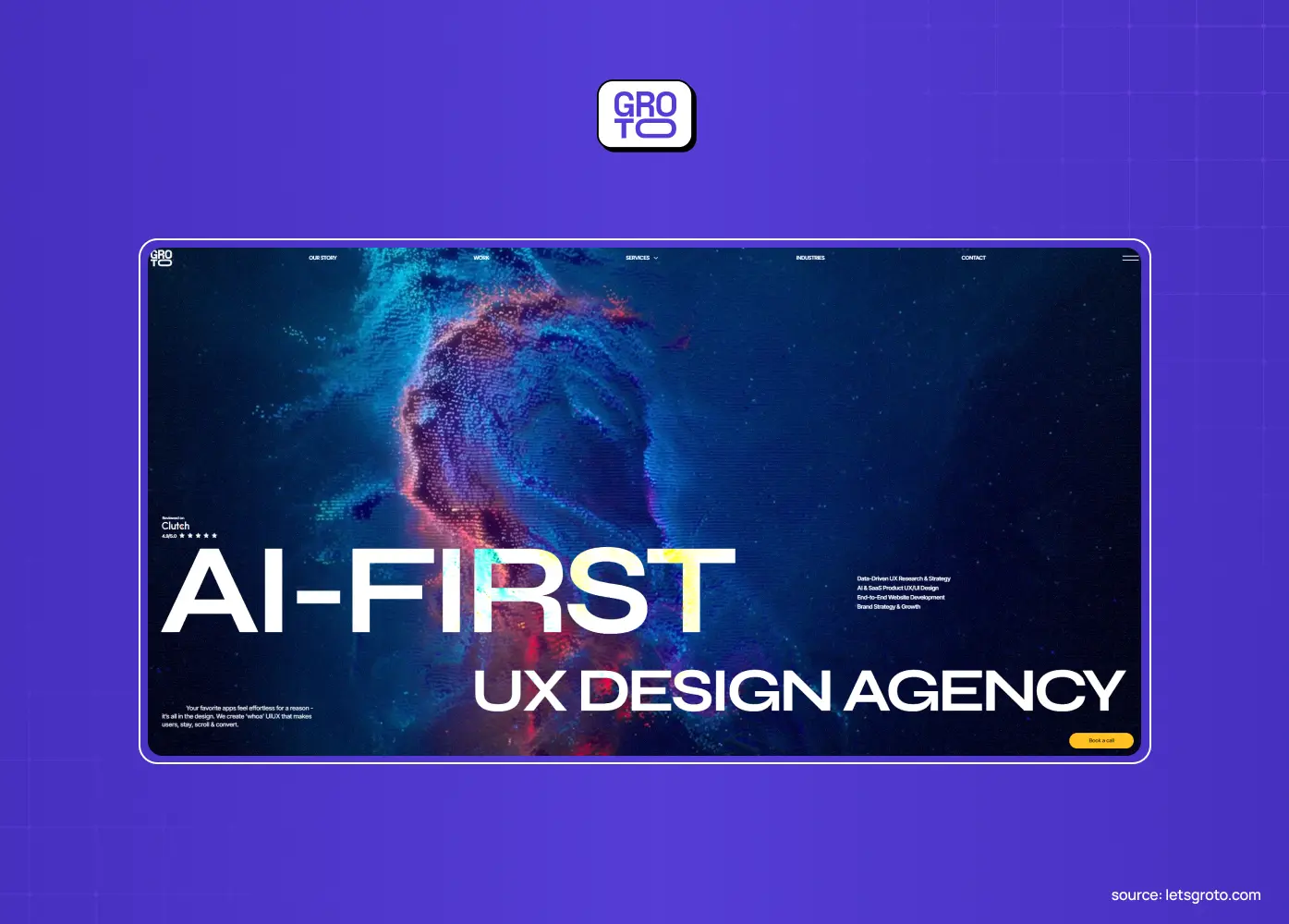
Best for: SaaS and AI product teams wanting senior, product-grade UI/UX and, where useful, design and build in one loop, without enterprise-firm overhead.
Groto is a design-led studio providing end-to-end UI design services for SaaS and AI products: research, IA, wireframing, prototyping, visual design, design systems, and iterative optimization. Our particular depth is in designing AI product experiences, where non-deterministic outputs, trust, and adoption behave differently than in a standard SaaS flow. Our Creative Director ranks in the global top 3% of UX designers, and the studio's client list runs from funded-stage startups to Fortune 500 names including Colgate and ABInBev.
Services offered:
End-to-end product UI/UX: research, IA, wireframing, prototyping, visual design, and design systems
AI-first product design, including copilots, conversational UI, and agentic interfaces
SaaS UX design for onboarding, retention, and data-heavy dashboards
UX strategy and post-launch UX measurement
Web development, brand identity, and marketing design for teams that want the full build under one roof
Why teams choose Groto:
When we worked on PathwaysX, an AI-driven B2B hiring platform, the challenge wasn't styling screens, it was making personality-based, AI-generated assessments feel trustworthy enough that hiring teams would act on them without second-guessing the output.
Our work on Gini turned DNA insights and AI-powered food logging into a health hub that adapts to each user's lifestyle, which meant designing for clarity first and cleverness second, on a product where getting that wrong has real consequences.
With Barista, we redesigned a PR-first AI tool to work like a teammate rather than a dashboard, so PR teams could collaborate faster without ever having to think about the AI underneath.
Design and build stay in one loop here, so teams get research through engineering handoff from a single team instead of reconciling two vendors' timelines and files.
2. MetaLab
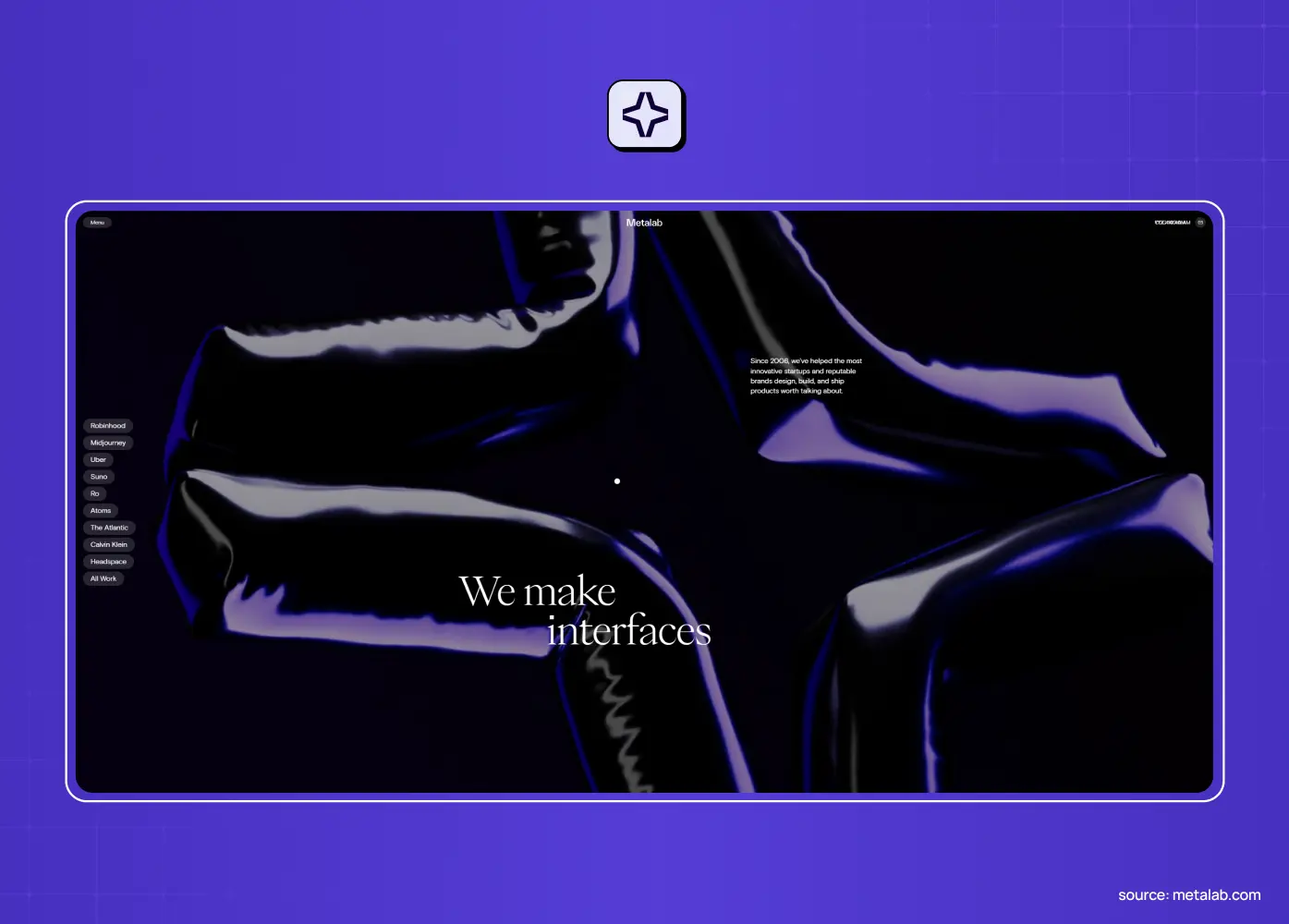
Best for: Well-funded companies wanting a marquee product-design partner.
A world-renowned product design studio known for shaping recognizable digital experiences, MetaLab brings a strong focus on simplicity, usability, and visual polish.
Services offered:
Product strategy and UI/UX design
Brand and visual identity work alongside product design
High-fidelity prototyping
Why teams choose MetaLab:
Strong reputation for turning early-stage products into polished, recognizable brands
A track record with well-known consumer and SaaS names
Deep bench of senior product designers
3. Clay
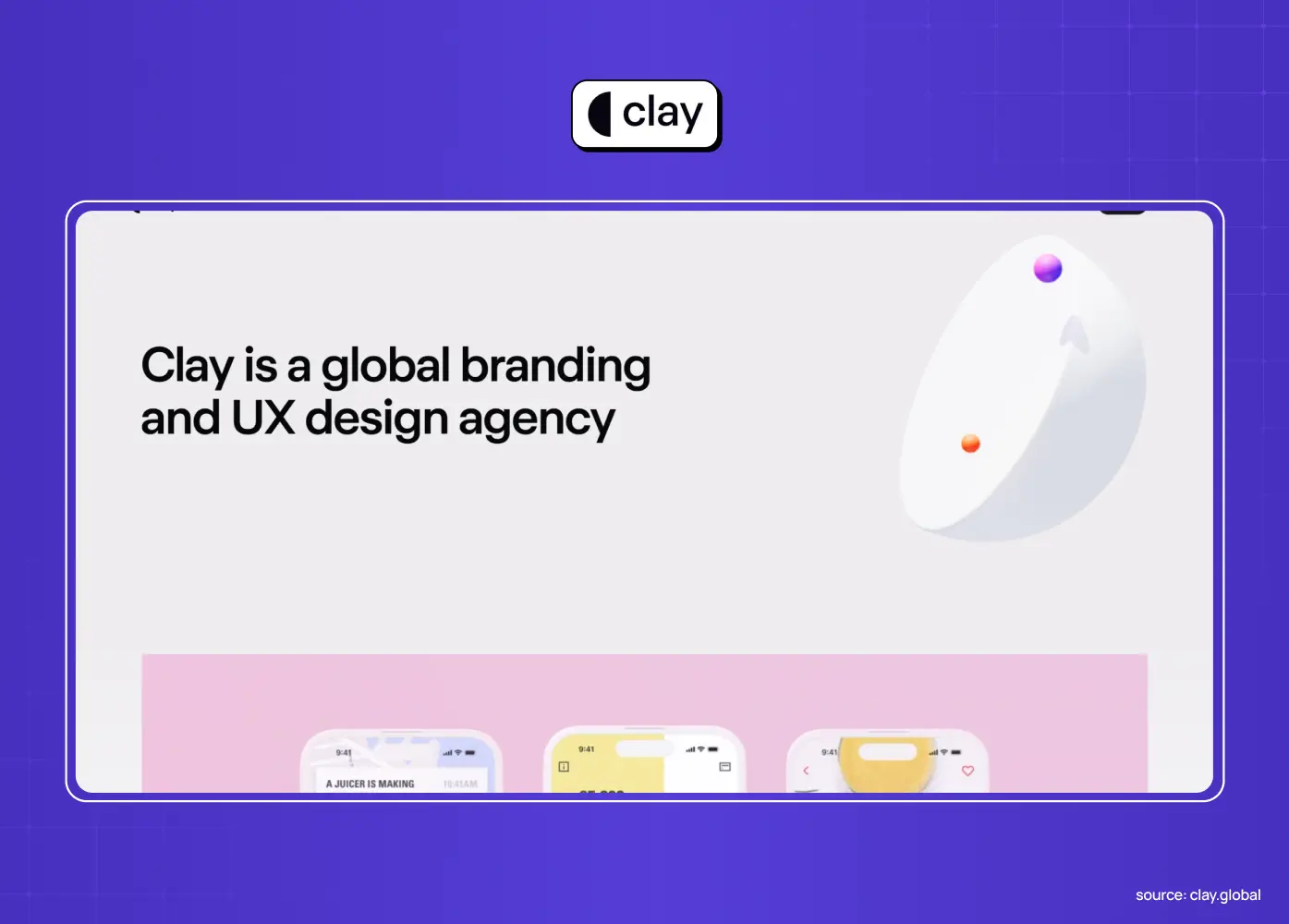
Best for: Teams with the budget and appetite for standout, brand-led UI work.
Clay is a premium design and branding agency producing high-craft, visually ambitious digital experiences.
Services offered:
Brand and visual identity
Product and web design
Motion and interaction design
Why teams choose Clay:
Visually distinctive work that stands out in a crowded market
Strong integration between brand identity and product UI
A fit for companies where visual craft is a competitive differentiator
4. Fantasy
Best for: Enterprises and well-funded companies wanting bold, premium design.
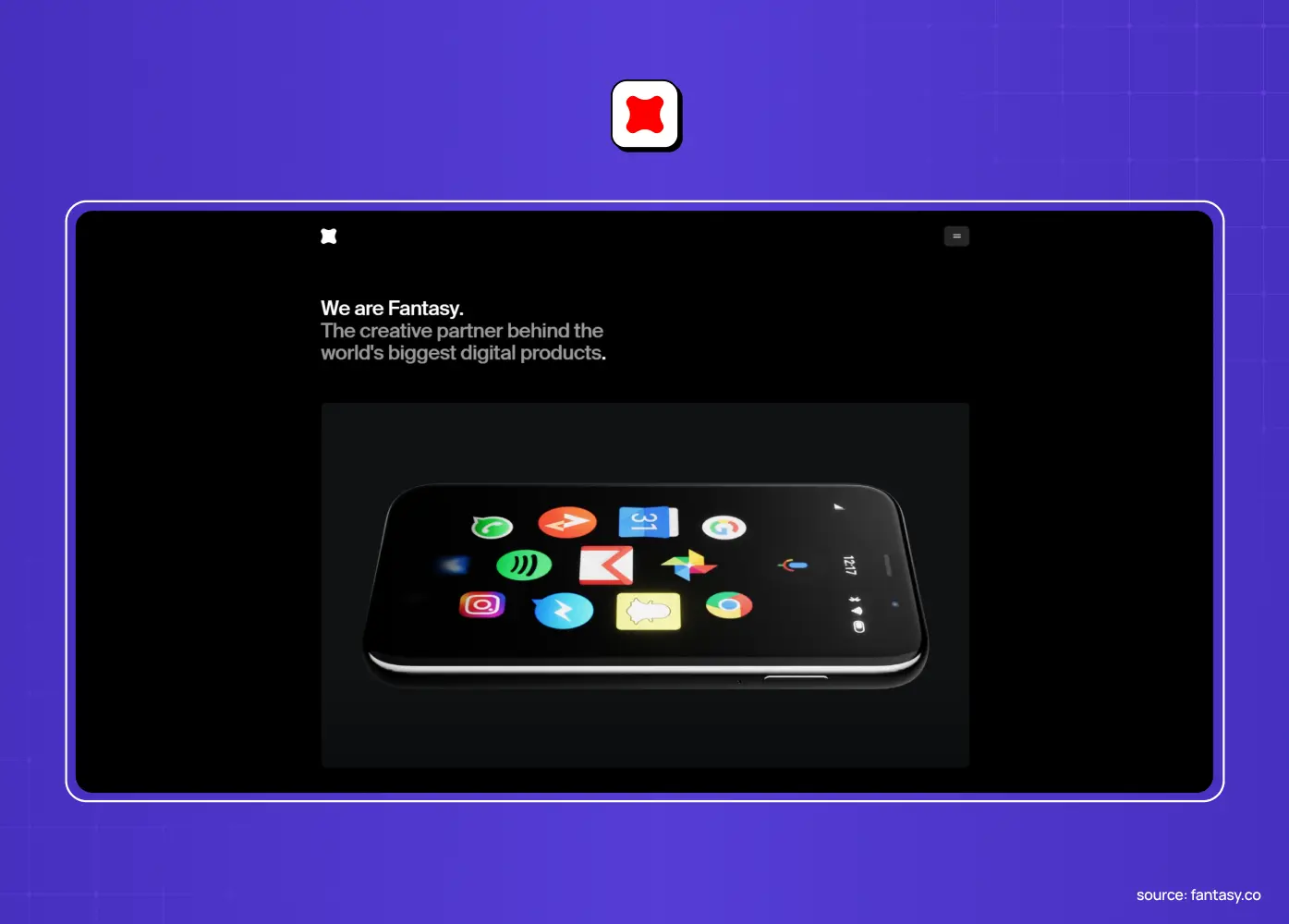
Fantasy is a premium product design studio known for ambitious, high-end interface and experience work.
Services offered:
Product design and UI/UX
Brand and campaign design
Emerging-tech interface design
Why teams choose Fantasy:
Comfortable working on ambitious, unconventional interface challenges
Strong portfolio across premium consumer and enterprise brands
A fit when "safe" design isn't the goal
5. UX Studio
Best for: Redesigns that depend on understanding established user workflows before changing the interface.
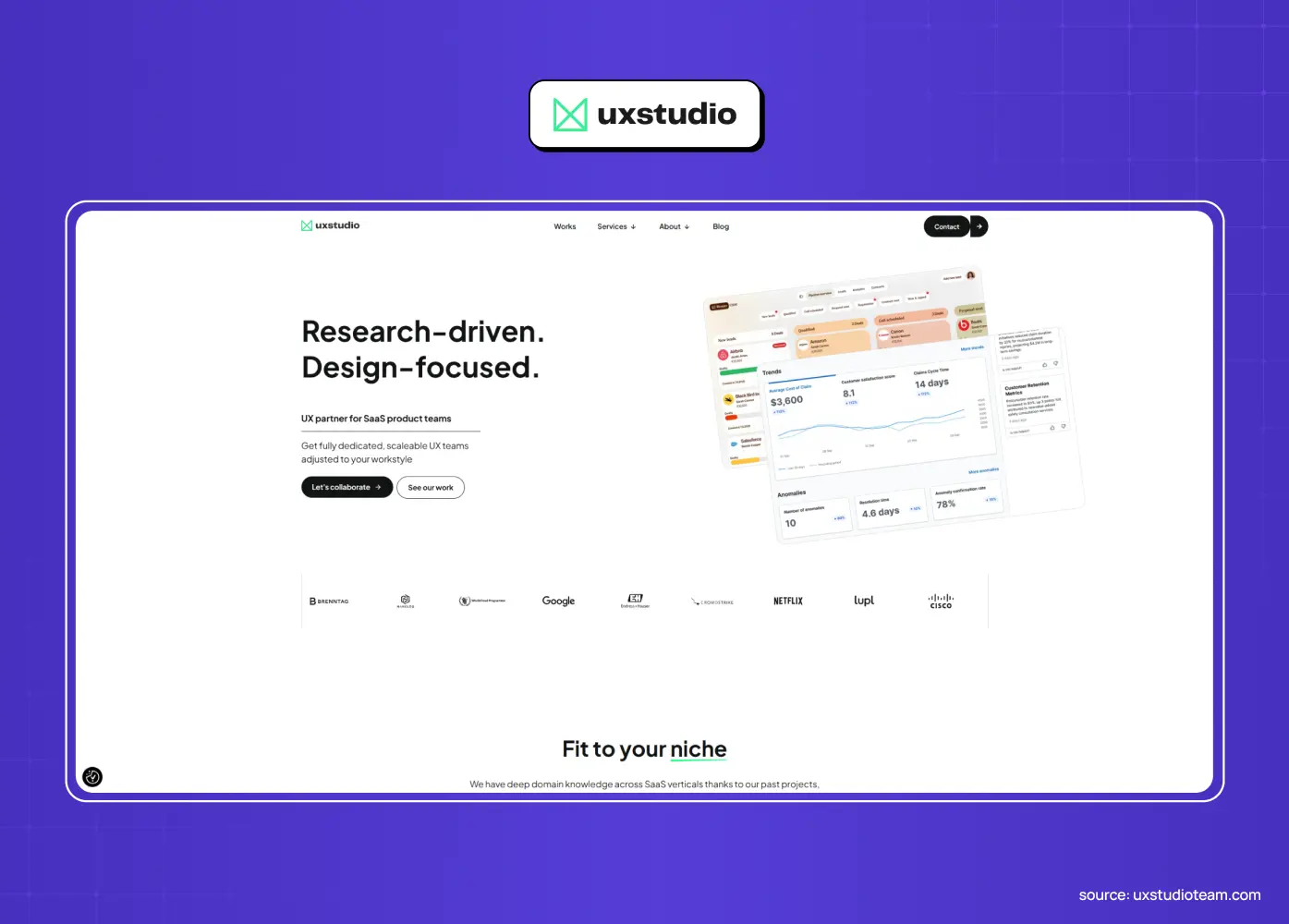
Operating since 2013 with international clients, UX Studio uses an embedded model where a dedicated UX/UI team integrates directly into your product organization.
Services offered:
Embedded UX/UI teams
User research and usability testing
Redesign and design-system work
Why teams choose UX Studio:
Deep familiarity with a client's product before recommending changes
Long operating history with international B2B clients
Strong fit for teams that want a design partner, not a project vendor
6. Eleken
Best for: SaaS teams wanting ongoing, embedded UI/UX capacity rather than a one-off project.
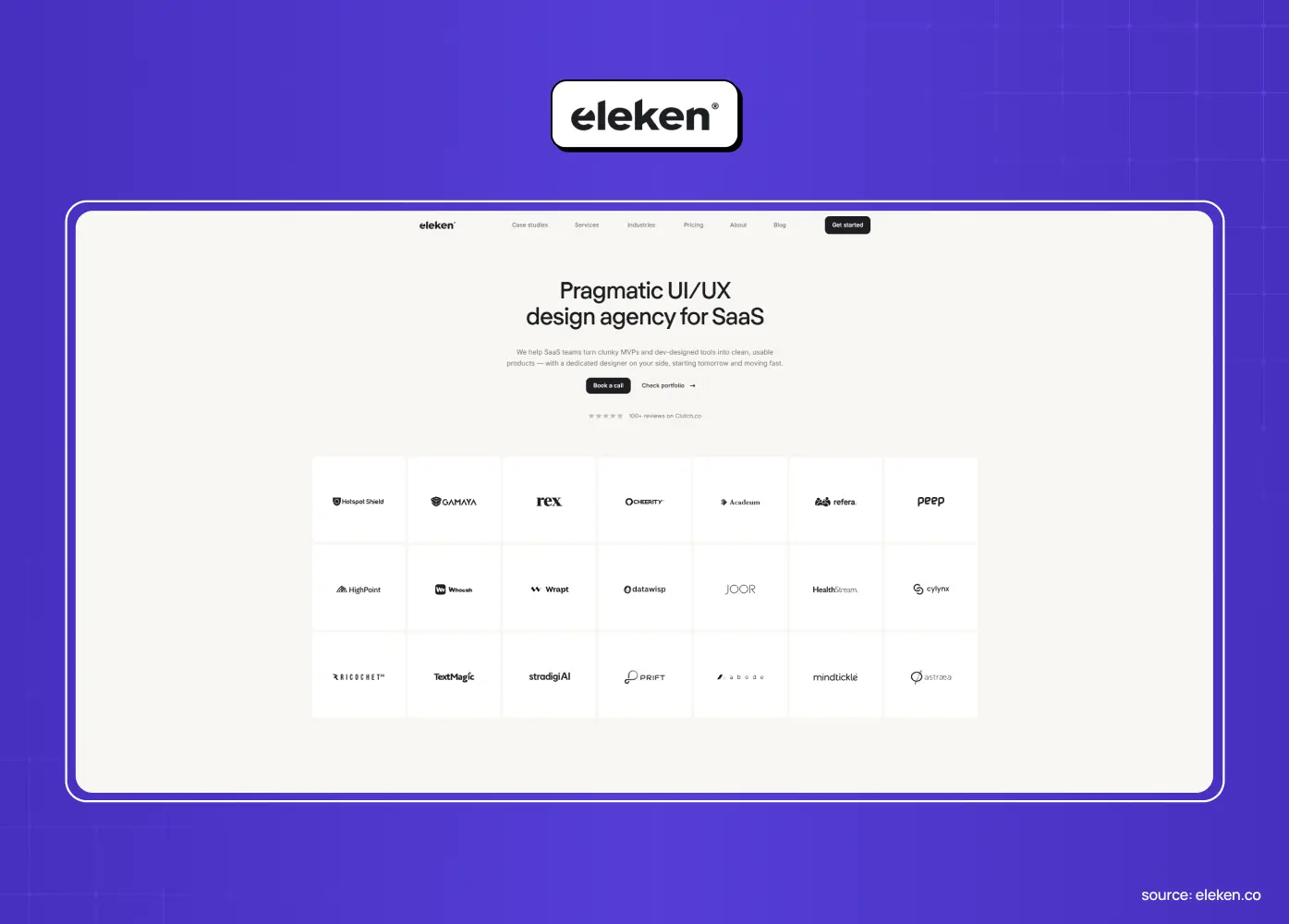
Eleken works exclusively with SaaS products, offering a subscription model with a dedicated designer and a track record across 200+ SaaS products.
Services offered:
Subscription-based dedicated design capacity
UI/UX design for SaaS dashboards and workflows
Design-system maintenance
Why teams choose Eleken:
SaaS-exclusive focus means less ramp-up time on B2B product patterns
Subscription pricing suits teams without the budget for a large fixed project
High project volume across similar product types
7. Ramotion
Best for: Companies wanting brand plus product UI from one studio.
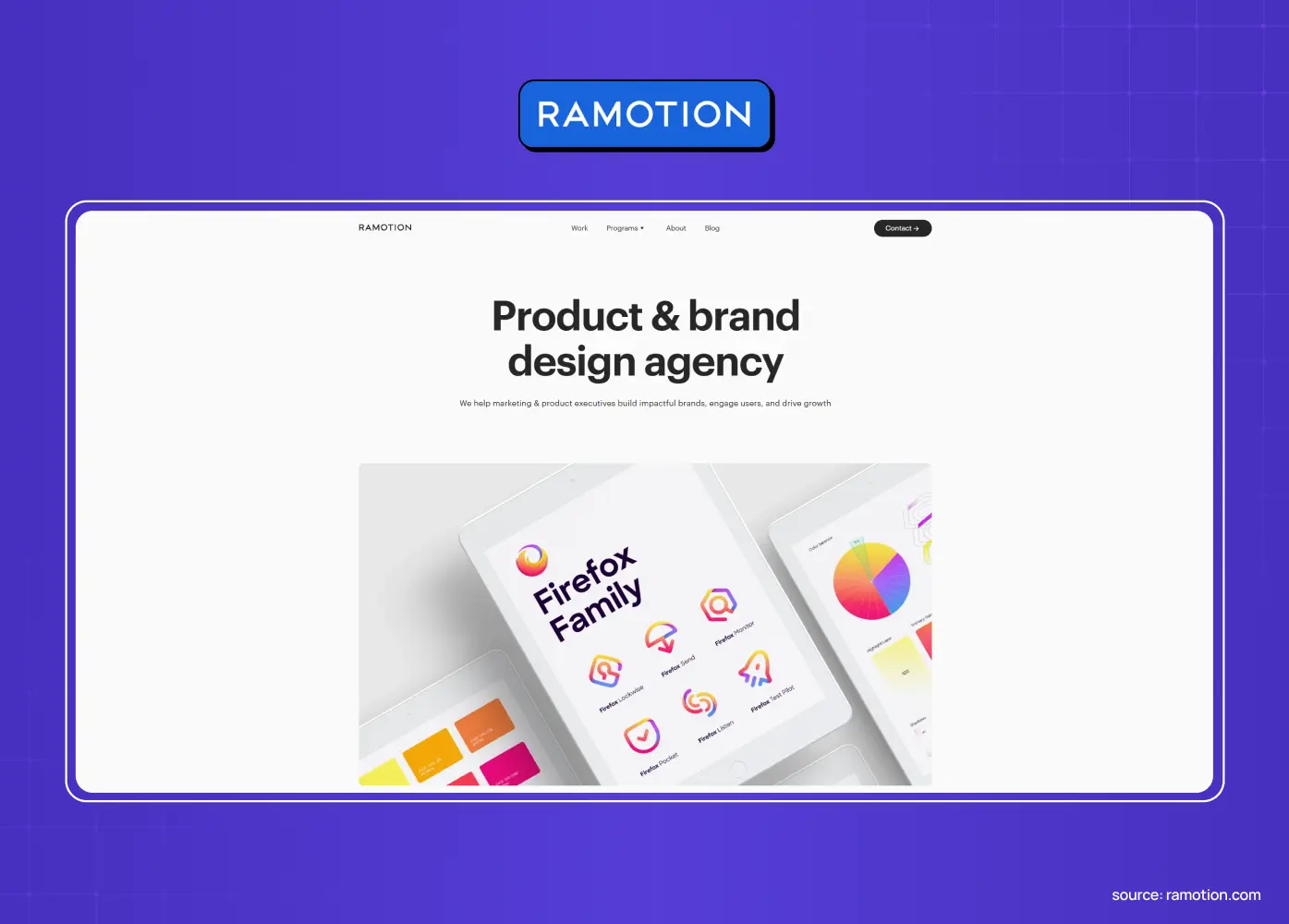
Ramotion spans brand, product, and web design on modern platforms.
Services offered:
Brand identity
Product UI/UX design
Web design and development
Why teams choose Ramotion:
One team handling both brand and product reduces cross-vendor inconsistency
Broad portfolio across startups and modern platforms
Strong visual and interaction design craft
8. Phenomenon Studio
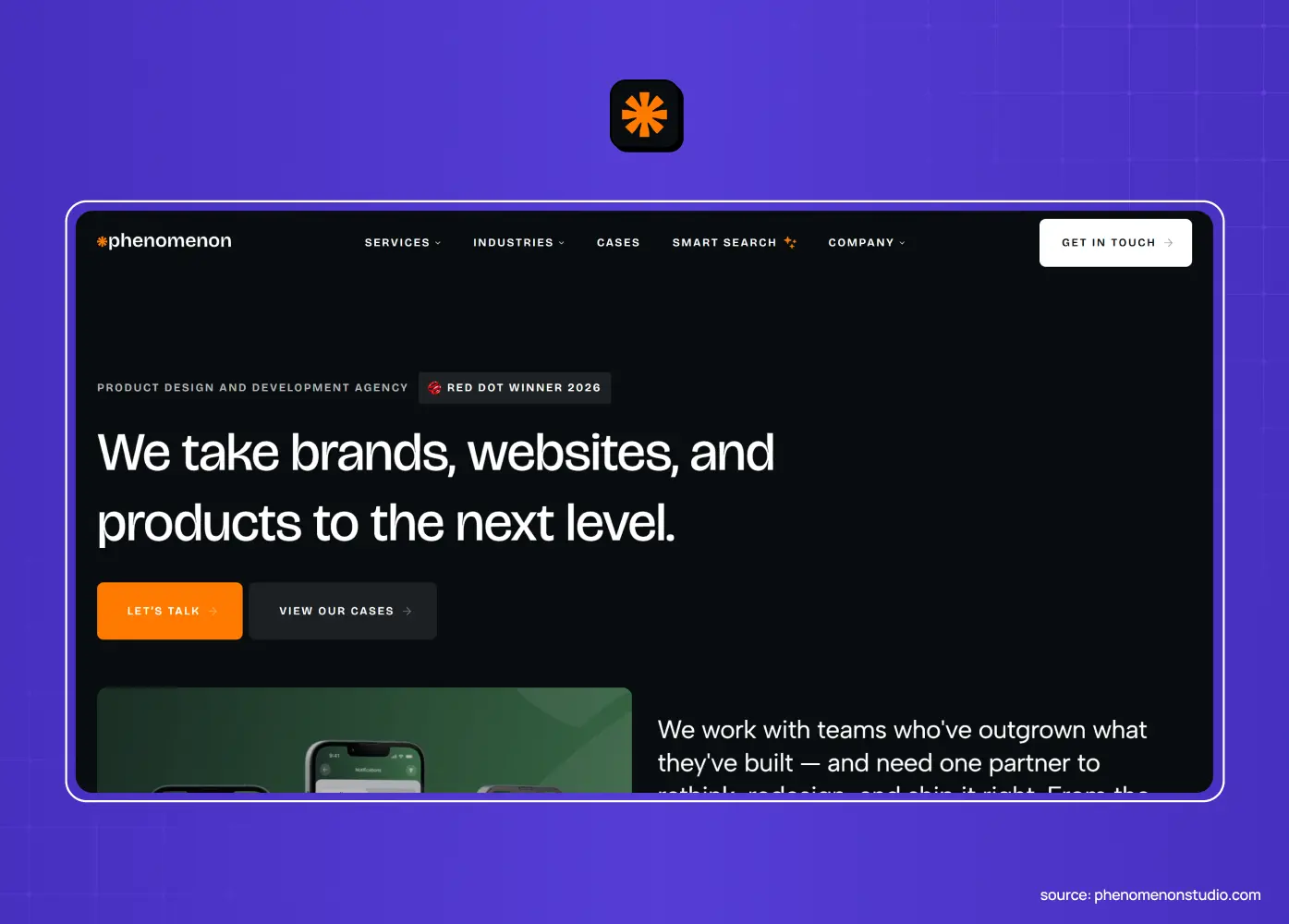
Best for: SaaS companies wanting solid, well-rounded UI/UX delivery.
Phenomenon is a product design studio with a strong B2B SaaS portfolio.
Services offered:
Product UI/UX design
Design systems
User research
Why teams choose Phenomenon Studio:
Consistent, reliable B2B SaaS delivery
Well-rounded service offering without premium-studio pricing
Comfortable with dense, workflow-heavy SaaS products
9. Work & Co
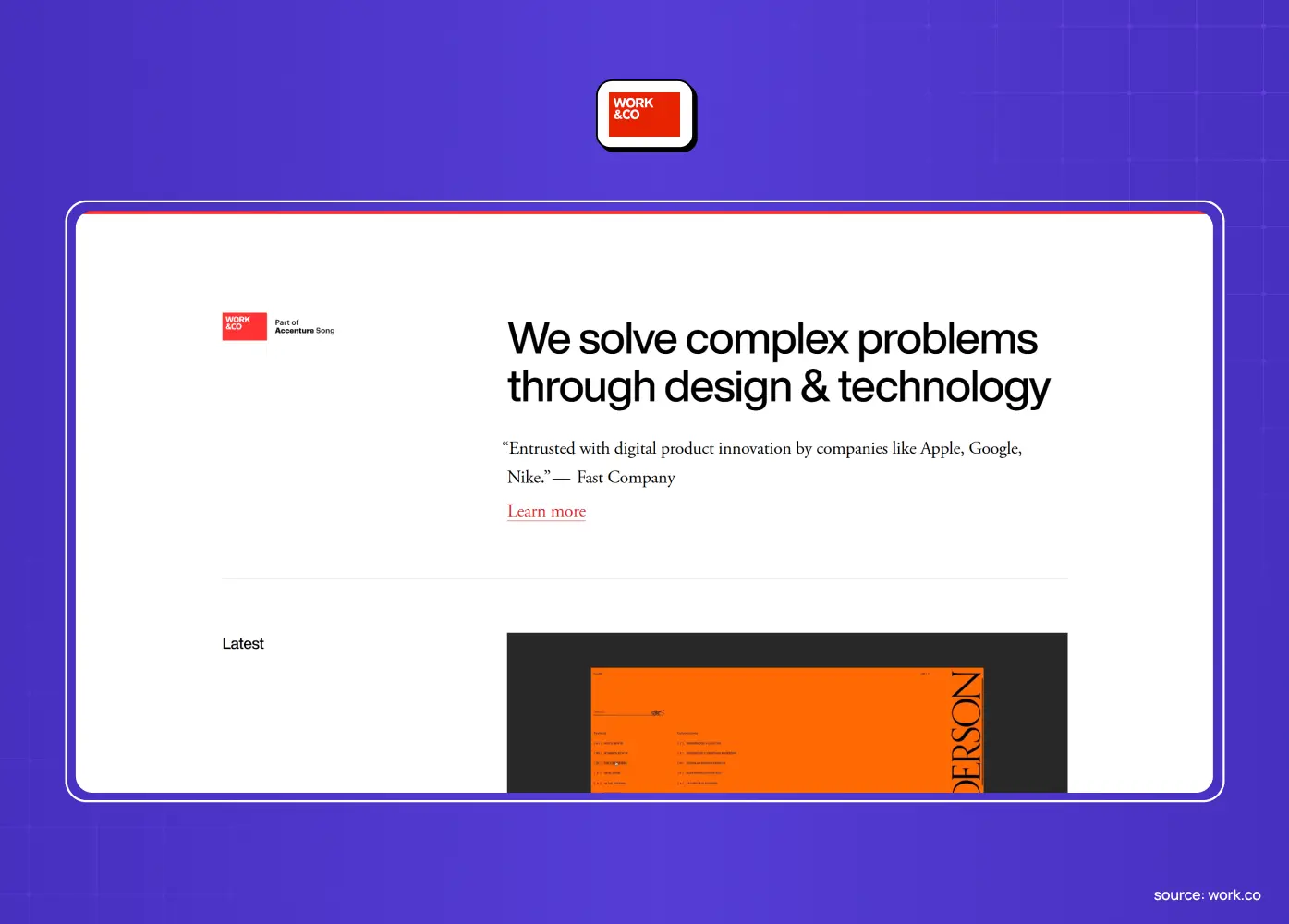
Best for: Large organizations with demanding, data-heavy system requirements.
Work & Co is a top choice for enterprise systems and complex products, known for turning intricate, data-heavy interfaces into intuitive experiences.
Services offered:
Enterprise product design
Complex systems UI/UX
Design and engineering collaboration
Why teams choose Work & Co:
Proven ability to simplify genuinely complex, data-dense interfaces
Enterprise-grade process and account management
A fit for large organizations with multiple stakeholders
10. IDEO
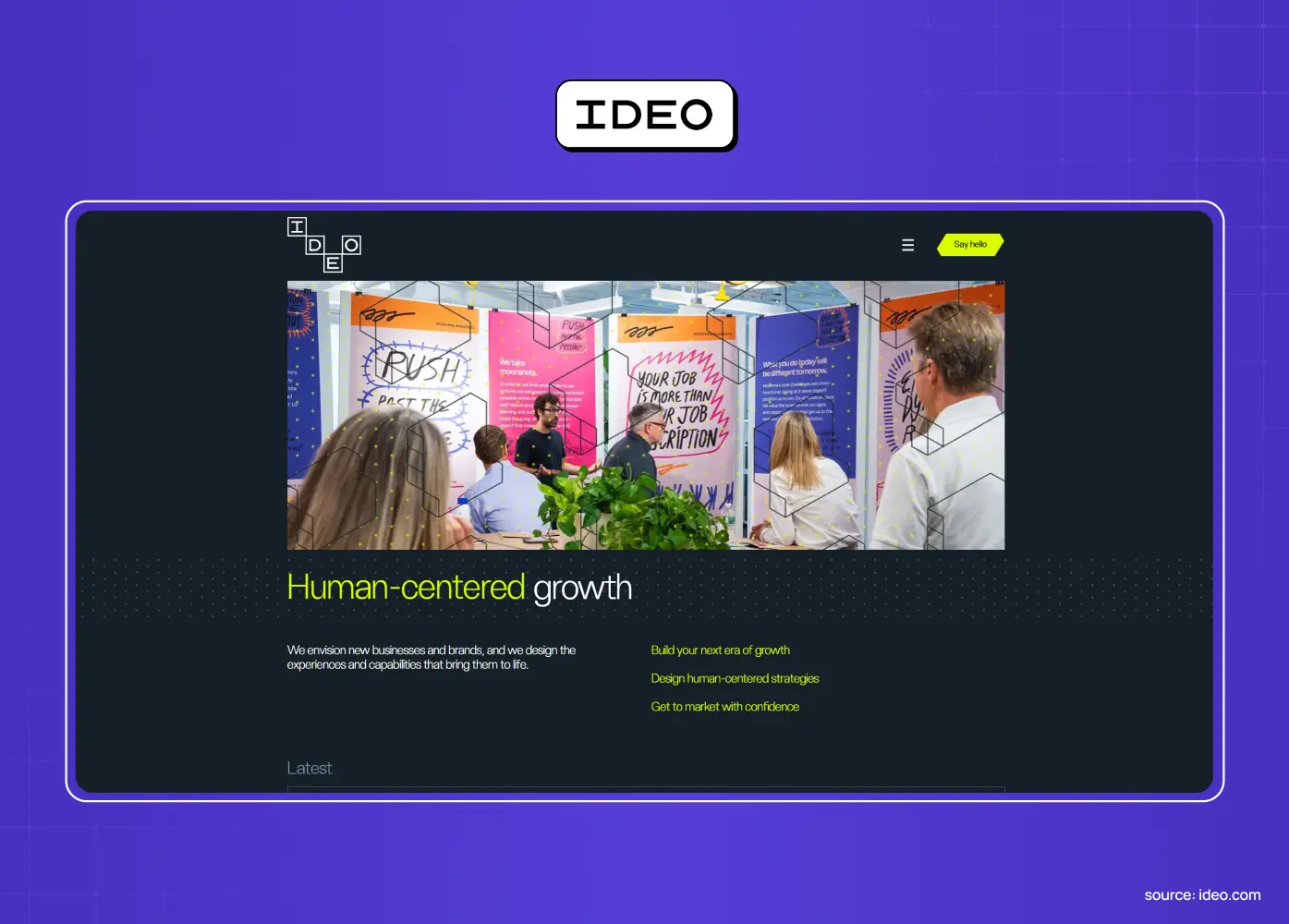
Best for: Enterprises where getting the problem right matters as much as the interface.
The firm that popularized design thinking, IDEO excels at human-centered problem framing for complex, ambiguous challenges.
Services offered:
Design research and strategy
Human-centered problem framing
Product and service design
Why teams choose IDEO:
Strength in ambiguous, undefined problem spaces
Deep, structured research methodology
Best suited to challenges where the "right" UI depends on getting the problem definition right first
11. Fireart Studio
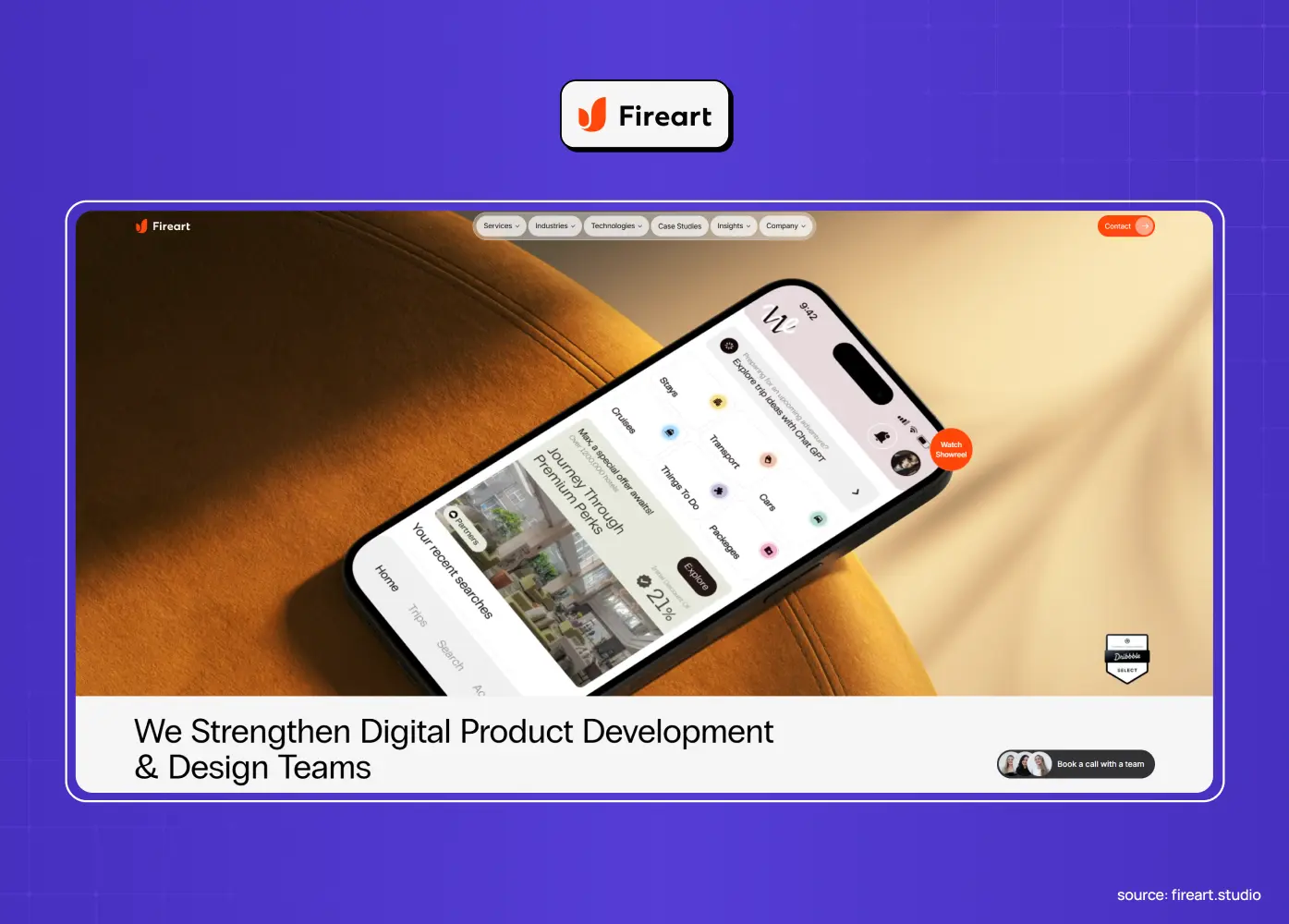
Best for: Startups and scale-ups wanting quality design without an enterprise price tag.
Fireart is a full-service, startup-friendly design studio offering product and UI/UX work with strong craft.
Services offered:
Product UI/UX design
Web and mobile app design
MVP design support
Why teams choose Fireart Studio:
Startup-friendly pricing relative to premium studios
Full-service scope without enterprise overhead
Comfortable working at MVP and early-growth stage
12. Goji Labs
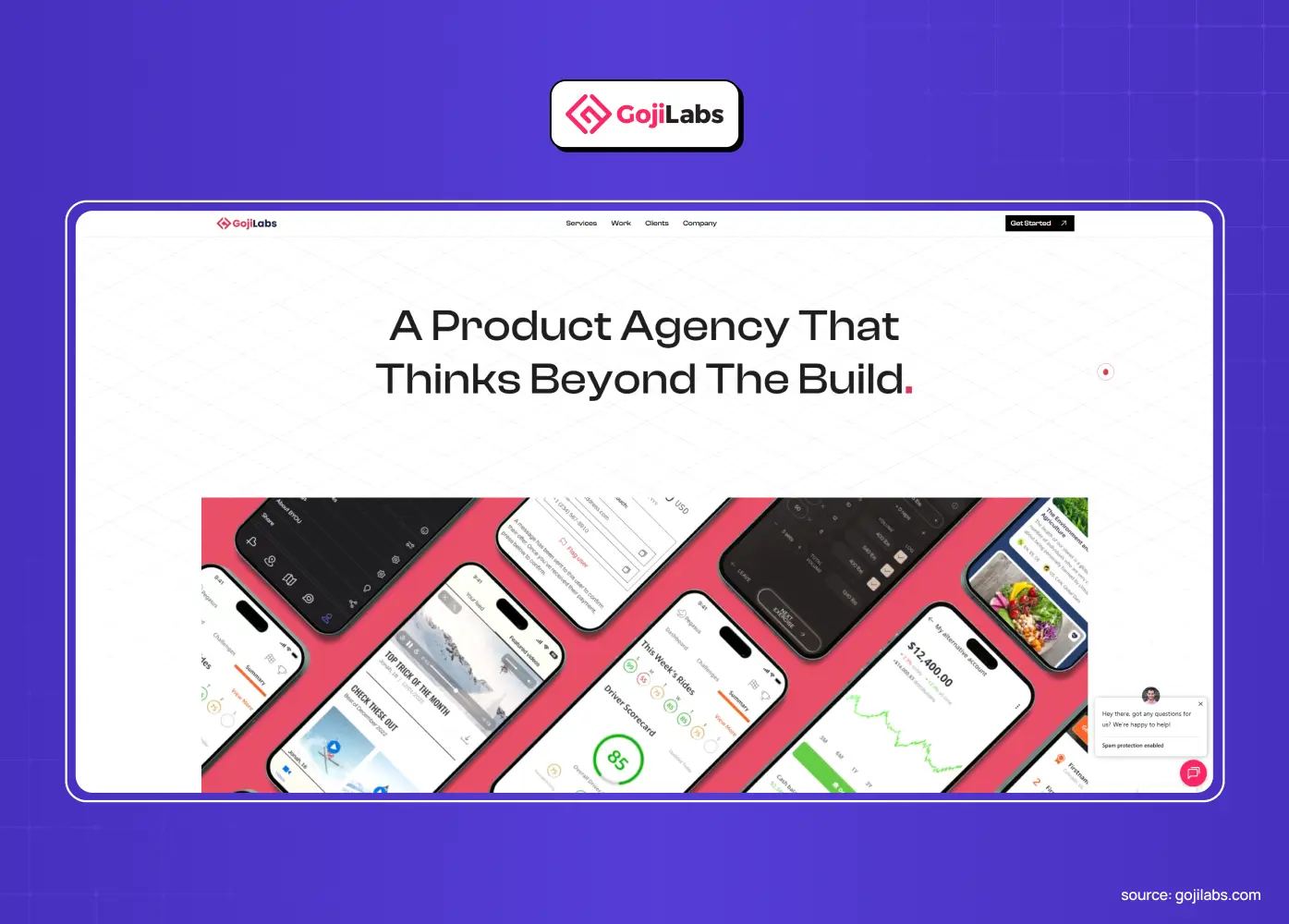
Best for: Startups wanting design and build under one roof.
Goji Labs offers full-service, startup-friendly product design and development, frequently cited among top UI/UX providers.
Services offered:
Product design and UI/UX
Full-stack development
MVP to scale-stage product work
Why teams choose Goji Labs:
Design and engineering under one team reduces handoff friction
Startup-oriented pricing and process
Track record across early-stage product builds
Choosing the right partner for your situation
Choose on fit, not reputation. The right provider is the one whose past work most closely matches your product's complexity, industry constraints, and team maturity.
Choose Groto if:
You're building an AI product and need a team that understands non-deterministic UI, trust, and adoption, not just visual polish
You want design and build handled by the same team, without coordinating separate vendors
You're a funded-stage to growth SaaS company that wants senior, product-grade work without paying enterprise-firm overhead
Choose an enterprise specialist (Work & Co, IDEO) if:
Your product is genuinely complex, data-heavy, or serves multiple large stakeholder groups
You need deep problem-framing work before any UI decisions get made
Budget and timeline can support enterprise-scale engagements
Groto's roster includes Fortune 500 names like Colgate and ABInBev, so this scale of complexity isn't unfamiliar territory either, particularly when the complexity is AI-driven
Choose a SaaS specialist (Eleken, UX Studio, Ramotion, Phenomenon) if:
You need ongoing, embedded design capacity rather than a single project
Your product is a workflow-heavy SaaS tool with an established user base
You want a team that's already fluent in SaaS product patterns
The Barista redesign is a useful reference point here too, since it's exactly this kind of workflow-heavy SaaS simplification work
Choose a startup-friendly full-service studio (Fireart, Goji Labs) if:
You're early-stage and need design and development from one team
Budget is a real constraint and enterprise pricing isn't realistic
Speed to MVP matters more than premium visual craft
Funded-stage teams building AI products, like PathwaysX and Gini, are also squarely in Groto's range, especially once "fast" and "AI-trustworthy" both need to be true at once
Choose a premium, brand-led studio (MetaLab, Clay, Fantasy) if:
You have the budget and want visual craft as a competitive differentiator
Your product benefits from a distinctive, ownable visual identity
You're optimizing for brand impact as much as usability
Then run a consistent process regardless of which category fits: shortlist two or three providers, ask each to walk through a past project with constraints like yours, request detailed proposals with timeline, deliverables, and pricing, and ask directly about post-launch support. Decide on that evidence rather than on who ranked themselves first, including on this list.
Conclusion
"UI design services" spans everything from a freelancer styling screens to a full product design partnership with research, a design system, and post-launch optimization, at prices ranging from a few hundred dollars per screen to $250,000+ for a full build. Here's how to shop for it well:
Know what the service should include before you ask for a quote, so you can compare scope rather than just price
Use the pricing bands here to sanity-check any proposal against what similar work typically costs
Run every finalist through the five-point evaluation test before you sign
Match a provider to your reality, whether that's AI-first, SaaS, enterprise, startup, or brand-led, rather than to its reputation
Ask what happens after launch, since that's where a lot of engagements quietly fall short
If you're looking for user interface design services for a SaaS or AI product, with end-to-end UI/UX from a senior, product-grade team, book a discovery call with Groto. We'll be honest about whether we're the right fit for your product, and if we're not, we'll help you figure out who is.