Harpreet Singh

Founder and Creative Director

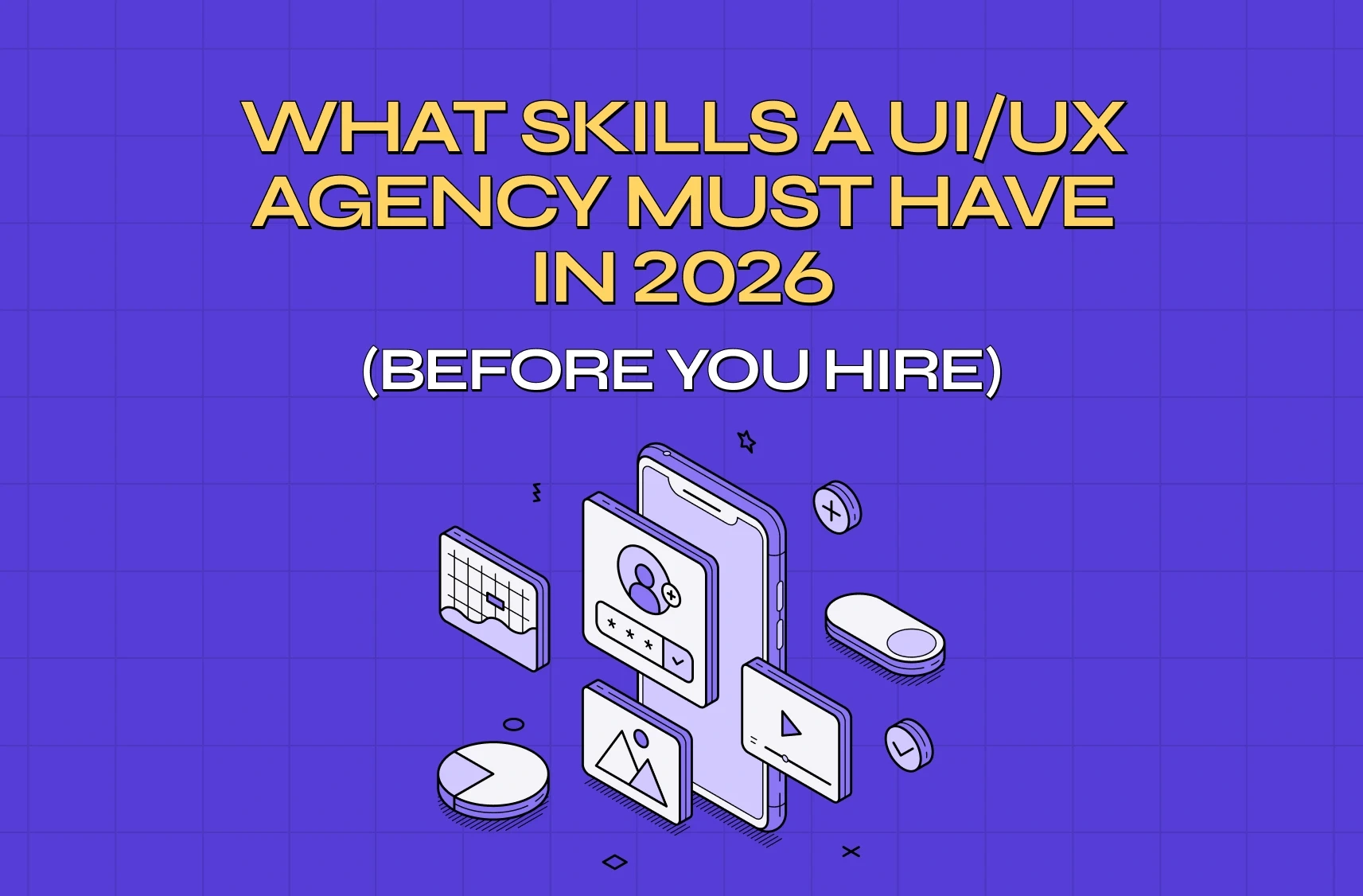
What Skills a UI/UX Agency Must Have in 2026 (Before You Hire)

Feb 7, 2026

A strategic guide to evaluating UI UX agency skills in 2026, helping product leaders identify capabilities that drive growth, scalability, and measurable UX impact.

Harpreet Singh

Founder and Creative Director

What Skills a UI/UX Agency Must Have in 2026 (Before You Hire)

Feb 7, 2026

A strategic guide to evaluating UI UX agency skills in 2026, helping product leaders identify capabilities that drive growth, scalability, and measurable UX impact.

Hiring a UI/UX partner in 2026 is not about aesthetics or deliverables. It is about capability depth, systems thinking, and measurable impact. This guide outlines the must-have skills modern agencies need to support real product growth.

Choosing the right agency requires more than reviewing portfolios.

Why This Decision Matters More Than Ever

The UI/UX landscape has changed.

Products are more complex. Users are less patient. Feature parity across competitors is common. What differentiates companies today is experience quality, scalability, and speed of iteration.

Hiring a UI/UX agency is no longer a creative outsourcing decision. It is a strategic product decision.

Choosing based on surface-level indicators often results in:

  • redesign cycles without measurable outcomes

  • inconsistent UX logic across modules

  • engineering friction and design debt

  • expensive rework six to twelve months later

Understanding ui ux agency skills at a deeper level helps prevent these outcomes before they happen.

In-House vs Agency: Making the Right Capability Decision

Before evaluating ui ux agency skills, product leaders often ask a more fundamental question:

Should we build in-house or partner with an agency?

This decision should be based on capability needs rather than preference.

When In-House Teams Make Sense

Internal teams are effective when:

  • Product design needs are continuous and predictable

  • Deep domain familiarity must be retained internally

  • Organizational scale supports long-term hiring investment

  • Iteration cycles require daily embedded collaboration

However, building internally introduces challenges:

  • Hiring lead times of 3–6 months

  • Senior talent acquisition costs

  • Skill gaps across research, systems, and strategy

  • Limited exposure to cross-industry innovation

In-house teams excel in continuity but may lack breadth of perspective.

When Agencies Deliver Higher Leverage

External partners typically provide stronger value when:

  • Rapid capability injection is required

  • Strategic realignment is underway

  • Product complexity is increasing

  • Internal teams face bandwidth constraints

  • Specialized skills are temporarily needed

Agencies bring:

  • cross-domain experience

  • structured methodologies

  • systems-level thinking

  • faster ramp-up timelines

The strongest organizations combine both approaches, using internal teams for continuity and agencies for acceleration and transformation.

Understanding this distinction ensures evaluation of professional ui ux agency skills happens within the correct strategic context.

The Reality of UI/UX Agency Expertise in 2026

Modern agencies are expected to operate across strategy, systems, and execution. The professional ui ux agency skills required today extend far beyond screen design.

High-performing agencies function as:

  • product thinking partners

  • system architects

  • behavioral design strategists

  • engineering collaborators

This shift defines the ui ux agency expertise 2026 buyers should evaluate.

The Core Skills of a Good UI/UX Agency

1. Behaviour-Driven UX Strategy

Design decisions must start with understanding user intent, friction points, and decision patterns.

Look for agencies that demonstrate:

  • discovery frameworks beyond feature workshops

  • behavioral modeling capabilities

  • friction mapping techniques

  • prioritization of user outcomes over visual direction

This skill ensures UX is aligned with business results, not visual preference.

It is one of the most important key skills for hiring ux agency partners.

2. Scalable UX Architecture Thinking

Modern digital products are ecosystems. Agencies must think beyond individual screens.

Critical capabilities include:

  • multi-role flow architecture

  • system-level journey mapping

  • modular UX planning

  • lifecycle experience modeling

Without this skill, UX becomes fragmented as products scale.

This competency separates tactical vendors from strategic partners.

3. Design System Development

Consistency and speed depend on systemization.

Evaluate whether the agency can:

  • create reusable component libraries

  • define interaction standards

  • establish governance models

  • support engineering implementation

Design systems reduce technical debt and accelerate product evolution.

This is a core element in must-have skills for ui ux agencies in complex SaaS and enterprise environments.

4. Engineering Collaboration Literacy

Strong agencies understand how design decisions impact development velocity.

Signals to look for:

  • understanding of frontend constraints

  • component-aware design workflows

  • documentation suited for developers

  • collaboration with engineering teams

This skill ensures designs translate into production efficiently rather than requiring rework.

5. Data-Informed Iteration Capabilities

UX should evolve based on evidence.

Evaluate ability to:

  • interpret behavioral analytics

  • run usability validation

  • synthesize research insights

  • connect UX changes to measurable outcomes

Agencies lacking this skill produce static deliverables instead of adaptive improvements.

6. AI-Aware Workflow Integration

By 2026, ignoring AI-enabled design workflows signals outdated capability.

Relevant expertise includes:

  • AI-assisted research synthesis

  • generative interface exploration

  • rapid prototyping automation

  • workflow acceleration tools

This reflects modern ui ux agency expertise 2026 expectations and indicates forward-thinking practice.

7. Domain Experience in Complex Products

Generalist portfolios are no longer sufficient.

Look for experience designing within:

  • SaaS ecosystems

  • AI-enabled platforms

  • fintech workflows

  • data-heavy dashboards

  • multi-user systems

Domain understanding reduces ramp-up time and improves decision relevance.

8. Communication and Decision Facilitation

A strong agency does not only design. It aligns stakeholders.

Indicators include:

  • workshop facilitation skills

  • cross-team communication

  • prioritization support

  • structured reporting

This capability prevents internal fragmentation during transformation initiatives.

Hiring a UI/UX Agency Checklist

Use this checklist during evaluation conversations:

  • Do they lead discovery beyond UI preferences?

  • Can they explain how UX decisions influence engineering velocity?

  • Do they demonstrate systems thinking rather than page-level thinking?

  • Have they built scalable design systems before?

  • Can they connect UX work to measurable outcomes?

  • Do they incorporate AI-enabled workflows where relevant?

  • Do they communicate with clarity across product and engineering teams?

This hiring a ui ux agency checklist helps identify capability depth before engagement begins.

Red Flags That Signal Capability Gaps

Watch for warning signs such as:

  • heavy emphasis on visual showcase work

  • lack of structured methodology

  • inability to discuss technical implications

  • unclear success measurement frameworks

  • generic discovery approaches

These often indicate absence of essential skills of a good ui ux agency.

How These Skills Translate Into Business Impact

Agencies possessing the right skill profile typically contribute to:

  • reduced redesign cycles

  • faster engineering throughput

  • stronger product adoption

  • improved retention signals

  • clearer product differentiation

The value of selecting agencies based on ui ux agency skills lies in long-term impact rather than immediate output.

Conclusion

Selecting a UX partner should not rely on creative impressions alone. The complexity of modern products demands agencies that combine strategic thinking, technical awareness, behavioral insight, and scalable system design.

If you are evaluating partners and want clarity on how your product experience, architecture, and UX strategy compare against modern standards, a focused discussion can surface meaningful direction.

Book a 20-minute consultation with our team to assess where your product stands and what capabilities matter most for your next growth stage.

This conversation is designed to provide insight, not obligation, and may help you make a more confident hiring decision.

FAQs

1. How do I know if I should hire a UI/UX agency at all?
If your team is facing recurring redesign cycles, slow feature adoption, or internal alignment challenges, external perspective can accelerate clarity. Agencies are most valuable when internal capability gaps affect product velocity or experience quality.

2. What should a UI/UX agency realistically cost?
Engagements vary widely depending on scope, complexity, and maturity stage. Focused UX initiatives may range from $10K to $40K, while system-level engagements can extend beyond $100K. Cost should be evaluated relative to product impact, not deliverable count.

3. Will bringing in an agency disrupt internal workflows?
Strong agencies integrate alongside product and engineering teams rather than replacing them. Structured collaboration models allow parallel execution, minimizing disruption while introducing external capability depth.

4. How can we measure whether agency work delivered value?
Effective engagements define success metrics upfront. Common indicators include improved task completion, reduced iteration cycles, increased feature adoption, and enhanced design-to-development efficiency.

5. Is it better to hire freelancers instead of agencies?
Freelancers can be effective for execution-focused work. Agencies are more suited for strategic, multi-disciplinary challenges requiring coordinated expertise across research, systems, and architecture.

6. How long should an agency engagement last?Durations depend on objectives. Discovery-led initiatives may span several weeks, while systemic UX transformations often extend across months. The focus should remain on outcomes rather than timelines.

Hiring a UI/UX partner in 2026 is not about aesthetics or deliverables. It is about capability depth, systems thinking, and measurable impact. This guide outlines the must-have skills modern agencies need to support real product growth.

Choosing the right agency requires more than reviewing portfolios.


Why This Decision Matters More Than Ever

The UI/UX landscape has changed.

Products are more complex. Users are less patient. Feature parity across competitors is common. What differentiates companies today is experience quality, scalability, and speed of iteration.

Hiring a UI/UX agency is no longer a creative outsourcing decision. It is a strategic product decision.

Choosing based on surface-level indicators often results in:

  • redesign cycles without measurable outcomes

  • inconsistent UX logic across modules

  • engineering friction and design debt

  • expensive rework six to twelve months later

Understanding ui ux agency skills at a deeper level helps prevent these outcomes before they happen.

In-House vs Agency: Making the Right Capability Decision

Before evaluating ui ux agency skills, product leaders often ask a more fundamental question:

Should we build in-house or partner with an agency?

This decision should be based on capability needs rather than preference.

When In-House Teams Make Sense

Internal teams are effective when:

  • Product design needs are continuous and predictable

  • Deep domain familiarity must be retained internally

  • Organizational scale supports long-term hiring investment

  • Iteration cycles require daily embedded collaboration

However, building internally introduces challenges:

  • Hiring lead times of 3–6 months

  • Senior talent acquisition costs

  • Skill gaps across research, systems, and strategy

  • Limited exposure to cross-industry innovation

In-house teams excel in continuity but may lack breadth of perspective.

When Agencies Deliver Higher Leverage

External partners typically provide stronger value when:

  • Rapid capability injection is required

  • Strategic realignment is underway

  • Product complexity is increasing

  • Internal teams face bandwidth constraints

  • Specialized skills are temporarily needed

Agencies bring:

  • cross-domain experience

  • structured methodologies

  • systems-level thinking

  • faster ramp-up timelines

The strongest organizations combine both approaches, using internal teams for continuity and agencies for acceleration and transformation.

Understanding this distinction ensures evaluation of professional ui ux agency skills happens within the correct strategic context.

The Reality of UI/UX Agency Expertise in 2026

Modern agencies are expected to operate across strategy, systems, and execution. The professional ui ux agency skills required today extend far beyond screen design.

High-performing agencies function as:

  • product thinking partners

  • system architects

  • behavioral design strategists

  • engineering collaborators

This shift defines the ui ux agency expertise 2026 buyers should evaluate.

The Core Skills of a Good UI/UX Agency

1. Behaviour-Driven UX Strategy

Design decisions must start with understanding user intent, friction points, and decision patterns.

Look for agencies that demonstrate:

  • discovery frameworks beyond feature workshops

  • behavioral modeling capabilities

  • friction mapping techniques

  • prioritization of user outcomes over visual direction

This skill ensures UX is aligned with business results, not visual preference.

It is one of the most important key skills for hiring ux agency partners.

2. Scalable UX Architecture Thinking

Modern digital products are ecosystems. Agencies must think beyond individual screens.

Critical capabilities include:

  • multi-role flow architecture

  • system-level journey mapping

  • modular UX planning

  • lifecycle experience modeling

Without this skill, UX becomes fragmented as products scale.

This competency separates tactical vendors from strategic partners.

3. Design System Development

Consistency and speed depend on systemization.

Evaluate whether the agency can:

  • create reusable component libraries

  • define interaction standards

  • establish governance models

  • support engineering implementation

Design systems reduce technical debt and accelerate product evolution.

This is a core element in must-have skills for ui ux agencies in complex SaaS and enterprise environments.

4. Engineering Collaboration Literacy

Strong agencies understand how design decisions impact development velocity.

Signals to look for:

  • understanding of frontend constraints

  • component-aware design workflows

  • documentation suited for developers

  • collaboration with engineering teams

This skill ensures designs translate into production efficiently rather than requiring rework.

5. Data-Informed Iteration Capabilities

UX should evolve based on evidence.

Evaluate ability to:

  • interpret behavioral analytics

  • run usability validation

  • synthesize research insights

  • connect UX changes to measurable outcomes

Agencies lacking this skill produce static deliverables instead of adaptive improvements.

6. AI-Aware Workflow Integration

By 2026, ignoring AI-enabled design workflows signals outdated capability.

Relevant expertise includes:

  • AI-assisted research synthesis

  • generative interface exploration

  • rapid prototyping automation

  • workflow acceleration tools

This reflects modern ui ux agency expertise 2026 expectations and indicates forward-thinking practice.

7. Domain Experience in Complex Products

Generalist portfolios are no longer sufficient.

Look for experience designing within:

  • SaaS ecosystems

  • AI-enabled platforms

  • fintech workflows

  • data-heavy dashboards

  • multi-user systems

Domain understanding reduces ramp-up time and improves decision relevance.

8. Communication and Decision Facilitation

A strong agency does not only design. It aligns stakeholders.

Indicators include:

  • workshop facilitation skills

  • cross-team communication

  • prioritization support

  • structured reporting

This capability prevents internal fragmentation during transformation initiatives.

Hiring a UI/UX Agency Checklist

Use this checklist during evaluation conversations:

  • Do they lead discovery beyond UI preferences?

  • Can they explain how UX decisions influence engineering velocity?

  • Do they demonstrate systems thinking rather than page-level thinking?

  • Have they built scalable design systems before?

  • Can they connect UX work to measurable outcomes?

  • Do they incorporate AI-enabled workflows where relevant?

  • Do they communicate with clarity across product and engineering teams?

This hiring a ui ux agency checklist helps identify capability depth before engagement begins.

Red Flags That Signal Capability Gaps

Watch for warning signs such as:

  • heavy emphasis on visual showcase work

  • lack of structured methodology

  • inability to discuss technical implications

  • unclear success measurement frameworks

  • generic discovery approaches

These often indicate absence of essential skills of a good ui ux agency.

How These Skills Translate Into Business Impact

Agencies possessing the right skill profile typically contribute to:

  • reduced redesign cycles

  • faster engineering throughput

  • stronger product adoption

  • improved retention signals

  • clearer product differentiation

The value of selecting agencies based on ui ux agency skills lies in long-term impact rather than immediate output.

Conclusion

Selecting a UX partner should not rely on creative impressions alone. The complexity of modern products demands agencies that combine strategic thinking, technical awareness, behavioral insight, and scalable system design.

If you are evaluating partners and want clarity on how your product experience, architecture, and UX strategy compare against modern standards, a focused discussion can surface meaningful direction.

Book a 20-minute consultation with our team to assess where your product stands and what capabilities matter most for your next growth stage.

This conversation is designed to provide insight, not obligation, and may help you make a more confident hiring decision.

FAQs

1. How do I know if I should hire a UI/UX agency at all?
If your team is facing recurring redesign cycles, slow feature adoption, or internal alignment challenges, external perspective can accelerate clarity. Agencies are most valuable when internal capability gaps affect product velocity or experience quality.

2. What should a UI/UX agency realistically cost?
Engagements vary widely depending on scope, complexity, and maturity stage. Focused UX initiatives may range from $10K to $40K, while system-level engagements can extend beyond $100K. Cost should be evaluated relative to product impact, not deliverable count.

3. Will bringing in an agency disrupt internal workflows?
Strong agencies integrate alongside product and engineering teams rather than replacing them. Structured collaboration models allow parallel execution, minimizing disruption while introducing external capability depth.

4. How can we measure whether agency work delivered value?
Effective engagements define success metrics upfront. Common indicators include improved task completion, reduced iteration cycles, increased feature adoption, and enhanced design-to-development efficiency.

5. Is it better to hire freelancers instead of agencies?
Freelancers can be effective for execution-focused work. Agencies are more suited for strategic, multi-disciplinary challenges requiring coordinated expertise across research, systems, and architecture.

6. How long should an agency engagement last?Durations depend on objectives. Discovery-led initiatives may span several weeks, while systemic UX transformations often extend across months. The focus should remain on outcomes rather than timelines.

Extreme close-up black and white photograph of a human eye

Let’s bring your vision to life

Tell us what's on your mind? We'll hit you back in 24 hours. No fluff, no delays - just a solid vision to bring your idea to life.

Profile portrait of a man in a white shirt against a light background

Harpreet Singh

Founder and Creative Director

Get in Touch

Extreme close-up black and white photograph of a human eye

Let’s bring your vision to life

Tell us what's on your mind? We'll hit you back in 24 hours. No fluff, no delays - just a solid vision to bring your idea to life.

Profile portrait of a man in a white shirt against a light background

Harpreet Singh

Founder and Creative Director

Get in Touch

Harpreet Singh

Founder and Creative Director

What Skills a UI/UX Agency Must Have in 2026 (Before You Hire)

Feb 7, 2026

A strategic guide to evaluating UI UX agency skills in 2026, helping product leaders identify capabilities that drive growth, scalability, and measurable UX impact.

Hiring a UI/UX partner in 2026 is not about aesthetics or deliverables. It is about capability depth, systems thinking, and measurable impact. This guide outlines the must-have skills modern agencies need to support real product growth.

Choosing the right agency requires more than reviewing portfolios.


Why This Decision Matters More Than Ever

The UI/UX landscape has changed.

Products are more complex. Users are less patient. Feature parity across competitors is common. What differentiates companies today is experience quality, scalability, and speed of iteration.

Hiring a UI/UX agency is no longer a creative outsourcing decision. It is a strategic product decision.

Choosing based on surface-level indicators often results in:

  • redesign cycles without measurable outcomes

  • inconsistent UX logic across modules

  • engineering friction and design debt

  • expensive rework six to twelve months later

Understanding ui ux agency skills at a deeper level helps prevent these outcomes before they happen.

In-House vs Agency: Making the Right Capability Decision

Before evaluating ui ux agency skills, product leaders often ask a more fundamental question:

Should we build in-house or partner with an agency?

This decision should be based on capability needs rather than preference.

When In-House Teams Make Sense

Internal teams are effective when:

  • Product design needs are continuous and predictable

  • Deep domain familiarity must be retained internally

  • Organizational scale supports long-term hiring investment

  • Iteration cycles require daily embedded collaboration

However, building internally introduces challenges:

  • Hiring lead times of 3–6 months

  • Senior talent acquisition costs

  • Skill gaps across research, systems, and strategy

  • Limited exposure to cross-industry innovation

In-house teams excel in continuity but may lack breadth of perspective.

When Agencies Deliver Higher Leverage

External partners typically provide stronger value when:

  • Rapid capability injection is required

  • Strategic realignment is underway

  • Product complexity is increasing

  • Internal teams face bandwidth constraints

  • Specialized skills are temporarily needed

Agencies bring:

  • cross-domain experience

  • structured methodologies

  • systems-level thinking

  • faster ramp-up timelines

The strongest organizations combine both approaches, using internal teams for continuity and agencies for acceleration and transformation.

Understanding this distinction ensures evaluation of professional ui ux agency skills happens within the correct strategic context.

The Reality of UI/UX Agency Expertise in 2026

Modern agencies are expected to operate across strategy, systems, and execution. The professional ui ux agency skills required today extend far beyond screen design.

High-performing agencies function as:

  • product thinking partners

  • system architects

  • behavioral design strategists

  • engineering collaborators

This shift defines the ui ux agency expertise 2026 buyers should evaluate.

The Core Skills of a Good UI/UX Agency

1. Behaviour-Driven UX Strategy

Design decisions must start with understanding user intent, friction points, and decision patterns.

Look for agencies that demonstrate:

  • discovery frameworks beyond feature workshops

  • behavioral modeling capabilities

  • friction mapping techniques

  • prioritization of user outcomes over visual direction

This skill ensures UX is aligned with business results, not visual preference.

It is one of the most important key skills for hiring ux agency partners.

2. Scalable UX Architecture Thinking

Modern digital products are ecosystems. Agencies must think beyond individual screens.

Critical capabilities include:

  • multi-role flow architecture

  • system-level journey mapping

  • modular UX planning

  • lifecycle experience modeling

Without this skill, UX becomes fragmented as products scale.

This competency separates tactical vendors from strategic partners.

3. Design System Development

Consistency and speed depend on systemization.

Evaluate whether the agency can:

  • create reusable component libraries

  • define interaction standards

  • establish governance models

  • support engineering implementation

Design systems reduce technical debt and accelerate product evolution.

This is a core element in must-have skills for ui ux agencies in complex SaaS and enterprise environments.

4. Engineering Collaboration Literacy

Strong agencies understand how design decisions impact development velocity.

Signals to look for:

  • understanding of frontend constraints

  • component-aware design workflows

  • documentation suited for developers

  • collaboration with engineering teams

This skill ensures designs translate into production efficiently rather than requiring rework.

5. Data-Informed Iteration Capabilities

UX should evolve based on evidence.

Evaluate ability to:

  • interpret behavioral analytics

  • run usability validation

  • synthesize research insights

  • connect UX changes to measurable outcomes

Agencies lacking this skill produce static deliverables instead of adaptive improvements.

6. AI-Aware Workflow Integration

By 2026, ignoring AI-enabled design workflows signals outdated capability.

Relevant expertise includes:

  • AI-assisted research synthesis

  • generative interface exploration

  • rapid prototyping automation

  • workflow acceleration tools

This reflects modern ui ux agency expertise 2026 expectations and indicates forward-thinking practice.

7. Domain Experience in Complex Products

Generalist portfolios are no longer sufficient.

Look for experience designing within:

  • SaaS ecosystems

  • AI-enabled platforms

  • fintech workflows

  • data-heavy dashboards

  • multi-user systems

Domain understanding reduces ramp-up time and improves decision relevance.

8. Communication and Decision Facilitation

A strong agency does not only design. It aligns stakeholders.

Indicators include:

  • workshop facilitation skills

  • cross-team communication

  • prioritization support

  • structured reporting

This capability prevents internal fragmentation during transformation initiatives.

Hiring a UI/UX Agency Checklist

Use this checklist during evaluation conversations:

  • Do they lead discovery beyond UI preferences?

  • Can they explain how UX decisions influence engineering velocity?

  • Do they demonstrate systems thinking rather than page-level thinking?

  • Have they built scalable design systems before?

  • Can they connect UX work to measurable outcomes?

  • Do they incorporate AI-enabled workflows where relevant?

  • Do they communicate with clarity across product and engineering teams?

This hiring a ui ux agency checklist helps identify capability depth before engagement begins.

Red Flags That Signal Capability Gaps

Watch for warning signs such as:

  • heavy emphasis on visual showcase work

  • lack of structured methodology

  • inability to discuss technical implications

  • unclear success measurement frameworks

  • generic discovery approaches

These often indicate absence of essential skills of a good ui ux agency.

How These Skills Translate Into Business Impact

Agencies possessing the right skill profile typically contribute to:

  • reduced redesign cycles

  • faster engineering throughput

  • stronger product adoption

  • improved retention signals

  • clearer product differentiation

The value of selecting agencies based on ui ux agency skills lies in long-term impact rather than immediate output.

Conclusion

Selecting a UX partner should not rely on creative impressions alone. The complexity of modern products demands agencies that combine strategic thinking, technical awareness, behavioral insight, and scalable system design.

If you are evaluating partners and want clarity on how your product experience, architecture, and UX strategy compare against modern standards, a focused discussion can surface meaningful direction.

Book a 20-minute consultation with our team to assess where your product stands and what capabilities matter most for your next growth stage.

This conversation is designed to provide insight, not obligation, and may help you make a more confident hiring decision.
FAQs

1. How do I know if I should hire a UI/UX agency at all?
If your team is facing recurring redesign cycles, slow feature adoption, or internal alignment challenges, external perspective can accelerate clarity. Agencies are most valuable when internal capability gaps affect product velocity or experience quality.
2. What should a UI/UX agency realistically cost?
Engagements vary widely depending on scope, complexity, and maturity stage. Focused UX initiatives may range from $10K to $40K, while system-level engagements can extend beyond $100K. Cost should be evaluated relative to product impact, not deliverable count.

3. Will bringing in an agency disrupt internal workflows?
Strong agencies integrate alongside product and engineering teams rather than replacing them. Structured collaboration models allow parallel execution, minimizing disruption while introducing external capability depth.

4. How can we measure whether agency work delivered value?
Effective engagements define success metrics upfront. Common indicators include improved task completion, reduced iteration cycles, increased feature adoption, and enhanced design-to-development efficiency.

5. Is it better to hire freelancers instead of agencies?
Freelancers can be effective for execution-focused work. Agencies are more suited for strategic, multi-disciplinary challenges requiring coordinated expertise across research, systems, and architecture.

6. How long should an agency engagement last?Durations depend on objectives. Discovery-led initiatives may span several weeks, while systemic UX transformations often extend across months. The focus should remain on outcomes rather than timelines.

Extreme close-up black and white photograph of a human eye

Let’s bring your vision to life

Tell us what's on your mind? We'll hit you back in 24 hours. No fluff, no delays - just a solid vision to bring your idea to life.

Profile portrait of a man in a white shirt against a light background

Harpreet Singh

Founder and Creative Director

Get in Touch

Extreme close-up black and white photograph of a human eye

Let’s bring your vision to life

Tell us what's on your mind? We'll hit you back in 24 hours. No fluff, no delays - just a solid vision to bring your idea to life.

Profile portrait of a man in a white shirt against a light background

Harpreet Singh

Founder and Creative Director

Get in Touch