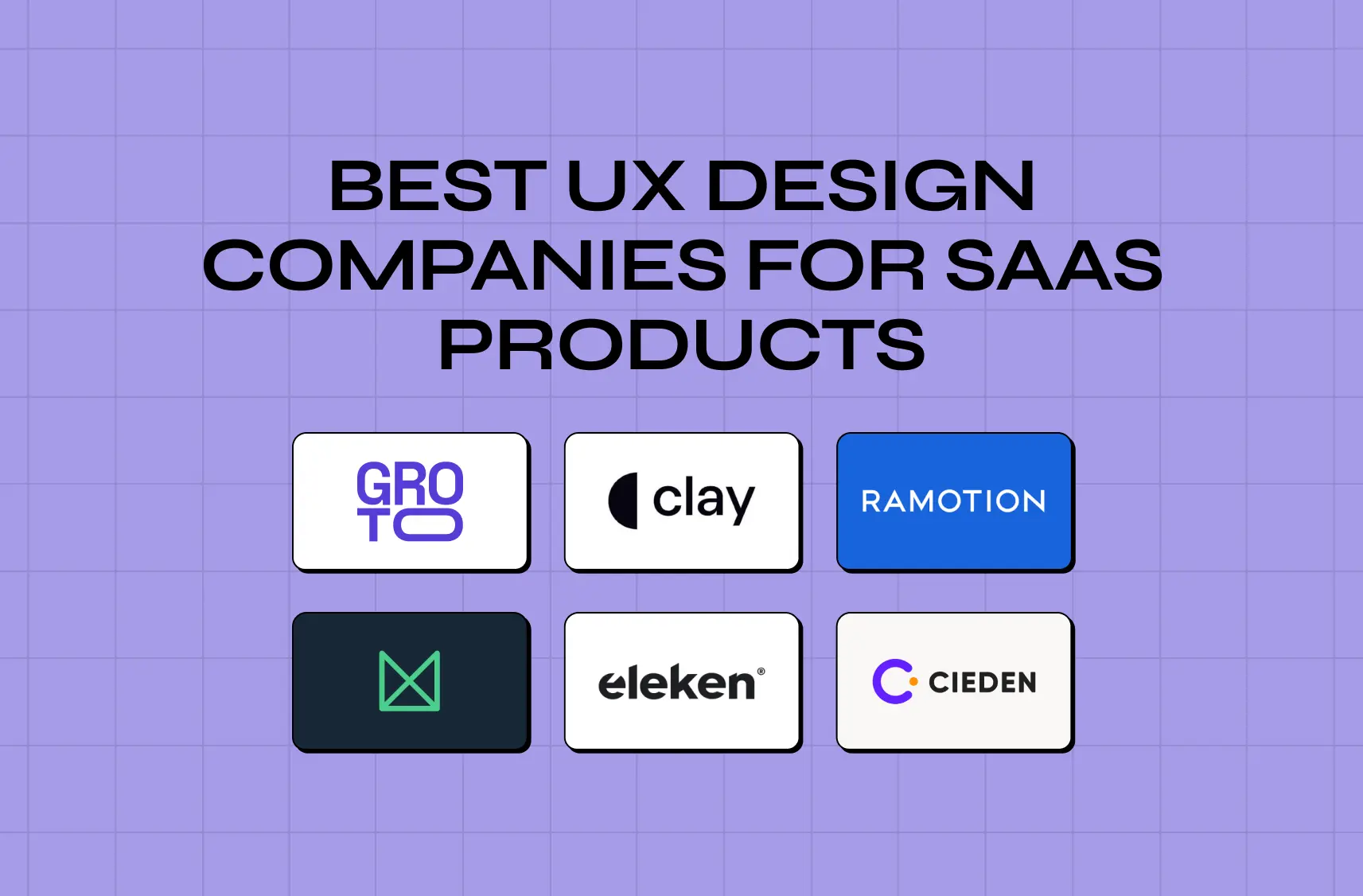
Best UX Design Companies for SAAS Products in 2026

Best UX Design Companies for SAAS Products in 2026

Compare six UX design companies for SaaS products by fit, engagement model, pricing and tradeoffs, with a decision table and checklists to choose the right partner in 2026.

Best UX Design Companies for SAAS Products in 2026

Best UX Design Companies for SAAS Products in 2026

Compare six UX design companies for SaaS products by fit, engagement model, pricing and tradeoffs, with a decision table and checklists to choose the right partner in 2026.

Choosing a SaaS UX design company is a systems decision, not a portfolio contest. See six firms compared on fit, pricing and tradeoffs, plus the tables and checklists to shortlist with confidence

Find the SaaS UX design partner that fits your product risk, budget and stage.

TL;DR

  • The right SaaS UX design company depends on the product risk you need to reduce: weak activation, UX debt, dense workflows, AI features users do not trust, or a simple shortage of design capacity.

  • Six companies are compared below by fit, engagement model, price signal and tradeoff, not by logo count.

  • Published pricing: Groto plans run from $2,399 to $5,999 per month, and Eleken lists $3,799 (part-time) and $5,999 (full-time) per month.

  • Ask every candidate for a case study that shows the problem, the constraints, what shipped and which metric moved.

  • Use the decision table and the evaluation checklists to build a shortlist before you take a single call.

Your SaaS product can have strong functionality and still lose users in the first week. Onboarding needs too much explaining, navigation gets harder with every release, and power users invent workarounds while new users never reach the value you built. That is usually the moment a team starts looking for a SaaS UX design company.

The search is harder than it looks. SaaS UX is a systems problem, not a screen problem. Roles, permissions, empty states, integrations and, in 2026, AI features all have to work together, and they keep changing after launch. A partner who is excellent at marketing pages can still struggle with every one of them.

This guide compares six UX design companies for SaaS products, shows what each does best, gives real pricing where it is published, and explains how to choose without leaning on a ranking alone. We publish this guide and list ourselves first, so we also say where we are not the right fit. If you are hiring in North America, a focused shortlist of US SaaS agencies is a useful companion to the decision framework below.

What a SaaS UX design company actually does in 2026

A SaaS product is not a set of screens someone visits once. People return to it daily while roles, features and business rules keep shifting. The partner you hire is therefore judged on how well the experience holds together as the product grows, not on how the first release looks.

That work has widened. These are the areas where projects now succeed or stall:

  • AI features: users need to see what the system did, judge whether the output is reliable, and recover when it is wrong. Without that, people tend to stop using the feature.

  • Roles and permissions: admins, managers and operators need different views of the same data, and each view needs its own empty, error and permission-denied states.

  • Data density: daily users usually want more information on screen, not less, so the job is organizing it rather than stripping it out.

  • Design systems: new features should ship from reusable patterns instead of one-off components that engineering has to reinterpret.

  • Mobile behavior: when phones are a primary surface, SaaS mobile UX needs touch-first patterns documented for engineering, not a shrunken desktop layout.

The best UX designers for SaaS tie each of these areas to a business metric such as activation, onboarding completion or feature adoption. They also know that early decisions compound. Building a SaaS product end to end shows how design and engineering sequencing decide whether a multi-user architecture scales or needs expensive rework.

Which type of SaaS UX partner do you need?

Most failed hires come from buying the wrong kind of help, not from picking a weak agency. Start with the problem, then match the partner.

Your situation

What to prioritize

Where to look next

You are validating a new product

Scope discipline and fast prototypes

MVP feature prioritization and UX agency fit for early-stage SaaS

Users sign up but do not activate

Research first, then onboarding design

UX research firms

Your design lead seat is empty

Temporary senior capacity

interim design support

The roadmap needs steady design hands

Subscription or embedded designer

design subscription agency options

You are choosing between agency and hire

Cost per output and speed to start

The agency versus in-house trade-off for UX designers for SaaS

The product serves many roles and stakeholders

Systems thinking and permission modeling

enterprise UX design agencies

The product is financial or regulated

Domain-specific research and compliance patterns

fintech UX design firms

AI features are hard to understand or trust

AI interaction design plus user testing

AI product design experts

If you know users are struggling but cannot say why, buy diagnosis before you buy a redesign. If the direction is already clear and your team just needs more hands, do not pay for another strategy phase. The table exists to stop that mismatch before the first call.

Top UX design companies for SaaS products in 2026

We compared each company on five things: proof of real SaaS product work, research before screens, handling of complex workflows, design system and engineering handoff, and how clearly the engagement model and pricing are explained. The table narrows the field, and the profiles below explain each fit.

Company

Best for

Engagement model

Price signal

Main tradeoff

Groto

AI-first SaaS and AI products

Subscription with UX strategy

$2,399 to $5,999 per month

Design only, no engineering builds

Eleken

Ongoing SaaS design capacity

Dedicated designer subscription

$3,799 to $5,999 per month

Design only, two-month minimum

Clay

Premium brand and product polish

Project based


Quote on request

Brand-led, not SaaS-only


UX Studio

Evidence before redesign

Research-led team

Quote on request

Research-first pace

Cieden

Complex B2B SaaS and AI logic

Project or dedicated team

Quote on request


More depth than simple products need

Ramotion

Brand and design system alignment

Project or team extension

Quote on request

Less suited to weekly feature work

1. Groto: full-stack design for SaaS and AI products
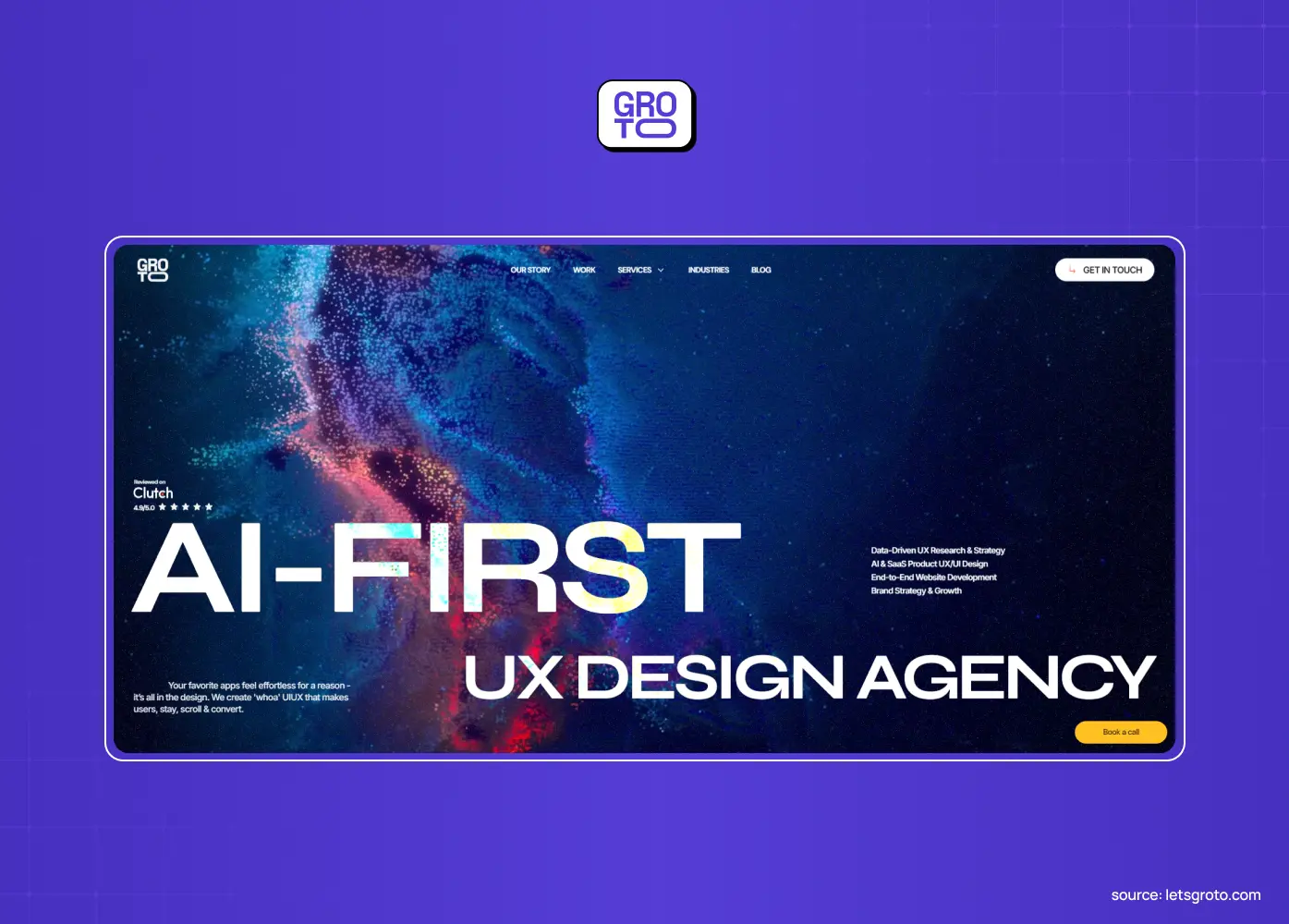
Groto AI-first UX design agency website featuring a colorful digital face and the headline “AI-FIRST UX DESIGN AGENCY.”

We are a full-stack, AI-first design agency. We start from user behavior and business metrics before any visual work, then move from strategy to working prototypes in weeks rather than quarters. Our SaaS product design covers onboarding, dashboards, role-based workflows and design systems, and our client roster includes Colgate and ABInBev alongside SaaS and AI teams.

Three engagements show how we work:

  • PathwaysX: we built its AI-powered B2B hiring platform from scratch, mapping candidates, startup hiring managers and talent partners as three distinct journeys inside one architecture. The platform is in development with MVP testing next.

  • Barista: we redesigned this AI platform for PR agencies into a modular, role-aware product, treating it as a long-term system rather than a feature-led AI tool. It is ready for pilot testing.

  • LearnSphere: we redesigned the edtech platform into a role-based experience for admins, teachers and students, adding a unified notification system and dynamic KPIs without flattening the AI logic underneath.

Our plans are subscription based and run from $2,399 to $5,999 per month depending on weekly hours and billing cycle. Part-time and full-time plans include a dedicated UX strategist and a UX audit within two weeks, and a 7-day free trial lets you test us on a real task first. Teams that need interim design cover while they hire a design lead often start here, and for bespoke AI interfaces we design around how the model behaves instead of adapting a template.

  • Best for: SaaS and AI teams that want strategy and design in one subscription.

  • Look elsewhere: you need engineers included in the same engagement.

Want to know where your users are dropping off?

We’ll break down the exact moments users lose interest, and why.

Want to know where your users are dropping off?

We’ll break down the exact moments users lose interest, and why.

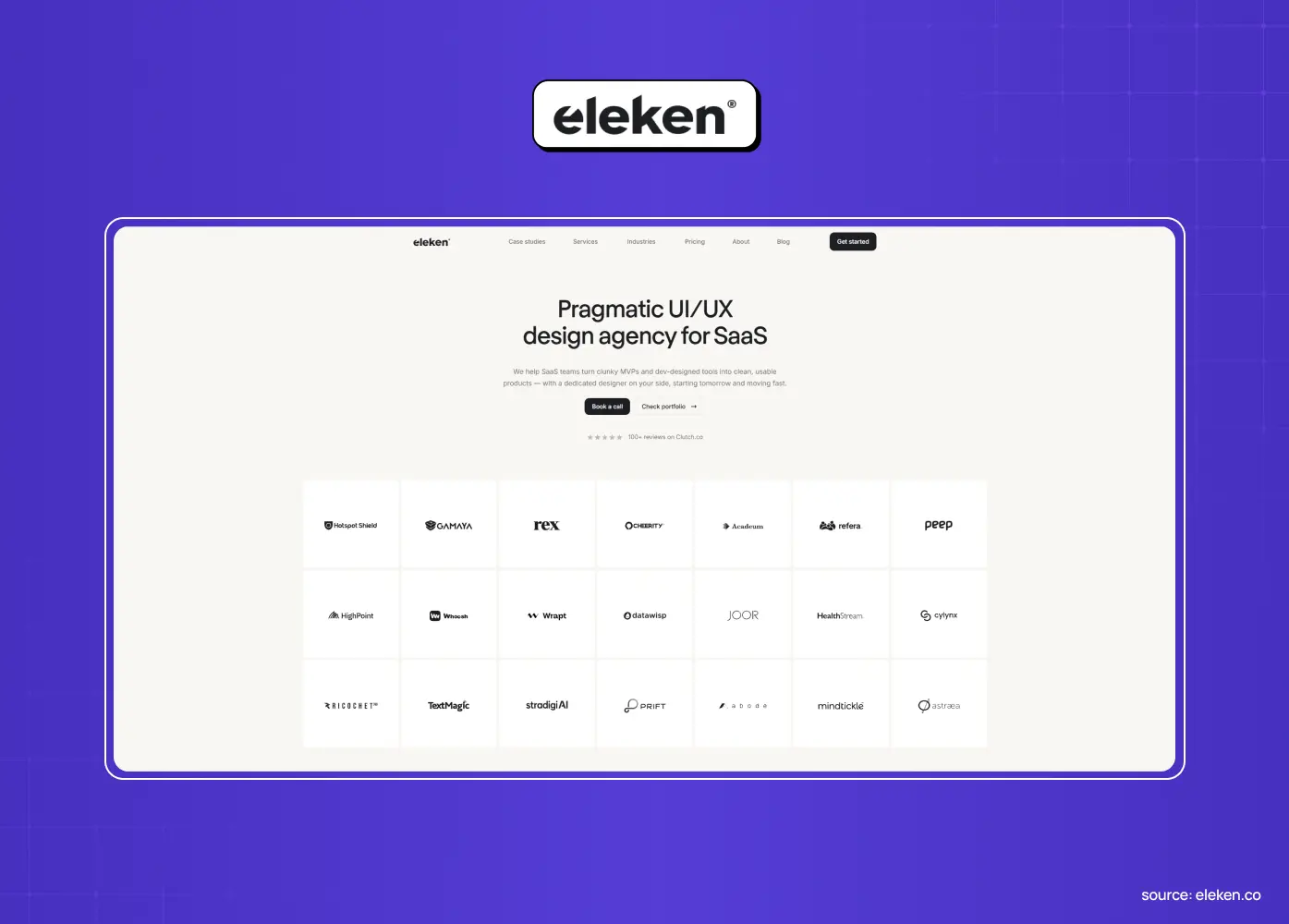
2. Eleken: SaaS-only design capacity

Eleken website showcasing a pragmatic UI/UX design agency for SaaS, with a grid of client logos.

Eleken works exclusively on SaaS products and assigns a dedicated designer who joins your workflow. It is one of the SaaS-specialist agencies that has built its whole model around software teams. Its pricing page lists $3,799 per month for a part-time designer and $5,999 for a full-time designer, with a two-month minimum contract.

Eleken is design only, so engineering stays on your side. That suits teams with developers and a busy roadmap, and it limits teams that need one partner to design and build. To see how other SaaS design agencies compare against this model, our Eleken alternatives breakdown covers the field.

  • Best for: active roadmaps that need consistent design output every month.

  • Look elsewhere: you need strategy, research or engineering under one roof.

3. Clay: premium design for well-funded tech brands
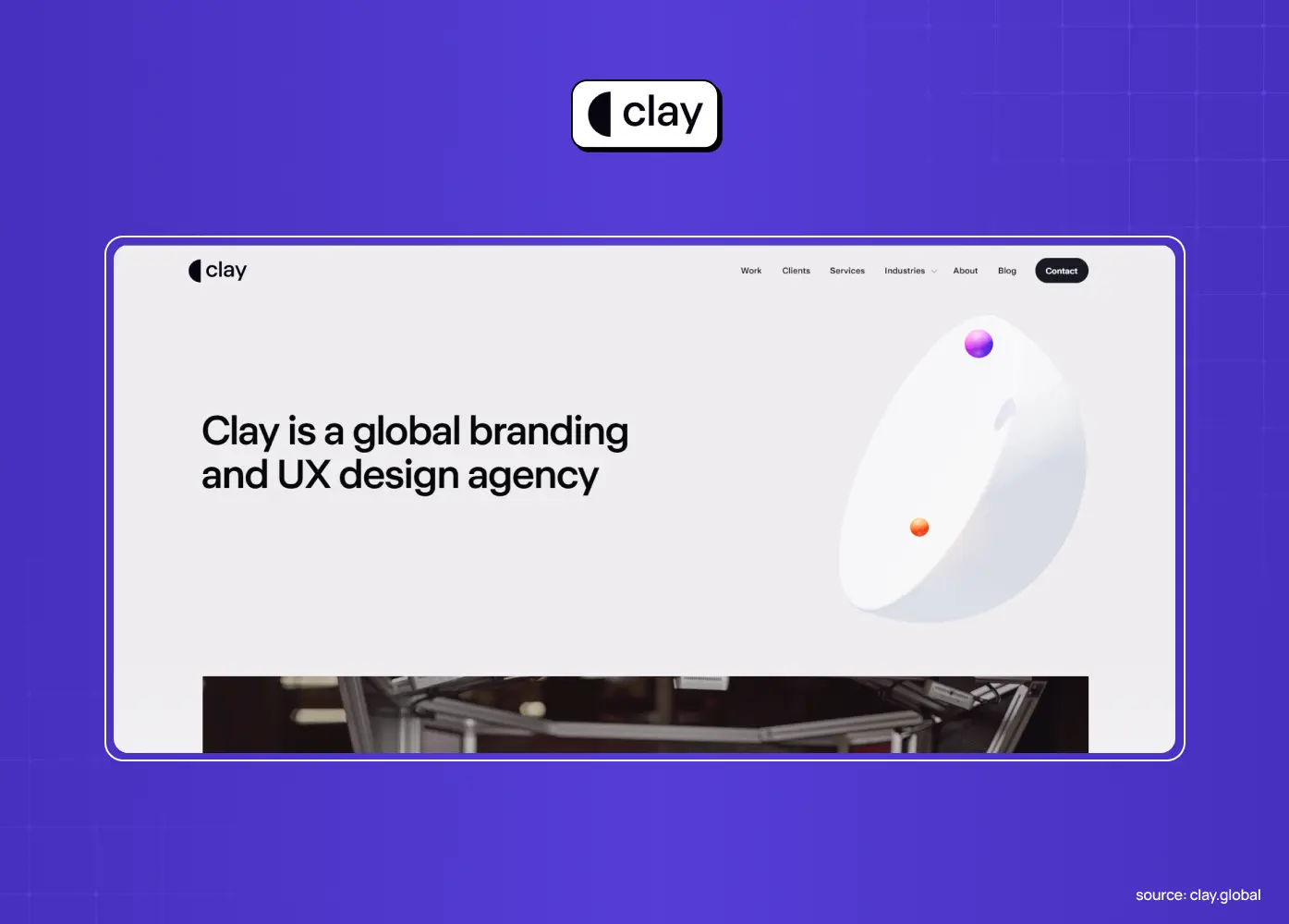
Clay website presenting a global branding and UX design agency with minimalist typography and abstract 3D artwork.

Clay focuses on polished, high-craft interfaces for established technology companies with sophisticated users. Its strength is visual execution and brand consistency, and that matters beyond looks: SaaS brand consistency across product and marketing determines whether the interface, the marketing site and every touchpoint reinforce the same impression.

Clay works closely with client teams to fit existing brand guidelines and technical constraints. It is brand-led rather than SaaS-only, and pricing is quoted per project, so scope the deliverable precisely before committing.

  • Best for: well-funded companies rebuilding brand and product together.

  • Look elsewhere: you need a SaaS specialist or a predictable monthly rate.

4. UX Studio: research-led B2B SaaS design
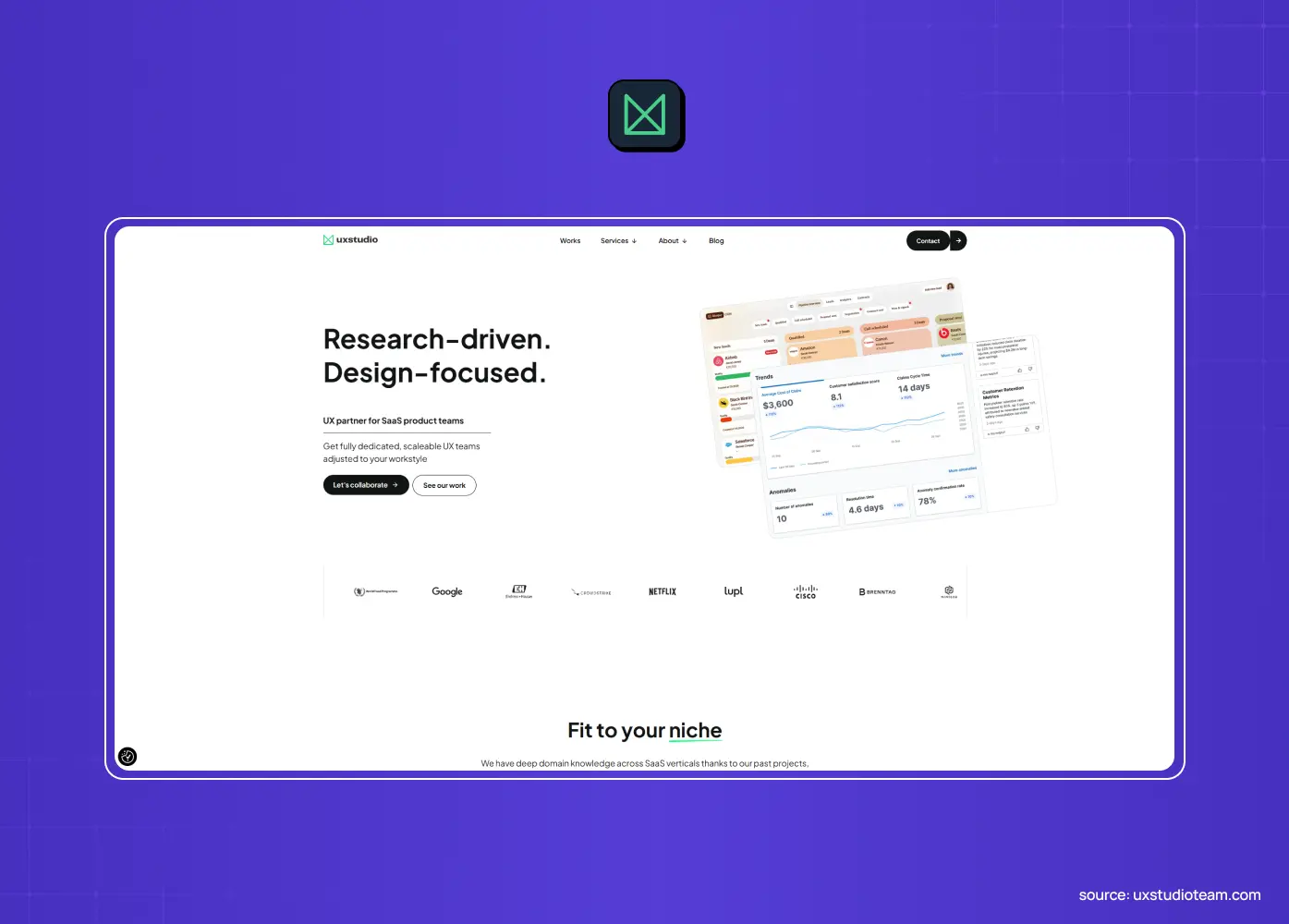
UX studio website featuring the headline “Research-driven. Design-focused.” alongside a SaaS product dashboard interface.

UX Studio brings a European, research-first approach to B2B SaaS. Its services include usability testing, discovery, UX audits, redesign, design systems and embedded product teams. The output is disciplined SaaS UI design backed by evidence rather than surface styling.

That evidence-first process helps when internal opinions have stalled a decision. If you already know exactly what to fix, the research phase can add time you do not need.

  • Best for: teams that see usability or adoption problems but cannot yet explain them.

  • Look elsewhere: the diagnosis is done and you need fast execution.

5. Cieden: complex B2B and AI workflows

Cieden website promoting strategic UX for complex B2B healthcare platforms, with a dark interface and bright green typography.

Cieden focuses on the hard end of B2B SaaS: dense workflows, data-heavy interfaces, multiple user types and AI-enabled products. Its work spans discovery, UX strategy, prototyping and design systems, and it validates complicated logic before expensive implementation.

That depth pays off when the UX problem is really a business-logic problem wearing an interface. For a simple single-role product, it may be more process than you need.

  • Best for: permissions, automations and multi-step workflows that must be simplified without losing control.

  • Look elsewhere: a lightweight product with one main user type.

6. Ramotion: brand and design systems at scale
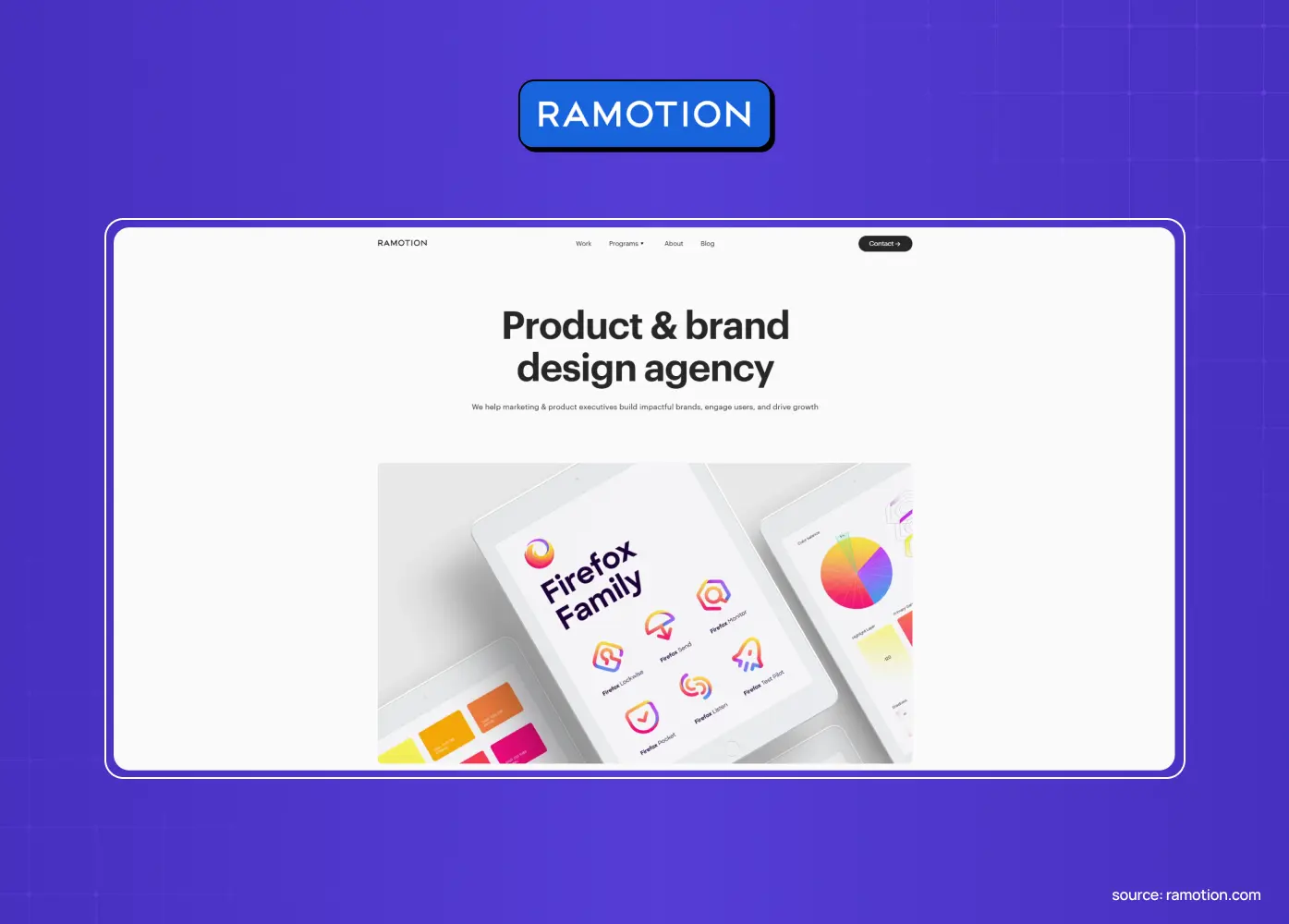
Ramotion website showcasing a product and brand design agency with a Firefox Family product interface visual.

Ramotion combines SaaS product design with brand systems. Its SaaS work covers research, multi-user workflows, information architecture, usability testing, component systems and developer handoff. That breadth matters once a product has outgrown its early patterns and needs scaled design systems that hold across product, brand and engineering.

It is less compelling as extra design hands for weekly feature work, since its value sits in system-level coherence.

  • Best for: growth-stage and enterprise SaaS tackling design-system debt or a brand and product mismatch.

  • Look elsewhere: you want a dedicated designer inside your sprint cycle.

For a wider comparison set, see our list of top UX agencies for SaaS USA.

What SaaS UX design costs and what you are actually buying

There is no universal price, because scope ranges from a focused audit to a full platform redesign. What matters is the engagement model, and each one buys a different kind of certainty.

Model

Usually makes sense when

Price signal in this shortlist

Subscription with a dedicated designer

The roadmap needs steady design output

Groto $2,399 to $5,999 per month, Eleken $3,799 to $5,999 per month

Fixed project

Scope and deliverables are clearly defined

Quoted per project

Discovery sprint or audit

You need to validate the problem before committing

Smaller upfront spend

Embedded team

Design must work daily with product and engineering

Scales with team size

Cost rises with the number of user roles, research depth, testing rounds, design system requirements and engineering collaboration. A cheaper proposal that jumps straight to screens may be solving a much smaller problem than one that includes research and production-ready design. Our SaaS UX redesign cost breakdown itemizes what each part of a redesign contains.

Two more variables are worth checking. Volume-based creative subscriptions differ from product-focused ones, and Superside vs alternatives explains which models suit product work. Location also changes what a budget buys, and design agencies in India have built async workflows that make cross-team collaboration practical.

When you compare quotes, ask what uncertainty and implementation work the price actually covers, not only what it totals.

How to evaluate a SaaS UX design company before you sign

A case study should show how an agency thinks when the product is messy, not only what the final interface looked like. Check for:

  • The original problem and who the users were

  • The constraints that shaped the work, such as legacy data or compliance rules

  • The evidence that influenced decisions

  • What actually shipped, not only concept screens

  • The metric the work was meant to move, and whether it moved

Be careful when a story jumps from "the old design was outdated" straight to a gallery of polished screens. That shows visual skill, not product thinking.

Portfolios also tell you more when you know which signals to read:

Signal

Stronger evidence

Weaker evidence


Role coverage

Separate flows for admins, managers and end users

One generic user journey

Edge states

Empty, error and permission-denied screens designed

Only ideal-path screens

Metric language

Activation, task success, onboarding completion

Broad claims about revenue or retention

Handoff

Component specs, states and documented decisions

Figma files delivered and nothing after

After launch

Involvement in QA and iteration

Engagement ends at approval

Fit within your category matters too. Work in your vertical SaaS niche shows the agency knows its conventions, and a specialist app design agency may serve you better if mobile is your main surface. Bring questions worth asking to the final call, because how an agency answers reveals more than its portfolio does.

What to expect once the engagement starts

A good SaaS partnership changes how your team makes decisions, not only what it ships:

  • Strategy before screens: expect early conversations about segmentation, onboarding, feature discoverability and retention, before any visual work.

  • Close collaboration with engineering: components, states and constraints are shaped with your developers, and documentation outlives the project.

  • A system left behind: patterns and rules that help your team make the next hundred design decisions without the agency.

  • Measured outcomes: baselines agreed upfront, then tracked against activation, adoption and task success.

Treat guaranteed lifts in revenue or retention with caution. Those outcomes depend on many factors beyond UX, so serious agencies commit to measurable design outcomes and explain how they connect to the bigger number.

Conclusion

  • The best SaaS UX design company is the one whose model matches your current product risk, not the one with the longest logo list.

  • Match the problem first: diagnosis, capacity, complexity, brand alignment or AI trust each call for a different partner.

  • Check pricing and engagement terms early, and ask what each quote actually covers.

  • Judge case studies by problem, constraints, what shipped and which metric moved.

  • Choose a partner who leaves your team with a working system, not only design files.

  • Ready to talk through your product? Book a call with us and we will show you where users drop off and what to fix first.

Choosing a SaaS UX design company is a systems decision, not a portfolio contest. See six firms compared on fit, pricing and tradeoffs, plus the tables and checklists to shortlist with confidence

Find the SaaS UX design partner that fits your product risk, budget and stage.

TL;DR

  • The right SaaS UX design company depends on the product risk you need to reduce: weak activation, UX debt, dense workflows, AI features users do not trust, or a simple shortage of design capacity.

  • Six companies are compared below by fit, engagement model, price signal and tradeoff, not by logo count.

  • Published pricing: Groto plans run from $2,399 to $5,999 per month, and Eleken lists $3,799 (part-time) and $5,999 (full-time) per month.

  • Ask every candidate for a case study that shows the problem, the constraints, what shipped and which metric moved.

  • Use the decision table and the evaluation checklists to build a shortlist before you take a single call.

Your SaaS product can have strong functionality and still lose users in the first week. Onboarding needs too much explaining, navigation gets harder with every release, and power users invent workarounds while new users never reach the value you built. That is usually the moment a team starts looking for a SaaS UX design company.

The search is harder than it looks. SaaS UX is a systems problem, not a screen problem. Roles, permissions, empty states, integrations and, in 2026, AI features all have to work together, and they keep changing after launch. A partner who is excellent at marketing pages can still struggle with every one of them.

This guide compares six UX design companies for SaaS products, shows what each does best, gives real pricing where it is published, and explains how to choose without leaning on a ranking alone. We publish this guide and list ourselves first, so we also say where we are not the right fit. If you are hiring in North America, a focused shortlist of US SaaS agencies is a useful companion to the decision framework below.

What a SaaS UX design company actually does in 2026

A SaaS product is not a set of screens someone visits once. People return to it daily while roles, features and business rules keep shifting. The partner you hire is therefore judged on how well the experience holds together as the product grows, not on how the first release looks.

That work has widened. These are the areas where projects now succeed or stall:

  • AI features: users need to see what the system did, judge whether the output is reliable, and recover when it is wrong. Without that, people tend to stop using the feature.

  • Roles and permissions: admins, managers and operators need different views of the same data, and each view needs its own empty, error and permission-denied states.

  • Data density: daily users usually want more information on screen, not less, so the job is organizing it rather than stripping it out.

  • Design systems: new features should ship from reusable patterns instead of one-off components that engineering has to reinterpret.

  • Mobile behavior: when phones are a primary surface, SaaS mobile UX needs touch-first patterns documented for engineering, not a shrunken desktop layout.

The best UX designers for SaaS tie each of these areas to a business metric such as activation, onboarding completion or feature adoption. They also know that early decisions compound. Building a SaaS product end to end shows how design and engineering sequencing decide whether a multi-user architecture scales or needs expensive rework.

Which type of SaaS UX partner do you need?

Most failed hires come from buying the wrong kind of help, not from picking a weak agency. Start with the problem, then match the partner.

Your situation

What to prioritize

Where to look next

You are validating a new product

Scope discipline and fast prototypes

MVP feature prioritization and UX agency fit for early-stage SaaS

Users sign up but do not activate

Research first, then onboarding design

UX research firms

Your design lead seat is empty

Temporary senior capacity

interim design support

The roadmap needs steady design hands

Subscription or embedded designer

design subscription agency options

You are choosing between agency and hire

Cost per output and speed to start

The agency versus in-house trade-off for UX designers for SaaS

The product serves many roles and stakeholders

Systems thinking and permission modeling

enterprise UX design agencies

The product is financial or regulated

Domain-specific research and compliance patterns

fintech UX design firms

AI features are hard to understand or trust

AI interaction design plus user testing

AI product design experts

If you know users are struggling but cannot say why, buy diagnosis before you buy a redesign. If the direction is already clear and your team just needs more hands, do not pay for another strategy phase. The table exists to stop that mismatch before the first call.

Top UX design companies for SaaS products in 2026

We compared each company on five things: proof of real SaaS product work, research before screens, handling of complex workflows, design system and engineering handoff, and how clearly the engagement model and pricing are explained. The table narrows the field, and the profiles below explain each fit.

Company

Best for

Engagement model

Price signal

Main tradeoff

Groto

AI-first SaaS and AI products

Subscription with UX strategy

$2,399 to $5,999 per month

Design only, no engineering builds

Eleken

Ongoing SaaS design capacity

Dedicated designer subscription

$3,799 to $5,999 per month

Design only, two-month minimum

Clay

Premium brand and product polish

Project based


Quote on request

Brand-led, not SaaS-only


UX Studio

Evidence before redesign

Research-led team

Quote on request

Research-first pace

Cieden

Complex B2B SaaS and AI logic

Project or dedicated team

Quote on request


More depth than simple products need

Ramotion

Brand and design system alignment

Project or team extension

Quote on request

Less suited to weekly feature work

1. Groto: full-stack design for SaaS and AI products

Groto AI-first UX design agency website featuring a colorful digital face and the headline “AI-FIRST UX DESIGN AGENCY.”

We are a full-stack, AI-first design agency. We start from user behavior and business metrics before any visual work, then move from strategy to working prototypes in weeks rather than quarters. Our SaaS product design covers onboarding, dashboards, role-based workflows and design systems, and our client roster includes Colgate and ABInBev alongside SaaS and AI teams.

Three engagements show how we work:

  • PathwaysX: we built its AI-powered B2B hiring platform from scratch, mapping candidates, startup hiring managers and talent partners as three distinct journeys inside one architecture. The platform is in development with MVP testing next.

  • Barista: we redesigned this AI platform for PR agencies into a modular, role-aware product, treating it as a long-term system rather than a feature-led AI tool. It is ready for pilot testing.

  • LearnSphere: we redesigned the edtech platform into a role-based experience for admins, teachers and students, adding a unified notification system and dynamic KPIs without flattening the AI logic underneath.

Our plans are subscription based and run from $2,399 to $5,999 per month depending on weekly hours and billing cycle. Part-time and full-time plans include a dedicated UX strategist and a UX audit within two weeks, and a 7-day free trial lets you test us on a real task first. Teams that need interim design cover while they hire a design lead often start here, and for bespoke AI interfaces we design around how the model behaves instead of adapting a template.

  • Best for: SaaS and AI teams that want strategy and design in one subscription.

  • Look elsewhere: you need engineers included in the same engagement.

Want to know where your users are dropping off?

We’ll break down the exact moments users lose interest, and why.

2. Eleken: SaaS-only design capacity

Eleken website showcasing a pragmatic UI/UX design agency for SaaS, with a grid of client logos.

Eleken works exclusively on SaaS products and assigns a dedicated designer who joins your workflow. It is one of the SaaS-specialist agencies that has built its whole model around software teams. Its pricing page lists $3,799 per month for a part-time designer and $5,999 for a full-time designer, with a two-month minimum contract.

Eleken is design only, so engineering stays on your side. That suits teams with developers and a busy roadmap, and it limits teams that need one partner to design and build. To see how other SaaS design agencies compare against this model, our Eleken alternatives breakdown covers the field.

  • Best for: active roadmaps that need consistent design output every month.

  • Look elsewhere: you need strategy, research or engineering under one roof.

3. Clay: premium design for well-funded tech brands

Clay website presenting a global branding and UX design agency with minimalist typography and abstract 3D artwork.

Clay focuses on polished, high-craft interfaces for established technology companies with sophisticated users. Its strength is visual execution and brand consistency, and that matters beyond looks: SaaS brand consistency across product and marketing determines whether the interface, the marketing site and every touchpoint reinforce the same impression.

Clay works closely with client teams to fit existing brand guidelines and technical constraints. It is brand-led rather than SaaS-only, and pricing is quoted per project, so scope the deliverable precisely before committing.

  • Best for: well-funded companies rebuilding brand and product together.

  • Look elsewhere: you need a SaaS specialist or a predictable monthly rate.

4. UX Studio: research-led B2B SaaS design

UX studio website featuring the headline “Research-driven. Design-focused.” alongside a SaaS product dashboard interface.

UX Studio brings a European, research-first approach to B2B SaaS. Its services include usability testing, discovery, UX audits, redesign, design systems and embedded product teams. The output is disciplined SaaS UI design backed by evidence rather than surface styling.

That evidence-first process helps when internal opinions have stalled a decision. If you already know exactly what to fix, the research phase can add time you do not need.

  • Best for: teams that see usability or adoption problems but cannot yet explain them.

  • Look elsewhere: the diagnosis is done and you need fast execution.

5. Cieden: complex B2B and AI workflows

Cieden website promoting strategic UX for complex B2B healthcare platforms, with a dark interface and bright green typography.

Cieden focuses on the hard end of B2B SaaS: dense workflows, data-heavy interfaces, multiple user types and AI-enabled products. Its work spans discovery, UX strategy, prototyping and design systems, and it validates complicated logic before expensive implementation.

That depth pays off when the UX problem is really a business-logic problem wearing an interface. For a simple single-role product, it may be more process than you need.

  • Best for: permissions, automations and multi-step workflows that must be simplified without losing control.

  • Look elsewhere: a lightweight product with one main user type.

6. Ramotion: brand and design systems at scale

Ramotion website showcasing a product and brand design agency with a Firefox Family product interface visual.

Ramotion combines SaaS product design with brand systems. Its SaaS work covers research, multi-user workflows, information architecture, usability testing, component systems and developer handoff. That breadth matters once a product has outgrown its early patterns and needs scaled design systems that hold across product, brand and engineering.

It is less compelling as extra design hands for weekly feature work, since its value sits in system-level coherence.

  • Best for: growth-stage and enterprise SaaS tackling design-system debt or a brand and product mismatch.

  • Look elsewhere: you want a dedicated designer inside your sprint cycle.

For a wider comparison set, see our list of top UX agencies for SaaS USA.

What SaaS UX design costs and what you are actually buying

There is no universal price, because scope ranges from a focused audit to a full platform redesign. What matters is the engagement model, and each one buys a different kind of certainty.

Model

Usually makes sense when

Price signal in this shortlist

Subscription with a dedicated designer

The roadmap needs steady design output

Groto $2,399 to $5,999 per month, Eleken $3,799 to $5,999 per month

Fixed project

Scope and deliverables are clearly defined

Quoted per project

Discovery sprint or audit

You need to validate the problem before committing

Smaller upfront spend

Embedded team

Design must work daily with product and engineering

Scales with team size

Cost rises with the number of user roles, research depth, testing rounds, design system requirements and engineering collaboration. A cheaper proposal that jumps straight to screens may be solving a much smaller problem than one that includes research and production-ready design. Our SaaS UX redesign cost breakdown itemizes what each part of a redesign contains.

Two more variables are worth checking. Volume-based creative subscriptions differ from product-focused ones, and Superside vs alternatives explains which models suit product work. Location also changes what a budget buys, and design agencies in India have built async workflows that make cross-team collaboration practical.

When you compare quotes, ask what uncertainty and implementation work the price actually covers, not only what it totals.

How to evaluate a SaaS UX design company before you sign

A case study should show how an agency thinks when the product is messy, not only what the final interface looked like. Check for:

  • The original problem and who the users were

  • The constraints that shaped the work, such as legacy data or compliance rules

  • The evidence that influenced decisions

  • What actually shipped, not only concept screens

  • The metric the work was meant to move, and whether it moved

Be careful when a story jumps from "the old design was outdated" straight to a gallery of polished screens. That shows visual skill, not product thinking.

Portfolios also tell you more when you know which signals to read:

Signal

Stronger evidence

Weaker evidence


Role coverage

Separate flows for admins, managers and end users

One generic user journey

Edge states

Empty, error and permission-denied screens designed

Only ideal-path screens

Metric language

Activation, task success, onboarding completion

Broad claims about revenue or retention

Handoff

Component specs, states and documented decisions

Figma files delivered and nothing after

After launch

Involvement in QA and iteration

Engagement ends at approval

Fit within your category matters too. Work in your vertical SaaS niche shows the agency knows its conventions, and a specialist app design agency may serve you better if mobile is your main surface. Bring questions worth asking to the final call, because how an agency answers reveals more than its portfolio does.

What to expect once the engagement starts

A good SaaS partnership changes how your team makes decisions, not only what it ships:

  • Strategy before screens: expect early conversations about segmentation, onboarding, feature discoverability and retention, before any visual work.

  • Close collaboration with engineering: components, states and constraints are shaped with your developers, and documentation outlives the project.

  • A system left behind: patterns and rules that help your team make the next hundred design decisions without the agency.

  • Measured outcomes: baselines agreed upfront, then tracked against activation, adoption and task success.

Treat guaranteed lifts in revenue or retention with caution. Those outcomes depend on many factors beyond UX, so serious agencies commit to measurable design outcomes and explain how they connect to the bigger number.

Conclusion

  • The best SaaS UX design company is the one whose model matches your current product risk, not the one with the longest logo list.

  • Match the problem first: diagnosis, capacity, complexity, brand alignment or AI trust each call for a different partner.

  • Check pricing and engagement terms early, and ask what each quote actually covers.

  • Judge case studies by problem, constraints, what shipped and which metric moved.

  • Choose a partner who leaves your team with a working system, not only design files.

  • Ready to talk through your product? Book a call with us and we will show you where users drop off and what to fix first.

Have a project in mind?

Let’s talk through your idea and see what makes sense.

Harpreet Singh

Harpreet Singh

Founder at Groto

Have a project in mind?

Let’s talk through your idea and see what makes sense.

Harpreet Singh

Harpreet Singh

Founder at Groto

FAQ

Everything you were going to ask (and a few things you didn’t know to)

Should we commission a UX audit or go straight to a redesign?

Start with an audit when you can see the symptoms but not the cause, such as weak activation or rising support requests. An audit can show the fix is smaller than a redesign. Go straight to redesign only when the problems are already documented and the direction is agreed.

How soon will we see results after hiring an agency?

Design deliverables usually arrive within days on a subscription model, and most Groto tasks finish within one to three business days. Metric movement takes longer, because the work must ship and enough users must pass through it before a change is measurable.

What should we prepare before the first call?

Bring analytics access, your main user roles, current Figma files, known drop-off points and any engineering constraints. Add the one metric you most want to improve. That lets the agency judge scope in the first conversation.

Can an agency work inside our existing design system and Figma files?

Yes, and a good one will audit what exists before proposing changes. The aim is to extend your components rather than replace them. Agree early who owns component decisions so design and engineering stay aligned.

Can an India-based team work with US or EU time zones?

Yes. Our team works Monday to Friday, 10:30 AM to 6:30 PM IST, with async daily updates and weekly meetings scheduled to suit your time zone, even outside IST hours when needed.

Who on our side should own the engagement?

Name one product owner with real decision authority, usually a product manager or head of product. Add an engineer for feasibility checks. Founders can join milestone reviews, which avoids feedback by committee..
Should we commission a UX audit or go straight to a redesign?

Start with an audit when you can see the symptoms but not the cause, such as weak activation or rising support requests. An audit can show the fix is smaller than a redesign. Go straight to redesign only when the problems are already documented and the direction is agreed.

How soon will we see results after hiring an agency?

Design deliverables usually arrive within days on a subscription model, and most Groto tasks finish within one to three business days. Metric movement takes longer, because the work must ship and enough users must pass through it before a change is measurable.

What should we prepare before the first call?

Bring analytics access, your main user roles, current Figma files, known drop-off points and any engineering constraints. Add the one metric you most want to improve. That lets the agency judge scope in the first conversation.

Can an agency work inside our existing design system and Figma files?

Yes, and a good one will audit what exists before proposing changes. The aim is to extend your components rather than replace them. Agree early who owns component decisions so design and engineering stay aligned.

Can an India-based team work with US or EU time zones?

Yes. Our team works Monday to Friday, 10:30 AM to 6:30 PM IST, with async daily updates and weekly meetings scheduled to suit your time zone, even outside IST hours when needed.

Who on our side should own the engagement?

Name one product owner with real decision authority, usually a product manager or head of product. Add an engineer for feasibility checks. Founders can join milestone reviews, which avoids feedback by committee..
More Articles

Extreme close-up black and white photograph of a human eye

Let’s bring your vision to life

Tell us what's on your mind? We'll hit you back in 24 hours. No fluff, no delays - just a solid vision to bring your idea to life.

Profile portrait of a man in a white shirt against a light background

Harpreet Singh

Founder and Creative Director

Get in Touch