Harpreet Singh

Founder and Creative Director

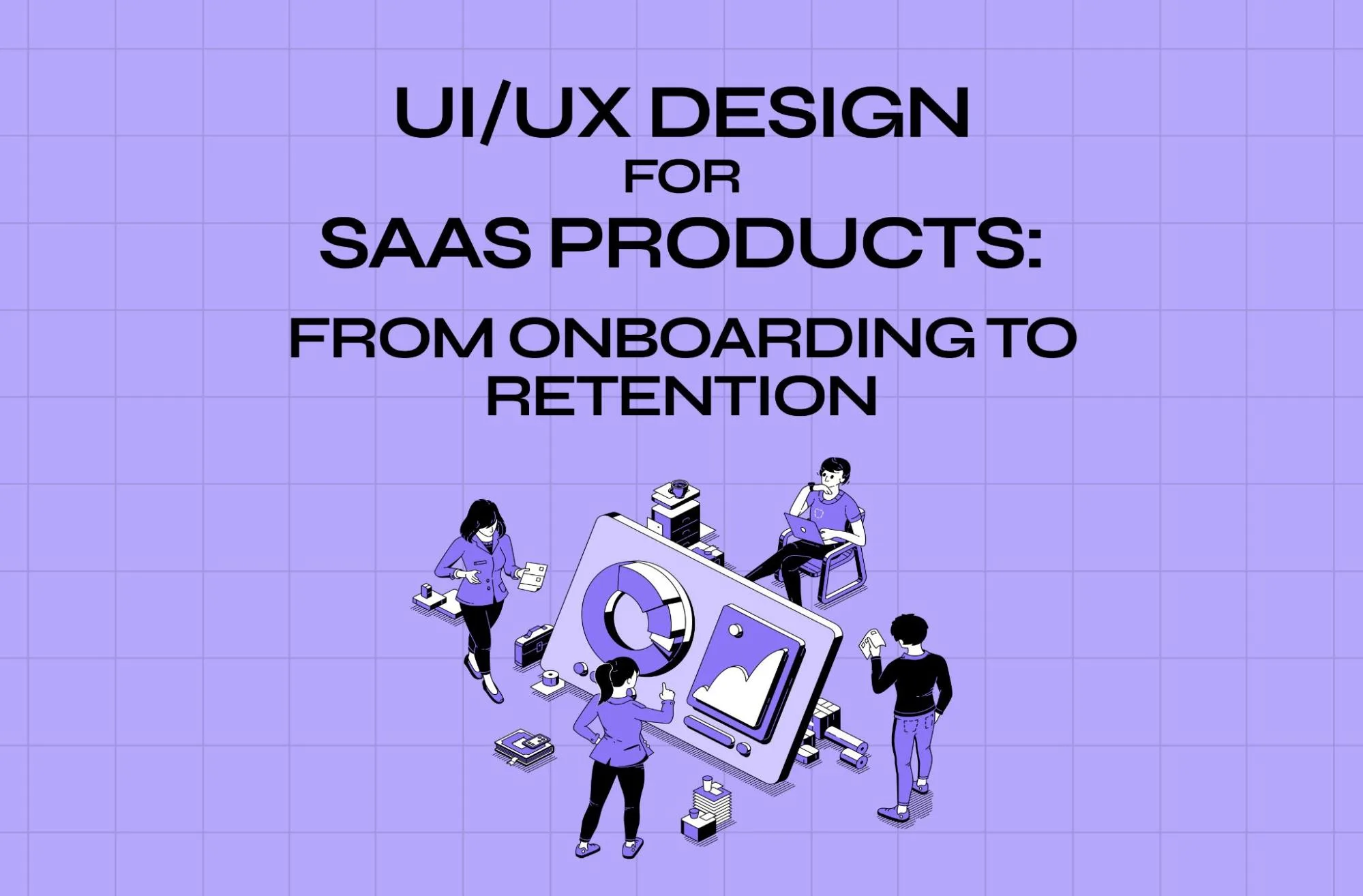
UI/UX Design for SaaS Products: From Onboarding to Retention

Feb 12, 2026

A conversion-focused guide to UI/UX design for SaaS products showing how onboarding, activation, and retention UX directly impact revenue, adoption, and long-term growth.

Harpreet Singh

Founder and Creative Director

UI/UX Design for SaaS Products: From Onboarding to Retention

Feb 12, 2026

A conversion-focused guide to UI/UX design for SaaS products showing how onboarding, activation, and retention UX directly impact revenue, adoption, and long-term growth.

Most SaaS products do not fail because of missing features. They fail because users do not reach value fast enough. This guide explains how UI/UX design for SaaS products drives onboarding success, activation, and retention, and how to build experiences that convert consistently.

UI/UX is the growth engine of SaaS products.


Why UI/UX Design for SaaS Products Directly Impacts Revenue Growth

SaaS founders often invest heavily in development and marketing, yet conversion stagnates. Trials do not upgrade. Activation slows. Feature usage drops.

The symptoms are familiar:

  • Users sign up but do not complete onboarding

  • Features exist but remain unused

  • Support questions repeat

  • Churn appears without clear cause

  • Retention flattens early

These are rarely pricing or positioning problems.

They are experience problems.

In SaaS, UX determines:

  • How quickly users reach value

  • How confident they feel progressing

  • How clearly outcomes are communicated

  • How much effort is required to succeed

And those directly affect revenue.

Increasing customer retention by just 5% can raise profits between 25% and 95%, according to Bain & Company [source]. That is why UI/UX design for SaaS products has moved from interface work to strategic investment.

This is not about visual polish.
It is about shaping user behavior.

Where Poor SaaS UX Silently Reduces Activation and Retention

Across product audits, the same structural issues show up repeatedly:

Low Activation Momentum

Users sign up but fail to reach meaningful outcomes.

Invisible Value

Products work but value is not surfaced clearly.

Decision Overload

Interfaces demand interpretation rather than guiding action.

Feature Adoption Gaps

Capabilities exist but do not integrate into workflows.

Retention Friction

Users lose confidence between sessions.

UI/UX strategy addresses these through behavioral architecture rather than aesthetic redesign.

Users who reach activation milestones are 3 to 4 times more likely to convert to paid plans, according to Appcues research.

Users who reach activation milestones are 2–5x more likely to convert to paid plans, according to product analytics benchmarks and Appcues research on trial conversion.

That milestone is driven by experience design.

Optimizing SaaS Onboarding UX to Accelerate Time to Value

Onboarding is not an introduction.
It is a behavioral funnel.

Many SaaS onboarding flows still rely on:

  • product tours

  • checklists

  • feature explanations

Activation happens when users complete meaningful tasks, not when they finish screens.

What High-Performing Onboarding UX Prioritizes

  • Immediate path to value

  • Reduced setup complexity

  • Contextual guidance

  • Role-aware entry flows

  • Clear progress signaling

Instead of explaining capabilities, effective onboarding focuses on enabling outcomes quickly.

Practical Activation Techniques

  • Preconfigured starting states

  • Task-first onboarding

  • Progressive disclosure

  • Inline assistance

  • Outcome-driven microcopy

Reducing interpretation friction between discovery and evaluation workflows can significantly improve completion momentum without adding functionality. This comes from clarifying interaction pathways.

Improving Feature Adoption Through Behavior-Driven SaaS UX Design

Many products lose users after onboarding because value stops being reinforced.

Adoption weakens when:

  • features feel disconnected from workflows

  • next actions are not surfaced

  • success signals are unclear

  • users must remember paths

UX Strategies That Increase Adoption

Contextual Surfacing

Features appear when relevant.

Progressive Capability Reveal

Power increases as user confidence grows.

Behavior Reinforcement

Success states encourage continued use.

Embedded Guidance

Learning happens inside workflows.

Aligning system feedback with user progress improves continued engagement by reducing ambiguity around outcomes.

Adoption UX is reinforcement, not education.

Designing SaaS UX That Protects Retention and Lifetime Value

Retention design receives less attention, yet profitability depends on it.

Users churn when:

  • progress is invisible

  • workflows feel heavy

  • effort outweighs reward

  • trust erodes

  • value perception weakens

Retention-Focused UX Patterns

Progress Continuity

Users resume where they left off.

Outcome Visibility

Impact is measurable and surfaced.

Effort Reduction

Recurring workflows lighten over time.

Predictive Guidance

Interfaces anticipate next steps.

Trust Signals

Performance feedback reinforces confidence.

Retention UX turns products into habits.

This is where experience design protects revenue.

How Strategic SaaS UX Improves Engineering Velocity and Scalability

Experience design also affects delivery speed.

Poor UX architecture leads to:

  • inconsistent components

  • repeated frontend rebuilds

  • unclear feature priorities

  • design debt evolving into tech debt

Strong UX structure enables:

  • scalable component systems

  • predictable flows

  • faster feature deployment

  • reduced cross-team ambiguity

This is why UI/UX design for SaaS products functions as infrastructure rather than decoration.

Signals That Your SaaS Product Needs UX Intervention

Structural UX issues typically appear as:

  • Activation requiring multiple sessions

  • Features rarely explored

  • Data exported instead of acted upon

  • Ongoing redesign debates

  • Adoption dependent on support

These are behavioral signals that incremental UI changes rarely fix.

Final Perspective on Conversion-Focused SaaS UX

UI/UX design determines:

  • how fast users trust

  • how easily they act

  • how often they return

  • how long they stay

It is one of the highest leverage growth investments available because it compounds across acquisition, activation, adoption, and retention simultaneously.

Products that succeed long-term are rarely the most feature-rich.
They are the most behaviorally aligned.

Strategy Call

If you are evaluating how UI/UX is impacting activation, adoption, or retention inside your SaaS product, a structured teardown can identify conversion friction and workflow gaps quickly.

In a focused session we typically:

  • Map onboarding momentum gaps

  • Identify adoption blockers

  • Evaluate retention signals

  • Outline scalable UX priorities

Book a conversation with our team to assess where experience design can unlock measurable growth outcomes.

FAQs

1. How does UI/UX design influence SaaS conversions?
UI/UX shapes how quickly users reach value, how confidently they progress, and how much effort workflows require. These directly affect activation, upgrades, and retention.

2. What is the biggest onboarding UX mistake SaaS teams make?
Designing tours instead of activation paths. Users convert when they complete meaningful tasks rather than viewing interface explanations.

3. When should a SaaS product invest in UX strategy?
When activation slows, adoption plateaus, or churn appears without clear cause. These typically signal structural experience gaps.

4. Can UX improvements increase retention without adding features?
Yes. Many retention gains come from clarifying workflows, reinforcing outcomes, and reducing friction rather than expanding functionality.

5. What does a SaaS UX strategy session uncover?
Common findings include decision overload, unclear value signals, architectural inconsistencies, and adoption pathway gaps that materially affect growth.

Most SaaS products do not fail because of missing features. They fail because users do not reach value fast enough. This guide explains how UI/UX design for SaaS products drives onboarding success, activation, and retention, and how to build experiences that convert consistently.

UI/UX is the growth engine of SaaS products.


Why UI/UX Design for SaaS Products Directly Impacts Revenue Growth

SaaS founders often invest heavily in development and marketing, yet conversion stagnates. Trials do not upgrade. Activation slows. Feature usage drops.

The symptoms are familiar:

  • Users sign up but do not complete onboarding

  • Features exist but remain unused

  • Support questions repeat

  • Churn appears without clear cause

  • Retention flattens early

These are rarely pricing or positioning problems.

They are experience problems.

In SaaS, UX determines:

  • How quickly users reach value

  • How confident they feel progressing

  • How clearly outcomes are communicated

  • How much effort is required to succeed

And those directly affect revenue.

Increasing customer retention by just 5% can raise profits between 25% and 95%, according to Bain & Company [source]. That is why UI/UX design for SaaS products has moved from interface work to strategic investment.

This is not about visual polish.
It is about shaping user behavior.

Where Poor SaaS UX Silently Reduces Activation and Retention

Across product audits, the same structural issues show up repeatedly:

Low Activation Momentum

Users sign up but fail to reach meaningful outcomes.

Invisible Value

Products work but value is not surfaced clearly.

Decision Overload

Interfaces demand interpretation rather than guiding action.

Feature Adoption Gaps

Capabilities exist but do not integrate into workflows.

Retention Friction

Users lose confidence between sessions.

UI/UX strategy addresses these through behavioral architecture rather than aesthetic redesign.

Users who reach activation milestones are 3 to 4 times more likely to convert to paid plans, according to Appcues research.

Users who reach activation milestones are 2–5x more likely to convert to paid plans, according to product analytics benchmarks and Appcues research on trial conversion.

That milestone is driven by experience design.

Optimizing SaaS Onboarding UX to Accelerate Time to Value

Onboarding is not an introduction.
It is a behavioral funnel.

Many SaaS onboarding flows still rely on:

  • product tours

  • checklists

  • feature explanations

Activation happens when users complete meaningful tasks, not when they finish screens.

What High-Performing Onboarding UX Prioritizes

  • Immediate path to value

  • Reduced setup complexity

  • Contextual guidance

  • Role-aware entry flows

  • Clear progress signaling

Instead of explaining capabilities, effective onboarding focuses on enabling outcomes quickly.

Practical Activation Techniques

  • Preconfigured starting states

  • Task-first onboarding

  • Progressive disclosure

  • Inline assistance

  • Outcome-driven microcopy

Reducing interpretation friction between discovery and evaluation workflows can significantly improve completion momentum without adding functionality. This comes from clarifying interaction pathways.

Improving Feature Adoption Through Behavior-Driven SaaS UX Design

Many products lose users after onboarding because value stops being reinforced.

Adoption weakens when:

  • features feel disconnected from workflows

  • next actions are not surfaced

  • success signals are unclear

  • users must remember paths

UX Strategies That Increase Adoption

Contextual Surfacing

Features appear when relevant.

Progressive Capability Reveal

Power increases as user confidence grows.

Behavior Reinforcement

Success states encourage continued use.

Embedded Guidance

Learning happens inside workflows.

Aligning system feedback with user progress improves continued engagement by reducing ambiguity around outcomes.

Adoption UX is reinforcement, not education.

Designing SaaS UX That Protects Retention and Lifetime Value

Retention design receives less attention, yet profitability depends on it.

Users churn when:

  • progress is invisible

  • workflows feel heavy

  • effort outweighs reward

  • trust erodes

  • value perception weakens

Retention-Focused UX Patterns

Progress Continuity

Users resume where they left off.

Outcome Visibility

Impact is measurable and surfaced.

Effort Reduction

Recurring workflows lighten over time.

Predictive Guidance

Interfaces anticipate next steps.

Trust Signals

Performance feedback reinforces confidence.

Retention UX turns products into habits.

This is where experience design protects revenue.

How Strategic SaaS UX Improves Engineering Velocity and Scalability

Experience design also affects delivery speed.

Poor UX architecture leads to:

  • inconsistent components

  • repeated frontend rebuilds

  • unclear feature priorities

  • design debt evolving into tech debt

Strong UX structure enables:

  • scalable component systems

  • predictable flows

  • faster feature deployment

  • reduced cross-team ambiguity

This is why UI/UX design for SaaS products functions as infrastructure rather than decoration.

Signals That Your SaaS Product Needs UX Intervention

Structural UX issues typically appear as:

  • Activation requiring multiple sessions

  • Features rarely explored

  • Data exported instead of acted upon

  • Ongoing redesign debates

  • Adoption dependent on support

These are behavioral signals that incremental UI changes rarely fix.

Final Perspective on Conversion-Focused SaaS UX

UI/UX design determines:

  • how fast users trust

  • how easily they act

  • how often they return

  • how long they stay

It is one of the highest leverage growth investments available because it compounds across acquisition, activation, adoption, and retention simultaneously.

Products that succeed long-term are rarely the most feature-rich.
They are the most behaviorally aligned.

Strategy Call

If you are evaluating how UI/UX is impacting activation, adoption, or retention inside your SaaS product, a structured teardown can identify conversion friction and workflow gaps quickly.

In a focused session we typically:

  • Map onboarding momentum gaps

  • Identify adoption blockers

  • Evaluate retention signals

  • Outline scalable UX priorities

Book a conversation with our team to assess where experience design can unlock measurable growth outcomes.

FAQs

1. How does UI/UX design influence SaaS conversions?
UI/UX shapes how quickly users reach value, how confidently they progress, and how much effort workflows require. These directly affect activation, upgrades, and retention.

2. What is the biggest onboarding UX mistake SaaS teams make?
Designing tours instead of activation paths. Users convert when they complete meaningful tasks rather than viewing interface explanations.

3. When should a SaaS product invest in UX strategy?
When activation slows, adoption plateaus, or churn appears without clear cause. These typically signal structural experience gaps.

4. Can UX improvements increase retention without adding features?
Yes. Many retention gains come from clarifying workflows, reinforcing outcomes, and reducing friction rather than expanding functionality.

5. What does a SaaS UX strategy session uncover?
Common findings include decision overload, unclear value signals, architectural inconsistencies, and adoption pathway gaps that materially affect growth.

Extreme close-up black and white photograph of a human eye

Let’s bring your vision to life

Tell us what's on your mind? We'll hit you back in 24 hours. No fluff, no delays - just a solid vision to bring your idea to life.

Profile portrait of a man in a white shirt against a light background

Harpreet Singh

Founder and Creative Director

Get in Touch

Extreme close-up black and white photograph of a human eye

Let’s bring your vision to life

Tell us what's on your mind? We'll hit you back in 24 hours. No fluff, no delays - just a solid vision to bring your idea to life.

Profile portrait of a man in a white shirt against a light background

Harpreet Singh

Founder and Creative Director

Get in Touch

Harpreet Singh

Founder and Creative Director

UI/UX Design for SaaS Products: From Onboarding to Retention

Feb 12, 2026

A conversion-focused guide to UI/UX design for SaaS products showing how onboarding, activation, and retention UX directly impact revenue, adoption, and long-term growth.

Most SaaS products do not fail because of missing features. They fail because users do not reach value fast enough. This guide explains how UI/UX design for SaaS products drives onboarding success, activation, and retention, and how to build experiences that convert consistently.

UI/UX is the growth engine of SaaS products.


Why UI/UX Design for SaaS Products Directly Impacts Revenue Growth

SaaS founders often invest heavily in development and marketing, yet conversion stagnates. Trials do not upgrade. Activation slows. Feature usage drops.

The symptoms are familiar:

  • Users sign up but do not complete onboarding

  • Features exist but remain unused

  • Support questions repeat

  • Churn appears without clear cause

  • Retention flattens early

These are rarely pricing or positioning problems.

They are experience problems.

In SaaS, UX determines:

  • How quickly users reach value

  • How confident they feel progressing

  • How clearly outcomes are communicated

  • How much effort is required to succeed

And those directly affect revenue.

Increasing customer retention by just 5% can raise profits between 25% and 95%, according to Bain & Company [source]. That is why UI/UX design for SaaS products has moved from interface work to strategic investment.

This is not about visual polish.
It is about shaping user behavior.

Where Poor SaaS UX Silently Reduces Activation and Retention

Across product audits, the same structural issues show up repeatedly:

Low Activation Momentum

Users sign up but fail to reach meaningful outcomes.

Invisible Value

Products work but value is not surfaced clearly.

Decision Overload

Interfaces demand interpretation rather than guiding action.

Feature Adoption Gaps

Capabilities exist but do not integrate into workflows.

Retention Friction

Users lose confidence between sessions.

UI/UX strategy addresses these through behavioral architecture rather than aesthetic redesign.

Users who reach activation milestones are 3 to 4 times more likely to convert to paid plans, according to Appcues research.

Users who reach activation milestones are 2–5x more likely to convert to paid plans, according to product analytics benchmarks and Appcues research on trial conversion.

That milestone is driven by experience design.

Optimizing SaaS Onboarding UX to Accelerate Time to Value

Onboarding is not an introduction.
It is a behavioral funnel.

Many SaaS onboarding flows still rely on:

  • product tours

  • checklists

  • feature explanations

Activation happens when users complete meaningful tasks, not when they finish screens.

What High-Performing Onboarding UX Prioritizes

  • Immediate path to value

  • Reduced setup complexity

  • Contextual guidance

  • Role-aware entry flows

  • Clear progress signaling

Instead of explaining capabilities, effective onboarding focuses on enabling outcomes quickly.

Practical Activation Techniques

  • Preconfigured starting states

  • Task-first onboarding

  • Progressive disclosure

  • Inline assistance

  • Outcome-driven microcopy

Reducing interpretation friction between discovery and evaluation workflows can significantly improve completion momentum without adding functionality. This comes from clarifying interaction pathways.

Improving Feature Adoption Through Behavior-Driven SaaS UX Design

Many products lose users after onboarding because value stops being reinforced.

Adoption weakens when:

  • features feel disconnected from workflows

  • next actions are not surfaced

  • success signals are unclear

  • users must remember paths

UX Strategies That Increase Adoption

Contextual Surfacing

Features appear when relevant.

Progressive Capability Reveal

Power increases as user confidence grows.

Behavior Reinforcement

Success states encourage continued use.

Embedded Guidance

Learning happens inside workflows.

Aligning system feedback with user progress improves continued engagement by reducing ambiguity around outcomes.

Adoption UX is reinforcement, not education.

Designing SaaS UX That Protects Retention and Lifetime Value

Retention design receives less attention, yet profitability depends on it.

Users churn when:

  • progress is invisible

  • workflows feel heavy

  • effort outweighs reward

  • trust erodes

  • value perception weakens

Retention-Focused UX Patterns

Progress Continuity

Users resume where they left off.

Outcome Visibility

Impact is measurable and surfaced.

Effort Reduction

Recurring workflows lighten over time.

Predictive Guidance

Interfaces anticipate next steps.

Trust Signals

Performance feedback reinforces confidence.

Retention UX turns products into habits.

This is where experience design protects revenue.

How Strategic SaaS UX Improves Engineering Velocity and Scalability

Experience design also affects delivery speed.

Poor UX architecture leads to:

  • inconsistent components

  • repeated frontend rebuilds

  • unclear feature priorities

  • design debt evolving into tech debt

Strong UX structure enables:

  • scalable component systems

  • predictable flows

  • faster feature deployment

  • reduced cross-team ambiguity

This is why UI/UX design for SaaS products functions as infrastructure rather than decoration.

Signals That Your SaaS Product Needs UX Intervention

Structural UX issues typically appear as:

  • Activation requiring multiple sessions

  • Features rarely explored

  • Data exported instead of acted upon

  • Ongoing redesign debates

  • Adoption dependent on support

These are behavioral signals that incremental UI changes rarely fix.

Final Perspective on Conversion-Focused SaaS UX

UI/UX design determines:

  • how fast users trust

  • how easily they act

  • how often they return

  • how long they stay

It is one of the highest leverage growth investments available because it compounds across acquisition, activation, adoption, and retention simultaneously.

Products that succeed long-term are rarely the most feature-rich.
They are the most behaviorally aligned.

Strategy Call

If you are evaluating how UI/UX is impacting activation, adoption, or retention inside your SaaS product, a structured teardown can identify conversion friction and workflow gaps quickly.

In a focused session we typically:

  • Map onboarding momentum gaps

  • Identify adoption blockers

  • Evaluate retention signals

  • Outline scalable UX priorities

Book a conversation with our team to assess where experience design can unlock measurable growth outcomes.

FAQs

1. How does UI/UX design influence SaaS conversions?
UI/UX shapes how quickly users reach value, how confidently they progress, and how much effort workflows require. These directly affect activation, upgrades, and retention.

2. What is the biggest onboarding UX mistake SaaS teams make?
Designing tours instead of activation paths. Users convert when they complete meaningful tasks rather than viewing interface explanations.

3. When should a SaaS product invest in UX strategy?
When activation slows, adoption plateaus, or churn appears without clear cause. These typically signal structural experience gaps.

4. Can UX improvements increase retention without adding features?
Yes. Many retention gains come from clarifying workflows, reinforcing outcomes, and reducing friction rather than expanding functionality.

5. What does a SaaS UX strategy session uncover?
Common findings include decision overload, unclear value signals, architectural inconsistencies, and adoption pathway gaps that materially affect growth.
Extreme close-up black and white photograph of a human eye

Let’s bring your vision to life

Tell us what's on your mind? We'll hit you back in 24 hours. No fluff, no delays - just a solid vision to bring your idea to life.

Profile portrait of a man in a white shirt against a light background

Harpreet Singh

Founder and Creative Director

Get in Touch

Extreme close-up black and white photograph of a human eye

Let’s bring your vision to life

Tell us what's on your mind? We'll hit you back in 24 hours. No fluff, no delays - just a solid vision to bring your idea to life.

Profile portrait of a man in a white shirt against a light background

Harpreet Singh

Founder and Creative Director

Get in Touch