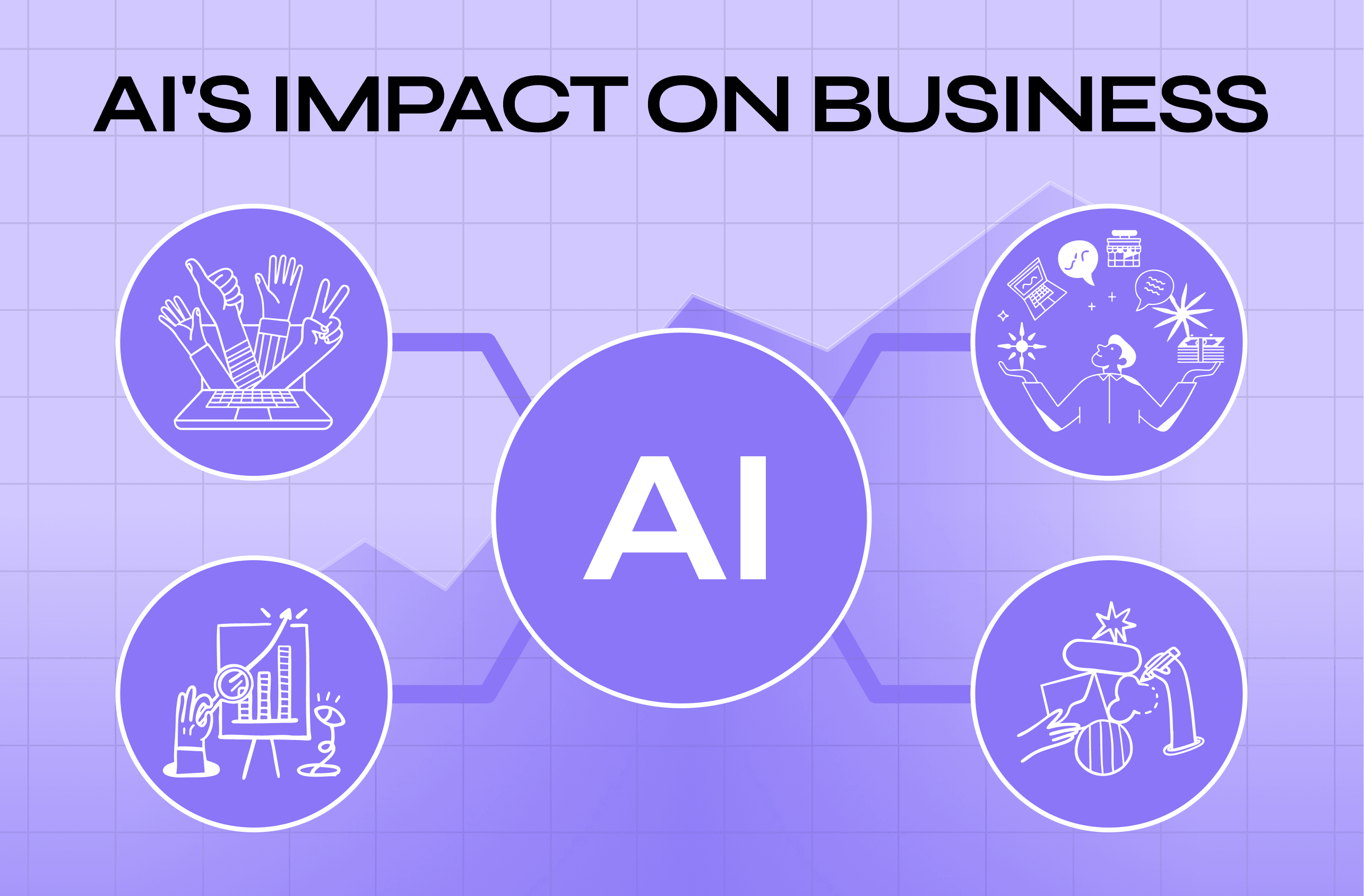
AI driven UX is transforming how digital products convert, guide, and retain users. This guide explains practical implementation strategies, decision frameworks, and real-world applications businesses can use to turn intelligent experience design into measurable growth.
AI driven UX is becoming a growth requirement.
Most organizations don’t lose users because their interface looks outdated.
They lose them because their experience remains static while user expectations evolve.
Users expect:
Guidance instead of exploration
Relevance instead of configuration
Momentum instead of friction
AI driven UX addresses these expectations by allowing products to adapt continuously rather than relying on periodic redesign cycles.
This shift is not aesthetic. It is operational.
Products that integrate intelligence into interaction logic consistently improve activation velocity, onboarding clarity, and engagement depth.
This guide breaks down the practices that matter, how to prioritize them, and how to evaluate readiness before investing.
Why AI Driven UX Is Now a Business Growth Lever
Feature parity across SaaS and digital products has largely stabilised — and AI UX vs traditional UX comparisons make clear why experience differentiation now determines adoption.
When UX adapts based on behavior:
Decision fatigue reduces
Task completion accelerates
Confidence improves
Engagement deepens
These shifts compound into measurable business impact. AI driven UX is therefore no longer innovation theater. It is competitive infrastructure — infrastructure that extends further still once human-agent product design becomes the layer governing how systems act, not just adapt, on a user's behalf.
Practice 1: Predictive Interfaces That Remove Decision Effort
Predictive UX anticipates likely actions and surfaces them early — a direct lever on feature adoption.
Examples include:
Workflow prioritization based on historical usage
Smart defaults in complex configuration flows
Contextual shortcuts
Adaptive navigation
These interactions reduce the cognitive effort required to progress — a core aim of modern AI product design.
In work with PathwaysX, adaptive prioritization in hiring workflow dashboards simplified recruiter evaluation loops. Rather than navigating multiple data layers, users were guided toward high-confidence candidate signals, reducing interaction friction and improving engagement depth across sessions.
Predictive experience design transforms products from reactive tools into proactive partners — the same trajectory that, taken further, produces AI-assembled interfaces the system builds around each user's intent.
Practice 2: Adaptive Personalization at Decision Moments
Personalization delivers value only when applied where user commitment occurs — and AI onboarding patterns is the highest-stakes application of that principle, since commitment is most fragile during the first session before users have experienced product value.
High-impact areas include:
Onboarding sequencing
Dashboard emphasis
Task ordering
Guidance timing
Low-impact areas include purely cosmetic customization.
During the redesign of Gini’s health tracking experience, contextual adaptation helped restructure how insights surfaced to users. Instead of static reporting flows, adaptive content sequencing aligned outputs with behavioral context, improving clarity around sensitive metrics and reducing hesitation during interpretation.
Effective personalization influences behavior, not appearance — one of the AI UX trends separating genuinely adaptive products from merely customizable ones.
Practice 3: Intelligent Onboarding That Minimizes Time to Value
Traditional onboarding explains products.
AI onboarding accelerates value discovery.
Key methods:
Behavior-based step reduction
Role detection
Smart configuration presets
Adaptive progress pacing
This shifts onboarding from instruction to enablement — a shift that goes further still once autonomous workflow navigation enters the product, where the system doesn't just guide the user toward value but begins acting toward it directly.
This is especially critical in SaaS UX design, where trial models and activation-driven funnels mean onboarding improvements directly affect revenue trajectory.
Practice 4: Continuous Insight Generation Through AI Research
UX research traditionally operates in cycles.
AI enables ongoing synthesis.
Capabilities include:
Pattern extraction across feedback streams
Behavioral clustering
Sentiment detection
Insight summarization
The right AI tools for UI/UX designers make this practical — shortening validation loops and improving decision speed across teams. Organizations integrating AI research workflows consistently reduce iteration delays and strengthen roadmap alignment.
Practice 5: Context-Aware Microcopy That Guides Behavior
Language plays a larger role in AI UX than most teams expect.
Adaptive messaging can reduce user hesitation, improve task confidence, prevent abandonment, and clarify commitment moments — and as voice becomes an increasingly common input mode in AI-driven products, voice interface design for AI products shows how spoken interaction patterns require context-aware language decisions that go beyond what visual microcopy alone can handle. Contextual communication aligns tone with behavioral state, transforming microcopy into a conversion mechanism rather than a decorative layer.
Practice 6: Workflow Intelligence That Optimizes Navigation
Navigation structures built once rarely remain optimal — and AI UX design principles covers the design framework behind adaptive navigation and workflow intelligence, showing how behavioral data feeds back into interaction logic rather than just surface-level personalization.
AI analysis enables:
Behavioral pathway refinement
Interaction compression
Navigation reordering
Feature exposure balancing — capabilities that become significantly more complex when AI agent interaction patterns are introduced, since agents navigate workflows autonomously rather than following paths a human user would take.
This supports evolving usage patterns without disruptive redesigns.
Workflow intelligence improves long-term experience elasticity.
Competitive Reality: The Cost of Static UX
Products that remain static while competitors deploy intelligence face three risks:
Experience obsolescence
Perceived complexity
Engagement erosion
Many of these risks stem from common AI UX design mistakes that are entirely avoidable with the right framework. AI driven UX does not guarantee market leadership, but ignoring it increasingly guarantees disadvantage.
Self-Assessment: AI UX Readiness Scorecard*
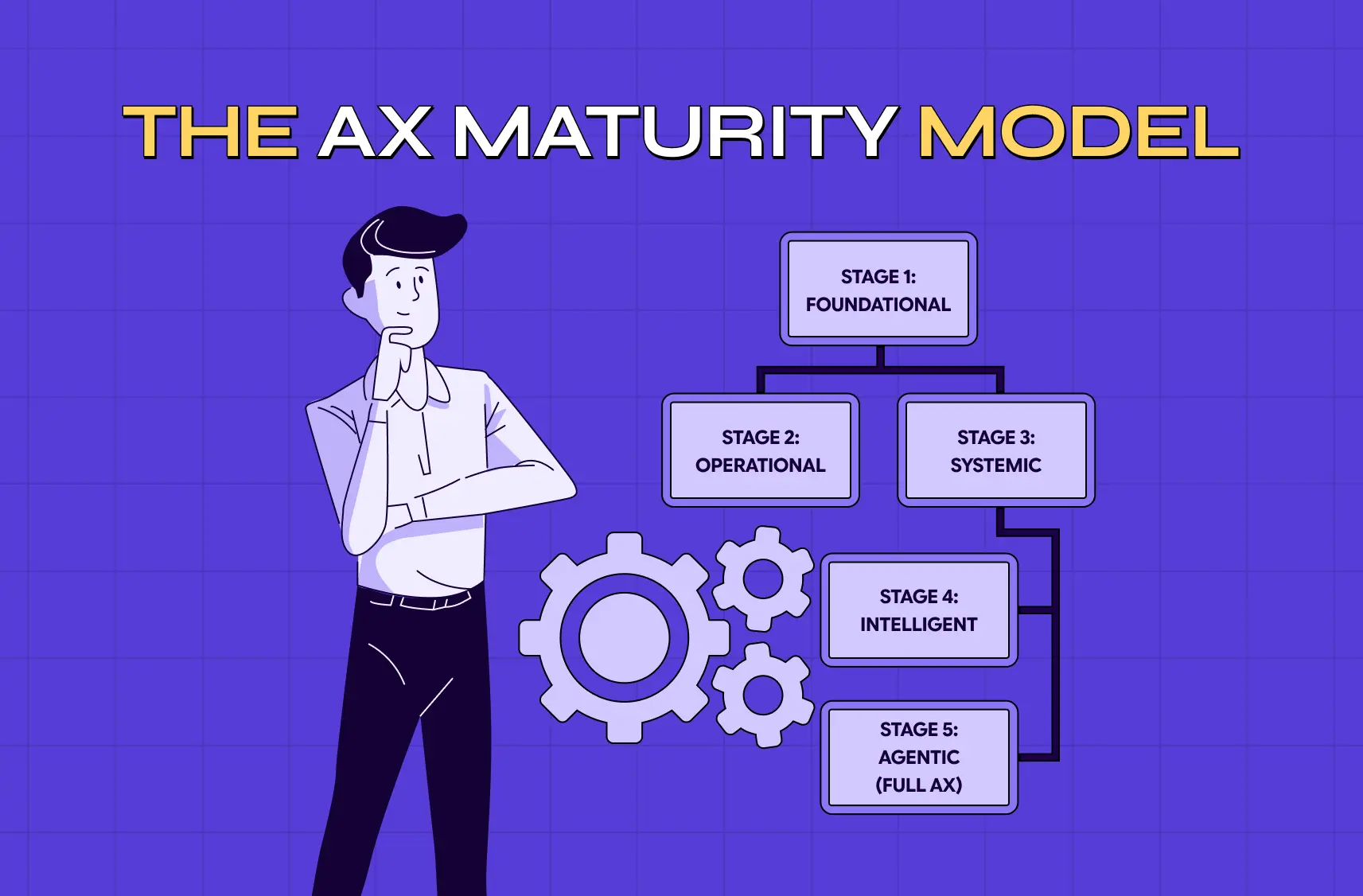
Use this quick scoring block to evaluate current maturity, or for a more structured staged framework, an intelligent UX readiness model maps the same dimensions across five distinct evolutionary stages.
Rate each statement from 1 (Not True) to 5 (Fully True).
We capture behavioral interaction data consistently
UX flows are modular and adaptable (a hallmark of modular AI design systems)
Success events are clearly defined
Personalization logic exists beyond content
Onboarding adapts by user type
UX decisions are validated continuously
Dashboards prioritize user decisions over metrics
Interaction feedback is context aware
Microcopy reflects user state changes
UX metrics influence roadmap planning
Scoring Interpretation
40–50
Strong readiness for advanced AI UX deployment
25–39
Moderate readiness with structural improvements needed
Below 25
Foundational UX alignment required before scaling intelligence
This block often reveals implementation priorities faster than lengthy audits.
*This quick score offers surface-level direction. A meaningful evaluation typically requires deeper behavioural and system analysis alongside a professional UX strategy team — the kind of depth AI product design partners bring to intelligent-UX work.
Decision Framework: Where Should You Start?
Not every organization should adopt every AI UX practice immediately.
Prioritization should reflect maturity and data readiness.
Business Condition | Recommended AI UX Focus | Expected Outcome |
Low activation rates | Intelligent onboarding | Faster user commitment |
Feature underuse | Predictive interfaces | Higher adoption |
Complex dashboards | Adaptive prioritization | Reduced cognitive load |
High churn post-trial | Behavioral personalization | Improved retention |
Slow UX iteration cycles | AI research synthesis | Faster insights |
Fragmented journeys | Workflow intelligence | Experience continuity |
This framework helps teams avoid spreading investment thinly across experimental initiatives. For the "Complex dashboards" row specifically, intelligent metrics surfacing practices give teams a concrete starting framework rather than a generic adaptive-prioritization goal.
Conclusion
How AI is transforming UX/UI development is now reshaping how digital products guide behavior, reduce friction, and improve outcomes — moving from a conceptual layer to the structural logic behind effective product experiences.
It is no longer a conceptual layer added after design. It is becoming the structural logic behind effective product experiences.
Organizations adopting intelligent UX practices — the essence of design-led AI strategy — see stronger alignment between user intent and product response. They also gain clearer visibility into where effort, hesitation, or confusion impacts business performance.
If you want clarity on where AI driven UX could improve your product experience, we can help map opportunity areas, evaluate readiness, and prioritize initiatives aligned with measurable outcomes.
Book a strategy call with our team to explore where intelligent UX can create the most impact in your product roadmap.