Hiring a mobile app UX design agency for a SaaS product is not the same as hiring one for a consumer app. Here are six agencies that understand the difference, ranked honestly by what they deliver.
Six agencies. Ranked by SaaS product fit, not brand recognition.
TL;DR
Most mobile UX agencies are built for consumer apps. SaaS mobile needs something different.
We ranked six agencies by SaaS product fit, process rigour, and measurable outcomes.
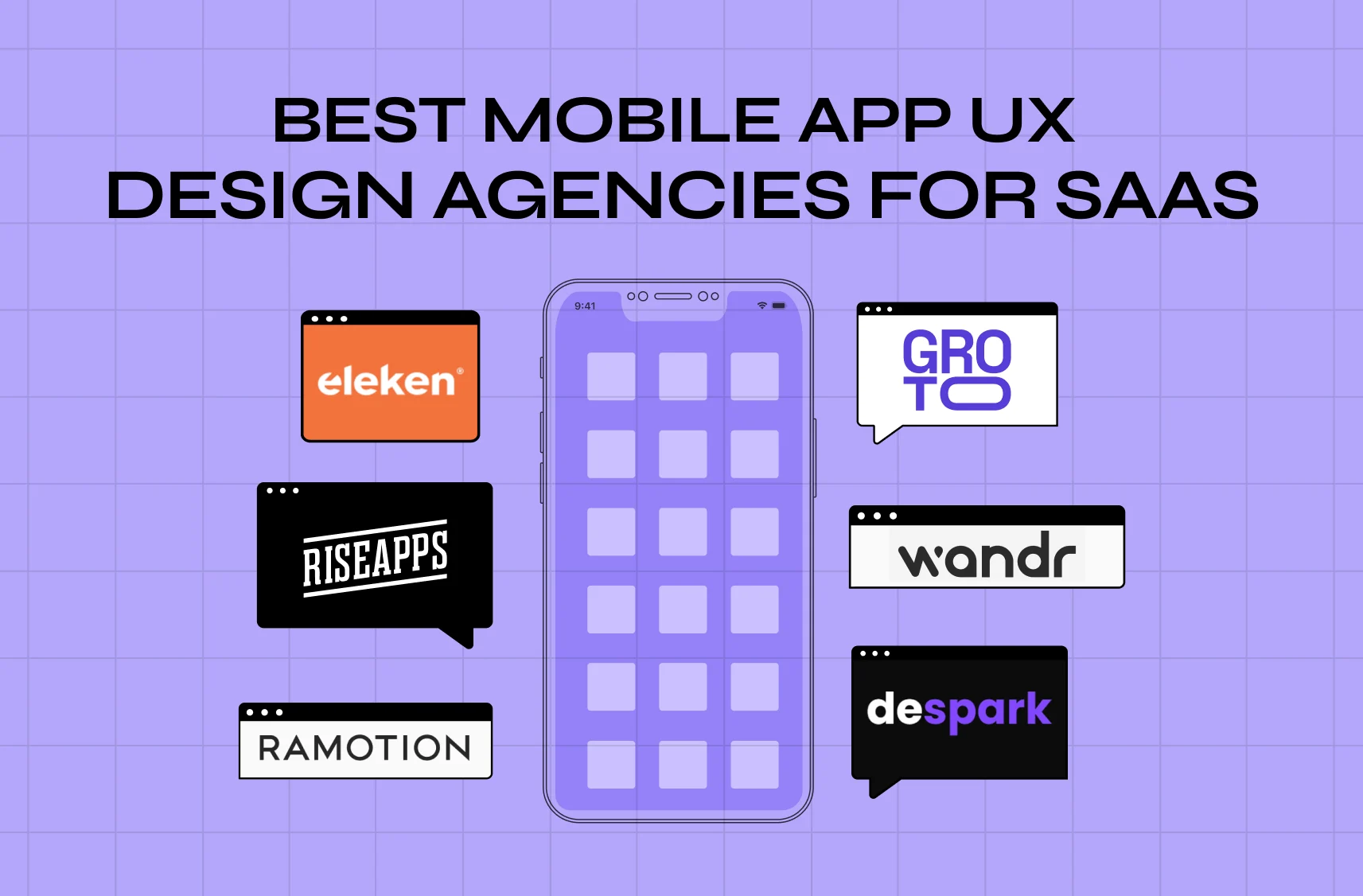
Groto leads for SaaS-specific mobile UX. Eleken for ongoing support. WANDR and Despark for undefined scopes. Ramotion for funded startups needing brand plus development. Riseapps for fast MVPs.
Every agency has a minimum engagement size and a defined strength. Match your stage to the right fit.
If your SaaS mobile product has low DAU or poor onboarding completion, start with an audit before a full rebuild.
A mobile app UX design agency does more than design screens. It maps user intent to interface behaviour, structures navigation around task completion, and builds interaction systems that work within the real constraints of how people use mobile products. For SaaS products specifically, that means designing for short sessions, workflow-triggered interactions, and the reality that most users are on mobile to do one specific thing before returning to desktop. The criteria for choosing the right mobile app UX design agency change significantly when the product is SaaS. This list is built around that distinction.
Finding the right mobile app UX design agency is hard enough. Finding one that actually understands SaaS mobile is harder. Most agency shortlists are built on Dribbble portfolios and Google rankings rather than evidence of real SaaS product outcomes.
This list is different. We ranked six agencies by how well they understand the specific design problem that SaaS mobile presents: short sessions, task-oriented workflows, decision-moment interactions, and the need to design for a context that is completely different from the desktop product. Portfolio aesthetics are not the criteria. Product fit, process rigour, and measurable results are.
If you are a PM, CTO, or founder looking to hire a mobile app UX design agency for a SaaS product, this is the comparison you need.
What to Look for in a Mobile App UX Design Agency for SaaS
Before getting into the list, a few criteria that separate a good SaaS mobile UX agency from a generic one.
They audit before they design. Any agency that skips a diagnostic phase and jumps straight to wireframes is guessing — and knowing the agency skills to vet in advance is what prevents a bad hire. A SaaS mobile audit covers session data, drop-off rates, mobile-specific flow failures, and platform edge cases on iOS and Android. Without this, the work is built on assumptions.
They understand SaaS-specific mobile patterns. SaaS mobile sessions are short, task-bounded, and often triggered by a push notification. Consumer mobile design conventions, such as exploratory navigation, feature discovery, and long scroll formats, actively harm SaaS mobile UX — and the 2026 mobile design shifts have sharpened that distinction further. Ask any prospective agency to explain the difference. Their answer is diagnostic.
They can show a metric that moved. Understanding what agencies deliver versus what they claim to deliver is the fastest way to separate the right partner from the wrong one. Screens are easy to present. Session completion rates, mobile onboarding lift, and DAU growth are harder. Ask for evidence of an outcome, not just a deliverable.
They think in flows, not screens. SaaS mobile UX lives or dies on information architecture. An agency that talks about "beautiful UI" before addressing task flow and navigation structure is optimising the wrong thing.
When Should You Hire a Mobile App UX Design Agency?
Not every SaaS product needs an agency at every stage. These are the three moments where bringing one in makes a measurable difference.
You are building your first mobile product. If your SaaS product lives on desktop and you are extending to mobile for the first time, a mobile app design agency with SaaS mobile experience will save you from the most expensive mistake in this space: porting the desktop experience to a smaller screen and calling it a mobile app. The scope, architecture, and interaction model need to be rethought from the ground up.
Your mobile product exists but is underperforming. Low DAU relative to installs, onboarding completion below 50% of desktop, or core flows that take too many taps are all signals that the design is not serving real workflow needs. This is a fixable problem, but it requires a diagnostic audit before any new design work begins.
You are scaling and mobile is becoming a primary surface. If mobile sessions are growing as a share of total product usage, and your current mobile experience was built as an afterthought, the gap between what users expect and what they get will widen fast. Bringing in a specialist agency that understands SaaS UX scope across both surfaces at this stage prevents a full rebuild later.
1. Groto — Best Mobile App UX Design Agency for SaaS Products
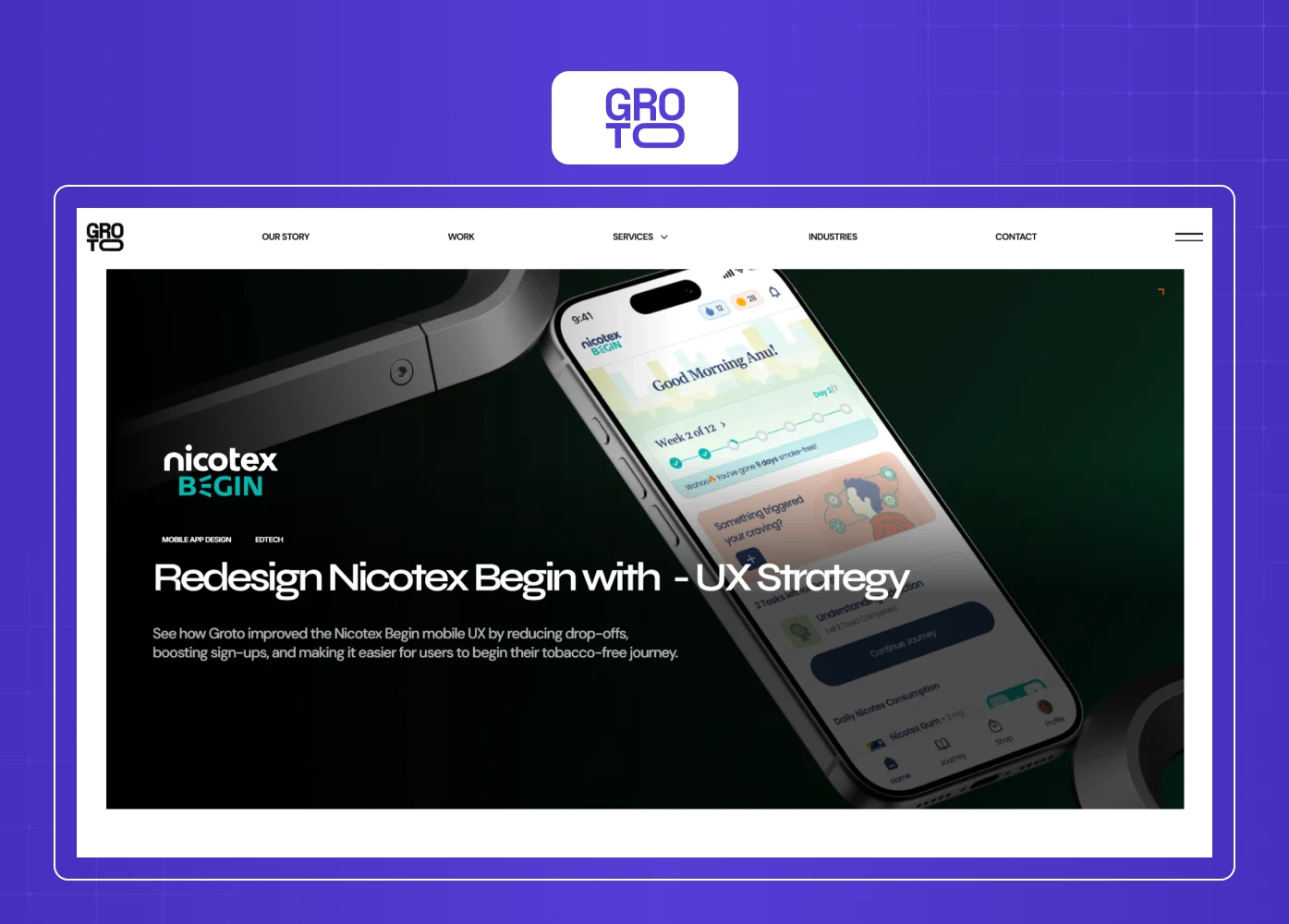
Groto is a product design agency specialising in SaaS and AI products. We have completed 140+ five-star design projects, our clients have raised over $8M in combined funding, and our designers rank in the top 3% globally. Every mobile engagement starts with a Mobile Moment Audit before a single screen is sketched.
What Groto brings to SaaS mobile UX
We designed the Mobile Moment Stack, a framework that maps every SaaS user interaction to one of three mobile-specific categories: decision moments, check-in moments, and alert moments. Before designing any mobile interface, we identify which moments belong on mobile, which should redirect to desktop, and which can be compressed into a single-action flow. This prevents scope creep, aligns product and design teams on mobile intent, and delivers a product that users actually return to.
Our work with Camb.ai, an AI dubbing platform used by media teams in 14 countries, is a clear example of this diagnostic approach. Their iOS onboarding completion was running at 31% against 68% on desktop. We identified a native file picker interaction that broke the flow for Google Drive users. Two days of design work resolved the problem. Catching it required asking the right question at the start of the engagement, not after the wireframes were approved.
For PolicyBazaar's mobile advisor toolset, the audit revealed that 80% of advisor sessions involved two tasks: viewing a policy summary and sending a client quote. We rebuilt the mobile architecture around those two flows. Mobile task completion increased by 58% in the following quarter.
Pricing and fit
Groto works on a project and retainer basis. Engagements start with a two-week Mobile Moment Audit before scoping the full project. This means you know exactly what needs to be designed before committing to a full redesign.
Best for: SaaS startups and scale-ups that need bespoke mobile UX — product-first design, not cosmetic redesigns. Particularly strong for AI SaaS products, multi-role platforms, and SaaS products with workflow-heavy mobile use cases.
Pros: SaaS-specific diagnostic process, proven outcome metrics across AI and multi-role platforms, audit-first engagement model.
Limitation: Design only. A separate development partner is needed for build.
Ready to audit your SaaS mobile UX? Book a discovery call with Groto.
2. Eleken — Strong SaaS Focus, Subscription Model

Eleken is a Ukraine-based UI/UX agency that works exclusively on SaaS products. They have built a strong reputation for clean, product-driven design delivered through a dedicated designer model. One designer, embedded in your team, working full-time on your product. No juggling between accounts.
What Eleken brings to SaaS mobile UX
Eleken understands SaaS product design. Their portfolio spans fintech dashboards, data tools, healthcare platforms, and AI products. They think in product flows rather than landing page aesthetics, and their process includes UX research, wireframing, and Figma handoff rather than just visual design.
Their mobile work is competent but follows a responsive-first approach rather than a mobile-moment approach. They will design a strong, clean mobile product. Teams that find the subscription model limiting for a defined mobile sprint should also review the wider range of subscription design options before committing.
Clutch rating: 4.9 from 100+ SaaS clients.
Projects range from $10,000 to $50,000.
Pricing and fit
Subscription-based retainer model, starting at $5,000 per month. Cancel-anytime flexibility. No change orders.
Best for: SaaS startups with in-house developers who want consistent, ongoing design support and a clean, reliable execution style. Strong fit for teams that need a dedicated designer to plug into an existing workflow.
Pros: Dedicated designer model, cancel-anytime flexibility, strong SaaS portfolio across fintech and healthcare.
Limitation: Subscription model is less suited to time-boxed mobile sprints. No development.
3. WANDR — Strategy-Led UX for B2B SaaS
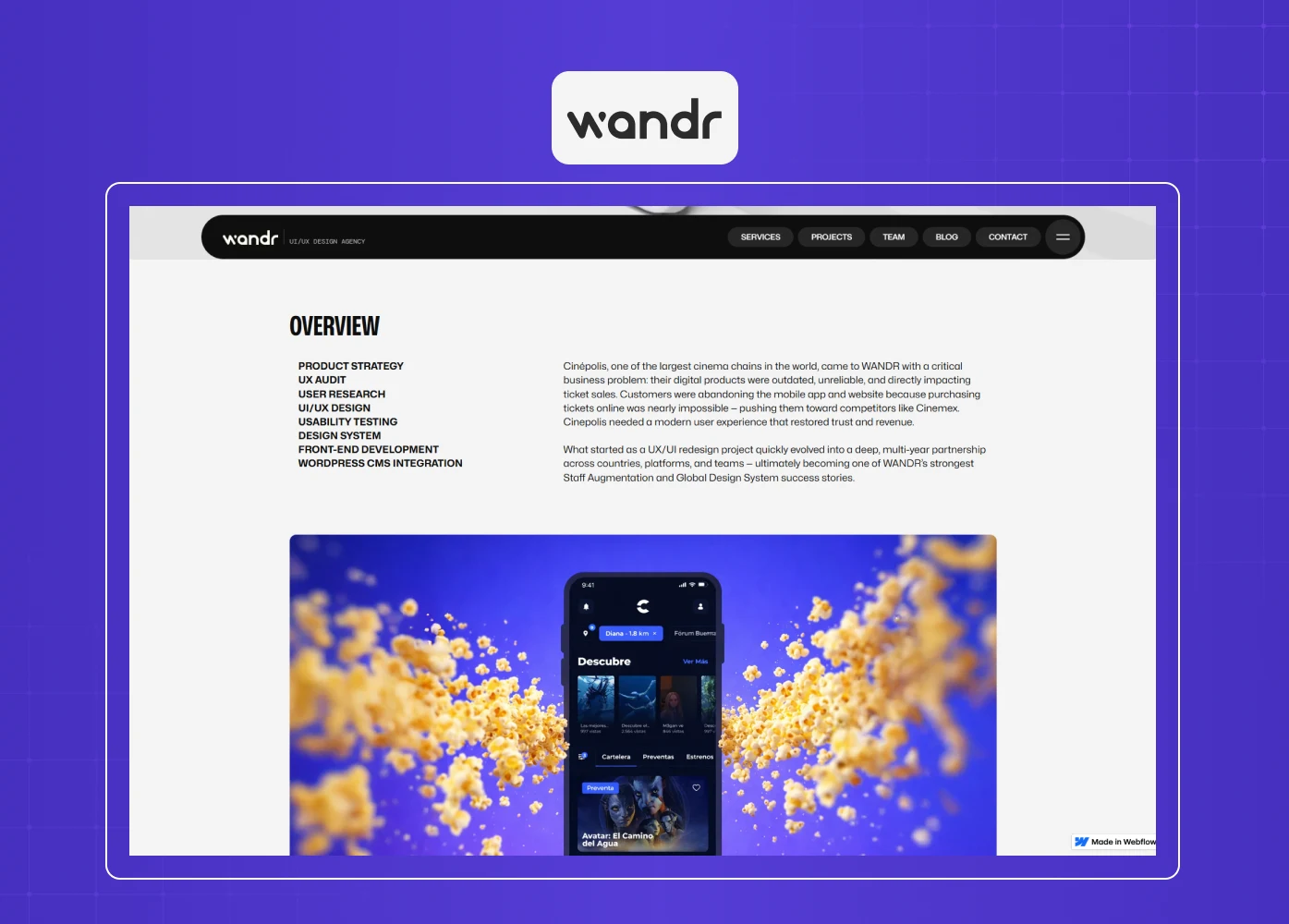
WANDR is a Los Angeles-based strategy and UX design agency with a strong track record in B2B SaaS and complex product design. They have worked with IBM, Samsung, and a range of SaaS startups, and their process grounds every design decision in product strategy and user validation.
What WANDR brings to SaaS mobile UX
WANDR's strength is discovery and product validation before design. Their engagements often begin with workshops and research sprints to align on user needs and feature prioritisation, which is genuinely valuable for SaaS products where mobile scope tends to be over-ambitioned.
Their UX process is rigorous and research-backed. For SaaS teams that have never done structured mobile discovery, WANDR's workshops are a strong starting point — though teams in regulated categories specifically should also weigh financial product UX firms, where discovery has to account for compliance constraints WANDR's general B2B process doesn't specialize in.
Clutch rating: 5.0 from 34 client reviews.
Pricing and fit
Project-based pricing, starting at $25,000. Engagements typically include discovery workshops, UX audits, and interaction design.
Best for: Growth-stage SaaS companies with complex B2B products that need strategic clarity before committing to a mobile build. Strong fit for teams where the mobile scope is undefined and needs shaping before design begins.
Pros: Discovery workshops before design, research-backed UX process, strong B2B SaaS track record.
Limitation: Premium pricing relative to output for early-stage startups. Design only.
4. Ramotion — Brand-Forward Design for Funded SaaS

Ramotion is a US-based digital product agency that combines brand strategy, product design, and front-end development. They have worked with Redis, Cypress, Crunchbase, and other funded tech companies. Their output is consistently polished, and their process connects design tightly to front-end build quality.
What Ramotion brings to SaaS mobile UX
Ramotion is the right choice when brand identity and product design need to move together. If you are a VC-backed SaaS company refreshing your entire product identity alongside a mobile build, Ramotion can hold both workstreams in a single engagement.
Their mobile design process is tied to front-end development, which produces high design fidelity and consistent iOS/Android experiences. The trade-off is that they are less suited to lean, iterative mobile sprints. The engagement model is built for larger, more defined scopes.
Clutch rating: 4.9 from 28 reviews.
Pricing and fit
Project-based pricing. Projects start at $50,000.
Best for: Funded SaaS startups that need brand identity, product design, and mobile development handled in a single engagement. Strong fit if your product is maturing and needs visual and technical polish across all surfaces simultaneously. Teams scaling toward enterprise complexity beyond this stage should also compare large-scale UX partners built specifically for that next inflection point.
Pros: Brand and product design in one engagement, strong iOS/Android fidelity, front-end development included.
Limitation: Higher cost and longer timelines. Less suited to rapid iteration or early-stage budgets.
5. Despark — UX-First, Discovery-Led for Complex SaaS
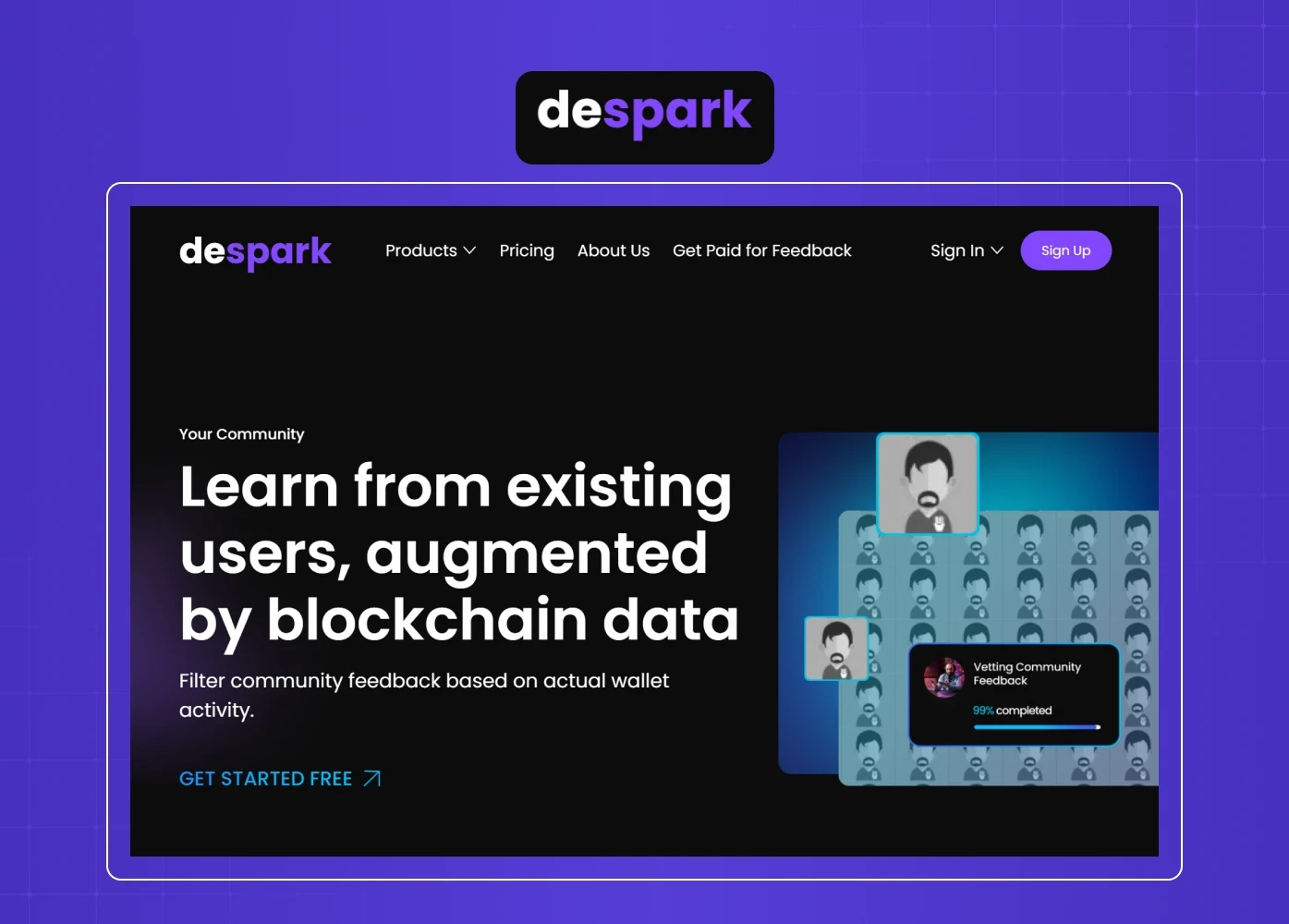
Despark is a UK-based digital product studio with 15+ years of experience in UX-first design. Their process is built around discovery and co-creation, with a strong emphasis on user research and product strategy before interface design begins.
What Despark brings to SaaS mobile UX
Despark's real strength is in products where the design problem is not yet well-defined. They run structured discovery workshops to align on user needs, define the right scope, and surface assumptions before design begins. For SaaS teams with complex workflows and multiple user roles, this upfront clarity prevents expensive redesign cycles later.
Their mobile work reflects their research-first philosophy: thoughtful, user-validated, and built for real workflows rather than aesthetic trends.
Clutch rating: 4.7 from 13 client reviews.
Pricing and fit
Project-based pricing, starting at $25,000. Research depth and workshop scope affect final cost.
Best for: Healthtech and edtech SaaS products with complex user needs that require strategic clarity before any design work begins. Strong fit for SaaS teams that have a fuzzy brief and need a partner to define it before building.
Pros: Discovery-led process, strong for complex or undefined briefs, 15+ years of UX research depth.
Limitation: Limited development capacity. Not suited to large-scale platforms needing rapid iteration.
6. Riseapps — Fast MVPs and Cross-Platform Builds
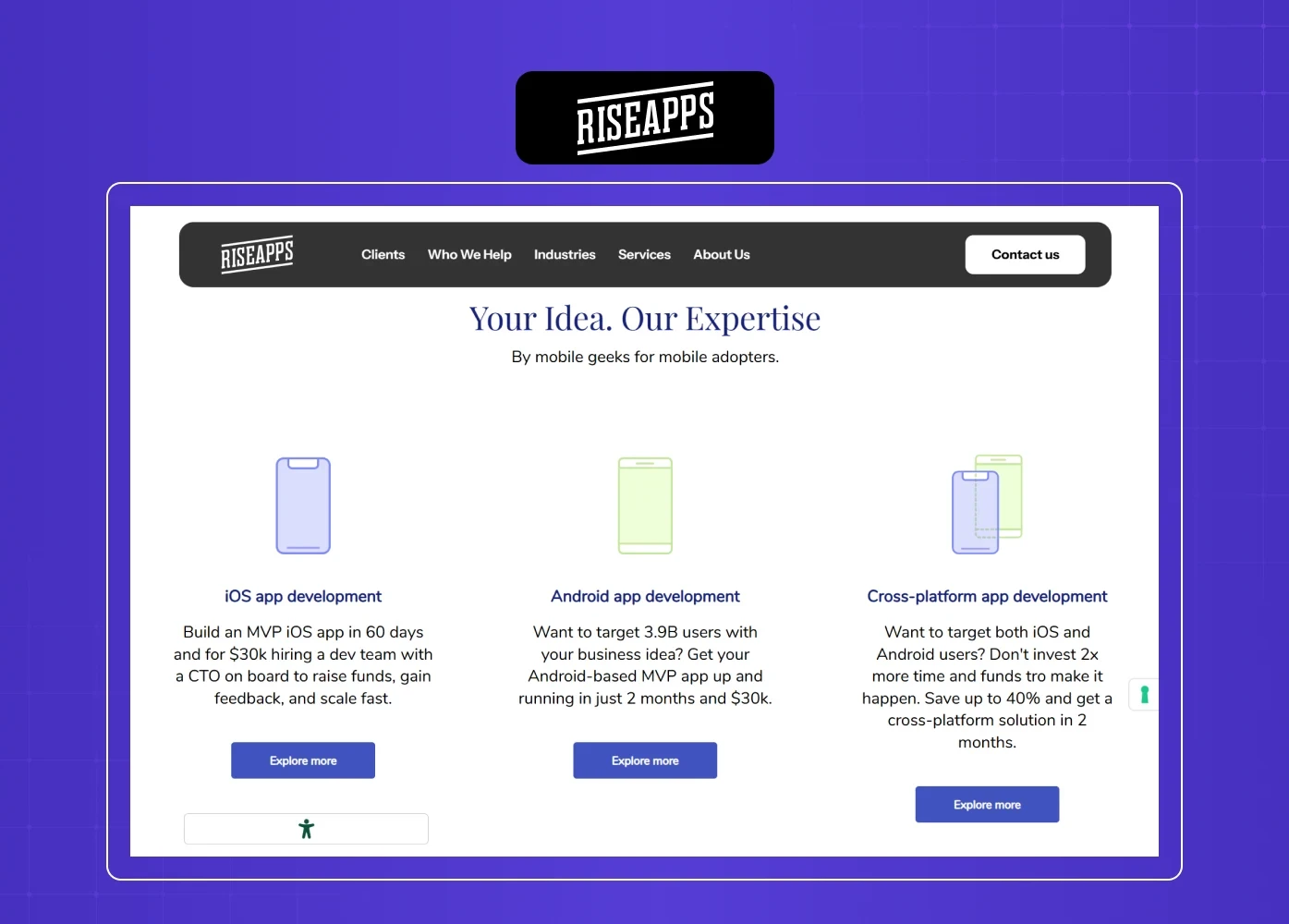
Riseapps is a Ukraine-based full-cycle design and development studio known for building fast, functional MVPs. They work with Flutter and React Native and offer end-to-end support from UX/UI design through to QA.
What Riseapps brings to SaaS mobile UX
Riseapps is the right choice when you need a mobile product built fast, not just designed. They handle UX and development in a single team, which reduces handoff friction and accelerates time to launch. For early-stage SaaS teams building their first mobile product on a constrained budget, they offer genuine value — though reviewing creative agency alternatives is worth doing if subscription-style delivery is closer to your actual need.
Their UX work is functional rather than strategically deep. They will produce a well-structured mobile product. They are less likely to challenge the scope or run a diagnostic audit to identify which moments belong on mobile.
Clutch rating: 4.9 from 58 reviews.
Pricing and fit
Project-based pricing, starting at $50,000 for full-cycle engagements.
Best for: Bootstrapped or early-stage SaaS startups that need a mobile MVP built quickly. Strong fit for teams with a defined brief who want design and development delivered by one team without needing to coordinate across two agencies.
Pros: Design and development from one team, Flutter and React Native expertise, fast time to launch.
Limitation: Visual finish may not meet premium SaaS brand standards. Some timezone friction for US teams.
Agency Comparison Table
Agency | Focus | Price (min) | Design only? | Best for |
Groto | Saas + AI product design | Discovery audit first | Yes | SaaS startups and scale-ups needing mobile UX that moves metrics |
Eleken | SaaS UI/UX, subscription | $5K/month | Yes | Ongoing design support, dedicated designer model |
WANDR | Strategy + UX design | $25K | Yes | B2B SaaS needing discovery before design |
Ramotion | Brand + design + dev | $50K | No | Funded startups needing brand and product in one |
Despark | UX research, complex products | $225K | Yes | Healthtech/edtech SaaS with undefined scope |
Riseapps | MVP design and development | $50K | No | Early-stage startups building first mobile product |
What Does It Cost to Hire a Mobile App UX Design Agency for SaaS?
Pricing for SaaS mobile UX work varies significantly based on agency model, engagement scope, and whether design and development are bundled. Cross-referencing these figures against broader agency pricing benchmarks will confirm whether what you are quoted is market-rate. Here is how the six agencies on this list break down by investment tier.
Tier | Agency | Starting Price | Model |
Audit-first, scoped to need | Groto | Discovery audit | Project or retainer |
Ongoing subscription | Eleken | $5,000/month | Monthly retainer |
Discovery and design | WANDR, Despark | $25,000 | Project-based |
Brand plus development | Ramotion, Riseapps | $50,000 | Project-based |
A few things worth knowing before you budget. An audit-first engagement like Groto's costs less in the long run than a full redesign built on assumptions. The $25,000 tier from WANDR and Despark typically covers discovery workshops, UX research, and core flow design. The $50,000 minimum at Ramotion and Riseapps reflects the inclusion of development, not just design. Eleken’s subscription model works out to less than a project engagement for teams that need sustained design support over six months or more. Teams whose main lever is cost sometimes widen the search to offshore hubs too, like the Delhi design partners in our roundup.
If budget is the primary constraint at this stage, the decision is not which agency is cheapest. It is which engagement model matches how much you actually know about what needs to be designed. The less defined your brief, the more valuable an audit-first or discovery-led model becomes, even if the upfront number looks similar.
Red Flags to Watch For When Hiring a Mobile UX Design Agency
Not every agency that ranks on Google or looks impressive on Dribbble is the right partner for a SaaS mobile product — the gap between generic digital studios and genuine SaaS-focused agencies is wider than most hiring teams expect. These are the signals worth walking away from.
They skip discovery and go straight to screens. If the first deliverable is a wireframe or a moodboard rather than a diagnostic framework or a set of research questions, the agency is designing without evidence. For SaaS mobile, that is expensive guessing.
They cannot explain the difference between SaaS and consumer mobile UX. This question separates agencies that have built real SaaS products from those that have applied consumer mobile conventions to a B2B context and hoped for the best. The answer should be specific, not generic.
They present portfolios without outcomes. Evaluating agency portfolios properly means reading for metrics alongside screens — session data, onboarding completion, and DAU movement are what confirm whether the design actually worked. Ask what moved.
They promise everything. No agency is equally strong at brand, product design, UX research, mobile architecture, and development. An agency that says yes to all of it without qualification is telling you what you want to hear.
Pricing is vague until after you commit. Any agency that will not give you a scoping framework or a pricing range before a contract is signed is creating information asymmetry in their favour. A good agency can tell you what drives cost and roughly where your project lands before you sign anything.
They have no SaaS clients in their portfolio. Consumer app design and SaaS product design are different disciplines. An agency whose portfolio is all fintech consumer apps, gaming interfaces, or e-commerce flows has not solved the problem you are bringing them.
How to Choose the Right Agency for Your SaaS Product
1. You are an early-stage SaaS startup building your first mobile product. Speed and product-market fit matter more than visual polish. Start with Groto for a Mobile Moment Audit to define what your mobile product should actually do, then scope the build. Riseapps is a reasonable option if you need design and development from a single team and cost is a primary constraint.
2. You need ongoing design support across your SaaS product, mobile included. Eleken's subscription model is efficient for teams that want a dedicated designer embedded in their workflow without the overhead of a full agency engagement.
3. Your brief is not yet defined and you have a complex B2B workflow. WANDR and Despark both run structured discovery processes that will surface the right scope before design begins. Before those conversations, work through a practical agency hiring checklist so you arrive knowing exactly what to ask.
4. You are a funded startup that needs brand, product, and development handled together. Ramotion is the right fit. Budget for $50,000 and a longer timeline.
5. Your existing SaaS mobile product is underperforming. This is Groto's home ground. We start with a diagnostic audit, identify the two to three highest-impact interventions, and design those before committing to a full rebuild. If you have a mobile product that is not driving DAU or completing key flows, a discovery call is the right first step.
Conclusion
Mobile app UX design for SaaS requires a specific kind of agency. Most consumer mobile agencies do not know the difference between a decision moment and a check-in moment. That gap shows up in the product.
The six agencies on this list all bring genuine value. The right one depends on your stage, budget, and whether you need design only or design plus development.
Groto is the strongest choice for SaaS teams that need mobile UX designed around real workflow patterns, not compressed desktop navigation.
If your mobile product has low DAU, poor onboarding completion, or critical flows that take too many taps, start with an audit before committing to a full redesign.
Book a discovery call with Groto to find out exactly what is breaking in your SaaS mobile UX and what it would take to fix it.