UX Agency vs In-House Designer: A CTO's Decision Framework for 2026

10 min read

10 min read

Tools & Resources

UX agency or in-house designer — which is right for your stage? A CTO-focused framework covering real costs, design systems, and engineering integration.

UX Agency vs In-House Designer: A CTO's Decision Framework for 2026

10 min read

10 min read

Tools & Resources

UX agency or in-house designer — which is right for your stage? A CTO-focused framework covering real costs, design systems, and engineering integration.

Most articles on UX agency vs in-house designer end with "it depends." This one doesn't. A stage-by-stage decision framework for CTOs — covering total cost of ownership, design system governance, engineering integration, and when each model breaks down.

The decision framework CTOs actually need — not another pro/con table.
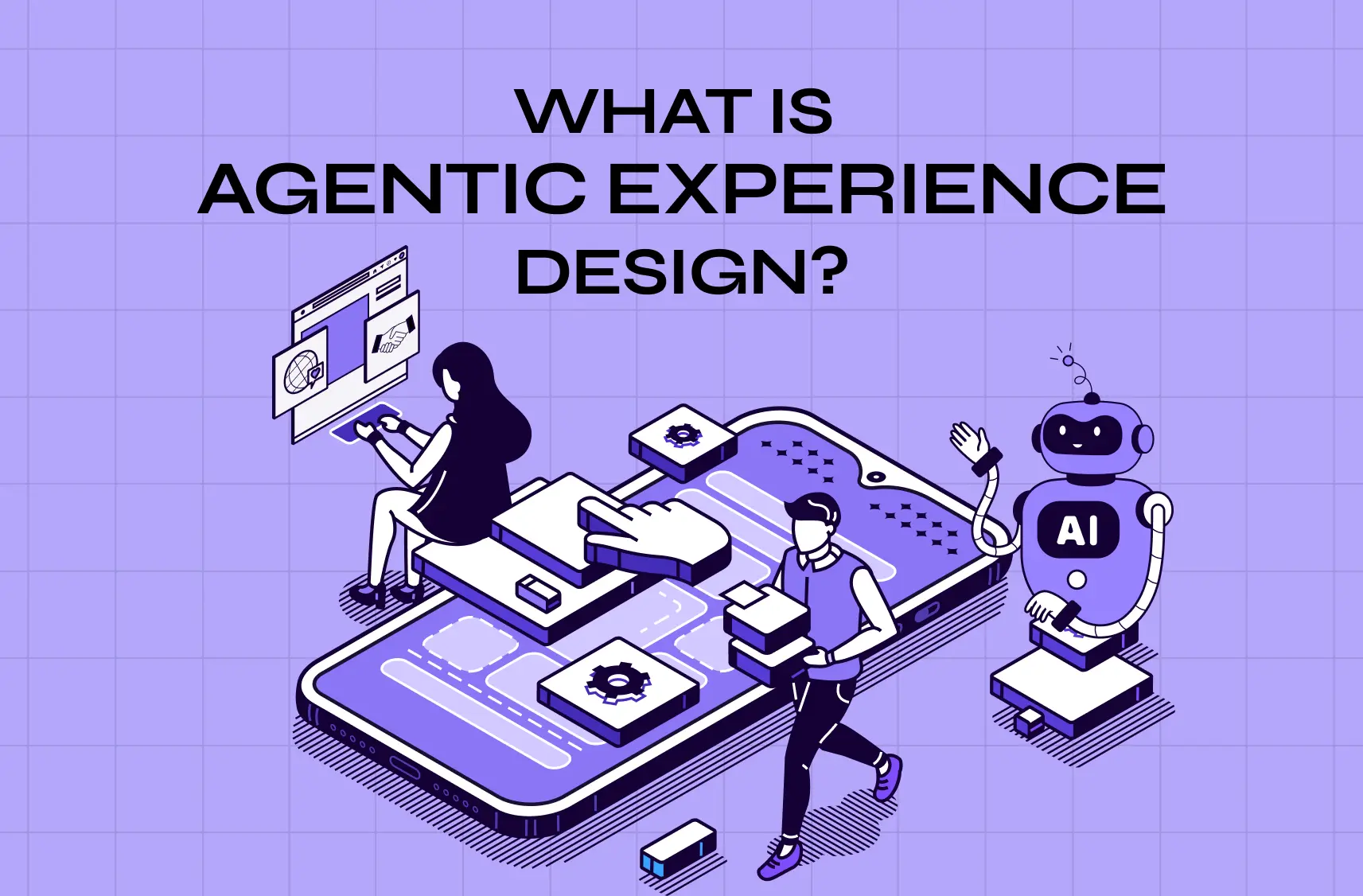
Isometric illustration of two people interacting with large mobile interfaces, selecting checkboxes and managing tasks in a digital workflow.

Most articles on this topic give you a pro/con table and call it a day. That's not a decision framework — that's a hedge.

If you're a CTO or technical leader, you've already Googled this question and landed on five articles that all conclude with "it depends" and "consider a hybrid model." You know that. What you actually need is a concrete way to make the call for your company, at your stage, with your engineering constraints.

This post is built for that decision. We'll go deeper than cost and speed — into design system ownership, engineering workflow integration, UX research infrastructure, and the hidden costs that never show up in job posting calculators. We'll also cover when each model breaks down and give you a decision matrix tied to company stage.

By the end, you'll have a clear framework — not more reasons to delay the decision.


Want to know where your users are dropping off?

We’ll break down the exact moments users lose interest, and why.

Want to know where your users are dropping off?

We’ll break down the exact moments users lose interest, and why.

The Five Questions Every CTO Should Answer Before Deciding

Before you compare agencies to in-house hires, answer these five questions about your company's current state. Your answers will do more work than any cost comparison.

1. Do you need design continuity or design capacity? Continuity means someone who knows your product deeply — your users, your design system, your engineering conventions. Capacity means skilled execution of scoped work. If you're a scaling SaaS product where every sprint involves interaction design decisions, you need continuity. If you're launching a specific feature or redesigning a checkout flow, you need capacity.

2. Who owns your design system — and does it exist? This is the question most CTOs don't think to ask. If you have a maturing design system that needs governance, maintenance, and iteration, an in-house designer is almost always the right call. Agencies ship work to your design system, but few maintain it with the same care as a full-time team member whose quarterly review depends on it.

3. How tightly coupled is UX work to your engineering roadmap? If your designers need to sit in sprint planning, attend retros, and pair with engineers on component decisions, geography and contractual overhead matter enormously. Agencies can simulate this with embedded models — but real-time integration still favors in-house.

4. Are you at a point of stable product vision or exploratory discovery? Early-stage products often benefit more from agency speed: structured discovery, rapid prototyping, external perspective. This question becomes especially consequential in product categories like e-commerce and AI personalization products, where the build-vs-hire decision carries additional technical and data dimensions. More mature products often need someone embedded enough to challenge assumptions they've been living with for months. 

5. What's your hiring timeline vs. your project timeline? A great UX hire takes 2–4 months from job post to productive contribution. If you have a critical launch in six weeks, that math doesn't work. Agencies can be onboarded in days.

The Real Cost Comparison (That Most Articles Get Wrong)
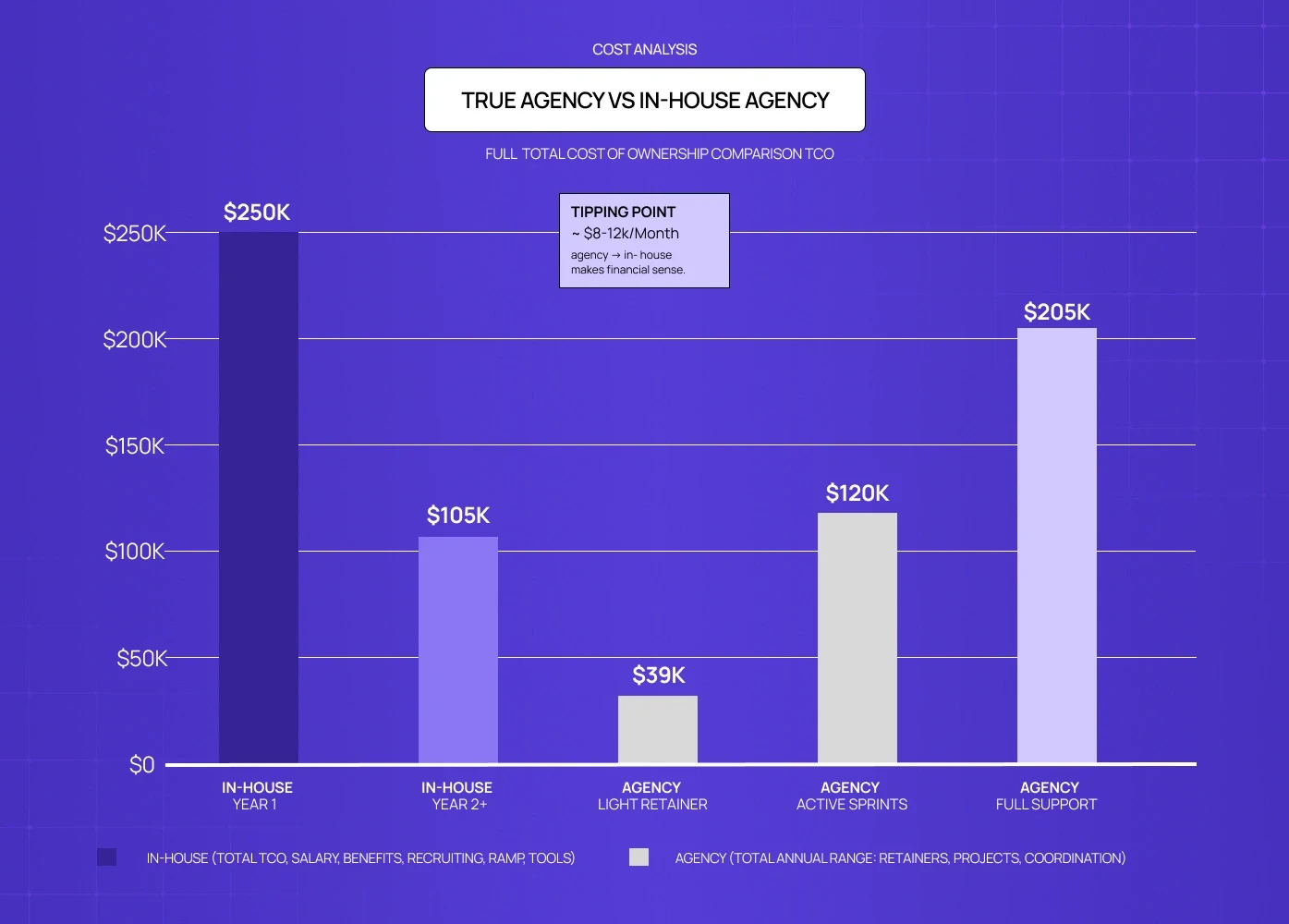
Bar chart comparing total cost of in-house vs agency design across stages, highlighting a tipping point where agency becomes more cost-effective.

Salary calculators make in-house design look more expensive than it is — and they make agencies look cheaper than they are. Let's model it properly.

In-House: Total Cost of Ownership

A mid-level UX designer in a major US tech hub earns $90,000–$130,000 in base salary. But that's not your cost.

Cost Item

Annual Estimate

Base salary (mid-level)

$90,000–$130,000

Benefits & health (25–30% of salary)

$22,500–$39,000

Recruiting fees (1x salary, amortized 3 years)

$30,000–$43,000

Onboarding/ramp time (3–6 months at 50% capacity)

~$22,500 lost productivity

Design tools (Figma, Maze, Hotjar, etc.)

$2,000–$5,000

Manager overhead (30 min/day × senior eng/PM)

$8,000–$12,000

Total Year 1 Cost

~$175,000–$251,500

Total Year 2+ Cost

~$120,000–$180,000

This doesn't include the cost of a bad hire — which, at the designer level, often costs 2–3x annual salary when you factor in the re-recruiting cycle.

Agency: True Cost Comparison

Agencies typically price at $100–$250/hour or via project retainers ($10,000–$80,000+ depending on scope). Here's what that actually looks like over 12 months for a product company in active development:

Engagement Model

Annual Cost Estimate

Lightweight retainer (20 hrs/month)

$24,000–$60,000

Active product sprint support (60 hrs/month)

$72,000–$180,000

Full project engagements (2–3 per year)

$60,000–$180,000

Internal coordination overhead (PM, eng time)

$15,000–$25,000

Total Annual Range

$39,000–$205,000

The key insight: at low-to-moderate design demand, agencies are often cheaper on a total cost basis — especially when you include Year 1 in-house ramp costs. At high design demand with ongoing product needs, the math flips somewhere around the 50–60 billable-hours-per-month mark — and calculating the full ROI of UX design investment beyond hourly rates is what moves this from a gut call to a defensible business case.

Stage-Based Decision Matrix
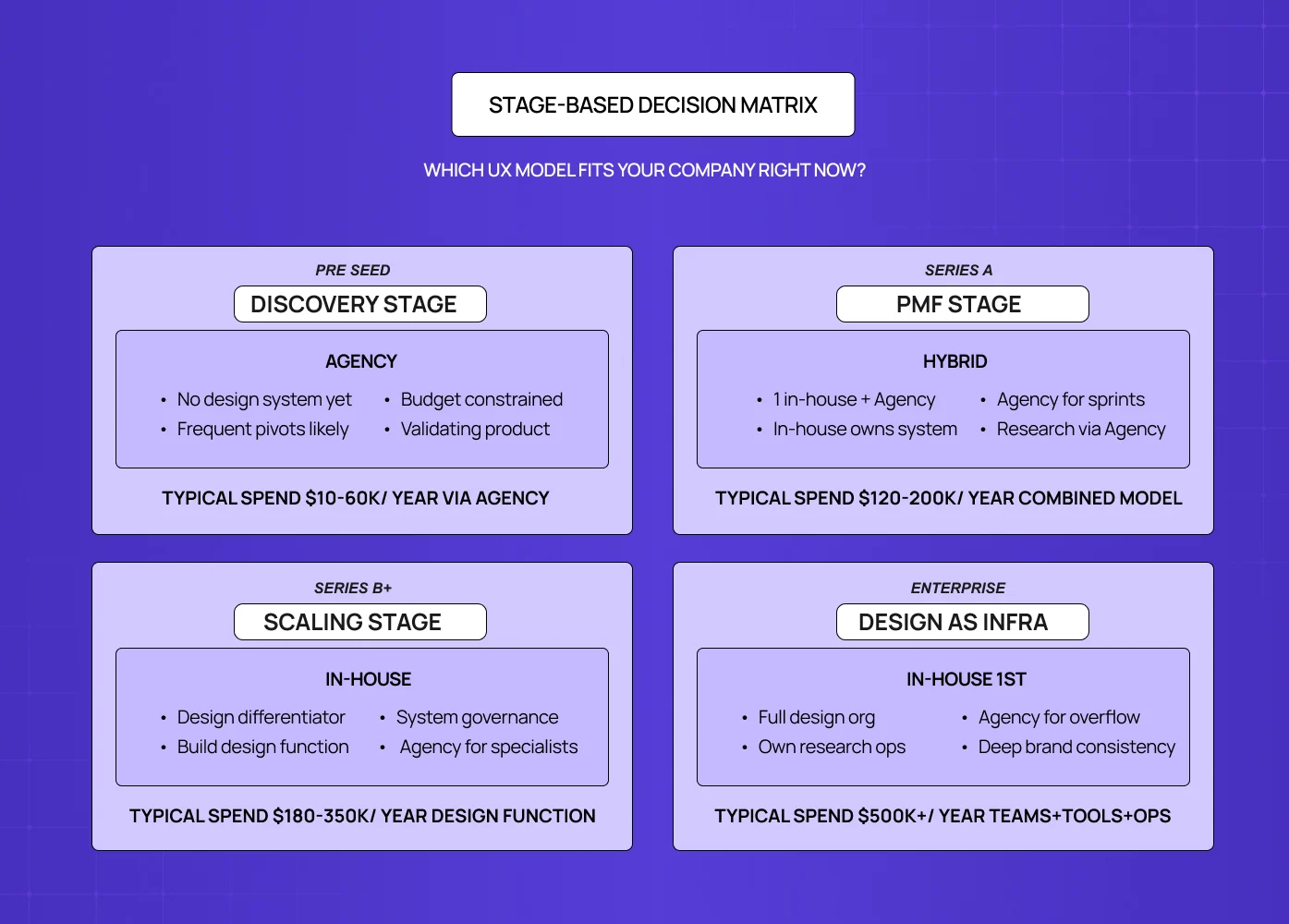
Stage-based decision matrix showing when to use agency, hybrid, or in-house design models across startup growth phases.

Your company's funding stage is one of the clearest signals for which model fits.

Pre-Seed / Seed

Recommended: UX Agency or Freelancer

You don't know yet what your design function needs to be. Before committing to either model, it helps to understand what a UI/UX design agency actually does — the roles, deliverables, and what you're getting for the engagement fee. You're still validating the product. You likely don't have a design system. Hiring full-time at this stage means either over-investing in infrastructure that might need to change, or under-using someone expensive while the rest of the team is in pure discovery mode. 

A good agency at seed stage provides structured discovery, rapid wireframing, and prototype validation — without the fixed cost of a salary through pivots.

Watch out for: Agencies who build in proprietary tooling or file structures that are hard to hand off — evaluating their UI/UX portfolio before you hire helps surface these structural patterns before they become a contractual problem. 

Series A

Recommended: Hybrid — One in-house designer + agency for capacity

You now have a product with users. You have a roadmap. You need someone who knows the product deeply and owns the design system as it matures. But you also have large UX bets to make (new features, potential redesigns) that exceed what one person can execute.

The Series A sweet spot: hire your first full-time UX designer to own vision and system governance, and use an agency for high-intensity sprints and research support.

Series B+

Recommended: Build toward in-house, use agency for specialization

At this stage, design quality is a competitive differentiator. You need researchers, product designers, and content designers. You're building a design function, not just a design role. In-house becomes the default — with agencies used for specialized work  — accessibility audits, user research studies, motion design — that your team doesn't need to own permanently. Understanding what a UX audit costs helps budget these engagements accurately when you're deciding how to allocate design spend across in-house and agency functions. 

Late-Stage / Enterprise

Recommended: Primarily in-house with agency partnerships for scale

Design is now infrastructure. Your team owns the design system, research ops, and product vision. Agencies support overflow, specialized audits, and specific campaigns — including specialist branding agencies for brand-level work that sits adjacent to your core product design function — but they are not running the show. 

Design System Governance: The Hidden Complexity

Most comparison articles completely skip this, but it's one of the most technically consequential parts of the decision for CTOs.

Your design system is shared infrastructure. It sits at the intersection of design and engineering. Every component that gets added, deprecated, or changed has downstream effects on your front-end codebase.

What agencies do well with design systems:

  • Build the foundation (tokens, base components, usage guidelines)

  • Audit existing systems for inconsistency

  • Ship new feature work that uses the system

What agencies do poorly:

  • Ongoing maintenance and governance

  • Making architectural decisions about when a pattern should become a component

  • Staying aligned with your engineering team's component library as it evolves

If your design system is actively growing and deeply coupled to your front-end — and it should be — this governance work needs an owner who understands how the UX design process maps to engineering delivery at each phase and is committed long-term. That typically means in-house. If you're still figuring out what your design system should be, an agency can lay a strong foundation and hand it off. Just ensure your contract includes thorough documentation and handoff deliverables.

UX Research: The Infrastructure Question CTOs Overlook

Research isn't just "running some user interviews." At scale, UX research is a function with its own tooling, participant recruitment pipelines, analysis workflows, and institutional memory.

Agency research strengths:

  • Faster recruitment through existing panels

  • Objective analysis (no internal bias)

  • Specific study types (benchmark studies, diary studies, competitive audits)

In-house research strengths:

  • Longitudinal understanding of your users

  • Faster access to your existing customer base

  • Research that feeds directly into product strategy on an ongoing basis

For most startups, the honest answer is that research at Series A and below is best served by agencies conducting structured studies. You don't need full-time research infrastructure until you have a product with complex enough user behavior to warrant continuous research investment (typically Series B+).

Engineering Integration: Where Agencies Most Often Fail

This is the complaint most CTOs make about UX agencies, and it's legitimate. Agencies often:

  • Deliver designs that don't account for your component library

  • Miss edge cases that only appear during implementation

  • Create specs that require clarification cycles that slow sprints

  • Aren't available in real-time when engineers hit a decision in the middle of a sprint

These are solvable problems with the right agency structure (embedded models, async-first processes, Figma access for engineers) — understanding how agencies build products that actually convert sets clearer expectations for the process scaffolding required. Many CTOs underestimate this overhead. 

In-house designers who sit in sprint planning, attend standups, and have Slack access to engineers close this gap naturally. The question is whether the business justifies that level of integration.

Decision rule of thumb: If design decisions are in the critical path of every sprint, you need in-house. If design is mostly batched work (feature designs completed two sprints ahead), agency models can work with proper process scaffolding.

When Each Model Breaks Down

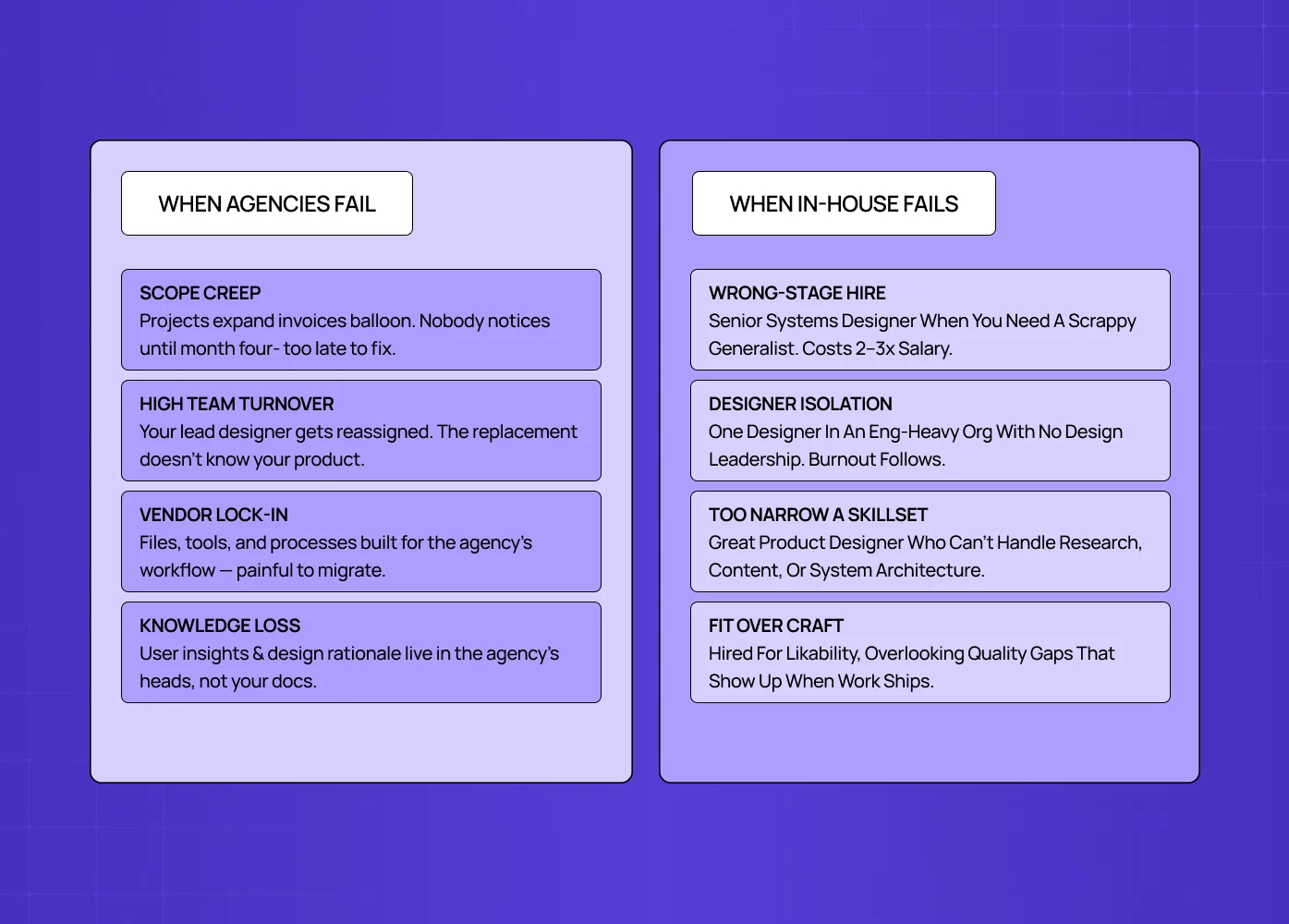
Side-by-side breakdown of common failure points in agencies vs in-house teams, including scope creep, turnover, wrong hires, and skill gaps.

When UX Agencies Fail

  • Scope creep without governance — Projects expand, invoices balloon, and no one catches it until month four

  • High turnover on your account — The lead designer you onboarded with gets reassigned; their replacement doesn't know your product

  • Vendor lock-in — Files, tools, and processes designed around the agency's workflow rather than your team's

  • Knowledge that walks out the door — User insights, edge case decisions, and design rationale that live in the agency's heads and not in your documentation

When In-House Fails

  • Hiring for the wrong stage — Bringing in a systems-focused senior designer when you need a scrappy generalist (or vice versa). A clear picture of what product designers actually do at each stage of development prevents this mismatch before the hire is made.

  • Designer isolation — One designer in an engineering-heavy organization without design leadership or community

  • Too narrow a skillset — A great product designer who's not equipped for user research, content design, or design system architecture when those needs emerge. Knowing which UX disciplines your product actually needs before you hire prevents this gap from becoming expensive to backfill. 

  • Cultural fit over craft — Hiring for fit and overlooking gaps in execution quality

The Hybrid Model Done Right

Hybrid isn't "have an in-house designer and also use an agency sometimes." Done well, it's a structured system with clear ownership.

A workable hybrid structure:

  1. In-house: Design system ownership — One internal designer whose job includes maintaining the component library, reviewing agency outputs for system consistency, and working closely with engineering

  2. Agency: Scoped project work — Audits, new feature prototyping, research studies, and high-volume design execution

  3. Agency: Overflow capacity — When your in-house team is sprint-locked and there's a parallel workstream, the agency absorbs it

  4. Clear handoff protocol — Every agency engagement ends with documented decision rationale, updated design system contributions, and knowledge transfer to in-house

The mistake companies make in hybrid models is treating them as permanent. Hybrid is a transitional state. As your product matures, you should be tracking the tipping point where agency spend would be better invested in an additional in-house hire.

How to Make the Call Right Now

Here's a simplified decision framework:

  • You have a critical project in the next 8 weeks with no current design coverage → Agency

  • Your design system is growing and no one owns it → In-house

  • You're pre-product-market-fit and still in heavy discovery → Agency

  • Design is blocking engineering more than once per sprint → In-house

  • You need specialized research or audit work → Agency

  • You have one in-house designer who is consistently overloaded → Hybrid

If you're in-between, the default answer for most Series A+ companies with active product roadmaps is: hire one strong in-house designer with broad ownership, and use a trusted agency for capacity surges and specialized work. If the agency path is right for your stage, a practical checklist for choosing the right web design agency covers the vetting process before you commit. 

Ready to Figure Out Which Model Is Right for You?

Every company is different, and the right answer depends on factors specific to your team, your roadmap, and your engineering constraints.

If you're a CTO or technical leader trying to make this call, we'd be happy to walk through your specific situation in a quick 30-minute discovery call. No pitch, no agenda — just a concrete conversation about what the right resourcing model looks like for your stage.


Most articles on UX agency vs in-house designer end with "it depends." This one doesn't. A stage-by-stage decision framework for CTOs — covering total cost of ownership, design system governance, engineering integration, and when each model breaks down.

The decision framework CTOs actually need — not another pro/con table.

Isometric illustration of two people interacting with large mobile interfaces, selecting checkboxes and managing tasks in a digital workflow.

Most articles on this topic give you a pro/con table and call it a day. That's not a decision framework — that's a hedge.

If you're a CTO or technical leader, you've already Googled this question and landed on five articles that all conclude with "it depends" and "consider a hybrid model." You know that. What you actually need is a concrete way to make the call for your company, at your stage, with your engineering constraints.

This post is built for that decision. We'll go deeper than cost and speed — into design system ownership, engineering workflow integration, UX research infrastructure, and the hidden costs that never show up in job posting calculators. We'll also cover when each model breaks down and give you a decision matrix tied to company stage.

By the end, you'll have a clear framework — not more reasons to delay the decision.


Want to know where your users are dropping off?

We’ll break down the exact moments users lose interest, and why.

The Five Questions Every CTO Should Answer Before Deciding

Before you compare agencies to in-house hires, answer these five questions about your company's current state. Your answers will do more work than any cost comparison.

1. Do you need design continuity or design capacity? Continuity means someone who knows your product deeply — your users, your design system, your engineering conventions. Capacity means skilled execution of scoped work. If you're a scaling SaaS product where every sprint involves interaction design decisions, you need continuity. If you're launching a specific feature or redesigning a checkout flow, you need capacity.

2. Who owns your design system — and does it exist? This is the question most CTOs don't think to ask. If you have a maturing design system that needs governance, maintenance, and iteration, an in-house designer is almost always the right call. Agencies ship work to your design system, but few maintain it with the same care as a full-time team member whose quarterly review depends on it.

3. How tightly coupled is UX work to your engineering roadmap? If your designers need to sit in sprint planning, attend retros, and pair with engineers on component decisions, geography and contractual overhead matter enormously. Agencies can simulate this with embedded models — but real-time integration still favors in-house.

4. Are you at a point of stable product vision or exploratory discovery? Early-stage products often benefit more from agency speed: structured discovery, rapid prototyping, external perspective. This question becomes especially consequential in product categories like e-commerce and AI personalization products, where the build-vs-hire decision carries additional technical and data dimensions. More mature products often need someone embedded enough to challenge assumptions they've been living with for months. 

5. What's your hiring timeline vs. your project timeline? A great UX hire takes 2–4 months from job post to productive contribution. If you have a critical launch in six weeks, that math doesn't work. Agencies can be onboarded in days.

The Real Cost Comparison (That Most Articles Get Wrong)

Bar chart comparing total cost of in-house vs agency design across stages, highlighting a tipping point where agency becomes more cost-effective.

Salary calculators make in-house design look more expensive than it is — and they make agencies look cheaper than they are. Let's model it properly.

In-House: Total Cost of Ownership

A mid-level UX designer in a major US tech hub earns $90,000–$130,000 in base salary. But that's not your cost.

Cost Item

Annual Estimate

Base salary (mid-level)

$90,000–$130,000

Benefits & health (25–30% of salary)

$22,500–$39,000

Recruiting fees (1x salary, amortized 3 years)

$30,000–$43,000

Onboarding/ramp time (3–6 months at 50% capacity)

~$22,500 lost productivity

Design tools (Figma, Maze, Hotjar, etc.)

$2,000–$5,000

Manager overhead (30 min/day × senior eng/PM)

$8,000–$12,000

Total Year 1 Cost

~$175,000–$251,500

Total Year 2+ Cost

~$120,000–$180,000

This doesn't include the cost of a bad hire — which, at the designer level, often costs 2–3x annual salary when you factor in the re-recruiting cycle.

Agency: True Cost Comparison

Agencies typically price at $100–$250/hour or via project retainers ($10,000–$80,000+ depending on scope). Here's what that actually looks like over 12 months for a product company in active development:

Engagement Model

Annual Cost Estimate

Lightweight retainer (20 hrs/month)

$24,000–$60,000

Active product sprint support (60 hrs/month)

$72,000–$180,000

Full project engagements (2–3 per year)

$60,000–$180,000

Internal coordination overhead (PM, eng time)

$15,000–$25,000

Total Annual Range

$39,000–$205,000

The key insight: at low-to-moderate design demand, agencies are often cheaper on a total cost basis — especially when you include Year 1 in-house ramp costs. At high design demand with ongoing product needs, the math flips somewhere around the 50–60 billable-hours-per-month mark — and calculating the full ROI of UX design investment beyond hourly rates is what moves this from a gut call to a defensible business case.

Stage-Based Decision Matrix

Stage-based decision matrix showing when to use agency, hybrid, or in-house design models across startup growth phases.

Your company's funding stage is one of the clearest signals for which model fits.

Pre-Seed / Seed

Recommended: UX Agency or Freelancer

You don't know yet what your design function needs to be. Before committing to either model, it helps to understand what a UI/UX design agency actually does — the roles, deliverables, and what you're getting for the engagement fee. You're still validating the product. You likely don't have a design system. Hiring full-time at this stage means either over-investing in infrastructure that might need to change, or under-using someone expensive while the rest of the team is in pure discovery mode. 

A good agency at seed stage provides structured discovery, rapid wireframing, and prototype validation — without the fixed cost of a salary through pivots.

Watch out for: Agencies who build in proprietary tooling or file structures that are hard to hand off — evaluating their UI/UX portfolio before you hire helps surface these structural patterns before they become a contractual problem. 

Series A

Recommended: Hybrid — One in-house designer + agency for capacity

You now have a product with users. You have a roadmap. You need someone who knows the product deeply and owns the design system as it matures. But you also have large UX bets to make (new features, potential redesigns) that exceed what one person can execute.

The Series A sweet spot: hire your first full-time UX designer to own vision and system governance, and use an agency for high-intensity sprints and research support.

Series B+

Recommended: Build toward in-house, use agency for specialization

At this stage, design quality is a competitive differentiator. You need researchers, product designers, and content designers. You're building a design function, not just a design role. In-house becomes the default — with agencies used for specialized work  — accessibility audits, user research studies, motion design — that your team doesn't need to own permanently. Understanding what a UX audit costs helps budget these engagements accurately when you're deciding how to allocate design spend across in-house and agency functions. 

Late-Stage / Enterprise

Recommended: Primarily in-house with agency partnerships for scale

Design is now infrastructure. Your team owns the design system, research ops, and product vision. Agencies support overflow, specialized audits, and specific campaigns — including specialist branding agencies for brand-level work that sits adjacent to your core product design function — but they are not running the show. 

Design System Governance: The Hidden Complexity

Most comparison articles completely skip this, but it's one of the most technically consequential parts of the decision for CTOs.

Your design system is shared infrastructure. It sits at the intersection of design and engineering. Every component that gets added, deprecated, or changed has downstream effects on your front-end codebase.

What agencies do well with design systems:

  • Build the foundation (tokens, base components, usage guidelines)

  • Audit existing systems for inconsistency

  • Ship new feature work that uses the system

What agencies do poorly:

  • Ongoing maintenance and governance

  • Making architectural decisions about when a pattern should become a component

  • Staying aligned with your engineering team's component library as it evolves

If your design system is actively growing and deeply coupled to your front-end — and it should be — this governance work needs an owner who understands how the UX design process maps to engineering delivery at each phase and is committed long-term. That typically means in-house. If you're still figuring out what your design system should be, an agency can lay a strong foundation and hand it off. Just ensure your contract includes thorough documentation and handoff deliverables.

UX Research: The Infrastructure Question CTOs Overlook

Research isn't just "running some user interviews." At scale, UX research is a function with its own tooling, participant recruitment pipelines, analysis workflows, and institutional memory.

Agency research strengths:

  • Faster recruitment through existing panels

  • Objective analysis (no internal bias)

  • Specific study types (benchmark studies, diary studies, competitive audits)

In-house research strengths:

  • Longitudinal understanding of your users

  • Faster access to your existing customer base

  • Research that feeds directly into product strategy on an ongoing basis

For most startups, the honest answer is that research at Series A and below is best served by agencies conducting structured studies. You don't need full-time research infrastructure until you have a product with complex enough user behavior to warrant continuous research investment (typically Series B+).

Engineering Integration: Where Agencies Most Often Fail

This is the complaint most CTOs make about UX agencies, and it's legitimate. Agencies often:

  • Deliver designs that don't account for your component library

  • Miss edge cases that only appear during implementation

  • Create specs that require clarification cycles that slow sprints

  • Aren't available in real-time when engineers hit a decision in the middle of a sprint

These are solvable problems with the right agency structure (embedded models, async-first processes, Figma access for engineers) — understanding how agencies build products that actually convert sets clearer expectations for the process scaffolding required. Many CTOs underestimate this overhead. 

In-house designers who sit in sprint planning, attend standups, and have Slack access to engineers close this gap naturally. The question is whether the business justifies that level of integration.

Decision rule of thumb: If design decisions are in the critical path of every sprint, you need in-house. If design is mostly batched work (feature designs completed two sprints ahead), agency models can work with proper process scaffolding.

When Each Model Breaks Down

Side-by-side breakdown of common failure points in agencies vs in-house teams, including scope creep, turnover, wrong hires, and skill gaps.

When UX Agencies Fail

  • Scope creep without governance — Projects expand, invoices balloon, and no one catches it until month four

  • High turnover on your account — The lead designer you onboarded with gets reassigned; their replacement doesn't know your product

  • Vendor lock-in — Files, tools, and processes designed around the agency's workflow rather than your team's

  • Knowledge that walks out the door — User insights, edge case decisions, and design rationale that live in the agency's heads and not in your documentation

When In-House Fails

  • Hiring for the wrong stage — Bringing in a systems-focused senior designer when you need a scrappy generalist (or vice versa). A clear picture of what product designers actually do at each stage of development prevents this mismatch before the hire is made.

  • Designer isolation — One designer in an engineering-heavy organization without design leadership or community

  • Too narrow a skillset — A great product designer who's not equipped for user research, content design, or design system architecture when those needs emerge. Knowing which UX disciplines your product actually needs before you hire prevents this gap from becoming expensive to backfill. 

  • Cultural fit over craft — Hiring for fit and overlooking gaps in execution quality

The Hybrid Model Done Right

Hybrid isn't "have an in-house designer and also use an agency sometimes." Done well, it's a structured system with clear ownership.

A workable hybrid structure:

  1. In-house: Design system ownership — One internal designer whose job includes maintaining the component library, reviewing agency outputs for system consistency, and working closely with engineering

  2. Agency: Scoped project work — Audits, new feature prototyping, research studies, and high-volume design execution

  3. Agency: Overflow capacity — When your in-house team is sprint-locked and there's a parallel workstream, the agency absorbs it

  4. Clear handoff protocol — Every agency engagement ends with documented decision rationale, updated design system contributions, and knowledge transfer to in-house

The mistake companies make in hybrid models is treating them as permanent. Hybrid is a transitional state. As your product matures, you should be tracking the tipping point where agency spend would be better invested in an additional in-house hire.

How to Make the Call Right Now

Here's a simplified decision framework:

  • You have a critical project in the next 8 weeks with no current design coverage → Agency

  • Your design system is growing and no one owns it → In-house

  • You're pre-product-market-fit and still in heavy discovery → Agency

  • Design is blocking engineering more than once per sprint → In-house

  • You need specialized research or audit work → Agency

  • You have one in-house designer who is consistently overloaded → Hybrid

If you're in-between, the default answer for most Series A+ companies with active product roadmaps is: hire one strong in-house designer with broad ownership, and use a trusted agency for capacity surges and specialized work. If the agency path is right for your stage, a practical checklist for choosing the right web design agency covers the vetting process before you commit. 

Ready to Figure Out Which Model Is Right for You?

Every company is different, and the right answer depends on factors specific to your team, your roadmap, and your engineering constraints.

If you're a CTO or technical leader trying to make this call, we'd be happy to walk through your specific situation in a quick 30-minute discovery call. No pitch, no agenda — just a concrete conversation about what the right resourcing model looks like for your stage.

FAQ

Everything you were going to ask (and a few things you didn’t know to)

At what company size should I hire my first in-house UX designer?

There's no universal headcount threshold, but a useful signal: if design decisions are blocking or delaying engineering work more than once per sprint, you've outgrown agency-only models. For most startups, this happens somewhere between 10–25 engineers — a stage that often overlaps with active SaaS application development cycles where design-engineering coupling intensifies and the cost of coordination overhead starts to compound. 

Can an agency maintain a design system long-term?

Some can, with the right contract structure — but it's rare and more expensive than it looks. Design system governance requires someone with skin in the game and continuity of ownership. Most agencies cycle through account teams, which introduces inconsistency.

What should I include in an agency contract to protect against knowledge lock-in?

Key clauses: IP ownership assigned to your company, required documentation deliverables at project end, Figma file organization standards aligned to your conventions, and explicit handoff meetings as contract milestones.

How do I evaluate whether an agency actually integrates with engineering teams?

Ask for a reference from a client who had them work within an active sprint cycle. Ask them to walk through how they've handled design decisions during implementation — and know what skills a UI/UX agency must have in 2026 before you begin that evaluation. Red flag: agencies that treat "engineering handoff" as the end of the engagement rather than the beginning of collaboration. 
When should I switch from agency to in-house?

Track your monthly agency spend. When it approaches or exceeds $8,000–$12,000/month consistently, the math typically favors in-house. Do the total cost of ownership math above, account for Year 1 ramp costs, and project forward 24 months.

Should I hire a UX agency or an in-house designer if I'm building an AI or data-heavy product?

AI and data-heavy products introduce UX complexity that most generalist designers — in-house or agency — aren't equipped for by default. Look specifically for experience with empty states, error handling, model confidence UI, and progressive disclosure of complex outputs. At early stages, an agency with demonstrated AI product work can move faster than a hiring cycle. At Series B+, the longitudinal understanding required to design around a maturing AI system almost always warrants in-house ownership.

At what company size should I hire my first in-house UX designer?

There's no universal headcount threshold, but a useful signal: if design decisions are blocking or delaying engineering work more than once per sprint, you've outgrown agency-only models. For most startups, this happens somewhere between 10–25 engineers — a stage that often overlaps with active SaaS application development cycles where design-engineering coupling intensifies and the cost of coordination overhead starts to compound. 

Can an agency maintain a design system long-term?

Some can, with the right contract structure — but it's rare and more expensive than it looks. Design system governance requires someone with skin in the game and continuity of ownership. Most agencies cycle through account teams, which introduces inconsistency.

What should I include in an agency contract to protect against knowledge lock-in?

Key clauses: IP ownership assigned to your company, required documentation deliverables at project end, Figma file organization standards aligned to your conventions, and explicit handoff meetings as contract milestones.

How do I evaluate whether an agency actually integrates with engineering teams?

Ask for a reference from a client who had them work within an active sprint cycle. Ask them to walk through how they've handled design decisions during implementation — and know what skills a UI/UX agency must have in 2026 before you begin that evaluation. Red flag: agencies that treat "engineering handoff" as the end of the engagement rather than the beginning of collaboration. 

When should I switch from agency to in-house?

Track your monthly agency spend. When it approaches or exceeds $8,000–$12,000/month consistently, the math typically favors in-house. Do the total cost of ownership math above, account for Year 1 ramp costs, and project forward 24 months.

Should I hire a UX agency or an in-house designer if I'm building an AI or data-heavy product?

AI and data-heavy products introduce UX complexity that most generalist designers — in-house or agency — aren't equipped for by default. Look specifically for experience with empty states, error handling, model confidence UI, and progressive disclosure of complex outputs. At early stages, an agency with demonstrated AI product work can move faster than a hiring cycle. At Series B+, the longitudinal understanding required to design around a maturing AI system almost always warrants in-house ownership.

More Articles

Extreme close-up black and white photograph of a human eye

Let’s bring your vision to life

Tell us what's on your mind? We'll hit you back in 24 hours. No fluff, no delays - just a solid vision to bring your idea to life.

Profile portrait of a man in a white shirt against a light background

Harpreet Singh

Founder and Creative Director

Get in Touch

Extreme close-up black and white photograph of a human eye

Let’s bring your vision to life

Tell us what's on your mind? We'll hit you back in 24 hours. No fluff, no delays - just a solid vision to bring your idea to life.

Profile portrait of a man in a white shirt against a light background

Harpreet Singh

Founder and Creative Director

Get in Touch

Extreme close-up black and white photograph of a human eye

Let’s bring your vision to life

Tell us what's on your mind? We'll hit you back in 24 hours. No fluff, no delays - just a solid vision to bring your idea to life.

Profile portrait of a man in a white shirt against a light background

Harpreet Singh

Founder and Creative Director

Get in Touch