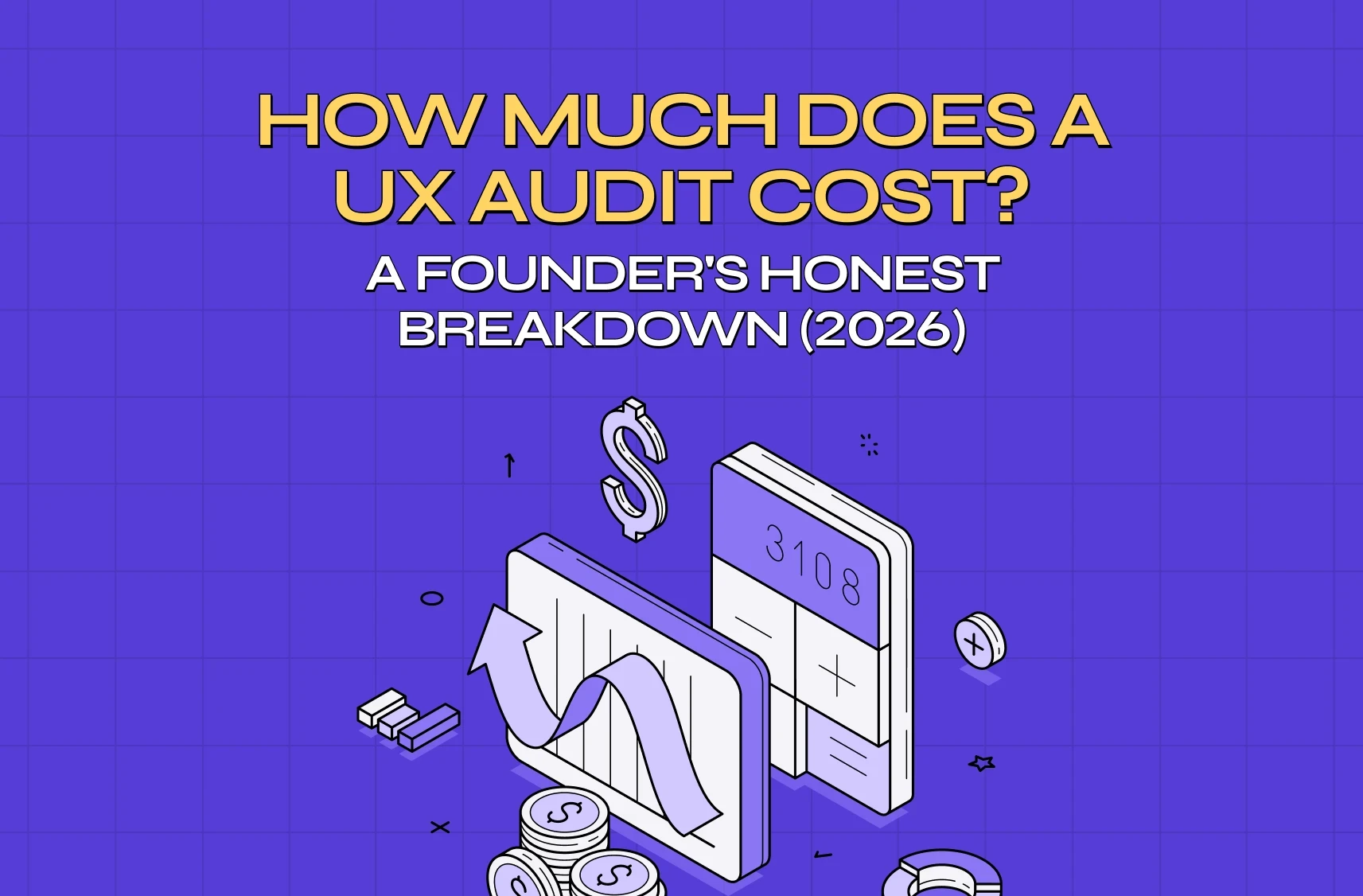
From $500 freelancer audits to $25,000 agency engagements, UX audit pricing is all over the place. This guide breaks down what you’re actually paying for, what you get at each tier, and how to decide what your product really needs.
UX audits range wildly in cost—here’s what actually drives the difference.

You launched. Users are signing up. But somewhere between sign-up and that critical first week, you're losing them — and you can't figure out where.
A UX audit is the diagnostic that tells you exactly what's broken and why. But the moment you start Googling the price, you get everything from "$500 on Fiverr" to "$30,000 agency retainer" — and no real explanation of what separates them.
This guide breaks down exactly how UX audit pricing works in 2026: what drives the cost, what you actually get at each price tier, the hidden costs nobody talks about, and how to decide whether a freelancer, boutique agency, or specialist firm is the right call for your stage.
What Is a UX Audit, and What Does It Actually Produce?
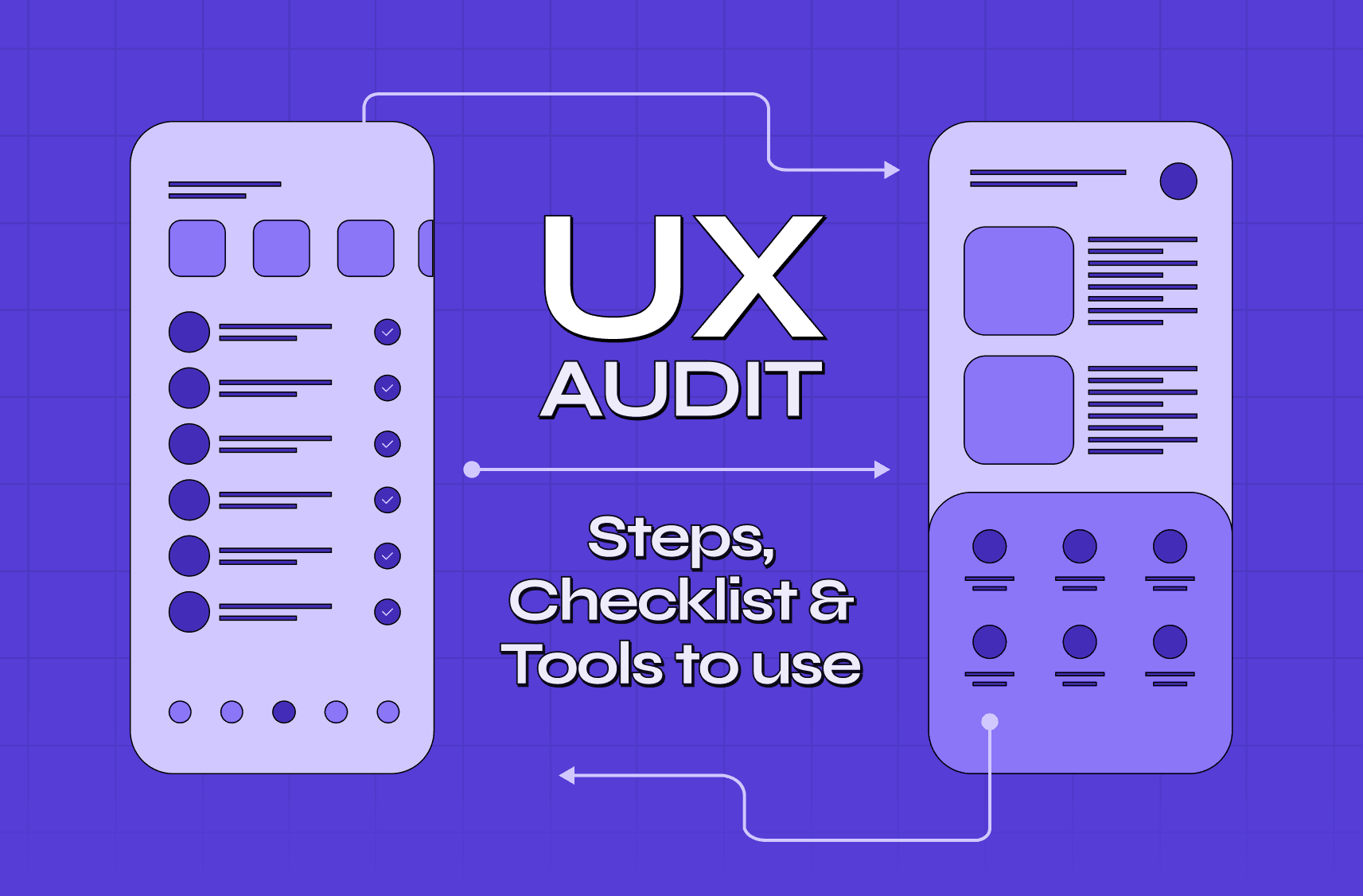
A UX audit is a systematic evaluation of your product's user experience — covering usability, onboarding, information architecture, error handling, and conversion flow. The output is a prioritised set of findings tied to specific UX problems, with recommendations for what to fix and in what order.If you need a step-by-step walkthrough of how to run one — tools, methodology, and what good outputs look like — the guide to how to do a UX audit covers the full process. This post focuses on what it costs and whether it's worth commissioning at your stage.
A strong audit answers three questions: Where are users dropping off? Why? And what's the highest-leverage fix? For AI products, a fourth question matters just as much — and dedicated AI product evaluation answers it: are the model's outputs good enough for users to trust?
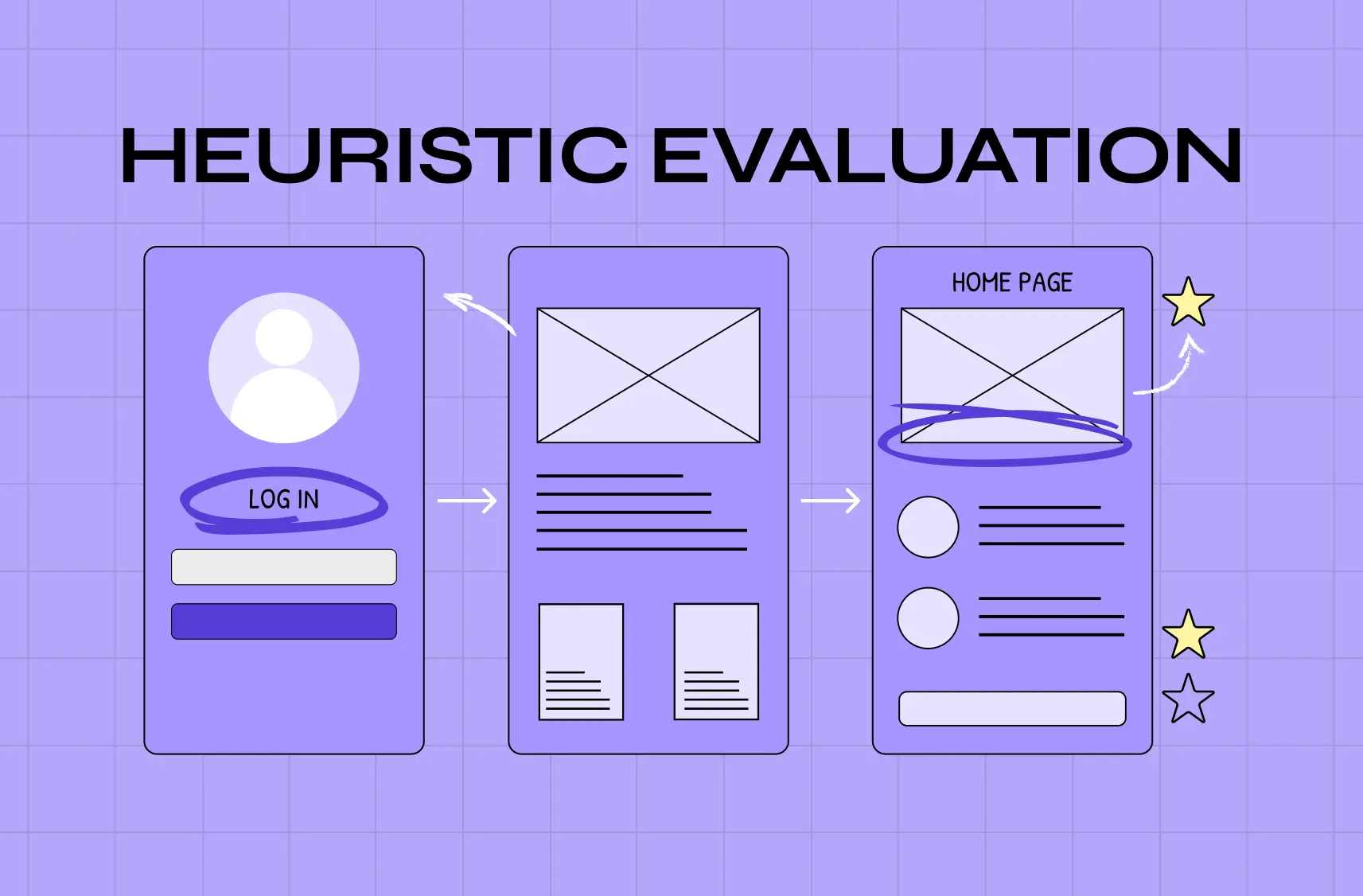
At the low end, you get a heuristic walkthrough — an expert reviewing your screens against Nielsen's 10 usability heuristics and flagging obvious issues. At the high end, you get recorded session analysis, user interviews, funnel data review, annotated wireframes with proposed fixes, and a full implementation roadmap with effort/impact scoring.
The deliverable matters as much as the methodology. Many audits produce a 40-page PDF that gets filed away. The best ones produce a living prioritisation matrix that your PM and designer can pull up in sprint planning the next day.
UX Audit Pricing: The Honest Breakdown by Tier
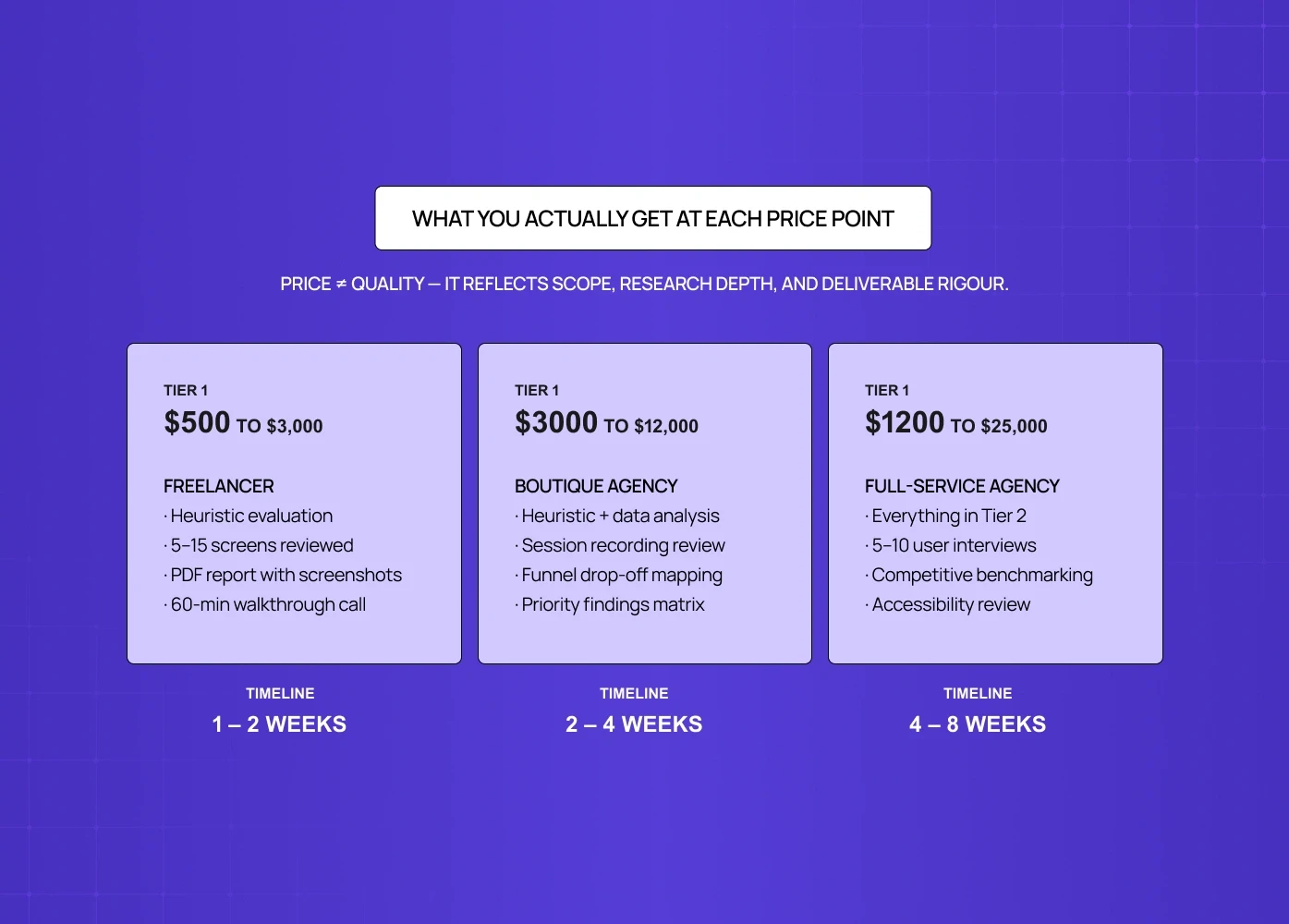
There is no universal price. What you pay depends on who does it, how deeply they go, and what deliverables you receive. Here's how the market actually breaks down.
Tier 1 — Freelancer Audit: $500–$3,000
Freelance UX auditors on Upwork, Toptal, or via direct referral typically charge by the hour ($75–$150/hr) or offer fixed-scope packages for defined deliverables.
What you get: A heuristic review process applied across 5–15 screens, a PDF report with screenshots and annotations, basic recommendations ordered by severity. Some include a 60-minute walkthrough call.
Best for: Very early-stage products (pre-Series A, under 1,000 MAU), solo founders who need a second opinion before redesigning, or teams who just want a fast sanity check before a launch.
Watch out for: Highly variable quality. A strong freelancer with 5+ years in SaaS UX can spot issues a junior auditor will miss entirely. Always review prior audit samples before committing. Freelancers also rarely provide implementation support — you'll own the "what to do next" problem yourself.
Tier 2 — Boutique Agency or Specialist Consultancy: $3,000–$12,000
This is the most common range for funded SaaS companies at Seed to Series A. A small UX agency (3–15 people) or specialist UX consultancy will run a structured audit over 2–4 weeks.
What you get: Expert heuristic review plus quantitative data analysis (Hotjar, Mixpanel, FullStory), recorded session review, user flow mapping, annotated wireframes for key broken flows, a prioritised findings matrix (effort × impact), and often a readout session with your team. If you want to understand what roles within a UX agency are responsible for producing each of these deliverables, the breakdown of what a UI UX design agency does covers the team
structure and responsibilities behind the output.
Best for: Series A companies with 1,000–50,000 MAUs experiencing churn they can't attribute to the product alone, or post-pivot products that need a systematic diagnosis before rebuilding.
The key differentiator: Whether the agency has B2B SaaS experience specifically. A generalist agency auditing your PLG onboarding flow will produce superficially useful but fundamentally incomplete findings because they don't understand the PLG activation model. To compare agencies by specialisation and audit scope before shortlisting, the list of leading UX research firms gives you a vetted starting point for this tier.
Tier 3 — Full-Service Agency Engagement: $12,000–$25,000+
Larger UX agencies and strategy consultancies operate at this tier. The scope expands significantly: user interviews (5–10 participants), competitive benchmarking, accessibility review, mobile vs. desktop analysis, and a full redesign recommendation set with proposed IA and flows.
What you get: Everything in Tier 2, plus primary research (user interviews or moderated usability testing), competitive landscape analysis, persona validation, and a redesign roadmap with resource estimates.
Best for: Series B+ companies with complex products and meaningful churn costs, or companies entering a new market segment where existing UX assumptions may not hold.
The honest truth: At this spend level, you're partly paying for methodology rigour and partly for the credibility to take the findings to your board. If your product has under 5,000 MAUs, you almost certainly don't need this tier yet. Before committing at this investment level, the practical checklist for choosing the right web design agency applies directly to vetting full-service audit partners — the evaluation criteria are the same.
What Actually Drives the Price Up?
Understanding the cost drivers helps you scope what you actually need — and avoid paying for deliverables that won't change what you do next.
Scope of screens reviewed. A single onboarding flow is materially cheaper to audit than your entire product. If you're trying to solve churn, define the problem first — then scope the audit to the flows where drop-off actually happens.
Research methodology. Heuristic evaluation (expert review) is fast and lower-cost. Adding moderated usability sessions with real users can add $3,000–$8,000 to any engagement — and teams without internal research capacity often find that partnering with a UX research agency for this layer delivers sharper findings than a generalist auditor running sessions outside their specialisation. It's worth it when you need to validate whether a problem is architectural vs. cosmetic — but not when you already know where users are dropping off from your own analytics.
Deliverable depth. A 15-page annotated findings report is a different investment than a full prioritisation matrix with annotated wireframes and effort estimates per fix. The latter costs more, but saves 20 hours of internal interpretation work.
Agency overhead. You're not just paying for the lead auditor's time. You're paying for project management, client communication, quality review, and account management. Freelancers carry none of that overhead — which is both a cost advantage and a risk.
Post-audit support. Some engagements include a 30-day follow-up period where you can ask questions as you implement. Others don't. This is rarely mentioned in proposals and is worth asking about explicitly.
The Hidden Costs Nobody Talks About
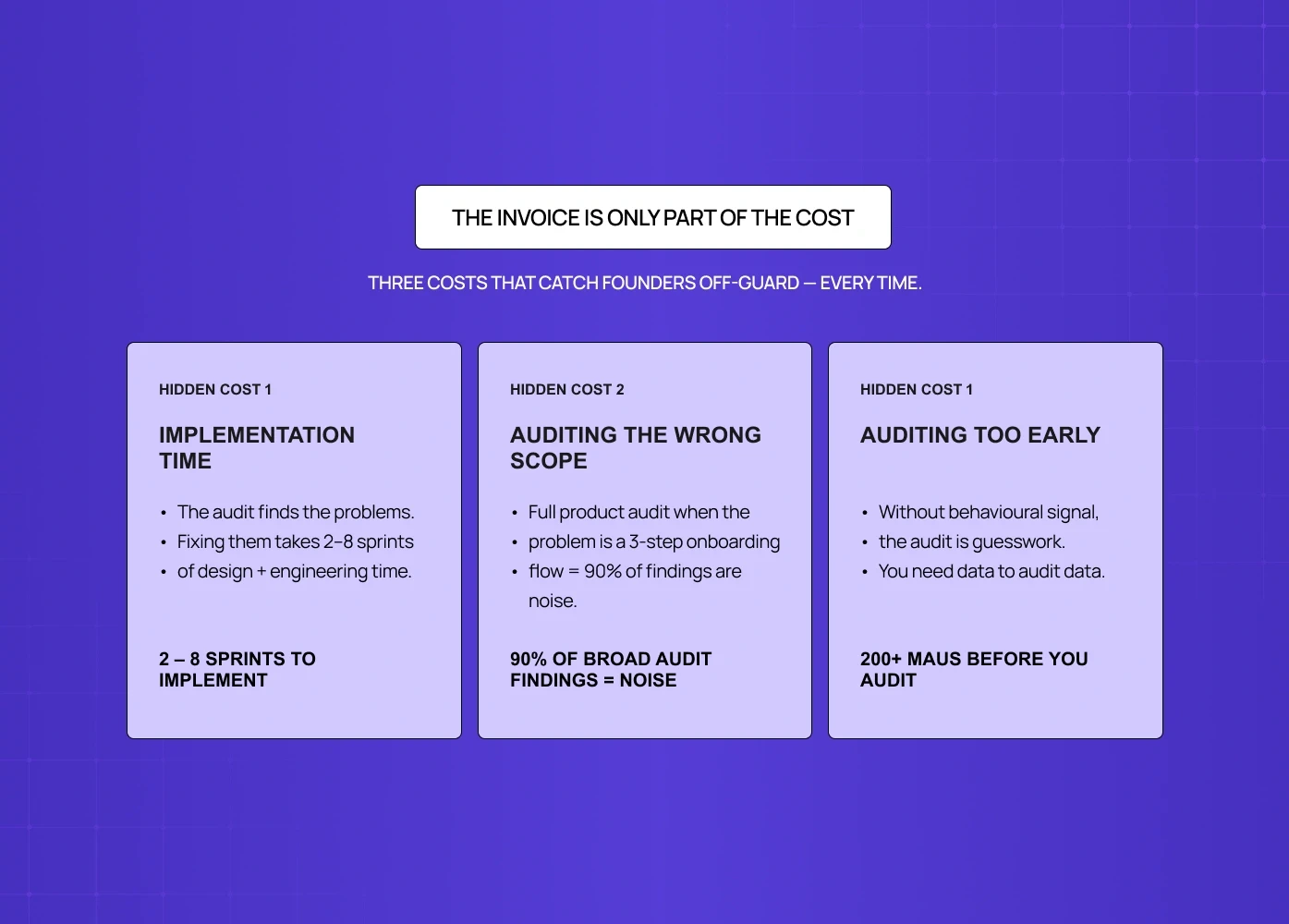
The invoice from your UX auditor is only part of the real cost. Three hidden costs consistently catch founders off-guard.
Internal implementation time. An audit produces a list of things to fix. Acting on it takes engineering and design time — typically 2–8 sprints depending on finding severity. Factor this in before you commission an audit. If your team is already at capacity, a 40-page findings doc will sit unopened for six months.
The cost of getting the wrong scope. If you audit your entire product when the core problem is a three-step onboarding flow, you'll spend $8,000 on findings that are 90% noise. Narrow scope → deeper findings → faster action.
Opportunity cost of doing it too early. UX audits shine brightest when you have real user behaviour data — session recordings, funnel analytics, support ticket themes. An audit on a brand-new product with 50 users is mostly guesswork. The minimum viable data set for a meaningful audit: 200+ MAUs, at least 3 months of funnel data, and at least 50 recorded sessions.
Freelancer vs. Agency: The Honest Trade-Off Matrix
This is the question founders get stuck on most. Here's the actual comparison — without the agency spin.
Freelancer | Boutique Agency | Full-Service Agency | |
|---|---|---|---|
Price range | $500–$3,000 | $3,000–$12,000 | $12,000–$25,000+ |
Timeline | 1–2 weeks | 2–4 weeks | 4–8 weeks |
Best for | Pre-PMF, quick check | Seed–Series A | Series B+ |
Research depth | Heuristic only | Heuristic + data | Heuristic + data + user research |
Deliverable quality | Variable | Consistent | High |
Implementation support | Rare | Sometimes included | Usually included |
B2B SaaS specialisation | Hit or miss | Depends on firm | Depends on firm |
The decision rule: If you're pre-Series A and have a specific drop-off problem you can isolate, start with a targeted freelancer or boutique agency audit. If you're post-Series A, churn is material (>5% monthly), and you need to align your team on a redesign roadmap, a boutique agency is usually the right call. Before you commit to any engagement, the web design agency pricing guide breaks down how agency costs are structured — which makes comparing proposals and spotting inflated scopes significantly easier.
When Is the Right Time to Get a UX Audit?
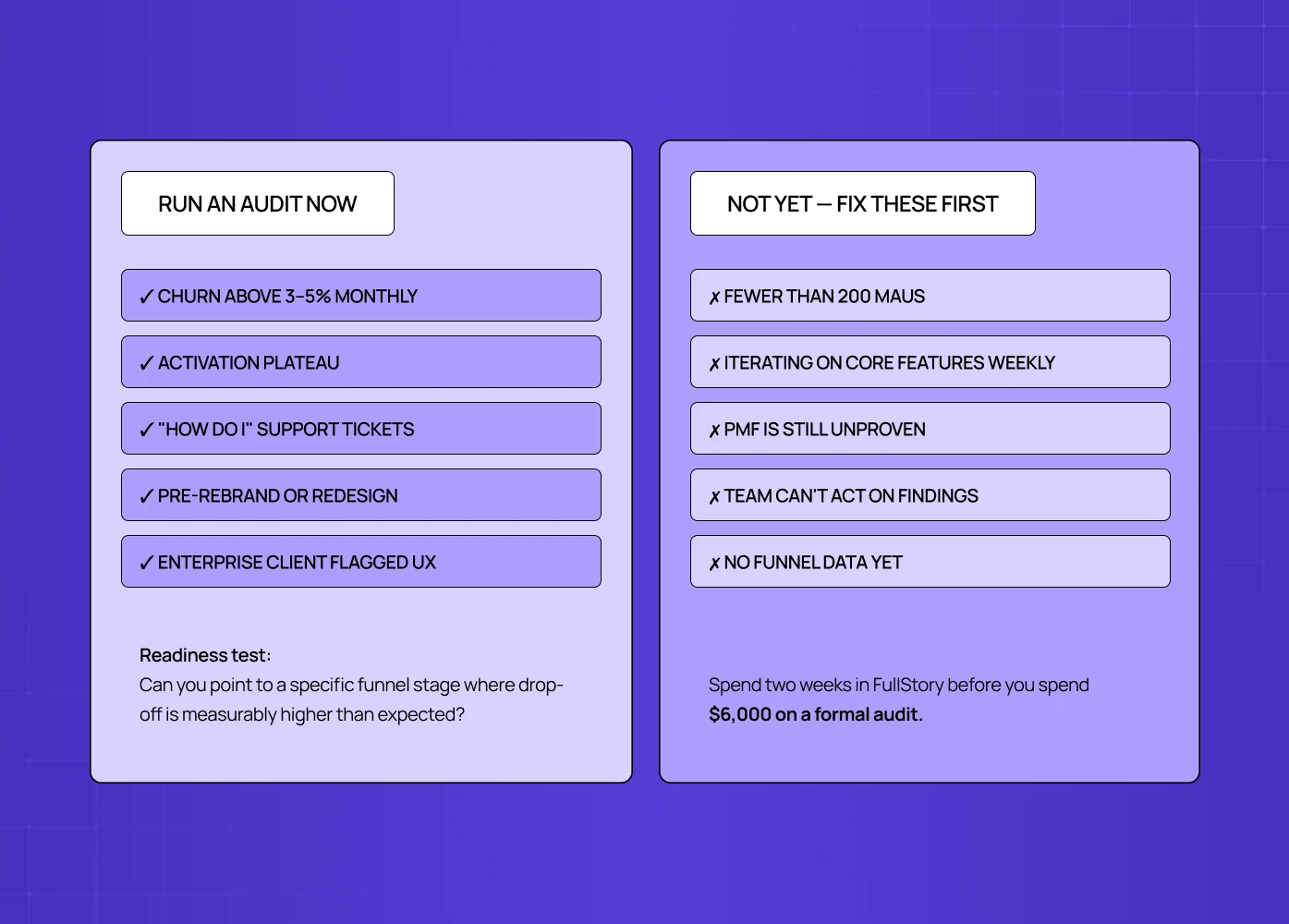
Timing matters more than most founders realise. An audit at the wrong stage produces findings you can't act on. In the broader UX design process, audits typically sit after initial product validation and before a major redesign or feature overhaul — which is what makes the timing question more nuanced than it first appears.
Run a UX audit when:
Monthly churn is consistently above 3–5% and you've ruled out product-market fit as the cause
Activation rate has plateaued despite onboarding copy changes and email sequences
Support ticket volume contains a recurring cluster of "how do I" questions (signal: UX clarity problem)
You're preparing for a rebrand or major redesign and want to establish a baseline
A new enterprise client has flagged usability concerns during their evaluation
Don't run a UX audit when:
You have fewer than 200 MAUs — you don't have enough behavioural signal yet
You're still iterating weekly on core features — the audit findings will be stale by the time you read them
The real problem is product-market fit, not UX — no amount of polish will retain users who don't need the product
The readiness test: Can you point to a specific funnel stage where drop-off is measurably higher than expected? If yes, you're ready. If you just have a feeling that "something is off," spend two weeks in FullStory first.
What a Good UX Audit Deliverable Actually Looks Like
Most founders who've received a disappointing audit say the same thing: "It told us things we already knew." That's a methodology problem, not an audit problem. Here's what to insist on:
A prioritised findings matrix — essentially a register of your usability debt. Every finding should be tagged by severity (critical / major / minor), affected funnel stage, estimated user impact, and implementation complexity. This is what makes findings actionable instead of interesting.
Annotated screen recordings or wireframes. Theoretical findings without visual anchors are useless. Every major finding should include a screenshot, session recording clip, or annotated wireframe showing exactly what the problem looks like. For a concrete reference of what these problems look like across common product interfaces, the breakdown of bad UX design examples and how to fix them is a useful primer for interpreting audit findings when they land.
A "quick wins" list. Alongside the full findings, insist on a separate list of fixes that can be deployed in under a sprint. Copy changes, CTA repositioning, empty state additions — these drive near-term activation improvement while larger fixes are being scoped. The most common items on this list overlap directly with the UI UX mistakes that hurt conversions most — issues that cost under a sprint to fix but have an outsized impact on activation and retention.
Quantified drop-off context. Where does each finding appear in your funnel, and what's the approximate percentage of users affected? Even rough estimates make the prioritisation conversation with your engineering lead orders of magnitude easier.
UX Audit Cost vs. ROI: The Numbers That Matter
Here's the ROI case, built from real SaaS benchmarks.
A typical Seed-stage SaaS product with $50K MRR and 5% monthly churn is losing $2,500/month in revenue — $30,000 per year. If a UX audit identifies and resolves the onboarding drop-off driving 40% of that churn (a conservative estimate for UX-fixable churn), that's a $12,000/year revenue recovery.
A $6,000 audit that delivers a $12,000/year revenue improvement pays back in six months. The ROI calculus gets dramatically stronger as MRR scales — and the frameworks for calculating the ROI of UX design give you the methodology to run those numbers for your specific product and present them to stakeholders who think in revenue terms, not design terms.
The flip side: a $6,000 audit that produces findings you never act on delivers exactly $0 in ROI. Implementation is where audits fail — not the research. For teams whose audit findings point toward a structural redesign rather than incremental fixes, understanding SaaS UX redesign cost after audit gives you the budget framework to scope what acting on those findings will actually require before presenting the investment case.
The one question to ask before commissioning any audit: "Do we have the design and engineering capacity to implement at least 80% of what we find in the next 60 days?" If the answer is no, fix that first.
Conclusion: Book a Discovery Call Before You Scope
UX audit pricing in 2026 ranges from $500 to $25,000+, and the price difference is entirely explained by research depth, deliverable quality, and agency overhead — not by how good the findings will be. A $2,500 freelancer with deep PLG SaaS experience will out-deliver a $15,000 generalist agency nine times out of ten.
At Groto, we run UX audits specifically for B2B SaaS products at Seed through Series B. Our audits are scoped to the flows where your drop-off actually happens, not your entire product — which means faster findings, sharper recommendations, and a prioritisation matrix your team can pull straight into sprint planning.
Book a discovery call → We'll tell you in 30 minutes whether an audit is the right intervention for your specific churn or activation problem.