How Much Does a SaaS UX Redesign Cost — And What Are You Actually Buying?

A no-fluff breakdown of SaaS UX redesign costs by depth, funding stage, and scope — so you can budget with confidence and defend the number.

How Much Does a SaaS UX Redesign Cost — And What Are You Actually Buying?

A no-fluff breakdown of SaaS UX redesign costs by depth, funding stage, and scope — so you can budget with confidence and defend the number.

Most agencies hand you a number and call it a quote. We break down SaaS UX redesign cost by depth, stage, and scope — so you know exactly what you're buying before you sign.

What a SaaS UX redesign actually costs — and what you're paying for.

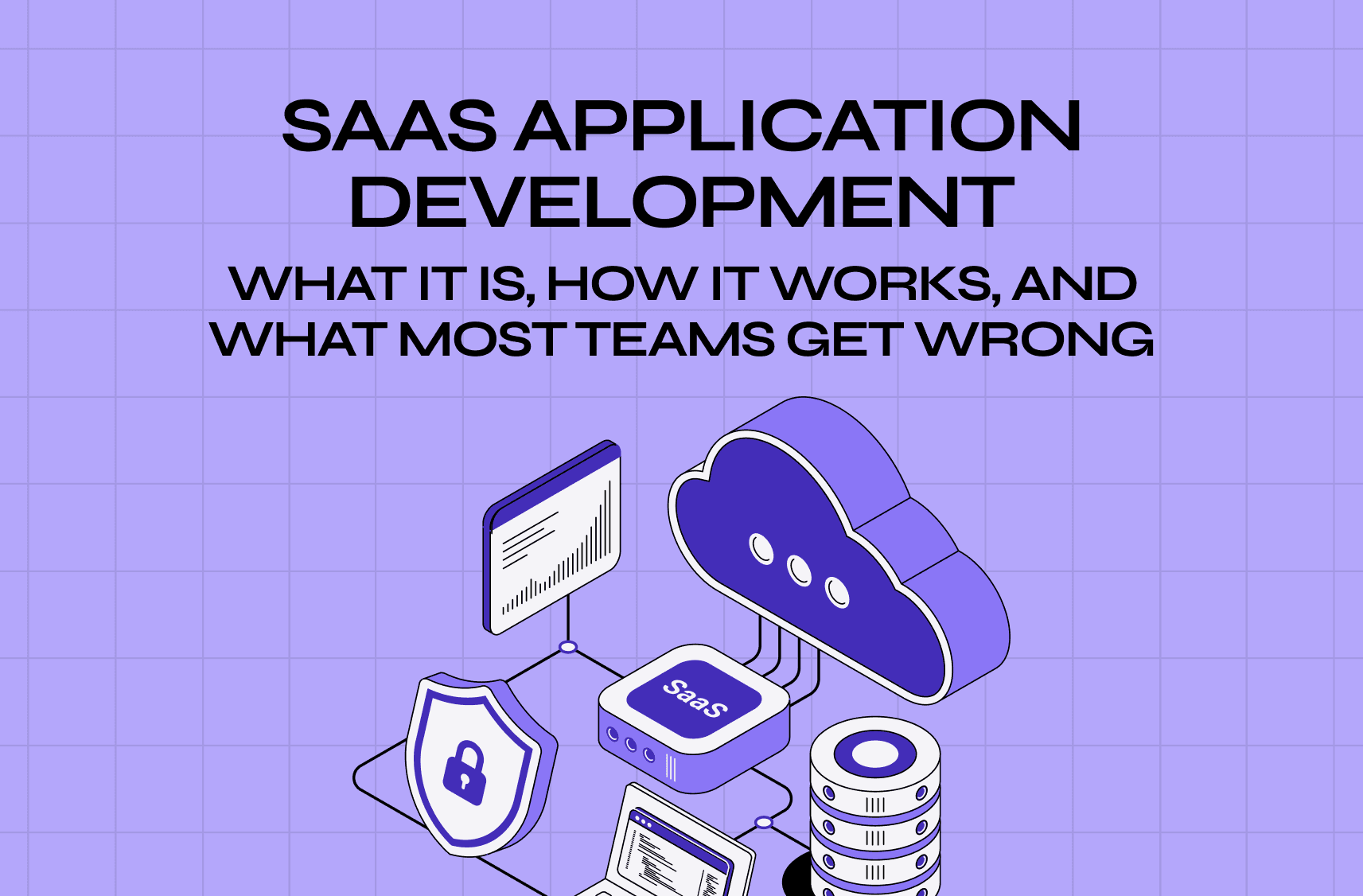
Isometric illustration of SaaS architecture with cloud, database, security, and connected systems.

The question most SaaS founders and product leads ask us isn't "should we redesign?" It's "how do we explain the budget to the board?"

And that's where most agencies fail them. You get a number — $40,000, $75,000, $120,000 — with a vague scope attached. You're told it depends on complexity. You're sent a proposal that reads like it was generated for a different product in a different industry. The real SaaS UX redesign cost conversation — the one that accounts for your product's actual architecture, your users' actual workflows, and what a surface-level refresh versus a structural overhaul actually involves — rarely happens up4147front.

It should happen before you sign anything. This is that conversation.

Forrester research puts the ROI of UX investment at $100 returned for every $1 spent. But that number is meaningless without a framework for knowing what level of redesign you actually need — and therefore what you're actually budgeting for. At Groto, we've run UX redesigns for SaaS products from Series A to enterprise scale, across fintech, edtech, HR, and analytics platforms. What we've learned is that the cost question is really a depth question. Get the depth right, and the budget becomes defensible. If you're still in the validation stage — asking whether a redesign is needed rather than what it costs — the guide to 5 signs your SaaS website needs a redesign is the right starting point. 

What a SaaS UX Redesign Actually Involves (It's Not a Website Redesign)

Before pricing anything, a distinction worth making: a SaaS UX redesign is not a website redesign. They are different problems with different complexity profiles.

A website redesign touches pages. A SaaS UX redesign touches systems — user flows across multiple states, role-based access controls, onboarding sequences, data-heavy dashboards, integration touchpoints, and the internal logic that connects them. When a competitor's "pricing guide" quotes you $8,000–$25,000 for a UI refresh and blends that with website redesign pricing, they're conflating categorically different projects.

The scope of a SaaS product redesign typically includes some combination of:

  • User research and discovery (interviews, analytics review, session recordings, heatmap analysis)

  • Information architecture restructuring (how modules relate, how navigation works at scale)

  • Interaction design across core workflows (onboarding, activation, key feature flows)

  • Component library and design system work (if you want to ship faster and maintain quality after launch)

  • Dashboard and data visualisation redesign (often the most complex and most underpriced component)

  • Prototype testing and iteration before handoff

  • Developer collaboration and handoff documentation

Not every redesign requires all of these. Which ones you need — and how deeply — determines the cost. That's the framework we'll use. For a complete picture of what SaaS UX design involves across the full product lifecycle — from onboarding through retention — the complete guide to SaaS UX design provides the foundational context before scoping any investment. 

SaaS UX Redesign Cost by Funding Stage
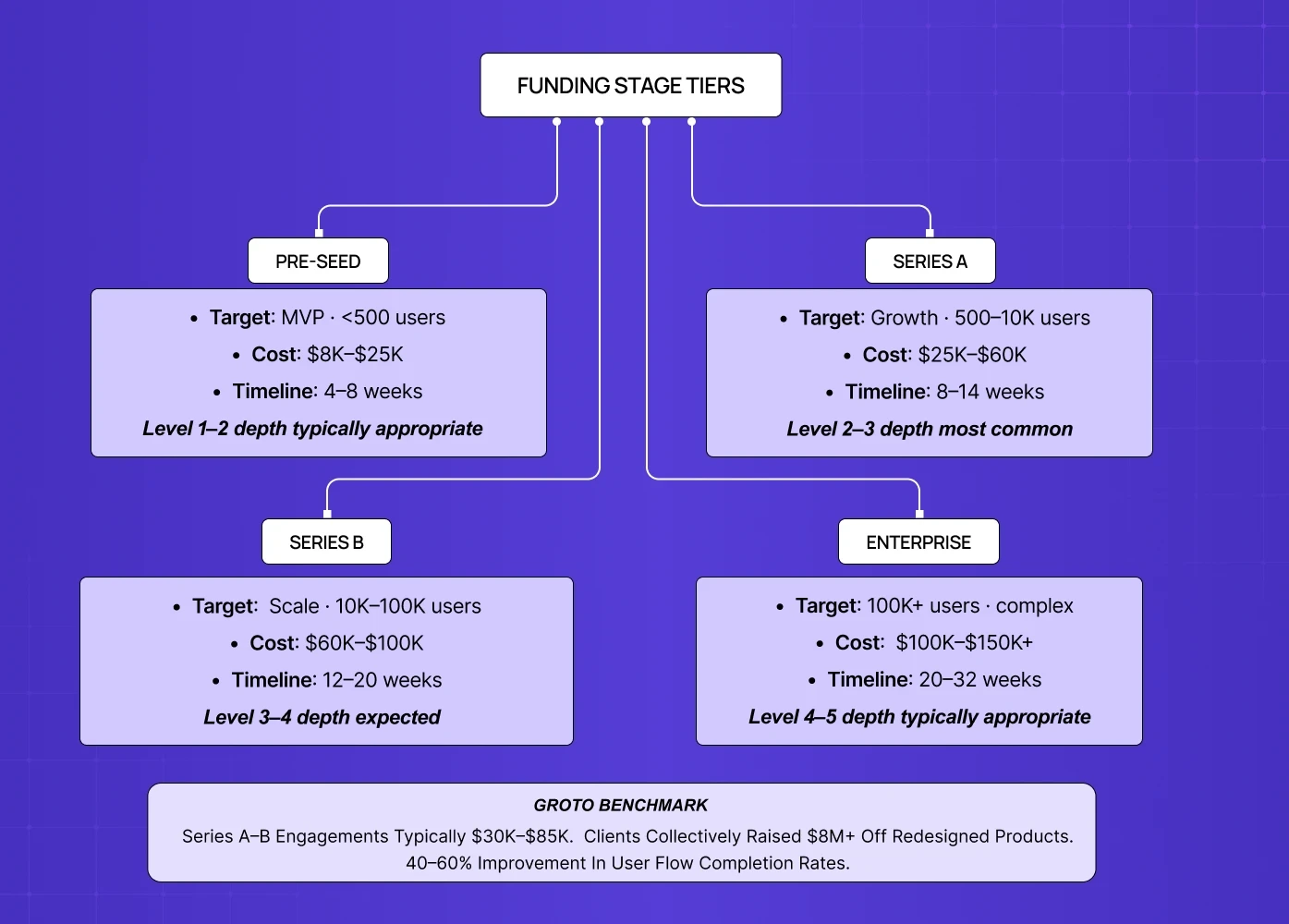
Breakdown of SaaS funding stages (Pre-seed to Enterprise) with typical costs, timelines, and redesign depth.

Cost ranges are meaningful only when anchored to context. A seed-stage SaaS with 200 users redesigning their MVP activation flow has a different problem — and a different appropriate budget — than a Series B product with 50,000 users, a legacy dashboard, and a retention problem driven by navigation complexity.

Here's how SaaS UX redesign cost typically maps to funding stage, based on market rates and our own project data:

Funding Stage

Typical Scope

Cost Range

Timeline

Pre-seed / Seed

MVP flows, core onboarding, 10–20 screens

$8,000–$25,000

4–8 weeks

Series A

Full product audit + key flow redesign, design system foundations

$25,000–$60,000

8–14 weeks

Series B / Growth

Comprehensive redesign + design system + handoff

$60,000–$100,000

12–20 weeks

Enterprise / Scale

Full platform redesign, multi-role, complex integrations

$100,000–$150,000+

20–32 weeks

These ranges assume a specialist SaaS design agency working with a clear brief. Freelancers at the low end of the market can reduce cost by 40–60%, with corresponding reductions in research depth, handoff quality, and design system maturity. Enterprise consultancies at the high end can push budgets above these figures — especially when research, stakeholder management, and change management are scoped in. The web design agency pricing guide breaks down how agencies structure fees across these engagement types in detail.

At Groto, our Series A and B engagements typically sit in the $30,000–$85,000 range depending on scope, and we're consistently able to point to outcomes: our clients have collectively raised $8M+ off the back of products we've built or redesigned, and we've delivered 40–60% improvements in user flow completion rates across multiple SaaS products. For a broader view of how the agencies in this space compare by rate, specialisation, and engagement model, the guide to UX design companies for SaaS products maps the market. 

The Redesign Depth Framework: What Level Does Your Product Need?
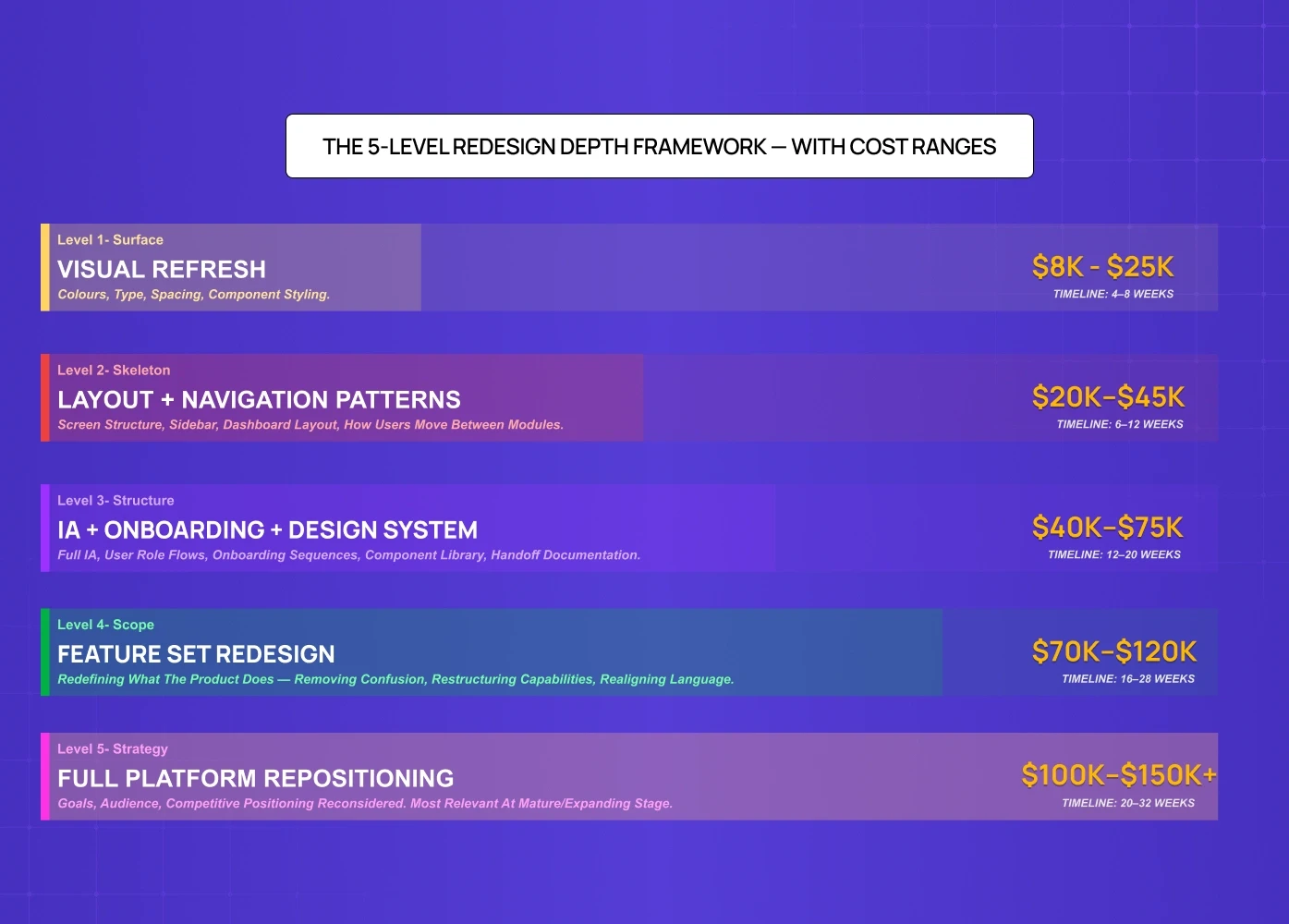
Framework showing five levels of SaaS redesign from visual refresh to full platform repositioning with costs.

Funding stage tells you budget range. But the depth of the redesign tells you how to spend it. This is the framework we use at Groto before scoping any engagement — five levels of redesign depth, each with a distinct cost profile and set of appropriate use cases. For teams who also want to understand how the redesign process unfolds step by step — not just what it costs at each level — that guide covers the execution sequence in detail. 

Level 1 — Surface Redesign ($8,000–$25,000)

  • Visual refresh only. Typography, colour system, spacing, component styling. 

  • The underlying information architecture, navigation, and core workflows stay intact.

  • Appropriate when your product's usability is fundamentally sound but the visual language has dated, a rebrand has happened, or you need to close the perception gap with competitors.

What Surface doesn't fix: conversion problems, onboarding drop-off, navigation confusion, or any issue rooted in how the product is structured rather than how it looks.

Level 2 — Skeleton Redesign ($20,000–$45,000)

  • Visual + interface layout and navigation patterns. 

  • Where Surface touches styling, Skeleton restructures how screens are laid out and how the user moves between them. 

Common applications: consolidating a cluttered sidebar, redesigning a dashboard from card-based to analytics-first, improving the structure of a settings area that's become a dumping ground.

Level 3 — Structure Redesign ($40,000–$75,000)

  • This is where most growth-stage SaaS redesigns land. 

  • Structure addresses the information architecture — how modules relate to each other, how user roles experience different versions of the product, how onboarding sequences are designed to build habit rather than just complete setup. 

  • It includes design system work, component documentation, and handoff that engineering teams can actually use.

At this level, we typically run four to six weeks of research before a line of UI is designed. Our work on PolicyBazaar's flows involved a full IA restructure at this depth — the result was a measurably shorter time-to-value for new users and a reduction in support tickets that were previously routing users to help docs for navigation questions. For a detailed look at what quality SaaS product design delivers at this level — the patterns and practices that separate effective structural redesigns from expensive polishing exercises — that guide is useful grounding. 

Level 4 — Scope Redesign ($70,000–$120,000)

  • The product's feature set itself is part of the problem. 

  • At this level, Scope-level redesign involves defining or redefining what the product does — removing features that create confusion, restructuring how core capabilities are packaged and presented, aligning the product's language with how users actually describe their problems. 

  • This requires significant research investment and stakeholder alignment work alongside the design work.

Level 5 — Strategy Redesign ($100,000–$150,000+)

  • Full platform repositioning. 

  • The product's goals, audience, and competitive differentiation are reconsidered as part of the redesign process. 

  • Rare for early-stage companies. 

  • Most relevant when a mature product has accumulated years of scope creep, faces a competitor threat to its core positioning, or is expanding to a new market segment.

SaaS-Specific Cost Drivers That Inflate Budgets

Generic UX pricing guides quote rates and page counts. Neither accounts for what makes SaaS design expensive. These are the factors that consistently push budgets upward — and that you should discuss explicitly with any agency before scoping.

Data-heavy dashboards 

Designing a dashboard that communicates insight rather than just displaying data is among the most time-intensive UX work in enterprise SaaS. Chart type selection, drill-down architecture, filter logic, empty states, loading states, and responsive behaviour across screen sizes — each of these requires design decisions that take meaningful time. Underpriced dashboards are the single most common cause of scope creep we see in competitor handoffs.

Role-based access and permissioning 

A product that presents differently to an admin, a manager, and an end user isn't three products — but it's close to three design tracks. Every screen that has conditional rendering logic requires design coverage across states. If your product has three or more roles with meaningfully different UIs, expect 20–35% added scope.

Multi-step onboarding with integration complexity 

Onboarding for a SaaS product that connects to Salesforce, Slack, or an API is not onboarding for a standalone app. Integration setup flows, authentication states, error handling, and the edge cases around partial setups add design time that generic pricing models don't account for.

Design system maturity

Projects that inherit no design system are faster to start but slower to finish — every component needs to be designed from scratch and then documented. Projects inheriting a poorly maintained legacy design system often require an audit and partial rebuild before the redesign can proceed efficiently. Both scenarios add cost — and if your product is in this situation, understanding how much a UX audit costs as a standalone exercise helps you separate the pre-redesign diagnostic spend from the redesign budget itself. 

Engineering collaboration depth

Some clients have strong frontend engineers who own implementation. Others need handoff documentation, annotation, and active design QA during development. If Groto is expected to be in the room during implementation sprints, that time is in scope.

The Hidden Costs Nobody Quotes Upfront
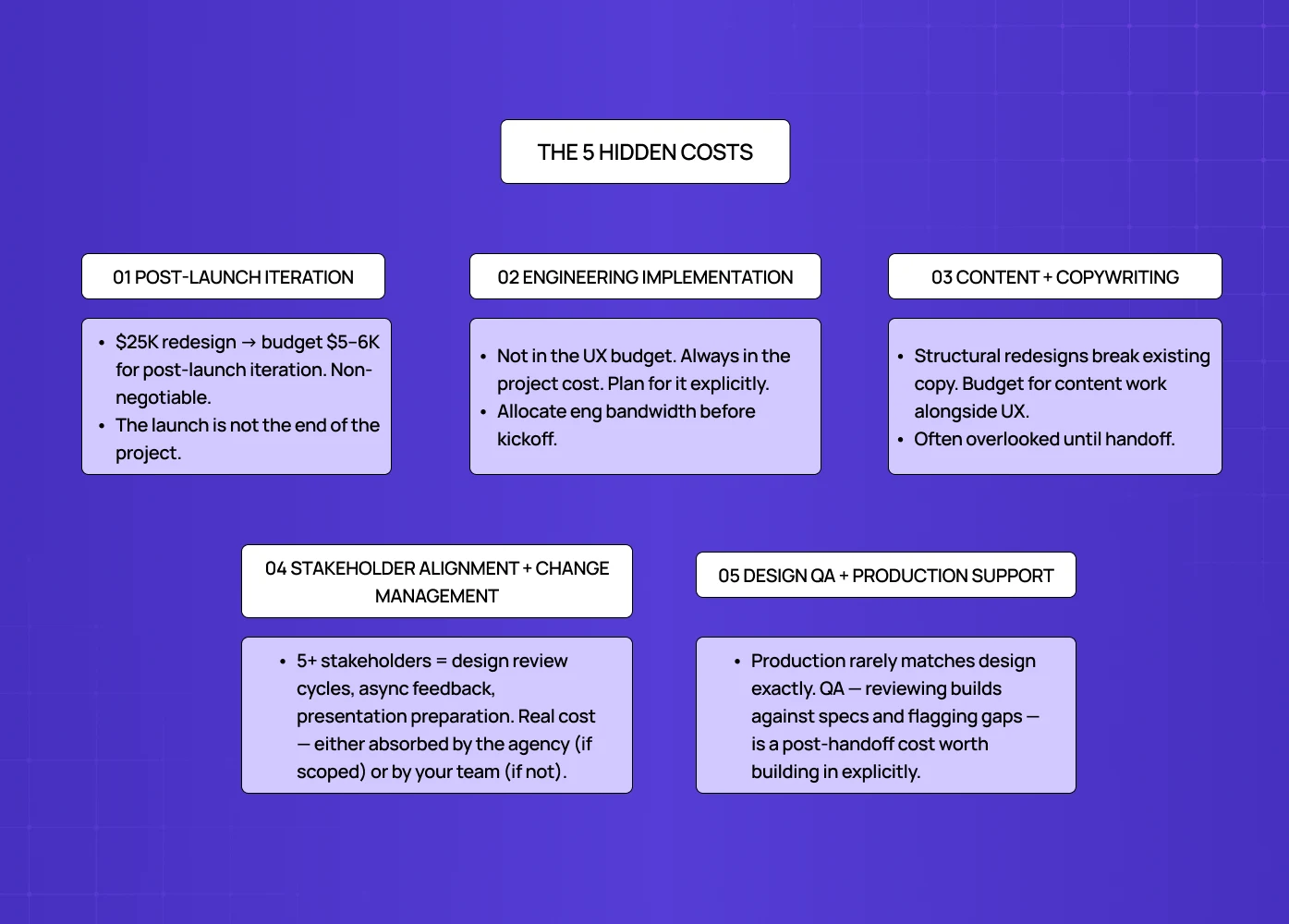
Overview of hidden UX costs including iteration, engineering, content, stakeholder alignment, and QA.

The invoiced cost of a SaaS UX redesign is rarely the total cost. Here's what typically adds up outside the agency's scope:

Post-launch iteration budget

A redesign is a starting point, not a finishing line. Our recommendation is to reserve 15–25% of the initial redesign budget for the first three months post-launch — for A/B tests, user research follow-up, and iteration on flows that underperform after real users interact with them.

Engineering implementation time

A complete redesign requires engineering time to implement. This is often not in the UX budget but absolutely in the project cost. Complex redesigns can take 3–4x the design hours in engineering hours to ship. Plan for it — and for teams evaluating the full development scope alongside design, the guide to SaaS application development covers the engineering side of the cost equation in detail. 

Content and copywriting 

New navigation and IA often requires new microcopy, empty states, error messages, and onboarding copy. If your redesign includes structural changes, budget for content work alongside design work.

Stakeholder alignment and change management 

In organisations with five or more product stakeholders, getting design decisions ratified takes time. Design reviews, async feedback cycles, and presentation preparation are real costs — either absorbed by the agency (if it's in scope) or by your team (if it isn't).

Design QA and production support 

Production rarely matches design exactly. Design QA — reviewing implemented builds against design specs and flagging discrepancies — is a post-handoff cost that's worth building in explicitly.

When Not to Redesign

Most SaaS UX pricing articles assume you've already decided to redesign. We'd be doing you a disservice if we didn't push back on that assumption — and if the timing question isn't fully resolved, the guide to when to redesign your SaaS UX and UI helps you validate the decision before committing budget. 

A full redesign is not always the right tool. Consider iterative improvement first when:

  1. Your analytics show one or two problem areas but overall engagement metrics are healthy. 

A targeted intervention — redesigning a specific onboarding step, improving a dashboard layout — may deliver faster ROI than an end-to-end scope.

  1. Your product is under 12 months old and hasn't been iterated based on real user feedback. 

Redesigning before you've learned what your users actually do in the product is expensive guesswork. Run sessions, review recordings, and ship pointed improvements first.

  1. Your retention problem is driven by product-market fit rather than UX. 

No amount of polish fixes a feature set that doesn't solve the problem. If your churn is telling you users don't need the product, a redesign won't change that.

  1. Your engineering team can't absorb the implementation. 

A beautifully redesigned product that ships 14 months from now while your team is stretched is worse than a moderately improved product that ships in two months.

At Groto, we've turned away work because the diagnosis pointed to targeted iteration rather than full redesign. That conversation is always worth having before a proposal is written. The guide to bad UX design examples and how to fix them gives you a diagnostic lens for distinguishing surface problems from structural ones before you decide on scope. 

How to Measure ROI After a SaaS UX Redesign

One of the most consistent findings from industry research is that 81% of executives say UX matters, but only 59% actually measure its impact post-investment. That gap is where ROI gets lost — not in the design quality, but in the measurement.

Before a redesign begins, align on the metrics that will determine whether the investment delivered. For most SaaS products, the relevant indicators are:

Activation rate 

  • Percentage of new users completing a defined activation event. 

  • Redesigned onboarding should move this measurably within 30–60 days of launch.

Time-to-value 

  • How long from signup to first meaningful action.

  • Structural redesigns targeting onboarding complexity should compress this. If it doesn't change, the bottleneck was elsewhere.

30 and 60-day retention

  • The lagging indicator of UX quality. 

  • Meaningful improvements typically show 8–12 weeks post-launch.

Support ticket volume by category

  • Navigation confusion, feature discoverability, and empty state handling all generate support load. 

  • A good redesign should reduce support tickets in the categories it addressed.

NPS or CSAT delta

  • Not a reliable leading indicator (too slow), but a useful confirmation signal 90 days out.

Our work on Camb.ai's interface delivered measurable improvements across activation and engagement metrics within 45 days of launch. The measurement framework was agreed before a single screen was designed. 

Conclusion: Getting the Budget Right Starts With Getting the Depth Right

The SaaS UX redesign cost conversation is being poorly served by generic pricing guides that blend website, app, and SaaS pricing into single tables. The real question isn't "how much does a redesign cost?" — it's "what depth of redesign does our product actually need, and what will the outcome justify?"

A few things worth taking away:

  • Budget by funding stage is a useful starting point, but depth level is the more precise anchor — a Seed-stage product can need Level 3 work, and a Series B product can need only Level 2.

  • SaaS-specific cost drivers — dashboards, role-based UX, integration complexity — consistently add 20–40% to baseline estimates. Flag them early.

  • Reserve 15–25% of your initial budget for post-launch iteration. The redesign launch is not the end of the project.

  • If your metrics point to one or two problem areas, explore targeted intervention before full redesign — it's faster, cheaper, and often sufficient.

  • Measure before you design and after you launch. The 59% of companies that don't measure UX ROI are leaving the business case on the table.

If your team is preparing a redesign brief, evaluating proposals, or trying to calibrate what a fair scope looks like for your stage and complexity — that's exactly the conversation we run in our discovery calls. And if you're still building your agency shortlist before those calls, the practical checklist for choosing the right design agency gives you the evaluation framework to run a rigorous comparison. 
Book a discovery call →

Most agencies hand you a number and call it a quote. We break down SaaS UX redesign cost by depth, stage, and scope — so you know exactly what you're buying before you sign.

What a SaaS UX redesign actually costs — and what you're paying for.

Isometric illustration of SaaS architecture with cloud, database, security, and connected systems.

The question most SaaS founders and product leads ask us isn't "should we redesign?" It's "how do we explain the budget to the board?"

And that's where most agencies fail them. You get a number — $40,000, $75,000, $120,000 — with a vague scope attached. You're told it depends on complexity. You're sent a proposal that reads like it was generated for a different product in a different industry. The real SaaS UX redesign cost conversation — the one that accounts for your product's actual architecture, your users' actual workflows, and what a surface-level refresh versus a structural overhaul actually involves — rarely happens up4147front.

It should happen before you sign anything. This is that conversation.

Forrester research puts the ROI of UX investment at $100 returned for every $1 spent. But that number is meaningless without a framework for knowing what level of redesign you actually need — and therefore what you're actually budgeting for. At Groto, we've run UX redesigns for SaaS products from Series A to enterprise scale, across fintech, edtech, HR, and analytics platforms. What we've learned is that the cost question is really a depth question. Get the depth right, and the budget becomes defensible. If you're still in the validation stage — asking whether a redesign is needed rather than what it costs — the guide to 5 signs your SaaS website needs a redesign is the right starting point. 

What a SaaS UX Redesign Actually Involves (It's Not a Website Redesign)

Before pricing anything, a distinction worth making: a SaaS UX redesign is not a website redesign. They are different problems with different complexity profiles.

A website redesign touches pages. A SaaS UX redesign touches systems — user flows across multiple states, role-based access controls, onboarding sequences, data-heavy dashboards, integration touchpoints, and the internal logic that connects them. When a competitor's "pricing guide" quotes you $8,000–$25,000 for a UI refresh and blends that with website redesign pricing, they're conflating categorically different projects.

The scope of a SaaS product redesign typically includes some combination of:

  • User research and discovery (interviews, analytics review, session recordings, heatmap analysis)

  • Information architecture restructuring (how modules relate, how navigation works at scale)

  • Interaction design across core workflows (onboarding, activation, key feature flows)

  • Component library and design system work (if you want to ship faster and maintain quality after launch)

  • Dashboard and data visualisation redesign (often the most complex and most underpriced component)

  • Prototype testing and iteration before handoff

  • Developer collaboration and handoff documentation

Not every redesign requires all of these. Which ones you need — and how deeply — determines the cost. That's the framework we'll use. For a complete picture of what SaaS UX design involves across the full product lifecycle — from onboarding through retention — the complete guide to SaaS UX design provides the foundational context before scoping any investment. 

SaaS UX Redesign Cost by Funding Stage

Breakdown of SaaS funding stages (Pre-seed to Enterprise) with typical costs, timelines, and redesign depth.

Cost ranges are meaningful only when anchored to context. A seed-stage SaaS with 200 users redesigning their MVP activation flow has a different problem — and a different appropriate budget — than a Series B product with 50,000 users, a legacy dashboard, and a retention problem driven by navigation complexity.

Here's how SaaS UX redesign cost typically maps to funding stage, based on market rates and our own project data:

Funding Stage

Typical Scope

Cost Range

Timeline

Pre-seed / Seed

MVP flows, core onboarding, 10–20 screens

$8,000–$25,000

4–8 weeks

Series A

Full product audit + key flow redesign, design system foundations

$25,000–$60,000

8–14 weeks

Series B / Growth

Comprehensive redesign + design system + handoff

$60,000–$100,000

12–20 weeks

Enterprise / Scale

Full platform redesign, multi-role, complex integrations

$100,000–$150,000+

20–32 weeks

These ranges assume a specialist SaaS design agency working with a clear brief. Freelancers at the low end of the market can reduce cost by 40–60%, with corresponding reductions in research depth, handoff quality, and design system maturity. Enterprise consultancies at the high end can push budgets above these figures — especially when research, stakeholder management, and change management are scoped in. The web design agency pricing guide breaks down how agencies structure fees across these engagement types in detail.

At Groto, our Series A and B engagements typically sit in the $30,000–$85,000 range depending on scope, and we're consistently able to point to outcomes: our clients have collectively raised $8M+ off the back of products we've built or redesigned, and we've delivered 40–60% improvements in user flow completion rates across multiple SaaS products. For a broader view of how the agencies in this space compare by rate, specialisation, and engagement model, the guide to UX design companies for SaaS products maps the market. 

The Redesign Depth Framework: What Level Does Your Product Need?

Framework showing five levels of SaaS redesign from visual refresh to full platform repositioning with costs.

Funding stage tells you budget range. But the depth of the redesign tells you how to spend it. This is the framework we use at Groto before scoping any engagement — five levels of redesign depth, each with a distinct cost profile and set of appropriate use cases. For teams who also want to understand how the redesign process unfolds step by step — not just what it costs at each level — that guide covers the execution sequence in detail. 

Level 1 — Surface Redesign ($8,000–$25,000)

  • Visual refresh only. Typography, colour system, spacing, component styling. 

  • The underlying information architecture, navigation, and core workflows stay intact.

  • Appropriate when your product's usability is fundamentally sound but the visual language has dated, a rebrand has happened, or you need to close the perception gap with competitors.

What Surface doesn't fix: conversion problems, onboarding drop-off, navigation confusion, or any issue rooted in how the product is structured rather than how it looks.

Level 2 — Skeleton Redesign ($20,000–$45,000)

  • Visual + interface layout and navigation patterns. 

  • Where Surface touches styling, Skeleton restructures how screens are laid out and how the user moves between them. 

Common applications: consolidating a cluttered sidebar, redesigning a dashboard from card-based to analytics-first, improving the structure of a settings area that's become a dumping ground.

Level 3 — Structure Redesign ($40,000–$75,000)

  • This is where most growth-stage SaaS redesigns land. 

  • Structure addresses the information architecture — how modules relate to each other, how user roles experience different versions of the product, how onboarding sequences are designed to build habit rather than just complete setup. 

  • It includes design system work, component documentation, and handoff that engineering teams can actually use.

At this level, we typically run four to six weeks of research before a line of UI is designed. Our work on PolicyBazaar's flows involved a full IA restructure at this depth — the result was a measurably shorter time-to-value for new users and a reduction in support tickets that were previously routing users to help docs for navigation questions. For a detailed look at what quality SaaS product design delivers at this level — the patterns and practices that separate effective structural redesigns from expensive polishing exercises — that guide is useful grounding. 

Level 4 — Scope Redesign ($70,000–$120,000)

  • The product's feature set itself is part of the problem. 

  • At this level, Scope-level redesign involves defining or redefining what the product does — removing features that create confusion, restructuring how core capabilities are packaged and presented, aligning the product's language with how users actually describe their problems. 

  • This requires significant research investment and stakeholder alignment work alongside the design work.

Level 5 — Strategy Redesign ($100,000–$150,000+)

  • Full platform repositioning. 

  • The product's goals, audience, and competitive differentiation are reconsidered as part of the redesign process. 

  • Rare for early-stage companies. 

  • Most relevant when a mature product has accumulated years of scope creep, faces a competitor threat to its core positioning, or is expanding to a new market segment.

SaaS-Specific Cost Drivers That Inflate Budgets

Generic UX pricing guides quote rates and page counts. Neither accounts for what makes SaaS design expensive. These are the factors that consistently push budgets upward — and that you should discuss explicitly with any agency before scoping.

Data-heavy dashboards 

Designing a dashboard that communicates insight rather than just displaying data is among the most time-intensive UX work in enterprise SaaS. Chart type selection, drill-down architecture, filter logic, empty states, loading states, and responsive behaviour across screen sizes — each of these requires design decisions that take meaningful time. Underpriced dashboards are the single most common cause of scope creep we see in competitor handoffs.

Role-based access and permissioning 

A product that presents differently to an admin, a manager, and an end user isn't three products — but it's close to three design tracks. Every screen that has conditional rendering logic requires design coverage across states. If your product has three or more roles with meaningfully different UIs, expect 20–35% added scope.

Multi-step onboarding with integration complexity 

Onboarding for a SaaS product that connects to Salesforce, Slack, or an API is not onboarding for a standalone app. Integration setup flows, authentication states, error handling, and the edge cases around partial setups add design time that generic pricing models don't account for.

Design system maturity

Projects that inherit no design system are faster to start but slower to finish — every component needs to be designed from scratch and then documented. Projects inheriting a poorly maintained legacy design system often require an audit and partial rebuild before the redesign can proceed efficiently. Both scenarios add cost — and if your product is in this situation, understanding how much a UX audit costs as a standalone exercise helps you separate the pre-redesign diagnostic spend from the redesign budget itself. 

Engineering collaboration depth

Some clients have strong frontend engineers who own implementation. Others need handoff documentation, annotation, and active design QA during development. If Groto is expected to be in the room during implementation sprints, that time is in scope.

The Hidden Costs Nobody Quotes Upfront

Overview of hidden UX costs including iteration, engineering, content, stakeholder alignment, and QA.

The invoiced cost of a SaaS UX redesign is rarely the total cost. Here's what typically adds up outside the agency's scope:

Post-launch iteration budget

A redesign is a starting point, not a finishing line. Our recommendation is to reserve 15–25% of the initial redesign budget for the first three months post-launch — for A/B tests, user research follow-up, and iteration on flows that underperform after real users interact with them.

Engineering implementation time

A complete redesign requires engineering time to implement. This is often not in the UX budget but absolutely in the project cost. Complex redesigns can take 3–4x the design hours in engineering hours to ship. Plan for it — and for teams evaluating the full development scope alongside design, the guide to SaaS application development covers the engineering side of the cost equation in detail. 

Content and copywriting 

New navigation and IA often requires new microcopy, empty states, error messages, and onboarding copy. If your redesign includes structural changes, budget for content work alongside design work.

Stakeholder alignment and change management 

In organisations with five or more product stakeholders, getting design decisions ratified takes time. Design reviews, async feedback cycles, and presentation preparation are real costs — either absorbed by the agency (if it's in scope) or by your team (if it isn't).

Design QA and production support 

Production rarely matches design exactly. Design QA — reviewing implemented builds against design specs and flagging discrepancies — is a post-handoff cost that's worth building in explicitly.

When Not to Redesign

Most SaaS UX pricing articles assume you've already decided to redesign. We'd be doing you a disservice if we didn't push back on that assumption — and if the timing question isn't fully resolved, the guide to when to redesign your SaaS UX and UI helps you validate the decision before committing budget. 

A full redesign is not always the right tool. Consider iterative improvement first when:

  1. Your analytics show one or two problem areas but overall engagement metrics are healthy. 

A targeted intervention — redesigning a specific onboarding step, improving a dashboard layout — may deliver faster ROI than an end-to-end scope.

  1. Your product is under 12 months old and hasn't been iterated based on real user feedback. 

Redesigning before you've learned what your users actually do in the product is expensive guesswork. Run sessions, review recordings, and ship pointed improvements first.

  1. Your retention problem is driven by product-market fit rather than UX. 

No amount of polish fixes a feature set that doesn't solve the problem. If your churn is telling you users don't need the product, a redesign won't change that.

  1. Your engineering team can't absorb the implementation. 

A beautifully redesigned product that ships 14 months from now while your team is stretched is worse than a moderately improved product that ships in two months.

At Groto, we've turned away work because the diagnosis pointed to targeted iteration rather than full redesign. That conversation is always worth having before a proposal is written. The guide to bad UX design examples and how to fix them gives you a diagnostic lens for distinguishing surface problems from structural ones before you decide on scope. 

How to Measure ROI After a SaaS UX Redesign

One of the most consistent findings from industry research is that 81% of executives say UX matters, but only 59% actually measure its impact post-investment. That gap is where ROI gets lost — not in the design quality, but in the measurement.

Before a redesign begins, align on the metrics that will determine whether the investment delivered. For most SaaS products, the relevant indicators are:

Activation rate 

  • Percentage of new users completing a defined activation event. 

  • Redesigned onboarding should move this measurably within 30–60 days of launch.

Time-to-value 

  • How long from signup to first meaningful action.

  • Structural redesigns targeting onboarding complexity should compress this. If it doesn't change, the bottleneck was elsewhere.

30 and 60-day retention

  • The lagging indicator of UX quality. 

  • Meaningful improvements typically show 8–12 weeks post-launch.

Support ticket volume by category

  • Navigation confusion, feature discoverability, and empty state handling all generate support load. 

  • A good redesign should reduce support tickets in the categories it addressed.

NPS or CSAT delta

  • Not a reliable leading indicator (too slow), but a useful confirmation signal 90 days out.

Our work on Camb.ai's interface delivered measurable improvements across activation and engagement metrics within 45 days of launch. The measurement framework was agreed before a single screen was designed. 

Conclusion: Getting the Budget Right Starts With Getting the Depth Right

The SaaS UX redesign cost conversation is being poorly served by generic pricing guides that blend website, app, and SaaS pricing into single tables. The real question isn't "how much does a redesign cost?" — it's "what depth of redesign does our product actually need, and what will the outcome justify?"

A few things worth taking away:

  • Budget by funding stage is a useful starting point, but depth level is the more precise anchor — a Seed-stage product can need Level 3 work, and a Series B product can need only Level 2.

  • SaaS-specific cost drivers — dashboards, role-based UX, integration complexity — consistently add 20–40% to baseline estimates. Flag them early.

  • Reserve 15–25% of your initial budget for post-launch iteration. The redesign launch is not the end of the project.

  • If your metrics point to one or two problem areas, explore targeted intervention before full redesign — it's faster, cheaper, and often sufficient.

  • Measure before you design and after you launch. The 59% of companies that don't measure UX ROI are leaving the business case on the table.

If your team is preparing a redesign brief, evaluating proposals, or trying to calibrate what a fair scope looks like for your stage and complexity — that's exactly the conversation we run in our discovery calls. And if you're still building your agency shortlist before those calls, the practical checklist for choosing the right design agency gives you the evaluation framework to run a rigorous comparison. 

Book a discovery call →

Have a project in mind?

Let’s talk through your idea and see what makes sense.

Harpreet Singh

Founder at Groto

Have a project in mind?

Let’s talk through your idea and see what makes sense.

Harpreet Singh

Founder at Groto

FAQ

Everything you were going to ask (and a few things you didn’t know to)

1. How much does a SaaS UX redesign cost in 2025–2026?

SaaS UX redesign cost ranges from $8,000 for a surface-level visual refresh to $150,000+ for a full platform strategy redesign. For funded SaaS companies, the most common engagement range sits between $25,000 and $85,000 depending on funding stage and scope complexity.


2. What's the difference between a website redesign and a SaaS product redesign?

A website redesign addresses pages. A SaaS product redesign addresses systems — multi-state flows, user roles, onboarding sequences, dashboards, and the logic connecting them. Pricing that conflates the two will almost always underestimate SaaS project scope.

3. What drives SaaS UX redesign cost beyond screen count?

The most significant cost drivers are data-heavy dashboard complexity, role-based access that creates multiple UI tracks, integration setup flows, design system maturity, and engineering collaboration depth. These factors can add 20–40% to estimates built on screen count alone.

4. How do I know if I need a full redesign or just targeted UX improvements?

A full redesign is warranted when the product's information architecture, navigation structure, or core workflow logic is the source of user friction — not just the visual design. If analytics show broad disengagement across multiple flows, or if qualitative research surfaces systematic confusion rather than isolated pain points, structural redesign is appropriate. A structured UX audit is the most efficient way to make this determination before committing to full redesign scope — the guide to how to do a UX audit covers the steps and tools involved. 

5. What should I budget for post-launch after a SaaS UX redesign?

Reserve 15–25% of your initial redesign budget for the three months following launch. This covers A/B testing, user research follow-up, and iteration on flows that underperform with real users. A redesign launch is a starting point, not a finished product.

6. How do you measure the ROI of a SaaS UX redesign?

Align on metrics before the redesign begins — not after launch. The most reliable indicators are activation rate, time-to-value, 30 and 60-day retention, support ticket volume in categories the redesign addressed, and NPS or CSAT delta at 90 days. Companies that define success metrics upfront are significantly more likely to report positive ROI.

1. How much does a SaaS UX redesign cost in 2025–2026?

SaaS UX redesign cost ranges from $8,000 for a surface-level visual refresh to $150,000+ for a full platform strategy redesign. For funded SaaS companies, the most common engagement range sits between $25,000 and $85,000 depending on funding stage and scope complexity.

2. What's the difference between a website redesign and a SaaS product redesign?

A website redesign addresses pages. A SaaS product redesign addresses systems — multi-state flows, user roles, onboarding sequences, dashboards, and the logic connecting them. Pricing that conflates the two will almost always underestimate SaaS project scope.

3. What drives SaaS UX redesign cost beyond screen count?

The most significant cost drivers are data-heavy dashboard complexity, role-based access that creates multiple UI tracks, integration setup flows, design system maturity, and engineering collaboration depth. These factors can add 20–40% to estimates built on screen count alone.

4. How do I know if I need a full redesign or just targeted UX improvements?

A full redesign is warranted when the product's information architecture, navigation structure, or core workflow logic is the source of user friction — not just the visual design. If analytics show broad disengagement across multiple flows, or if qualitative research surfaces systematic confusion rather than isolated pain points, structural redesign is appropriate. A structured UX audit is the most efficient way to make this determination before committing to full redesign scope — the guide to how to do a UX audit covers the steps and tools involved. 

5. What should I budget for post-launch after a SaaS UX redesign?

Reserve 15–25% of your initial redesign budget for the three months following launch. This covers A/B testing, user research follow-up, and iteration on flows that underperform with real users. A redesign launch is a starting point, not a finished product.

6. How do you measure the ROI of a SaaS UX redesign?

Align on metrics before the redesign begins — not after launch. The most reliable indicators are activation rate, time-to-value, 30 and 60-day retention, support ticket volume in categories the redesign addressed, and NPS or CSAT delta at 90 days. Companies that define success metrics upfront are significantly more likely to report positive ROI.

More Articles

Extreme close-up black and white photograph of a human eye

Let’s bring your vision to life

Tell us what's on your mind? We'll hit you back in 24 hours. No fluff, no delays - just a solid vision to bring your idea to life.

Profile portrait of a man in a white shirt against a light background

Harpreet Singh

Founder and Creative Director

Get in Touch

Extreme close-up black and white photograph of a human eye

Let’s bring your vision to life

Tell us what's on your mind? We'll hit you back in 24 hours. No fluff, no delays - just a solid vision to bring your idea to life.

Profile portrait of a man in a white shirt against a light background

Harpreet Singh

Founder and Creative Director

Get in Touch

Extreme close-up black and white photograph of a human eye

Let’s bring your vision to life

Tell us what's on your mind? We'll hit you back in 24 hours. No fluff, no delays - just a solid vision to bring your idea to life.

Profile portrait of a man in a white shirt against a light background

Harpreet Singh

Founder and Creative Director

Get in Touch