Most products don't fail because of bad design. They fail because design had no direction. Design strategy is the framework that changes that — turning creative decisions into measurable business outcomes.
Design strategy is what separates design that looks good from design that delivers.

Most products don't fail because of bad design. They fail because design had no direction.
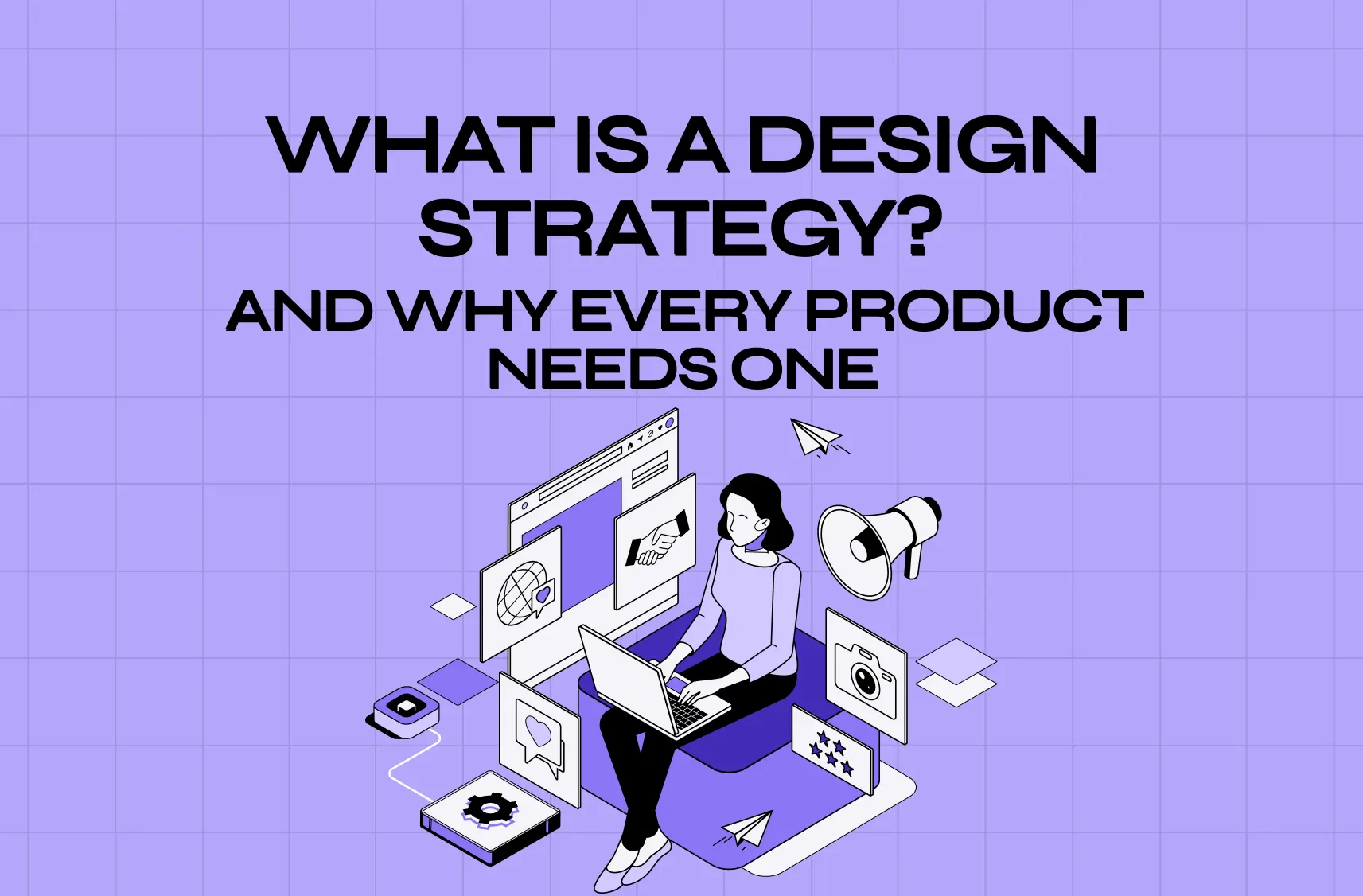
A design strategy is the bridge between what a business wants to achieve and what users actually need. It is the plan that ensures every design decision — from the layout of a landing page to the flow of an onboarding experience — serves a measurable purpose. Without it, even the most visually polished product can miss the mark entirely.
This blog breaks down what design strategy means, why it matters, and how to build one that actually works.
What Is Design Strategy?
At its core, design strategy is the intentional alignment of design thinking with business objectives, grounded in the design thinking process as a repeatable method rather than ad-hoc creativity. It is not just about aesthetics or usability in isolation. It is about making design decisions that are grounded in user research, business context, and measurable outcomes.
Think of it as the strategy definition applied to the creative process — a framework that tells a design team not just what to build, but why and for whom.
The term sits at the intersection of corporate strategy (how a business plans to achieve its long-term goals) and design thinking — one of several UX design methodologies that structure how teams research, frame, and solve problems. When the two come together, the result is a process that is both creative and strategic — purposeful in every step.
Why Design Strategy Matters
Design without strategy is decoration. Strategy without design is a document no one reads. The combination is where real product value gets created. The McKinsey Design Index tracked over 300 public companies and found that those with strong design commitment delivered 32% more revenue and 56% higher total returns to shareholders over five years. Forrester puts the ROI of systematically implemented design thinking above 85%. These are not design outcomes — they are business outcomes, driven by strategic intent.
Here is why a strong design strategy framework makes the difference:
It aligns teams around shared outcomes. When designers, developers, product managers, and stakeholders all work from the same strategic plan, fewer decisions get made in silos. The design process becomes collaborative by default, not by effort.
It reduces wasted iterations. A strategy sets clear success metrics upfront. Teams stop designing by assumption and start designing by intent — which means fewer rounds of revision and a shorter path to a product that works.IBM found that every dollar invested in UX returns up to 100 dollars — and calculating the ROI of UX design across the full product lifecycle shows that ratio only holds when design is working toward defined goals, not just aesthetic improvement.
It keeps the user at the center. User-centered design is not a phase. It is a stance. A design strategy embeds empathy and user research into every decision, so the end product serves real needs rather than internal assumptions.
It demonstrates design's business value. When design decisions are tied to outcomes — activation rates, conversion rates, retention — the impact of design becomes measurable and defensible.
Design Strategy vs. Business Strategy
Aspects | Design Strategy | Business Strategy |
Focus | User experience and product interaction | Market position and revenue growth |
Operates at | The product and experience level | The organisational level |
Key questions | How does this feel to the user? | Where should we compete and how do we win? |
Output | Interfaces, journeys, and design systems | Business models, competitive plans, financial goals |
Measures success by | Engagement, retention, usability metrics | Revenue, market share, profitability |
Works best when | Informed by business objectives | Expressed through intentional design |
Design Strategy vs. UX Strategy: What's the Difference?
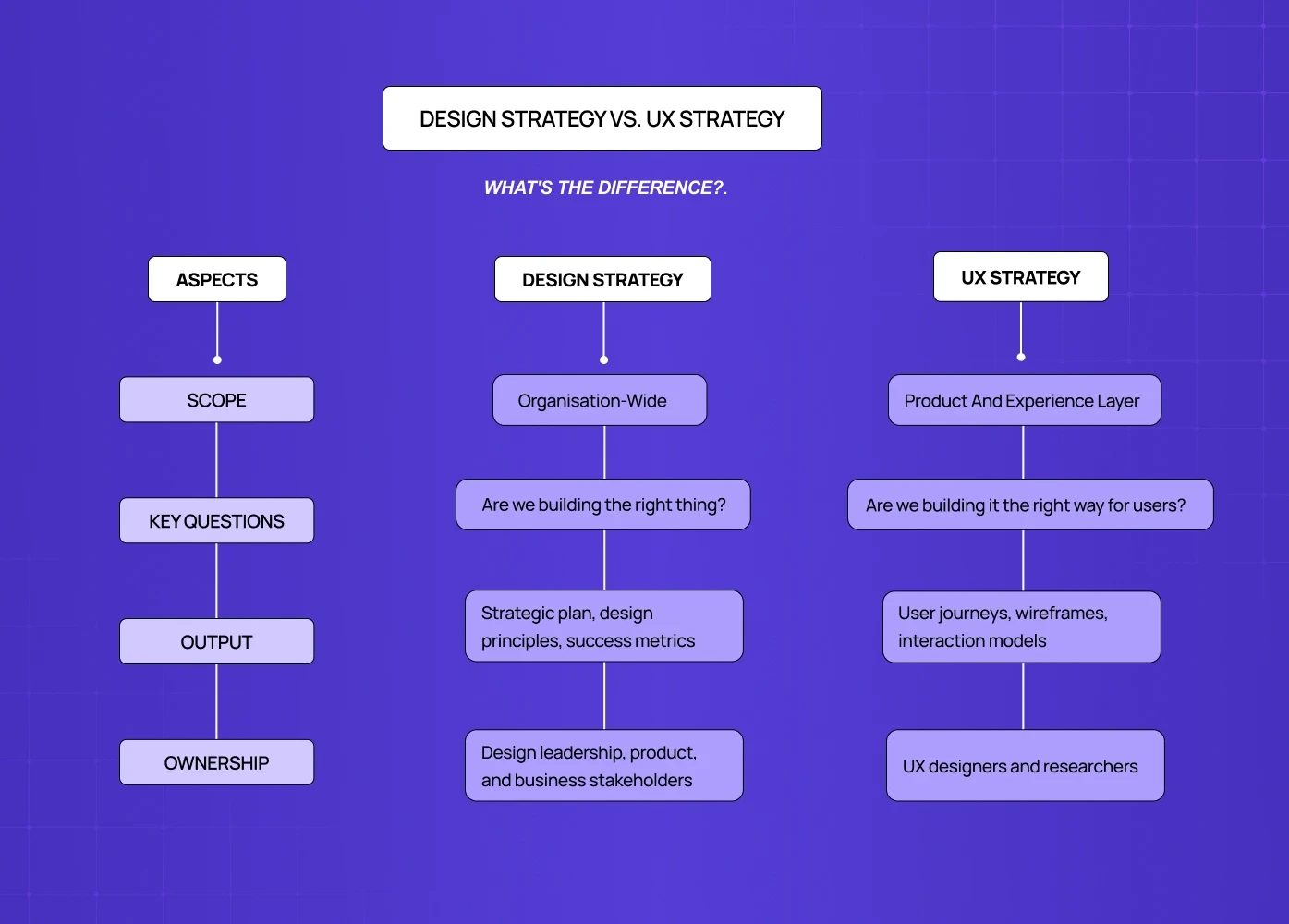
These two are often used interchangeably, but they operate at different levels of scope and ownership.
Design strategy is the overarching plan — it answers whether you are building the right thing, for the right people, in service of the right business goals. UX strategy sits within that. It focuses specifically on the user experience layer: how interactions are structured, how journeys flow, and how usability decisions map to user needs.
Design strategy informs UX strategy, not the reverse — and the UI/UX strategy frameworks top agencies use all start from that same sequencing principle. You need the broader strategic direction before you can make good UX decisions.
Aspects | Design Strategy | UX Strategy |
Scope | Organisation-wide | Product and experience layer |
Key question | Are we building the right thing? | Are we building it the right way for users? |
Output | Strategic plan, design principles, success metrics | User journeys, wireframes, interaction models |
Ownership | Design leadership, product, and business stakeholders | UX designers and researchers |
Core Components of a Design Strategy
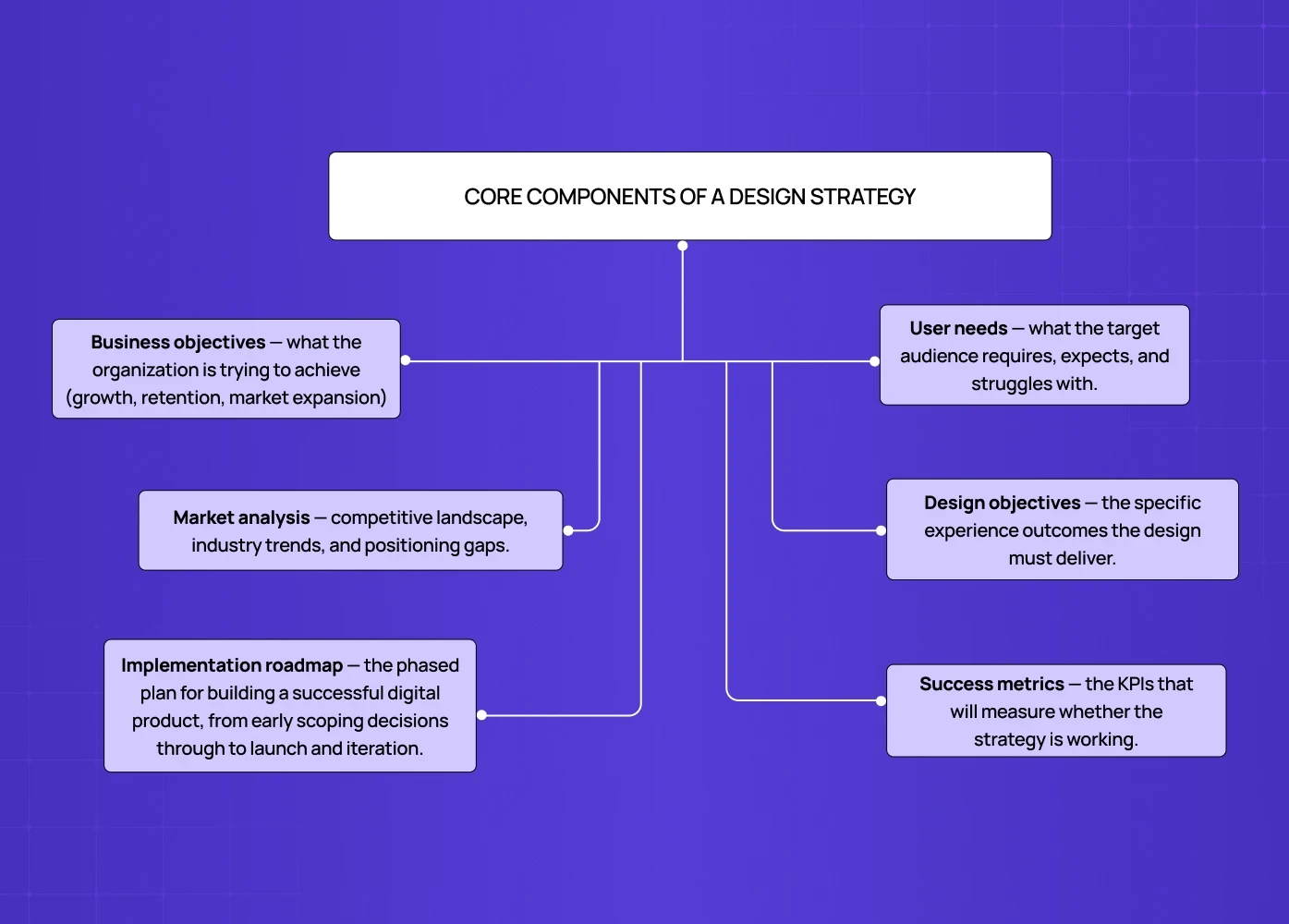
A well-built design strategy is not a single document. It is a living framework that includes:
Business objectives — what the organization is trying to achieve (growth, retention, market expansion)
User needs — what the target audience requires, expects, and struggles with
Market analysis — competitive landscape, industry trends, and positioning gaps, sharpened by a competitive UX audit of how rivals handle the same journeys
Design objectives — the specific experience outcomes the design must deliver, the kind a brief template captures so they're documented, not assumed
Implementation roadmap — the phased plan for building a successful digital product, from early scoping decisions through to launch and iteration
Success metrics — the KPIs that will measure whether the strategy is working
Each element informs the others. A design strategy that has clear business objectives but no user research is incomplete. One with strong user insights but no measurable outcomes cannot prove its value.
Where Design Strategy Has Influence
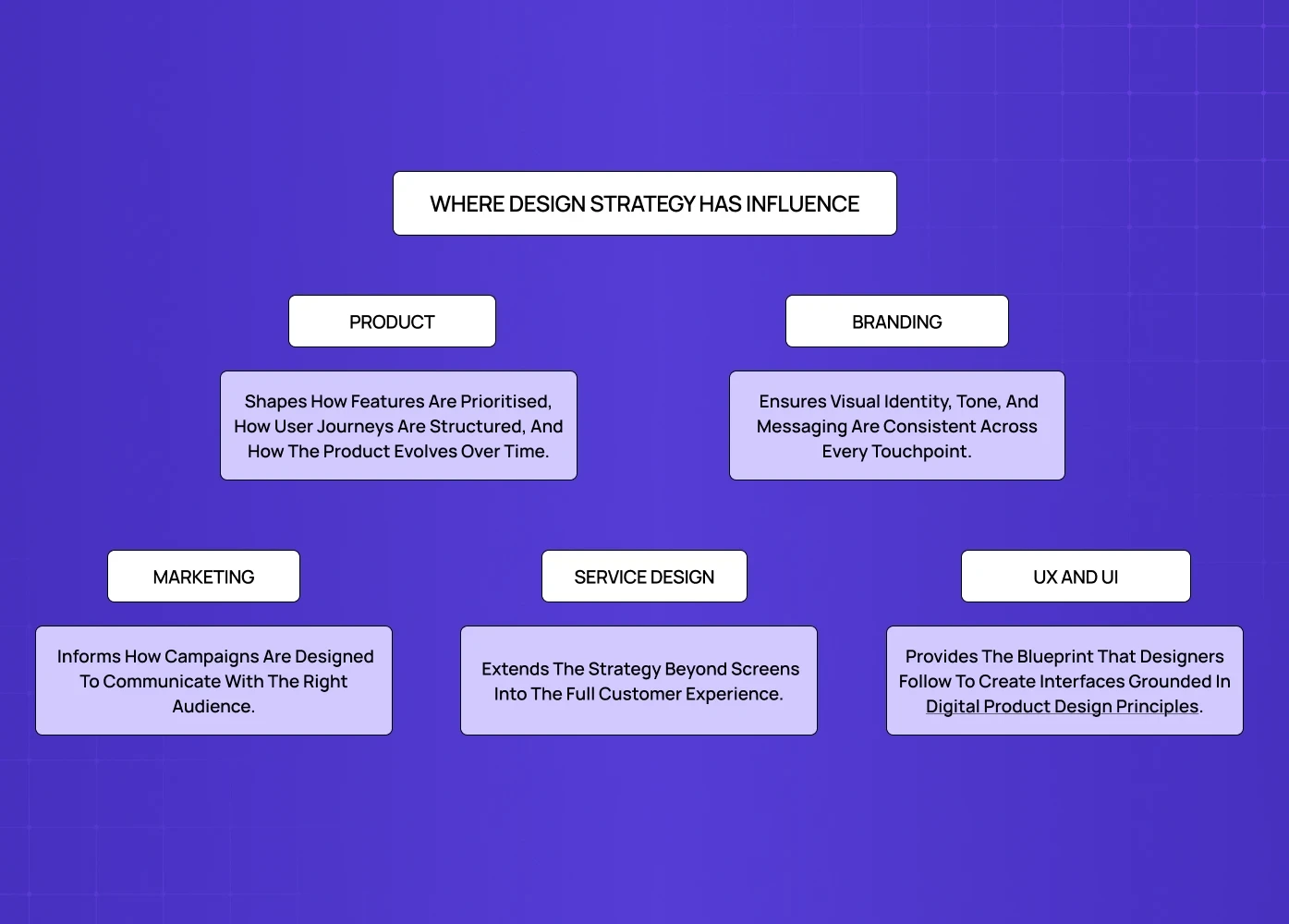
Design strategy does not live in one department. When implemented well, its influence extends across the entire organisation — cutting across the full range of UX disciplines rather than staying contained within a single team:
Product — shapes how features are prioritised, how user journeys are structured, and how the product evolves over time, sitting at the intersection of where UX design and product design converge in practice
Branding — ensures visual identity, tone, and messaging are consistent across every touchpoint, often operationalised through design systems for SaaS products that build recognition and trust at scale
Marketing — informs how campaigns are designed to communicate with the right audience, in the right way, at the right moment
Service design — extends the strategy beyond screens into the full customer experience, including support, onboarding, and offboarding
UX and UI — provides the blueprint that designers follow to create interfaces grounded in digital product design principles, intuitive to use, and aligned with both user needs and business goals
The wider the influence, the more cohesive the experience. Companies that treat design strategy as a product-only concern miss the compounding effect of consistent, strategic design across every surface a user encounters — the consistency an organization-wide design system is built to enforce.
How to Build a Design Strategy: A Framework
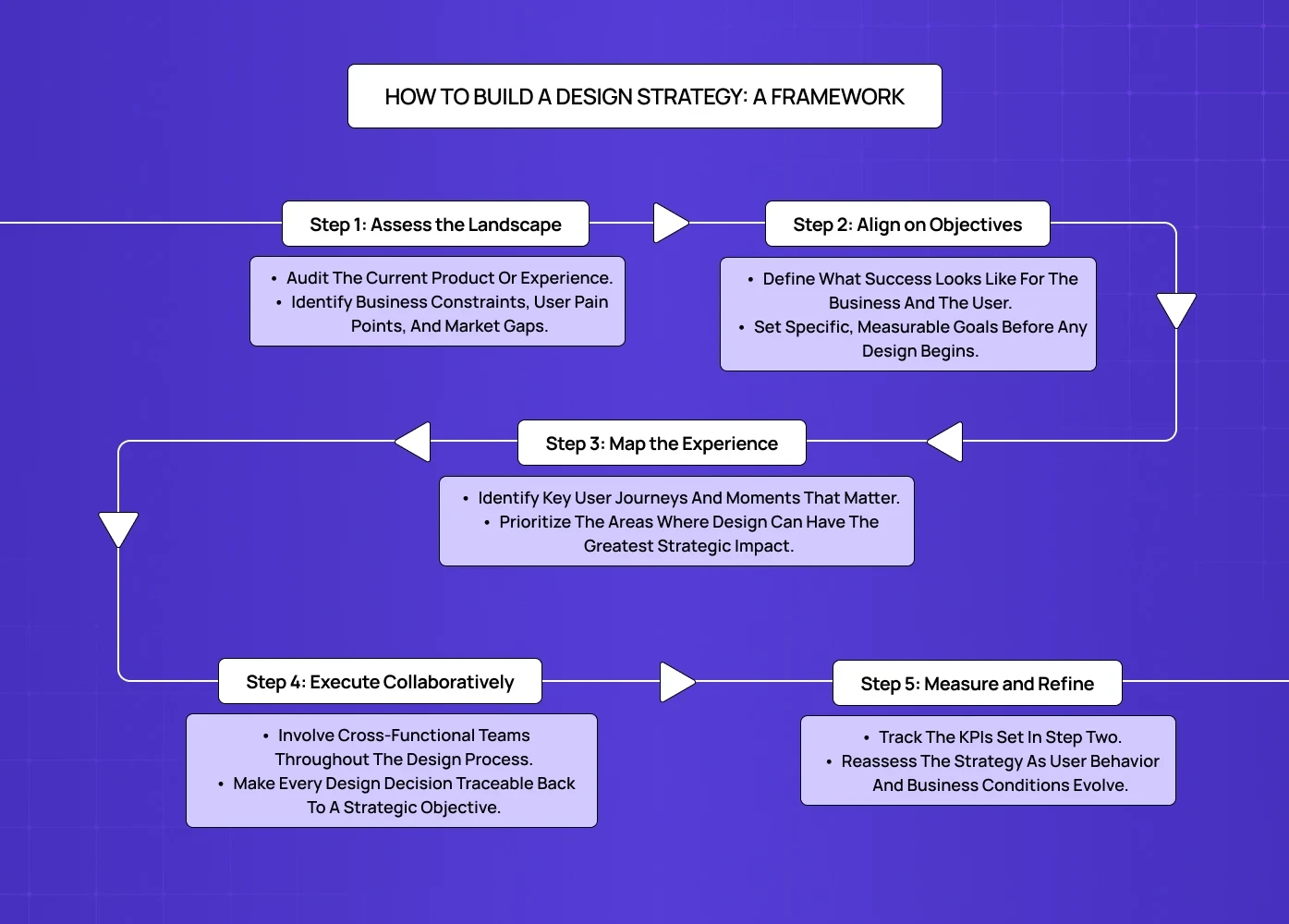
The UX design process gives us the human-centered foundation. Strategic thinking gives us the discipline to act on it with purpose. Here is a practical five-step design strategy framework:
Step 1: Assess the Landscape
Audit the current product or experience
Identify business constraints, user pain points, and market gaps
Use research tools to synthesize signals quickly
Step 2: Align on Objectives
Define what success looks like for the business and the user
Set specific, measurable goals before any design begins — and capture them in a design brief the full team can align around
Ensure stakeholders and designers are working toward the same outcomes
Step 3: Map the Experience
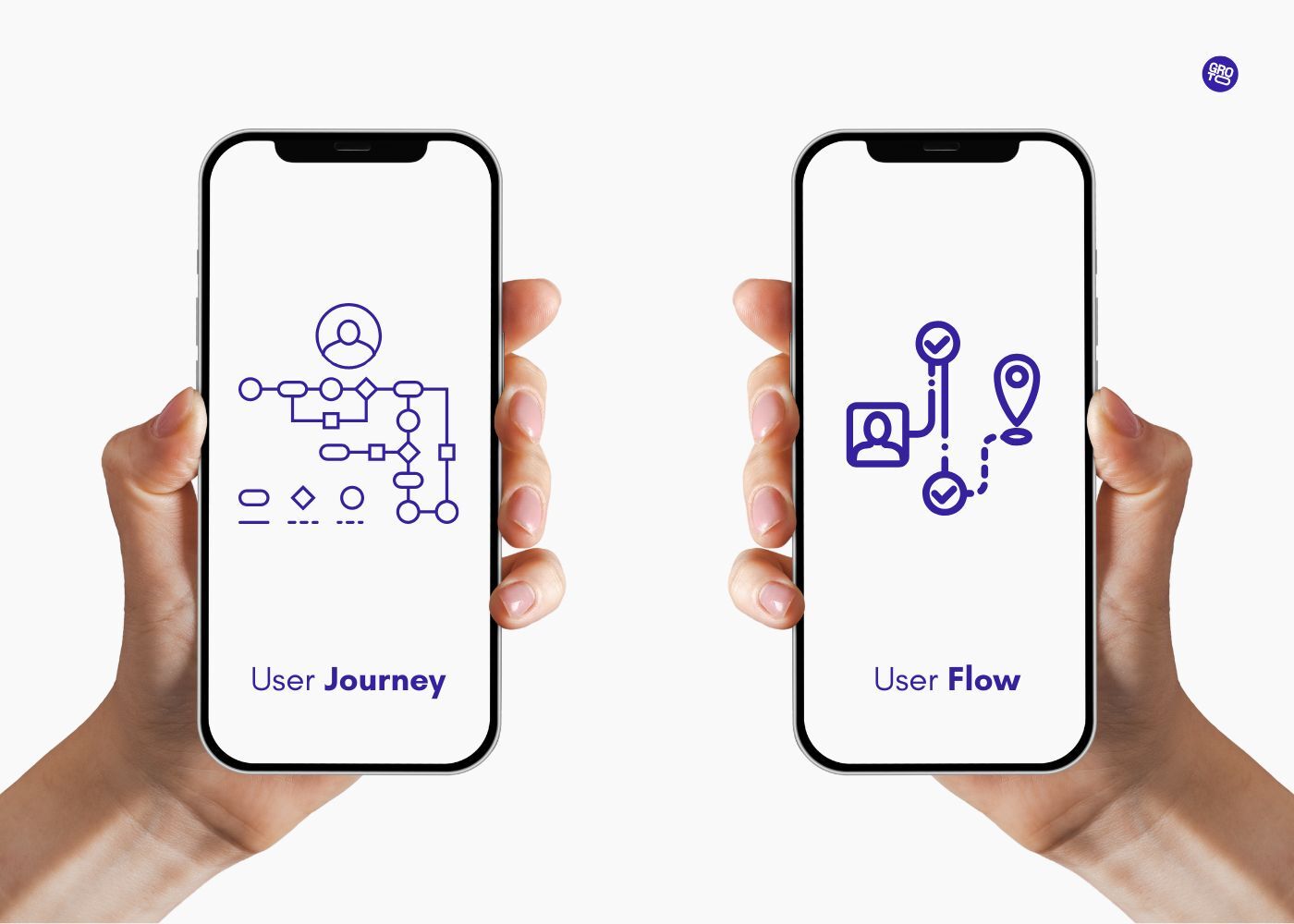
Identify key user journeys and moments that matter
Prioritize the areas where design can have the greatest strategic impact
Define the scope of the design effort clearly — and assessing your team against an inclusive design strategy maturity framework at this stage ensures accessibility is scoped in from the start rather than added after the experience map is already locked.
Step 4: Execute Collaboratively
Involve cross-functional teams throughout the design process — including product designers, developers, and stakeholders who each bring different lenses to execution
Make every design decision traceable back to a strategic objective
Build, test, and iterate — but always against defined metrics
Step 5: Measure and Refine
Track the KPIs set in step two
Reassess the strategy as user behavior and business conditions evolve
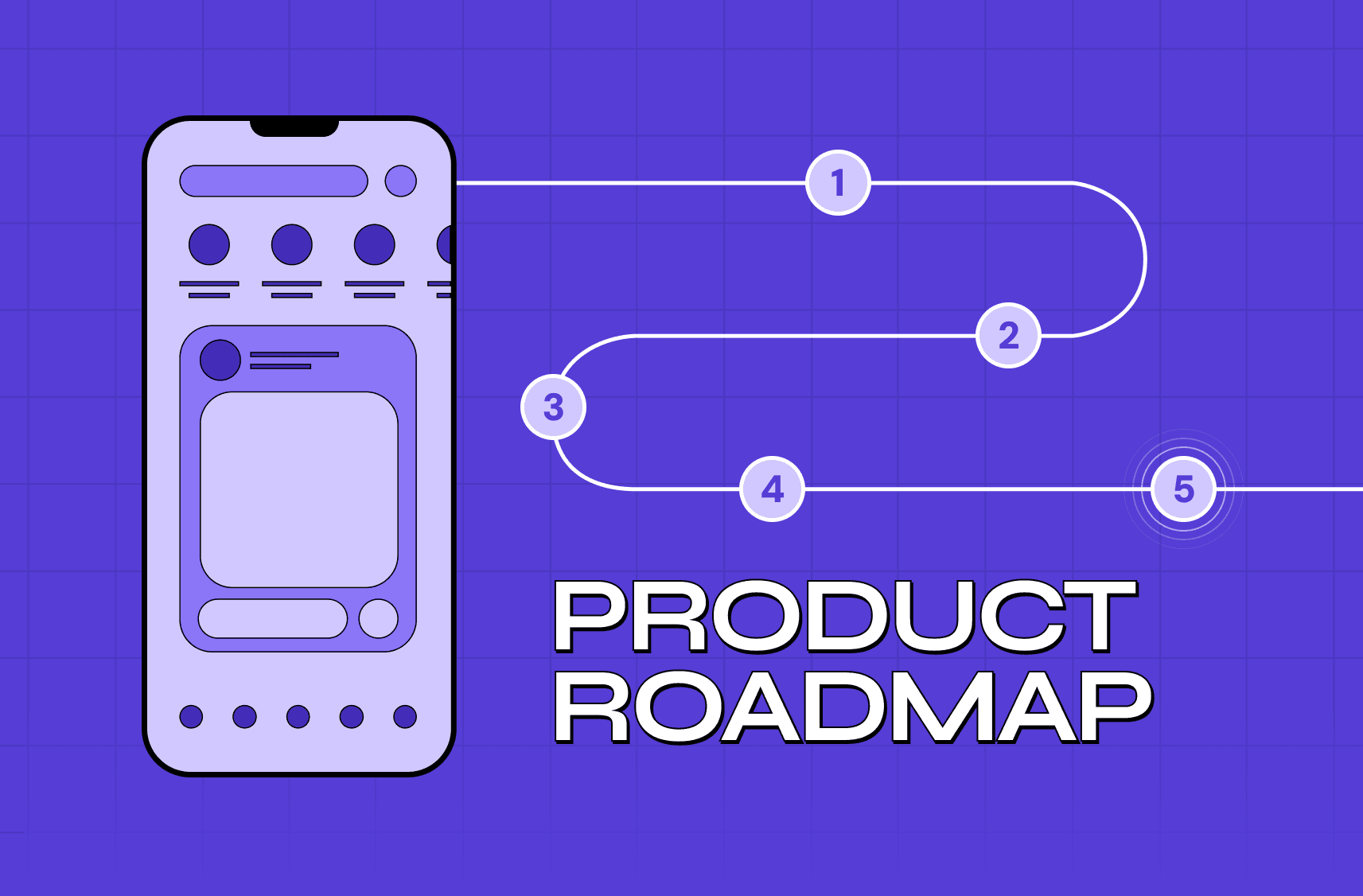
Treat the strategy as a living document, not a one-time deliverable
Here is the full section with the transition line and all fixes applied:
Design Strategy in Practice
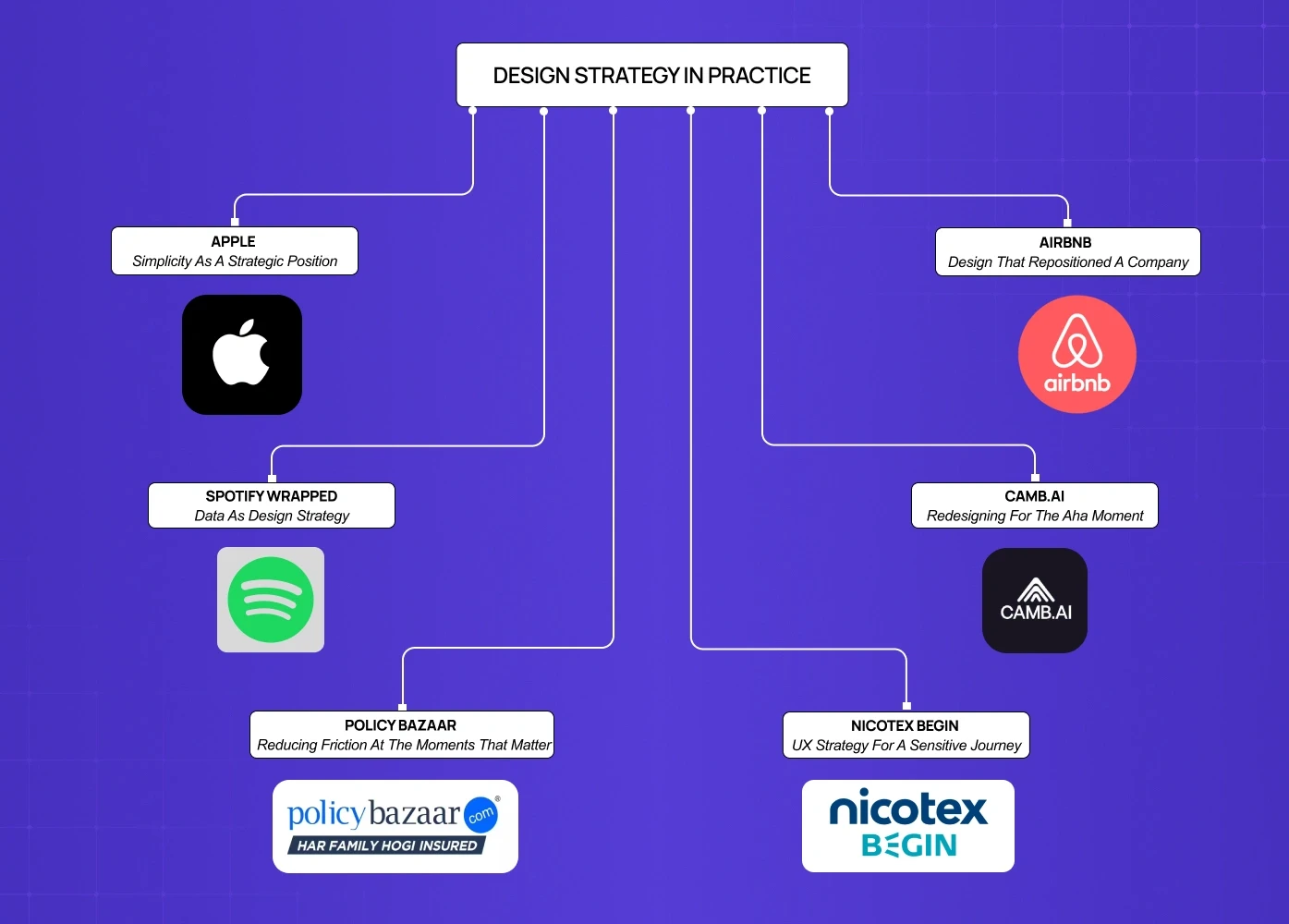
Before looking at how we apply this, it helps to see what design strategy has produced at scale.
Apple — Simplicity as a Strategic Position
Built its market position on one principle: ruthless simplicity and ecosystem coherence
Every product decision — removing ports, standardising typography, limiting SKUs — was a strategic choice about what not to include, guided by a design philosophy clear enough to function as a decision filter at every level of the organisation
The outcome was not just beautiful hardware; it was the highest customer loyalty and price premium in consumer electronics
Apple did not design products. It designed a position.
Airbnb — Design That Repositioned a Company
The 2014 redesign was not a visual refresh — it was a complete strategic repositioning around "Belong Anywhere"
Design strategy redefined what Airbnb was: not a booking platform, but a community built on belonging — a shift in brand experience design that reshaped how millions of users understood and related to the product
That shift, expressed entirely through design, helped the company grow from 4 million to over 150 million users over the following decade
The design did not follow the strategy. It was the strategy.
Spotify Wrapped — Data as Design Strategy
Wrapped turned passive listening data into a personalised, shareable visual experience
The result: millions of organic social impressions annually, with no paid media required
It embedded Spotify into culture — not through a marketing campaign, but through a single strategic design decision made once and compounded every year
When data and design strategy align, the product markets itself.
The pattern across all three: design strategy produced outcomes that no amount of good execution alone could have delivered — Airbnb's especially shows how a strategic rebrand, not merely a redesign, can redefine what a company is. Here is how we have applied the same thinking across our own work.
Camb.ai — Redesigning for the Aha Moment
Came to us with a technically powerful platform that was experientially fragmented
Users were dropping off before reaching core value — AI dubbing across 140+ languages
The strategic objective: get users to the aha moment faster, and give them a reason to stay
We restructured the user flow, simplified the interface, and anchored every design decision to engagement and retention outcomes
PolicyBazaar — Reducing Friction at the Moments That Matter
Insurance shopping is inherently complex — users were abandoning the process midway
We began by mapping exactly where drop-offs happened and why, before touching a single screen
Redesigned those specific moments to reduce friction and build trust at the points of highest hesitation
Outcome: improved sign-ups, reduced drop-offs, and a product that performed better — not just looked better
Nicotex Begin — UX Strategy for a Sensitive Journey
The goal was not a cleaner app — it was helping users commit to a tobacco-free start and follow through on it
We built the UX strategy around identifying and removing barriers at each step of the journey
Made the path to commitment feel achievable rather than clinical or overwhelming
Strategic thinking defined the experience before design defined the interface
Tips for Thinking More Strategically as a Designer
Strategic design is a mindset, not a job title. Any designer can build it with practice:
Ask more questions. Strategy lives in the "why" — why are we building this, why does the user struggle here, why does this metric matter?
Observe before you solve. Spend time understanding business goals and user behavior before jumping into solutions — and applying speculative design thinking extends this further, helping designers explore how those goals and behaviors might shift before committing to solutions that only serve today's context.
Connect design decisions to outcomes. Every choice should trace back to a measurable objective.
Communicate strategically. Frame design rationale in business language — not just visual language — when presenting to stakeholders.
Revisit and reassess. Strategy is not set once. Check your assumptions against real-world data as the project evolves.
Conclusion
Most products do not fail because of bad design. They fail because design had no direction — no strategic thread connecting creative decisions to business outcomes. That is the gap design strategy closes.
When design is built on clear objectives, grounded in user research, and measured against real outcomes, it stops being a service and starts being a driver. The difference shows up in activation rates, retention, revenue, and how confidently a team can explain every decision they made — and for product teams building in SaaS, the complete guide to SaaS UX design shows how those principles translate into product performance at the execution level.
For us at Groto, strategy is not a phase that precedes design — it is the foundation every project is built on. If your product needs design that performs, not just design that impresses, let's talk.