Best Design Subscription Agency for SaaS: The Guide That Actually Tells You Which One to Use

A no-fluff guide to finding the best design subscription agency for SaaS — and knowing when a subscription isn't what your product actually needs.

Best Design Subscription Agency for SaaS: The Guide That Actually Tells You Which One to Use

A no-fluff guide to finding the best design subscription agency for SaaS — and knowing when a subscription isn't what your product actually needs.

Most "best design subscription agency" guides rank services by price and turnaround time. This one tells you which type of subscription maps to which type of design problem — and when to skip the subscription model entirely.

Not every design subscription fits every SaaS team. Here's how to choose.

Illustration of a team collaborating around a large analytics dashboard, reviewing charts, data blocks, and interface elements.

Every roundup of the "best design subscription agency" lists the same dozen services ranked by price, turnaround time, and number of active requests. Read enough of them and you'll know that Design Pickle handles unlimited revisions and that Superside is great for enterprise scale. What none of them tell you is whether a design subscription model is actually right for what your SaaS company needs right now — and which specific type of subscription maps to which type of design work.

That distinction matters more than any ranking. A SaaS team that signs up for a graphic design subscription to improve their product UI is going to get social media assets delivered at speed and a product that looks exactly the same — understanding what a UI/UX design agency actually does clarifies why the two models serve entirely different problems.

 A team that signs up for a product UX subscription expecting strategic design direction will get components delivered but no framework for where the product is going. The best design subscription agency for your company is the one that matches the type of design problem you actually have — not the one with the best marketing site or the most LinkedIn followers.

At Groto, we work with SaaS teams at every stage from pre-seed to Series B, and the design subscription question comes up in almost every early engagement. Here's what we've learned about how to answer it correctly.

TL;DR 

Not all design subscriptions are built for SaaS. Graphic subscriptions handle marketing assets; product subscriptions handle UI and flows; neither handles strategic design. Match your need type to the right model — and know that no subscription can diagnose what's broken, only execute what's briefed. Groto sits outside the subscription category entirely, covering strategy and execution together for B2B SaaS teams from Seed to Series B. 

What Is a Design Subscription Agency?

A design subscription agency — sometimes called a "design as a service" or DaaS provider — is a company that offers ongoing design work for a fixed monthly fee. Unlike a traditional agency engagement (project-based, scoped, usually expensive) — see the guide on how to choose the right web design agency for when that model is the better fit), a design subscription gives you access to a designer or design team on a recurring basis, typically with unlimited requests, unlimited revisions, and defined turnaround times. 

The model became popular around 2015 with services like Design Pickle, which offered unlimited graphic design for a flat monthly rate. Since then, the category has expanded significantly. There are now design subscription agencies covering everything from social media graphics and marketing collateral to product UI, UX flows, and full design systems. Pricing ranges from $399/month for basic graphic design to $15,000+/month for enterprise-level creative production — for a full comparison of how these rates stack up against project-based and retainer models, the web design agency pricing guide covers the full spectrum.

The core appeal is predictability: you know what you're spending each month, you can submit work as needed, and you're not managing a freelancer relationship or going through a procurement process every time you need a new asset. For the right use case, it's an excellent model. For the wrong one, it becomes a subscription you're paying for while the design work your product actually needs isn't getting done — and calculating the ROI of UX design is the framework that makes the right/wrong distinction measurable rather than intuitive. 

Want to know where your users are dropping off?

We’ll break down the exact moments users lose interest, and why.

Want to know where your users are dropping off?

We’ll break down the exact moments users lose interest, and why.

The Two Types of Design Subscription — and Why Conflating Them Costs SaaS Teams Money

Type 1: Graphic Design Subscriptions

  • Handle marketing assets, brand collateral, and visual content production — social graphics, presentation decks, ad banners, email templates, print materials. For SaaS teams where SaaS branding is still being defined, a graphic design subscription is premature — the brand foundation needs to exist before execution volume adds value. 

  • Workflow is simple: submit a brief, a designer executes it, you review and revise.

  • Quality ceiling is well-defined — competent, brand-consistent execution of clearly scoped creative tasks.

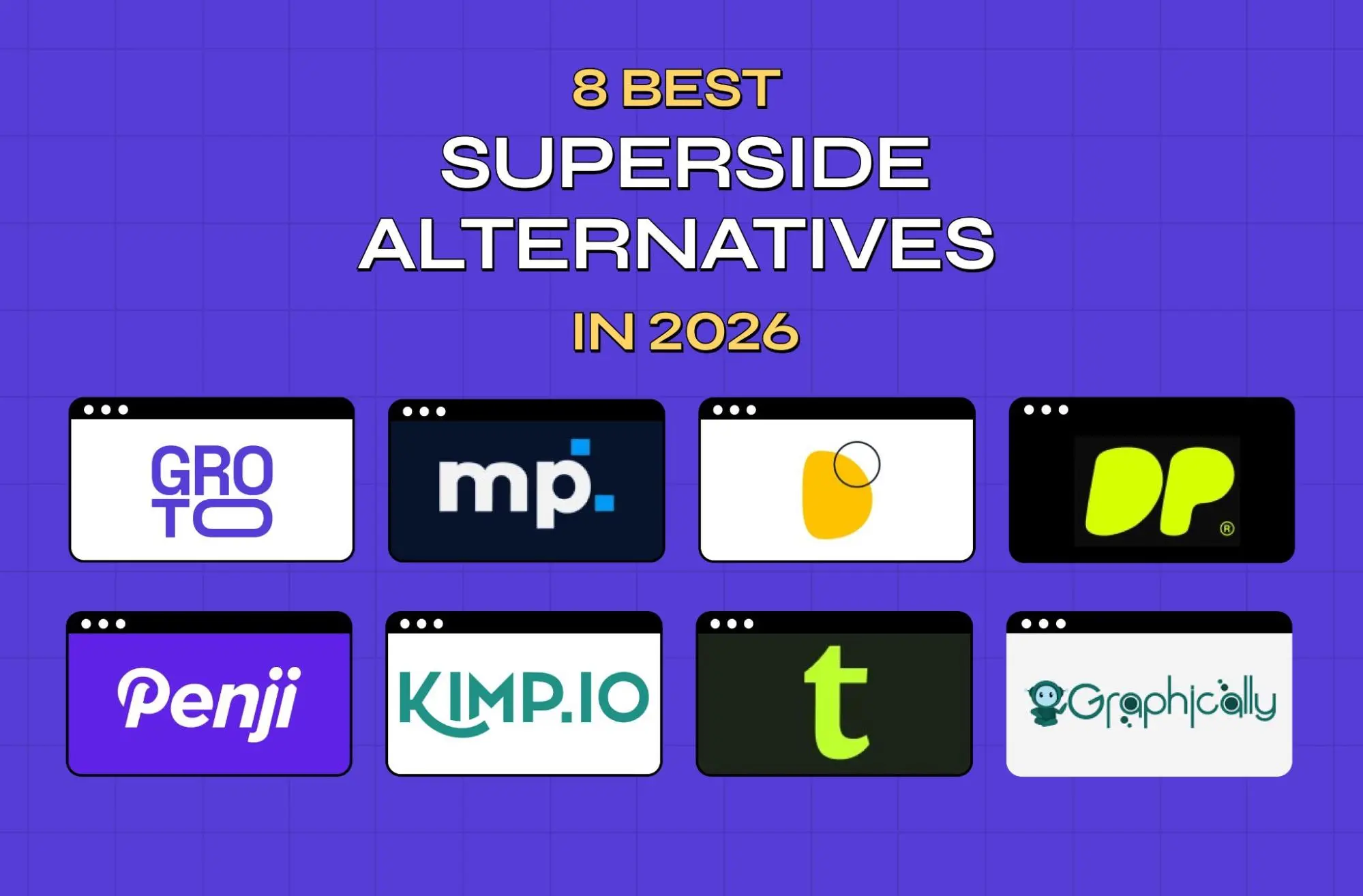
  • Best-in-class providers: Design Pickle, Kimp, Penji, ManyPixels (standard tier), Flocksy.

  • Who should use them: Marketing teams with consistent visual content volume; SaaS companies with an in-house product designer who needs marketing execution support — for teams still deciding between a UX agency versus hiring in-house, that decision shapes which subscription tier makes sense. 

  • Who shouldn't: SaaS teams whose primary bottleneck is product UI or conversion-critical pages — a graphic design subscription won't fix a homepage that isn't converting.

Type 2: Product and UX Design Subscriptions

  • Handle UI design, UX flows, landing page conversion design, design system components, and product interface work — the full scope of what SaaS UX design involves when done at the level that affects activation and retention.

  • More collaborative than graphic subscriptions; output is tied to product and business outcomes, not just asset production.

  • Best-in-class providers: DesignJoy, Superside (product tier), ManyPixels (product tier), dedicated SaaS design agencies on retainer.

  • Who should use them: SaaS teams with defined product direction who need consistent UI/UX execution across feature rollouts, onboarding redesigns, and design system maintenance.

  • Who shouldn't: Teams that need strategic design leadership — defining product direction, conducting user research, or diagnosing conversion problems.

The 6 Best Design Subscription Agencies for SaaS Teams
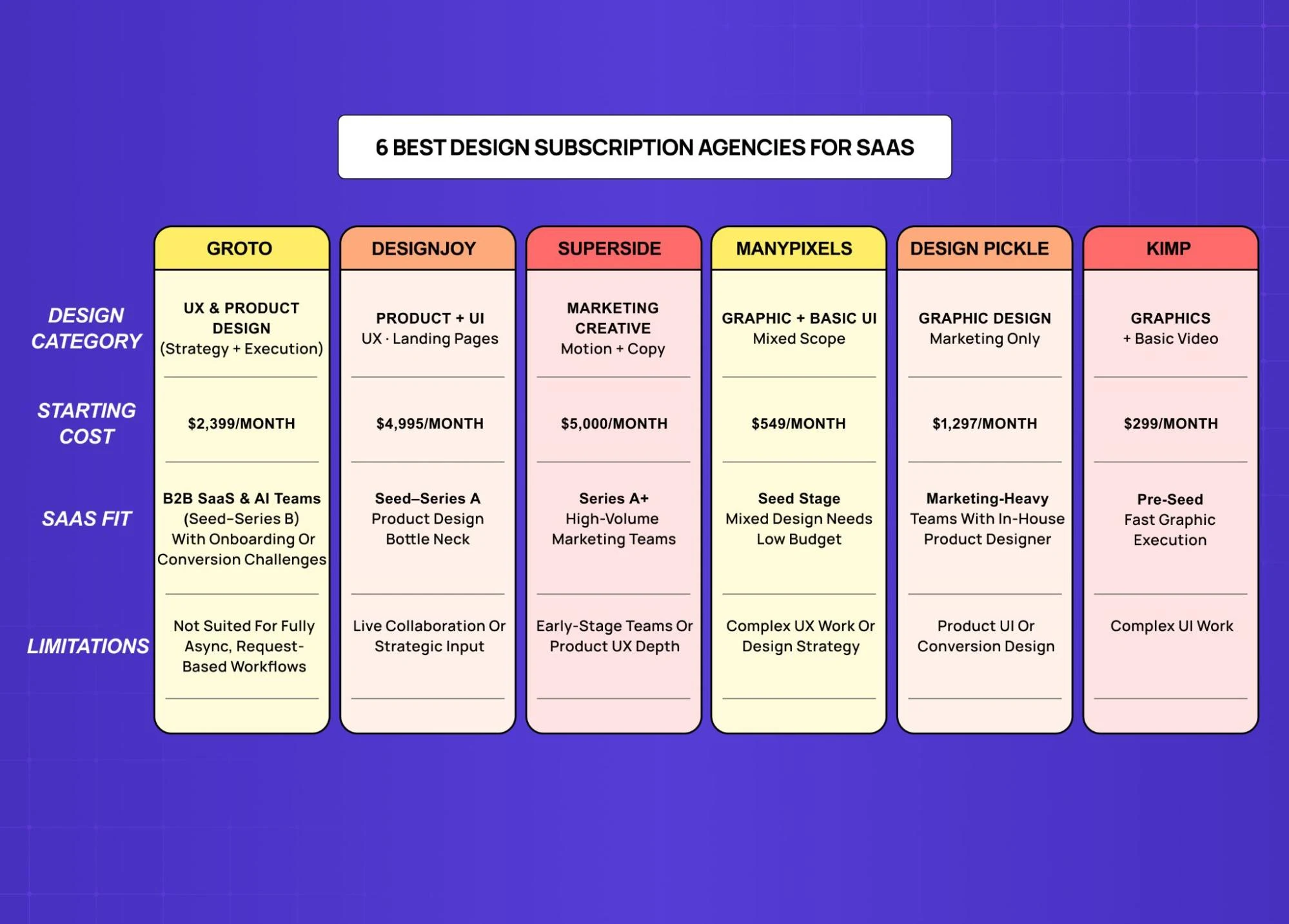
Comparison of six SaaS design subscription agencies with categories, pricing, fit, and limitations.

1. Groto — Best for SaaS Teams That Need Strategy and Execution Together

  • Groto is a design and UX agency built specifically for SaaS products — covering everything from product UI and conversion design to full UX audits and design system builds.

  • Unlike pure subscription services that operate on async request queues, we work as an embedded design partner — with live collaboration, stakeholder reviews, and strategic direction built into every engagement.

  • Our work spans the full product lifecycle: when Nicotex Begin needed to launch a digital quit-smoking experience, we designed the complete product interface from the ground up — mapping user flows, building the UI system, and iterating with the product team through testing phases.

  • Pricing: Engagements start at $2,399/month (Starter — 2 hrs/day) through to $5,999/month (Full-Time — 6 hrs/day), with the Part-Time plan at $4,399/month being the most popular for SaaS teams needing strategic oversight alongside consistent execution. 

  • For SaaS teams dealing with conversion problems, onboarding drop-off, or a product that's growing but creating UX friction, this is the level of engagement that moves the needle — not a request queue. The SaaS product design best practices that actually shift these metrics require more than execution capacity.

  • Best for: B2B SaaS and AI product teams from Seed to Series B where activation or onboarding is the measurable bottleneck — especially if you're losing trials before users reach the feature they signed up for, and you want diagnosis before execution.

  • Not right for: Teams looking for a fully async, request-queue-only model with no collaborative touchpoints — Groto's engagements are built around active partnership, not just ticket fulfilment.

2. DesignJoy — Best for Product-Focused SaaS Teams

  • One of the few design subscription agencies explicitly built for product design, not graphic design.

  • Covers UI design, landing pages, design systems, and UX flows — work that directly affects SaaS product and acquisition performance.

  • Founded by Brett Williams in 2017; operates as a single-designer service, meaning all work comes directly from the founder.

  • Pricing: Standard at $4,995/month (one active request) and Pro at $7,995/month (two active requests); 48-hour average turnaround.

  • Output is consistently product-ready at a quality floor significantly higher than most graphic design subscriptions.

  • Best for: SaaS teams at seed to Series A needing consistent product and marketing design execution at a senior level.

  • Not right for: Teams that need live design reviews, collaborative workshops, or strategic prioritisation input.

3. Superside — Best for High-Volume SaaS Marketing Teams

  • Enterprise-scale creative subscription covering design, video, copywriting, and motion.

  • Built for SaaS companies running high-volume paid campaigns, producing large amounts of collateral, and needing rapid creative iteration.

  • Pricing starts at approximately $10,000/month and scales significantly based on creative volume and team composition — this is an enterprise-tier service, not a startup subscription.

  • Product design capabilities exist but are secondary to the marketing production strength.

  • Best for: Series B+ SaaS companies with dedicated marketing teams needing consistent, high-volume creative production at scale.

  • Not right for: Early-stage teams or any team whose primary bottleneck is product design rather than marketing asset volume.

4. ManyPixels — Best All-Round Subscription for Growing SaaS Companies

  • Balanced subscription covering both graphic design and basic product design (landing pages, web design, UI elements).

  • Pricing ranges from $699–$2,599/month depending on tier — accessible for growing SaaS teams that need both marketing and product design coverage.

  • Hits a useful middle ground for SaaS companies that need marketing graphics and basic product design work.

  • Best for: Seed-stage SaaS companies needing a mix of marketing and basic product design at accessible pricing.

  • Not right for: Teams with complex UX problems or a need for deep product design partnership.

5. Design Pickle — Best for SaaS Marketing Assets at Scale

  • The category originator for unlimited graphic design — well-built platform, streamlined workflow, reliable turnaround.

  • Scope is focused on graphic design — marketing collateral, social assets, presentations, and illustrations; the Graphics Pro plan starts at approximately $1,349/month.

  • Product design capabilities are limited; this is a pure marketing execution service.

  • Best for: SaaS marketing teams needing a consistent, high-quality source of branded marketing assets.

  • Not right for: Teams whose bottleneck is in the product interface or conversion pages.

6. Kimp — Best for Teams Needing Graphics and Video in One Plan

  • Kimp's differentiation is its combined graphic design and video subscription — Graphics at $1,397/month, Video at $1,397/month, or Graphics + Video at $1,697/month.

  • Covers a wide range of design types including social media, presentations, landing pages, logo design, and custom illustrations — all without complicated tiers or add-ons.

  • Each plan comes with a dedicated team of one Project Manager and three designers, with up to three active requests simultaneously on the Graphics plan.

  • Best for: SaaS marketing teams that need both graphic design and motion/video output at a predictable monthly rate.

  • Not right for: Teams with complex product UX needs or those requiring strategic design direction.

The SaaS Design Fit Matrix — Groto's Framework for Choosing the Right Model
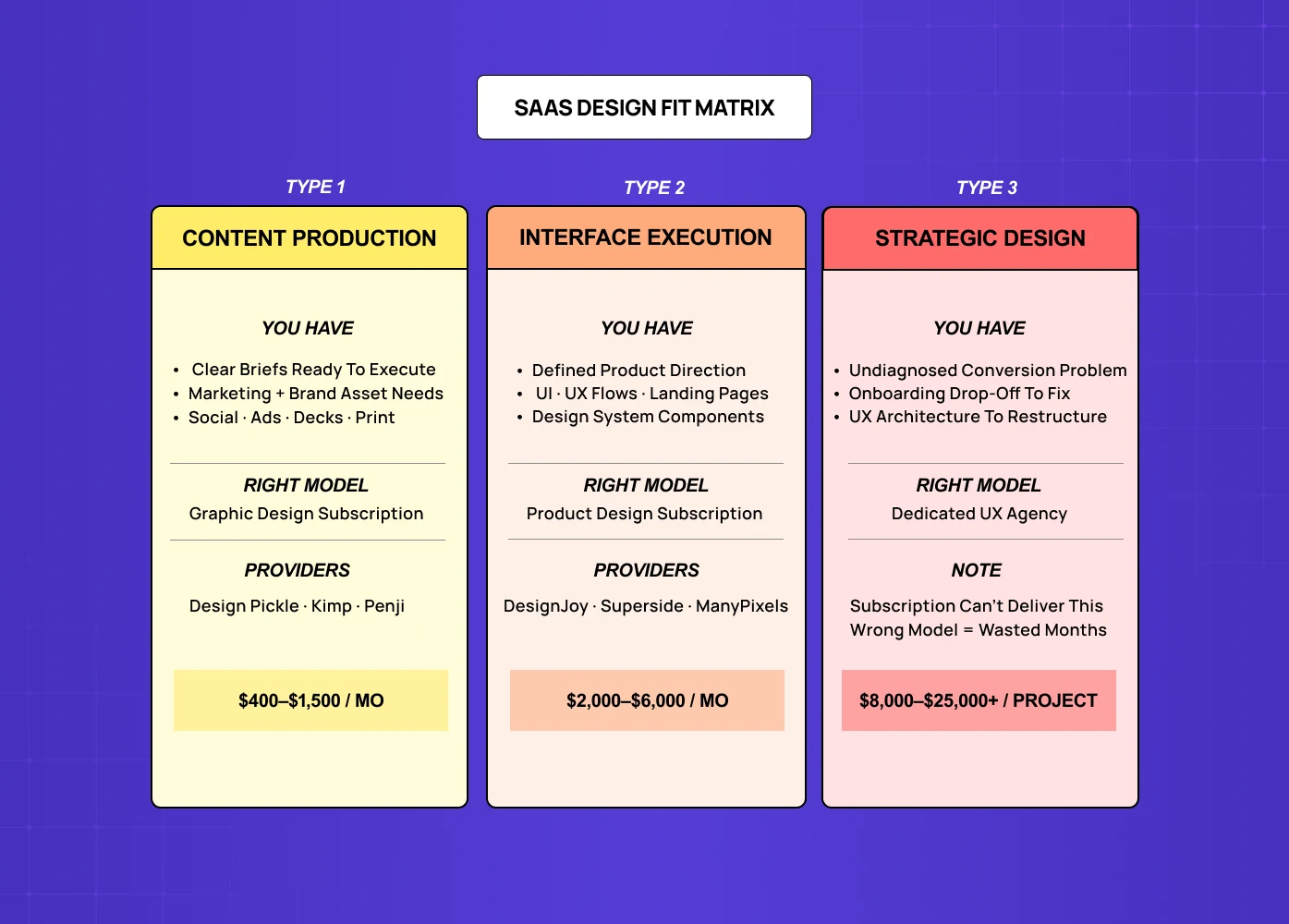
SaaS design fit matrix mapping content production, interface execution, and strategic design to the right service model and budget.

Need Type 1 — Content Production

  • You know what you need; the brief is clear; you need it produced quickly and consistently.

  • Examples: social graphics, email templates, ad creatives, presentation decks, brand assets.

  • Right model: Graphic design subscription | Budget: $700–$1,500/month

  • Recommended: Design Pickle, Kimp, Penji

Need Type 2 — Interface Execution

  • Product direction is defined; you know which screens need to be designed or redesigned.

  • You need a skilled UI/UX designer executing consistently across product and marketing touchpoints.

  • Right model: Product design subscription or design agency retainer | Budget: $2,000–$6,000/month

  • Recommended: DesignJoy, Superside (product tier), ManyPixels (product tier), or a dedicated SaaS design agency on monthly retainer.

Need Type 3 — Strategic Design

  • You need to figure out what should be designed, not just execute what's already decided.

  • Signals: a conversion problem you can't diagnose, an onboarding flow with 60%+ drop-off, product friction accelerating churn — the full scope of UI/UX design for SaaS products from onboarding to retention covers what resolving each of these actually requires. 

  • Requires user research, design audits, hierarchy restructuring, and strategic recommendations — not execution alone.

  • Right model: Dedicated UX design agency engagement | Budget: $8,000–$25,000+ (project) or $4,000–$10,000/month (retainer)

  • A subscription model cannot deliver this — the async, request-based workflow is structurally unable to support the deep product context and iterative collaboration strategic design requires; that's where UX design companies for SaaS products operate, and confusing the two models is the most expensive version of the wrong choice. 

  • Most SaaS teams have a mix of Need Types 1 and 2 — the sweet spot for design subscription value.

What the Best Design Subscription Agency Cannot Do for Your SaaS Product
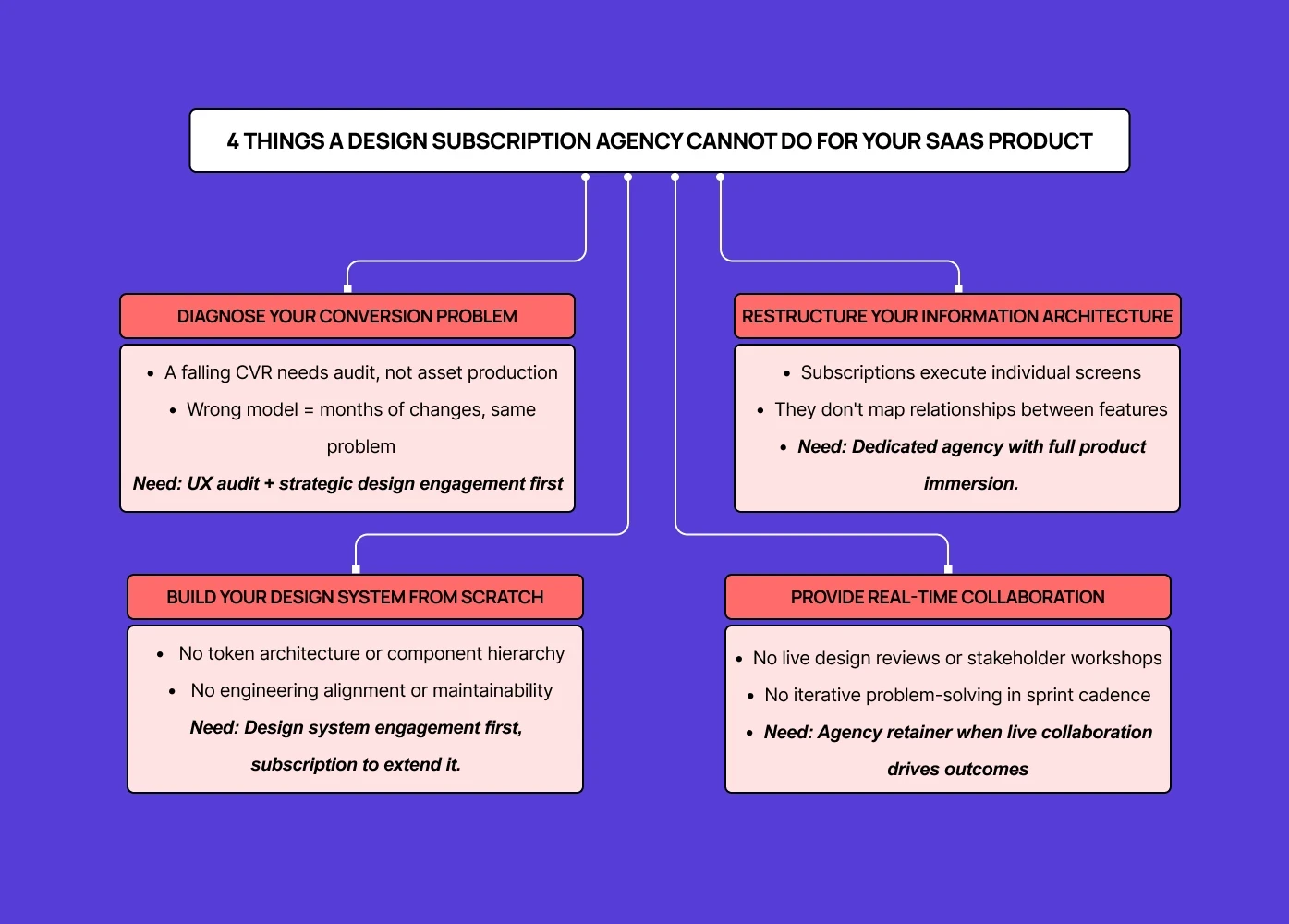
Diagram showing four things design subscription agencies cannot do, including diagnosing conversion issues and restructuring architecture.

Can't diagnose your conversion problem — a subscription can execute changes to your landing page, but it cannot identify why conversion is declining, what's creating friction in the funnel, or which change to prioritise first.

  • Can't restructure your information architecture — reorganising how features are surfaced, labelled, and connected requires understanding the whole product; subscription designers execute individual screens, not systemic product logic.

  • Can't build a design system from scratch — subscriptions can execute against an existing design system or produce individual components on request; building a coherent, maintainable system requires product immersion that the model doesn't support. For SaaS teams that need this built before subscriptions become viable, the guide on design systems for SaaS products covers what that process involves. 

  • Can't provide real-time collaboration — the async, request-based workflow that makes subscriptions cost-effective also prevents live design reviews, stakeholder workshops, and the iterative problem-solving that moves product design forward quickly.

At Groto, we're often brought in alongside design subscriptions — handling the strategic design layer (audits, architecture, conversion diagnosis) while a subscription handles execution volume. For Series A companies with both volume requirements and strategic design needs, the two models work well in combination.

How to Evaluate a Design Subscription Agency: 5 Questions Before You Subscribe

  • Is your primary need execution or strategy? If you can write a clear brief for every task, you need execution capacity — a subscription fits. If you're not sure what needs to change or why something isn't working, you need strategic design first.

  • What percentage of your design work is product vs. marketing? If more than 40% of your needs are product-facing (UI, UX flows, conversion pages), confirm the subscription has explicit product design capability — not just graphic design at scale.

  • What is the turnaround time for complex work? Most subscriptions advertise 24–48 hours for simple tasks — ask specifically about a full landing page redesign, a multi-screen UX flow, or a component set; the answer reveals whether the service is calibrated for your actual complexity.

  • How is quality controlled? Ask how consistency is managed across requests, how escalations work when output misses the mark, and what the revision process looks like — inconsistency in UI execution is more damaging for SaaS products than slowness. Reviewing past work through a structured UI/UX portfolio evaluation framework before subscribing is the most reliable way to answer this question before you've committed budget. 

  • What happens when your needs exceed the subscription scope? Understand the exclusions before you sign — certain file types, design types, or complexity levels may be out of scope; know the limits before your first out-of-scope request, not after.

Conclusion

  • The market divides clearly into graphic design subscriptions and product/UX design subscriptions — choosing the wrong type wastes months and budget.

  • The SaaS Design Fit Matrix maps three need types to three engagement models: graphic subscription for content production, product subscription or retainer for interface execution, dedicated agency for strategic design.

  • Groto leads for SaaS teams that need strategy and execution together; DesignJoy for senior product-focused execution; Superside for high-volume enterprise marketing at scale; ManyPixels for mixed needs at accessible pricing; Design Pickle for pure marketing asset production; Kimp for teams needing graphic design and video in one plan.

  • No design subscription can diagnose conversion problems, restructure information architecture, or replace strategic design leadership — knowing this boundary prevents the most expensive version of the wrong choice.

  • The best outcomes come from SaaS teams that pair a design subscription for execution volume with a dedicated agency relationship for strategic design direction.

If you're unsure whether a design subscription is the right model — or you've been through one and the strategic problems are still unsolved — that's exactly what a Groto discovery call is designed to work through.

Book a discovery call →
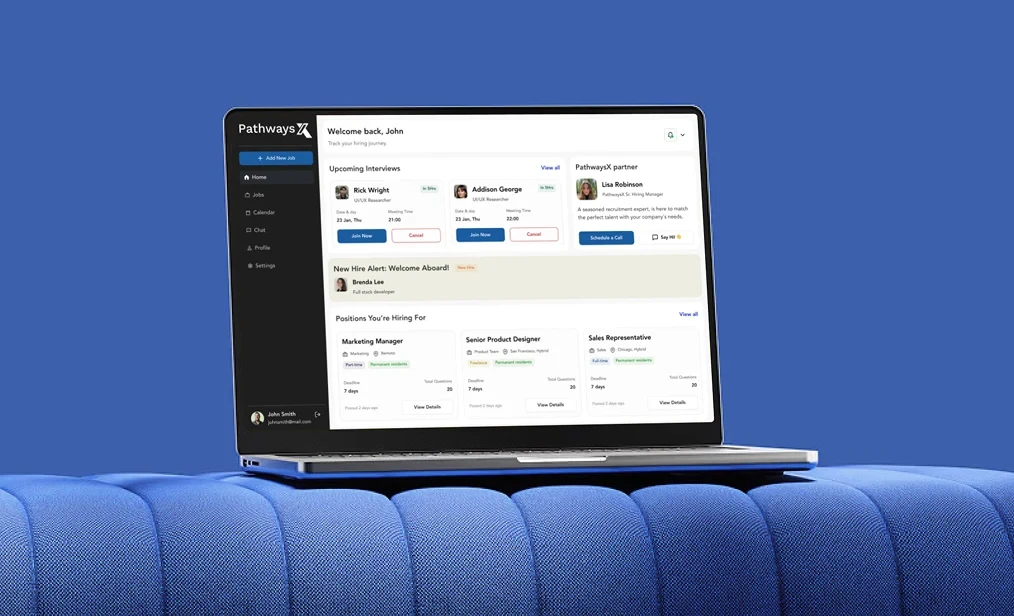
Most "best design subscription agency" guides rank services by price and turnaround time. This one tells you which type of subscription maps to which type of design problem — and when to skip the subscription model entirely.

Not every design subscription fits every SaaS team. Here's how to choose.

Illustration of a team collaborating around a large analytics dashboard, reviewing charts, data blocks, and interface elements.

Every roundup of the "best design subscription agency" lists the same dozen services ranked by price, turnaround time, and number of active requests. Read enough of them and you'll know that Design Pickle handles unlimited revisions and that Superside is great for enterprise scale. What none of them tell you is whether a design subscription model is actually right for what your SaaS company needs right now — and which specific type of subscription maps to which type of design work.

That distinction matters more than any ranking. A SaaS team that signs up for a graphic design subscription to improve their product UI is going to get social media assets delivered at speed and a product that looks exactly the same — understanding what a UI/UX design agency actually does clarifies why the two models serve entirely different problems.

 A team that signs up for a product UX subscription expecting strategic design direction will get components delivered but no framework for where the product is going. The best design subscription agency for your company is the one that matches the type of design problem you actually have — not the one with the best marketing site or the most LinkedIn followers.

At Groto, we work with SaaS teams at every stage from pre-seed to Series B, and the design subscription question comes up in almost every early engagement. Here's what we've learned about how to answer it correctly.

TL;DR 

Not all design subscriptions are built for SaaS. Graphic subscriptions handle marketing assets; product subscriptions handle UI and flows; neither handles strategic design. Match your need type to the right model — and know that no subscription can diagnose what's broken, only execute what's briefed. Groto sits outside the subscription category entirely, covering strategy and execution together for B2B SaaS teams from Seed to Series B. 

What Is a Design Subscription Agency?

A design subscription agency — sometimes called a "design as a service" or DaaS provider — is a company that offers ongoing design work for a fixed monthly fee. Unlike a traditional agency engagement (project-based, scoped, usually expensive) — see the guide on how to choose the right web design agency for when that model is the better fit), a design subscription gives you access to a designer or design team on a recurring basis, typically with unlimited requests, unlimited revisions, and defined turnaround times. 

The model became popular around 2015 with services like Design Pickle, which offered unlimited graphic design for a flat monthly rate. Since then, the category has expanded significantly. There are now design subscription agencies covering everything from social media graphics and marketing collateral to product UI, UX flows, and full design systems. Pricing ranges from $399/month for basic graphic design to $15,000+/month for enterprise-level creative production — for a full comparison of how these rates stack up against project-based and retainer models, the web design agency pricing guide covers the full spectrum.

The core appeal is predictability: you know what you're spending each month, you can submit work as needed, and you're not managing a freelancer relationship or going through a procurement process every time you need a new asset. For the right use case, it's an excellent model. For the wrong one, it becomes a subscription you're paying for while the design work your product actually needs isn't getting done — and calculating the ROI of UX design is the framework that makes the right/wrong distinction measurable rather than intuitive. 

Want to know where your users are dropping off?

We’ll break down the exact moments users lose interest, and why.

The Two Types of Design Subscription — and Why Conflating Them Costs SaaS Teams Money

Type 1: Graphic Design Subscriptions

  • Handle marketing assets, brand collateral, and visual content production — social graphics, presentation decks, ad banners, email templates, print materials. For SaaS teams where SaaS branding is still being defined, a graphic design subscription is premature — the brand foundation needs to exist before execution volume adds value. 

  • Workflow is simple: submit a brief, a designer executes it, you review and revise.

  • Quality ceiling is well-defined — competent, brand-consistent execution of clearly scoped creative tasks.

  • Best-in-class providers: Design Pickle, Kimp, Penji, ManyPixels (standard tier), Flocksy.

  • Who should use them: Marketing teams with consistent visual content volume; SaaS companies with an in-house product designer who needs marketing execution support — for teams still deciding between a UX agency versus hiring in-house, that decision shapes which subscription tier makes sense. 

  • Who shouldn't: SaaS teams whose primary bottleneck is product UI or conversion-critical pages — a graphic design subscription won't fix a homepage that isn't converting.

Type 2: Product and UX Design Subscriptions

  • Handle UI design, UX flows, landing page conversion design, design system components, and product interface work — the full scope of what SaaS UX design involves when done at the level that affects activation and retention.

  • More collaborative than graphic subscriptions; output is tied to product and business outcomes, not just asset production.

  • Best-in-class providers: DesignJoy, Superside (product tier), ManyPixels (product tier), dedicated SaaS design agencies on retainer.

  • Who should use them: SaaS teams with defined product direction who need consistent UI/UX execution across feature rollouts, onboarding redesigns, and design system maintenance.

  • Who shouldn't: Teams that need strategic design leadership — defining product direction, conducting user research, or diagnosing conversion problems.

The 6 Best Design Subscription Agencies for SaaS Teams

Comparison of six SaaS design subscription agencies with categories, pricing, fit, and limitations.

1. Groto — Best for SaaS Teams That Need Strategy and Execution Together

  • Groto is a design and UX agency built specifically for SaaS products — covering everything from product UI and conversion design to full UX audits and design system builds.

  • Unlike pure subscription services that operate on async request queues, we work as an embedded design partner — with live collaboration, stakeholder reviews, and strategic direction built into every engagement.

  • Our work spans the full product lifecycle: when Nicotex Begin needed to launch a digital quit-smoking experience, we designed the complete product interface from the ground up — mapping user flows, building the UI system, and iterating with the product team through testing phases.

  • Pricing: Engagements start at $2,399/month (Starter — 2 hrs/day) through to $5,999/month (Full-Time — 6 hrs/day), with the Part-Time plan at $4,399/month being the most popular for SaaS teams needing strategic oversight alongside consistent execution. 

  • For SaaS teams dealing with conversion problems, onboarding drop-off, or a product that's growing but creating UX friction, this is the level of engagement that moves the needle — not a request queue. The SaaS product design best practices that actually shift these metrics require more than execution capacity.

  • Best for: B2B SaaS and AI product teams from Seed to Series B where activation or onboarding is the measurable bottleneck — especially if you're losing trials before users reach the feature they signed up for, and you want diagnosis before execution.

  • Not right for: Teams looking for a fully async, request-queue-only model with no collaborative touchpoints — Groto's engagements are built around active partnership, not just ticket fulfilment.

2. DesignJoy — Best for Product-Focused SaaS Teams

  • One of the few design subscription agencies explicitly built for product design, not graphic design.

  • Covers UI design, landing pages, design systems, and UX flows — work that directly affects SaaS product and acquisition performance.

  • Founded by Brett Williams in 2017; operates as a single-designer service, meaning all work comes directly from the founder.

  • Pricing: Standard at $4,995/month (one active request) and Pro at $7,995/month (two active requests); 48-hour average turnaround.

  • Output is consistently product-ready at a quality floor significantly higher than most graphic design subscriptions.

  • Best for: SaaS teams at seed to Series A needing consistent product and marketing design execution at a senior level.

  • Not right for: Teams that need live design reviews, collaborative workshops, or strategic prioritisation input.

3. Superside — Best for High-Volume SaaS Marketing Teams

  • Enterprise-scale creative subscription covering design, video, copywriting, and motion.

  • Built for SaaS companies running high-volume paid campaigns, producing large amounts of collateral, and needing rapid creative iteration.

  • Pricing starts at approximately $10,000/month and scales significantly based on creative volume and team composition — this is an enterprise-tier service, not a startup subscription.

  • Product design capabilities exist but are secondary to the marketing production strength.

  • Best for: Series B+ SaaS companies with dedicated marketing teams needing consistent, high-volume creative production at scale.

  • Not right for: Early-stage teams or any team whose primary bottleneck is product design rather than marketing asset volume.

4. ManyPixels — Best All-Round Subscription for Growing SaaS Companies

  • Balanced subscription covering both graphic design and basic product design (landing pages, web design, UI elements).

  • Pricing ranges from $699–$2,599/month depending on tier — accessible for growing SaaS teams that need both marketing and product design coverage.

  • Hits a useful middle ground for SaaS companies that need marketing graphics and basic product design work.

  • Best for: Seed-stage SaaS companies needing a mix of marketing and basic product design at accessible pricing.

  • Not right for: Teams with complex UX problems or a need for deep product design partnership.

5. Design Pickle — Best for SaaS Marketing Assets at Scale

  • The category originator for unlimited graphic design — well-built platform, streamlined workflow, reliable turnaround.

  • Scope is focused on graphic design — marketing collateral, social assets, presentations, and illustrations; the Graphics Pro plan starts at approximately $1,349/month.

  • Product design capabilities are limited; this is a pure marketing execution service.

  • Best for: SaaS marketing teams needing a consistent, high-quality source of branded marketing assets.

  • Not right for: Teams whose bottleneck is in the product interface or conversion pages.

6. Kimp — Best for Teams Needing Graphics and Video in One Plan

  • Kimp's differentiation is its combined graphic design and video subscription — Graphics at $1,397/month, Video at $1,397/month, or Graphics + Video at $1,697/month.

  • Covers a wide range of design types including social media, presentations, landing pages, logo design, and custom illustrations — all without complicated tiers or add-ons.

  • Each plan comes with a dedicated team of one Project Manager and three designers, with up to three active requests simultaneously on the Graphics plan.

  • Best for: SaaS marketing teams that need both graphic design and motion/video output at a predictable monthly rate.

  • Not right for: Teams with complex product UX needs or those requiring strategic design direction.

The SaaS Design Fit Matrix — Groto's Framework for Choosing the Right Model

SaaS design fit matrix mapping content production, interface execution, and strategic design to the right service model and budget.

Need Type 1 — Content Production

  • You know what you need; the brief is clear; you need it produced quickly and consistently.

  • Examples: social graphics, email templates, ad creatives, presentation decks, brand assets.

  • Right model: Graphic design subscription | Budget: $700–$1,500/month

  • Recommended: Design Pickle, Kimp, Penji

Need Type 2 — Interface Execution

  • Product direction is defined; you know which screens need to be designed or redesigned.

  • You need a skilled UI/UX designer executing consistently across product and marketing touchpoints.

  • Right model: Product design subscription or design agency retainer | Budget: $2,000–$6,000/month

  • Recommended: DesignJoy, Superside (product tier), ManyPixels (product tier), or a dedicated SaaS design agency on monthly retainer.

Need Type 3 — Strategic Design

  • You need to figure out what should be designed, not just execute what's already decided.

  • Signals: a conversion problem you can't diagnose, an onboarding flow with 60%+ drop-off, product friction accelerating churn — the full scope of UI/UX design for SaaS products from onboarding to retention covers what resolving each of these actually requires. 

  • Requires user research, design audits, hierarchy restructuring, and strategic recommendations — not execution alone.

  • Right model: Dedicated UX design agency engagement | Budget: $8,000–$25,000+ (project) or $4,000–$10,000/month (retainer)

  • A subscription model cannot deliver this — the async, request-based workflow is structurally unable to support the deep product context and iterative collaboration strategic design requires; that's where UX design companies for SaaS products operate, and confusing the two models is the most expensive version of the wrong choice. 

  • Most SaaS teams have a mix of Need Types 1 and 2 — the sweet spot for design subscription value.

What the Best Design Subscription Agency Cannot Do for Your SaaS Product

Diagram showing four things design subscription agencies cannot do, including diagnosing conversion issues and restructuring architecture.

Can't diagnose your conversion problem — a subscription can execute changes to your landing page, but it cannot identify why conversion is declining, what's creating friction in the funnel, or which change to prioritise first.

  • Can't restructure your information architecture — reorganising how features are surfaced, labelled, and connected requires understanding the whole product; subscription designers execute individual screens, not systemic product logic.

  • Can't build a design system from scratch — subscriptions can execute against an existing design system or produce individual components on request; building a coherent, maintainable system requires product immersion that the model doesn't support. For SaaS teams that need this built before subscriptions become viable, the guide on design systems for SaaS products covers what that process involves. 

  • Can't provide real-time collaboration — the async, request-based workflow that makes subscriptions cost-effective also prevents live design reviews, stakeholder workshops, and the iterative problem-solving that moves product design forward quickly.

At Groto, we're often brought in alongside design subscriptions — handling the strategic design layer (audits, architecture, conversion diagnosis) while a subscription handles execution volume. For Series A companies with both volume requirements and strategic design needs, the two models work well in combination.

How to Evaluate a Design Subscription Agency: 5 Questions Before You Subscribe

  • Is your primary need execution or strategy? If you can write a clear brief for every task, you need execution capacity — a subscription fits. If you're not sure what needs to change or why something isn't working, you need strategic design first.

  • What percentage of your design work is product vs. marketing? If more than 40% of your needs are product-facing (UI, UX flows, conversion pages), confirm the subscription has explicit product design capability — not just graphic design at scale.

  • What is the turnaround time for complex work? Most subscriptions advertise 24–48 hours for simple tasks — ask specifically about a full landing page redesign, a multi-screen UX flow, or a component set; the answer reveals whether the service is calibrated for your actual complexity.

  • How is quality controlled? Ask how consistency is managed across requests, how escalations work when output misses the mark, and what the revision process looks like — inconsistency in UI execution is more damaging for SaaS products than slowness. Reviewing past work through a structured UI/UX portfolio evaluation framework before subscribing is the most reliable way to answer this question before you've committed budget. 

  • What happens when your needs exceed the subscription scope? Understand the exclusions before you sign — certain file types, design types, or complexity levels may be out of scope; know the limits before your first out-of-scope request, not after.

Conclusion

  • The market divides clearly into graphic design subscriptions and product/UX design subscriptions — choosing the wrong type wastes months and budget.

  • The SaaS Design Fit Matrix maps three need types to three engagement models: graphic subscription for content production, product subscription or retainer for interface execution, dedicated agency for strategic design.

  • Groto leads for SaaS teams that need strategy and execution together; DesignJoy for senior product-focused execution; Superside for high-volume enterprise marketing at scale; ManyPixels for mixed needs at accessible pricing; Design Pickle for pure marketing asset production; Kimp for teams needing graphic design and video in one plan.

  • No design subscription can diagnose conversion problems, restructure information architecture, or replace strategic design leadership — knowing this boundary prevents the most expensive version of the wrong choice.

  • The best outcomes come from SaaS teams that pair a design subscription for execution volume with a dedicated agency relationship for strategic design direction.

If you're unsure whether a design subscription is the right model — or you've been through one and the strategic problems are still unsolved — that's exactly what a Groto discovery call is designed to work through.

Book a discovery call →

Have a project in mind?

Let’s talk through your idea and see what makes sense.

Harpreet Singh

Founder at Groto

Have a project in mind?

Let’s talk through your idea and see what makes sense.

Harpreet Singh

Founder at Groto

FAQ

Everything you were going to ask (and a few things you didn’t know to)

What do people on Reddit actually say about the best design subscription agency?

Reddit threads on design subscriptions — particularly in r/SaaS and r/entrepreneur — consistently recommend DesignJoy for product-focused work and Design Pickle for graphic design volume. The recurring warning across threads: teams that sign up for a graphic design subscription expecting UX or product design output are frequently disappointed. Community consensus is that matching subscription type to actual design need is the deciding factor — not the platform itself.

Which design subscription service is best specifically for graphic design?

For pure graphic design — social assets, marketing collateral, ad creatives, presentation decks — Design Pickle and Kimp are the most consistent performers. Design Pickle offers a polished platform and reliable quality starting around $1,349/month for the Graphics Pro plan; Kimp is a strong alternative at $1,397/month with the added benefit of covering video design in a combined plan. ManyPixels is a solid middle option starting at $699/month if you need both graphic and basic web design within the same subscription. If your graphic design needs sit alongside product or UX work — or you want a single agency handling both — Groto covers the full spectrum, from brand and marketing assets to product interface design, within one engagement.

How do I know if my SaaS team is ready for a design subscription or needs an agency first?

If you can write a clear, specific brief for every design task you have in mind, you're ready for a subscription. If you're unsure what needs to change, why something isn't converting, or what your product's design priorities should be, you need an agency engagement first. Teams that skip this step often spend two to three months on a subscription before realising the underlying problem was never diagnosed — not just unexecuted. 

Is there a free design subscription service worth trying?

There is no genuinely free unlimited design subscription at a quality level suited for SaaS product or marketing work. Some platforms offer free trials — Kimp offers a 7-day free trial, and ManyPixels has offered trial periods. For early-stage teams, ManyPixels' entry plan around $699/month is among the more accessible paid starting points that still delivers usable output across both graphic and basic web design. If you're evaluating whether a design partner is the right fit before committing, Groto offers a discovery call to scope your needs and assess fit — a useful first step before locking into any subscription or retainer. 

What is the web design subscription model and is it right for SaaS landing pages?

A web design subscription typically covers landing page design, website UI updates, and basic front-end assets on a recurring basis — rather than one-off project builds. For SaaS teams iterating frequently on acquisition pages, pricing pages, or onboarding flows, this model offers a cost-effective alternative to project-based agency work. The caveat: if your landing page has a conversion problem that isn't yet diagnosed, the subscription executes changes without solving the underlying issue — strategic analysis needs to come first.

Can one design partner handle both strategic and execution design needs for a SaaS product?

Most design subscription services are built purely for execution — they handle what you brief, not what you should be doing. A dedicated SaaS design agency like Groto covers both: strategic work like UX audits, conversion diagnosis, and information architecture, alongside execution across product UI, landing pages, and marketing assets. For SaaS teams that want one consistent design relationship rather than splitting strategic and execution work across two vendors, this is the more efficient model.

What do people on Reddit actually say about the best design subscription agency?

Reddit threads on design subscriptions — particularly in r/SaaS and r/entrepreneur — consistently recommend DesignJoy for product-focused work and Design Pickle for graphic design volume. The recurring warning across threads: teams that sign up for a graphic design subscription expecting UX or product design output are frequently disappointed. Community consensus is that matching subscription type to actual design need is the deciding factor — not the platform itself.

Which design subscription service is best specifically for graphic design?

For pure graphic design — social assets, marketing collateral, ad creatives, presentation decks — Design Pickle and Kimp are the most consistent performers. Design Pickle offers a polished platform and reliable quality starting around $1,349/month for the Graphics Pro plan; Kimp is a strong alternative at $1,397/month with the added benefit of covering video design in a combined plan. ManyPixels is a solid middle option starting at $699/month if you need both graphic and basic web design within the same subscription. If your graphic design needs sit alongside product or UX work — or you want a single agency handling both — Groto covers the full spectrum, from brand and marketing assets to product interface design, within one engagement.

How do I know if my SaaS team is ready for a design subscription or needs an agency first?

If you can write a clear, specific brief for every design task you have in mind, you're ready for a subscription. If you're unsure what needs to change, why something isn't converting, or what your product's design priorities should be, you need an agency engagement first. Teams that skip this step often spend two to three months on a subscription before realising the underlying problem was never diagnosed — not just unexecuted. 

Is there a free design subscription service worth trying?

There is no genuinely free unlimited design subscription at a quality level suited for SaaS product or marketing work. Some platforms offer free trials — Kimp offers a 7-day free trial, and ManyPixels has offered trial periods. For early-stage teams, ManyPixels' entry plan around $699/month is among the more accessible paid starting points that still delivers usable output across both graphic and basic web design. If you're evaluating whether a design partner is the right fit before committing, Groto offers a discovery call to scope your needs and assess fit — a useful first step before locking into any subscription or retainer. 

What is the web design subscription model and is it right for SaaS landing pages?

A web design subscription typically covers landing page design, website UI updates, and basic front-end assets on a recurring basis — rather than one-off project builds. For SaaS teams iterating frequently on acquisition pages, pricing pages, or onboarding flows, this model offers a cost-effective alternative to project-based agency work. The caveat: if your landing page has a conversion problem that isn't yet diagnosed, the subscription executes changes without solving the underlying issue — strategic analysis needs to come first.

Can one design partner handle both strategic and execution design needs for a SaaS product?

Most design subscription services are built purely for execution — they handle what you brief, not what you should be doing. A dedicated SaaS design agency like Groto covers both: strategic work like UX audits, conversion diagnosis, and information architecture, alongside execution across product UI, landing pages, and marketing assets. For SaaS teams that want one consistent design relationship rather than splitting strategic and execution work across two vendors, this is the more efficient model.

More Articles

Extreme close-up black and white photograph of a human eye

Let’s bring your vision to life

Tell us what's on your mind? We'll hit you back in 24 hours. No fluff, no delays - just a solid vision to bring your idea to life.

Profile portrait of a man in a white shirt against a light background

Harpreet Singh

Founder and Creative Director

Get in Touch

Extreme close-up black and white photograph of a human eye

Let’s bring your vision to life

Tell us what's on your mind? We'll hit you back in 24 hours. No fluff, no delays - just a solid vision to bring your idea to life.

Profile portrait of a man in a white shirt against a light background

Harpreet Singh

Founder and Creative Director

Get in Touch

Extreme close-up black and white photograph of a human eye

Let’s bring your vision to life

Tell us what's on your mind? We'll hit you back in 24 hours. No fluff, no delays - just a solid vision to bring your idea to life.

Profile portrait of a man in a white shirt against a light background

Harpreet Singh

Founder and Creative Director

Get in Touch