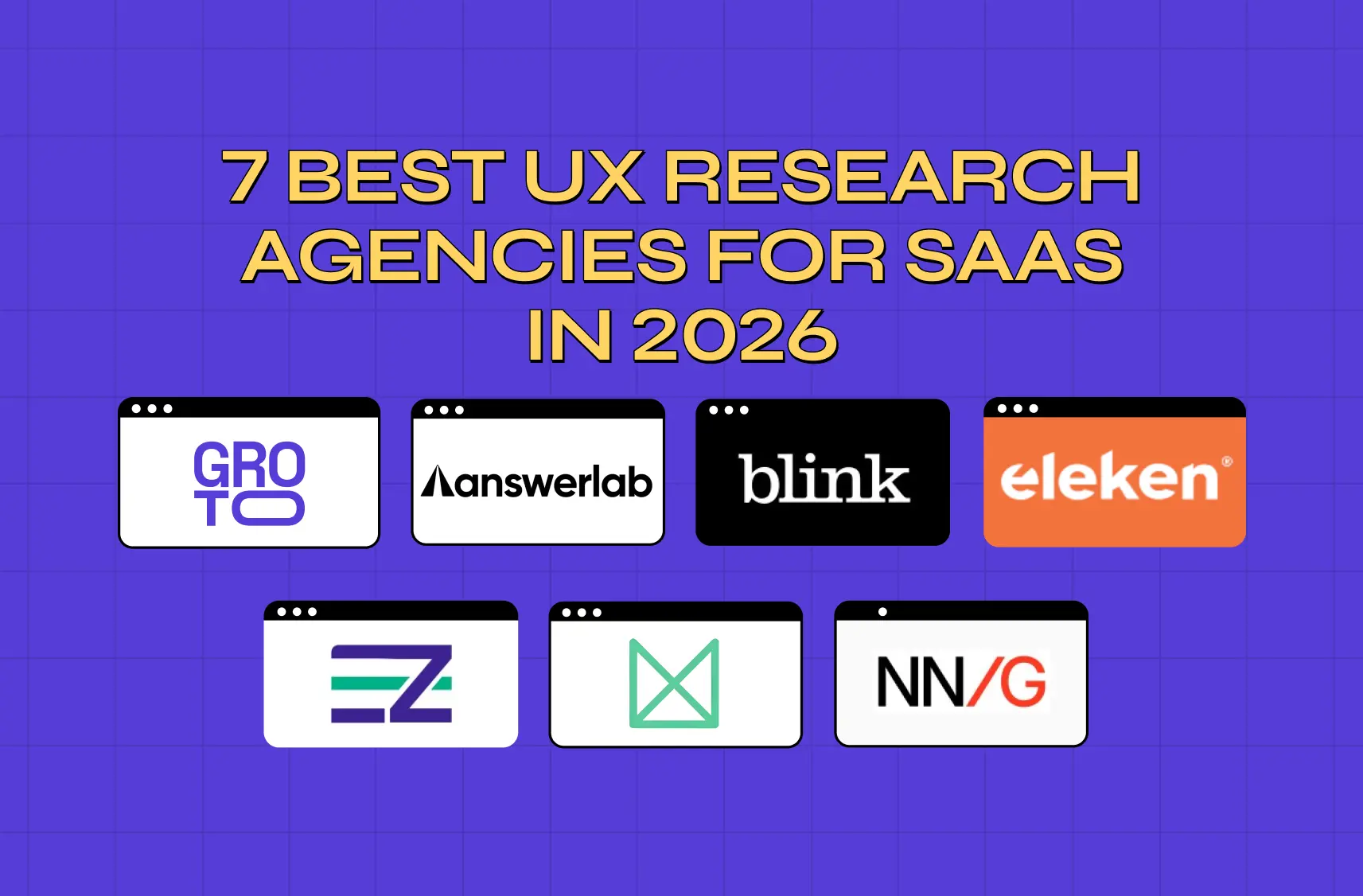
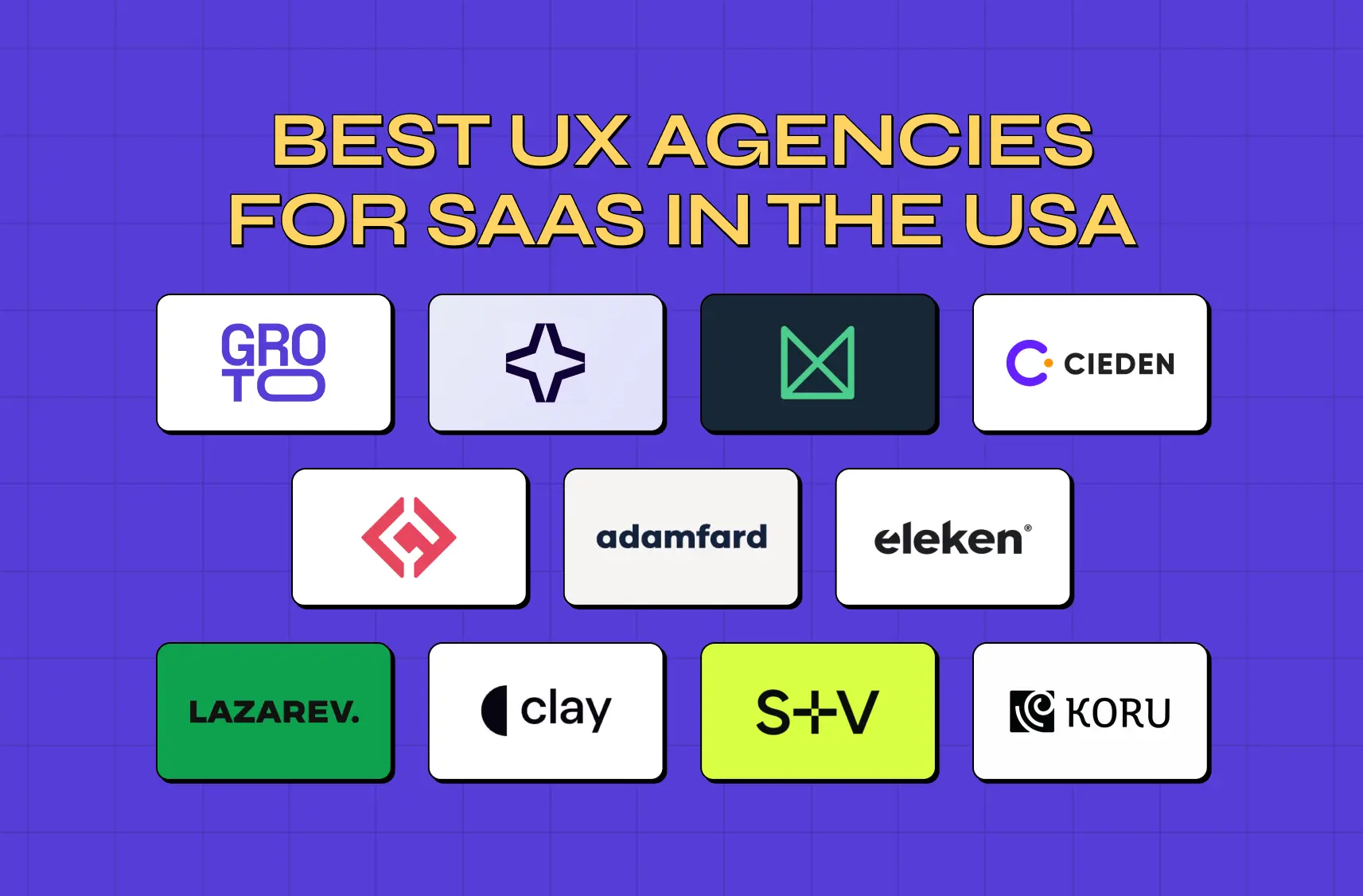
Best UX Agencies for SaaS in the USA: Pick by Go-to-Market Model, Not Rankings

Stop filtering SaaS UX agencies by Clutch ratings. The right agency depends on your go-to-market model — PLG, sales-led, or specialist vertical.

Best UX Agencies for SaaS in the USA: Pick by Go-to-Market Model, Not Rankings

Stop filtering SaaS UX agencies by Clutch ratings. The right agency depends on your go-to-market model — PLG, sales-led, or specialist vertical.

Most "best UX agency" lists rank by ratings and client logos. But for SaaS, the only filter that moves revenue is your go-to-market model — PLG, sales-led, or specialist. Here's how to choose.

The best SaaS UX agency isn't the most awarded — it's the right fit.

Most lists of "best UX agencies for SaaS" rank agencies by Clutch rating or client logo prestige and stop there. That's the wrong filter.

The reason you're looking for a SaaS-specific UX agency — not a general design firm — is because SaaS products have a fundamentally different design problem. It's not about how a screen looks. It's about how fast a new user reaches their first meaningful outcome, how clearly a dashboard communicates the state of a complex system, and whether the onboarding flow is doing the work your sales team can't. The broader landscape of UX design companies for SaaS products spans considerably wider than any single list — this guide narrows it by the filter that actually moves revenue. 

That problem changes completely depending on how your product grows. A product-led company where users self-serve to activation needs an entirely different UX approach than a sales-led company where the product experience needs to justify a $30K annual contract to a five-person buying committee.

The right question before building your agency shortlist isn't "who's the best?" It's: "Which agency is built for my go-to-market model and the specific metric I'm trying to move?" If geography also shapes your shortlist — you're based in New York or want a local partnership for in-person workshops — the guide to top UX design agencies in New York for 2025 covers that market specifically. 

The First Filter: PLG or Sales-Led?

Side-by-side comparison of PLG and sales-led SaaS UX approaches with key differences.

This is the most underused — and most important — filter when evaluating SaaS UX agencies.

Product-led growth (PLG) 

PLG means users discover, adopt, and expand within your product without a significant sales motion. Your UX is the funnel. Every screen between sign-up and first meaningful action is a drop-off risk. The agencies that perform best here are activation-obsessed — they think in terms of time-to-value, aha moment clarity, and reducing the cognitive overhead of the onboarding sequence. A first-session experience that converts 30% of trials to activation is worth more than any feature refinement. For foundational context on what SaaS UX design looks like across the full product lifecycle — from onboarding through retention and expansion — that's useful grounding before scoping any agency engagement. 

Sales-led growth 

It means a human closes the deal before the user gets deep into the product. But UX still matters — it matters during the demo, when a champion is selling the product internally, and in the first 90 days of enterprise onboarding where churn risk is highest. The agencies that perform best here are strong in complex information architecture, multi-role permission flows, and building interfaces that work for power users and occasional users simultaneously. Chicago's enterprise SaaS market runs heavily sales-led — if you're building within that ecosystem and want a locally-focused shortlist, the guide to UX design agencies in Chicago covers that market in depth. 

Most SaaS companies sit somewhere on the spectrum, and some operate a hybrid model — self-serve at the bottom of the market, sales-assisted at enterprise. Before shortlisting any agency, know which motion your product primarily runs on and which UX problem is actually costing you revenue.

Comparison table of UX agencies showing GTM fit, strengths, engagement model, and best stage.

PLG-Optimised UX Agencies for SaaS

These agencies have built their methodology around the self-serve growth model. They think in onboarding sequences, activation funnels, and first-session conversion — not just visual hierarchy.

Groto

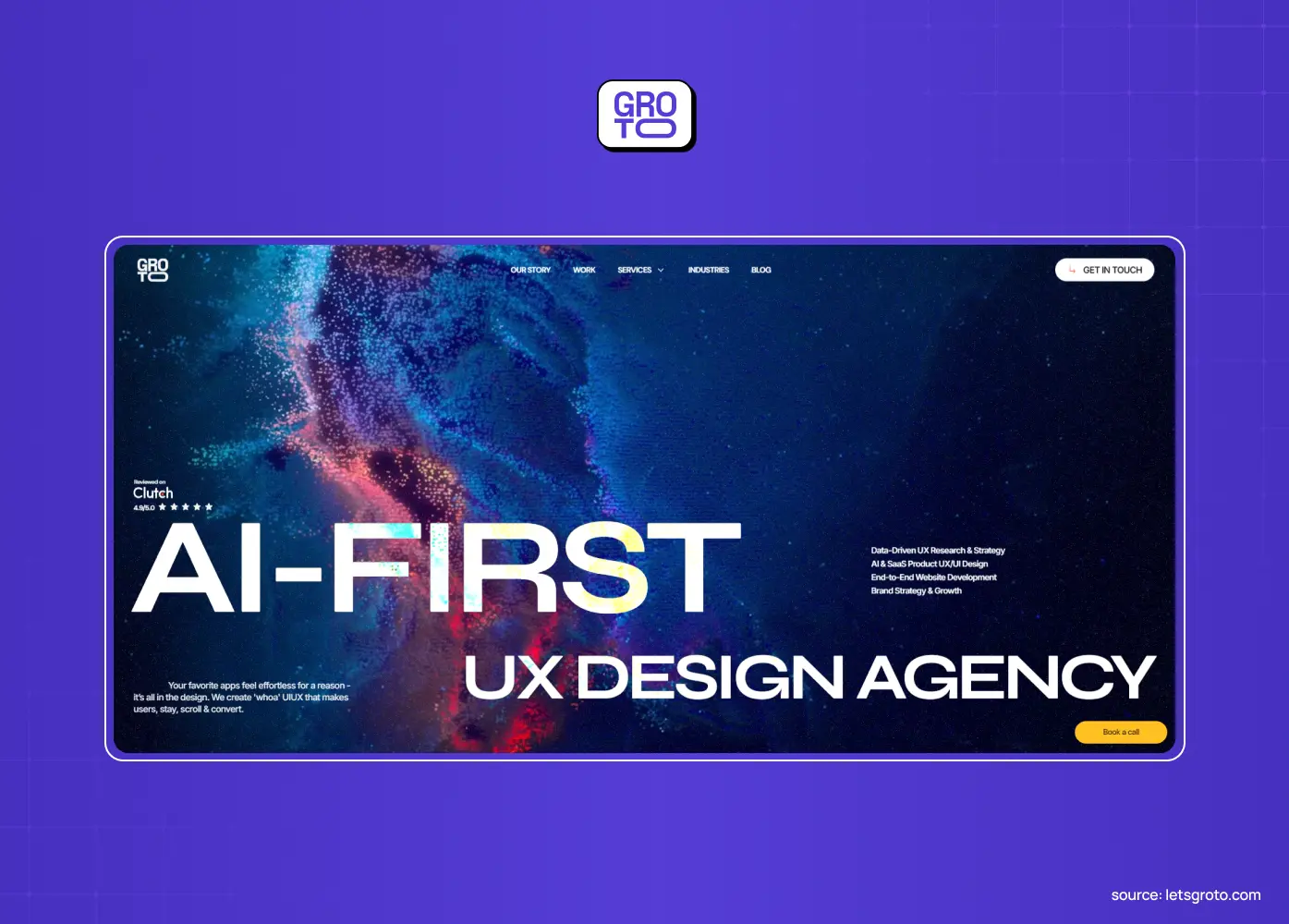
Groto homepage highlighting AI-first UX design agency with bold hero text and service offerings.

Engagement model: Project-based (audit or redesign) | Location: Remote (US clients)

Groto works exclusively with B2B SaaS and AI products at Seed through Series B. Our engagements start with the data — funnel analytics, session recordings, support ticket themes — before any design work begins. We scope to the specific flows where drop-off is happening, not the entire product, which means faster findings and faster implementation.

Our PLG experience is specifically in the activation layer: the sequence between sign-up and first meaningful action. If you're losing 60% of trials before they reach the feature they signed up for, that's the problem we're set up to solve. We also do sales-led onboarding work — particularly the first 90 days of enterprise customer experience, where implementation friction is the leading cause of early churn.

Best for: B2B SaaS companies where activation or onboarding is the measurable bottleneck, and you want diagnosis before execution.

Eleken

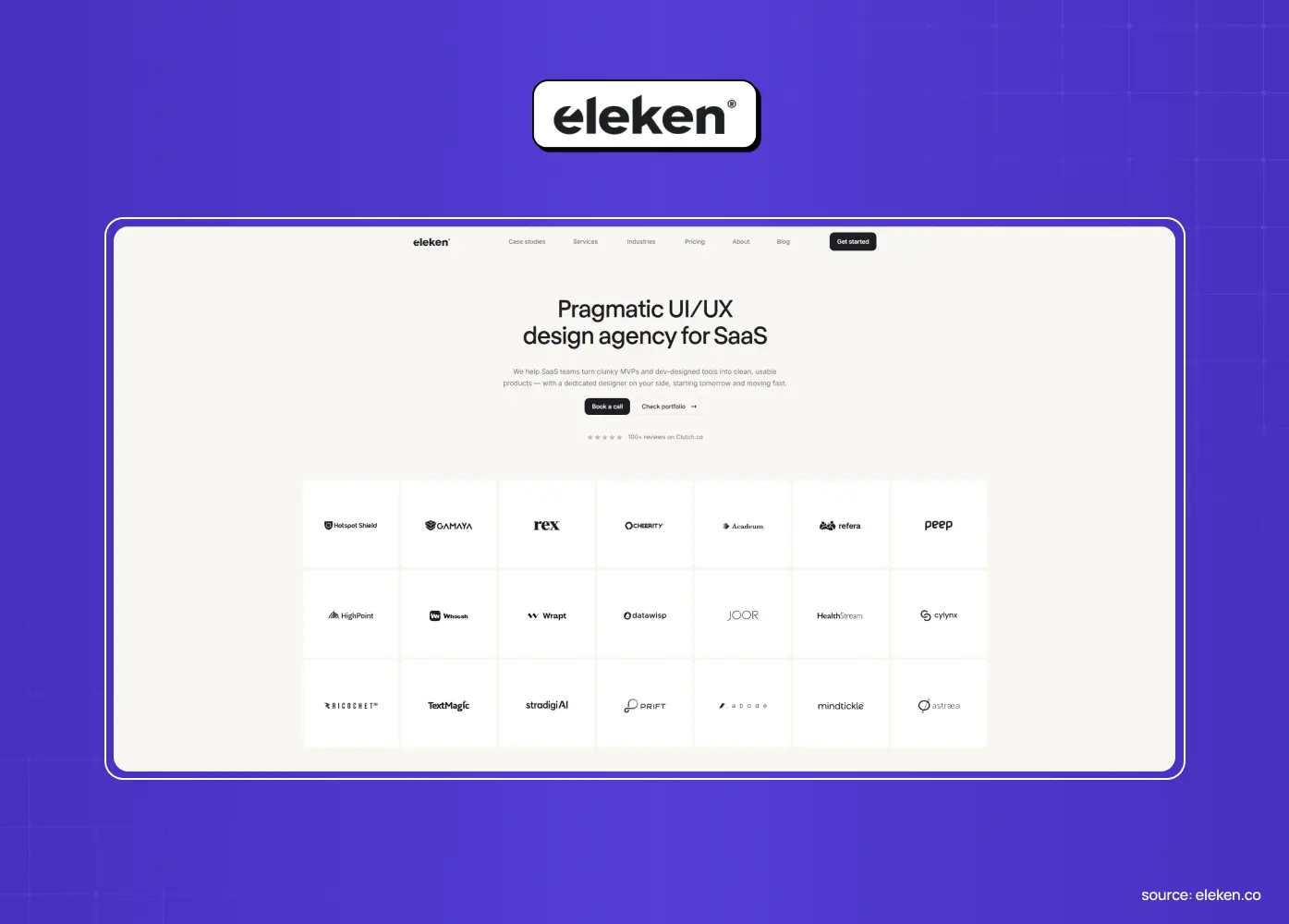
Eleken SaaS UX agency homepage emphasizing product usability and conversion-focused messaging.

Engagement model: Designer-on-retainer (monthly subscription) | Location: Remote (US clients)

Eleken positions explicitly as a SaaS design agency and has 200+ SaaS products in their portfolio. Their subscription model — a dedicated designer on retainer at a flat monthly rate — is well matched to PLG companies that need continuous iteration on activation flows rather than a one-time redesign. Their team has genuine fluency in dashboards, onboarding sequences, and analytics interfaces — the screen types that PLG companies iterate on most.

Where they shine: ongoing design output at reasonable cost, SaaS-specific visual language, speed of execution. Where they're less strong: the subscription model doesn't come with a research layer or activation diagnosis. You'll need to know what you want to improve; they'll execute it well.

Best for: Seed-to-Series A PLG companies that need consistent design execution alongside their engineering sprints, with a specific UX improvement agenda already defined. If the subscription model doesn't fit your engagement structure, the guide to Eleken alternatives covers agencies with comparable SaaS focus and different engagement models. 

StanVision

Stanvision UI/UX and Webflow agency homepage with large typography and abstract visual elements.

Engagement model: Project-based | Location: San Francisco

StanVision has built their approach around a specific UX philosophy: remove confusion, make the next step obvious. For PLG products, that translates to a strong focus on onboarding clarity and conversion-rate optimisation across the product funnel. They bring both product and marketing site expertise, which matters when your website and in-product onboarding need to set the same expectations.

Their team is small and selective, which means direct access to senior designers — a meaningful difference from agencies where you pitch the principals and get junior execution.

Best for: PLG SaaS companies where there's meaningful drop-off between sign-up and activation and the core fix is a clearer, simpler onboarding path.

Sales-Led & Enterprise-Ready UX Agencies for SaaS

These agencies are strong where the design challenge is complex workflow management, multi-stakeholder interfaces, and building products that need to work for a buying committee as much as a daily user.

MetaLab

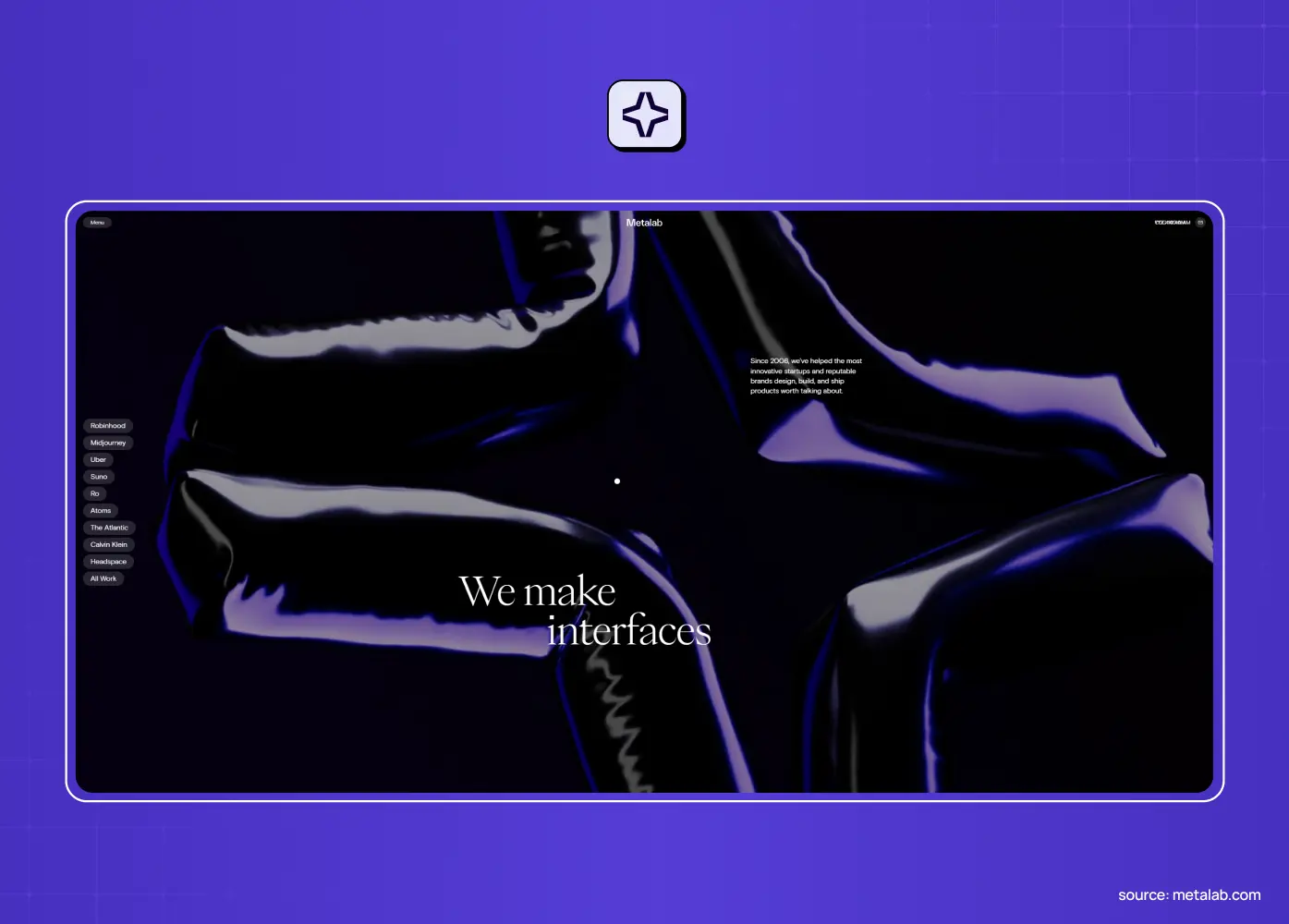
Metalab agency homepage with dark theme, showcasing product design expertise and client work.

Engagement model: Project-based | Location: Victoria, BC (strong US client base)

MetaLab's credibility anchor is the original Slack interface — a credential that speaks directly to the challenge of making complex B2B communication intuitive for enterprise teams. Their strength is in building design systems and interface patterns that hold together at scale — critical for sales-led SaaS companies where the product has to work across dozens of enterprise configurations.

They're a thoughtful partner for Series B+ companies preparing for an enterprise push and needing a product that can justify a serious contract in a competitive evaluation.

Best for: Mid-market to enterprise SaaS companies that need a design system that scales and a product interface that performs in enterprise procurement evaluations.

Goji Labs

Goji Labs digital product agency homepage featuring bold headline and product development focus.

Engagement model: Full-stack (strategy through development) | Location: Los Angeles, CA

Goji Labs brings product strategy and engineering alongside their UX practice — which makes them a stronger fit for sales-led companies where the design work needs to connect directly to development and where product scope decisions are still in flux. Their clients have collectively raised over $1B, and their approach to de-risking product launches aligns well with pre-launch or post-pivot sales-led SaaS.

They're particularly active in healthcare and education tech — verticals where regulatory complexity and multi-stakeholder decision-making are constant constraints.

Best for: Sales-led SaaS companies at Seed–Series A that need strategy, UX, and development aligned in a single engagement, particularly in regulated verticals. Goji Labs is based in Los Angeles — the guide to top UX design agencies in Los Angeles maps the broader LA ecosystem for teams searching within that market. 

Clay

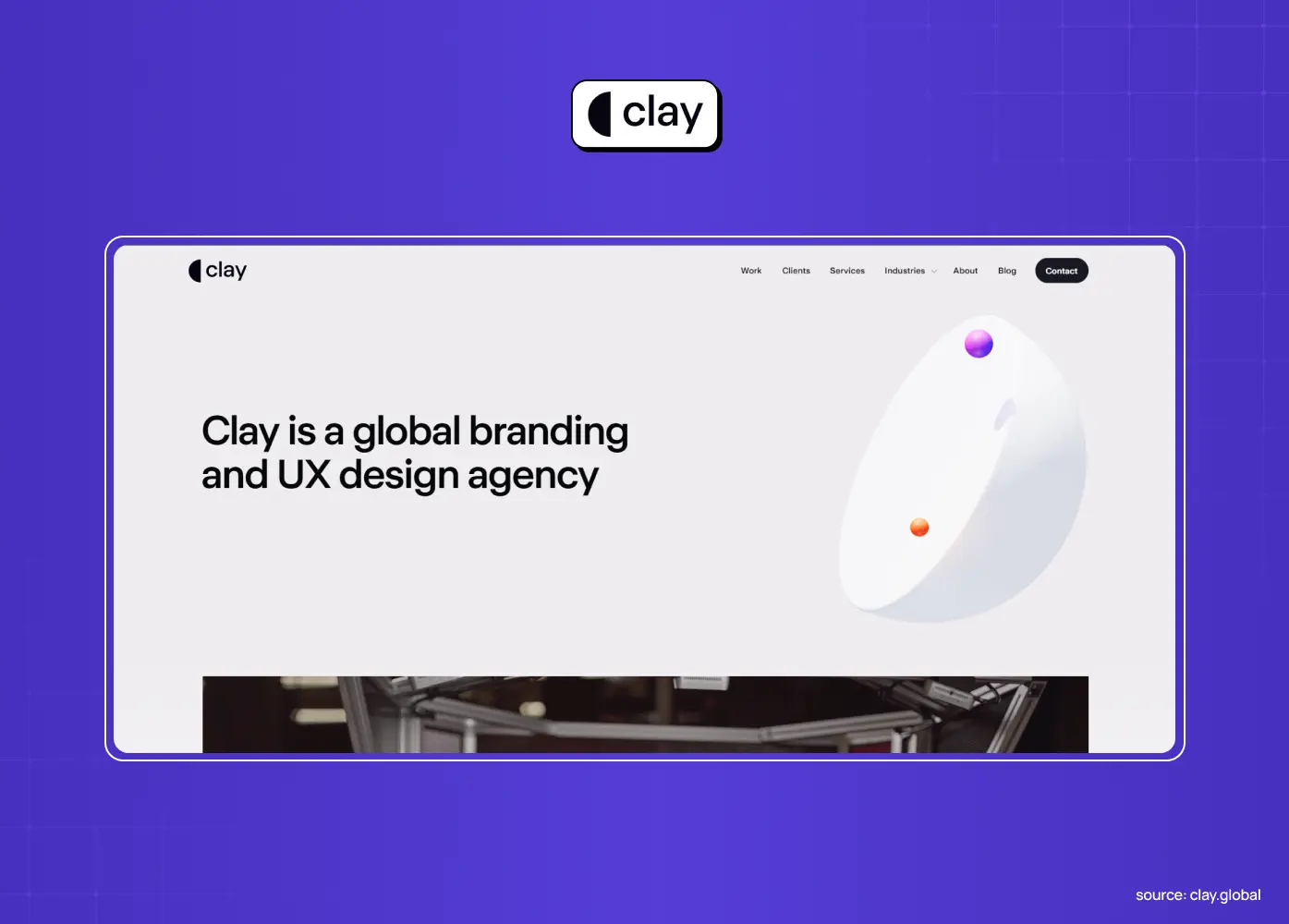
Clay branding and UX agency homepage with minimal layout and soft 3D visual elements.

Engagement model: Project-based | Location: San Francisco

Clay's portfolio — Slack, Coinbase, Stripe, Meta — speaks to their ability to handle product design at enterprise scale with exceptional visual craft. For sales-led SaaS companies, the Clay advantage is in the demo experience: a product that looks and feels like a premium enterprise tool makes the internal champion's job of selling up the chain materially easier.

The trade-off: Clay tends to be strong in the visual dimension and for companies where brand and product design need to move in lockstep. If your primary problem is activation rate or onboarding conversion, their strength may not match your bottleneck.

Best for: Series B+ sales-led SaaS companies entering enterprise upmarket where product craftsmanship and brand credibility are part of the competitive positioning. Clay is part of a strong design agency concentration in San Francisco — the guide to top UX design agencies in the San Francisco Bay Area maps the full ecosystem if location is a factor in your search. 

Specialist Agencies: AI Products, Compliance, and Data-Heavy SaaS

These agencies bring domain expertise that's worth the premium when your product lives in a regulated vertical, handles complex data, or involves AI-native interactions.

Lazarev Agency

Lazarev AI-focused product design agency homepage with bold typography and dark interface.

Engagement model: Project-based | Location: San Francisco

Lazarev has shipped 600+ products and has a specific focus on making AI-first interfaces feel approachable. With 30+ AI products in their portfolio, they've developed genuine expertise in the UX patterns that AI-native SaaS requires: confidence displays, uncertainty communication, explainability layers, and progressive disclosure of model-driven recommendations. For teams building AI products where the core challenge is making the AI output legible and trustworthy, this specialisation is rare and valuable.

Best for: AI-native SaaS and ML-heavy analytics products where the primary UX challenge is communicating intelligent output to non-technical users.

Adam Fard UX Studio

Adam Fard UX and AI design studio homepage highlighting B2B SaaS product expertise.

Engagement model: Project-based + DesignStream retainer | Location: Remote

Adam Fard brings a practitioner's credibility — he built UX Pilot, his own SaaS tool, to $5.3M ARR using the research-led UX methodology he applies to clients. That self-built product experience gives his team a different perspective on activation, retention, and the real constraints of building SaaS in a resource-constrained environment. Their specialisation in AI/LLM integration UX is also increasingly relevant for SaaS companies adding AI features to existing products.

Best for: SaaS companies with AI feature sets, fintech products, or teams that want a practitioner-founded agency with owned-product credibility.

Koru UX Design

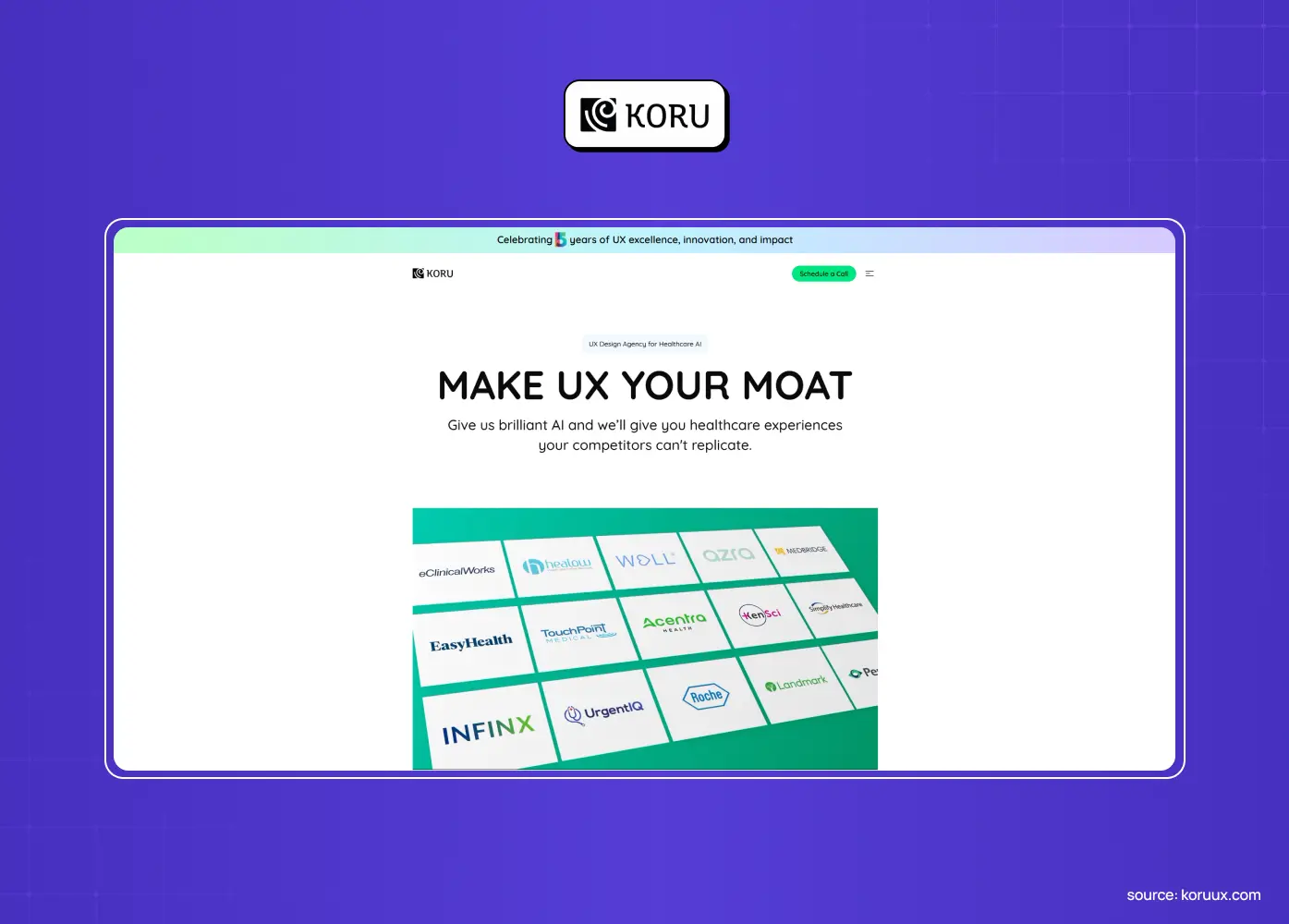
Koru UX design agency homepage focused on healthcare AI with clean and minimal layout.

Engagement model: Project-based | Location: India (US clients)

For SaaS companies in healthcare, medical devices, or compliance-heavy verticals, Koru brings domain expertise that most design agencies don't have. HIPAA workflow experience, clinical interface standards, and regulatory documentation requirements are not transferable skills — agencies that claim general healthcare experience and agencies that have shipped EHR and medical device interfaces are genuinely different. Koru falls into the latter category.

Best for: HealthTech and MedTech SaaS companies where compliance and clinical workflow design is a core product requirement, not an add-on.

CodeTheorem

Codetheorem UX design and AI development agency homepage with strong headline and CTA.

Engagement model: Project-based | Location: Remote (US and Australia clients)

CodeTheorem sits at the intersection of design and engineering — which makes them a strong partner for data-dense SaaS products (analytics dashboards, operations tools, fintech platforms) where the design work has to be in close conversation with the data model and front-end implementation. Their clients' platforms collectively support over $1B in revenue, and their fintech and operations-heavy portfolio is a reliable signal of comfort with complex state management and dense information environments.

Best for: Fintech, analytics, and operations SaaS where the product is data-dense and the design work needs tight engineering integration.

Agency Comparison at a Glance

Agency

GTM Fit

Primary Strength

Engagement Model

Best Stage

Groto

PLG + Sales-Led

Activation diagnosis + B2B SaaS

Project

Seed–B

Eleken

PLG

SaaS execution speed

Retainer

Seed–A

StanVision

PLG

Onboarding clarity + CRO

Project

Seed–B

MetaLab

Sales-Led

Design systems at scale

Project

B–C

Goji Labs

Sales-Led

Strategy + dev integration

Full-stack

Seed–A

Clay

Sales-Led

Visual craft + brand-product

Project

B+

Lazarev

Specialist

AI-native UX

Project

Any

Adam Fard

Specialist

AI/fintech + practitioner lens

Project + Retainer

Any

Koru UX

Specialist

HealthTech compliance

Project

Any

CodeTheorem

Specialist

Data-dense + engineering-close

Project

Any

Seven Questions to Ask Any SaaS UX Agency Before Hiring

List of seven strategic questions to evaluate UX agencies for SaaS products.

The first call with a UX agency is mostly positioning. These questions cut through to what you actually need to know — and pair well with the practical checklist for choosing the right design agency if you want a structured evaluation framework alongside the interview questions. 

  1. "Can you show me three projects where you improved a specific product metric — activation rate, time-to-value, or 30-day retention — and tell me what moved?"

 This is the single most important question. Agencies with genuine SaaS product design experience will have the answer. Agencies that are primarily visual designers will give you case studies about "improving the user experience" without a number attached.

  1. "How do you approach the onboarding sequence differently for a PLG product versus a sales-led product?" 

If they can't articulate the difference clearly, they haven't done both. The right answer involves specific things: PLG requires reducing time-to-aha, sales-led requires managing first-impression complexity across personas. Vague answers are a signal that "SaaS" in their positioning is broad.

  1. "What information do you need from us to start producing useful design decisions?" 

Good agencies name specific inputs: session recordings, funnel data, support ticket themes, user interview access. Agencies that say "just give us the brief and access to the product" are working from assumptions, not evidence.

  1. "How do you handle the gap between what your research finds and what the product team believes?" 

This reveals whether they'll give you a genuinely independent perspective or confirm your existing assumptions. The best answer includes an example of a finding that was initially unpopular and how they handled it.

  1. "What does a successful engagement look like at 90 days? How do we measure it?" 

Agencies that have clear, metric-tied success criteria understand that design is a means to an end. Agencies that describe success in terms of deliverables (wireframes, design system, final handoff) without connecting those deliverables to outcomes are telling you where their thinking stops. For a framework to quantify the expected business return before the engagement begins, the guide to calculating the ROI of UX design gives you the metrics to measure against from day one. 

  1. "Who will actually be doing the design work, and what's their SaaS background?" 

This is the most commonly avoided question and one of the most important. In many mid-sized agencies, senior designers pitch and junior designers execute. Ask specifically — not "who leads the project" but "who is doing the daily design work, and what products have they shipped that look like mine?" Cross-referencing their answer against the skills a UI/UX agency must have in 2026 gives you an objective framework to evaluate what you hear. 

  1. "What would make you tell us this isn't the right engagement for you?" 

Agencies that can name specific situations where they'd decline work — wrong stage, wrong problem type, insufficient data for diagnosis — are agencies that take fit seriously. Agencies that can't answer this question are agencies that will take the project regardless of fit.

Conclusion: Your Go-to-Market Model Is Your Agency Brief

The best UX agency for your SaaS product is not the one with the most awards or the longest client logo list. It's the one whose core methodology is built for your growth model and whose outcome orientation maps to the metric you're actually trying to move.

If you're PLG and your problem is activation, you need an agency that has lived that funnel from the inside. If you're sales-led and your problem is enterprise onboarding churn, you need an agency that understands multi-role complexity and implementation experience design. If your product is AI-native or lives in a regulated vertical, you need domain expertise that can't be acquired in a single engagement. And if your product sits outside the SaaS category — consumer apps, physical products with digital interfaces, or broader digital platforms — the guide to top product design agencies in 2025 covers the broader market across verticals. 

Groto sits specifically at the PLG and early sales-led intersection — B2B SaaS products at Seed through Series B where activation or onboarding is the measurable bottleneck. Our process starts with your data before any design work begins.

Book a discovery call → Tell us your growth model, your current activation rate, and where you're losing users. We'll tell you in 30 minutes whether we're the right fit — and if we're not, we'll point you toward who is.


Most "best UX agency" lists rank by ratings and client logos. But for SaaS, the only filter that moves revenue is your go-to-market model — PLG, sales-led, or specialist. Here's how to choose.

The best SaaS UX agency isn't the most awarded — it's the right fit.

Most lists of "best UX agencies for SaaS" rank agencies by Clutch rating or client logo prestige and stop there. That's the wrong filter.

The reason you're looking for a SaaS-specific UX agency — not a general design firm — is because SaaS products have a fundamentally different design problem. It's not about how a screen looks. It's about how fast a new user reaches their first meaningful outcome, how clearly a dashboard communicates the state of a complex system, and whether the onboarding flow is doing the work your sales team can't. The broader landscape of UX design companies for SaaS products spans considerably wider than any single list — this guide narrows it by the filter that actually moves revenue. 

That problem changes completely depending on how your product grows. A product-led company where users self-serve to activation needs an entirely different UX approach than a sales-led company where the product experience needs to justify a $30K annual contract to a five-person buying committee.

The right question before building your agency shortlist isn't "who's the best?" It's: "Which agency is built for my go-to-market model and the specific metric I'm trying to move?" If geography also shapes your shortlist — you're based in New York or want a local partnership for in-person workshops — the guide to top UX design agencies in New York for 2025 covers that market specifically. 

The First Filter: PLG or Sales-Led?

Side-by-side comparison of PLG and sales-led SaaS UX approaches with key differences.

This is the most underused — and most important — filter when evaluating SaaS UX agencies.

Product-led growth (PLG) 

PLG means users discover, adopt, and expand within your product without a significant sales motion. Your UX is the funnel. Every screen between sign-up and first meaningful action is a drop-off risk. The agencies that perform best here are activation-obsessed — they think in terms of time-to-value, aha moment clarity, and reducing the cognitive overhead of the onboarding sequence. A first-session experience that converts 30% of trials to activation is worth more than any feature refinement. For foundational context on what SaaS UX design looks like across the full product lifecycle — from onboarding through retention and expansion — that's useful grounding before scoping any agency engagement. 

Sales-led growth 

It means a human closes the deal before the user gets deep into the product. But UX still matters — it matters during the demo, when a champion is selling the product internally, and in the first 90 days of enterprise onboarding where churn risk is highest. The agencies that perform best here are strong in complex information architecture, multi-role permission flows, and building interfaces that work for power users and occasional users simultaneously. Chicago's enterprise SaaS market runs heavily sales-led — if you're building within that ecosystem and want a locally-focused shortlist, the guide to UX design agencies in Chicago covers that market in depth. 

Most SaaS companies sit somewhere on the spectrum, and some operate a hybrid model — self-serve at the bottom of the market, sales-assisted at enterprise. Before shortlisting any agency, know which motion your product primarily runs on and which UX problem is actually costing you revenue.

Comparison table of UX agencies showing GTM fit, strengths, engagement model, and best stage.

PLG-Optimised UX Agencies for SaaS

These agencies have built their methodology around the self-serve growth model. They think in onboarding sequences, activation funnels, and first-session conversion — not just visual hierarchy.

Groto

Groto homepage highlighting AI-first UX design agency with bold hero text and service offerings.

Engagement model: Project-based (audit or redesign) | Location: Remote (US clients)

Groto works exclusively with B2B SaaS and AI products at Seed through Series B. Our engagements start with the data — funnel analytics, session recordings, support ticket themes — before any design work begins. We scope to the specific flows where drop-off is happening, not the entire product, which means faster findings and faster implementation.

Our PLG experience is specifically in the activation layer: the sequence between sign-up and first meaningful action. If you're losing 60% of trials before they reach the feature they signed up for, that's the problem we're set up to solve. We also do sales-led onboarding work — particularly the first 90 days of enterprise customer experience, where implementation friction is the leading cause of early churn.

Best for: B2B SaaS companies where activation or onboarding is the measurable bottleneck, and you want diagnosis before execution.

Eleken

Eleken SaaS UX agency homepage emphasizing product usability and conversion-focused messaging.

Engagement model: Designer-on-retainer (monthly subscription) | Location: Remote (US clients)

Eleken positions explicitly as a SaaS design agency and has 200+ SaaS products in their portfolio. Their subscription model — a dedicated designer on retainer at a flat monthly rate — is well matched to PLG companies that need continuous iteration on activation flows rather than a one-time redesign. Their team has genuine fluency in dashboards, onboarding sequences, and analytics interfaces — the screen types that PLG companies iterate on most.

Where they shine: ongoing design output at reasonable cost, SaaS-specific visual language, speed of execution. Where they're less strong: the subscription model doesn't come with a research layer or activation diagnosis. You'll need to know what you want to improve; they'll execute it well.

Best for: Seed-to-Series A PLG companies that need consistent design execution alongside their engineering sprints, with a specific UX improvement agenda already defined. If the subscription model doesn't fit your engagement structure, the guide to Eleken alternatives covers agencies with comparable SaaS focus and different engagement models. 

StanVision

Stanvision UI/UX and Webflow agency homepage with large typography and abstract visual elements.

Engagement model: Project-based | Location: San Francisco

StanVision has built their approach around a specific UX philosophy: remove confusion, make the next step obvious. For PLG products, that translates to a strong focus on onboarding clarity and conversion-rate optimisation across the product funnel. They bring both product and marketing site expertise, which matters when your website and in-product onboarding need to set the same expectations.

Their team is small and selective, which means direct access to senior designers — a meaningful difference from agencies where you pitch the principals and get junior execution.

Best for: PLG SaaS companies where there's meaningful drop-off between sign-up and activation and the core fix is a clearer, simpler onboarding path.

Sales-Led & Enterprise-Ready UX Agencies for SaaS

These agencies are strong where the design challenge is complex workflow management, multi-stakeholder interfaces, and building products that need to work for a buying committee as much as a daily user.

MetaLab

Metalab agency homepage with dark theme, showcasing product design expertise and client work.

Engagement model: Project-based | Location: Victoria, BC (strong US client base)

MetaLab's credibility anchor is the original Slack interface — a credential that speaks directly to the challenge of making complex B2B communication intuitive for enterprise teams. Their strength is in building design systems and interface patterns that hold together at scale — critical for sales-led SaaS companies where the product has to work across dozens of enterprise configurations.

They're a thoughtful partner for Series B+ companies preparing for an enterprise push and needing a product that can justify a serious contract in a competitive evaluation.

Best for: Mid-market to enterprise SaaS companies that need a design system that scales and a product interface that performs in enterprise procurement evaluations.

Goji Labs

Goji Labs digital product agency homepage featuring bold headline and product development focus.

Engagement model: Full-stack (strategy through development) | Location: Los Angeles, CA

Goji Labs brings product strategy and engineering alongside their UX practice — which makes them a stronger fit for sales-led companies where the design work needs to connect directly to development and where product scope decisions are still in flux. Their clients have collectively raised over $1B, and their approach to de-risking product launches aligns well with pre-launch or post-pivot sales-led SaaS.

They're particularly active in healthcare and education tech — verticals where regulatory complexity and multi-stakeholder decision-making are constant constraints.

Best for: Sales-led SaaS companies at Seed–Series A that need strategy, UX, and development aligned in a single engagement, particularly in regulated verticals. Goji Labs is based in Los Angeles — the guide to top UX design agencies in Los Angeles maps the broader LA ecosystem for teams searching within that market. 

Clay

Clay branding and UX agency homepage with minimal layout and soft 3D visual elements.

Engagement model: Project-based | Location: San Francisco

Clay's portfolio — Slack, Coinbase, Stripe, Meta — speaks to their ability to handle product design at enterprise scale with exceptional visual craft. For sales-led SaaS companies, the Clay advantage is in the demo experience: a product that looks and feels like a premium enterprise tool makes the internal champion's job of selling up the chain materially easier.

The trade-off: Clay tends to be strong in the visual dimension and for companies where brand and product design need to move in lockstep. If your primary problem is activation rate or onboarding conversion, their strength may not match your bottleneck.

Best for: Series B+ sales-led SaaS companies entering enterprise upmarket where product craftsmanship and brand credibility are part of the competitive positioning. Clay is part of a strong design agency concentration in San Francisco — the guide to top UX design agencies in the San Francisco Bay Area maps the full ecosystem if location is a factor in your search. 

Specialist Agencies: AI Products, Compliance, and Data-Heavy SaaS

These agencies bring domain expertise that's worth the premium when your product lives in a regulated vertical, handles complex data, or involves AI-native interactions.

Lazarev Agency

Lazarev AI-focused product design agency homepage with bold typography and dark interface.

Engagement model: Project-based | Location: San Francisco

Lazarev has shipped 600+ products and has a specific focus on making AI-first interfaces feel approachable. With 30+ AI products in their portfolio, they've developed genuine expertise in the UX patterns that AI-native SaaS requires: confidence displays, uncertainty communication, explainability layers, and progressive disclosure of model-driven recommendations. For teams building AI products where the core challenge is making the AI output legible and trustworthy, this specialisation is rare and valuable.

Best for: AI-native SaaS and ML-heavy analytics products where the primary UX challenge is communicating intelligent output to non-technical users.

Adam Fard UX Studio

Adam Fard UX and AI design studio homepage highlighting B2B SaaS product expertise.

Engagement model: Project-based + DesignStream retainer | Location: Remote

Adam Fard brings a practitioner's credibility — he built UX Pilot, his own SaaS tool, to $5.3M ARR using the research-led UX methodology he applies to clients. That self-built product experience gives his team a different perspective on activation, retention, and the real constraints of building SaaS in a resource-constrained environment. Their specialisation in AI/LLM integration UX is also increasingly relevant for SaaS companies adding AI features to existing products.

Best for: SaaS companies with AI feature sets, fintech products, or teams that want a practitioner-founded agency with owned-product credibility.

Koru UX Design

Koru UX design agency homepage focused on healthcare AI with clean and minimal layout.

Engagement model: Project-based | Location: India (US clients)

For SaaS companies in healthcare, medical devices, or compliance-heavy verticals, Koru brings domain expertise that most design agencies don't have. HIPAA workflow experience, clinical interface standards, and regulatory documentation requirements are not transferable skills — agencies that claim general healthcare experience and agencies that have shipped EHR and medical device interfaces are genuinely different. Koru falls into the latter category.

Best for: HealthTech and MedTech SaaS companies where compliance and clinical workflow design is a core product requirement, not an add-on.

CodeTheorem

Codetheorem UX design and AI development agency homepage with strong headline and CTA.

Engagement model: Project-based | Location: Remote (US and Australia clients)

CodeTheorem sits at the intersection of design and engineering — which makes them a strong partner for data-dense SaaS products (analytics dashboards, operations tools, fintech platforms) where the design work has to be in close conversation with the data model and front-end implementation. Their clients' platforms collectively support over $1B in revenue, and their fintech and operations-heavy portfolio is a reliable signal of comfort with complex state management and dense information environments.

Best for: Fintech, analytics, and operations SaaS where the product is data-dense and the design work needs tight engineering integration.

Agency Comparison at a Glance

Agency

GTM Fit

Primary Strength

Engagement Model

Best Stage

Groto

PLG + Sales-Led

Activation diagnosis + B2B SaaS

Project

Seed–B

Eleken

PLG

SaaS execution speed

Retainer

Seed–A

StanVision

PLG

Onboarding clarity + CRO

Project

Seed–B

MetaLab

Sales-Led

Design systems at scale

Project

B–C

Goji Labs

Sales-Led

Strategy + dev integration

Full-stack

Seed–A

Clay

Sales-Led

Visual craft + brand-product

Project

B+

Lazarev

Specialist

AI-native UX

Project

Any

Adam Fard

Specialist

AI/fintech + practitioner lens

Project + Retainer

Any

Koru UX

Specialist

HealthTech compliance

Project

Any

CodeTheorem

Specialist

Data-dense + engineering-close

Project

Any

Seven Questions to Ask Any SaaS UX Agency Before Hiring

List of seven strategic questions to evaluate UX agencies for SaaS products.

The first call with a UX agency is mostly positioning. These questions cut through to what you actually need to know — and pair well with the practical checklist for choosing the right design agency if you want a structured evaluation framework alongside the interview questions. 

  1. "Can you show me three projects where you improved a specific product metric — activation rate, time-to-value, or 30-day retention — and tell me what moved?"

 This is the single most important question. Agencies with genuine SaaS product design experience will have the answer. Agencies that are primarily visual designers will give you case studies about "improving the user experience" without a number attached.

  1. "How do you approach the onboarding sequence differently for a PLG product versus a sales-led product?" 

If they can't articulate the difference clearly, they haven't done both. The right answer involves specific things: PLG requires reducing time-to-aha, sales-led requires managing first-impression complexity across personas. Vague answers are a signal that "SaaS" in their positioning is broad.

  1. "What information do you need from us to start producing useful design decisions?" 

Good agencies name specific inputs: session recordings, funnel data, support ticket themes, user interview access. Agencies that say "just give us the brief and access to the product" are working from assumptions, not evidence.

  1. "How do you handle the gap between what your research finds and what the product team believes?" 

This reveals whether they'll give you a genuinely independent perspective or confirm your existing assumptions. The best answer includes an example of a finding that was initially unpopular and how they handled it.

  1. "What does a successful engagement look like at 90 days? How do we measure it?" 

Agencies that have clear, metric-tied success criteria understand that design is a means to an end. Agencies that describe success in terms of deliverables (wireframes, design system, final handoff) without connecting those deliverables to outcomes are telling you where their thinking stops. For a framework to quantify the expected business return before the engagement begins, the guide to calculating the ROI of UX design gives you the metrics to measure against from day one. 

  1. "Who will actually be doing the design work, and what's their SaaS background?" 

This is the most commonly avoided question and one of the most important. In many mid-sized agencies, senior designers pitch and junior designers execute. Ask specifically — not "who leads the project" but "who is doing the daily design work, and what products have they shipped that look like mine?" Cross-referencing their answer against the skills a UI/UX agency must have in 2026 gives you an objective framework to evaluate what you hear. 

  1. "What would make you tell us this isn't the right engagement for you?" 

Agencies that can name specific situations where they'd decline work — wrong stage, wrong problem type, insufficient data for diagnosis — are agencies that take fit seriously. Agencies that can't answer this question are agencies that will take the project regardless of fit.

Conclusion: Your Go-to-Market Model Is Your Agency Brief

The best UX agency for your SaaS product is not the one with the most awards or the longest client logo list. It's the one whose core methodology is built for your growth model and whose outcome orientation maps to the metric you're actually trying to move.

If you're PLG and your problem is activation, you need an agency that has lived that funnel from the inside. If you're sales-led and your problem is enterprise onboarding churn, you need an agency that understands multi-role complexity and implementation experience design. If your product is AI-native or lives in a regulated vertical, you need domain expertise that can't be acquired in a single engagement. And if your product sits outside the SaaS category — consumer apps, physical products with digital interfaces, or broader digital platforms — the guide to top product design agencies in 2025 covers the broader market across verticals. 

Groto sits specifically at the PLG and early sales-led intersection — B2B SaaS products at Seed through Series B where activation or onboarding is the measurable bottleneck. Our process starts with your data before any design work begins.

Book a discovery call → Tell us your growth model, your current activation rate, and where you're losing users. We'll tell you in 30 minutes whether we're the right fit — and if we're not, we'll point you toward who is.


Have a project in mind?

Let’s talk through your idea and see what makes sense.

Harpreet Singh

Founder at Groto

Have a project in mind?

Let’s talk through your idea and see what makes sense.

Harpreet Singh

Founder at Groto

FAQ

Everything you were going to ask (and a few things you didn’t know to)

What makes a UX agency "SaaS-specific"?

A genuinely SaaS-specific UX agency has fluency in the product types and metrics that define SaaS: onboarding flows, dashboard interfaces, multi-role permission systems, activation funnels, and retention-adjacent UX decisions. More specifically, they understand the difference between designing for self-serve trial conversion and designing for enterprise onboarding. Agencies that claim SaaS specialisation but whose portfolio is primarily marketing sites, mobile consumer apps, or brand identity work are not SaaS-specific in a meaningful sense.
Should I hire a PLG-focused or sales-led-focused UX agency?

It depends entirely on your growth model. If 80% of your new customers come through self-serve sign-up and activate without a sales conversation, your most valuable UX investment is in the onboarding and activation layer — which requires PLG-oriented design expertise. If the majority of your revenue comes through sales-assisted deals, your UX investment is more valuable in the post-sale experience, complex workflow design, and demo-readiness of the product. Many companies run a hybrid model and need an agency comfortable with both.

How much do SaaS UX agencies charge in the USA?

Specialist SaaS UX agencies in the USA typically range from $6K–$30K for a scoped project (audit or focused redesign) and $3K–$10K/month for ongoing retainer arrangements. Full-service engagements including user research, IA overhaul, and design system delivery typically run $20K–$80K depending on scope and team size. Enterprise-tier firms (MetaLab, Clay) operate at the higher end of these ranges. The cost driver is always research depth and scope — a narrow activation audit is materially less expensive than a full product redesign.

How do I evaluate a SaaS UX agency's portfolio?

Look for: products with a similar level of workflow complexity to yours (not just visual similarity), case studies that mention measurable outcomes (activation improvement, retention change, support ticket reduction), evidence of both the problem they were solving and the research method they used, and a before/after or before/during narrative that proves they understand the UX problem they were hired to fix. Avoid placing too much weight on visual polish — the most visually impressive portfolio pages are sometimes the least evidence-rich in terms of product thinking.

What's the difference between a UX audit and a UX redesign for SaaS?

A UX audit diagnoses what's broken and why, typically by combining expert heuristic review with your existing analytics and session data. A redesign acts on those findings. For most SaaS products with an activation or retention problem, the audit comes first — it prevents you from redesigning the wrong thing. The combination (audit + targeted redesign of the problem flows) almost always outperforms a full product redesign without a diagnostic foundation.

Do SaaS UX agencies help with AI product design?

An increasing number do, though there's a wide range in genuine expertise. True AI product design specialisation involves understanding conversational UI patterns, confidence and uncertainty communication, progressive AI disclosure, and how to frame model-generated content so users trust and act on it. Agencies that "use AI tools in their workflow" are not the same as agencies that have shipped multiple AI-native product interfaces. For AI-native SaaS, Lazarev Agency and Adam Fard UX Studio both have demonstrable AI product design portfolios.

What makes a UX agency "SaaS-specific"?

A genuinely SaaS-specific UX agency has fluency in the product types and metrics that define SaaS: onboarding flows, dashboard interfaces, multi-role permission systems, activation funnels, and retention-adjacent UX decisions. More specifically, they understand the difference between designing for self-serve trial conversion and designing for enterprise onboarding. Agencies that claim SaaS specialisation but whose portfolio is primarily marketing sites, mobile consumer apps, or brand identity work are not SaaS-specific in a meaningful sense.

Should I hire a PLG-focused or sales-led-focused UX agency?

It depends entirely on your growth model. If 80% of your new customers come through self-serve sign-up and activate without a sales conversation, your most valuable UX investment is in the onboarding and activation layer — which requires PLG-oriented design expertise. If the majority of your revenue comes through sales-assisted deals, your UX investment is more valuable in the post-sale experience, complex workflow design, and demo-readiness of the product. Many companies run a hybrid model and need an agency comfortable with both.

How much do SaaS UX agencies charge in the USA?

Specialist SaaS UX agencies in the USA typically range from $6K–$30K for a scoped project (audit or focused redesign) and $3K–$10K/month for ongoing retainer arrangements. Full-service engagements including user research, IA overhaul, and design system delivery typically run $20K–$80K depending on scope and team size. Enterprise-tier firms (MetaLab, Clay) operate at the higher end of these ranges. The cost driver is always research depth and scope — a narrow activation audit is materially less expensive than a full product redesign.

How do I evaluate a SaaS UX agency's portfolio?

Look for: products with a similar level of workflow complexity to yours (not just visual similarity), case studies that mention measurable outcomes (activation improvement, retention change, support ticket reduction), evidence of both the problem they were solving and the research method they used, and a before/after or before/during narrative that proves they understand the UX problem they were hired to fix. Avoid placing too much weight on visual polish — the most visually impressive portfolio pages are sometimes the least evidence-rich in terms of product thinking.

What's the difference between a UX audit and a UX redesign for SaaS?

A UX audit diagnoses what's broken and why, typically by combining expert heuristic review with your existing analytics and session data. A redesign acts on those findings. For most SaaS products with an activation or retention problem, the audit comes first — it prevents you from redesigning the wrong thing. The combination (audit + targeted redesign of the problem flows) almost always outperforms a full product redesign without a diagnostic foundation.

Do SaaS UX agencies help with AI product design?

An increasing number do, though there's a wide range in genuine expertise. True AI product design specialisation involves understanding conversational UI patterns, confidence and uncertainty communication, progressive AI disclosure, and how to frame model-generated content so users trust and act on it. Agencies that "use AI tools in their workflow" are not the same as agencies that have shipped multiple AI-native product interfaces. For AI-native SaaS, Lazarev Agency and Adam Fard UX Studio both have demonstrable AI product design portfolios.

More Articles

Extreme close-up black and white photograph of a human eye

Let’s bring your vision to life

Tell us what's on your mind? We'll hit you back in 24 hours. No fluff, no delays - just a solid vision to bring your idea to life.

Profile portrait of a man in a white shirt against a light background

Harpreet Singh

Founder and Creative Director

Get in Touch

Extreme close-up black and white photograph of a human eye

Let’s bring your vision to life

Tell us what's on your mind? We'll hit you back in 24 hours. No fluff, no delays - just a solid vision to bring your idea to life.

Profile portrait of a man in a white shirt against a light background

Harpreet Singh

Founder and Creative Director

Get in Touch

Extreme close-up black and white photograph of a human eye

Let’s bring your vision to life

Tell us what's on your mind? We'll hit you back in 24 hours. No fluff, no delays - just a solid vision to bring your idea to life.

Profile portrait of a man in a white shirt against a light background

Harpreet Singh

Founder and Creative Director

Get in Touch