
Harpreet Singh

Founder and Creative Director

Modern Web Design Principles Every Business Should Know

Dec 7, 2025

A 2026 guide breaking down modern web design principles that drive trust, clarity, speed, and conversions across SaaS, B2B, fintech, and AI-led digital experiences.

Harpreet Singh

Founder and Creative Director

Modern Web Design Principles Every Business Should Know

Dec 7, 2025

A 2026 guide breaking down modern web design principles that drive trust, clarity, speed, and conversions across SaaS, B2B, fintech, and AI-led digital experiences.

Web design has changed more in the last two years than in the last decade. In 2026, aesthetics aren’t enough—your website must communicate value instantly, reduce friction, build trust, and convert high-intent users with precision.

Modern web design in 2026 is no longer about looks—it’s about performance and clarity.


Most websites look “modern” on the surface in 2026 — big typography, clean hero sections, generous white space, rounded cards, subtle gradients.

Yet most of them still underperform. 

Bounce rates don’t move. Demo bookings stagnate. Sales teams say “lead quality is dropping.”

Because what most companies call “modern web design” is really… decoration.
What high-performing companies use is conversion architecture — a system built on psychology, speed, intent, and clarity.

If you're building or scaling a digital product, this is the only 2026 web design playbook you need.

Who This Guide Is For

You’ll get the maximum value if you are:

  • A SaaS founder whose website isn’t translating product value into conversions

  • A B2B marketing leader trying to improve demo bookings and MQL quality

  • A fintech/AI operator needing high-trust design

  • A product team rebuilding or scaling complex web experiences

  • A leader choosing between DIY templates vs. custom architecture


If your goal is aesthetics only, this guide will feel “too strategic.” If your goal is revenue, trust, and conversion, welcome.

Why Modern Web Design Matters MORE in 2026
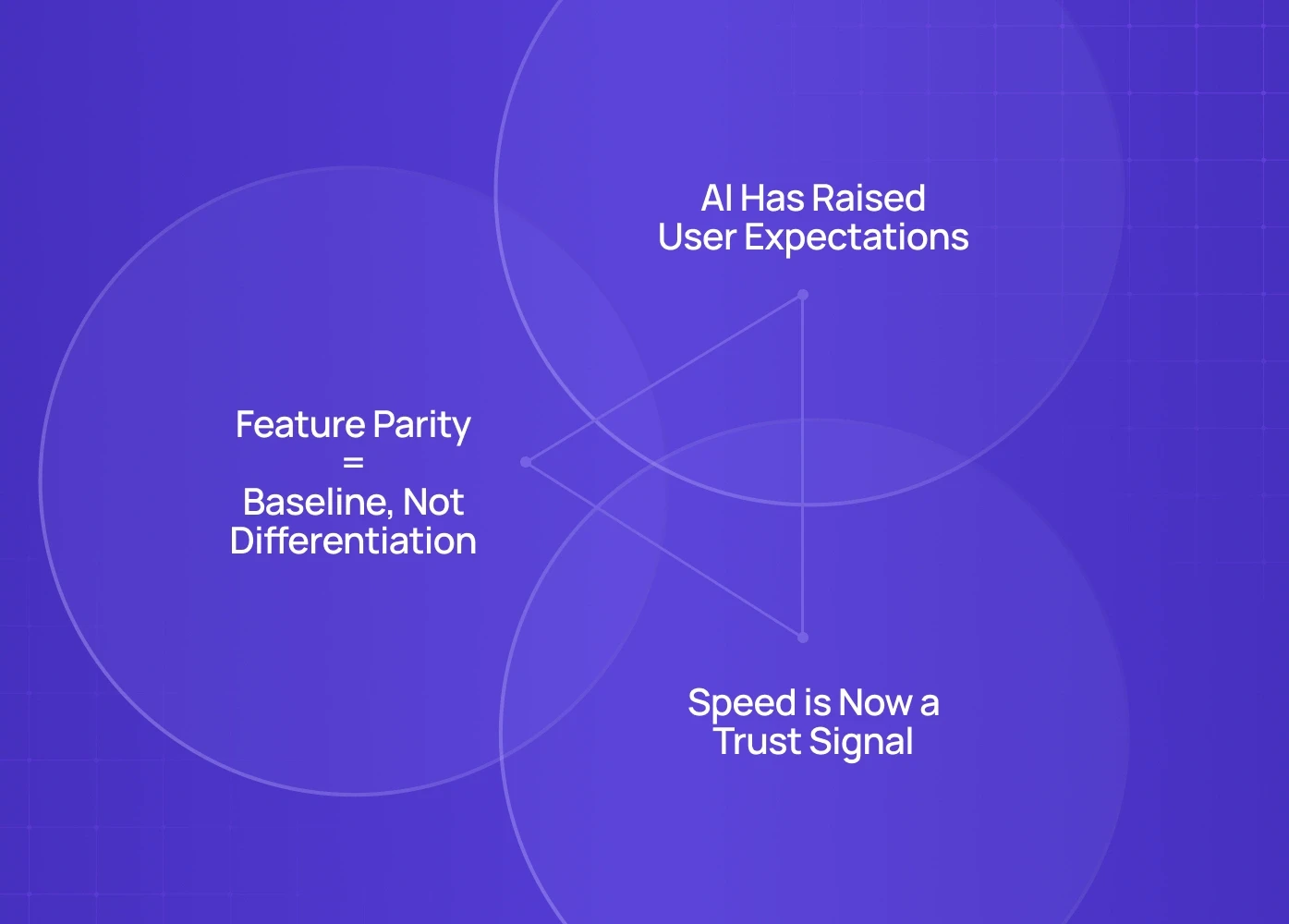

Three macro shifts changed how users evaluate websites:

1. Feature Parity = Baseline, Not Differentiation

Feature Parity = Baseline, Not Differentiation. In mature SaaS categories, functional overlap between top competitors exceeds 80% (Gartner, 2022). Your website is often the first and only differentiator.

2. AI Has Raised User Expectations

Users expect instant clarity, “explainability,” and predictive UX — even on the marketing site.

3. Speed is Now a Trust Signal

Speed is Now a Trust Signal. Delivering functional elements like reduced effort and avoided hassles drives loyalty, with top performers like Amazon excelling here (Bain, 2018). In B2B, speed silently communicates competence.

Your website is no longer a brochure; it’s a conversion engine. Companies that treat it that way win.

Modern teams increasingly invest in high-performance web design foundations to ensure their sites load fast, communicate value instantly, and support long-term scalability.

Principle 1: Design for Decision-Making, Not Decoration

Modern web design is decision design.

Every section must reduce one of the user's 3 frictions:

  1. “Is this for me?”

  2. “Can this solve my problem?”

  3. “Can I trust them?”

This is why many SaaS and B2B companies now begin with a defined UX strategy grounded in user behaviour, not visuals — so every section of the site reduces friction and speeds up decision-making.
The best websites in 2026 don’t look complex — they feel inevitable

Principle 2: Mobile-First, Not Mobile-Adjusted

Most teams still design desktop screens first, then shrink them down. That approach breaks in 2026.

Why?

  • Good UI design boosts app conversion by 200% and UX by 400%.

  • C-suite browsing patterns shifted to mobile-first during travel and meetings.

  • High-intent users (funded founders, B2B buyers) often convert after mobile research.

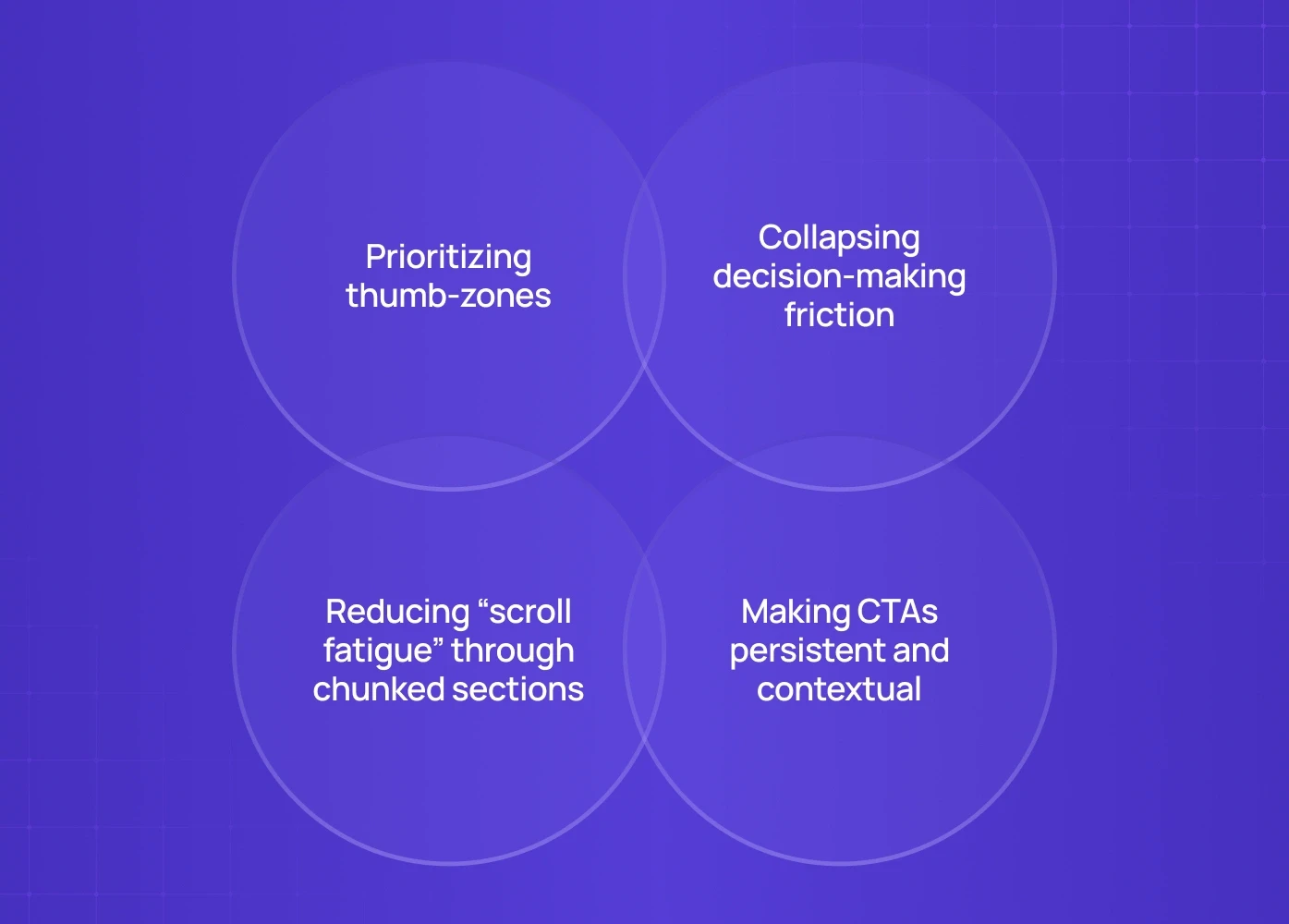
Mobile-first means:

  • Prioritizing thumb-zones

  • Collapsing decision-making friction

  • Making CTAs persistent and contextual

  • Reducing “scroll fatigue” through chunked sections

If you saw users scan, not read — your mobile experience is already losing conversions.

Principle 3: Intent-Driven Personalization (Without Feeling Creepy)

Modern personalization isn't “Hello John.”

Instead, it’s behavioral:

  • Showing different value props for technical vs. business audiences

  • Adjusting CTAs for primed vs. cold traffic

  • Auto-surfacing relevant case studies

  • Dynamically changing FAQ content based on scroll patterns

We see this most often in growth-stage teams refining their conversion journeys, where modern web design patterns help turn intent signals into clearer pathways and higher-quality leads.

Principle 4: Trust Architecture (Your New Competitive Advantage)

In 2026, users don’t trust easily.

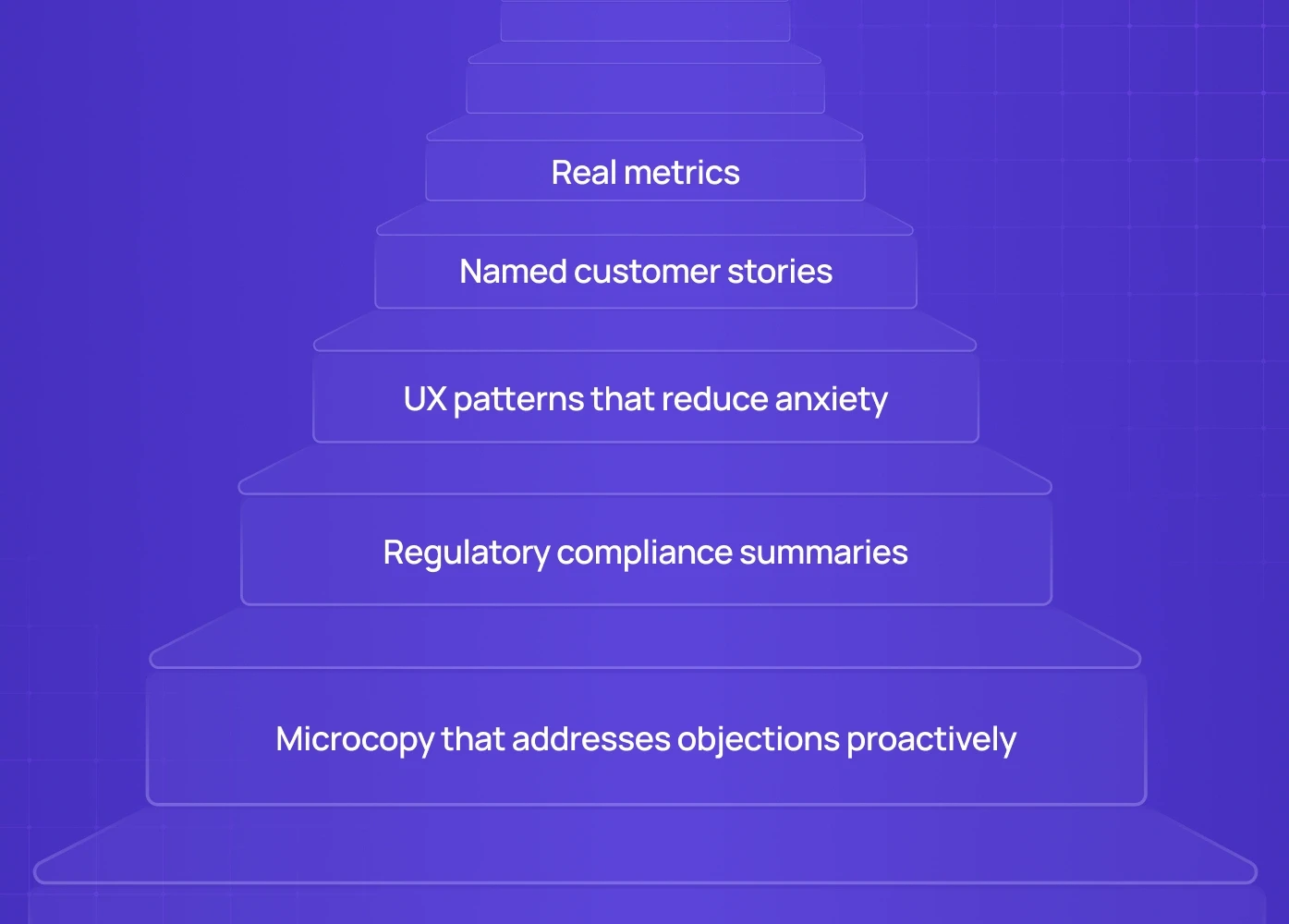
Modern trust-building requires more than logos and testimonials:

  • Regulatory compliance summaries

  • Real metrics (activation, uptime, accuracy)

  • Named customer stories

  • UX patterns that reduce anxiety (progress indicators, transparent pricing, predictable interactions)

  • Microcopy that addresses objections proactively


Trust is no longer added at the bottom; it must be architected through the entire site.

Strong trust design becomes even more critical when presenting pricing, guarantees, or case studies, which is why many teams reference best-in-class B2B web standards to benchmark their trust signals.

Principle 5: Conversational UX → Clear, Actionable Microcopy

Your website voices your product.

Clarity beats persuasion.

This is why microcopy principles align perfectly with our blog on
Improving UX Microcopy for Higher Conversions.

The best websites in 2026:

  • Use job-to-be-done language

  • Avoid jargon

  • Provide transparent expectations (“2-min setup,” “instant access”)

  • Prevent anxiety with actionable error states

  • Use explicit, value-first CTAs (“See How It Works for Fintech Teams”)

Principle 6: Conversion Flow Architecture (Not Page-by-Page Design)

“Modern design” is not a visual trend — it’s a flow logic.

High-performing sites follow a psychological sequence:

  1. Identity – “You’re in the right place.”

  2. Problem clarity – “You understand my pain better than I do.”

  3. Social proof – “Others like me trust you.”

  4. Value articulation – “This is uniquely useful.”

  5. Conversion bridge – “Here’s what to do next.”

  6. Objection handling – “My doubts are answered.”

  7. Commitment CTA

When executed well, this creates a predictable decision framework, similar to what you see in high-performing web design examples across B2B and SaaS.
That’s the system we use during every Groto audit.

Principle 7: Fast, Lightweight, AI-Compatible Web Architecture

This is the part everyone underestimates.

Your site isn’t just viewed by people — it’s viewed by AI models, search engines, LLM-powered agents, and context-aware browsers.

2026 demands:

  • semantic HTML

  • lightweight JS

  • compressed media

  • component-based builds

  • predictable structure for AI agents

  • performance budgets

  • Core Web Vitals > 90


Without this, even beautiful websites underperform.

Why Groto’s Approach Is Different

Most agencies “design pages.”

We design systems.

Our differentiators:

  • Deep B2B SaaS context — flows, metrics, adoption patterns

  • Design + engineering alignment — no Figma-to-dev chaos

  • AI-first architecture — built for speed, semantics, and explainability

  • Outcome-first orientation — 20–35% retention lifts, 30–40% faster engineering shipping

  • CRO-backed UX patterns — validated across 40+ audits

The same principles guide our work across web, product, and front-end systems, whether we’re architecting next-generation web experiences or full SaaS product ecosystems.

We don’t sell templates. We build predictable conversion machines.

Where To Start: A Simple Prioritization Framework (2026)

Most founders ask: “Which part do we fix first?”

Here’s a simple decision tree:

If bounce rate > 60% → Fix Above-the-Fold Clarity

Identity + problem + value must be unmistakable.

If demo conversions are weak → Strengthen Trust Architecture

Replace generic claims with numbers, stories, and transparent UX.

If users don’t scroll → Redesign Mobile Experience

Mobile-first interaction patterns, collapsible sections, persistent CTAs.

If time-to-value is unclear → Rewrite Microcopy

Short, strategic UX writing can outperform entire redesigns.

If engineering is blocked → Rebuild Frontend Architecture

Code debt hurts conversions more than design ever could.

Start with the friction that causes immediate revenue loss.

If your team needs a structured starting point, exploring clear web design basics can help identify the foundational gaps affecting your conversions today.

Conclusion

Modern web design isn’t about trends.It’s about building digital experiences that feel faster, clearer, and smarter — experiences users want to stay in.

If your website feels “fine,” but numbers aren’t moving, it’s not a surface issue. It’s architecture, trust, and decision design.

And fixing those changes everything. Businesses that master these principles often pair design improvements with a strong operational layer built on responsive web design practices to ensure performance and consistency across devices.

Want Us to Audit Your Website?

We’ll break down your site the same way we evaluate funded SaaS and fintech products:

  • Clarity analysis

  • Trust gaps

  • Conversion friction

  • Architecture issues

  • Microcopy weaknesses

Book a 20-minute teardown with our Creative Director (Top 3% Globally).

FAQ

1. How long does a modern web redesign take?
A focused conversion redesign takes 4–8 weeks. But the real cost isn't the timeline — it’s how many high-intent users churn while your site underperforms. Our phased approach ships improvements in 2–3 week cycles, reducing revenue leakage.

2. What does this typically cost?
Investment ranges from $3K–$15K, depending on complexity, pages, and engineering depth. Most clients recover this through higher demo conversions, improved retention, and shorter sales cycles.

3. Will this disrupt our engineering or marketing work?
No. We work in parallel, not in sequence. Design, copy, and architecture updates roll out gradually so teams never stall.

4. How do we measure success?
We track 4 core metrics:

  • Time-to-value

  • Scroll-depth → CTA interaction

  • Demo/Sales conversion

  • Bounce rate reduction
    These correlate directly with revenue.

5. Do these principles apply to ecommerce or consumer apps?Yes — but B2B teams see the fastest ROI because trust, clarity, and friction reduction drive immediate pipeline impact.

Web design has changed more in the last two years than in the last decade. In 2026, aesthetics aren’t enough—your website must communicate value instantly, reduce friction, build trust, and convert high-intent users with precision.

Modern web design in 2026 is no longer about looks—it’s about performance and clarity.


Most websites look “modern” on the surface in 2026 — big typography, clean hero sections, generous white space, rounded cards, subtle gradients.

Yet most of them still underperform. 

Bounce rates don’t move. Demo bookings stagnate. Sales teams say “lead quality is dropping.”

Because what most companies call “modern web design” is really… decoration.
What high-performing companies use is conversion architecture — a system built on psychology, speed, intent, and clarity.

If you're building or scaling a digital product, this is the only 2026 web design playbook you need.

Who This Guide Is For

You’ll get the maximum value if you are:

  • A SaaS founder whose website isn’t translating product value into conversions

  • A B2B marketing leader trying to improve demo bookings and MQL quality

  • A fintech/AI operator needing high-trust design

  • A product team rebuilding or scaling complex web experiences

  • A leader choosing between DIY templates vs. custom architecture


If your goal is aesthetics only, this guide will feel “too strategic.” If your goal is revenue, trust, and conversion, welcome.

Why Modern Web Design Matters MORE in 2026


Three macro shifts changed how users evaluate websites:

1. Feature Parity = Baseline, Not Differentiation

Feature Parity = Baseline, Not Differentiation. In mature SaaS categories, functional overlap between top competitors exceeds 80% (Gartner, 2022). Your website is often the first and only differentiator.

2. AI Has Raised User Expectations

Users expect instant clarity, “explainability,” and predictive UX — even on the marketing site.

3. Speed is Now a Trust Signal

Speed is Now a Trust Signal. Delivering functional elements like reduced effort and avoided hassles drives loyalty, with top performers like Amazon excelling here (Bain, 2018). In B2B, speed silently communicates competence.

Your website is no longer a brochure; it’s a conversion engine. Companies that treat it that way win.

Modern teams increasingly invest in high-performance web design foundations to ensure their sites load fast, communicate value instantly, and support long-term scalability.

Principle 1: Design for Decision-Making, Not Decoration

Modern web design is decision design.

Every section must reduce one of the user's 3 frictions:

  1. “Is this for me?”

  2. “Can this solve my problem?”

  3. “Can I trust them?”

This is why many SaaS and B2B companies now begin with a defined UX strategy grounded in user behaviour, not visuals — so every section of the site reduces friction and speeds up decision-making.
The best websites in 2026 don’t look complex — they feel inevitable

Principle 2: Mobile-First, Not Mobile-Adjusted


Most teams still design desktop screens first, then shrink them down. That approach breaks in 2026.

Why?

  • Good UI design boosts app conversion by 200% and UX by 400%.

  • C-suite browsing patterns shifted to mobile-first during travel and meetings.

  • High-intent users (funded founders, B2B buyers) often convert after mobile research.

Mobile-first means:

  • Prioritizing thumb-zones

  • Collapsing decision-making friction

  • Making CTAs persistent and contextual

  • Reducing “scroll fatigue” through chunked sections

If you saw users scan, not read — your mobile experience is already losing conversions.

Principle 3: Intent-Driven Personalization (Without Feeling Creepy)

Modern personalization isn't “Hello John.”

Instead, it’s behavioral:

  • Showing different value props for technical vs. business audiences

  • Adjusting CTAs for primed vs. cold traffic

  • Auto-surfacing relevant case studies

  • Dynamically changing FAQ content based on scroll patterns

We see this most often in growth-stage teams refining their conversion journeys, where modern web design patterns help turn intent signals into clearer pathways and higher-quality leads.

Principle 4: Trust Architecture (Your New Competitive Advantage)


In 2026, users don’t trust easily.

Modern trust-building requires more than logos and testimonials:

  • Regulatory compliance summaries

  • Real metrics (activation, uptime, accuracy)

  • Named customer stories

  • UX patterns that reduce anxiety (progress indicators, transparent pricing, predictable interactions)

  • Microcopy that addresses objections proactively


Trust is no longer added at the bottom; it must be architected through the entire site.

Strong trust design becomes even more critical when presenting pricing, guarantees, or case studies, which is why many teams reference best-in-class B2B web standards to benchmark their trust signals.

Principle 5: Conversational UX → Clear, Actionable Microcopy

Your website voices your product.

Clarity beats persuasion.

This is why microcopy principles align perfectly with our blog on
Improving UX Microcopy for Higher Conversions.

The best websites in 2026:

  • Use job-to-be-done language

  • Avoid jargon

  • Provide transparent expectations (“2-min setup,” “instant access”)

  • Prevent anxiety with actionable error states

  • Use explicit, value-first CTAs (“See How It Works for Fintech Teams”)

Principle 6: Conversion Flow Architecture (Not Page-by-Page Design)

“Modern design” is not a visual trend — it’s a flow logic.

High-performing sites follow a psychological sequence:

  1. Identity – “You’re in the right place.”

  2. Problem clarity – “You understand my pain better than I do.”

  3. Social proof – “Others like me trust you.”

  4. Value articulation – “This is uniquely useful.”

  5. Conversion bridge – “Here’s what to do next.”

  6. Objection handling – “My doubts are answered.”

  7. Commitment CTA

When executed well, this creates a predictable decision framework, similar to what you see in high-performing web design examples across B2B and SaaS.
That’s the system we use during every Groto audit.

Principle 7: Fast, Lightweight, AI-Compatible Web Architecture

This is the part everyone underestimates.

Your site isn’t just viewed by people — it’s viewed by AI models, search engines, LLM-powered agents, and context-aware browsers.

2026 demands:

  • semantic HTML

  • lightweight JS

  • compressed media

  • component-based builds

  • predictable structure for AI agents

  • performance budgets

  • Core Web Vitals > 90


Without this, even beautiful websites underperform.

Why Groto’s Approach Is Different

Most agencies “design pages.”

We design systems.

Our differentiators:

  • Deep B2B SaaS context — flows, metrics, adoption patterns

  • Design + engineering alignment — no Figma-to-dev chaos

  • AI-first architecture — built for speed, semantics, and explainability

  • Outcome-first orientation — 20–35% retention lifts, 30–40% faster engineering shipping

  • CRO-backed UX patterns — validated across 40+ audits

The same principles guide our work across web, product, and front-end systems, whether we’re architecting next-generation web experiences or full SaaS product ecosystems.

We don’t sell templates. We build predictable conversion machines.

Where To Start: A Simple Prioritization Framework (2026)

Most founders ask: “Which part do we fix first?”

Here’s a simple decision tree:

If bounce rate > 60% → Fix Above-the-Fold Clarity

Identity + problem + value must be unmistakable.

If demo conversions are weak → Strengthen Trust Architecture

Replace generic claims with numbers, stories, and transparent UX.

If users don’t scroll → Redesign Mobile Experience

Mobile-first interaction patterns, collapsible sections, persistent CTAs.

If time-to-value is unclear → Rewrite Microcopy

Short, strategic UX writing can outperform entire redesigns.

If engineering is blocked → Rebuild Frontend Architecture

Code debt hurts conversions more than design ever could.

Start with the friction that causes immediate revenue loss.

If your team needs a structured starting point, exploring clear web design basics can help identify the foundational gaps affecting your conversions today.

Conclusion

Modern web design isn’t about trends.It’s about building digital experiences that feel faster, clearer, and smarter — experiences users want to stay in.

If your website feels “fine,” but numbers aren’t moving, it’s not a surface issue. It’s architecture, trust, and decision design.

And fixing those changes everything. Businesses that master these principles often pair design improvements with a strong operational layer built on responsive web design practices to ensure performance and consistency across devices.

Want Us to Audit Your Website?

We’ll break down your site the same way we evaluate funded SaaS and fintech products:

  • Clarity analysis

  • Trust gaps

  • Conversion friction

  • Architecture issues

  • Microcopy weaknesses

Book a 20-minute teardown with our Creative Director (Top 3% Globally).

FAQ

1. How long does a modern web redesign take?
A focused conversion redesign takes 4–8 weeks. But the real cost isn't the timeline — it’s how many high-intent users churn while your site underperforms. Our phased approach ships improvements in 2–3 week cycles, reducing revenue leakage.

2. What does this typically cost?
Investment ranges from $3K–$15K, depending on complexity, pages, and engineering depth. Most clients recover this through higher demo conversions, improved retention, and shorter sales cycles.

3. Will this disrupt our engineering or marketing work?
No. We work in parallel, not in sequence. Design, copy, and architecture updates roll out gradually so teams never stall.

4. How do we measure success?
We track 4 core metrics:

  • Time-to-value

  • Scroll-depth → CTA interaction

  • Demo/Sales conversion

  • Bounce rate reduction
    These correlate directly with revenue.

5. Do these principles apply to ecommerce or consumer apps?Yes — but B2B teams see the fastest ROI because trust, clarity, and friction reduction drive immediate pipeline impact.

Extreme close-up black and white photograph of a human eye

Let’s bring your vision to life

Tell us what's on your mind? We'll hit you back in 24 hours. No fluff, no delays - just a solid vision to bring your idea to life.

Profile portrait of a man in a white shirt against a light background

Harpreet Singh

Founder and Creative Director

Get in Touch

Extreme close-up black and white photograph of a human eye

Let’s bring your vision to life

Tell us what's on your mind? We'll hit you back in 24 hours. No fluff, no delays - just a solid vision to bring your idea to life.

Profile portrait of a man in a white shirt against a light background

Harpreet Singh

Founder and Creative Director

Get in Touch

Harpreet Singh

Founder and Creative Director

Modern Web Design Principles Every Business Should Know

Dec 7, 2025

A 2026 guide breaking down modern web design principles that drive trust, clarity, speed, and conversions across SaaS, B2B, fintech, and AI-led digital experiences.

Web design has changed more in the last two years than in the last decade. In 2026, aesthetics aren’t enough—your website must communicate value instantly, reduce friction, build trust, and convert high-intent users with precision.

Modern web design in 2026 is no longer about looks—it’s about performance and clarity.


Most websites look “modern” on the surface in 2026 — big typography, clean hero sections, generous white space, rounded cards, subtle gradients.

Yet most of them still underperform. 

Bounce rates don’t move. Demo bookings stagnate. Sales teams say “lead quality is dropping.”

Because what most companies call “modern web design” is really… decoration.
What high-performing companies use is conversion architecture — a system built on psychology, speed, intent, and clarity.

If you're building or scaling a digital product, this is the only 2026 web design playbook you need.

Who This Guide Is For

You’ll get the maximum value if you are:

  • A SaaS founder whose website isn’t translating product value into conversions

  • A B2B marketing leader trying to improve demo bookings and MQL quality

  • A fintech/AI operator needing high-trust design

  • A product team rebuilding or scaling complex web experiences

  • A leader choosing between DIY templates vs. custom architecture


If your goal is aesthetics only, this guide will feel “too strategic.” If your goal is revenue, trust, and conversion, welcome.

Why Modern Web Design Matters MORE in 2026


Three macro shifts changed how users evaluate websites:

1. Feature Parity = Baseline, Not Differentiation

Feature Parity = Baseline, Not Differentiation. In mature SaaS categories, functional overlap between top competitors exceeds 80% (Gartner, 2022). Your website is often the first and only differentiator.

2. AI Has Raised User Expectations

Users expect instant clarity, “explainability,” and predictive UX — even on the marketing site.

3. Speed is Now a Trust Signal

Speed is Now a Trust Signal. Delivering functional elements like reduced effort and avoided hassles drives loyalty, with top performers like Amazon excelling here (Bain, 2018). In B2B, speed silently communicates competence.

Your website is no longer a brochure; it’s a conversion engine. Companies that treat it that way win.

Modern teams increasingly invest in high-performance web design foundations to ensure their sites load fast, communicate value instantly, and support long-term scalability.

Principle 1: Design for Decision-Making, Not Decoration

Modern web design is decision design.

Every section must reduce one of the user's 3 frictions:

  1. “Is this for me?”

  2. “Can this solve my problem?”

  3. “Can I trust them?”

This is why many SaaS and B2B companies now begin with a defined UX strategy grounded in user behaviour, not visuals — so every section of the site reduces friction and speeds up decision-making.
The best websites in 2026 don’t look complex — they feel inevitable

Principle 2: Mobile-First, Not Mobile-Adjusted


Most teams still design desktop screens first, then shrink them down. That approach breaks in 2026.

Why?

  • Good UI design boosts app conversion by 200% and UX by 400%.

  • C-suite browsing patterns shifted to mobile-first during travel and meetings.

  • High-intent users (funded founders, B2B buyers) often convert after mobile research.

Mobile-first means:

  • Prioritizing thumb-zones

  • Collapsing decision-making friction

  • Making CTAs persistent and contextual

  • Reducing “scroll fatigue” through chunked sections

If you saw users scan, not read — your mobile experience is already losing conversions.

Principle 3: Intent-Driven Personalization (Without Feeling Creepy)

Modern personalization isn't “Hello John.”

Instead, it’s behavioral:

  • Showing different value props for technical vs. business audiences

  • Adjusting CTAs for primed vs. cold traffic

  • Auto-surfacing relevant case studies

  • Dynamically changing FAQ content based on scroll patterns

We see this most often in growth-stage teams refining their conversion journeys, where modern web design patterns help turn intent signals into clearer pathways and higher-quality leads.

Principle 4: Trust Architecture (Your New Competitive Advantage)


In 2026, users don’t trust easily.

Modern trust-building requires more than logos and testimonials:

  • Regulatory compliance summaries

  • Real metrics (activation, uptime, accuracy)

  • Named customer stories

  • UX patterns that reduce anxiety (progress indicators, transparent pricing, predictable interactions)

  • Microcopy that addresses objections proactively


Trust is no longer added at the bottom; it must be architected through the entire site.

Strong trust design becomes even more critical when presenting pricing, guarantees, or case studies, which is why many teams reference best-in-class B2B web standards to benchmark their trust signals.

Principle 5: Conversational UX → Clear, Actionable Microcopy

Your website voices your product.

Clarity beats persuasion.

This is why microcopy principles align perfectly with our blog on
Improving UX Microcopy for Higher Conversions.

The best websites in 2026:

  • Use job-to-be-done language

  • Avoid jargon

  • Provide transparent expectations (“2-min setup,” “instant access”)

  • Prevent anxiety with actionable error states

  • Use explicit, value-first CTAs (“See How It Works for Fintech Teams”)

Principle 6: Conversion Flow Architecture (Not Page-by-Page Design)

“Modern design” is not a visual trend — it’s a flow logic.

High-performing sites follow a psychological sequence:

  1. Identity – “You’re in the right place.”

  2. Problem clarity – “You understand my pain better than I do.”

  3. Social proof – “Others like me trust you.”

  4. Value articulation – “This is uniquely useful.”

  5. Conversion bridge – “Here’s what to do next.”

  6. Objection handling – “My doubts are answered.”

  7. Commitment CTA

When executed well, this creates a predictable decision framework, similar to what you see in high-performing web design examples across B2B and SaaS.
That’s the system we use during every Groto audit.

Principle 7: Fast, Lightweight, AI-Compatible Web Architecture

This is the part everyone underestimates.

Your site isn’t just viewed by people — it’s viewed by AI models, search engines, LLM-powered agents, and context-aware browsers.

2026 demands:

  • semantic HTML

  • lightweight JS

  • compressed media

  • component-based builds

  • predictable structure for AI agents

  • performance budgets

  • Core Web Vitals > 90


Without this, even beautiful websites underperform.

Why Groto’s Approach Is Different

Most agencies “design pages.”

We design systems.

Our differentiators:

  • Deep B2B SaaS context — flows, metrics, adoption patterns

  • Design + engineering alignment — no Figma-to-dev chaos

  • AI-first architecture — built for speed, semantics, and explainability

  • Outcome-first orientation — 20–35% retention lifts, 30–40% faster engineering shipping

  • CRO-backed UX patterns — validated across 40+ audits

The same principles guide our work across web, product, and front-end systems, whether we’re architecting next-generation web experiences or full SaaS product ecosystems.

We don’t sell templates. We build predictable conversion machines.

Where To Start: A Simple Prioritization Framework (2026)

Most founders ask: “Which part do we fix first?”

Here’s a simple decision tree:

If bounce rate > 60% → Fix Above-the-Fold Clarity

Identity + problem + value must be unmistakable.

If demo conversions are weak → Strengthen Trust Architecture

Replace generic claims with numbers, stories, and transparent UX.

If users don’t scroll → Redesign Mobile Experience

Mobile-first interaction patterns, collapsible sections, persistent CTAs.

If time-to-value is unclear → Rewrite Microcopy

Short, strategic UX writing can outperform entire redesigns.

If engineering is blocked → Rebuild Frontend Architecture

Code debt hurts conversions more than design ever could.

Start with the friction that causes immediate revenue loss.

If your team needs a structured starting point, exploring clear web design basics can help identify the foundational gaps affecting your conversions today.

Conclusion

Modern web design isn’t about trends.It’s about building digital experiences that feel faster, clearer, and smarter — experiences users want to stay in.

If your website feels “fine,” but numbers aren’t moving, it’s not a surface issue. It’s architecture, trust, and decision design.

And fixing those changes everything. Businesses that master these principles often pair design improvements with a strong operational layer built on responsive web design practices to ensure performance and consistency across devices.

Want Us to Audit Your Website?

We’ll break down your site the same way we evaluate funded SaaS and fintech products:

  • Clarity analysis

  • Trust gaps

  • Conversion friction

  • Architecture issues

  • Microcopy weaknesses

Book a 20-minute teardown with our Creative Director (Top 3% Globally).

FAQ

1. How long does a modern web redesign take?
A focused conversion redesign takes 4–8 weeks. But the real cost isn't the timeline — it’s how many high-intent users churn while your site underperforms. Our phased approach ships improvements in 2–3 week cycles, reducing revenue leakage.

2. What does this typically cost?
Investment ranges from $3K–$15K, depending on complexity, pages, and engineering depth. Most clients recover this through higher demo conversions, improved retention, and shorter sales cycles.

3. Will this disrupt our engineering or marketing work?
No. We work in parallel, not in sequence. Design, copy, and architecture updates roll out gradually so teams never stall.

4. How do we measure success?
We track 4 core metrics:

  • Time-to-value

  • Scroll-depth → CTA interaction

  • Demo/Sales conversion

  • Bounce rate reduction
    These correlate directly with revenue.

5. Do these principles apply to ecommerce or consumer apps?Yes — but B2B teams see the fastest ROI because trust, clarity, and friction reduction drive immediate pipeline impact.
Extreme close-up black and white photograph of a human eye

Let’s bring your vision to life

Tell us what's on your mind? We'll hit you back in 24 hours. No fluff, no delays - just a solid vision to bring your idea to life.

Profile portrait of a man in a white shirt against a light background

Harpreet Singh

Founder and Creative Director

Get in Touch

Extreme close-up black and white photograph of a human eye

Let’s bring your vision to life

Tell us what's on your mind? We'll hit you back in 24 hours. No fluff, no delays - just a solid vision to bring your idea to life.

Profile portrait of a man in a white shirt against a light background

Harpreet Singh

Founder and Creative Director

Get in Touch