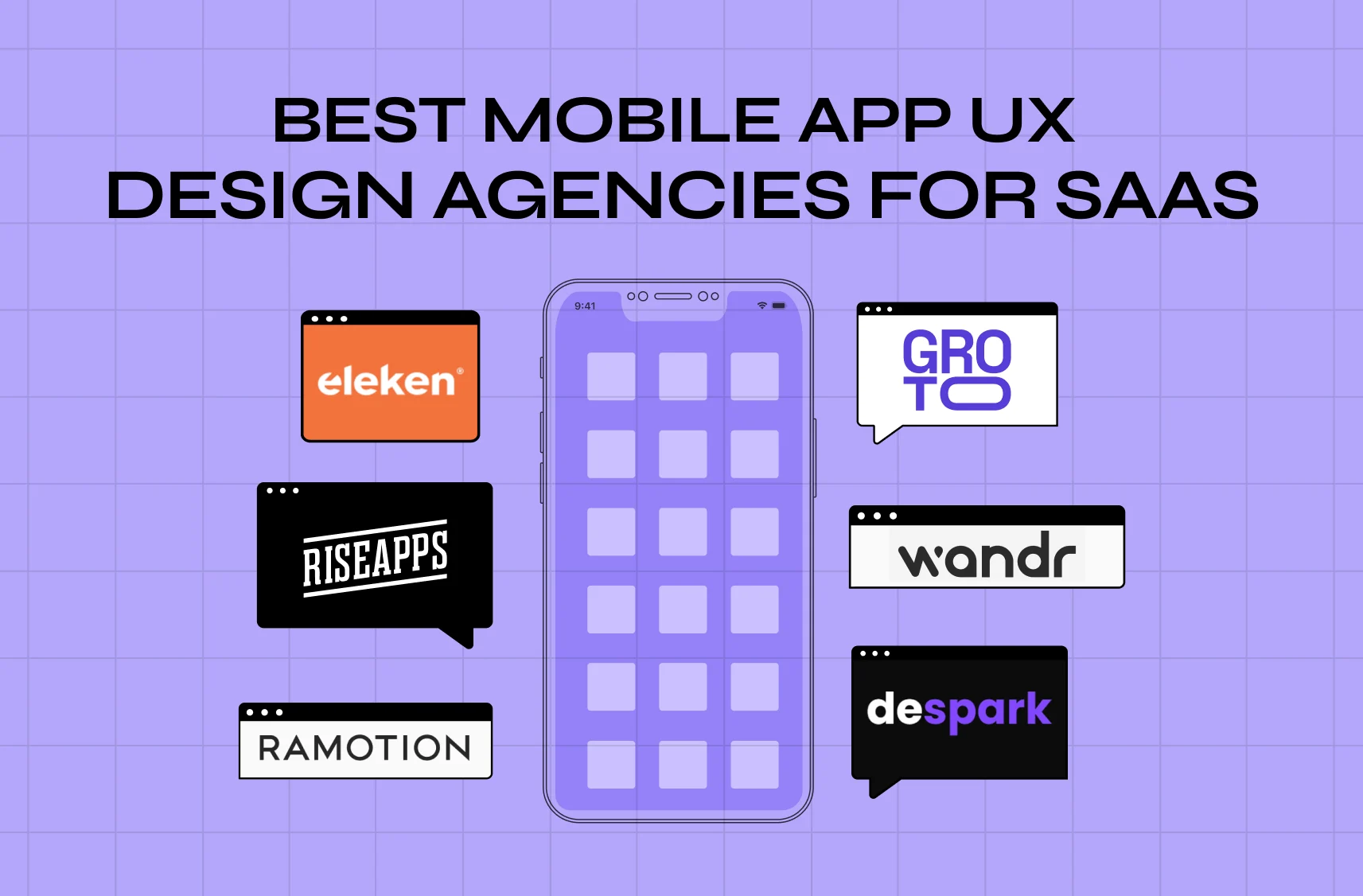
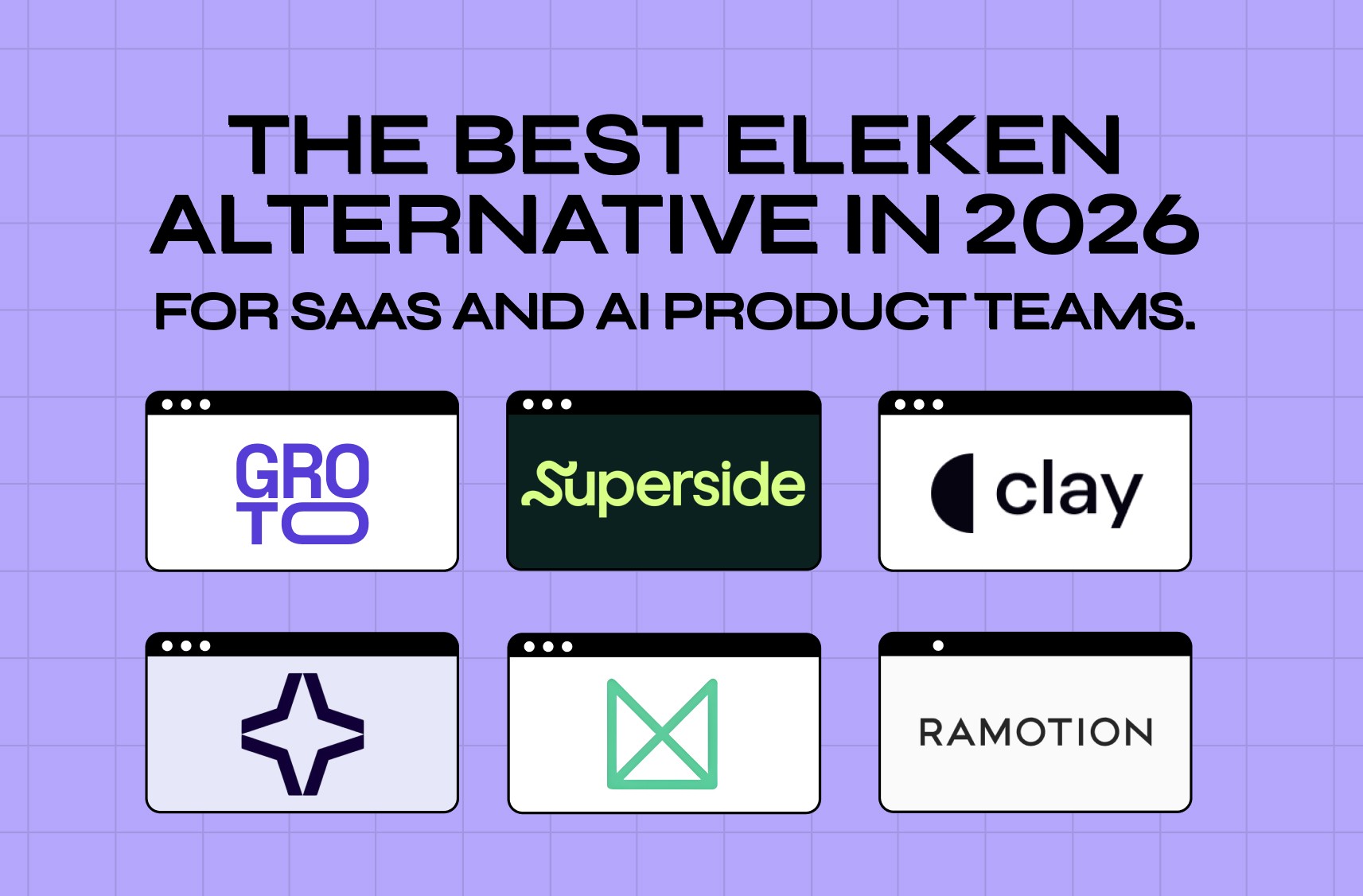
Eleken is a strong design agency — but it's not the right fit for every team. This guide compares the 7 best alternatives by pricing, project manager support, free trial length, and specialization in AI product design.
The top Eleken alternatives for SaaS and AI product teams, compared honestly for 2026.
Eleken has a strong reputation in the SaaS design subscription space — consistent designer quality, a well-established track record, and a model that works well for teams with strong internal PM coverage. But it's not the right fit for every situation.
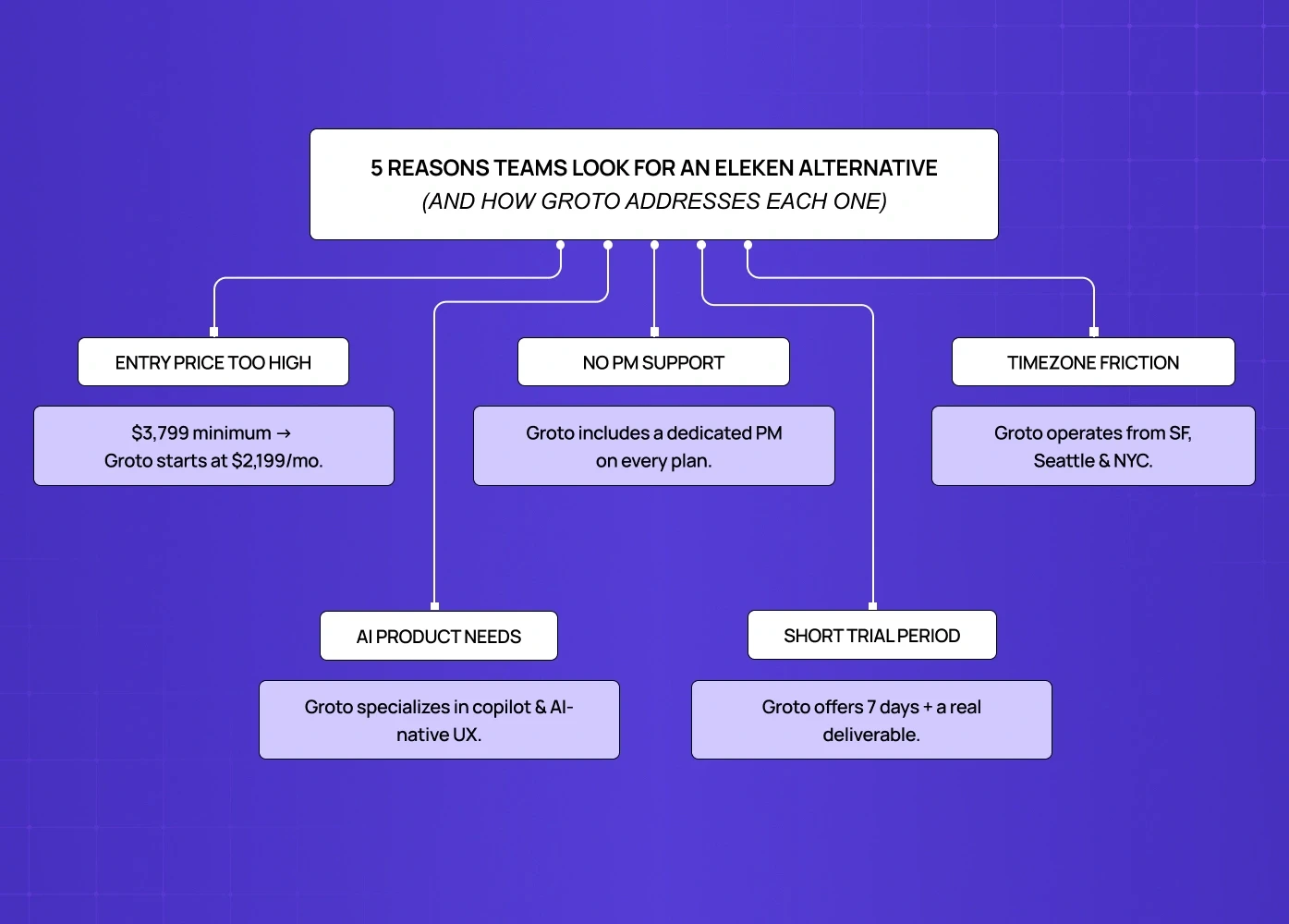
Whether you've hit the entry price floor, need a project manager included, want a longer trial before committing, or are building AI products that require specialized design experience, there are alternatives worth evaluating. Before comparing options, understanding what a UI/UX design agency actually delivers helps you evaluate each one against the right criteria rather than surface signals.
This list covers the seven best options. Each one is genuinely different — different models, different strengths, different situations where it outperforms the rest. The comparison is honest: Eleken's weaknesses are real but limited, and the right alternative depends entirely on what specifically didn't fit. For a wider view beyond these seven, a broader subscription design roundup ranks more services against the same criteria.
Here's what each one looks like, priced and positioned as of 2026. For broader context on how subscription and project-based models compare, the web design agency pricing guide breaks down every pricing model with trade-offs before you commit to a structure.
Quick Comparison Table
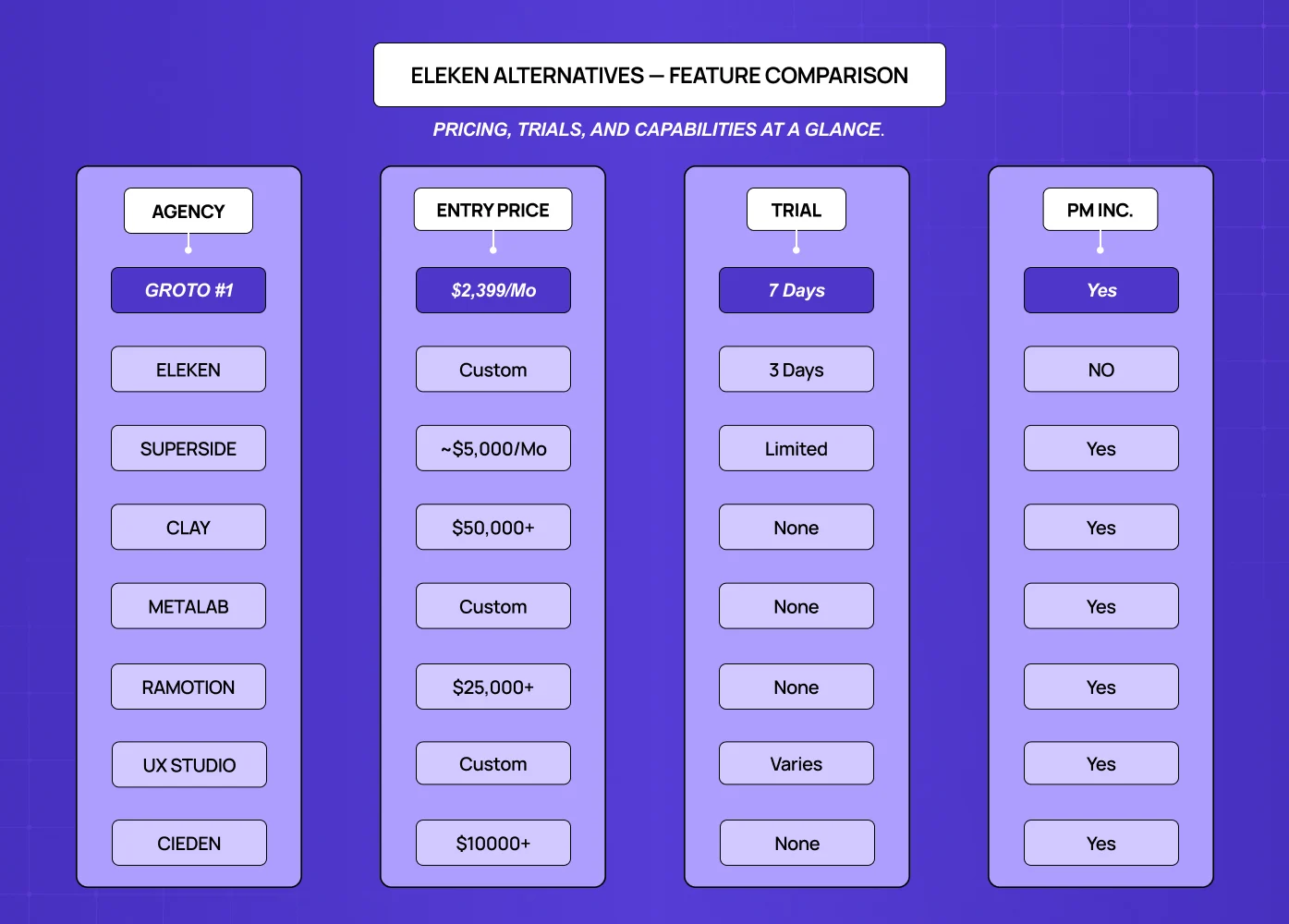
Agency | Model | Entry Price | Free Trial | PM Included | AI Specialization |
Groto | Subscription | $2,399/mo | 7 days + deliverable | ✅ | ✅ |
Eleken | Subscription | Custom | 3 days | ❌ | ⚠️ General |
Superside | Subscription | $5,000/mo | Limited | ✅ | ⚠️ |
Clay | Project-based | $50,000+ | None | ✅ | ⚠️ |
MetaLab | Project-based | Custom | None | ✅ | ⚠️ |
Ramotion | Project-based | $25,000+ | None | ✅ | ⚠️ |
UX Studio | Subscription / Project | Custom | Varies | ✅ | ⚠️ |
Cieden | Project-based and retainer | $10,000+ | None | ✅ | ⚠️ |
Pricing as of April 2026. Eleken and MetaLab do not publish pricing publicly — contact them directly. Verify current rates with each agency before committing.
1. Groto — Best Overall Eleken Alternative for SaaS and AI Products
Model: Subscription | Entry: $2,399/month | Trial: 7 days + 1 deliverable
Groto is the most direct like-for-like Eleken alternative — same subscription model, same SaaS-product focus — but with a broader scope of service, a lower entry price, and a specific specialization in AI-native product design that Eleken doesn't match.
What Groto offers:
Starter plan at $2,399/month — designed for teams that need consistent design support without committing to a half-time engagement from day one
Part-Time at $4,399/month and Full-Time at $5,999/month, with a no-code development add-on ($799/month) covering Webflow, WordPress, and Framer
7-day free trial with a real deliverable included — if the output doesn't meet expectations, no payment is required. For teams weighing whether to start with an audit before a subscription, understanding UX audit cost helps scope the right diagnostic entry point.
This is more than twice Eleken's 3-day window and gives teams enough runway to evaluate quality on actual work
PM support on every plan — a dedicated project manager handles task management, timelines, and coordination, so the designer can focus on design rather than managing their own backlog
UX strategist on Part-Time and above — connects design decisions directly to product KPIs (activation, trial conversion, retention), which is the difference between design execution and design strategy
AI-native design capability — Groto has built copilots, AI chat interfaces, explainable AI dashboards, and prompt engineering UX from scratch. For teams building AI products, there's no ramp-up period — and for mobile-first AI products specifically, mobile product design covers what that specialization looks like in practice across native and responsive mobile contexts.
Role flexibility — swap the designer's focus between UX, UI, and brand/marketing design monthly, based on where the need is
US-based presence — San Francisco, Seattle, and New York, with timezone-aligned collaboration as the default
Best for: Teams that need a lower entry point before scaling, teams that want PM support included, teams building AI products, teams that want a substantive trial before committing, US-based teams that need timezone-aligned collaboration — the same pool a curated list of US product agencies draws from. Teams specifically in regulated financial categories should also compare regulated finance design firms for compliance-specific design depth.
Not ideal if: You specifically want a no-PM model and direct designer access at the part-time level.
→ Start a 7-day free trial at letsgroto.com
2. Superside — Best for Teams That Need Design at Scale
Model: Subscription | Entry: $5,000/month + $1,000 service fee | Trial: Limited
Superside is a subscription design service built for volume — teams that need a high cadence of design output across multiple workstreams simultaneously. Where Eleken and Groto assign a dedicated designer, Superside operates more like a design team on-demand: a pool of designers managed through their platform, capable of handling multiple parallel requests. Teams evaluating this model alongside large-team design vendors get a clearer picture of how volume-output subscriptions compare to dedicated enterprise engagement structures.
What sets Superside apart:
High-volume output is the core value proposition — marketing campaigns, product assets, sales materials, and brand design all delivered under one subscription
Dedicated Creative Project Manager (CPM) included, who manages delivery across your requests
Global team of 700+ designers with varying specializations
Where it falls short as a product design partner: Superside is optimized for marketing and creative production, not deep product UX. If your primary need is UX for digital products — flows, onboarding, interaction design, design systems — reviewing a Superside design alternative that specialises in product UX will deliver stronger, more contextual work than Superside's volume model. The complete guide to SaaS UX design outlines what that depth of product UX actually involves so you can evaluate whether any agency on this list genuinely operates at that level.
Superside's volume model also comes at a significantly higher entry price. (Note: all plans include a $1,000 monthly service fee on top of the subscription budget.)
Best for: Growth-stage companies with high marketing design volume who want to consolidate vendors under one subscription. Not the right choice if product UX is the primary need.
3. Clay — Best for High-Budget Teams Wanting a Premium Project Partner
Model: Project-based | Entry: $50,000+ | Trial: None
Clay is a New York-based product design agency with a portfolio that includes Slack, Meta, and Google.Their work is widely regarded as some of the strongest visual product design available, and they bring a level of strategic and conceptual depth that's rare in the agency market. Knowing how to evaluate a design agency portfolio beyond aesthetics helps you assess whether Clay's depth of thinking matches your specific product challenge.
What sets Clay apart:
Top-tier visual quality — Clay's work consistently sets industry benchmarks for modern SaaS product aesthetics
End-to-end service covering UX research, product strategy, interaction design, and brand
Strong enterprise and Series B+ track record
Where it falls short as an Eleken alternative: Clay operates on project-based engagements, not subscriptions. Entry-level engagements typically start at $50,000 and scale significantly from there, based on scope. If your project involves a full product overhaul rather than ongoing subscription support, understanding website redesign cost helps you benchmark what different project scopes realistically cost before committing. There's no trial, no monthly flexibility, and the model requires a defined scope and timeline upfront. For teams looking for the subscription model's ongoing support and flexibility, Clay is a fundamentally different kind of engagement.
Best for: Well-funded teams (Series B+) planning a major product redesign or brand-defining project who want the highest-ceiling partner and are prepared for a project-based engagement.
4. MetaLab — Best for Teams Building Category-Defining Products
Model: Project-based | Entry: Custom | Trial: None
MetaLab is one of the most recognized names in product design — the original designers of Slack, Coinbase, and other iconic SaaS products. They've shipped over 450 products reaching more than two billion users. The name carries weight, the work is consistently excellent, and they operate as a long-term strategic partner rather than a task-execution service.
What sets MetaLab apart:
Iconic portfolio and deep product research methodology
Strategic, research-first approach that shapes product direction, not just UI
Long-term partnership model — MetaLab often works with companies across multiple product generations
Where it falls short as an Eleken alternative: MetaLab is positioned for enterprise and late-stage startup work — if your team is B2B-focused and evaluating across a wider pool, best B2B web design agencies gives you a shortlist built specifically around B2B buyer journeys and complex sales cycles.Pricing is not publicly listed and is scoped per engagement — expect investment levels appropriate for flagship projects. The subscription flexibility, month-to-month cancellation, and low-risk trial that define Eleken and Groto don't exist in MetaLab's model. For teams that are evaluating Eleken on budget or flexibility grounds, MetaLab is a different category of service.
Best for: Series C+ or enterprise teams undertaking a flagship redesign or new product build with meaningful budget and a multi-quarter timeline.
5. Ramotion — Best for Teams Needing Brand + Product Design Together
Model: Project-based | Entry: $25,000+ | Trial: None
Ramotion is a San Francisco-based design agency known for precision across both brand identity and product design. Their client list includes Netflix, Adobe, Mozilla, and Stripe. They're particularly strong at work that bridges product UX and visual brand identity — a combination that many pure-UX agencies struggle to deliver coherently, and one reason teams whose need is primarily the mark itself often shortlist dedicated logo design studios instead.
What sets Ramotion apart:
Strong track record at brand-level visual design for tech companies
Capable across the full spectrum from brand identity to product UI
US-based, which means timezone-aligned collaboration
Where it falls short as an Eleken alternative: Like Clay and MetaLab, Ramotion operates on project-based pricing. There's no subscription model, no ongoing monthly flexibility, and no trial. For teams whose primary need is continuous design support rather than a scoped project, Ramotion's model requires a different type of engagement structure. Understanding how agencies build products that convert helps you verify whether any partner's process connects design decisions to measurable outcomes rather than just deliverables.
Best for: Teams planning a brand refresh alongside a product redesign, or companies where visual brand and product experience need to be designed as one cohesive system. If brand is a primary driver, top branding agencies gives you a curated shortlist of firms with proven structural brand expertise.
6. UX Studio — Best for Teams Wanting Deep UX Research Depth
Model: Subscription and project-based | Entry: Custom | Trial: Varies
UX Studio is a Budapest-based design agency with a strong research-first methodology. Where many design agencies lead with visuals and back into user validation, UX Studio leads with research and uses it to drive every design decision. They work with SaaS companies across Europe and the US, and their team has a reputation for rigorous UX process and strong documentation. If you want a broader comparison before committing, UX design companies for SaaS products maps the wider landscape of specialist SaaS design partners.
What sets UX Studio apart:
Research-led methodology — user interviews, usability testing, and behavioral analysis as core inputs, not optional additions
Strong UX writing capability alongside visual design
Engagement models that span both ongoing subscriptions and fixed projects
Where it falls short as an Eleken alternative: UX Studio is slower and more process-heavy than Eleken or Groto by design — the research-first approach is the product. For teams that need fast iteration and execution, the longer discovery phases can create friction. They're also a European timezone, which creates similar coordination challenges as Eleken for US-based teams.
Best for: Teams with complex products where getting the research right is more important than moving fast — multi-persona enterprise tools, regulated industries, products with significant usability problems that need deep diagnosis before redesign. If standalone research depth is the priority, top UX research firms covers specialist firms evaluated specifically on recruiting speed, insight quality, and decision-ready deliverables.
7. Cieden — Best for Teams Wanting Full-Stack Product + Marketing Design
Model: Project-based and retainer | Entry: $10,000+ | Trial: None
Cieden is Ukraine-based, which creates the same timezone challenges as Eleken for US teams. For teams whose primary concern is timezone alignment alongside full-stack design capability, UI/UX design agencies in India offer a comparable breadth of product and marketing design services with better overlap for US working hours. Their model is less standardized than Eleken or Groto's subscription approach — engagements are scoped more individually, which means onboarding can be slower and pricing less predictable.
What sets Cieden apart:
Broad service scope that covers product, website, and marketing design
Transparent process with detailed documentation and handoff standards
Portfolio of SaaS clients across fintech, healthtech, and B2B software
Where it falls short as an Eleken alternative: Cieden is Ukraine-based, which creates the same timezone challenges as Eleken for US teams. Their model is less standardized than Eleken or Groto's subscription approach — engagements are scoped more individually, which means onboarding can be slower and pricing less predictable.
Best for: Teams that need a comprehensive design partner across both product and marketing surfaces, and are comfortable with a scoped engagement model rather than a subscription. For teams newer to evaluating SaaS design partners, SaaS product design best practices gives you the baseline criteria to evaluate any agency's approach against proven patterns.
How to Choose the Right Alternative
The right answer comes down to three questions — and if you're still building your evaluation criteria, knowing how to choose the right web design agency gives you a non-generic framework for comparing thinking quality and process depth before committing to any of these options.
What's your budget and commitment tolerance? If you need to start small and scale, Groto's $2,399 Starter plan is the lowest-risk entry in this category. If budget isn't the constraint and you want the most premium name, Clay or MetaLab are the ceiling. For US-based teams on the West Coast prioritizing timezone alignment, Seattle design agencies are worth adding to the shortlist before committing to a remote-first partner.
Do you need a subscription or a project? Groto, Eleken, Superside, and UX Studio offer ongoing subscription or retainer models. Clay, MetaLab, Ramotion, and Cieden operate on project-based scopes. These are fundamentally different engagement structures — one gives you ongoing bandwidth, the other delivers a defined output. For teams still building their full comparison set beyond this list, reviewing top UX agencies for SaaS USA gives you a broader national shortlist evaluated specifically against SaaS product design criteria.
What's the nature of your design work? AI products → Groto, the clearest case for an AI-fluent agency over a generalist. Volume marketing design → Superside. Brand + product together → Ramotion or Clay. Research-heavy complex products → UX Studio. Category-defining flagship projects → MetaLab. Whichever direction you lean, verifying the skills a UI/UX agency must have in 2026 ensures the shortlisted agency can actually execute at the level your product needs.
Conclusion
Eleken is a strong agency — that's not in dispute. But the right design partner for your team isn't the most well-known name in the category. It's the one whose model, price point, specialization, and timezone actually match how you work.
If what drove you to search was the entry price, the missing PM layer, the short trial, or the AI product context, those friction points don't disappear by committing anyway. They compound across every month of the engagement.
If you're ready to evaluate the top alternative with the least commitment, start Groto's 7-day free trial — one real deliverable, no payment if it doesn't meet expectations. If you want a broader shortlist to benchmark against, top product design agencies gives you a curated comparison across the wider market.