Full software rewrites fail 70 to 88% of the time, mostly for organizational reasons. This guide shows you how to modernize a legacy product incrementally instead, delivering value continuously, keeping production running, and staying able to roll back at every step.
Modernize your legacy product incrementally, without betting two years on a risky rewrite

TL;DR
Here's what we tell every founder who asks us about outsourcing their website, before they spend a single dollar:
Most small business websites cost $2,000 to $8,000, with DIY tools from $0 to $30 a month and agencies starting near $10,000
Freelancers charge $35 to $150 an hour or $1,000 to $5,000 per project, while agencies bring a full team, strategy, and accountability for $10,000 and up
Outsourcing usually beats DIY or hiring in-house for most small and growing businesses, since it delivers expertise without the overhead of a full-time salary
Vet any partner on process, ownership, total cost, and post-launch support before signing anything
A small budget can still buy a professional site if you phase the build, come prepared with content, and keep scope tight
Outsourcing web design means handing the job of building or redesigning your website to a professional designer, freelancer, or agency instead of doing it yourself or hiring an in-house team. Exactly what that job covers varies more than people expect, and what a design agency does sets out the standard scope. At Groto, we work with founders navigating exactly this decision every week, and for most of them, it is the fastest way to get a site that looks credible, works well, and actually brings in business, without the time or learning curve of doing it alone. The tricky part is not deciding whether to outsource. It is figuring out what it should cost, who to trust, and how to make it work on your budget. That is exactly what we're breaking down in this guide.
Deciding to outsource your website should feel exciting. You're investing in the front door to your business. Instead, for most founders and small-business owners, it triggers a wave of anxiety: How much will this actually cost? How do I know which company to trust? And can I even afford a professional site on my budget? Those three questions stop more people from getting a great website than any technical hurdle ever does, and we've heard all three on nearly every discovery call we've ever run.
We're answering all three here, honestly and in one place. At Groto, we'll break down real 2026 pricing, the exact questions to ask a web design company before you hire, and practical ways to get a professional site even on a small budget, plus the red flags that signal you're about to overpay for underwhelming work. By the end, you'll know what fair pricing looks like, how to vet a partner, and how to spend your budget where it actually matters.
Why outsource web design at all?
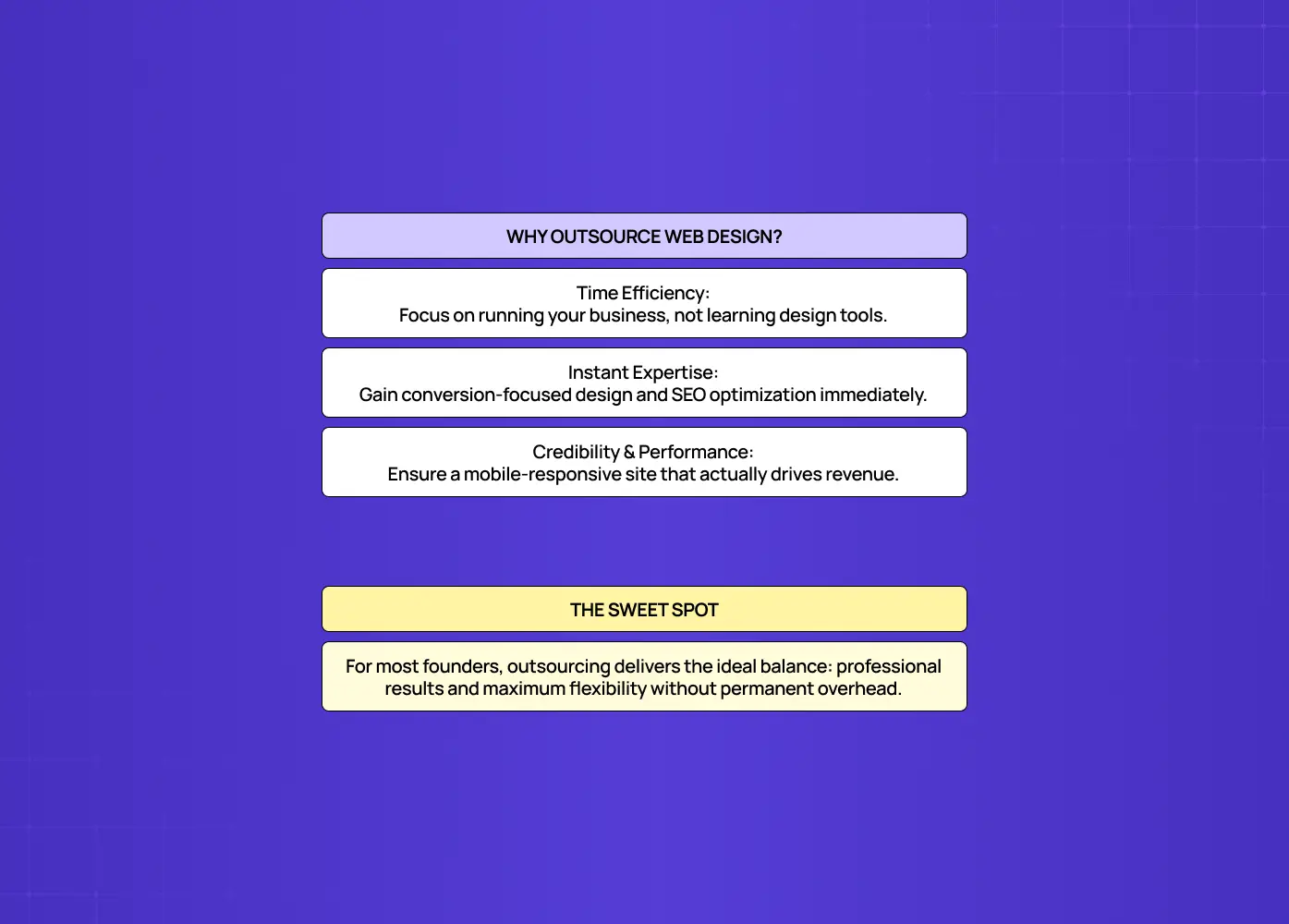
First, the quick case. Most businesses outsource web design because building it yourself is a false economy. Here's what we believe a professional partner should bring to the table that DIY usually can't:
Time back. Your hours are worth more spent running the business than learning design software
Design and conversion expertise most founders would take months to build on their own
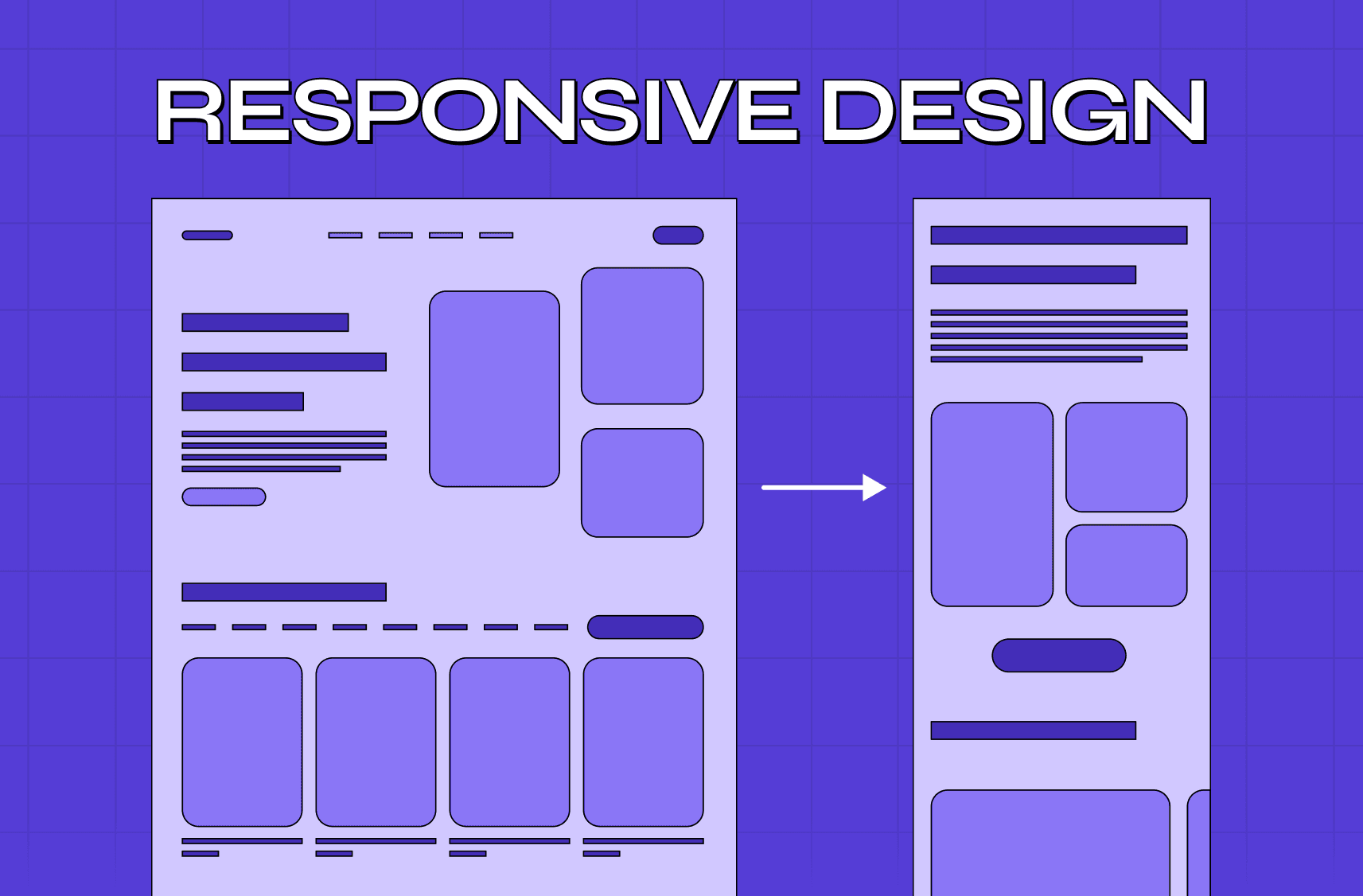
A site that looks credible, works on every device through proper responsive web design services, and ranks in search
A website that actually converts visitors, not one that simply exists
The real question isn't usually whether to outsource. It's to whom, and for how much, which is exactly what the rest of this guide tackles.
It helps to know your three broad paths:
DIY. An AI builder or template you set up yourself. Cheapest and fastest, but limited by your own time and skill
Outsourcing. A freelancer or agency. Buys expertise and results without a permanent hire, the right fit for most small and growing businesses
In-house. Only makes sense once you have continuous, full-time web and design work to justify a salary, which most small businesses don't. The full cost and control comparison is in agency vs in-house designer.
For the vast majority of founders and small teams, outsourcing hits the sweet spot: professional quality, no long-term overhead, and flexibility to scale the engagement up or down. This is the path we help clients get right at Groto, and the rest of this guide focuses on doing that outsourcing well, getting real value without overpaying or getting burned.
How much does it cost to hire a web designer?
In 2026, a professional website typically costs a small business between $2,000 and $8,000, though prices range from a few hundred dollars for DIY tools to $50,000+ for custom builds. Our full web design agency pricing breakdown goes deeper on what each tier includes. What you pay depends mostly on who you hire and how complex your site is. Here's the honest landscape:
Option | Typical cost (2026) | Best for |
DIY / AI website builder | $0–$30 / month | Simplest sites, tight budgets, validating |
Freelance web designer | $1,000–$5,000 (or 35–150/hr) | Small custom sites, personal brands |
Web design agency | $10,000–$100,000+ | Businesses needing strategy, scale, result |
Ongoing maintenance | $500–$3,000 / month | Keeping any professional site healthy |
Here's what we see most often when clients come to us with quotes from other providers, a few specifics worth knowing:
Freelancers range widely by experience. Entry-level designers charge roughly $35 to $55 an hour, while experienced ones with strong portfolios command $75 to $150
Location affects rate too. US-based designers typically run $50 to $150 an hour, while offshore talent can run $15 to $40 for comparable work in some cases. The trade-offs beyond hourly rate are covered in local vs remote design agency.
Agencies start around $10,000 for the initial build and climb well past $100,000 for complex e-commerce or enterprise platforms. You're paying for a full team, strategy, and accountability, not just pages
Don't forget ongoing costs. Most professional sites need maintenance, hosting, and updates, often via a $500 to $3,000 a month retainer for small businesses. Website maintenance covers what that retainer should actually include.
All figures are directional for 2026. Always confirm quotes with your shortlisted partners. If your project is a redesign rather than a new build, the cost to redesign a website works out differently.
What actually affects the price
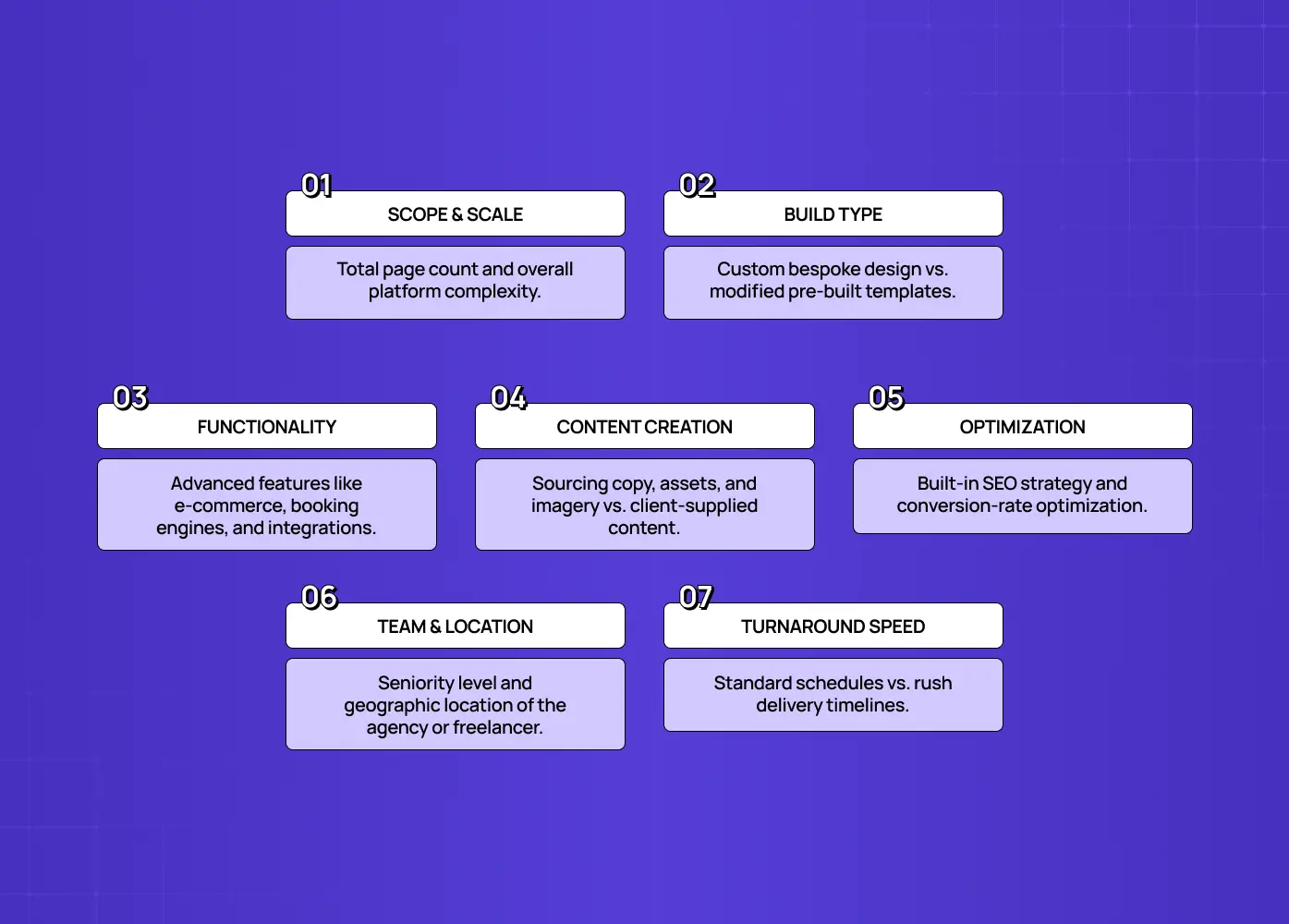
Understanding the drivers helps you control the number. At Groto, this is usually the first thing we walk clients through before we ever talk numbers, since cost goes up with:
Number of pages and complexity. A five-page brochure site is a fraction of the cost of a 50-page platform
Custom design vs. templates. Bespoke work costs more than adapting a template
Functionality. E-commerce, booking systems, integrations, and custom features all add hours
Content needs. Whether you provide copy and images or the designer creates them from scratch
SEO and conversion work built into the build itself
Seniority and location of who you hire. If you're weighing offshore delivery seriously, UI UX design agencies in India are the most common comparison point.
Timeline. Rush work almost always costs more
The practical upshot: much of your budget is within your control, which is the key to the affordability question below.
Web design pricing models, explained
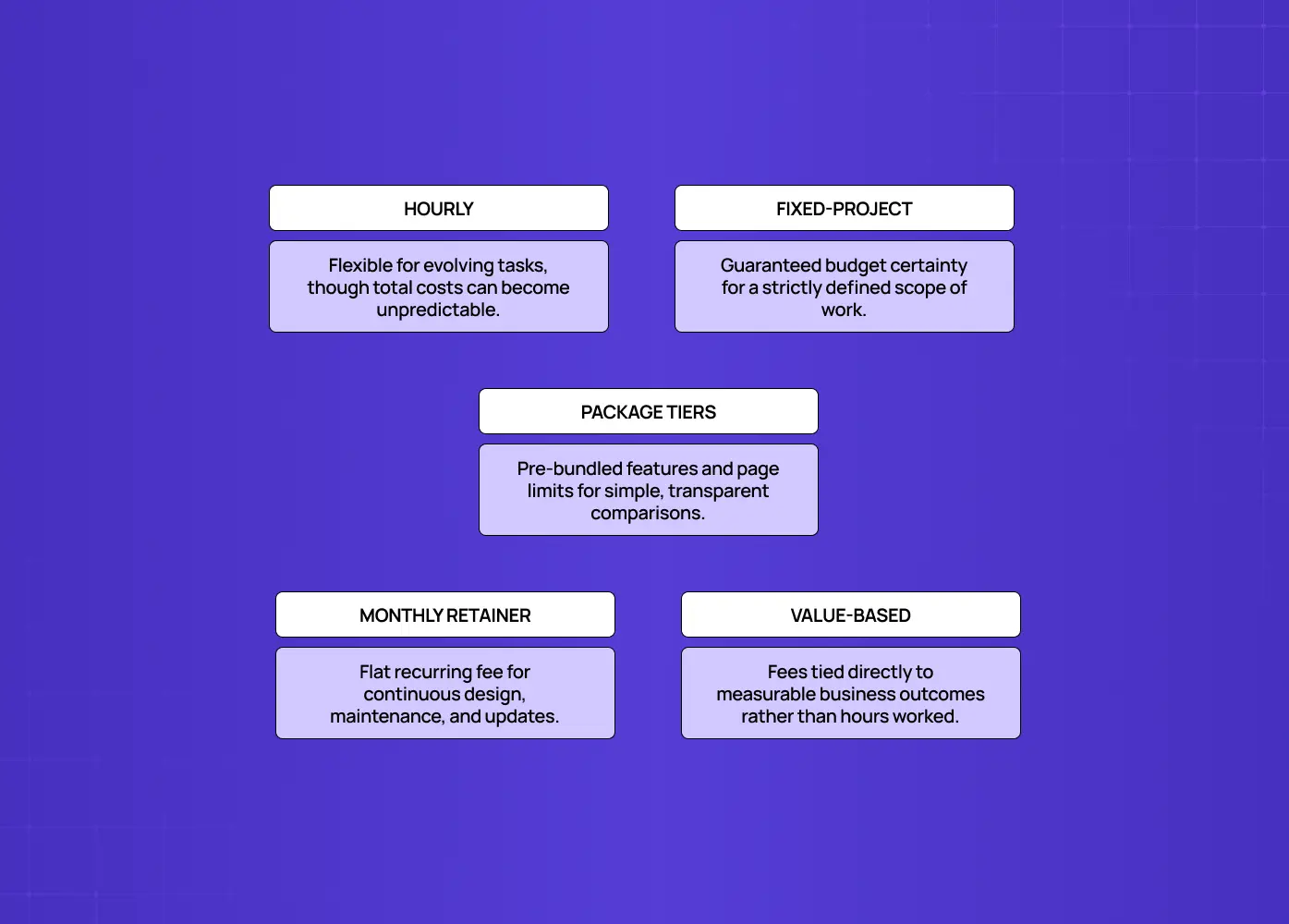
Beyond the headline number, how you're charged matters, and we always encourage prospective clients to understand the models before comparing quotes:
Hourly pricing. Common with freelancers, flexible and transparent for small or evolving work, though the total can be unpredictable if scope isn't tight
Fixed-project pricing. One agreed number for a defined scope, great for budgeting certainty as long as the scope is genuinely clear. Watch for change-order fees on anything outside it
Package pricing. Bundles a set of pages and features at tiered price points, common with agencies and productized studios, and makes it easy to compare what you get
Monthly retainers. Cover ongoing work such as maintenance, updates, content, and minor development, typically after the initial build. A design subscription agency productizes that model further, trading project fees for a flat monthly rate.
Value-based pricing. Some partners tie their fee to the business outcome rather than hours worked
When comparing quotes, make sure you're comparing like for like. A low fixed price with a narrow scope can cost more than a higher one that includes content, revisions, testing, and post-launch support. Knowing what a strong UX design proposal contains makes those differences much easier to spot. Always ask what's included and what triggers extra fees. The cheapest quote is rarely the cheapest project.
Can you afford professional web design on a small budget?
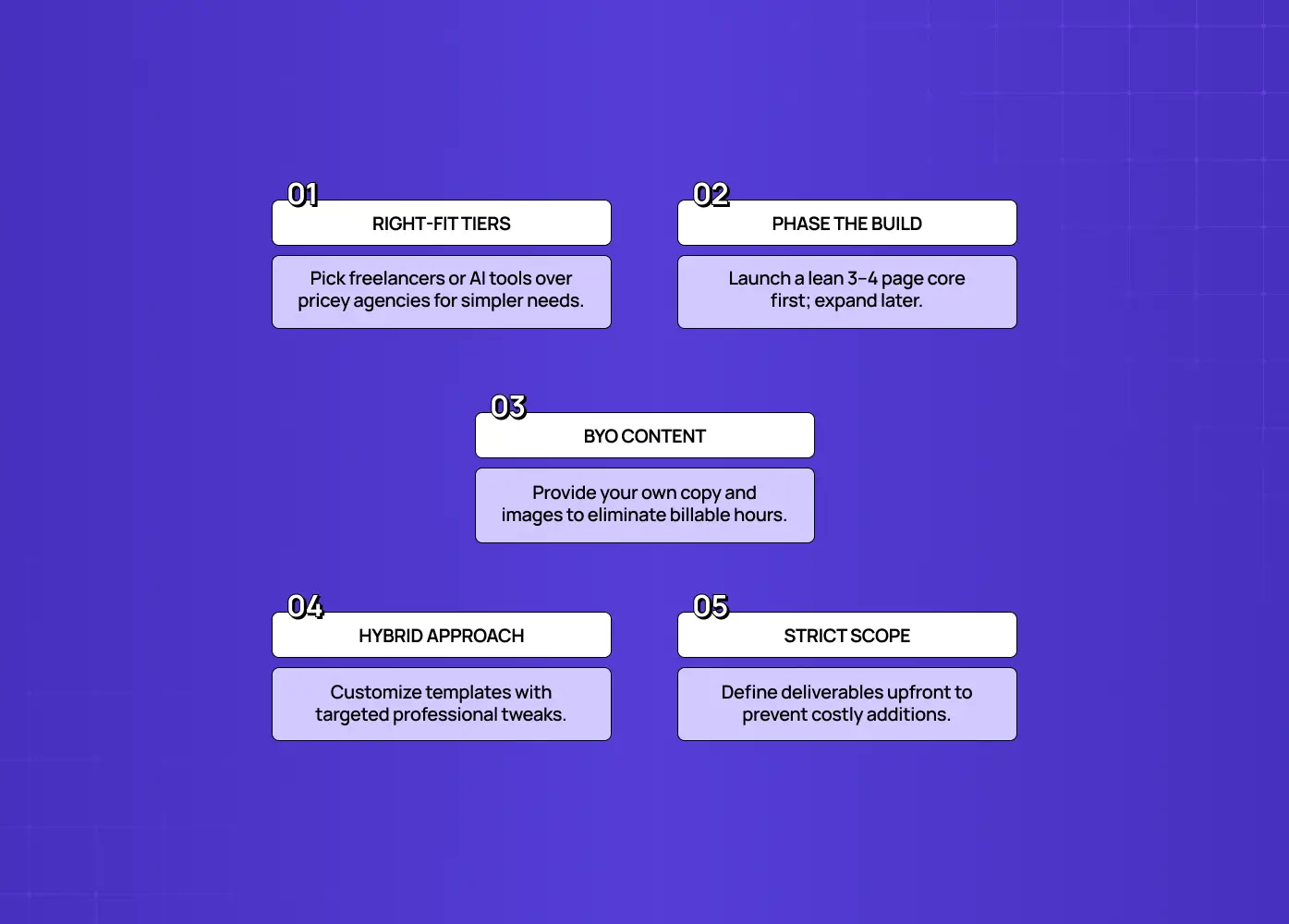
Yes. Professional web design is achievable on a small budget if you match the option to your needs and spend strategically rather than trying to buy everything at once. Most small business website design services are priced with exactly this constraint in mind. Here's how we advise clients to get quality without overspending:
Choose the right tier. If you need a simple, credible presence, a well-set-up AI website builder or a good freelancer delivers far more value than an agency you can't afford. Match the tool to the job.
Start with essentials, then phase. You don't need a 30-page site on day one. Launch a focused, high-quality core (home, services, about, contact) and add pages as the business grows. A phased approach spreads cost and gets you live sooner.
Come prepared. Providing your own copy, images, and a clear brief dramatically cuts hours (and cost), because content creation and endless revisions are where budgets balloon.
Consider a hybrid approach. Use an AI builder or template for the foundation and hire a professional to refine the parts that matter most, the sweet spot for many small businesses. A no code website design agency runs that hybrid as a single service if you'd rather not manage both halves yourself.
Be crystal clear on scope. The fastest way to blow a small budget is scope creep. Define exactly what you need up front and treat additions as deliberate decisions.
One honest caution: cheap can become expensive. A bargain site that loads slowly, doesn't convert, or needs rebuilding in a year costs more than doing it right the first time. "Affordable" should mean good value for your goals, not simply the lowest sticker price. The goal is a site that pays for itself, and even a modest budget, spent well, can achieve that.
What should you ask a web design company before hiring?
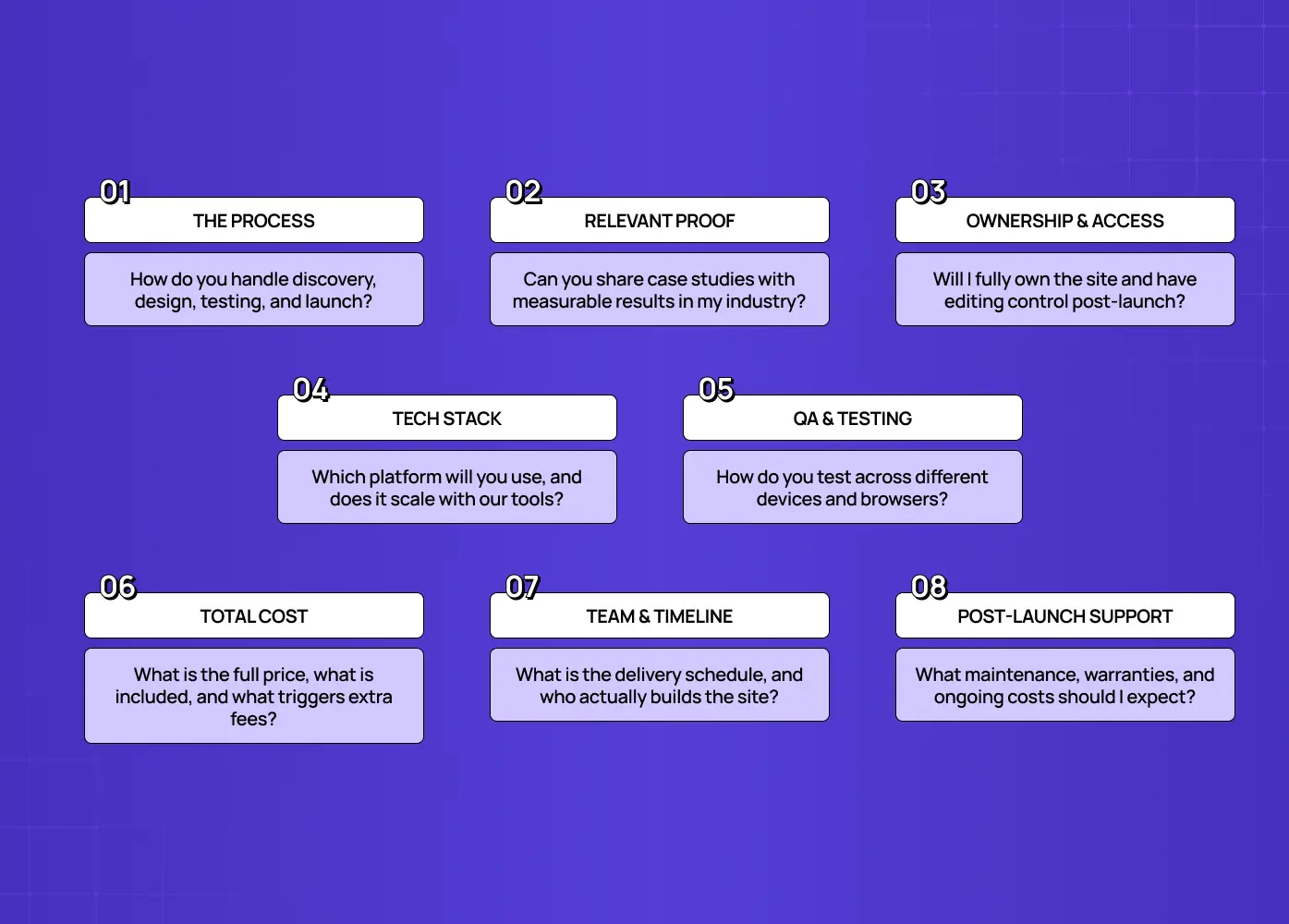
Vetting is where you avoid expensive mistakes. Our checklist for choosing the right web design agency goes deeper on each of the questions below. At Groto, we're happy to be asked every one of these on a first call, and we think you should expect the same from any partner. Before signing with any web designer or agency, get clear answers to these questions:
What's your process, start to finish? A real partner can walk you through how they gather your goals, research, design, build, test, and launch. Vagueness here is a warning sign.
Can I see relevant work? Ask for examples similar to your industry, scope, or goals, and ideally outcomes, not just screenshots. Evaluating an agency portfolio properly means reading for process and results, which is harder than it sounds.
Will I own the website, and can I edit it after launch? Confirm you'll own the site and understand exactly what access and editing control you'll have. Never get locked out of your own site.
What platform and tools will you use? Make sure the platform supports what you actually need (blog, portfolio, e-commerce, the tools you already use) now and as you grow.
How do you handle testing and QA? Your site should be tested across devices and browsers before and after launch so everything works everywhere.
What's the total cost, and what's included? Ask directly what you'll pay in total, what's covered, and what costs extra. Ask their average completed-project cost to sense-check the quote.
What's the timeline and who's on my team? Understand how long it'll take, how you'll communicate, and who actually does the work (not just who pitches you). Sense-check whatever they quote against a typical website redesign timeline.
What happens after launch? Clarify support, maintenance, and what ongoing costs to expect.
The answers to these separate a trustworthy partner from an expensive lesson, and asking them signals you're a serious client, which good agencies respect. Pair them with the skills a UI UX agency must have and you have a complete screen.
Red flags to watch for when outsourcing web design
We've seen these patterns burn founders before they ever got to work with us, so a few warning signs should give you pause:
A firm-price quote given before they understand your project
No clear process, or unwillingness to explain it
A portfolio of screenshots with no results or client references
Reluctance to confirm you'll own your site
Vague or evasive answers about total cost, a setup for surprise fees later
No mention of testing or post-launch support
Communication that's already slow or unclear during the sales process. It rarely improves after you've paid
Trust the pattern. If getting straight answers is hard now, it'll be harder later.
How to get the most value from your web design budget
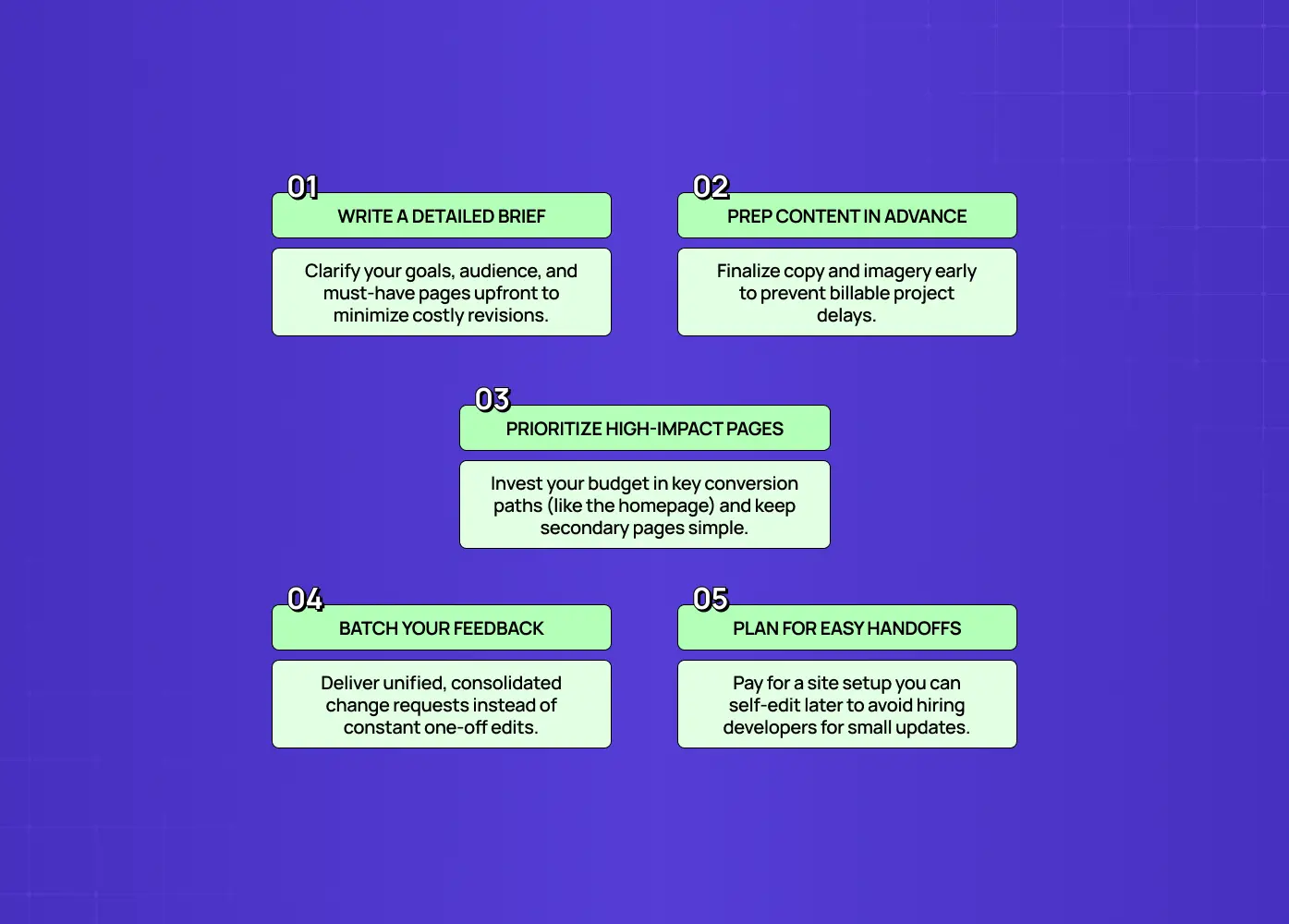
Whatever you spend, these are the habits we see stretch every dollar the furthest:
Nail your brief before you start. The clearer you are about goals, audience, must-have pages, and examples you like, the less time and money gets spent guessing and revising. A proper design brief is the format for getting all of that down in one place.
Prepare your content early. Waiting on copy and images is the number-one cause of delays and creep, and designers charging hourly bill for that limbo
Prioritize ruthlessly. Spend on the pages and flows that drive your business, like the homepage and the core conversion path, and keep the rest simple
Consolidate feedback into clear, batched rounds rather than a trickle of one-off change requests, which is faster and cheaper
Think beyond launch. A slightly higher upfront investment in a site that's easy for you to update yourself often beats a cheap build that needs a developer for every tweak. Ask about their design handoff process early, since that's what actually determines how editable the site ends up being.
Value isn't about spending the least. It's about getting a site that earns more than it cost, which is a very different, and better, target.
How to choose the right option for you
At Groto, we pull this together for clients by matching the choice to their situation, and we'd suggest you do the same:
Need a simple site fast and cheap? Use an AI builder or a good freelancer
Does your website have a real job to do, like ranking, converting, integrating, or representing a serious brand? Invest in an agency or an experienced designer whose process and accountability justify the cost. For B2B specifically, the best B2B web design agencies roundup narrows the field.
Budget-constrained but need quality? Go hybrid or phased. Start with a strong core and grow
The real question isn't usually whether to outsource. It's to whom, and for how much, which is exactly what the rest of this guide tackles. If you want a starting shortlist while you read, the top web design agencies roundup is a reasonable place to begin. The worst outcome isn't spending too much or too little. It's paying for a site that doesn't move your business forward.
Conclusion
Outsourcing web design comes down to three honest questions, and at Groto, we believe you deserve straight answers to all three:
Cost. Expect to pay somewhere from a few hundred dollars for DIY, to $2,000 to $8,000 for most small-business sites, to $10,000 and up for agency work
Trust. Vet any partner hard on process, ownership, and total cost before you sign
Budget. Stretch what you have by phasing the build, preparing your content, and matching the tool to the job
Do that, and you'll get a website that's worth every dollar, one that works as hard as you do.
If you want a web design partner with transparent pricing, a clear process, and work built to actually convert, book a discovery call with Groto. We'll talk through your goals, your budget, and the smartest way to get you a site that earns its keep, no jargon, no surprise fees. Let's build your best front door.