
What Is UX Debt (and Why Should You Care About It)?

What Is UX Debt (and Why Should You Care About It)?

A practical guide to UX debt for CTOs and PMs: what it is, why it silently hurts conversion and retention, and how to measure and pay it down.

What Is UX Debt (and Why Should You Care About It)?

What Is UX Debt (and Why Should You Care About It)?

A practical guide to UX debt for CTOs and PMs: what it is, why it silently hurts conversion and retention, and how to measure and pay it down.

Your metrics look fine but activation is slipping and support tickets keep repeating. That's UX debt: the accumulated cost of design shortcuts compounding silently. Here's how to identify it, measure it, and pay it down without stalling your roadmap.

UX debt is quietly costing you conversions. Here's how to spot it and fix it.

UX debt illustration showing a person interacting with a digital interface, symbolizing design decisions, usability, and product investment.

UX debt is what happens when a product accumulates small design compromises over time until those compromises start working against the business. If your team has ever said "we'll fix that later" about a confusing flow, a mismatched component, or a workaround nobody loves, you've already started accruing it. Most teams don't have a name for it until it shows up in their metrics, and by then it's already expensive.

Your product ships features on schedule, your engineering is solid, your metrics look... fine. But activation has quietly slipped, support tickets keep repeating the same complaints, and every new feature seems to take a little longer to fit in than the last. There's a good chance you're paying interest on UX debt, the accumulated cost of design shortcuts that, like technical debt, compounds silently until it starts dragging on growth. For SaaS and AI companies, it compounds faster than technical debt, and most teams don't have it on any dashboard.

This guide is written for CTOs and product managers who need to understand UX debt as a business problem, not just a design one. We'll define what it is, why it happens, how it quietly hurts conversion and retention, how it differs from technical debt, and, most importantly, how to measure it and pay it down without halting your roadmap. If UX has started to feel like it's working against your growth, this is why, and what to do about it.

TL;DR

  • UX debt is the accumulated cost of design shortcuts, decisions made to save time or money that eventually make a product harder to use.

  • It builds up quietly through speed-over-polish decisions, missing design systems, feature-first roadmaps, and unclear ownership.

  • It directly hurts conversion, activation, and retention, and it's becoming a hard blocker as AI agents try to execute on messy interfaces.

  • You measure it by combining product analytics, session recordings, support tickets, usability testing, and heuristic evaluation, then tying it back to retention.

  • You pay it down incrementally: prioritize core flows, take quick wins, reserve sprint time, and prevent recurrence with a design system.

What is UX debt?
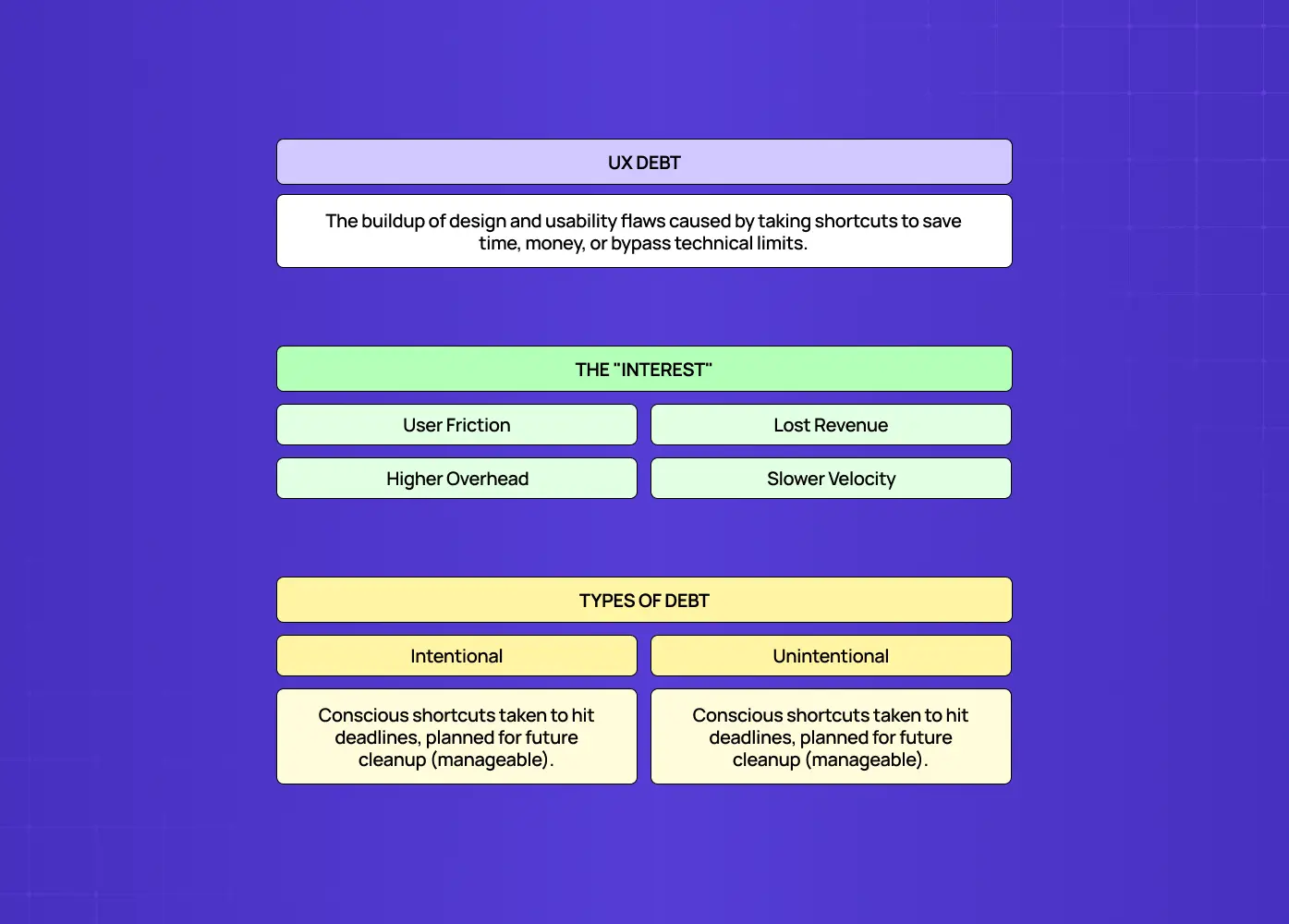
Defines UX debt, its impact as “interest” through user friction, lost revenue, overhead, and slower velocity, and distinguishes intentional from unintentional debt.

UX debt is the accumulation of design and usability shortcomings that build up in a product over time when decisions are made against the user's best interest, usually to save time or money, or because of a technical constraint. It's the user-experience cousin of technical debt: each individual shortcut seems reasonable in the moment ("ship it now, fix the flow later"), but the compromises accumulate into a product that's inconsistent, confusing, and progressively harder to use.

What "interest" looks like on UX debt

Like financial debt, it charges interest. Every time you build on top of a shaky experience, the shortcut costs you again, and that interest shows up as:

  • Ongoing user frustration with the same friction points

  • Lost conversions from people who quietly give up

  • Higher support load as the same complaints repeat

  • Slower future development, since every new feature has to work around the old mess

And like technical debt, it's largely invisible on the surface until it's big enough to hurt.

Intentional vs. unintentional UX debt

Not all UX debt gets created the same way, and the distinction matters when you're deciding what to prioritize.

  • Intentional UX debt is a conscious trade-off. You know a flow isn't ideal, but shipping now matters more, and you plan to revisit it once there's bandwidth.

  • Unintentional UX debt happens when you don't realize a gap exists at all, often because user needs shifted, a feature was bolted on without anyone reviewing the whole journey, or nobody was watching for drift.

Intentional debt is manageable because you already know where it lives. Unintentional debt is the more dangerous kind, since it hides until a support ticket, a churn conversation, or a usability test surfaces it.

Why UX debt happens
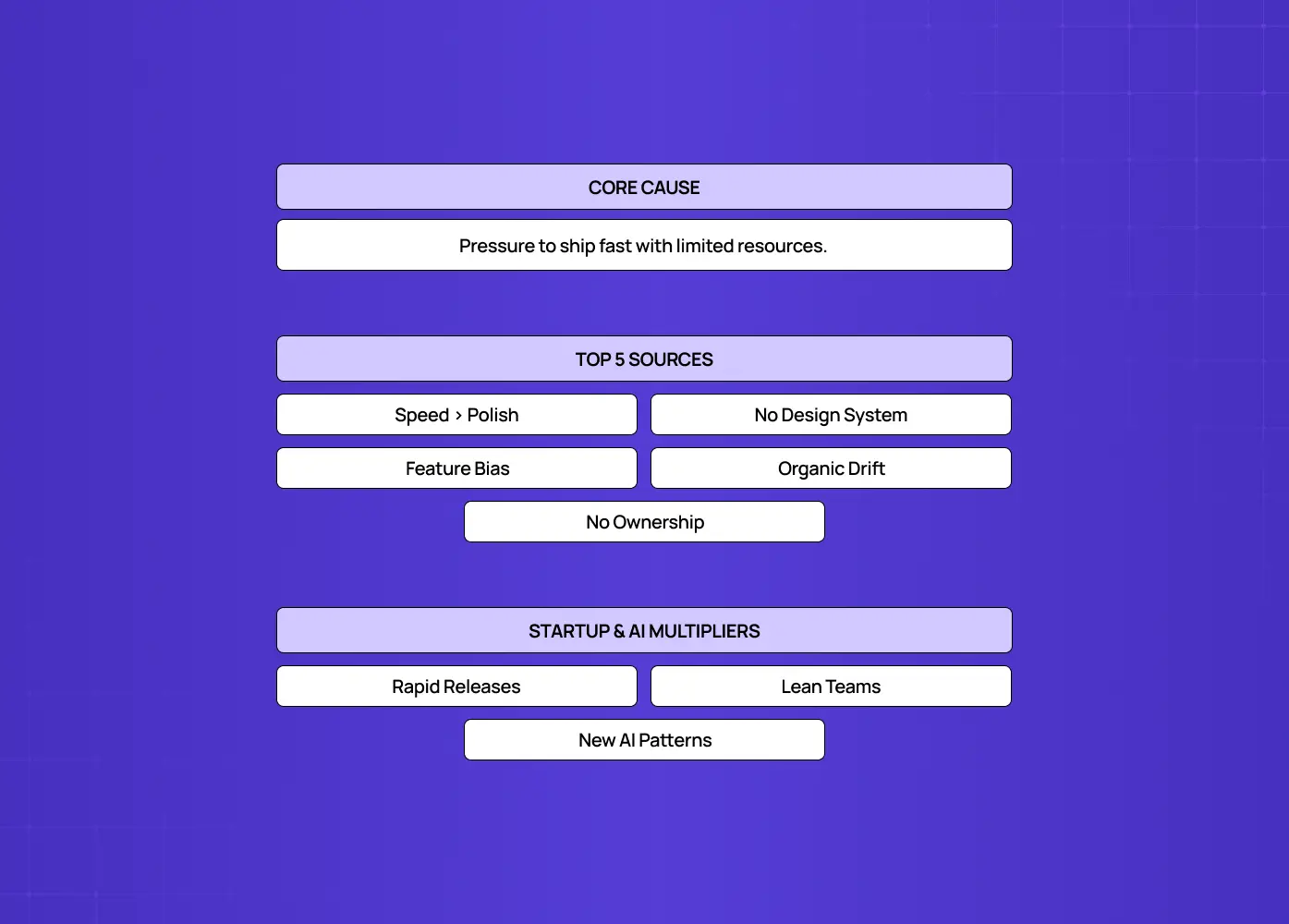
Highlights shipping pressure as the core cause, with speed over polish, lack of a design system, feature bias, organic drift, and lack of ownership as key sources.

UX debt accrues from the everyday pressures of building software: tight deadlines, limited resources, shipping fast, and making local decisions without a system to keep them consistent. No one sets out to create it, it's the natural byproduct of moving quickly.

The most common sources

  • Speed over polish. MVP and "ship it now" decisions leave rough edges you intend to fix later (but rarely do).

  • No design system. When designers and developers rebuild components and patterns from scratch each time instead of reusing a design system for SaaS, inconsistency and debt accumulate.

  • Feature-first prioritization. Roadmaps reward new features; fixing existing UX rarely makes the cut, so debt compounds while attention goes elsewhere.

  • Organic drift. As a product matures and many hands touch it, small inconsistencies and workarounds pile up naturally over months and years.

  • No ownership. When no one is accountable for the end-to-end experience, quality erodes one reasonable-seeming trade-off at a time.

Your UX debt is already becoming tech debt. Here's how to stop it.

See how design inconsistencies compound into engineering slowdowns, and how to reverse it before your velocity drops.

No Spam. Free Lifetime

Your UX debt is already becoming tech debt. Here's how to stop it.

See how design inconsistencies compound into engineering slowdowns, and how to reverse it before your velocity drops.

No Spam. Free Lifetime

Why SaaS and AI startups accrue it faster

  • Fast-moving teams ship weekly or biweekly, leaving less time to revisit older flows.

  • Small teams often don't have a dedicated design system owner, so consistency depends on whoever's building that week.

  • AI-first products add new interaction patterns (chat, agents, generative UI) faster than design guidelines can keep up with them.

The main types of UX debt
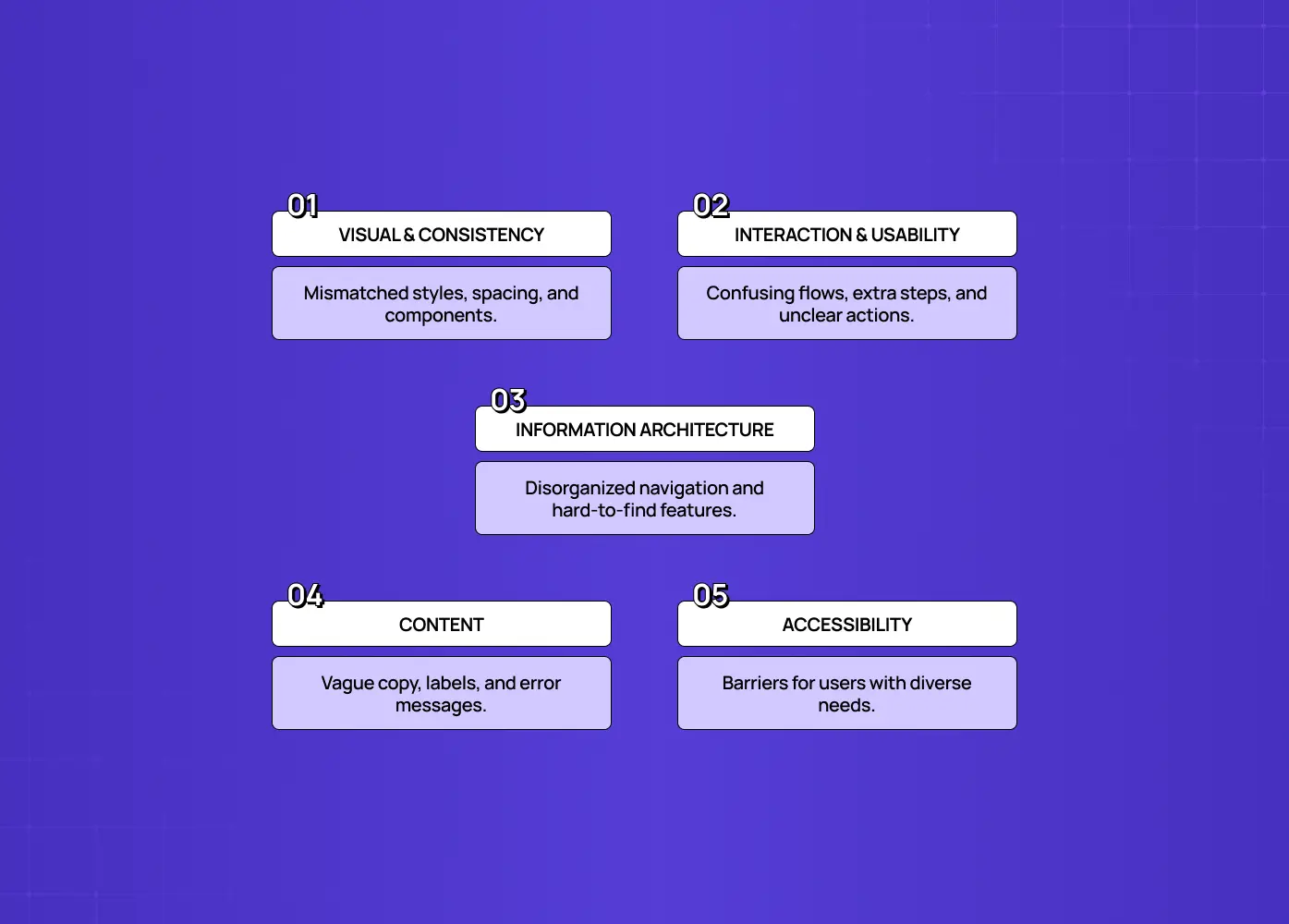
Covers visual consistency, interaction and usability, information architecture, content quality, and accessibility issues.

UX debt isn't one thing, it shows up across several dimensions of the experience, and recognizing the types helps you spot it.

The five types you'll run into most

  • Visual and consistency debt. Mismatched styles, spacing, and components that make the product feel disjointed.

  • Interaction and usability debt. Confusing flows, unclear actions, and steps that make tasks harder than they should be.

  • Information architecture debt. Disorganized navigation and structure that makes things hard to find.

  • Content debt. Unclear labels, error messages, and copy.

  • Accessibility debt. The ways the product fails users with different needs.

Most products carry a mix of all five, and they interact. Visual inconsistency often signals deeper structural debt underneath. Seeing them as concrete bad UX design examples rather than categories makes them far easier to spot in your own product.

A quick UX debt example

Imagine a SaaS dashboard where the "export" action lives under three different icons across three different screens, a download arrow on one, a share icon on another, and a text link on a third. No single instance is a bug. But a new user has to relearn the pattern every time they switch context, support fields the same "where's export" question every week, and the team building the next screen has to guess which pattern to follow. That relearning is cognitive load, and it's the tax users pay on every unit of debt you leave unpaid. That's UX debt in miniature: small, individually defensible decisions that add up to real friction.

Why you should care: the business impact of UX debt
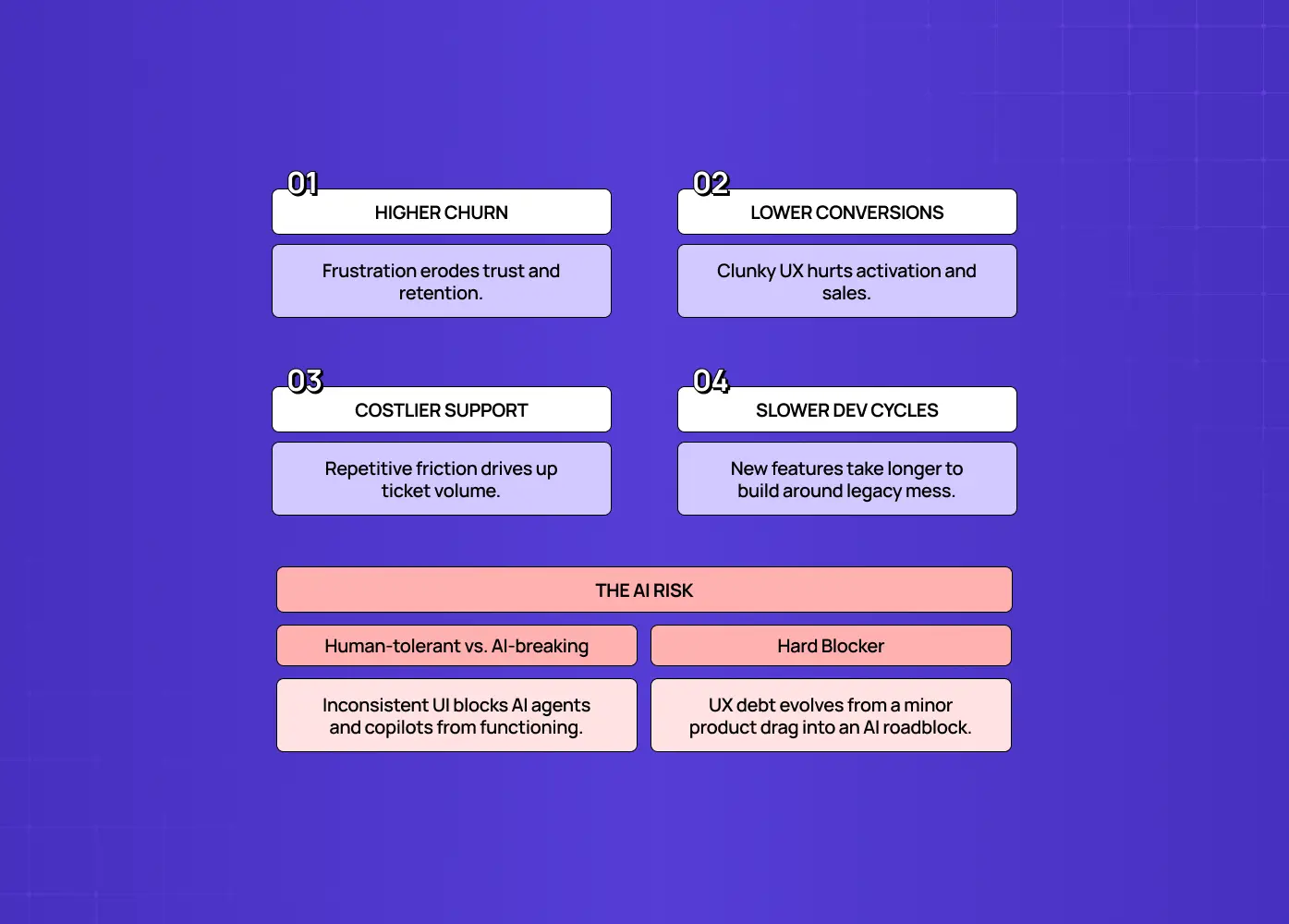
Shows how UX debt leads to higher churn, lower conversions, costlier support, and slower development, with growing risks for AI products.

You should care about UX debt because it directly damages the metrics your business runs on, conversion, activation, and retention, while quietly raising the cost of every future change. This is the part that makes it a leadership issue, not a design nicety.

How it shows up in your metrics

  • Users lose trust, get frustrated, and churn

  • Acquisition channels get constrained because a clunky product converts worse

  • Support costs rise as people struggle with the same friction points

  • Every new feature has to work around the accumulated mess, so future updates get slower and more expensive

None of it announces itself. The issues are invisible at first, then they start slowing the product down and eating into growth.

Why AI raises the stakes

Design debt that was tolerable when humans navigated around it becomes intolerable when an AI system tries to execute on it programmatically. An inconsistent, poorly structured interface that a person could muddle through will break an AI agent or copilot trying to act on it. As you add AI features, unpaid UX debt stops being a drag and becomes a blocker. For a CTO or PM, UX debt is a growth liability with interest, and the interest rate is rising.

Signs your product has UX debt
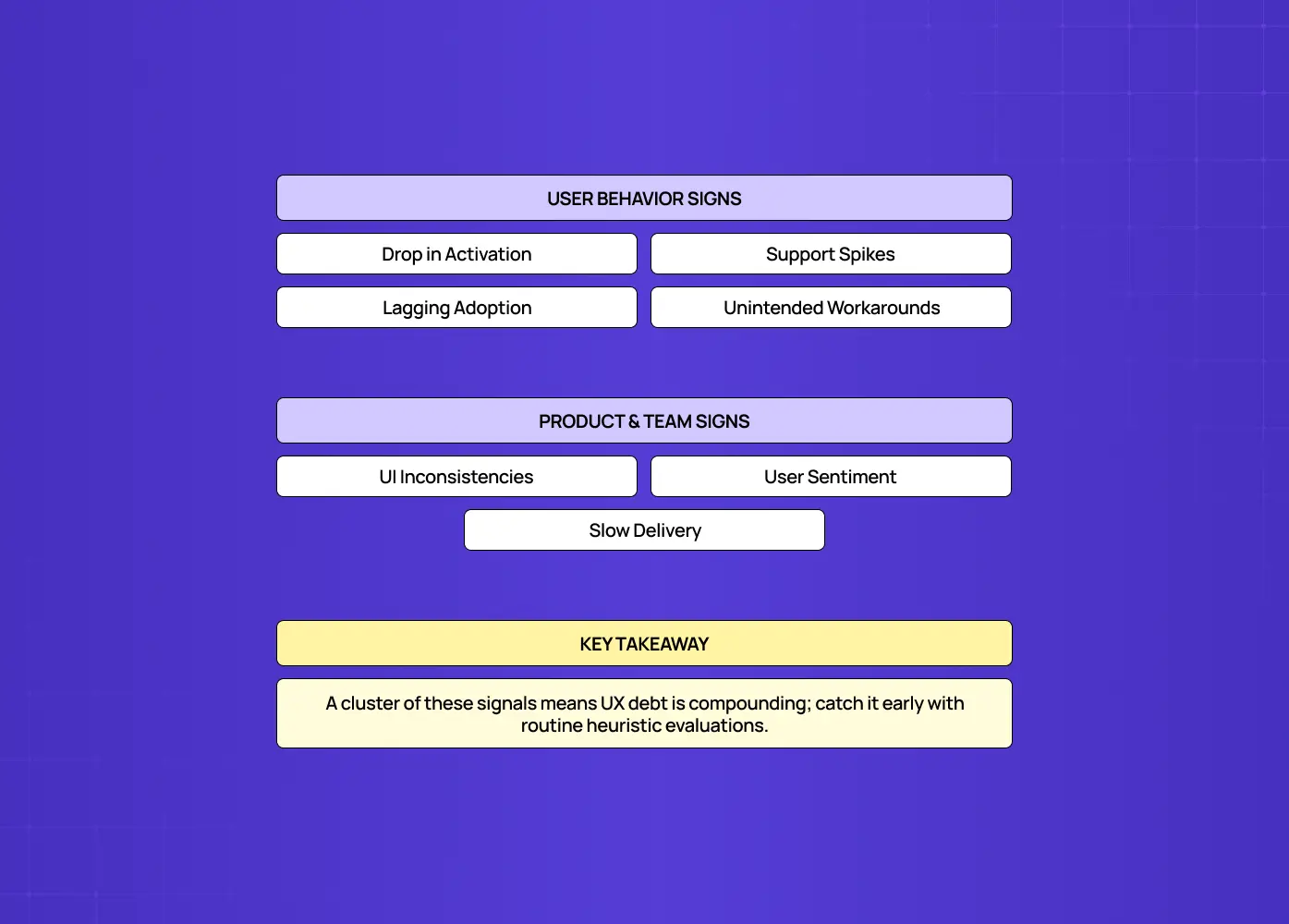
Identifies user and team signals such as declining activation, support spikes, lagging adoption, UI inconsistencies, negative user sentiment, and slow delivery.

You likely have significant UX debt if your product shows a cluster of these symptoms, most of which are visible in data you already collect.

Signs in user behavior

  • Slipping activation or onboarding completion (users struggle to reach first value)

  • Rising or repetitive support tickets about the same confusing areas

  • Feature adoption that lags because people can't find or understand what you shipped

  • Users creating workarounds instead of using the intended flow

Signs in your product and team

  • Inconsistent UI where different parts of the product look and behave differently

  • User complaints that it feels "clunky," "confusing," or "harder than it used to be"

  • Each new feature taking longer to design and build because it has to work around existing mess

One of these might be noise. Several together are UX debt with the interest coming due. The earlier you recognize the pattern, the cheaper it is to address, which is why a periodic, honest look at these signals is worth building into your process. A heuristic evaluation is the structured version of that look, and the cheapest way to run one.

UX debt vs. technical debt

UX debt and technical debt are close cousins: both are the accumulated cost of shortcuts, but technical debt lives in the codebase while UX debt lives in the experience. Technical debt slows down engineering and makes the system fragile; UX debt slows down users and makes the product frustrating.

At a glance

Aspects

UX debt

Technical debt

Where it lives

The experience: flows, layout, copy, interaction patterns

The codebase: architecture, code quality, infrastructure

Who feels it first

Users and support teams

Engineers and QA

How it's tracked

Rarely tracked in most orgs

Usually tracked in the backlog or sprint planning

What it slows down

Conversion, activation, retention

Build speed, deploy velocity, system stability

How it compounds

Faster in scaling SaaS products, every new user multiplies the impact

Steadily, as more code is built on a fragile base

How it's paid down

UX audits, heuristic evaluations, design system investment

Refactoring, code review, architecture updates


Why the visibility gap matters

Technical debt is at least discussed in engineering, it shows up in slow builds, bugs, and velocity. UX debt is rarely tracked at all, so it grows unchecked. If your team takes technical debt seriously, UX debt deserves the same discipline, it just hasn't had the same vocabulary.

How to identify and measure UX debt
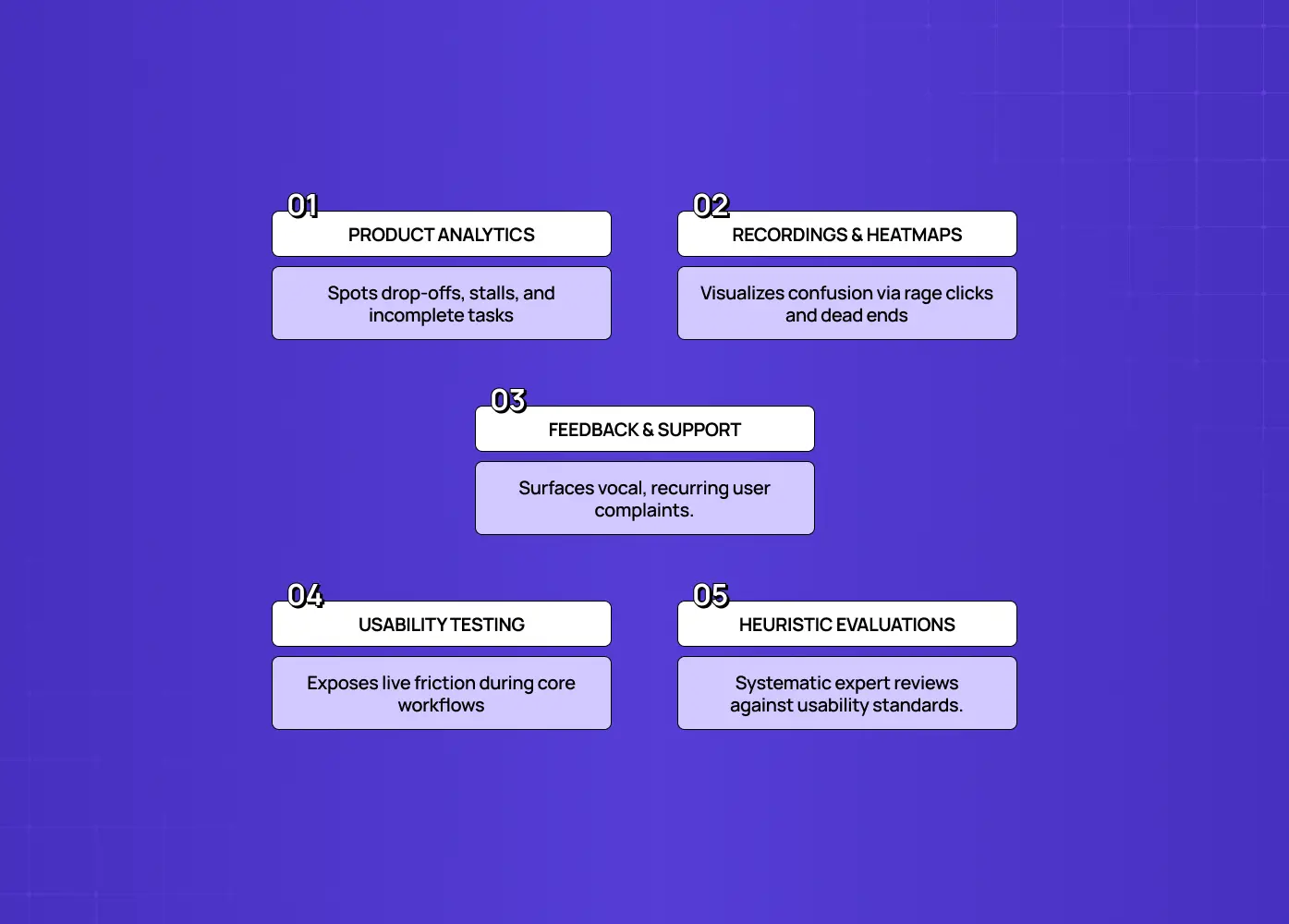
Covers product analytics, recordings and heatmaps, user feedback and support, usability testing, and heuristic evaluations.

You measure UX debt by combining behavioral data with expert evaluation, then connecting both to business outcomes. A structured UX audit is the standard way to run that combination in a single pass. You can't fix what you can't see, and UX debt is measurable if you look in the right places.

The methods worth using

  • Product analytics (Amplitude, Mixpanel) reveal where users drop off, stall, or fail to complete key tasks, the fingerprints of UX debt.

  • Session recordings and heatmaps (Hotjar, FullStory) show the confusion directly: rage clicks, dead ends, repeated attempts.

  • In-app feedback and support tickets surface recurring complaints, which are debt made vocal.

  • Usability testing (Maze, UserTesting) puts real users against core flows to expose friction.

  • Heuristic evaluations, expert reviews of your workflows against usability principles, catalog debt systematically.

Tracking it without extra tooling

You don't need a dedicated UX debt calculator or specialized UX debt tracker to get started. A shared spreadsheet with columns for severity, frequency, and effort to fix does the job for most teams, and it doubles as a living UX debt log so issues stay visible instead of getting rediscovered every quarter. Then connect it to retention: track whether UX improvements in onboarding, information architecture, and guidance translate into users still being active at 30, 60, and 90 days. Set your baseline UX metrics for SaaS before the first fix ships, or you'll have nothing to compare the results against.

How to pay down UX debt (without stopping your roadmap)
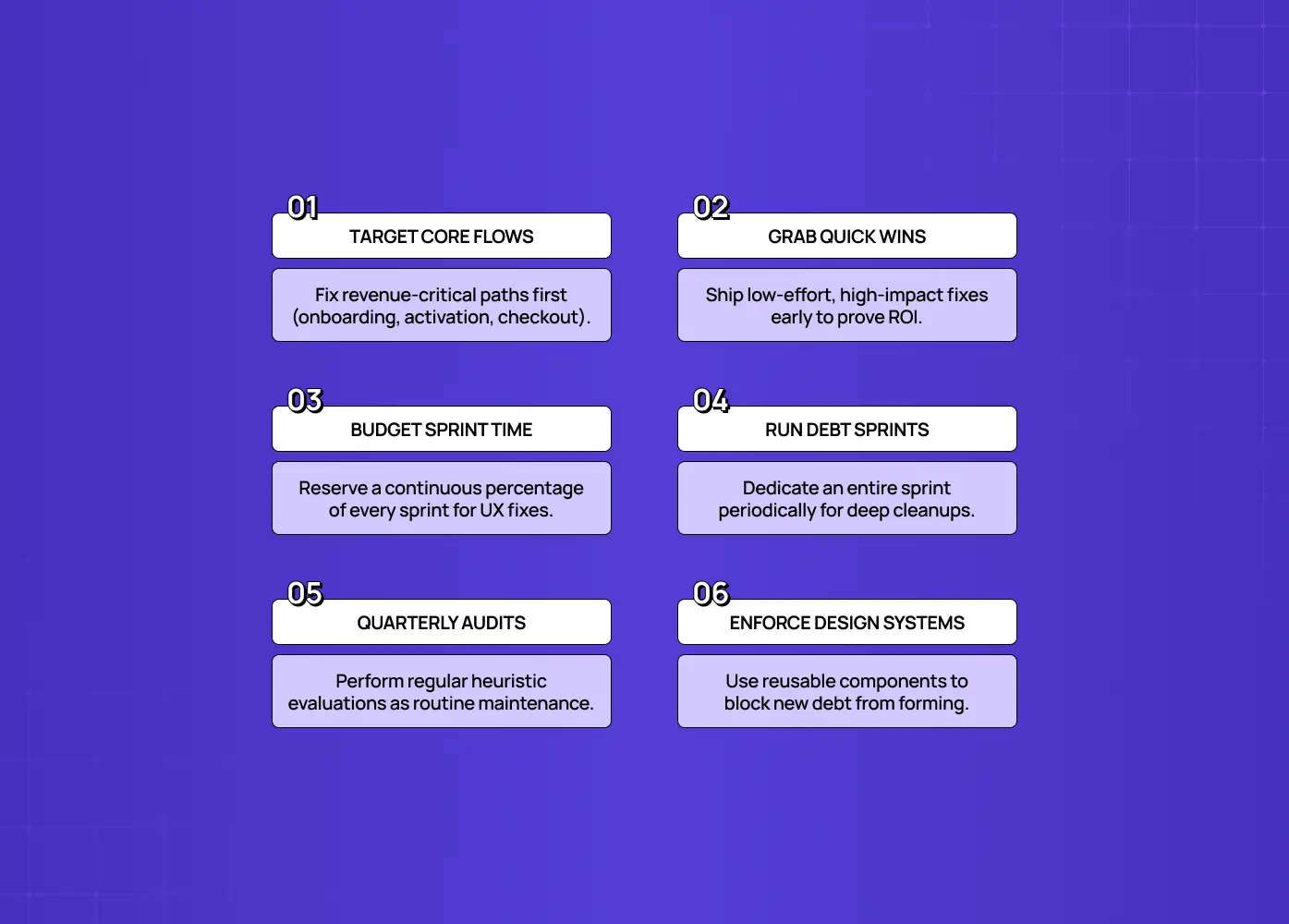
Recommends fixing core flows first, addressing quick wins, allocating sprint time for UX fixes, running dedicated debt sprints, conducting quarterly audits, and enforcing design systems.

You pay down UX debt incrementally, prioritizing the highest-impact flows and building fixes into your regular cadence, rather than halting everything for a giant redesign. Knowing when to redesign instead is the fork worth understanding before you commit either way, since debt occasionally does compound past the point incremental fixes can reach.

The practical playbook

  • Prioritize core flows first. Debt in onboarding, activation, and checkout has the greatest effect on user success and revenue, so fix there before cosmetic issues elsewhere.

  • Chase quick wins. Tackle low-effort, high-impact fixes early to build momentum and show ROI to leadership.

  • Allocate time every sprint. Reserve a slice of each sprint for chipping away at usability issues, the same way mature teams budget for technical debt.

  • Run occasional debt sprints. Periodically dedicate a full sprint to UX debt when it's built up enough to warrant focused attention.

  • Do quarterly heuristic evaluations. Treat regular expert reviews of core workflows as essential maintenance, not a one-off.

  • Prevent recurrence with a design system. A consistent, reusable system stops new debt from accumulating with every feature, it's the single best long-term defense.

The goal isn't zero UX debt (impossible in a living product) but managed UX debt, kept low enough that it never becomes the thing quietly capping your growth. Treated as ongoing UX optimization rather than a cleanup project, it stops being something you schedule and becomes something you run.

How to make the case for paying down UX debt

To get buy-in for UX debt work, frame it in the language leadership already uses: metrics, cost, and risk, not aesthetics. The standard methods for calculating the ROI of UX design give you exactly that language. This is where many product and design leaders lose the argument, pitching "let's clean up the UX" against revenue-generating features and losing.

Reframe debt in terms leadership already accepts

  • "This onboarding friction is costing us X% of activations."

  • "These repeated tickets cost the support team Y hours a month."

  • "This inconsistency is why the new feature took an extra sprint."

Borrow the credibility of technical debt. Leadership already accepts that unaddressed shortcuts slow the team down; UX debt is the same argument applied to users and growth.

Make the ask low-risk

Executives fear "redesign" because it sounds like a big, expensive bet with uncertain payoff. Bringing a real SaaS UX redesign cost into the conversation makes that contrast concrete rather than rhetorical. UX debt paydown is the opposite: prioritized, measurable, quick-win-first, and built into the existing cadence. Propose starting with a focused UX audit that quantifies the debt and identifies the highest-ROI fixes, then a small pilot on one core flow with before and after metrics. A visible win on activation or conversion turns UX debt from a hard sell into an easy, ongoing investment, and gives you the proof of ROI that funds the next round. The teams that win this argument don't ask for a redesign budget; they show a metric problem, name UX debt as the cause, and propose a measured fix.

Conclusion

  • UX debt is the silent tax on your product: a slow accumulation of design shortcuts that erodes conversion, retention, and trust while making every future change harder and more expensive.

  • It's increasingly the thing blocking the AI features you want to ship, not just a UX inconvenience.

  • The good news is that it's measurable and payable using data and evaluations most teams already have access to.

  • Put it on your radar the way you already track technical debt, and pay it down where it hurts most: your core flows.

  • Do that, and you turn a hidden liability into a compounding advantage.

If you suspect UX debt is quietly slowing your product but you want a clear read before committing to a redesign, book a discovery call with Groto. We start with a focused UX audit that pinpoints your highest-impact debt and the fixes that move your metrics. It's a low-risk first step toward a product that works for your growth, not against it.


Your metrics look fine but activation is slipping and support tickets keep repeating. That's UX debt: the accumulated cost of design shortcuts compounding silently. Here's how to identify it, measure it, and pay it down without stalling your roadmap.

UX debt is quietly costing you conversions. Here's how to spot it and fix it.

UX debt illustration showing a person interacting with a digital interface, symbolizing design decisions, usability, and product investment.

UX debt is what happens when a product accumulates small design compromises over time until those compromises start working against the business. If your team has ever said "we'll fix that later" about a confusing flow, a mismatched component, or a workaround nobody loves, you've already started accruing it. Most teams don't have a name for it until it shows up in their metrics, and by then it's already expensive.

Your product ships features on schedule, your engineering is solid, your metrics look... fine. But activation has quietly slipped, support tickets keep repeating the same complaints, and every new feature seems to take a little longer to fit in than the last. There's a good chance you're paying interest on UX debt, the accumulated cost of design shortcuts that, like technical debt, compounds silently until it starts dragging on growth. For SaaS and AI companies, it compounds faster than technical debt, and most teams don't have it on any dashboard.

This guide is written for CTOs and product managers who need to understand UX debt as a business problem, not just a design one. We'll define what it is, why it happens, how it quietly hurts conversion and retention, how it differs from technical debt, and, most importantly, how to measure it and pay it down without halting your roadmap. If UX has started to feel like it's working against your growth, this is why, and what to do about it.

TL;DR

  • UX debt is the accumulated cost of design shortcuts, decisions made to save time or money that eventually make a product harder to use.

  • It builds up quietly through speed-over-polish decisions, missing design systems, feature-first roadmaps, and unclear ownership.

  • It directly hurts conversion, activation, and retention, and it's becoming a hard blocker as AI agents try to execute on messy interfaces.

  • You measure it by combining product analytics, session recordings, support tickets, usability testing, and heuristic evaluation, then tying it back to retention.

  • You pay it down incrementally: prioritize core flows, take quick wins, reserve sprint time, and prevent recurrence with a design system.

What is UX debt?

Defines UX debt, its impact as “interest” through user friction, lost revenue, overhead, and slower velocity, and distinguishes intentional from unintentional debt.

UX debt is the accumulation of design and usability shortcomings that build up in a product over time when decisions are made against the user's best interest, usually to save time or money, or because of a technical constraint. It's the user-experience cousin of technical debt: each individual shortcut seems reasonable in the moment ("ship it now, fix the flow later"), but the compromises accumulate into a product that's inconsistent, confusing, and progressively harder to use.

What "interest" looks like on UX debt

Like financial debt, it charges interest. Every time you build on top of a shaky experience, the shortcut costs you again, and that interest shows up as:

  • Ongoing user frustration with the same friction points

  • Lost conversions from people who quietly give up

  • Higher support load as the same complaints repeat

  • Slower future development, since every new feature has to work around the old mess

And like technical debt, it's largely invisible on the surface until it's big enough to hurt.

Intentional vs. unintentional UX debt

Not all UX debt gets created the same way, and the distinction matters when you're deciding what to prioritize.

  • Intentional UX debt is a conscious trade-off. You know a flow isn't ideal, but shipping now matters more, and you plan to revisit it once there's bandwidth.

  • Unintentional UX debt happens when you don't realize a gap exists at all, often because user needs shifted, a feature was bolted on without anyone reviewing the whole journey, or nobody was watching for drift.

Intentional debt is manageable because you already know where it lives. Unintentional debt is the more dangerous kind, since it hides until a support ticket, a churn conversation, or a usability test surfaces it.

Why UX debt happens

Highlights shipping pressure as the core cause, with speed over polish, lack of a design system, feature bias, organic drift, and lack of ownership as key sources.

UX debt accrues from the everyday pressures of building software: tight deadlines, limited resources, shipping fast, and making local decisions without a system to keep them consistent. No one sets out to create it, it's the natural byproduct of moving quickly.

The most common sources

  • Speed over polish. MVP and "ship it now" decisions leave rough edges you intend to fix later (but rarely do).

  • No design system. When designers and developers rebuild components and patterns from scratch each time instead of reusing a design system for SaaS, inconsistency and debt accumulate.

  • Feature-first prioritization. Roadmaps reward new features; fixing existing UX rarely makes the cut, so debt compounds while attention goes elsewhere.

  • Organic drift. As a product matures and many hands touch it, small inconsistencies and workarounds pile up naturally over months and years.

  • No ownership. When no one is accountable for the end-to-end experience, quality erodes one reasonable-seeming trade-off at a time.

Your UX debt is already becoming tech debt. Here's how to stop it.

See how design inconsistencies compound into engineering slowdowns, and how to reverse it before your velocity drops.

No Spam. Free Lifetime

Why SaaS and AI startups accrue it faster

  • Fast-moving teams ship weekly or biweekly, leaving less time to revisit older flows.

  • Small teams often don't have a dedicated design system owner, so consistency depends on whoever's building that week.

  • AI-first products add new interaction patterns (chat, agents, generative UI) faster than design guidelines can keep up with them.

The main types of UX debt

Covers visual consistency, interaction and usability, information architecture, content quality, and accessibility issues.

UX debt isn't one thing, it shows up across several dimensions of the experience, and recognizing the types helps you spot it.

The five types you'll run into most

  • Visual and consistency debt. Mismatched styles, spacing, and components that make the product feel disjointed.

  • Interaction and usability debt. Confusing flows, unclear actions, and steps that make tasks harder than they should be.

  • Information architecture debt. Disorganized navigation and structure that makes things hard to find.

  • Content debt. Unclear labels, error messages, and copy.

  • Accessibility debt. The ways the product fails users with different needs.

Most products carry a mix of all five, and they interact. Visual inconsistency often signals deeper structural debt underneath. Seeing them as concrete bad UX design examples rather than categories makes them far easier to spot in your own product.

A quick UX debt example

Imagine a SaaS dashboard where the "export" action lives under three different icons across three different screens, a download arrow on one, a share icon on another, and a text link on a third. No single instance is a bug. But a new user has to relearn the pattern every time they switch context, support fields the same "where's export" question every week, and the team building the next screen has to guess which pattern to follow. That relearning is cognitive load, and it's the tax users pay on every unit of debt you leave unpaid. That's UX debt in miniature: small, individually defensible decisions that add up to real friction.

Why you should care: the business impact of UX debt

Shows how UX debt leads to higher churn, lower conversions, costlier support, and slower development, with growing risks for AI products.

You should care about UX debt because it directly damages the metrics your business runs on, conversion, activation, and retention, while quietly raising the cost of every future change. This is the part that makes it a leadership issue, not a design nicety.

How it shows up in your metrics

  • Users lose trust, get frustrated, and churn

  • Acquisition channels get constrained because a clunky product converts worse

  • Support costs rise as people struggle with the same friction points

  • Every new feature has to work around the accumulated mess, so future updates get slower and more expensive

None of it announces itself. The issues are invisible at first, then they start slowing the product down and eating into growth.

Why AI raises the stakes

Design debt that was tolerable when humans navigated around it becomes intolerable when an AI system tries to execute on it programmatically. An inconsistent, poorly structured interface that a person could muddle through will break an AI agent or copilot trying to act on it. As you add AI features, unpaid UX debt stops being a drag and becomes a blocker. For a CTO or PM, UX debt is a growth liability with interest, and the interest rate is rising.

Signs your product has UX debt

Identifies user and team signals such as declining activation, support spikes, lagging adoption, UI inconsistencies, negative user sentiment, and slow delivery.

You likely have significant UX debt if your product shows a cluster of these symptoms, most of which are visible in data you already collect.

Signs in user behavior

  • Slipping activation or onboarding completion (users struggle to reach first value)

  • Rising or repetitive support tickets about the same confusing areas

  • Feature adoption that lags because people can't find or understand what you shipped

  • Users creating workarounds instead of using the intended flow

Signs in your product and team

  • Inconsistent UI where different parts of the product look and behave differently

  • User complaints that it feels "clunky," "confusing," or "harder than it used to be"

  • Each new feature taking longer to design and build because it has to work around existing mess

One of these might be noise. Several together are UX debt with the interest coming due. The earlier you recognize the pattern, the cheaper it is to address, which is why a periodic, honest look at these signals is worth building into your process. A heuristic evaluation is the structured version of that look, and the cheapest way to run one.

UX debt vs. technical debt

UX debt and technical debt are close cousins: both are the accumulated cost of shortcuts, but technical debt lives in the codebase while UX debt lives in the experience. Technical debt slows down engineering and makes the system fragile; UX debt slows down users and makes the product frustrating.

At a glance

Aspects

UX debt

Technical debt

Where it lives

The experience: flows, layout, copy, interaction patterns

The codebase: architecture, code quality, infrastructure

Who feels it first

Users and support teams

Engineers and QA

How it's tracked

Rarely tracked in most orgs

Usually tracked in the backlog or sprint planning

What it slows down

Conversion, activation, retention

Build speed, deploy velocity, system stability

How it compounds

Faster in scaling SaaS products, every new user multiplies the impact

Steadily, as more code is built on a fragile base

How it's paid down

UX audits, heuristic evaluations, design system investment

Refactoring, code review, architecture updates


Why the visibility gap matters

Technical debt is at least discussed in engineering, it shows up in slow builds, bugs, and velocity. UX debt is rarely tracked at all, so it grows unchecked. If your team takes technical debt seriously, UX debt deserves the same discipline, it just hasn't had the same vocabulary.

How to identify and measure UX debt

Covers product analytics, recordings and heatmaps, user feedback and support, usability testing, and heuristic evaluations.

You measure UX debt by combining behavioral data with expert evaluation, then connecting both to business outcomes. A structured UX audit is the standard way to run that combination in a single pass. You can't fix what you can't see, and UX debt is measurable if you look in the right places.

The methods worth using

  • Product analytics (Amplitude, Mixpanel) reveal where users drop off, stall, or fail to complete key tasks, the fingerprints of UX debt.

  • Session recordings and heatmaps (Hotjar, FullStory) show the confusion directly: rage clicks, dead ends, repeated attempts.

  • In-app feedback and support tickets surface recurring complaints, which are debt made vocal.

  • Usability testing (Maze, UserTesting) puts real users against core flows to expose friction.

  • Heuristic evaluations, expert reviews of your workflows against usability principles, catalog debt systematically.

Tracking it without extra tooling

You don't need a dedicated UX debt calculator or specialized UX debt tracker to get started. A shared spreadsheet with columns for severity, frequency, and effort to fix does the job for most teams, and it doubles as a living UX debt log so issues stay visible instead of getting rediscovered every quarter. Then connect it to retention: track whether UX improvements in onboarding, information architecture, and guidance translate into users still being active at 30, 60, and 90 days. Set your baseline UX metrics for SaaS before the first fix ships, or you'll have nothing to compare the results against.

How to pay down UX debt (without stopping your roadmap)

Recommends fixing core flows first, addressing quick wins, allocating sprint time for UX fixes, running dedicated debt sprints, conducting quarterly audits, and enforcing design systems.

You pay down UX debt incrementally, prioritizing the highest-impact flows and building fixes into your regular cadence, rather than halting everything for a giant redesign. Knowing when to redesign instead is the fork worth understanding before you commit either way, since debt occasionally does compound past the point incremental fixes can reach.

The practical playbook

  • Prioritize core flows first. Debt in onboarding, activation, and checkout has the greatest effect on user success and revenue, so fix there before cosmetic issues elsewhere.

  • Chase quick wins. Tackle low-effort, high-impact fixes early to build momentum and show ROI to leadership.

  • Allocate time every sprint. Reserve a slice of each sprint for chipping away at usability issues, the same way mature teams budget for technical debt.

  • Run occasional debt sprints. Periodically dedicate a full sprint to UX debt when it's built up enough to warrant focused attention.

  • Do quarterly heuristic evaluations. Treat regular expert reviews of core workflows as essential maintenance, not a one-off.

  • Prevent recurrence with a design system. A consistent, reusable system stops new debt from accumulating with every feature, it's the single best long-term defense.

The goal isn't zero UX debt (impossible in a living product) but managed UX debt, kept low enough that it never becomes the thing quietly capping your growth. Treated as ongoing UX optimization rather than a cleanup project, it stops being something you schedule and becomes something you run.

How to make the case for paying down UX debt

To get buy-in for UX debt work, frame it in the language leadership already uses: metrics, cost, and risk, not aesthetics. The standard methods for calculating the ROI of UX design give you exactly that language. This is where many product and design leaders lose the argument, pitching "let's clean up the UX" against revenue-generating features and losing.

Reframe debt in terms leadership already accepts

  • "This onboarding friction is costing us X% of activations."

  • "These repeated tickets cost the support team Y hours a month."

  • "This inconsistency is why the new feature took an extra sprint."

Borrow the credibility of technical debt. Leadership already accepts that unaddressed shortcuts slow the team down; UX debt is the same argument applied to users and growth.

Make the ask low-risk

Executives fear "redesign" because it sounds like a big, expensive bet with uncertain payoff. Bringing a real SaaS UX redesign cost into the conversation makes that contrast concrete rather than rhetorical. UX debt paydown is the opposite: prioritized, measurable, quick-win-first, and built into the existing cadence. Propose starting with a focused UX audit that quantifies the debt and identifies the highest-ROI fixes, then a small pilot on one core flow with before and after metrics. A visible win on activation or conversion turns UX debt from a hard sell into an easy, ongoing investment, and gives you the proof of ROI that funds the next round. The teams that win this argument don't ask for a redesign budget; they show a metric problem, name UX debt as the cause, and propose a measured fix.

Conclusion

  • UX debt is the silent tax on your product: a slow accumulation of design shortcuts that erodes conversion, retention, and trust while making every future change harder and more expensive.

  • It's increasingly the thing blocking the AI features you want to ship, not just a UX inconvenience.

  • The good news is that it's measurable and payable using data and evaluations most teams already have access to.

  • Put it on your radar the way you already track technical debt, and pay it down where it hurts most: your core flows.

  • Do that, and you turn a hidden liability into a compounding advantage.

If you suspect UX debt is quietly slowing your product but you want a clear read before committing to a redesign, book a discovery call with Groto. We start with a focused UX audit that pinpoints your highest-impact debt and the fixes that move your metrics. It's a low-risk first step toward a product that works for your growth, not against it.

Have a project in mind?

Let’s talk through your idea and see what makes sense.

Harpreet Singh

Founder at Groto

Have a project in mind?

Let’s talk through your idea and see what makes sense.

Harpreet Singh

Founder at Groto

FAQ

Everything you were going to ask (and a few things you didn’t know to)

Is some UX debt normal, or should you aim for zero?

Some UX debt is unavoidable in any product that ships regularly. The goal isn't eliminating it, since that would mean never moving fast, it's keeping it at a managed level where it never accumulates enough to visibly hurt conversion, activation, or retention.

Who should own UX debt inside a company?

Ownership is where most teams fall short. Design typically identifies UX debt, but paying it down needs buy-in from product and engineering too, since fixes usually touch both the interface and the underlying code. Without a named owner, usually a PM or design lead, UX debt tends to sit in the backlog indefinitely.


Can a brand-new product already have UX debt?

Yes. UX debt isn't about product age, it's about decisions made under pressure. A three-month-old MVP can carry significant UX debt if it launched with rushed flows, no design system, and no plan to revisit either.

How often should you audit for UX debt?

A lightweight review every sprint catches small issues early, while a deeper heuristic evaluation once a quarter is enough to catch the debt that accumulates gradually across multiple releases. Waiting longer than that usually means the fixes get more expensive and more tangled with newer features.

Does fixing UX debt mean redesigning the product?

Rarely. Most UX debt gets resolved through targeted fixes to specific flows, not a full redesign. Redesigns are usually reserved for cases where debt has compounded so heavily across the product that incremental fixes can no longer keep up.

Does UX debt affect accessibility compliance?

Often, yes. Accessibility gaps are one of the five common types of UX debt, and they tend to compound the same way visual or interaction debt does: a missing alt text pattern or a low-contrast component gets copied into new features before anyone catches it, turning one gap into many.

Is some UX debt normal, or should you aim for zero?

Some UX debt is unavoidable in any product that ships regularly. The goal isn't eliminating it, since that would mean never moving fast, it's keeping it at a managed level where it never accumulates enough to visibly hurt conversion, activation, or retention.

Who should own UX debt inside a company?

Ownership is where most teams fall short. Design typically identifies UX debt, but paying it down needs buy-in from product and engineering too, since fixes usually touch both the interface and the underlying code. Without a named owner, usually a PM or design lead, UX debt tends to sit in the backlog indefinitely.


Can a brand-new product already have UX debt?

Yes. UX debt isn't about product age, it's about decisions made under pressure. A three-month-old MVP can carry significant UX debt if it launched with rushed flows, no design system, and no plan to revisit either.

How often should you audit for UX debt?

A lightweight review every sprint catches small issues early, while a deeper heuristic evaluation once a quarter is enough to catch the debt that accumulates gradually across multiple releases. Waiting longer than that usually means the fixes get more expensive and more tangled with newer features.

Does fixing UX debt mean redesigning the product?

Rarely. Most UX debt gets resolved through targeted fixes to specific flows, not a full redesign. Redesigns are usually reserved for cases where debt has compounded so heavily across the product that incremental fixes can no longer keep up.

Does UX debt affect accessibility compliance?

Often, yes. Accessibility gaps are one of the five common types of UX debt, and they tend to compound the same way visual or interaction debt does: a missing alt text pattern or a low-contrast component gets copied into new features before anyone catches it, turning one gap into many.

More Articles

Extreme close-up black and white photograph of a human eye

Let’s bring your vision to life

Tell us what's on your mind? We'll hit you back in 24 hours. No fluff, no delays - just a solid vision to bring your idea to life.

Profile portrait of a man in a white shirt against a light background

Harpreet Singh

Founder and Creative Director

Get in Touch

Extreme close-up black and white photograph of a human eye

Let’s bring your vision to life

Tell us what's on your mind? We'll hit you back in 24 hours. No fluff, no delays - just a solid vision to bring your idea to life.

Profile portrait of a man in a white shirt against a light background

Harpreet Singh

Founder and Creative Director

Get in Touch

Extreme close-up black and white photograph of a human eye

Let’s bring your vision to life

Tell us what's on your mind? We'll hit you back in 24 hours. No fluff, no delays - just a solid vision to bring your idea to life.

Profile portrait of a man in a white shirt against a light background

Harpreet Singh

Founder and Creative Director

Get in Touch