Your design lead just left, and the search could take months. This guide breaks down when an interim design agency makes sense to cover the gap, when a fractional or interim leader fits better, and how to set it up and hand off cleanly.
When to bring in an interim design agency to cover a design-lead search.

TL;DR
A design-lead gap breaks two things at once: team management and design direction. Both stall the roadmap.
An interim design agency covers the execution and direction half, keeping design work shipping at quality while you run a proper search.
It does not cover team management, careers, or long-term org strategy. That's a fractional or interim leader's job.
Agency cover fits best when your internal team is small or nonexistent, your roadmap can't wait, or you need senior direction without committing to a full-time executive yet.
Set it up as a scoped bridge with clear ownership and continuity documentation, then hand off deliberately so the permanent hire inherits a healthy function, not a mess.
Losing a design lead is one of the more disruptive gaps a product team can face, and it's exactly where an interim design agency earns its place. Unlike a general staffing gap, a design-lead vacancy stalls two things at once: the people who need managing and the work that needs direction. Bringing in an agency to cover that gap is a specific, well-scoped move, not a generic stopgap, and knowing when it's the right one (and when it isn't) is what this guide is about.
Your Head of Design just gave notice. The roadmap doesn't care. You've got a product to ship, a design team (or no design team) looking for direction, and a senior search that, with three-month notice periods now standard for design leaders, could realistically take four to six months to fill well. So you face a choice most leaders don't plan for until it's urgent: do you let design coast on momentum and hope, rush the hire and risk getting it wrong, bring in a fractional or interim leader, or hire an agency to cover the gap while you run a proper search?
This guide is about that last option, using an interim design agency to cover a design-lead search, and just as importantly, when not to. It's written for founders, CTOs, and PMs staring at a design-leadership gap, and it's honest: an agency is the right cover in some situations and the wrong one in others. We'll walk through why the gap is more dangerous than it looks, what agency cover actually provides (and what it doesn't), when it makes sense versus when a fractional or interim leader is the better call, how to set it up so it protects rather than complicates your search, and how to hand off cleanly to the permanent hire. By the end you'll know which cover fits your situation.
Why a design-leadership gap is more dangerous than it looks
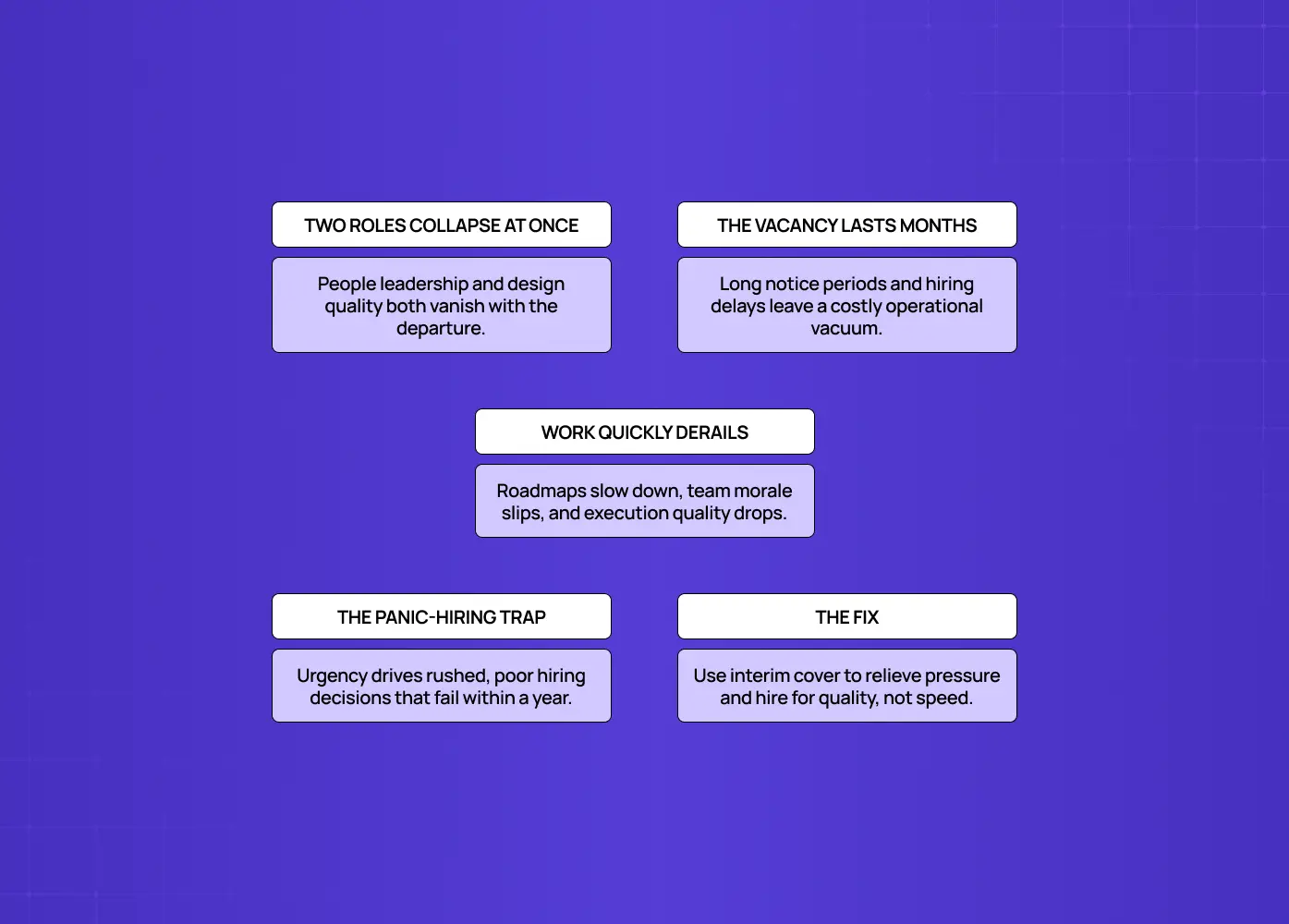
A design-lead gap is dangerous because a design leader does two different jobs at once, and when they leave, both stop at the same time. It's tempting to treat the vacancy as a line item to backfill, but the damage compounds while the seat is empty.
Start with the timeline:
Senior design roles increasingly come with three-month notice periods.
Advertising, interviewing, and closing an offer typically takes months on top of that.
Overlap between outgoing and incoming leaders is rare. Far more often there's a real gap of several months.
During that gap, whatever your design leader was holding together starts to fray.
They were holding together two distinct things:
Leadership: managing the team's day-to-day work, sprints, careers, and morale, aligning with stakeholders, and owning design strategy.
Design direction and execution: setting the quality bar, making the hard design calls, and making sure good work actually ships.
When the leader leaves, both halves lose their owner at once. The team drifts without management, and the work drifts without direction, so the roadmap slows exactly when you can least afford it.
That slowdown creates the real trap: pressure. A stalled roadmap and a rudderless team make the vacancy hurt every week, which pushes you to hire fast rather than well. But a design leader is a high-stakes, hard-to-reverse hire. Rushing it because the pain is acute is how companies end up re-running the same search a year later. The entire point of cover, whatever form it takes, is to remove that pressure so you can hire on quality, not desperation.
What "covering the search with an agency" actually means
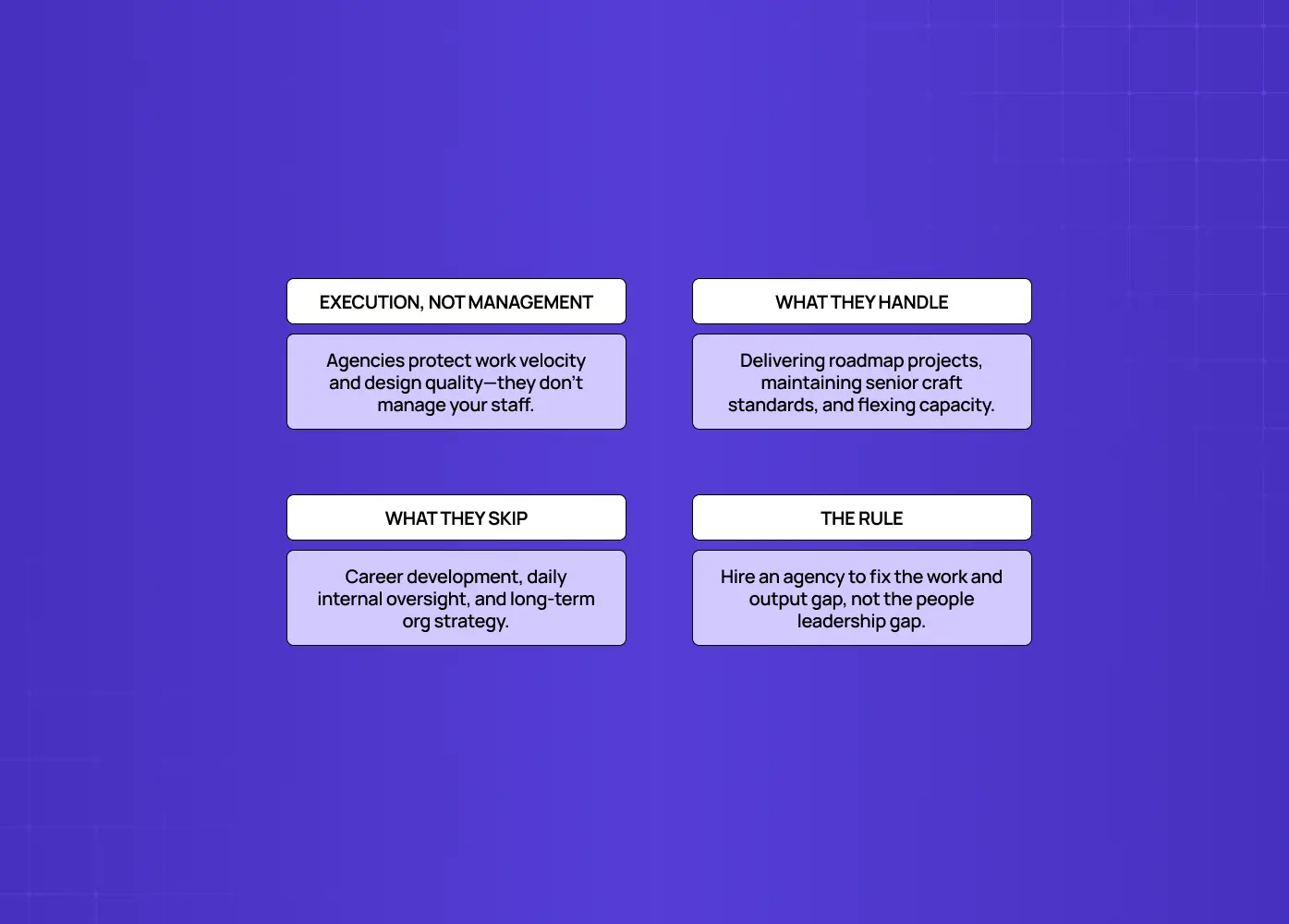
Hiring an interim design agency to cover a design-lead search means bringing in an outside team that plugs into your existing design process to keep design work shipping at quality, providing execution capacity and senior design direction during the gap. It does not mean outsourcing the leadership of your internal team. This distinction is the whole key to deciding whether an agency is right for you, so it's worth being precise.
What an agency covers:
Taking the roadmap and keeping it moving with quality output.
Senior designers setting and holding the bar so standards don't slip while the seat is empty.
Scaling capacity up or down as the gap's needs change.
What an agency generally does not do:
Manage your internal design team's day-to-day, including individual careers, performance, and growth.
Own your long-term org strategy.
Act as the internal figure the team reports to.
Those are leadership responsibilities that live inside the company. An agency keeps the output moving and the quality high. It isn't a manager for your people. Recognizing which of those two halves your gap most needs is how you choose the right cover, which brings us to the cases.
When hiring an agency to cover the gap makes sense
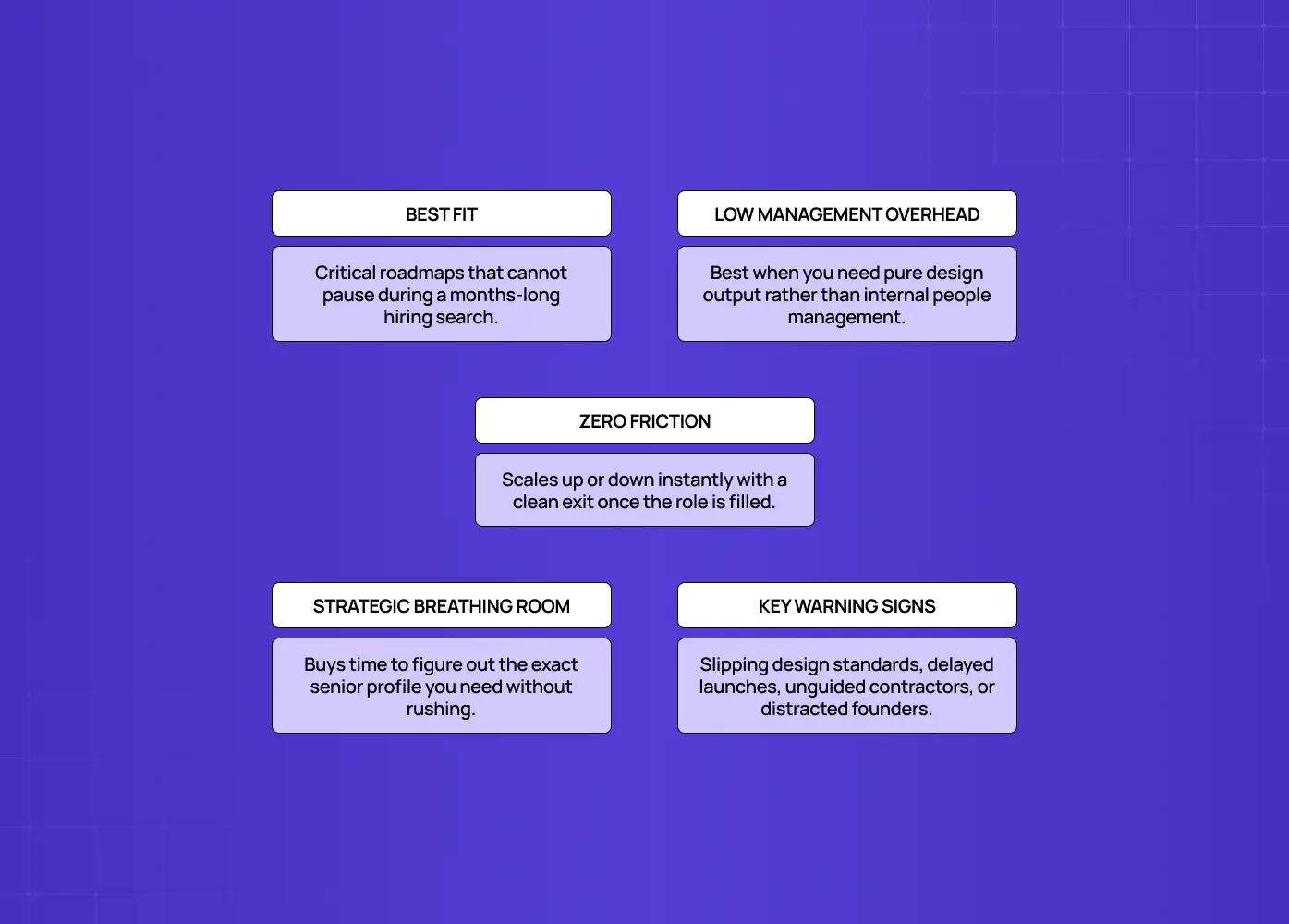
Agency cover makes sense when the gap is mostly about keeping design work shipping at quality. The strong-fit situations:
Your roadmap can't wait the length of a proper search. If a critical design leader resigns and the product can't pause for four-plus months, an agency keeps momentum, a whole team ready to ship, while you run the search unhurried. This is the classic and best-fit case.
The gap is primarily execution, not team management. If you have a small design team, or none, just engineers and PMs who need design support, there isn't much internal team to manage. What you need is capacity and direction to keep quality work flowing. An agency delivers that directly, where a single interim manager would have little to manage.
You want optionality and a clean exit. An agency scales with your needs and ends when the permanent leader is in place, similar in spirit to the flexibility of the best design subscription services. No severance, no reorg, no awkward 'what do we do with the interim person now' question.
You're not yet sure what permanent role you need. Sometimes a departure is the moment to rethink the role: a hands-on design director, a people-first design manager, a VP? Agency cover buys you time to answer that without a stalled roadmap forcing a premature decision.
You need senior design direction now, but a full-time exec is premature. For an earlier-stage company, a full-time design executive may be more than the stage warrants, yet the work still needs senior judgment today, the same gap a UX design agency for startups often fills before a founding designer is hired. An agency gives you that direction without committing to an executive salary before you're ready.This is a common pattern for SaaS and AI-first product teams still finding their footing on org design.
A few signals worth watching for specifically:
Work is shipping without a consistent quality bar and no one owns the call on what's good enough.
Multiple designers or contractors are being onboarded at once with no one to set standards or turn priorities into a plan.
A launch or initiative is already behind schedule and needs experienced hands to triage it.
Your founder or exec team is focused on fundraising or strategy and no one is sitting in the day-to-day work.
In all of these, the through-line is the same: the thing at risk is the work, shipping and quality, and an agency is built to protect exactly that.
When an agency isn't the right cover
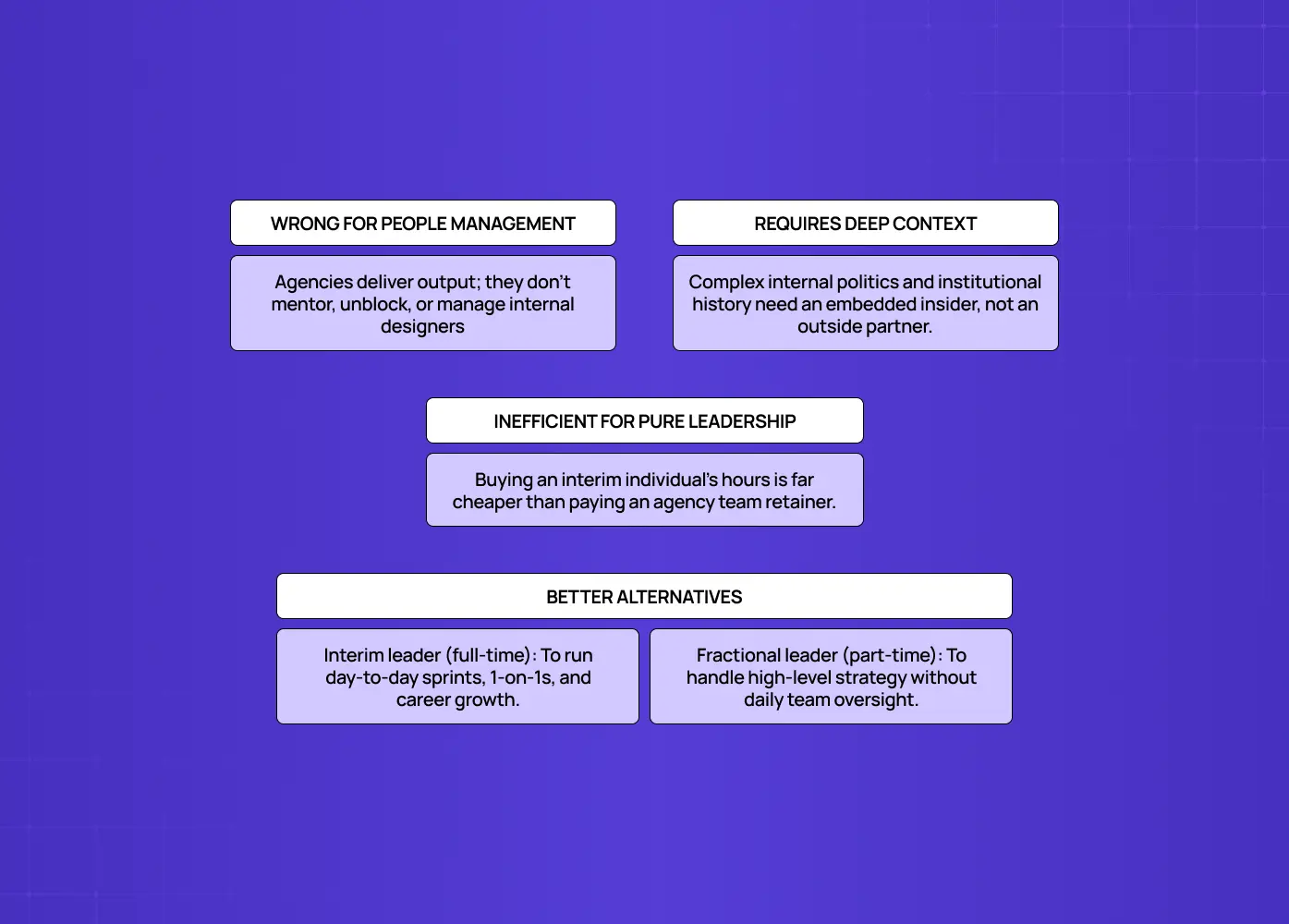
An agency is the wrong cover when the gap is primarily about leadership. Being honest about this is what makes the recommendation trustworthy when it does apply.
You have an established internal design team, often the case at the kind of scale best enterprise UX design agencies typically serve. Several designers who need managing, mentoring, unblocking, and someone accountable for their growth and morale. An agency won't fill that void, because managing your internal people isn't what an agency does. What you need is a person in the seat: an interim design leader (full-time and temporary, covering the empty seat through the search) or a fractional one (part-time and ongoing, typically one to three days a week).
The role demands deep institutional or domain context that only an embedded leader accrues over time: internal relationships, history, political knowledge.
Leadership hours alone are what you need. For leadership-only coverage, a fractional or interim leader can cost meaningfully less than an agency retainer, in the same range discussed in how much it costs to redesign a website, because you're buying one person's hours rather than a team's output.
One trade-off worth flagging even within the leadership option: a fractional leader usually won't run day-to-day projects, sprints, and careers. If that management is exactly your gap, lean interim rather than fractional. The agency's advantage shows up specifically when you need execution capacity plus direction, not leadership hours alone.
Agency vs. interim vs. fractional leader: a quick decision frame
Choose based on which half of the design-lead role your gap most needs:
Biggest risk is the work stalling (features not shipping, quality slipping, no senior eye on output) and you have little internal team to manage: an agency is your best cover.
Biggest risk is the team drifting (designers unmanaged, careers stalled, no one steering the function day to day): an interim design leader (full-time, temporary) fits better.
You mainly need strategic guidance and senior judgment a couple of days a week, and the team can otherwise run itself: a fractional design leader is the efficient choice.
These aren't mutually exclusive. A common strong setup is an agency keeping execution and quality moving while a fractional leader provides light-touch strategic oversight, covering both halves without a full-time commitment to either. Map your actual gap (work vs. team vs. strategy) to these options and the answer usually resolves quickly.
How to set up agency cover so it protects your search
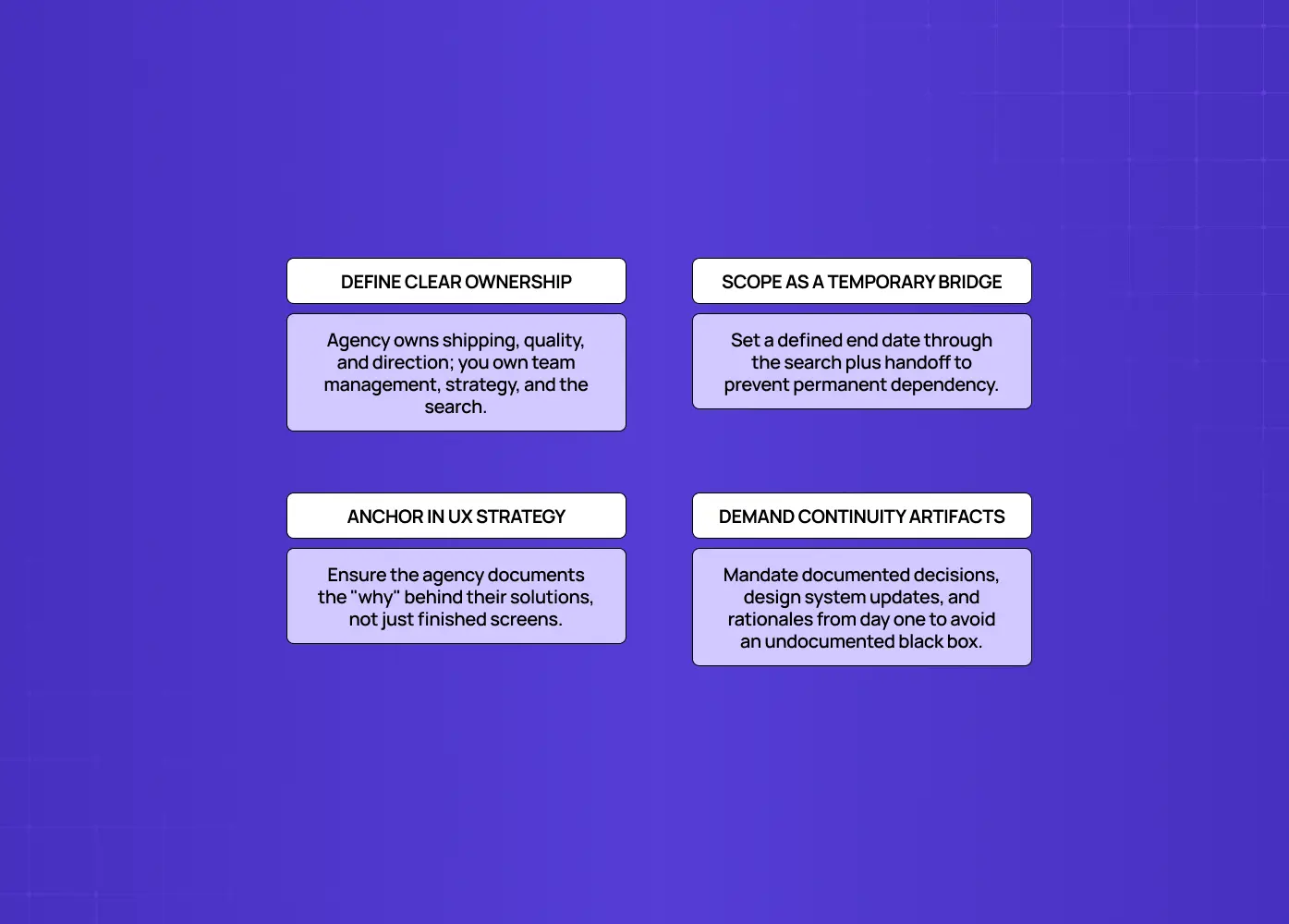
Set up agency cover as an explicit bridge. Cover done carelessly can complicate the very search it's meant to protect, so structure it deliberately:
Be explicit about ownership. The agency owns keeping the roadmap moving, design direction, and quality. The company retains team management, final strategic calls, and the search itself. Writing that line down prevents both the agency overreaching into internal leadership and gaps where each side assumes the other has something covered.
Scope the engagement as a bridge with an end, with the same clear-timeline discipline as a website redesign timeline. Through the search plus a handoff window, so it doesn't quietly harden into a permanent dependency, and so everyone knows a permanent leader is the goal.
Insist on continuity artifacts from day one: documented design decisions, an up-to-date design system, and a record of in-flight work and rationale.The worst outcome of any interim arrangement is a permanent leader inheriting an undocumented black box.
This is also where it's worth anchoring the engagement in UX strategy rather than pure output. A good agency doesn't just ship screens, it documents the reasoning behind decisions, which is a large part of what you're paying for. Set that expectation at the start, not at the handoff.
Handing off to the permanent hire
Plan the handoff from day one:
Have the agency document decisions and in-flight work throughout, not just at the end.
Transition deliberately when the permanent leader starts, rather than an abrupt cutover.
Let the agency taper rather than vanish, staying on for execution capacity while the new leader finds their feet, and stepping back as the leader takes hold.
The handoff is where interim cover succeeds or fails in the eyes of the person who matters most, the leader you worked so hard to hire. Because the agency has been keeping continuity artifacts all along, the transition is a structured handover rather than an archaeology project: the new leader gets the decisions, the rationale, the system, and the state of every in-flight initiative. That overlap gives the permanent hire the runway to lead from strength instead of spending their first month firefighting.
Common mistakes when using an agency to cover a design gap
Mismatching the cover to the gap. Using an agency to cover a leadership gap when you actually needed someone managing the team, or the reverse: hiring a single interim manager when the real need was execution capacity.
Not scoping an end. Cover either hardens into an accidental permanent arrangement or gets cut before the new leader is ready.
Skipping documentation. The permanent hire inherits an undocumented mess and the continuity you paid for evaporates.
Rushing the permanent hire regardless. This defeats the entire purpose. Cover exists to let you hire well, so use the breathing room.
Treating agency cover and the search as either/or. The right frame is that the agency protects the search by removing the pressure that causes bad hires.
Avoid these, and cover does its job: the work keeps moving, the team stays steady, and you hire the right leader on your timeline.
Conclusion
A design-leadership gap does two kinds of damage at once: the team drifts and the work stalls, and the resulting pressure is what pushes companies into rushed, expensive mis-hires.
Cover exists to remove that pressure, not to replace the search.
An interim design agency is the right cover when the gap is mostly about keeping design work shipping at quality: a small or nonexistent internal team, a roadmap that can't wait, and a need for senior direction without a premature executive commitment.
It's the wrong cover when the gap is really about managing an established team. That's a job for a fractional or interim leader in the seat.
Match the cover to the half of the role you're missing, scope it as a bridge with a clean handoff, and you protect both your roadmap and your search.
If your design lead has moved on and you need to keep product and design shipping at quality while you run a proper search, with senior direction now and a clean handoff later, book a discovery call with Groto. We've stepped into fast-moving SaaS and AI-first product teams to keep design direction and quality moving without a leader in the seat. Let's keep design steady while you find the perfect fit.