Choosing the wrong app design agency costs you twice: once in wasted spend, once in a redesign. This guide breaks down what these agencies actually do, honest 2026 pricing, a shortlist of 10 vetted partners, and a clear framework for picking the right one for your product.
Everything you need to know before hiring an app design agency in 2026.
TL;DR
An app design agency owns the UX and UI of your app: research, flows, wireframes, prototypes, visual design, design systems, testing, and developer handoff.
Good design determines whether people keep using your app or delete it in the first minute. Fixing a poorly designed app after launch costs more than getting it right the first time.
Pricing ranges from $10,000 for a focused MVP design to $250,000+ for full end-to-end design and development, depending on scope, complexity, and agency seniority.
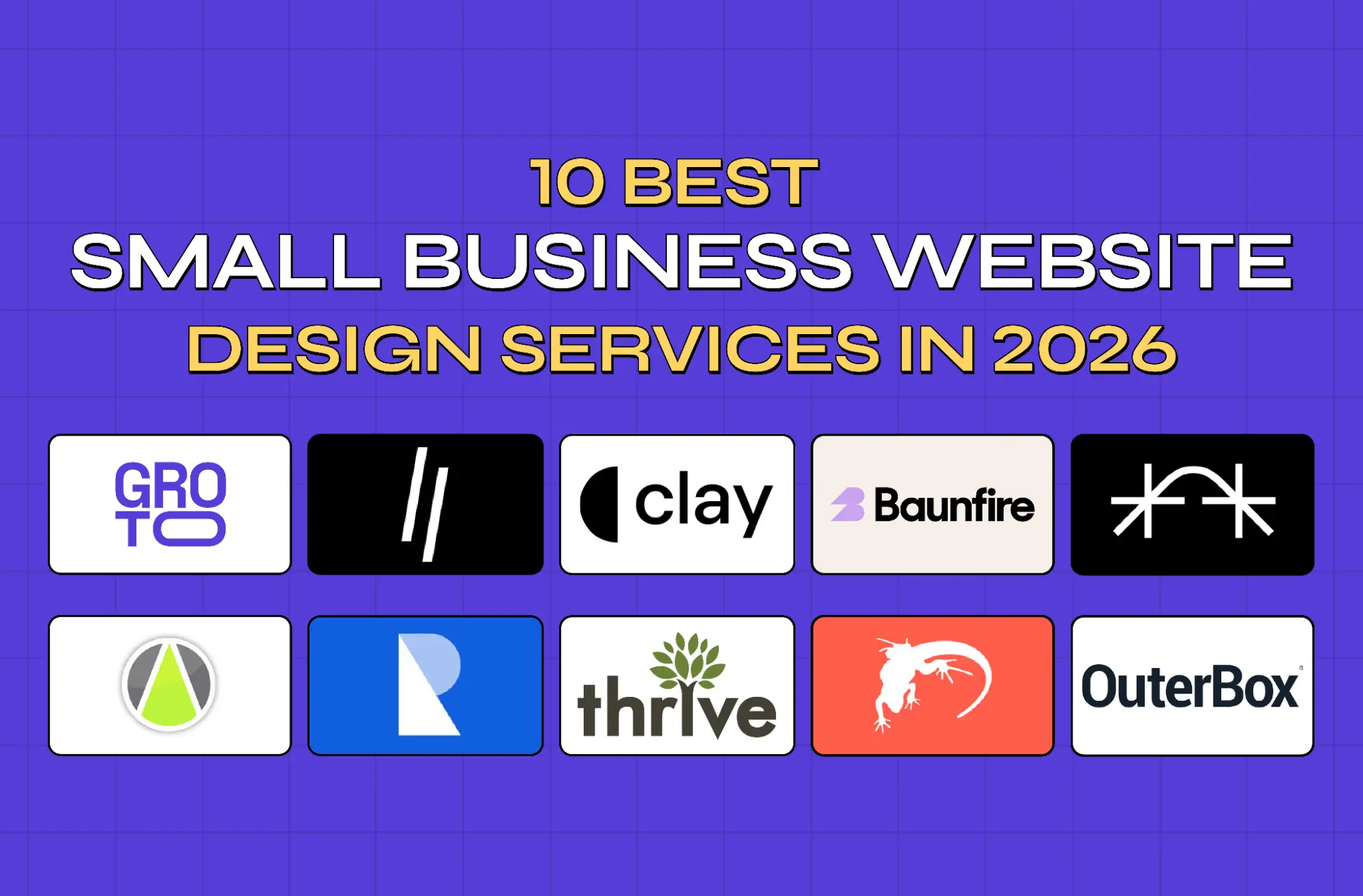
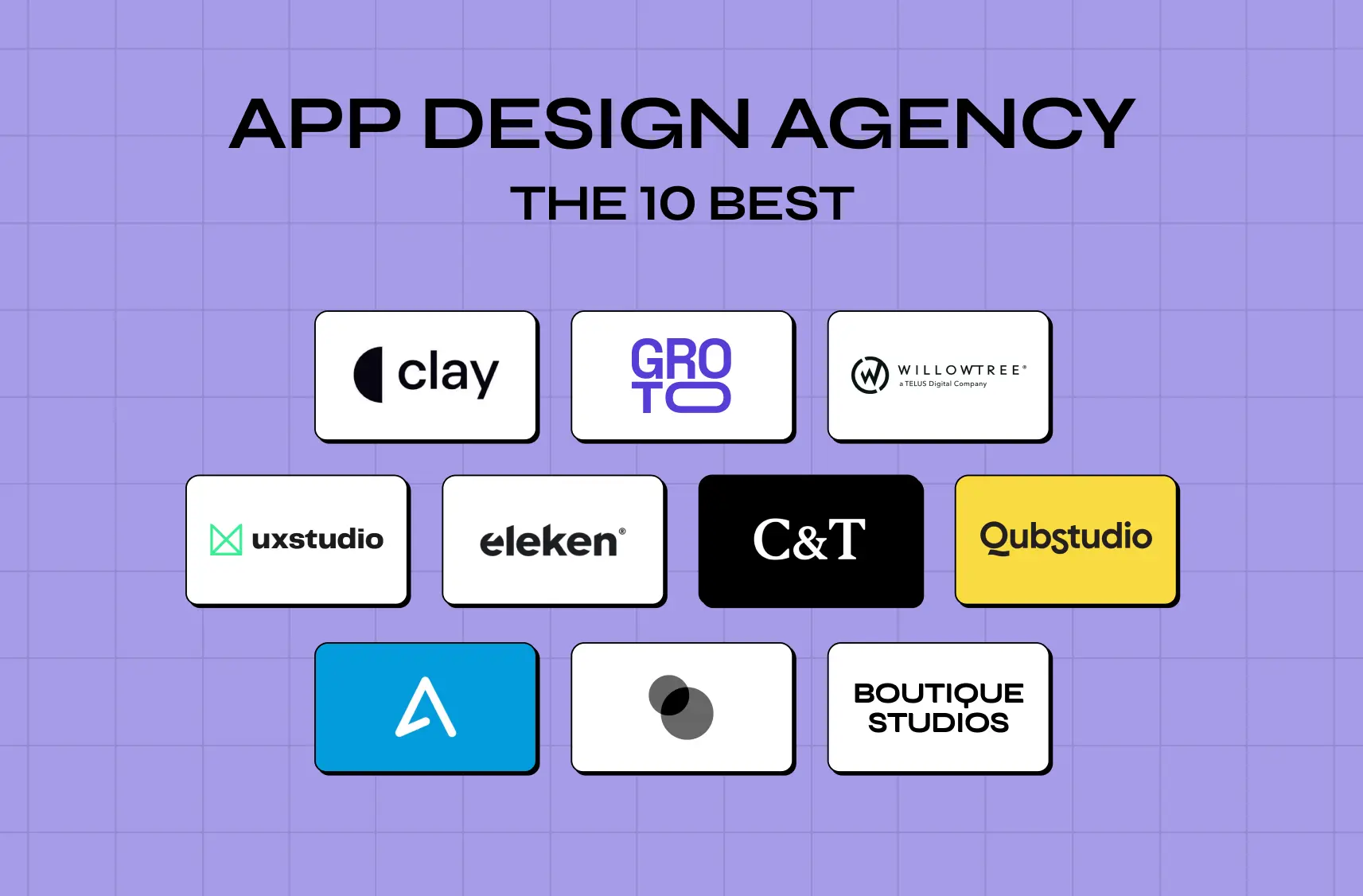
Our shortlist of 10 agencies for 2026 covers everything from premium enterprise studios to SaaS-focused subscription partners to boutique freelance collectives, with verified pricing and clients for each.
Match the agency to your stage: research-led product partners for startups and SaaS, large full-service firms for complex enterprise builds, and boutique or subscription models for narrower budgets.
An app design agency turns a product idea into an app people actually use, blending research, UX strategy, and UI craft into a single engagement. If your product is specifically a SaaS mobile app, a mobile app UX design agency is the narrower specialism worth understanding first. Working with the right partner is often the difference between an app that gets adopted and one that gets deleted within a week. This guide breaks down what such an agency does, what it costs, and how to choose one you can trust with your product before you sign anything.
A beautiful app that people can't figure out is just an expensive way to lose users. On mobile especially, attention is brutal, and what counts as "effortless" shifts fast enough that the current mobile app UI UX trends are worth a skim before you brief anyone. If your app confuses or frustrates someone in the first minute, they delete it and move on, and you rarely get a second chance. That's why choosing the right app design agency is one of the highest-stakes decisions in building a product: the partner you pick shapes whether your app feels effortless and gets used, or polished but abandoned.
This guide cuts through the noise. We'll cover what an app design agency actually does, the criteria that separate a great one from an expensive one, an honest shortlist of the best app design agencies for 2026 with what each is good for, real pricing, and a simple framework for choosing. Whether you're a founder building your first app or a product team planning a redesign, here's how to find a partner that designs an app people actually love to use.
What does an app design agency do?
An app design agency designs the user experience (UX) and user interface (UI) of mobile and web applications, turning an idea into an intuitive, attractive, usable product. That's more than making screens look good. A strong agency:
Does user research to understand who you're building for
Maps user flows
Creates wireframes and interactive prototypes
Designs the visual interface and interactions across screen sizes, following mobile first design best practices.
Builds a design system for consistency
Tests designs with real users
Hands off clean specs to developers through a defined design handoff process (some also handle development end to end).
In short, they own how your app works and feels, not just how it looks. If you want the full breakdown of roles and deliverables, what a UI UX agency does covers the standard scope in detail. That's exactly what determines whether people keep using it.
Why good app design matters
It's worth being clear on the stakes, because they justify the investment. On mobile, users decide almost instantly whether an app is worth their time, and the market is unforgiving. A confusing onboarding, a cluttered screen, or a flow with one too many steps doesn't just annoy people; it drives them to abandon and delete, and getting a churned user back is far harder than keeping them. For AI-native products the bar is higher still, which is why AI onboarding UX has become the most requested first deliverable. Great app design is what earns those crucial first minutes: it makes the value obvious, the next action clear, and the whole experience feel effortless enough that people stick around and come back.
The flip side is the cost of getting it wrong, and it's usually paid twice. A poorly designed app burns your acquisition spend on users who bounce, then costs again when you have to redesign and re-launch to fix it. Investing in strong design up front is almost always cheaper than repairing a weak app after it's failed to retain users. That's the real reason the choice of app design agency matters so much: it's not about aesthetics, it's about whether your app survives contact with real users.
What makes a great app design agency
Before the list, the lens. The best app design agencies share a few traits worth screening for:
Research-led: they test designs with real users rather than just making things pretty
Relevant niche experience: an agency that has designed in your space already understands your users, regulations, and common pitfalls, so it moves faster. In regulated categories this matters most, which is why fintech UX design agencies are usually shortlisted separately.
Strong problem-solvers: the real signal is how they approach problems and the specific challenges they've already solved, not how they describe themselves. Banking app design, for instance, carries constraints a generic portfolio will never reveal.
Design systems built for consistency and scale
Transparent about process, pricing, and what's included
Every agency below is framed against these signals rather than logo count. For a sense of where the bar sits, best app designs shows what the output looks like when all of them are present.
The 10 best app design agencies for 2026
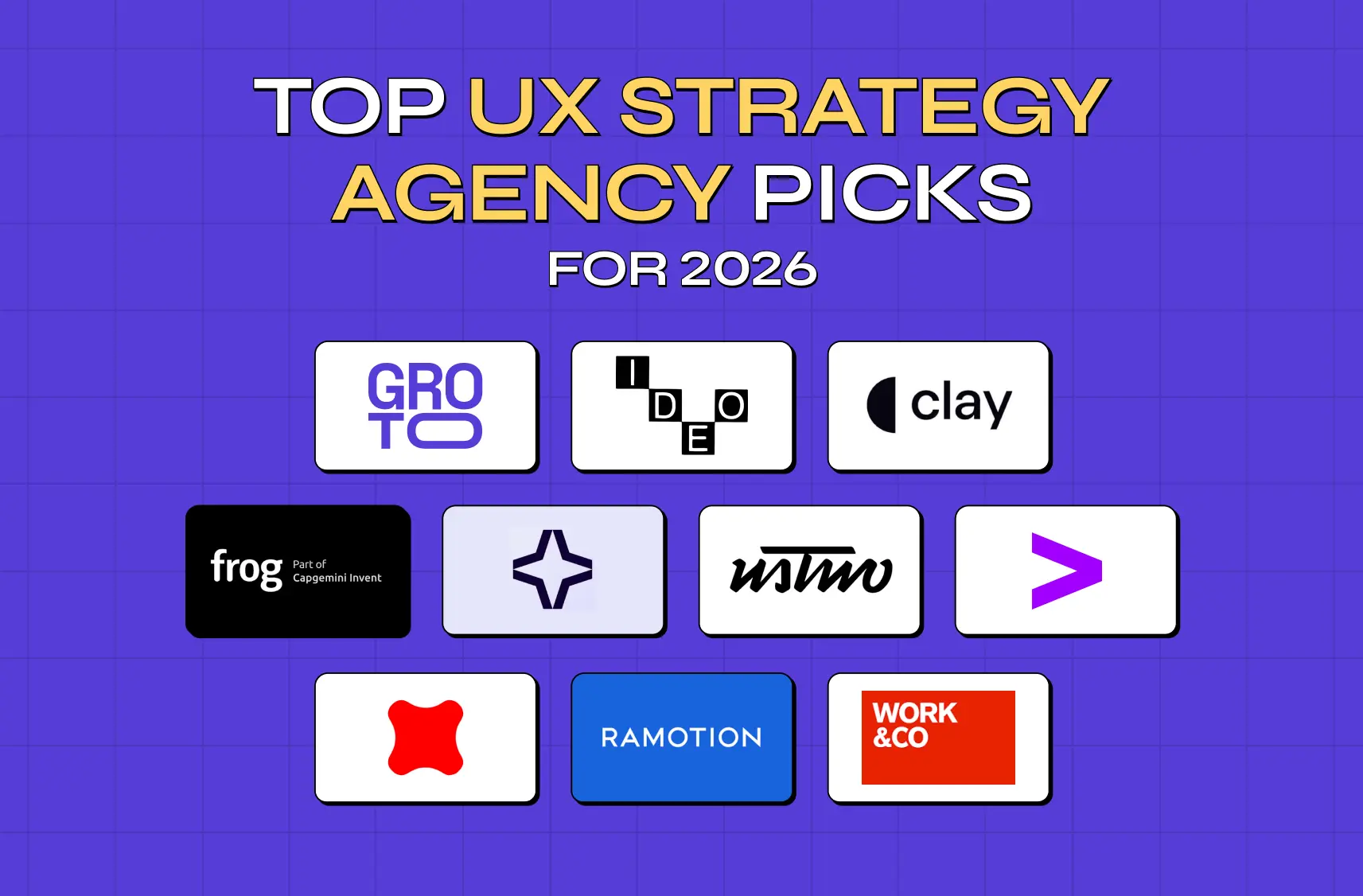
Pricing and client references below are current as of 2026 and drawn from each agency's public Clutch profile and site. Always confirm directly with the agency, since rates and minimums shift. For partners working beyond app work specifically, our top product design agencies roundup covers a wider field.
1. Clay : best for premium enterprise app experiences
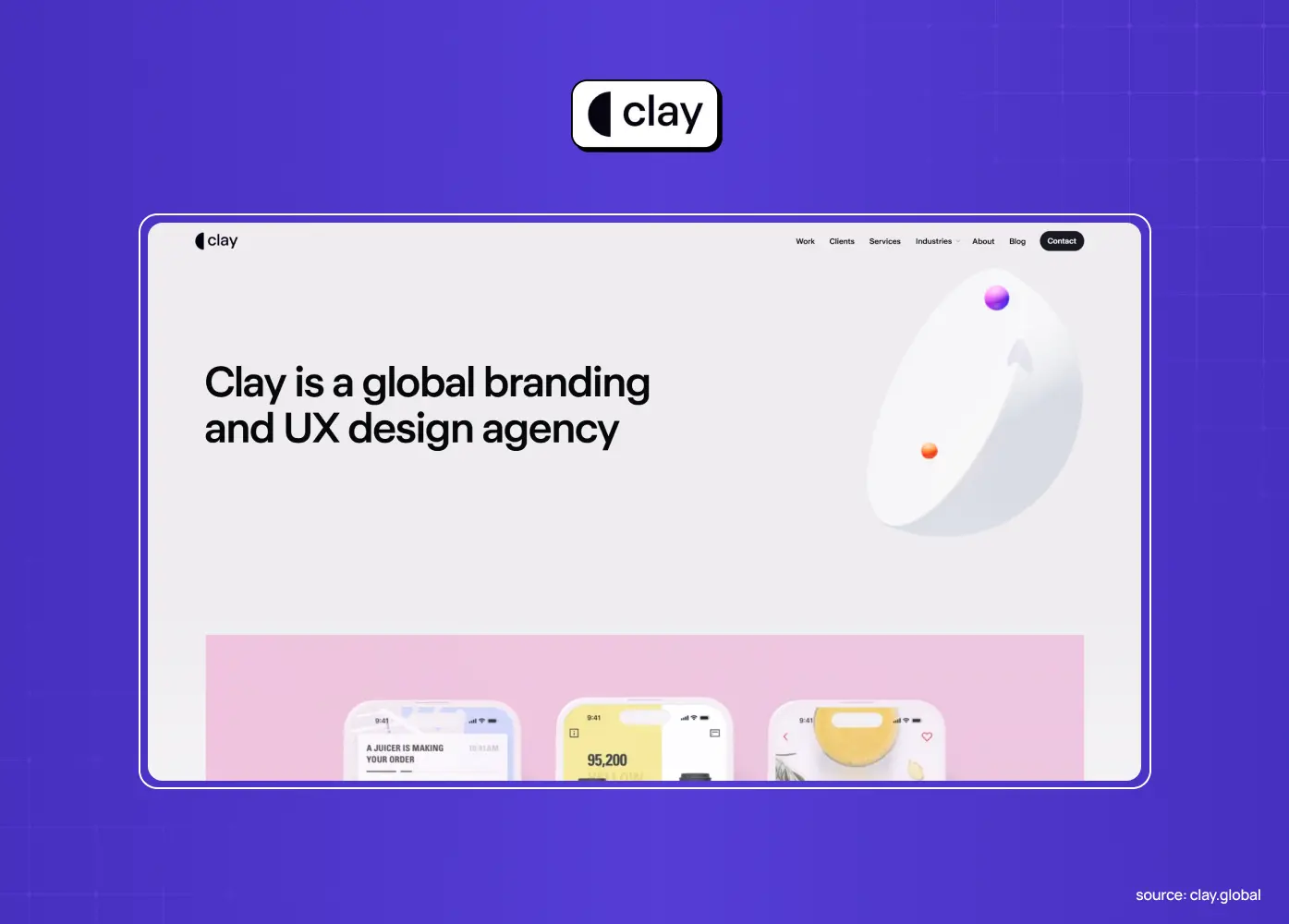
Clay is a San Francisco digital design agency known for sharp, smooth mobile app experiences, helping enterprise and tech teams simplify complex products with thoughtful UX. Premium craft at a premium price. Best for: well-funded enterprise and tech teams wanting top-tier polish.
Location: San Francisco, CA
Pricing: $150–199/hr, $50,000+ minimum project
Clutch rating: 4.8
Clay pairs interface design with brand identity in one team, a combination most product-only studios don't carry. Its client roster includes Facebook, Google, Slack, Coinbase, Stripe, and Amazon, and its work is consistently cited as a visual benchmark for modern SaaS product design. Engagements are project-based rather than subscription, so there's no monthly flexibility or trial period; you're committing to a defined scope upfront.
Strongest for:
Growth-stage and enterprise teams where brand and product experience need to be designed as one cohesive system
Teams with a $50,000+ budget prioritizing visual craft and strategic depth over speed or flexibility
2. Groto : best for SaaS & startup apps
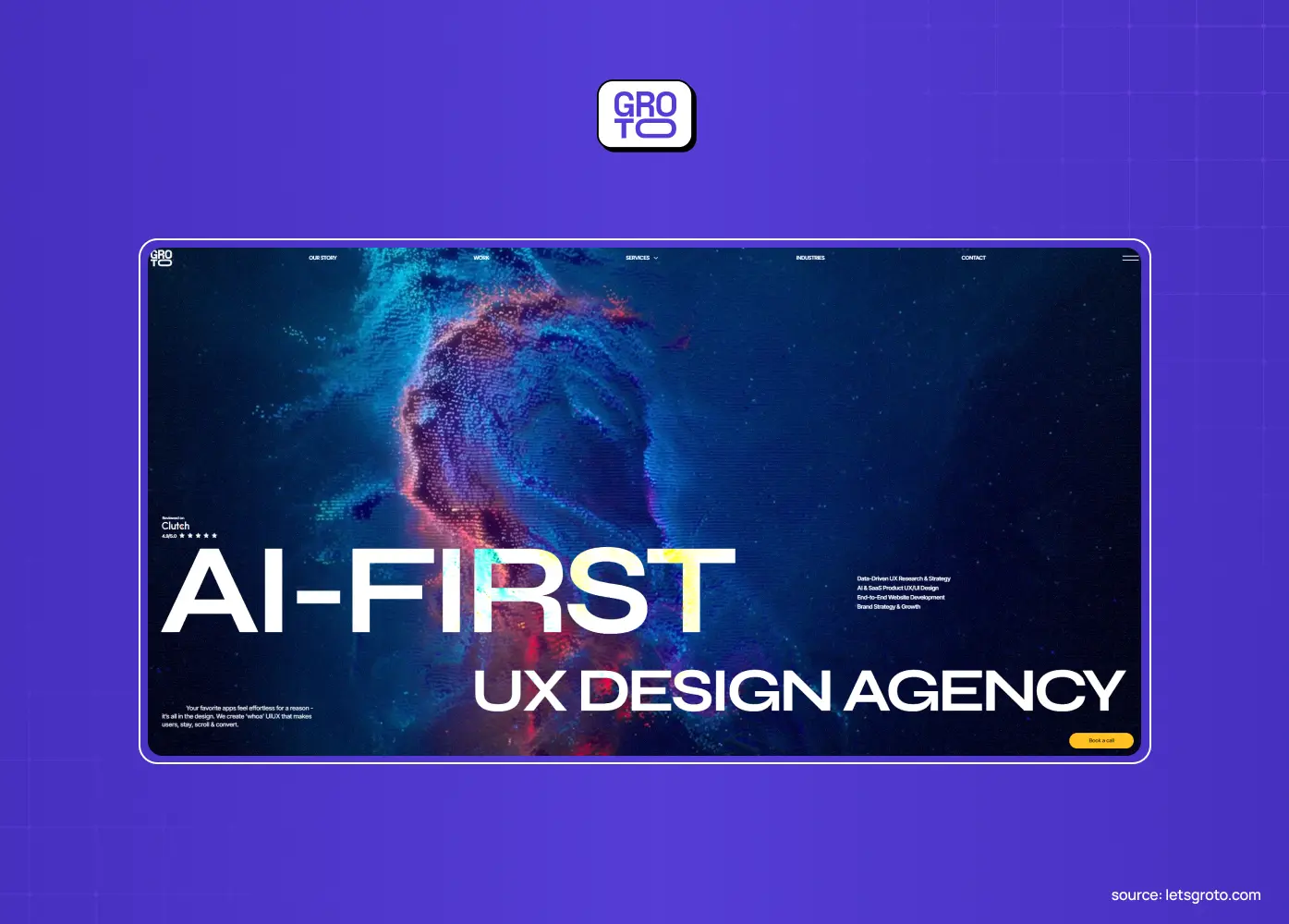
Groto is our top pick for SaaS and startup apps because it ties app design decisions to product outcomes. Groto is a product and UX design partner built for SaaS companies and startups, pairing user research and data with high-craft mobile and web UI so the app you ship is validated, usable, and built to retain. It separates discovery from execution (so you never pay for polish before the problem is understood) and blends senior human strategy with AI-accelerated production for speed without cutting corners. Best for: SaaS and startup apps, MVPs, and teams that want measurable results, not just screens.
Location: US-based, with teams in San Francisco, Seattle, and New York
Pricing: Subscription model, Starter at $2,399/month, Part-Time at $4,399/month, Full-Time at $5,999/month, with a no-code development add-on at $799/month
Clutch Rating: 4.9/5
Unlike most agencies on this list, Groto runs on a subscription rather than a fixed-scope project. You get a dedicated designer with a project manager included on every plan, so the designer's time stays focused on design rather than status updates and scope wrangling. A UX strategist is included on Part-Time and above, connecting design decisions to product KPIs like activation, trial conversion, and retention rather than just shipping screens. A 7-day free trial, more than twice the industry-standard 3-day window, includes one real deliverable so you can evaluate the work before committing.
Strongest for:
SaaS and startup teams that want ongoing design capacity without the overhead of a full-time hire
Teams building AI-native products specifically, since Groto has shipped copilots, AI chat interfaces, and explainable AI dashboards from scratch
3. WillowTree : best for large-scale, full-service app builds
WillowTree is a well-known agency delivering end-to-end mobile app design and development for major brands, with the scale to handle complex, high-profile products. Best for: enterprises needing design and development at scale.
Location: Charlottesville, VA (now part of TELUS Digital)
Pricing: Enterprise-scale, quoted per engagement
Notable clients: T-Mobile, Marriott, Domino's, PepsiCo, Synchrony Financial
Founded in 2007, WillowTree has shipped 300+ mobile and digital products, bridging consumer-grade UX with enterprise-grade security and compliance requirements. Its acquisition by TELUS Digital gave it a larger bench of mobile strategists, UX designers, and engineers, useful for programs that need multiple workstreams running in parallel rather than a single small team.
Strongest for:
Enterprises that want app design and development handled by one accountable team at scale
Programs where dedicated mobile strategy and UX research need to sit alongside engineering from day one
4. UX Studio : best research-driven app partner
UX Studio offers specialized mobile and web app design with a research-driven process and a focus on scalable design systems. A strong fit for teams that want depth of research embedded in the work. Best for: teams prioritizing research and scalable systems.
Location: Budapest, Hungary, serving US and global clients remotely
Pricing: $50–99/hr, $10,000+ minimum
Clutch rating: 4.8
Notable clients: Netflix, Microsoft, IKEA, BMW
UX Studio's 40-person team works on product design exclusively, no branding, no development, which keeps the focus narrow and deep. Clutch reviewers consistently highlight the team's ability to back design decisions with actual research rather than opinion, and its embedded-team model suits ongoing collaboration on products with multiple user roles.
Strongest for:
Products with several distinct user types or complex, evolving workflows where getting the research right matters more than moving fast
Teams that already have their own development resources, since UX Studio is design-only
5. Eleken : best value for SaaS startups
Eleken is a SaaS-focused UI/UX agency that's cost-effective for startups, offering a subscription-style model for ongoing product design work. Best for: startups wanting quality SaaS design on a leaner budget.
Location: Kyiv, Ukraine, remote-first
Pricing: Subscription from approximately $3,800/month
Clutch rating: 4.9 (120+ reviews)
Notable clients: TextMagic, Gamaya, TenderX
Eleken runs a subscription model similar to Groto's: a dedicated SaaS-experienced designer working full-time on your product. The key difference is structure. Eleken gives you direct, unfiltered designer access with no project manager layer in between, which some teams prefer and others find means more of the coordination work falls on them. A 3-day free trial lets you test the collaboration before committing, and the agency has shipped work across 200+ SaaS products.
Strongest for:
SaaS teams with strong internal PM coverage who want direct designer access without an added layer
Teams whose budget sits below Clay or WillowTree's project minimums but who still want ongoing, dedicated support
6. Y Media Labs : best for innovative enterprise apps
Y Media Labs is a global agency for enterprise apps, known for integrating emerging tech (AI, AR/VR) and strong e-commerce experiences. Best for: enterprises wanting cutting-edge, innovative app experiences.
Location: Silicon Valley (Redwood City, CA), with additional US offices
Pricing: Project-based, roughly 40,000–250,000+ depending on platform and complexity
Notable clients: The Home Depot, PayPal, eBay, Apple, The North Face
Founded in 2009 as Y Media Labs and now operating as YML (part of Code and Theory), the agency built its reputation on integrating emerging technology into consumer-facing enterprise apps, work that's been recognized by Ad Age and covered by TechCrunch and Forbes. Its design-led approach spans product strategy, experience design, and development.
Strongest for:
Enterprises wanting innovation-forward app design that pulls in AI, AR/VR, or other emerging tech
Consumer-facing apps at Fortune 500 scale where design needs to drive measurable engagement, not just look modern
7. Qubstudio : best for UX audits and flow optimization
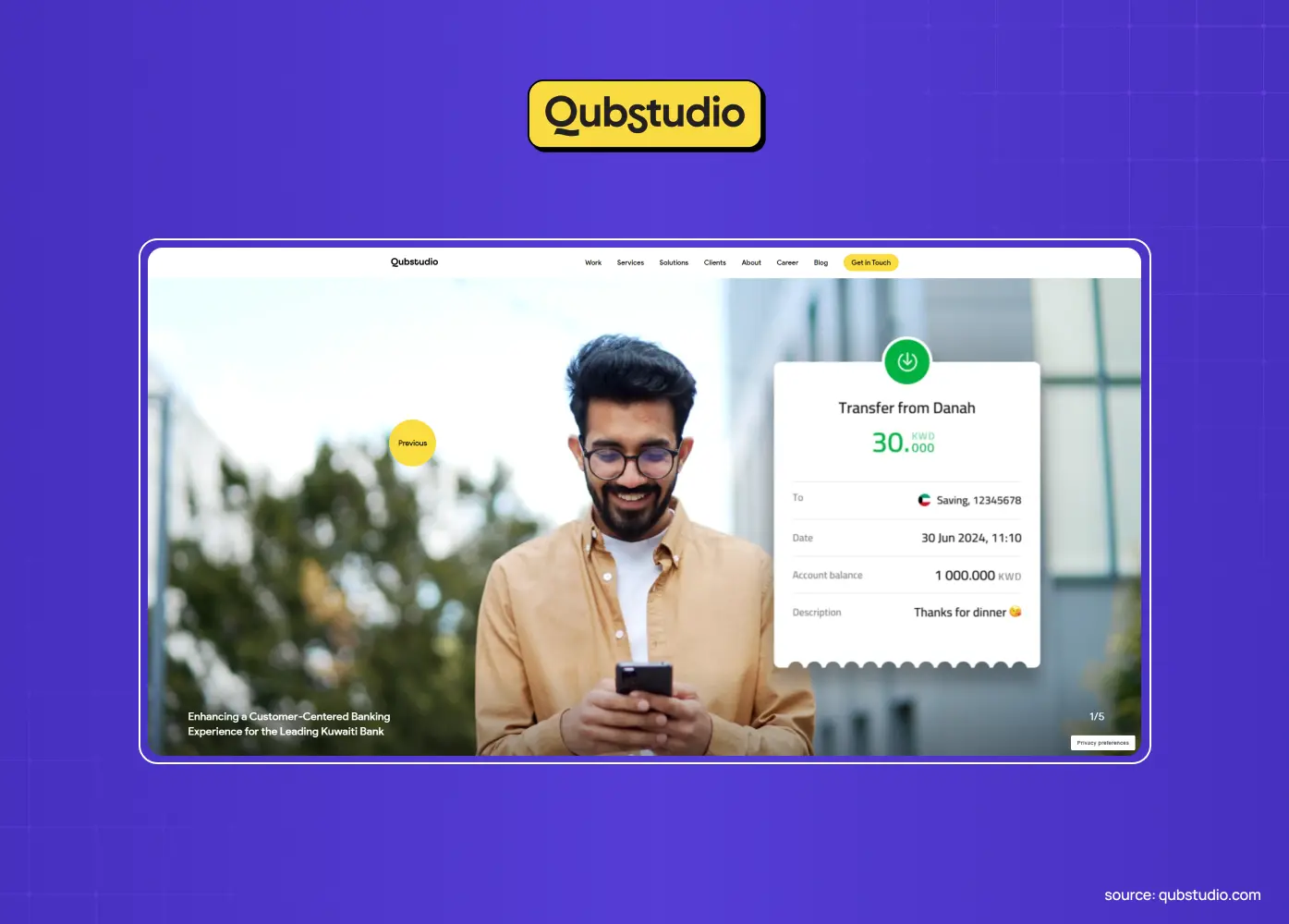
Qubstudio identifies friction points in user flows and redesigns them for smoother navigation, builds unified design systems, and offers ongoing UI/UX support. Best for: improving and optimizing an existing app's UX.
Location: Global, distributed team, founded 2007
Pricing: $50–99/hr, $10,000+ minimum
Recognition: Clutch Top-5 UX Design Agency since 2017, Net Promoter Score of +97, Red Dot Design Award
Qubstudio's model is built around diagnosis before redesign. Rather than starting from a blank screen, its process is oriented toward existing products in fintech, healthcare, logistics, and EdTech that need a UX audit before deciding what to rebuild. Clients consistently praise its collaborative process and its ability to translate audit findings into shipped improvements rather than a report that sits unused.
Strongest for:
Teams with an existing, live app that's underperforming and need a structured audit before committing to a redesign
Regulated or data-intensive products (fintech, healthcare) where the fix needs to be diagnosed carefully first
8. Appinventiv : best for end-to-end design and development
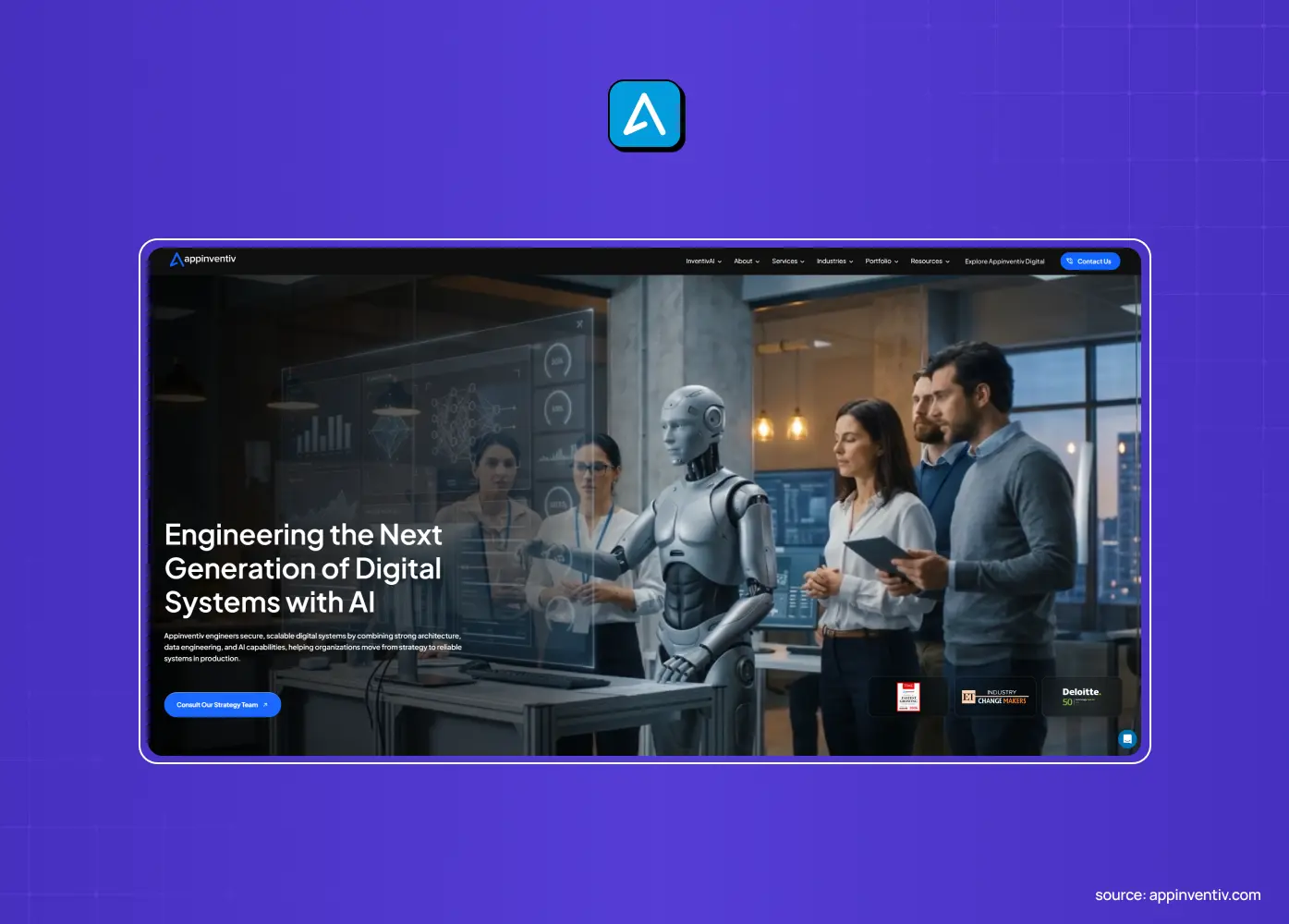
Appinventiv offers app design alongside full development, at accessible rates, making it a fit for teams that want one partner from design through build. Best for: design-plus-development under one roof on a moderate budget.
Location: Offices in the US, UK, UAE, and India
Pricing: Project-based, roughly 10,000–300,000+ depending on scope
Notable clients: American Express, Adidas, IKEA, KPMG
With a team of 1,600+ engineers and designers, Appinventiv positions itself as a full-cycle mobile app development company rather than a design-only studio, handling everything from UX/UI through native and cross-platform development, QA, and DevOps. That scale makes it one of the more accessible full-service options on this list relative to firms like WillowTree or Clay.
Strongest for:
Teams that want a single vendor accountable for design through launch, without coordinating separate design and development partners
Mid-market and growth-stage companies that need enterprise-grade delivery at a more moderate price point
9. Fuselab Creative : best for polished mid-market app UI/UX
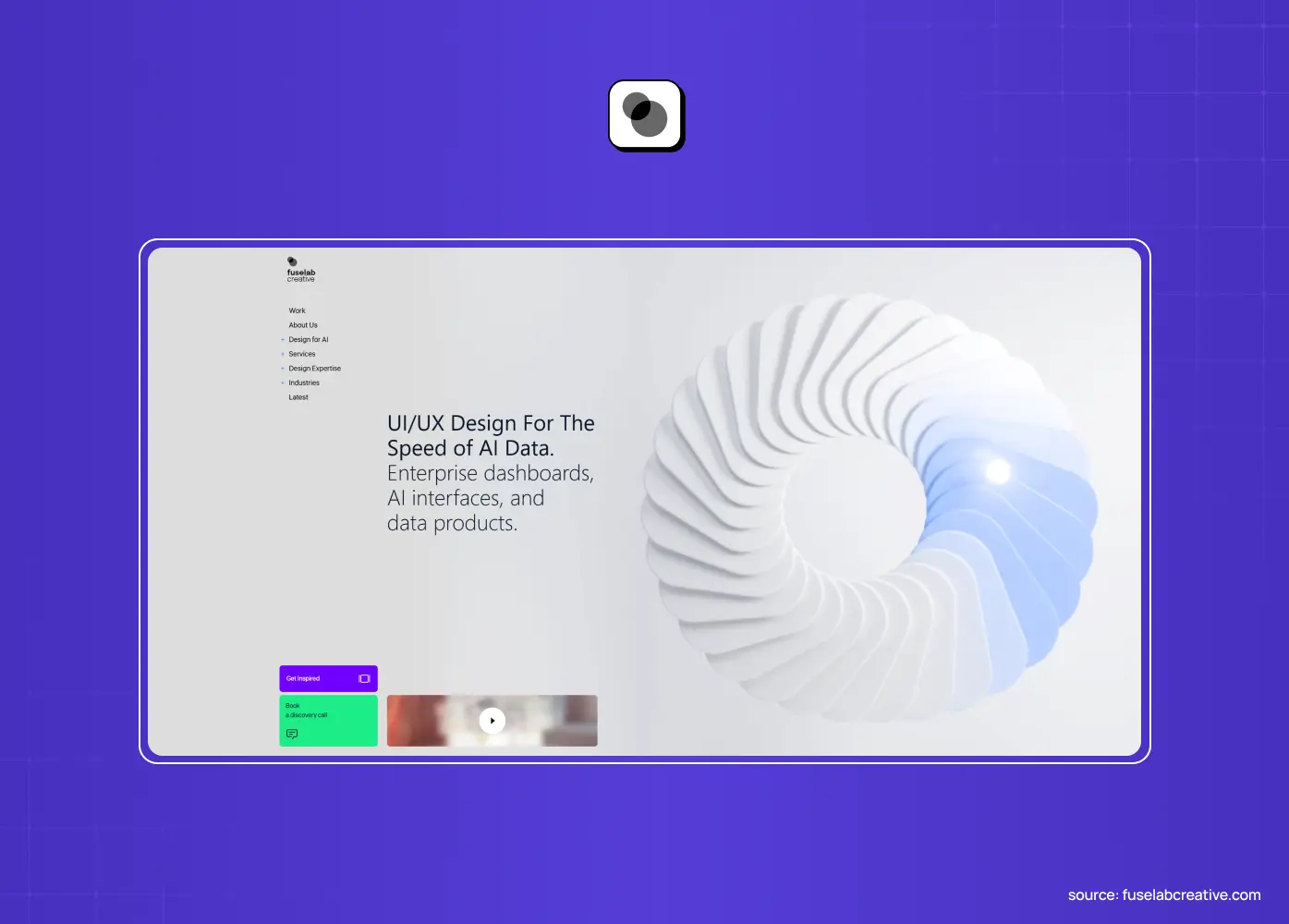
Fuselab is a UX/UI-focused studio delivering clean, modern app design for mid-market clients and startups. Best for: businesses wanting strong UI craft without enterprise pricing.
Location: McLean, VA
Pricing: $100–149/hr, $25,000 minimum
Clutch rating: 5.0
Notable clients: NASA, Fiserv, Uber, NIH, California's DHCS
Founded in 2017, Fuselab has built a specialty in translating dense, data-heavy environments (dashboards, BI systems, AI-driven workflows) into usable interfaces, and its GSA Schedule contract lets government agencies engage it at pre-negotiated rates without a full competitive bid. That regulated-industry depth carries over well to mid-market clients with their own data-heavy or compliance-sensitive products.
Strongest for:
Mid-market businesses wanting strong UI craft and dashboard or data-heavy design without enterprise-level pricing
Products in regulated or data-dense spaces (healthcare, government, fintech) where compliance shapes the design
10. A boutique studio or senior freelance collective
Finally, plenty of boutique studios and senior freelancers take on focused app work: a single flow, a design system, or an MVP. Excellent value for narrow scopes, with capacity and continuity as the trade-offs. Best for: well-defined, limited-scope app projects.
Where Groto fits in
If you're a SaaS company or startup weighing this list, here's the honest pitch. The US-focused best UX agencies for SaaS roundup covers more options if you want to compare us against a wider field first. Groto is built specifically for teams that need design decisions tied to product outcomes, not just polished screens. We separate discovery from execution so you're never paying for visual polish before the underlying problem is actually understood, and we pair senior human strategy with AI-accelerated production so speed doesn't come at the cost of craft. A dedicated project manager and, on Part-Time plans and above, a UX strategist come standard, so the work stays connected to your product goals rather than becoming a queue of disconnected design tickets. If your priority is an app that's validated, usable, and built to retain users rather than one that just looks good in a portfolio, that's the specific gap we're built to fill. Start with the 7-day trial if you want to see the work before committing to anything.
How much does app design cost? (2026)
Pricing is the question every founder asks. Here's the honest range for the app design market in 2026, and our fuller agency pricing breakdown if you want the reasoning behind each tier.
Engagement | Typical cost (2026) |
Hourly agency rate | $40 to $200 / hour |
MVP or focused app design | $10,000 to $40,000 |
Full app UI/UX (design only) | $30,000 to $80,000 |
End-to-end (design + development) | $80,000 to $250,000+ |
Premium / enterprise agency (minimum) | $50,000+ |
Hourly rates span widely by agency and location:
$40 to $80/hour at accessible shops
$60 to $120/hour at mid-tier agencies
$130 to $200+/hour at premium firms
What moves the number is scope (design only vs. design plus development), app complexity, the number of platforms (iOS, Android, web), research depth, and the agency's seniority. Most first engagements are scoped as MVP UX design, which is where the lower end of that range sits. If an agency quotes a firm price before understanding your scope, treat that as a flag. (All figures directional for 2026; confirm quotes.)
Agency vs. freelancer vs. in-house: which is right?
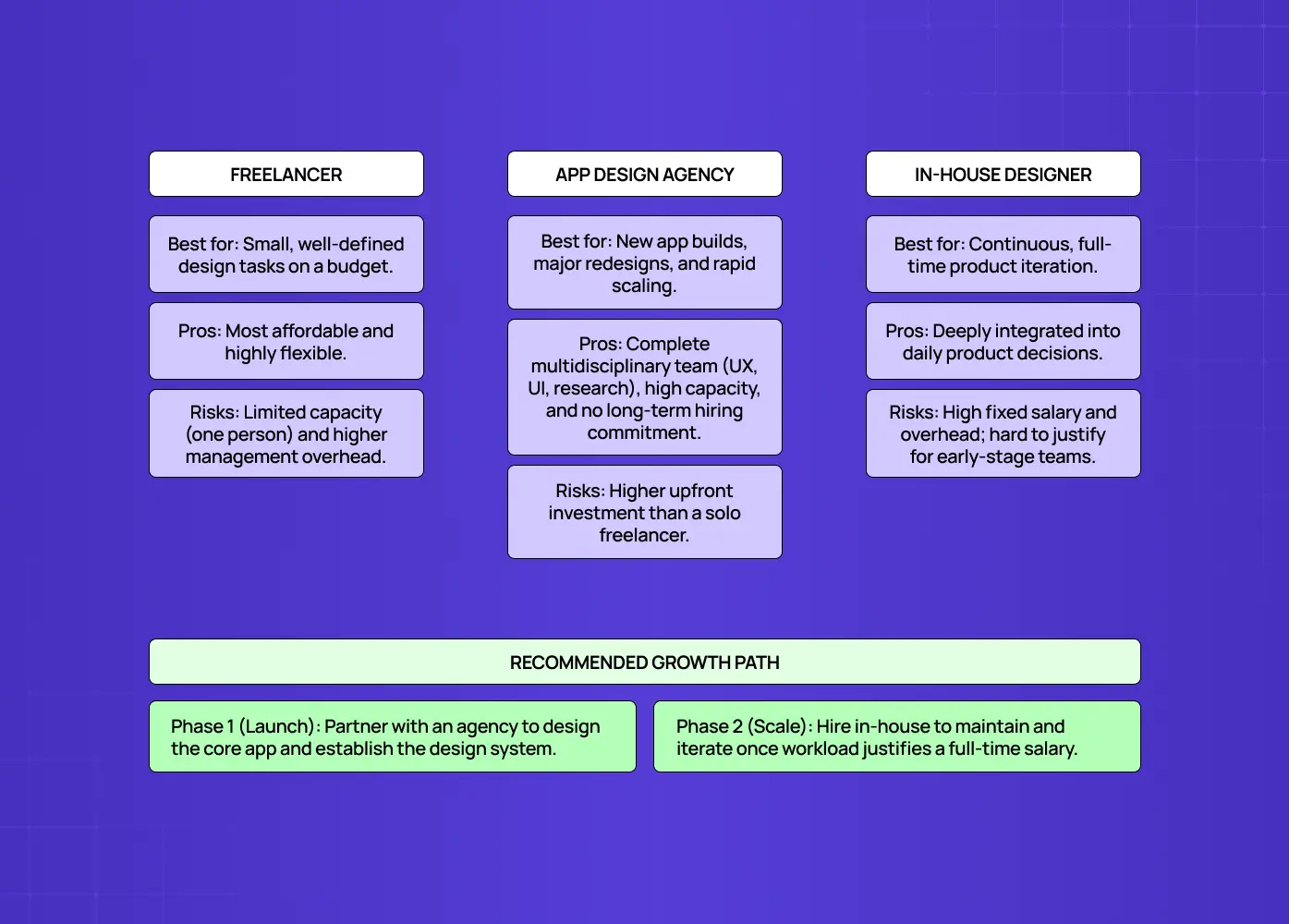
Before committing to an agency at all, it's worth knowing your alternatives.
Freelancer: often the most affordable option, and can be great for a small, well-defined piece of app design. Capacity is limited to one person, and you take on more project management and risk if they're unavailable.
In-house designer: makes sense once you have continuous, full-time app design work to justify a salary, and you want design embedded in daily product decisions. It's a big fixed cost most early-stage teams can't yet justify, and agency vs in-house designer runs the full cost and control comparison.
App design agency: gives you a full team (research, UX, UI, sometimes development) with breadth, capacity, and accountability, ideal for building or substantially redesigning an app without a permanent hire.
For most founders and product teams, the agency route hits the sweet spot: professional, multidisciplinary design without the overhead of hiring, and the flexibility to scale the engagement up or down. Early-stage teams should look specifically at a UX design agency for startups, since pricing structures and process differ meaningfully at that stage. A common and effective path is to use an agency to design and launch the app (and establish the design system), then bring design in-house later to maintain and extend it once the volume of work justifies it. Match the choice to your stage and the amount of ongoing design work you realistically have.
How to choose the right app design agency
With the shortlist in hand, match the agency to your situation. Our full agency selection checklist covers the non-obvious screens if you want to go deeper than the four cases below:
Startup or SaaS team needing measurable product outcomes at speed: prioritize research-led, product-focused partners (like Groto) over big brand shops, and scan the wider list of UX design companies for SaaS for more options.
Enterprise with a complex, high-stakes app: the scale of firms like WillowTree, Clay, or Y Media Labs may justify the premium, and enterprise UX design agencies covers what else to weigh at that tier.
Narrow or budget-limited need: a value-focused agency, subscription model, or boutique can deliver strong work for less
Want design and development together: choose a full-service partner
Above all, judge agencies on how they solve problems and what they've already shipped, not how they describe themselves. The portfolio of solved problems is the real signal.
Questions to ask an app design agency before you hire
Use these on your first call:
Ask about their process and where research and user testing fit (beware anyone who jumps straight to visuals)
Ask for relevant work in your space, and outcomes, not just screenshots. Knowing how to evaluate a portfolio properly is what separates a useful review from a nice-looking one.
Ask who will actually work on your project, not just who pitches it
Ask whether they design only or also develop, and how handoff works
Ask about design systems and how they keep the app consistent and scalable
Ask about timeline, communication, and total cost: what's included and what's extra. Knowing what a strong design proposal contains makes the differences between quotes far easier to spot.
Ask how they measure success
Clear, specific answers separate a genuine product partner from a vendor who'll hand you pretty screens and disappear. Pair these with the skills an agency must have in 2026 and you have a complete screen.
Red flags to watch for
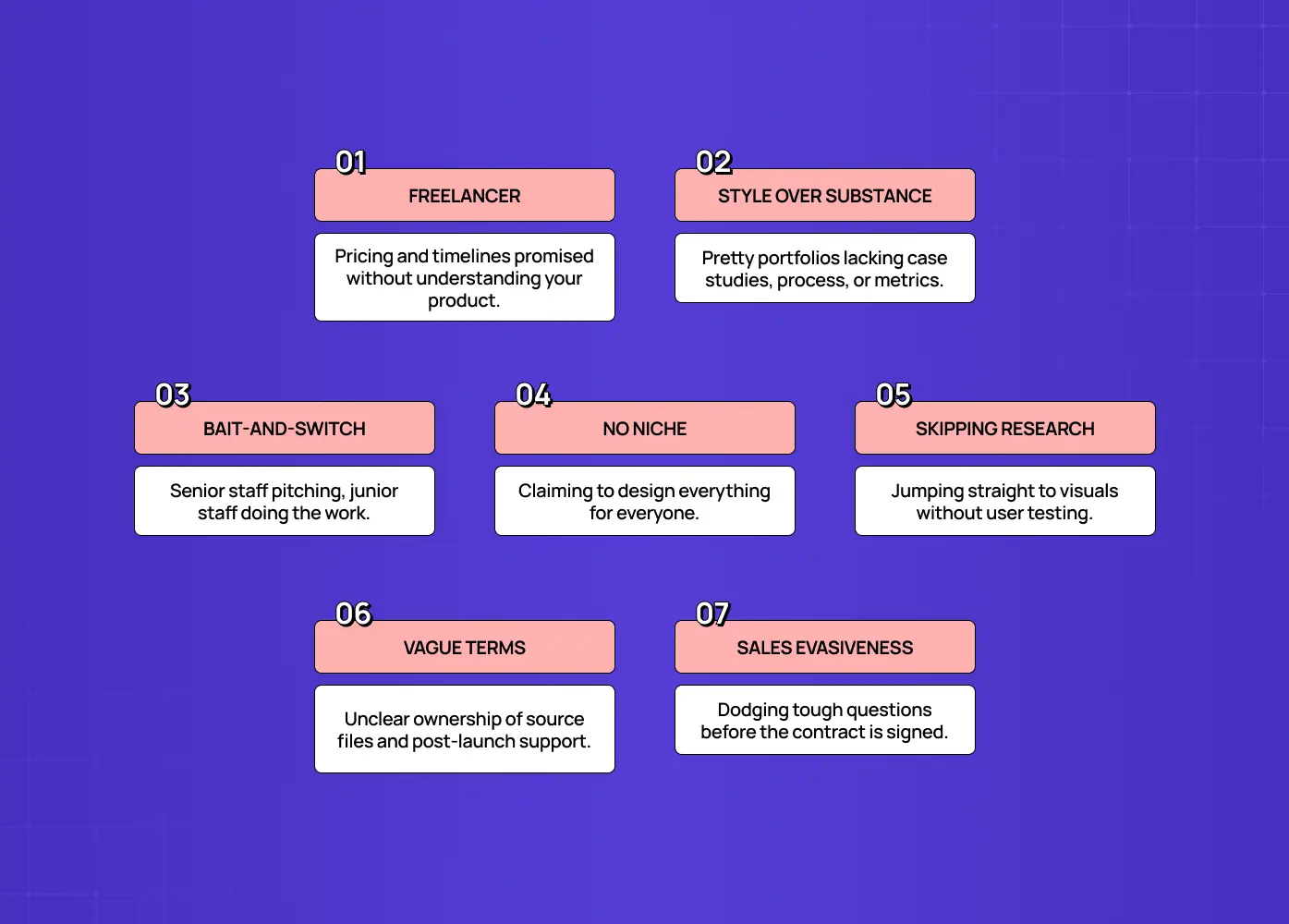
Not every polished pitch hides a good partner. A few warning signs should give you pause:
An agency that quotes a fixed price and timeline before understanding your app; real scoping requires understanding your users and goals first
A portfolio of pretty screenshots with no outcomes, process, or references; craft without results is decoration
They can't tell you who will actually design your app (the seniors who pitch aren't always the ones who do the work)
"We design everything for everyone"; the best agencies have a clear focus and ideal client
Anyone who skips research and user testing, jumping straight to visuals; on mobile especially, untested design is a gamble
Vague answers about ownership, source files, or what happens after launch
A great app design partner will ask sharp questions about your users, push back on assumptions, and show exactly how they've solved problems like yours before. If straight answers are hard to get during the sales process, they won't get easier after you've signed.
Conclusion
The best app design agency for you isn't the one with the flashiest reel or the top spot in a pay-to-play directory. It's the one whose process, niche experience, and problem-solving map to your app and stage.
Screen for research-led design, relevant experience, and a track record of solved problems.
Get real pricing up front.
Match the engagement (design-only vs. end-to-end, project vs. ongoing) to your needs.
Do that, and you'll get an app people find effortless: the kind they keep, use, and recommend.
If you're building a mobile or web app and want a partner that ties design to real product outcomes, with startup speed and senior craft, book a discovery call with Groto. We'll talk through your product, your users, and whether we're the right fit. No pressure, no jargon.