The shift from UX to AX isn't just a naming change — it's a fundamental rethinking of how design teams evolve, scale, and lead in a world where AI is embedded in every experience layer.
Design maturity looks different now. Here's what AX actually means.
TL;DR
AX (Agentic Experience) is the evolution of UX: it puts human-AI collaboration at the center of design.
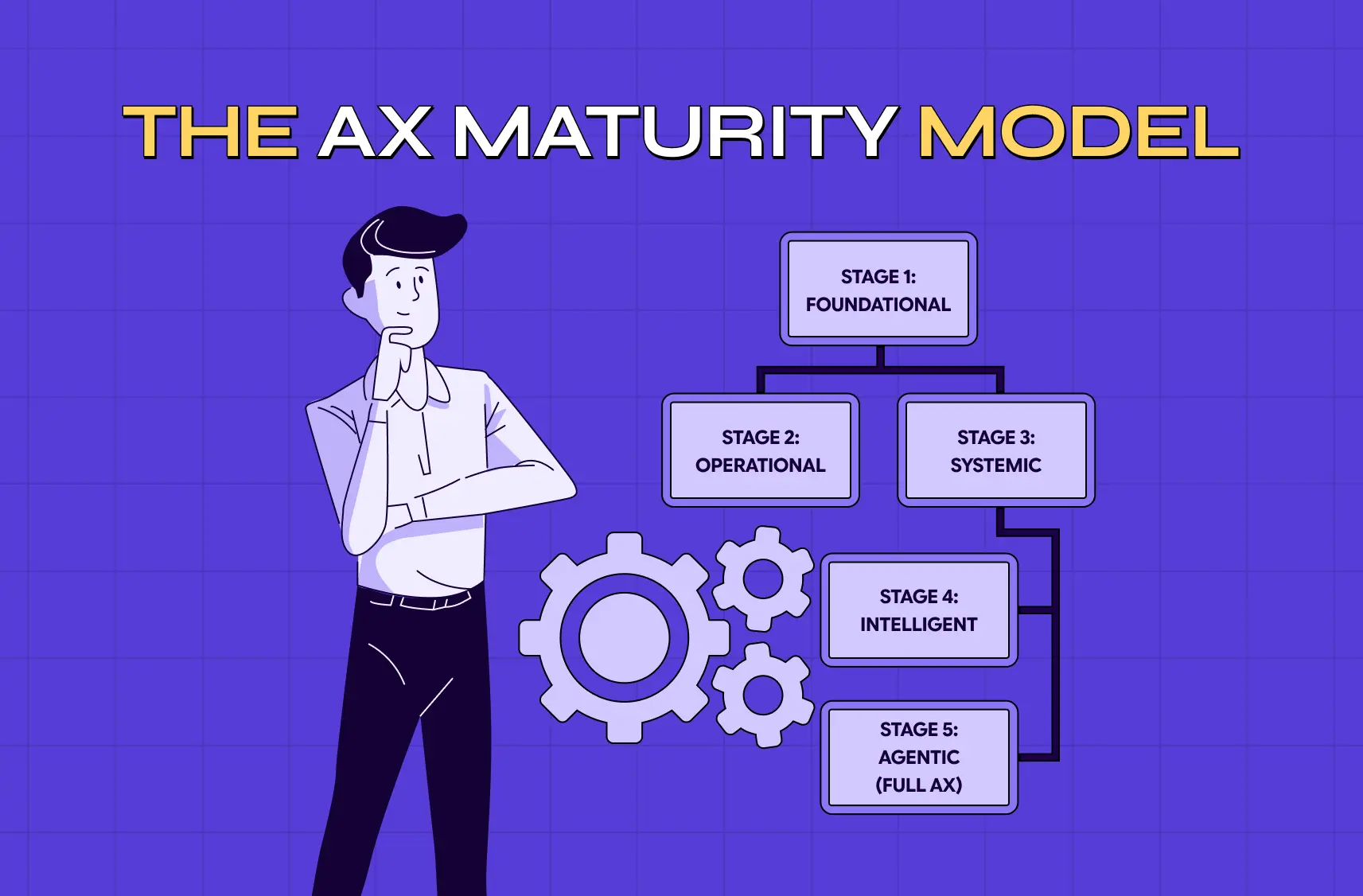
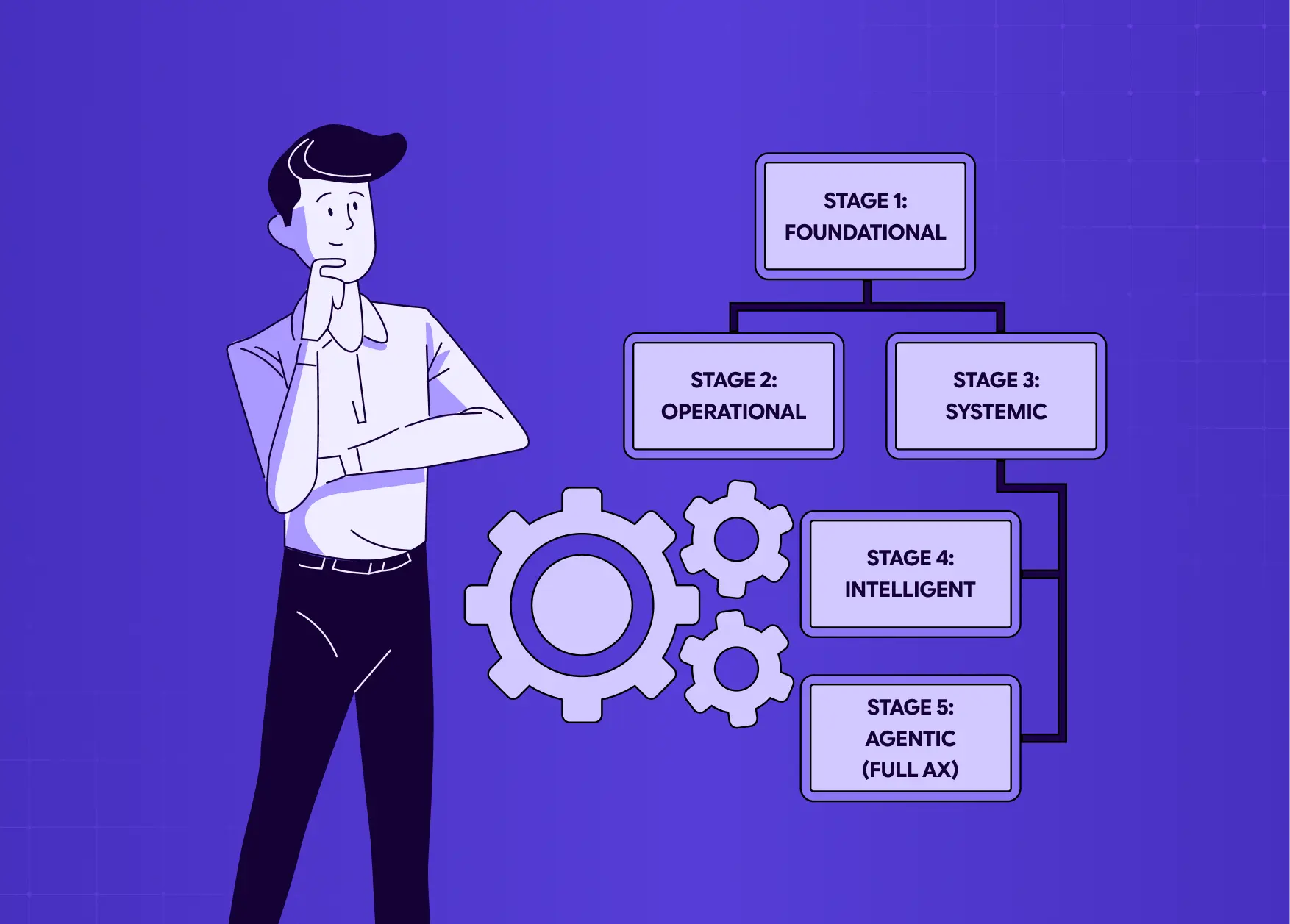
The AX maturity model maps five stages of design evolution: from ad-hoc AI use to fully orchestrated agentic systems.
Most teams are stuck at Stage 2 or 3, using AI for productivity but not yet for adaptive experience design.
Each stage has distinct signals: how your design system behaves, how AI is embedded, and how the team makes decisions.
Design-led organizations don't skip stages, they build intentionally through each one.
At Groto, we help product and design teams understand where they are and how to move forward.
While earlier industry discussions have named these five evolutionary phases, they remained abstract conceptual buckets. The Groto AX Design Maturity Model operationalizes these stages for the first time, establishing explicit diagnostic thresholds, systemic transition triggers, and clear governance criteria for product design teams building in the age of AI.
Why Design Maturity Models Need to Catch Up
For a long time, design maturity frameworks served one purpose: measuring how deeply design thinking was embedded inside an organization. The classic five-level model from Nielsen Norman Group: ranging from absent to user-driven, gave teams a shared vocabulary and a progression to aspire toward.
That model made sense when the primary question was "how central is design to our product decisions?"
The question has changed.
Today, AI is not a feature being designed into products - it is the substrate that products are increasingly built on. Research synthesis, content generation, component recommendations, accessibility audits, user flow optimization: all of these are now being touched by AI in some form. The conversation has moved fast. And the maturity models have not kept up.
This is where AX comes in.
AX, Agentic Experience is the term increasingly used to describe experiences where humans and AI systems collaborate, co-create, and co-decide. It is not simply "AI-powered UX." It describes a fundamentally different relationship between the user, the system, and the design team that built it, one that the research on what actually works in AI UX versus traditional UX for SaaS products maps concretely at the feature and metric level.
For design teams at SaaS companies and AI-native product studios, understanding where they sit on the AX maturity spectrum is now one of the most strategic questions they can ask.
According to McKinsey's 2025 State of AI report, 88% of organizations are now using AI in at least one business function, yet only 39% report any measurable EBIT impact at the enterprise level. The gap between adoption and maturity has never been wider and it is the central problem addressed by the AI-driven UX practices every business should know in 2026.
What Is the AX Maturity Model?
The AX maturity model is a staged framework that maps how design functions evolve from basic, reactive AI tool use to the deliberate orchestration of intelligent, adaptive experiences. It builds on the foundations of what AI UX design is and why it matters but applies a systems lens to how those foundations develop into capability over time.
It is not about how many AI tools your team has subscribed to. It is about how deeply AI shapes the way your team thinks, builds, and measures design outcomes.
Unlike earlier design maturity frameworks that focused on process and culture, the AX maturity model introduces a new variable: the intelligence of your design system itself. At higher levels of maturity, the system is not static - it adapts, it responds, it learns.
Five stages define the model. Each one has clear signals. Most importantly, each stage requires intentional work to move through. There are no shortcuts.
The 5 Stages of AX Design Maturity
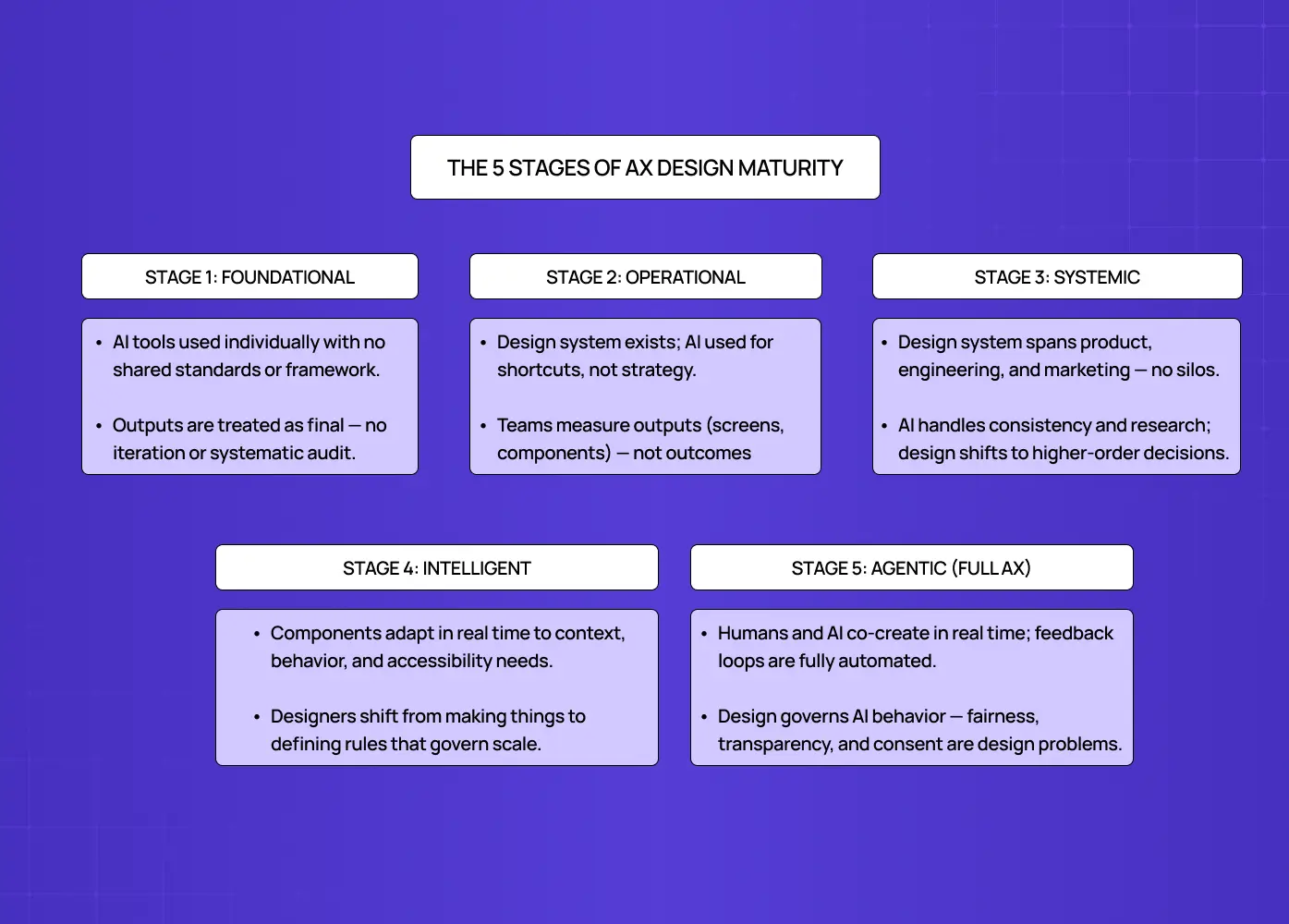
Stage 1: Foundational
What it looks like:
Design craft is present but inconsistent
AI tools are used individually and experimentally, with no shared standards
Design system, if it exists, is minimal or undocumented
AI outputs are treated as final rather than iterated
At this stage, teams are reactive. AI tools show up as individual subscriptions, one designer using Midjourney, another using Figma AI, someone else experimenting with a generative copy tool. There is no shared framework for when to use AI, how to audit its outputs, or how to build on it systematically.
This is where most teams begin, and there is nothing wrong with being here. The risk is staying here without noticing.
Failure Mode: The Individual Subscriptions Trap
Siloed AI tool usage with no unified UI/UX principles across the team
Each designer operates a personal AI stack with no shared output standards
AI outputs are accepted as-is rather than validated against design criteria — there's no AI output validation step at all
How to Advance to Stage 2:
Audit every AI tool currently in use across the team and map overlaps
Define a minimum shared standard for how AI outputs get reviewed before use
Assign ownership of the design system, even a basic one, to a named person. Teams with a well-defined UX design process already in place tend to complete this transition faster. The process scaffolding absorbs new AI tooling rather than needing to be rebuilt around it.
Responsible AI Signal at this stage: Raw model outputs are used without any validation layer. The team has no process for catching hallucinated copy, biased imagery, or accessibility failures in AI-generated assets.
Stage 2: Operational
What it looks like:
A design system exists and is actively maintained
AI is used for productivity gains: Copilot features, layout automation, content drafts
Design still operates primarily as a service function, responding to briefs rather than shaping strategy
Teams measure outputs (screens delivered, components built) rather than outcomes — with no design-impact measurement tying design to what actually moves the product
The operational stage is where many design teams plateau. Things look organized from the outside: there is a design system, there are templates, AI tools are being used. But the intelligence stops at the tool level. The design system itself is still static. AI is a shortcut, not a strategic layer.
This is the stage most often confused with maturity. Productivity is high, but adaptability is low and it is why teams that have focused heavily on how AI copilot design works at a product level often find their copilot features outpacing their design maturity: the output is shipping, but the system intelligence is not growing.
BCG's 2025 research found that while generative AI has helped some teams achieve 15–30% productivity improvements, most organizations have not yet embedded AI deeply enough into workflows to realize enterprise-level returns. That is the Stage 2 ceiling in practice, our research on how product teams are using agentic AI in their design workflows documents the specific patterns that separate Stage 2 tool users from Stage 3 infrastructure builders.
Failure Mode: The Productivity Plateau
Output volume increases but core product experience does not improve
AI is generating more screens faster without solving deeper UX problems
Design velocity is used as a proxy for design progress
How to Advance to Stage 3:
Audit localized AI usage and build shared UI standards from the patterns that emerge
Establish a cross-functional AI design guild with representatives from product and engineering
Transition component token architectures to handle probabilistic and variable content outputs
Timeline: Stage 2 to Stage 3 typically takes 2–4 months of focused tooling alignment and cross-team standard-setting. Understanding how to build a product design roadmap that sequences this investment is one of the clearest predictors of whether teams complete the transition in that window or significantly exceed it.
Responsible AI Signal at this stage: Compliance is treated as a checklist. Regulatory requirements are acknowledged but not embedded into design decisions or component documentation.
Stage 3: Systemic
Gartner's 2025 survey found that in 57% of high-maturity AI organizations, business units actively trust and adopt new AI solutions, compared to only 14% in low-maturity ones. That trust gap is built at Stage 3, not before.
What it looks like:
Design systems are integrated across product, engineering, and marketing workflows
AI is embedded in research synthesis, QA, and accessibility checks
Measurable consistency across platforms and touchpoints
Teams begin tracking design impact on product metrics and knowing which SaaS metrics connect to design outcomes is what determines whether that tracking creates accountability or just reporting.
At this stage, design stops being siloed. The design system becomes a shared infrastructure, not just a Figma library, but a living component of how the entire product organization works. AI handles the grunt work of consistency checking, pattern validation, and research analysis, freeing designers to focus on higher-order decisions.
For product-led SaaS companies, this is where design starts generating measurable business value. Our guide to best practices for integrating AI into SaaS UX documents the specific integration decisions that define this transition, the structural differences between teams using AI as a tool and teams that have made it infrastructure. The analytics maturity model analogy is useful here: just as organizations move from raw data collection to reporting to insight generation, design teams at Stage 3 are making the shift from delivery to analysis.
Failure Mode: The Perpetual Pilot Trap
Proofs-of-concept succeed in isolation but fail to reach production
Design system architecture is too rigid to support dynamic or AI-generated outputs at scale
Teams run multiple pilots simultaneously without a framework for deciding which to scale
How to Advance to Stage 4:
Restructure the design system to support variable, AI-generated content, not just static components
Define behavioral boundaries for AI outputs within product — often enforced with feature-flag controls — deciding what the system can generate autonomously and what requires human review
Establish shared outcome metrics that engineering, product, and design all track together
Timeline: Stage 3 to Stage 4 is the hardest transition on the curve, plan for 6–12 months. This is where teams move from a static component library to an adaptive, predictive interface layer. Most teams underestimate the engineering dependency here: if your software architecture cannot support dynamic token generation or real-time model telemetry, your design team cannot execute Stage 4 strategies regardless of design capability.
Responsible AI Signal at this stage: Algorithmic bias and edge-case errors are integrated into the standard QA pipeline, not handled as exceptions. Accessibility audits include AI-generated content, not just static components.
Stage 4: Intelligent
What it looks like:
Design systems are dynamic and respond to real-time inputs
Variable-driven components, AI-generated guidelines, and automated governance are in place
Design teams build and maintain decision frameworks that AI operates within
Human designers shift from execution to curation and oversight
This is where the design system becomes genuinely intelligent. Components are no longer static; they adapt based on user context, behavioral data, and accessibility requirements — the same adaptive logic that underpins adaptive dashboard intelligence, where the surfaces users rely on most need to reflect real-time confidence and context rather than static views. AI does not just assist design, it participates in design decisions within boundaries set by the team. This is the practical application of the agentic UI patterns that define trust-first interface behaviour, not operating as isolated components, but as a governed system responding to real-time context.
This stage requires a new kind of design leadership. The work is less about making things and more about defining the parameters within which intelligent systems operate. It is rigorous, consequential, and genuinely exciting to build.
We have seen this pattern emerge in our work with AI-native product teams: the transition to Stage 4 always involves a moment where the team stops asking "what should this look like?" and starts asking "what rules should govern how this looks at scale?"
Failure Mode: Governance Abstraction
Exhaustive AI safety documentation exists but is too detached from day-to-day design tooling to be enforced
Policies live in wikis; designers work in Figma - the two never connect
Governance becomes a compliance theater exercise rather than a live design constraint
How to Advance to Stage 5:
Embed governance rules directly into design system documentation and component behavior specs
Build feedback loops between real-time user behavior data and design system updates
Shift the design leadership mandate from execution oversight to system goal-setting
Responsible AI Signal at this stage: Active interface monitoring is in place for over-automation risks and user manipulation patterns. The design team, not just legal or engineering - owns a point of view on where the system should defer to the human.
Stage 5: Agentic (Full AX)
What it looks like:
Teams orchestrate fully agentic experiences where humans and AI co-create in real time
The focus shifts from consistency to adaptivity, personalization, and ethical stewardship
Design governance includes AI behavior standards, not just visual standards
Feedback loops between user behavior, AI output, and design iteration are automated
The highest level of AX maturity is not a destination most teams reach quickly and that is appropriate. At this stage, design is no longer primarily about interface. It is about orchestrating the relationship between a user and an intelligent system: what the system learns, what it decides, what it offers, and when it defers — the central design problem human-agent collaboration design exists to solve.
Ethical stewardship becomes a design function. Questions about fairness, transparency, and consent are not left to legal or engineering, they live in the design layer. The most mature AX teams are the ones who understand that designing for agentic experiences means designing the experience of trust, not just the experience of interaction.
This is the frontier. And the organizations building there are not the ones who chased the newest AI plugin, they are the ones who invested in each stage deliberately.
Failure Mode: Ethics Outsourcing
AI safety and bias mitigation are treated as legal and compliance problems, not design problems
The design team has no formal ownership of algorithmic fairness or transparency standards
Trust is assumed rather than designed
Responsible AI Signal at this stage: Ethical stewardship is a design function with named owners, documented standards, and regular audits, not a downstream handoff. The design team leads on questions of fairness, consent, and system transparency.
What Most Design Teams Get Wrong
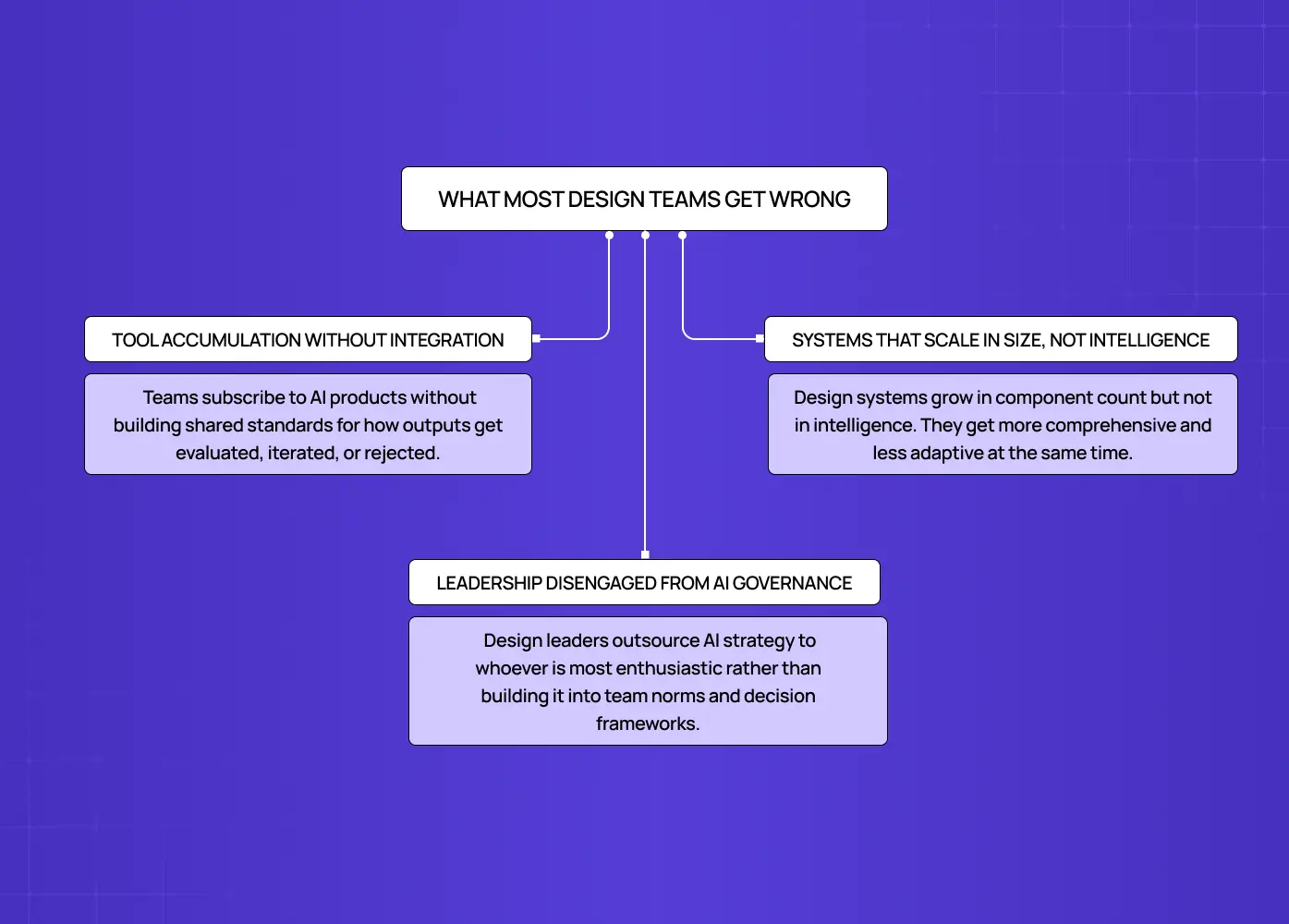
The biggest mistake is treating AI adoption as a proxy for AX maturity.
Having access to more AI tools does not move a team up the maturity curve. Neither does generating more outputs faster. The defining variable at each stage is not what AI the team uses, it is how intelligently the team has integrated AI into its design culture, decision-making, and systems.
Three patterns appear repeatedly in teams that are stuck:
Tool accumulation without process integration. Teams subscribe to AI products without building shared standards for how outputs get evaluated, iterated, or rejected.
System static-ness at scale. Design systems grow in component count but not in intelligence. They get more comprehensive and less adaptive at the same time.
Leadership disengagement from AI governance. Design leaders outsource AI strategy to whoever is most enthusiastic rather than building it into team norms and decision frameworks.
For a full catalogue of the AI UX design mistakes that keep teams at lower maturity stages, the patterns there map directly to these three failure modes with specific design decisions to address each.
It is worth distinguishing this framework from Jakob Nielsen's Capability Maturity Model for AI in Design, which focuses on broad corporate AI capability, workflows like vibe coding, system gardening, and organizational AI adoption at scale. The Groto AX Design Maturity Model is built for a narrower, higher-stakes purpose: helping product design leaders assess and evolve the intelligence of the core product's user experience architecture. The questions are different. So are the answers.
The numbers reflect this directly. Deloitte's 2025 Emerging Technology Trends study found that while 30% of organizations are exploring agentic AI and 38% are running pilots, only 11% are actively using these systems in production. The bottleneck is almost never the https://www.letsgroto.com/blog/ai-ux-design-mistakes technology, it is the absence of design culture and governance infrastructure to scale it.
The data science maturity model community has a useful parallel: organizations that progress fastest are not the ones that bought the most data tools, they are the ones that built data culture alongside data infrastructure. The same principle applies to AX.
How the Design Leader's Role Evolves
The maturity curve does not just change your design system. It changes what design leadership actually means — the shift to AI design leadership the curve demands. At each stage, the primary responsibility shifts:
Stage | Leadership Persona | Primary Focus |
Stage 1: Foundational | The Evangelist | Securing baseline AI tooling budgets and building foundational skills |
Stage 2: Operational | The Standardizer | Unifying fractured team toolkits into repeatable, shared workflows |
Stage 3: Systemic | The Integrator | Redesigning design systems to handle automated, variable outputs |
Stage 4: Intelligent | The Governor | Setting semantic rules, behavioural boundaries, and system-level goals |
Stage 5: Agentic | The Steward | Managing system health, algorithmic bias, and trust calibration at scale |
The shift from Integrator to Governor (Stage 3 to Stage 4) is where most design leaders stall. It requires moving from a craft-first to a systems-first mindset and that transition is as much organizational as it is technical. Approaching it deliberately means treating it as a design strategy problem, not just a capability one.
How Groto Thinks About AX Maturity
The McKinsey Design Index found that top-quartile design-led companies generate 32% higher revenue growth and 56% higher total returns to shareholders over five years — across industries. Design maturity is not a soft metric. It is a business one. For teams making this case internally, our breakdown of how to calculate the ROI of UX design translates those index findings into metrics finance and leadership teams can act on.
We work with product teams and B2B SaaS companies across growth stages, and the AX maturity model is not abstract for us, it is something we apply directly to how we scope, advise, and build.
When we partnered with LearnSphere, the brief went well beyond visual design. The platform needed to serve admins, teachers, and students simultaneously - each with distinct roles, permissions, and interaction patterns — all within a single AI-powered product. The questions we were asking were Stage 3 and Stage 4 questions: how does a design system maintain consistency across vastly different user contexts? How do you build governance for a product whose intelligence adapts to each role?
Our approach at Groto is to meet teams where they are on the maturity curve, then build deliberately toward the next stage. That means not over-engineering a Stage 1 team with intelligent system infrastructure they are not ready for, and not leaving a Stage 3 team doing manual consistency work when they should be building toward adaptivity. It is the same sequencing principle encoded in the UI/UX strategy frameworks top agencies use to drive growth — maturity investments are staged, not front-loaded.
The AX maturity model gives us and our clients a shared language for that conversation.
Assess Your Team: AX Maturity Scorecard
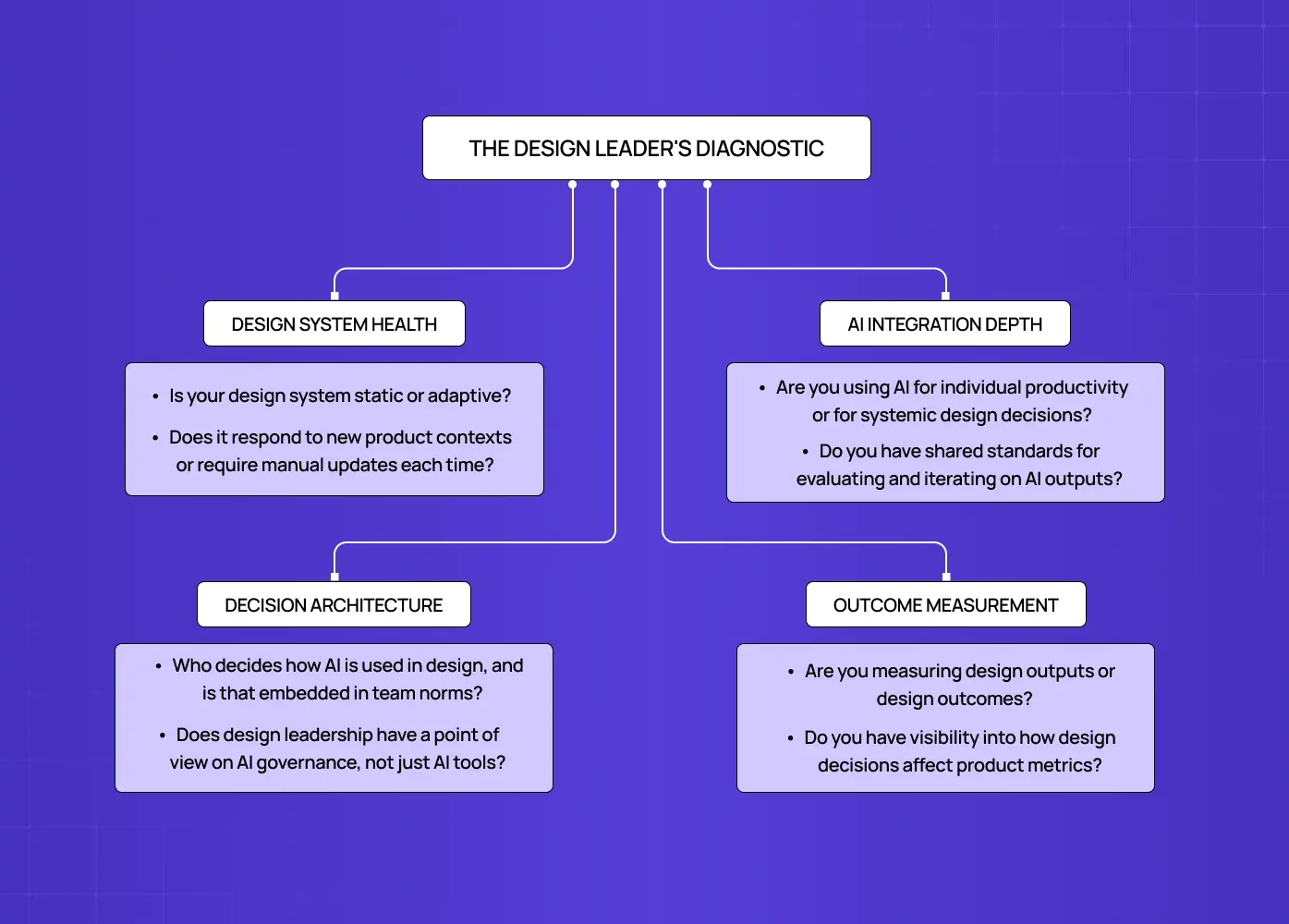
Score your team across four dimensions. Use the descriptions to find where you honestly land, then add up your total. Teams at Stage 1 or Stage 2 often find it useful to run a structured UX audit before completing this diagnostic, it surfaces the current state of your design system and AI integration, giving the scoring a concrete baseline rather than an estimate.
Diagnostic Dimension | Score 1-2 | Score 3-4 | Score 5 |
Design System Health | Static UI components, no AI data orchestration | Tokenized systems with manual AI integrations | Dynamic, automated generative UI patterns |
AI integration Depth | Third-party tools used in isolation by individuals | Dedicated single-agent workflows with shared standards | Interconnected multi-agent orchestration across product surfaces |
Decision Architecture | Humans design every interface manually | Designers curate and validate AI-generated options | System autonomously adapts to real-time user telemetry |
Outcome Measurement | Legacy task completion rates and output counts | Internal design system efficiency metrics | Autonomous delegation and recovery rates tied to product outcomes |
Scoring Key:
4–8 points: Stage 1 - Foundational
9–14 points: Stage 2 - Operational
15–20 points: Stage 3 - Systemic
21–25 points: Stage 4 - Intelligent
26+ points: Stage 5 - Agentic
Conclusion
Design maturity has not disappeared, it has been redefined by the shift from UX to AX.
The AX maturity model gives design teams a clear, staged framework to understand where they are and where to build next.
Moving up the maturity curve requires intentional design culture work, not just more AI subscriptions and that work always begins with what a deliberate UX strategy looks like and how to build one.
The most consequential stage transitions are from Operational to Systemic and from Systemic to Intelligent - both require structural investment in design systems and governance. For SaaS teams building this foundation, our guide to what SaaS UX design looks like at each maturity stage provides the broader product context that AX maturity sits within.
Agentic experience design is not a future aspiration; it is already being built by the teams that invested early in each stage.
At Groto, we help design-led product teams navigate this curve with research-backed, system-level thinking.