What Should a UX Design Proposal Include?

10 min read

10 min read

UX Design

What Should a UX Design Proposal Include?

A practical breakdown of what a UX design proposal should include, what to expect from an agency at every stage, and a free template to compare against.

What Should a UX Design Proposal Include?

10 min read

10 min read

UX Design

What Should a UX Design Proposal Include?

A practical breakdown of what a UX design proposal should include, what to expect from an agency at every stage, and a free template to compare against.

Most people evaluating a UX design proposal have no real benchmark for what "good" looks like. This guide breaks down exactly what should be included, what to expect from an agency, and gives you a free template to compare against.

Not sure what a solid UX design proposal should actually include? Here's your benchmark.
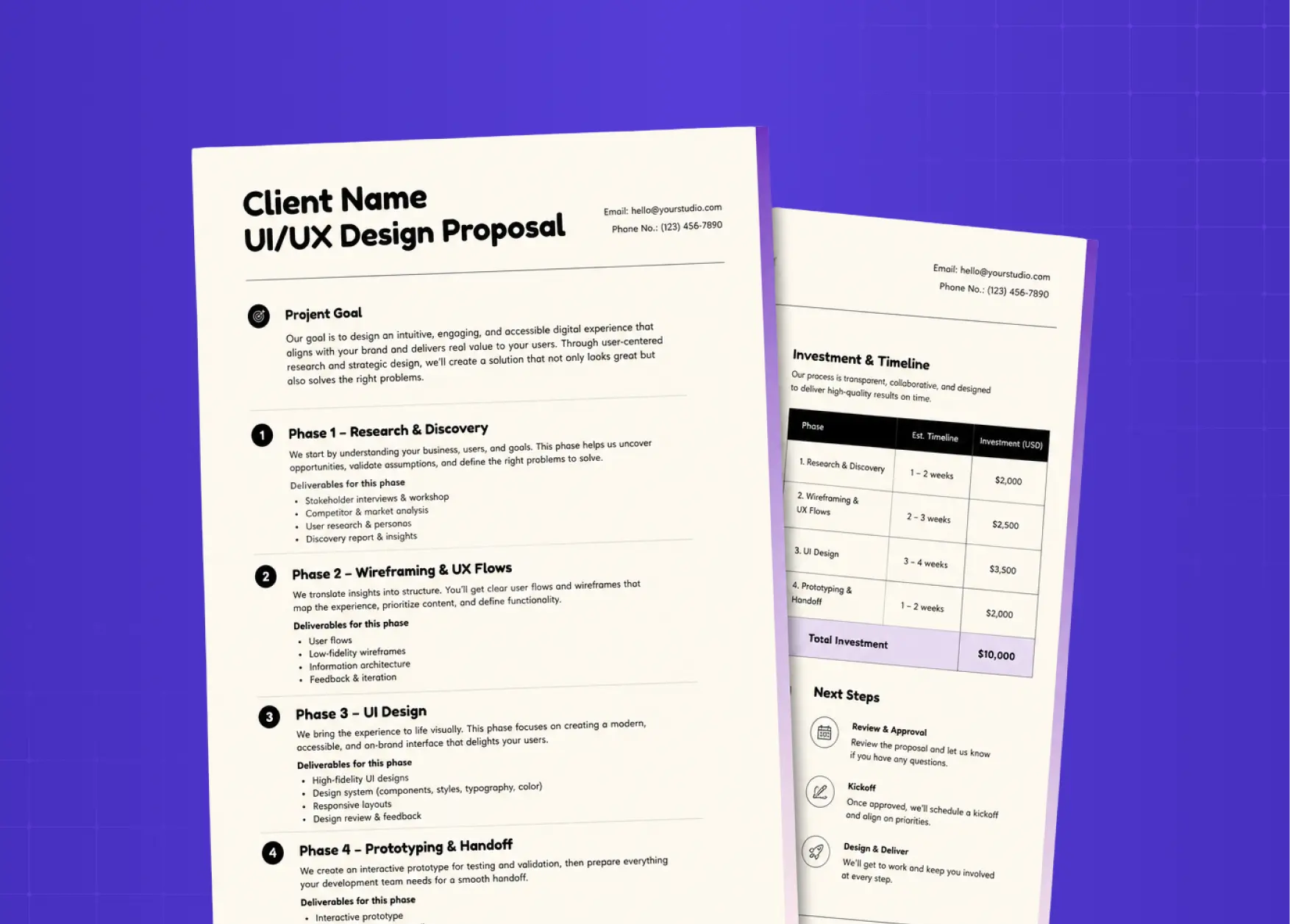
Sample UX design proposal document outlining project phases, timeline, deliverables, pricing, and next steps for a client.

If you have ever received a UX design proposal from an agency and felt unsure whether it was actually good, you are not alone. Most people evaluating a proposal have no benchmark to compare it against. Is a five-page document normal? Should pricing be a flat number or a range? Is it a red flag if there is no timeline at all? Without knowing what a solid proposal looks like, it is hard to tell a great agency from one that is just good at sounding confident.

We write UX proposals at Groto every week, and we have also sat on the other side of the table reviewing proposals from partner agencies and vendors. The pattern is consistent. Proposals that are vague about scope, timeline, or pricing tend to come from agencies that will be vague about those same things once the project starts. Proposals that are specific and honest, even when the honest answer is "this will take longer than you'd like," tend to come from agencies that follow through.

This guide walks through exactly what a UX design proposal should include, what you should reasonably expect from an agency at each stage, and what a finished proposal actually looks like. We also built a free downloadable template alongside this article, so if you are the one writing the proposal, you are not starting from a blank page either.

TL;DR

  • A UX design proposal is a written plan that defines the problem, the proposed solution, the process, the timeline, the deliverables, and the cost, so both sides agree before work starts.

  • The core sections every proposal needs are: summary, problem statement, scope, process, timeline, deliverables, team credibility, pricing, and terms.

  • A trustworthy agency will give you a phased timeline with real week numbers, a scope that says what is and is not included, and pricing you do not have to hunt for.

  • Vague scope, no timeline, or "unlimited revisions" promises are the most common signs a proposal is overselling rather than planning.

  • Real project examples in a proposal are one of the fastest ways to judge whether an agency can actually deliver what they are promising.

  • You can grab our free UX design proposal template (Word and PDF) further down this article.

What Is a UX Design Proposal?

A UX design proposal is a document that outlines a problem you are facing and the plan an agency or designer intends to follow to solve it through UI UX design. It is the bridge between "we should probably redesign our app" and an actual signed contract with a start date.

People often use "UX proposal," "design brief," and "scope of work" interchangeably, but they are not quite the same thing (and if you are unsure what a UX design brief actually is, we cover it separately):

Document

What it actually takes

UX design proposal

Persuades the client and outlines the plan, timeline, and cost

Design brief

Captures the client’s goals and requirements, usually written before or with the proposal

Scope of work

The legal, itemized breakdown of deliverables once the proposal is accepted

Contract

The binding agreement covering payment terms, IP ownership, and liability

A proposal is the only one of these four that has to sell the work while also being technically accurate. That is what makes it worth scrutinizing. An agency that gets this document right is usually showing you, in miniature, how they will run the actual project.

If you have seen the phrase "proposed design" and wondered what it means, it simply refers to the specific solution being recommended, as opposed to the current state of your product. When a proposal says "the proposed design will consolidate the four-step checkout into two steps," that is the proposed design being described in plain terms.

What Should a UX Design Proposal Include?
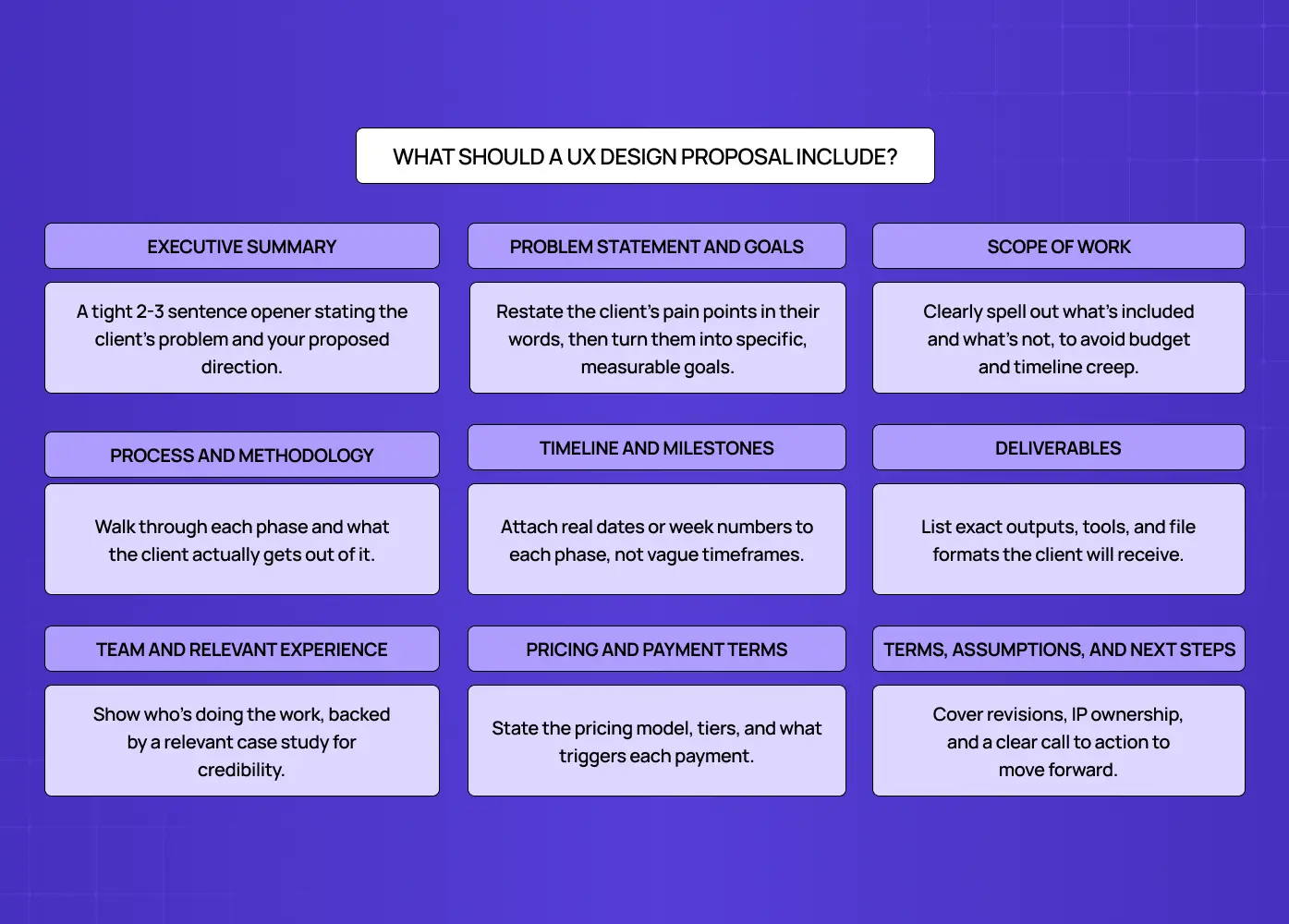
Infographic listing the essential sections of a UX proposal, including scope, timeline, pricing, deliverables, and project methodology.

Here is what a professional proposal covers, and what you should expect to see in each part when an agency sends you one.

1. Executive Summary

Two or three sentences at the top stating your problem and the agency's proposed direction. If this section reads like generic marketing copy rather than something written specifically for your business, that is worth noticing. A summary that could be copy-pasted into any client's proposal usually means the discovery conversation did not go very deep.

2. Problem Statement and Goals

This is where an agency proves it actually listened during your discovery call, and where a clear UX strategy starts to show. You should see your own pain points reflected back in specific language, not paraphrased into vague design-speak. Then those pain points should be translated into measurable goals. "Improve conversion" is vague. "Reduce signup abandonment from 42% to under 25% within two months of launch" gives you something to hold the agency accountable to later."Reduce signup abandonment from 42% to under 25% within two months of launch" gives you something to hold the agency accountable to later, and ties directly to the ROI of UX design work.

3. Scope of Work

Expect a list of exactly what is included and, just as important, what is not. Vague scope is the number one reason projects run over budget and over time. If the proposal only says "we will redesign your website" without naming pages, screens, or flows, ask for specifics before signing. A clear scope protects you as much as it protects the agency.

4. Process and Methodology

You should be able to understand, without a design background, what happens between kickoff and final delivery. This is essentially the agency's UX design process mapped onto your project. A typical breakdown looks like:

  • Discovery and research (interviews, analytics review, competitor audit), often structured as a formal UX audit

  • Information architecture and user flows

  • Wireframing

  • Visual design and UI

  • Prototyping and usability testing

  • Handoff and developer support

You do not need a paragraph explaining every UX method by name. What matters is that each phase connects to something you actually get out of it.

5. Timeline and Milestones

This is one of the sections worth reading most carefully, because it tells you a lot about how realistic the agency is being. Expect a phased breakdown with actual week numbers or dates, essentially a product design roadmap, not a single vague estimate like "a few weeks." A proposal that says "8 to 10 weeks depending on feedback turnaround" is more trustworthy than one that promises a suspiciously fast "2 weeks" for a full redesign. We cover what typical phase lengths look like in the next section.

6. Deliverables

Expect a specific list of what you will actually receive: wireframes in Figma, a clickable prototype, a full design system, developer handoff documentation, whatever applies to your project. If you are unclear on what a UX design agency delivers in the first place, that list is where it becomes concrete.. This section should also mention file formats and tools, so there is no confusion three weeks in about how to open the files you are handed.

7. Team and Relevant Experience

A short section showing who is doing the work and proof they have solved similar problems before. This is where a case study earns its place. When we proposed a redesign for Meydan, a Dubai free zone business setup platform, the client's biggest concern was whether we could simplify a genuinely complicated compliance process into something a first-time entrepreneur could self-serve through. Showing them the actual before-and-after of a comparable project did more to build confidence than any paragraph about design philosophy could have. If a proposal has no examples of past work at all, that is worth asking about directly, and it helps to know how to read UI UX portfolio examples before you hire.

8. Pricing and Payment Terms

Pricing should be specific and easy to find, not buried in a paragraph, and it helps to know typical web design agency pricing before you compare quotes. Fixed fee, hourly, or milestone-based, and what triggers each payment. If the agency offers tiers, expect them laid out side by side so you can compare rather than guess. If you have to ask "so what does this actually cost" after reading the whole document, that is a sign the proposal was written to impress rather than inform.

9. Terms, Assumptions, and Next Steps

Expect this section to cover revision limits, what happens if you go quiet mid-project, who owns the IP after final payment, and a clear next step for moving forward, whether that is signing, scheduling a call, or replying with questions.

The UX playbook that takes you from MVP traction to Series A growth

Identify the UX mistakes silently killing your activation rate and the exact fixes to improve conversions without a full product redesign.

No Spam. Free Lifetime

The UX playbook that takes you from MVP traction to Series A growth

Identify the UX mistakes silently killing your activation rate and the exact fixes to improve conversions without a full product redesign.

No Spam. Free Lifetime

What Should You Expect From an Agency's Proposal?

Beyond the sections themselves, there are a few things worth expecting from the process around the proposal, since these are usually a preview of what working with the agency will actually feel like.

Turnaround time. After a solid discovery call, a proposal typically takes anywhere from two days to a week to arrive. A same-day proposal for a complex project is often a sign it was templated rather than thought through. A proposal that takes three weeks may signal the agency is overbooked or disorganized.

A realistic timeline, not just an optimistic one. For a full website redesign specifically, here is a rough benchmark of what phased timelines usually look like, so you have something to compare against:

Table comparing typical website project sizes with estimated delivery timelines, from small business sites to enterprise redesigns.

If a proposal promises something dramatically faster than these ranges for a comparable project, ask what is being cut to make that possible.

Clarity on communication. You should know, from the proposal or the conversation around it, how often you will hear from the agency, who your point of contact is, and how feedback rounds work. Agencies that leave this vague tend to go quiet mid-project.

Willingness to explain, not just present. A good agency welcomes questions about scope or pricing. If pushback on a section is met with defensiveness rather than a straight answer, that tells you something about how disagreements will be handled later.

Case studies that actually relate to your problem. Anyone can list past clients. What matters is whether the examples shown relate to the kind of problem you are hiring them to solve. When we scoped the PolicyBazaar insurance shopping redesign, the relevant proof point for that client was not just "we've done website redesigns before," it was evidence of handling a similarly complex, multi-stakeholder review process without the timeline collapsing.

UX Design Proposal Example

Here is a condensed example of how these sections come together for a mid-size website redesign. This is illustrative, not a real client, but it mirrors the structure we actually use.

Project: Website redesign for a B2B SaaS company Client goal: Increase demo bookings from the homepage from 1.8% to 4%

Summary: The current site buries the product's core value proposition below three scrolls of generic copy, and the demo CTA competes with four other buttons above the fold. We propose a redesign focused on a clearer hierarchy, one primary CTA, and social proof placed earlier in the page.

Scope: Homepage, pricing page, and two product pages. Excludes blog template and careers page.

Process: 1 week discovery, 2 weeks wireframes and IA, 3 weeks UI design, 1 week prototyping and testing, 1 week handoff. 8 weeks total.

Deliverables: Figma wireframes, high-fidelity UI files, interactive prototype, developer handoff spec.

Investment: Fixed fee, split into three milestone payments at kickoff, mid-project, and final delivery.

This is roughly a page and a half when formatted properly, not the ten-page document some templates push you toward. If you are the one receiving proposals, a document this specific and this short is usually a better sign than a long one padded with generic agency language.

Free UX Design Proposal Template

We put together a UX design proposal template you can download and adapt, whether you are writing one for a client or want a benchmark to compare against a proposal you received. It includes every section covered above, formatted and ready to fill in, available as both a Word document and a PDF.

The structure is intentionally simple. If you are writing a proposal, swap in your own project details and keep the timeline honest based on your own past project data. If you are evaluating someone else's proposal, use it as a checklist for what should be there.

Red Flags and Green Flags When Reading a Proposal

Whether you are writing a proposal or deciding whether to sign one, these are the patterns worth watching for.

Red flags:

  • Vague scope with no named pages, screens, or flows

  • No timeline breakdown, just a single end date with no phases

  • "Unlimited revisions" promised with no boundaries, which usually means poor planning rather than generosity

  • Pricing buried at the bottom of a wall of text instead of laid out clearly

  • No past work or case studies relevant to your type of project

  • Sent as a plain, unformatted email rather than a proper document

Green flags:

  • Scope that clearly states what is included and what is not

  • A phased timeline with real week numbers and built-in buffer for feedback delays

  • Pricing shown in a table or clearly separated section

  • At least one relevant case study or example of comparable work

  • A defined point of contact and communication cadence

  • A proposal that is specific enough it could not be sent to a different client unchanged

How Groto Approaches UX Design Proposals

Every proposal we send follows the structure in this article, but the details always come from an actual discovery conversation first. We do not template our way through the problem statement or timeline, because those two sections are exactly where a client can tell whether an agency actually understood their situation or is just filling in a form.

Projects like our Camb.ai redesign or the Nicotex Begin UX strategy work started as proposals with the same bones covered here: a clear problem, a phased process, honest timelines, and deliverables spelled out before a single wireframe was drawn. If you are comparing agency proposals right now, or want a second set of eyes on one you already received, you can see more of our work on the projects page or reach out directly.

Conclusion

  • A UX design proposal should include a summary, problem statement, scope, process, timeline, deliverables, team credibility, pricing, and terms.

  • A trustworthy agency proposal is specific rather than generic, with named pages or flows, a phased timeline, and pricing you do not have to search for.

  • Vague scope, missing timelines, and promises like "unlimited revisions" are common warning signs worth asking about directly.

  • Real, relevant case studies do more to prove an agency can deliver than any amount of design philosophy language.

  • A short, well-formatted proposal generally beats a long, generic one, both to read and to trust.

  • Use our free template as a starting point, whether you are writing a proposal or checking one you received against a clear benchmark.

Most people evaluating a UX design proposal have no real benchmark for what "good" looks like. This guide breaks down exactly what should be included, what to expect from an agency, and gives you a free template to compare against.

Not sure what a solid UX design proposal should actually include? Here's your benchmark.

Sample UX design proposal document outlining project phases, timeline, deliverables, pricing, and next steps for a client.

If you have ever received a UX design proposal from an agency and felt unsure whether it was actually good, you are not alone. Most people evaluating a proposal have no benchmark to compare it against. Is a five-page document normal? Should pricing be a flat number or a range? Is it a red flag if there is no timeline at all? Without knowing what a solid proposal looks like, it is hard to tell a great agency from one that is just good at sounding confident.

We write UX proposals at Groto every week, and we have also sat on the other side of the table reviewing proposals from partner agencies and vendors. The pattern is consistent. Proposals that are vague about scope, timeline, or pricing tend to come from agencies that will be vague about those same things once the project starts. Proposals that are specific and honest, even when the honest answer is "this will take longer than you'd like," tend to come from agencies that follow through.

This guide walks through exactly what a UX design proposal should include, what you should reasonably expect from an agency at each stage, and what a finished proposal actually looks like. We also built a free downloadable template alongside this article, so if you are the one writing the proposal, you are not starting from a blank page either.

TL;DR

  • A UX design proposal is a written plan that defines the problem, the proposed solution, the process, the timeline, the deliverables, and the cost, so both sides agree before work starts.

  • The core sections every proposal needs are: summary, problem statement, scope, process, timeline, deliverables, team credibility, pricing, and terms.

  • A trustworthy agency will give you a phased timeline with real week numbers, a scope that says what is and is not included, and pricing you do not have to hunt for.

  • Vague scope, no timeline, or "unlimited revisions" promises are the most common signs a proposal is overselling rather than planning.

  • Real project examples in a proposal are one of the fastest ways to judge whether an agency can actually deliver what they are promising.

  • You can grab our free UX design proposal template (Word and PDF) further down this article.

What Is a UX Design Proposal?

A UX design proposal is a document that outlines a problem you are facing and the plan an agency or designer intends to follow to solve it through UI UX design. It is the bridge between "we should probably redesign our app" and an actual signed contract with a start date.

People often use "UX proposal," "design brief," and "scope of work" interchangeably, but they are not quite the same thing (and if you are unsure what a UX design brief actually is, we cover it separately):

Document

What it actually takes

UX design proposal

Persuades the client and outlines the plan, timeline, and cost

Design brief

Captures the client’s goals and requirements, usually written before or with the proposal

Scope of work

The legal, itemized breakdown of deliverables once the proposal is accepted

Contract

The binding agreement covering payment terms, IP ownership, and liability

A proposal is the only one of these four that has to sell the work while also being technically accurate. That is what makes it worth scrutinizing. An agency that gets this document right is usually showing you, in miniature, how they will run the actual project.

If you have seen the phrase "proposed design" and wondered what it means, it simply refers to the specific solution being recommended, as opposed to the current state of your product. When a proposal says "the proposed design will consolidate the four-step checkout into two steps," that is the proposed design being described in plain terms.

What Should a UX Design Proposal Include?

Infographic listing the essential sections of a UX proposal, including scope, timeline, pricing, deliverables, and project methodology.

Here is what a professional proposal covers, and what you should expect to see in each part when an agency sends you one.

1. Executive Summary

Two or three sentences at the top stating your problem and the agency's proposed direction. If this section reads like generic marketing copy rather than something written specifically for your business, that is worth noticing. A summary that could be copy-pasted into any client's proposal usually means the discovery conversation did not go very deep.

2. Problem Statement and Goals

This is where an agency proves it actually listened during your discovery call, and where a clear UX strategy starts to show. You should see your own pain points reflected back in specific language, not paraphrased into vague design-speak. Then those pain points should be translated into measurable goals. "Improve conversion" is vague. "Reduce signup abandonment from 42% to under 25% within two months of launch" gives you something to hold the agency accountable to later."Reduce signup abandonment from 42% to under 25% within two months of launch" gives you something to hold the agency accountable to later, and ties directly to the ROI of UX design work.

3. Scope of Work

Expect a list of exactly what is included and, just as important, what is not. Vague scope is the number one reason projects run over budget and over time. If the proposal only says "we will redesign your website" without naming pages, screens, or flows, ask for specifics before signing. A clear scope protects you as much as it protects the agency.

4. Process and Methodology

You should be able to understand, without a design background, what happens between kickoff and final delivery. This is essentially the agency's UX design process mapped onto your project. A typical breakdown looks like:

  • Discovery and research (interviews, analytics review, competitor audit), often structured as a formal UX audit

  • Information architecture and user flows

  • Wireframing

  • Visual design and UI

  • Prototyping and usability testing

  • Handoff and developer support

You do not need a paragraph explaining every UX method by name. What matters is that each phase connects to something you actually get out of it.

5. Timeline and Milestones

This is one of the sections worth reading most carefully, because it tells you a lot about how realistic the agency is being. Expect a phased breakdown with actual week numbers or dates, essentially a product design roadmap, not a single vague estimate like "a few weeks." A proposal that says "8 to 10 weeks depending on feedback turnaround" is more trustworthy than one that promises a suspiciously fast "2 weeks" for a full redesign. We cover what typical phase lengths look like in the next section.

6. Deliverables

Expect a specific list of what you will actually receive: wireframes in Figma, a clickable prototype, a full design system, developer handoff documentation, whatever applies to your project. If you are unclear on what a UX design agency delivers in the first place, that list is where it becomes concrete.. This section should also mention file formats and tools, so there is no confusion three weeks in about how to open the files you are handed.

7. Team and Relevant Experience

A short section showing who is doing the work and proof they have solved similar problems before. This is where a case study earns its place. When we proposed a redesign for Meydan, a Dubai free zone business setup platform, the client's biggest concern was whether we could simplify a genuinely complicated compliance process into something a first-time entrepreneur could self-serve through. Showing them the actual before-and-after of a comparable project did more to build confidence than any paragraph about design philosophy could have. If a proposal has no examples of past work at all, that is worth asking about directly, and it helps to know how to read UI UX portfolio examples before you hire.

8. Pricing and Payment Terms

Pricing should be specific and easy to find, not buried in a paragraph, and it helps to know typical web design agency pricing before you compare quotes. Fixed fee, hourly, or milestone-based, and what triggers each payment. If the agency offers tiers, expect them laid out side by side so you can compare rather than guess. If you have to ask "so what does this actually cost" after reading the whole document, that is a sign the proposal was written to impress rather than inform.

9. Terms, Assumptions, and Next Steps

Expect this section to cover revision limits, what happens if you go quiet mid-project, who owns the IP after final payment, and a clear next step for moving forward, whether that is signing, scheduling a call, or replying with questions.

The UX playbook that takes you from MVP traction to Series A growth

Identify the UX mistakes silently killing your activation rate and the exact fixes to improve conversions without a full product redesign.

No Spam. Free Lifetime

What Should You Expect From an Agency's Proposal?

Beyond the sections themselves, there are a few things worth expecting from the process around the proposal, since these are usually a preview of what working with the agency will actually feel like.

Turnaround time. After a solid discovery call, a proposal typically takes anywhere from two days to a week to arrive. A same-day proposal for a complex project is often a sign it was templated rather than thought through. A proposal that takes three weeks may signal the agency is overbooked or disorganized.

A realistic timeline, not just an optimistic one. For a full website redesign specifically, here is a rough benchmark of what phased timelines usually look like, so you have something to compare against:

Table comparing typical website project sizes with estimated delivery timelines, from small business sites to enterprise redesigns.

If a proposal promises something dramatically faster than these ranges for a comparable project, ask what is being cut to make that possible.

Clarity on communication. You should know, from the proposal or the conversation around it, how often you will hear from the agency, who your point of contact is, and how feedback rounds work. Agencies that leave this vague tend to go quiet mid-project.

Willingness to explain, not just present. A good agency welcomes questions about scope or pricing. If pushback on a section is met with defensiveness rather than a straight answer, that tells you something about how disagreements will be handled later.

Case studies that actually relate to your problem. Anyone can list past clients. What matters is whether the examples shown relate to the kind of problem you are hiring them to solve. When we scoped the PolicyBazaar insurance shopping redesign, the relevant proof point for that client was not just "we've done website redesigns before," it was evidence of handling a similarly complex, multi-stakeholder review process without the timeline collapsing.

UX Design Proposal Example

Here is a condensed example of how these sections come together for a mid-size website redesign. This is illustrative, not a real client, but it mirrors the structure we actually use.

Project: Website redesign for a B2B SaaS company Client goal: Increase demo bookings from the homepage from 1.8% to 4%

Summary: The current site buries the product's core value proposition below three scrolls of generic copy, and the demo CTA competes with four other buttons above the fold. We propose a redesign focused on a clearer hierarchy, one primary CTA, and social proof placed earlier in the page.

Scope: Homepage, pricing page, and two product pages. Excludes blog template and careers page.

Process: 1 week discovery, 2 weeks wireframes and IA, 3 weeks UI design, 1 week prototyping and testing, 1 week handoff. 8 weeks total.

Deliverables: Figma wireframes, high-fidelity UI files, interactive prototype, developer handoff spec.

Investment: Fixed fee, split into three milestone payments at kickoff, mid-project, and final delivery.

This is roughly a page and a half when formatted properly, not the ten-page document some templates push you toward. If you are the one receiving proposals, a document this specific and this short is usually a better sign than a long one padded with generic agency language.

Free UX Design Proposal Template

We put together a UX design proposal template you can download and adapt, whether you are writing one for a client or want a benchmark to compare against a proposal you received. It includes every section covered above, formatted and ready to fill in, available as both a Word document and a PDF.

The structure is intentionally simple. If you are writing a proposal, swap in your own project details and keep the timeline honest based on your own past project data. If you are evaluating someone else's proposal, use it as a checklist for what should be there.

Red Flags and Green Flags When Reading a Proposal

Whether you are writing a proposal or deciding whether to sign one, these are the patterns worth watching for.

Red flags:

  • Vague scope with no named pages, screens, or flows

  • No timeline breakdown, just a single end date with no phases

  • "Unlimited revisions" promised with no boundaries, which usually means poor planning rather than generosity

  • Pricing buried at the bottom of a wall of text instead of laid out clearly

  • No past work or case studies relevant to your type of project

  • Sent as a plain, unformatted email rather than a proper document

Green flags:

  • Scope that clearly states what is included and what is not

  • A phased timeline with real week numbers and built-in buffer for feedback delays

  • Pricing shown in a table or clearly separated section

  • At least one relevant case study or example of comparable work

  • A defined point of contact and communication cadence

  • A proposal that is specific enough it could not be sent to a different client unchanged

How Groto Approaches UX Design Proposals

Every proposal we send follows the structure in this article, but the details always come from an actual discovery conversation first. We do not template our way through the problem statement or timeline, because those two sections are exactly where a client can tell whether an agency actually understood their situation or is just filling in a form.

Projects like our Camb.ai redesign or the Nicotex Begin UX strategy work started as proposals with the same bones covered here: a clear problem, a phased process, honest timelines, and deliverables spelled out before a single wireframe was drawn. If you are comparing agency proposals right now, or want a second set of eyes on one you already received, you can see more of our work on the projects page or reach out directly.

Conclusion

  • A UX design proposal should include a summary, problem statement, scope, process, timeline, deliverables, team credibility, pricing, and terms.

  • A trustworthy agency proposal is specific rather than generic, with named pages or flows, a phased timeline, and pricing you do not have to search for.

  • Vague scope, missing timelines, and promises like "unlimited revisions" are common warning signs worth asking about directly.

  • Real, relevant case studies do more to prove an agency can deliver than any amount of design philosophy language.

  • A short, well-formatted proposal generally beats a long, generic one, both to read and to trust.

  • Use our free template as a starting point, whether you are writing a proposal or checking one you received against a clear benchmark.

Have a project in mind?

Let’s talk through your idea and see what makes sense.

Harpreet Singh

Founder at Groto

Have a project in mind?

Let’s talk through your idea and see what makes sense.

Harpreet Singh

Founder at Groto

FAQ

Everything you were going to ask (and a few things you didn’t know to)

What are the 4 major parts of a project proposal?

Most project proposals boil down to the problem being solved, the proposed approach, the timeline and cost, and proof of capability such as past work or team credentials. A UX proposal follows the same logic, just with design-specific detail layered into each part.

What does a design proposal look like?

A well-formatted design proposal is usually one and a half to three pages, structured with clear headings, a short summary at the top, a scope section, a phased timeline, and pricing laid out in a table rather than paragraph form. It should read more like a clean one-pager than a legal document.

What's the best format for a UX proposal?

A PDF is the safest format since it renders consistently across devices and looks professional when opened. Some agencies also present proposals as a short deck or Notion page for a more interactive walkthrough, but a clean PDF or Word document works for most client relationships.

How long should a UX design proposal be?

Long enough to cover every section in this article, and no longer. Most effective proposals land between one and three pages. If a proposal you receive is pushing past four or five pages, it is worth asking what could be tightened, since length is not usually a sign of thoroughness.

What's the difference between a UX proposal and a project brief?

A brief is typically written to capture the client's needs and goals, often before or alongside the proposal. The proposal is the response: the agency's interpretation of those needs, plus the plan, timeline, and cost to address them. Some teams combine both into a single document, but keeping them separate usually makes each one clearer.

Should I expect to pay before an agency starts working, or after?

Most agencies structure payment around milestones rather than one lump sum before or after the project. A common pattern is a percentage at kickoff, a percentage at a mid-project checkpoint, and the remainder at final delivery. If a proposal asks for full payment upfront with no milestones, it is reasonable to ask why.

What are the 4 major parts of a project proposal?

Most project proposals boil down to the problem being solved, the proposed approach, the timeline and cost, and proof of capability such as past work or team credentials. A UX proposal follows the same logic, just with design-specific detail layered into each part.

What does a design proposal look like?

A well-formatted design proposal is usually one and a half to three pages, structured with clear headings, a short summary at the top, a scope section, a phased timeline, and pricing laid out in a table rather than paragraph form. It should read more like a clean one-pager than a legal document.

What's the best format for a UX proposal?

A PDF is the safest format since it renders consistently across devices and looks professional when opened. Some agencies also present proposals as a short deck or Notion page for a more interactive walkthrough, but a clean PDF or Word document works for most client relationships.

How long should a UX design proposal be?

Long enough to cover every section in this article, and no longer. Most effective proposals land between one and three pages. If a proposal you receive is pushing past four or five pages, it is worth asking what could be tightened, since length is not usually a sign of thoroughness.

What's the difference between a UX proposal and a project brief?

A brief is typically written to capture the client's needs and goals, often before or alongside the proposal. The proposal is the response: the agency's interpretation of those needs, plus the plan, timeline, and cost to address them. Some teams combine both into a single document, but keeping them separate usually makes each one clearer.

Should I expect to pay before an agency starts working, or after?

Most agencies structure payment around milestones rather than one lump sum before or after the project. A common pattern is a percentage at kickoff, a percentage at a mid-project checkpoint, and the remainder at final delivery. If a proposal asks for full payment upfront with no milestones, it is reasonable to ask why.

More Articles

Extreme close-up black and white photograph of a human eye

Let’s bring your vision to life

Tell us what's on your mind? We'll hit you back in 24 hours. No fluff, no delays - just a solid vision to bring your idea to life.

Profile portrait of a man in a white shirt against a light background

Harpreet Singh

Founder and Creative Director

Get in Touch

Extreme close-up black and white photograph of a human eye

Let’s bring your vision to life

Tell us what's on your mind? We'll hit you back in 24 hours. No fluff, no delays - just a solid vision to bring your idea to life.

Profile portrait of a man in a white shirt against a light background

Harpreet Singh

Founder and Creative Director

Get in Touch

Extreme close-up black and white photograph of a human eye

Let’s bring your vision to life

Tell us what's on your mind? We'll hit you back in 24 hours. No fluff, no delays - just a solid vision to bring your idea to life.

Profile portrait of a man in a white shirt against a light background

Harpreet Singh

Founder and Creative Director

Get in Touch