8 Best Superside Alternatives in 2026 — Matched to Your Design Need and Budget

10 min read

10 min read

Tools & Resources

8 Best Superside Alternatives in 2026 — Matched to Your Design Need and Budget

Superside starts at $10K/month with a year-long lock-in. Here are 8 alternatives matched to your team size, design type, and budget.

8 Best Superside Alternatives in 2026 — Matched to Your Design Need and Budget

10 min read

10 min read

Tools & Resources

8 Best Superside Alternatives in 2026 — Matched to Your Design Need and Budget

Superside starts at $10K/month with a year-long lock-in. Here are 8 alternatives matched to your team size, design type, and budget.

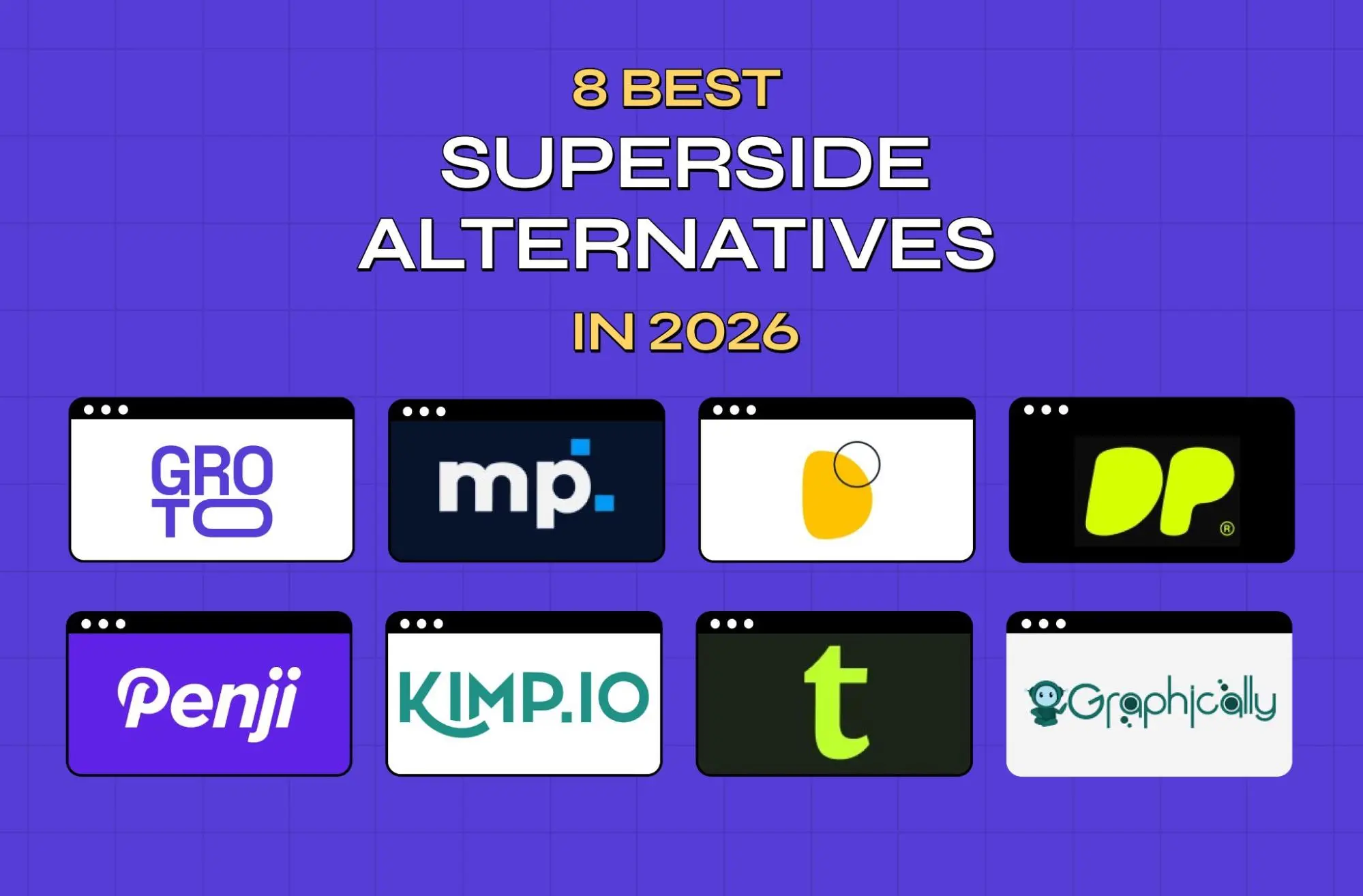
Superside costs $10,000+/month with a mandatory 12-month commitment — making it inaccessible for most SaaS and growth-stage teams. Here are 8 purpose-matched alternatives across product design, marketing subscriptions, and managed creative services.

8 Superside alternatives matched to your design need and budget.

Superside is a powerful creative operations platform — and it's priced accordingly.

With subscriptions starting at $10,000 per month and a mandatory annual commitment, Superside's minimum spend is $120,000 per year before you've seen a single deliverable. For enterprise marketing teams running high-volume campaign production across multiple channels, that investment can make sense. For most SaaS companies, startups, and growing product teams, it doesn't.

The teams searching for a Superside alternative are usually in one of three situations: they've been quoted a price that's beyond their current runway, they've outgrown Superside's marketing-asset focus and need product design capability, or they signed an annual contract and found the output quality or specialisation didn't match the spend. Some teams leaving Superside are also reconsidering the agency model entirely — the agency vs. in-house designer breakdown is worth reading before you decide whether another service or a hire is the right next move. 

Each situation calls for a different kind of alternative. This guide doesn't just list services — it matches eight options to four distinct buyer types who outgrow or pass on Superside, using what we call the Design Capacity Decision framework.

TL;DR

  • Superside starts at $10,000/month with a mandatory 12-month commitment — making it viable only for enterprise marketing teams at scale.

  • Most teams searching for a Superside alternative fall into one of four buyer types: SaaS product teams, growth-stage startups, high-volume marketing teams, or enterprise creative ops. If you're also comparing other product design subscriptions, Eleken alternatives covers a closely related set of options for SaaS-focused teams. 

  • For SaaS companies needing product UX design (not marketing creative), Superside is the wrong category of service entirely. Groto is built for this.

  • Budget-friendly alternatives for marketing design: ManyPixels ($699/mo), Penji ($995/mo), Kimp ($1,397/mo).

  • For enterprise scope without the annual lock-in: Designity and Teamtown.

Why Teams Look for a Superside Alternative
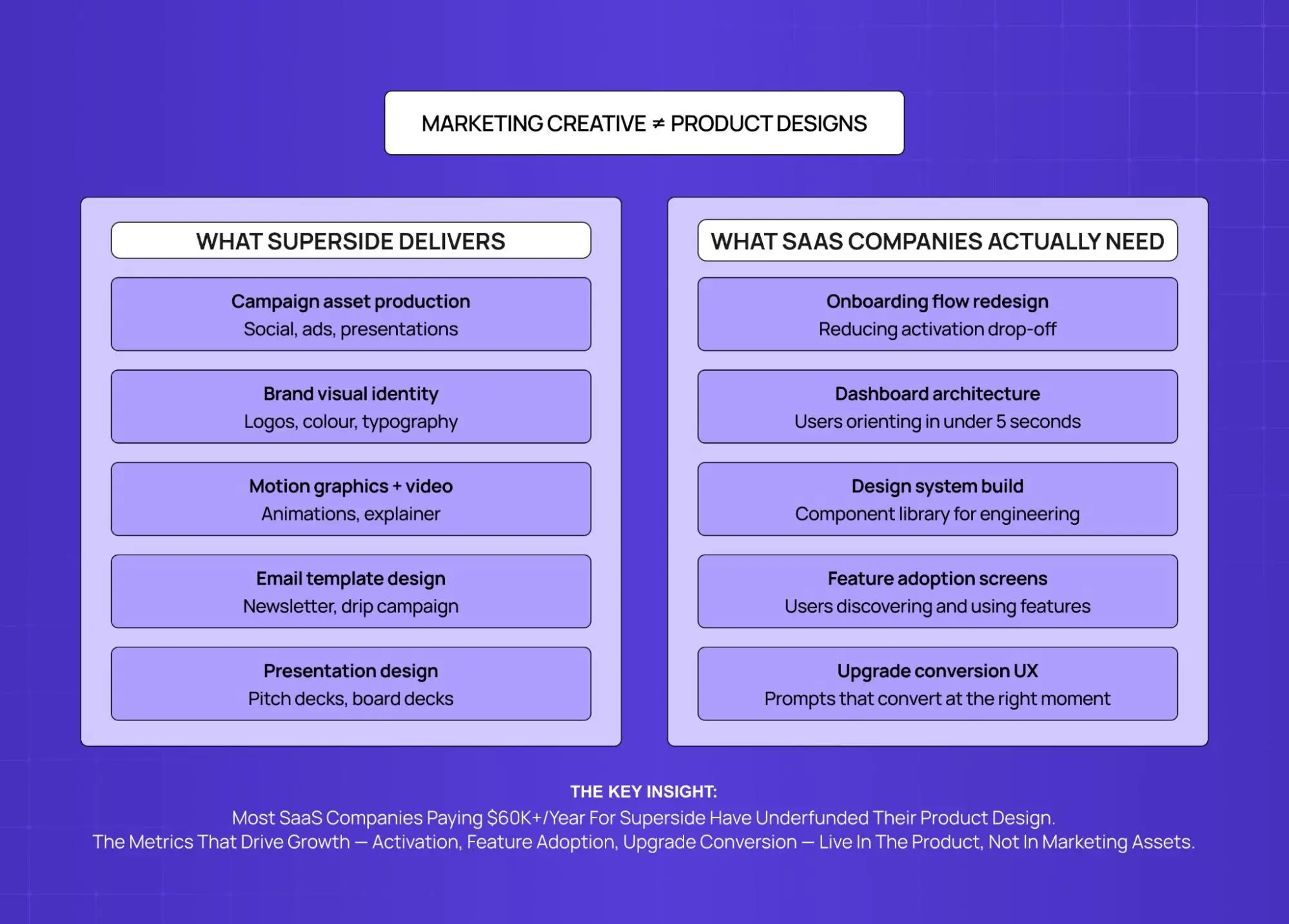
Comparison between marketing creative services and SaaS product design needs for growth-focused companies.

Before diving into the alternatives, it helps to be clear about what Superside does well and where it falls short — because the right alternative depends entirely on the gap you're trying to fill.

What Superside does well: High-volume marketing creative for enterprise teams. Campaign assets, social graphics, presentation design, motion graphics, and brand-consistent output at scale. For teams evaluating Superside specifically for brand work, our list of top branding agencies covers the broader landscape beyond subscription-model services. 

If you're a 500-person company running quarterly product launches with 40 marketing deliverables each, Superside's managed model is genuinely efficient.

Want to know where your users are dropping off?

We’ll break down the exact moments users lose interest, and why.

Want to know where your users are dropping off?

We’ll break down the exact moments users lose interest, and why.

Where Superside falls short for SaaS companies:

Cost and commitment that price out most growth-stage teams

  • $120K+/year annual contracts are enterprise procurement decisions, not startup budget line items. For a broader breakdown of what design agency pricing actually looks like across tiers, the pricing guide covers the full range from freelancer to enterprise retainer. 

  • SaaS companies at Seed or Series A rarely have that level of design budget available in a single vendor contract.

  • The model offers no flexibility to scale spend up or down as priorities shift.

Marketing creative is not the same as product design

  • Superside excels at brand and campaign execution — not UX research, SaaS dashboard design, onboarding flow optimisation, or design systems work.

  • If your most urgent design need is fixing your activation rate, not producing campaign assets, Superside is the wrong category of service entirely.

No SaaS-specialised product thinking

  • Superside's team executes on briefs. For SaaS companies that need a design partner who understands product metrics, user flows, and activation/retention strategy, that execution-only model produces work that looks good in isolation but misses the product context that makes design commercially effective. If you're unclear on the distinction, what a UI/UX design agency actually delivers explains the roles, responsibilities, and deliverables you should expect from a genuine product design partner. 

The Design Capacity Decision: 4 Buyer Types
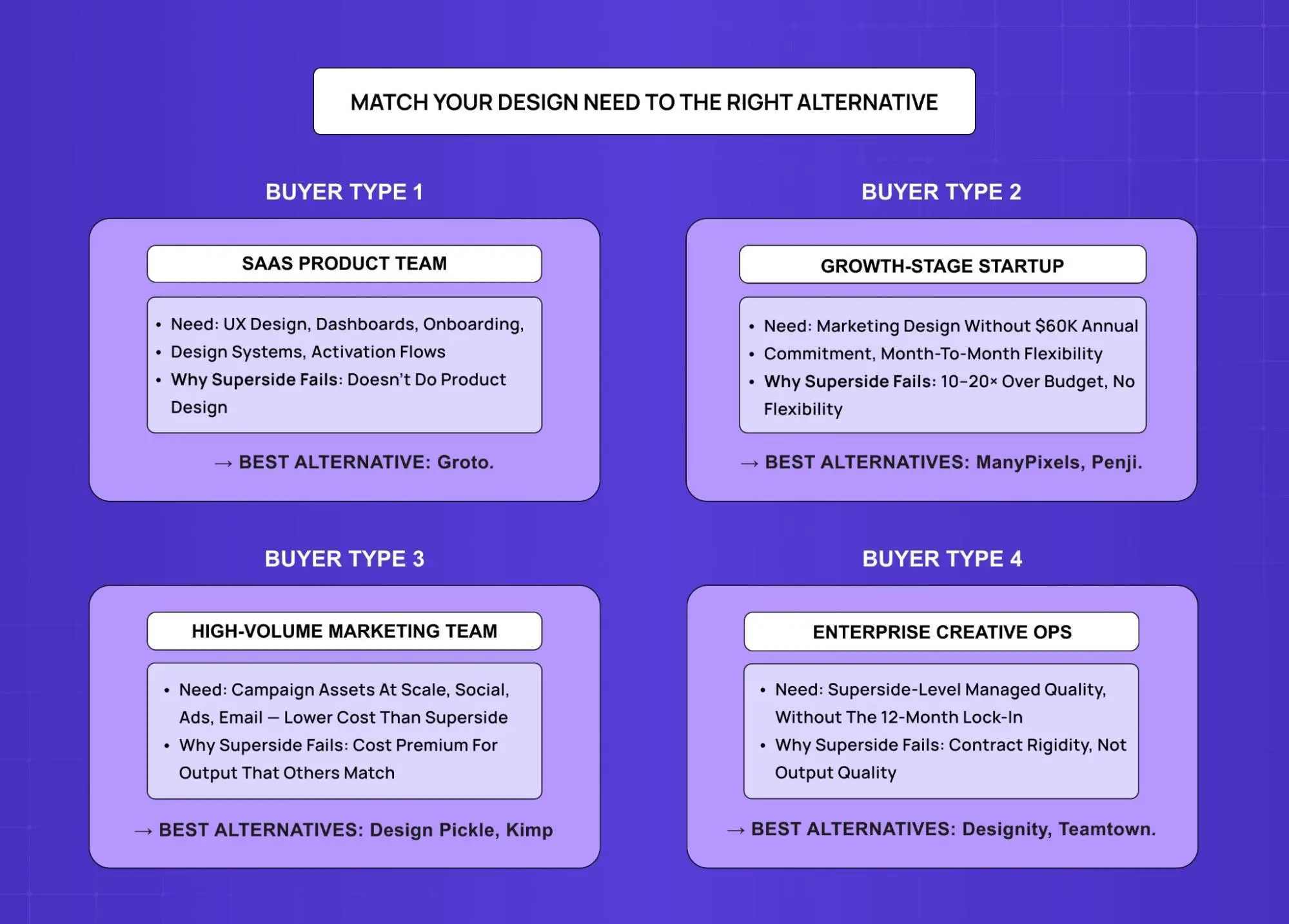
Buyer-type breakdown showing the best design subscription alternatives for different business needs.

Most Superside alternatives posts list services alphabetically or by price. The more useful lens is buyer type — what you actually need design capacity for. If your need falls on the product side rather than marketing, the best product design agencies list covers that category specifically. 

Buyer Type

Primary Design Need

What Superside Gets Wrong

Best Alternative Type

SaaS product team

Product UX, dashboards, onboarding, design systems

Doesn't do product design

Specialist SaaS product partner

Growth-stage startup

Marketing + brand design, no annual lock-in

Too expensive, 12-month commitment

Flexible subscription service

High-volume marketing team

Campaign assets at scale, lower cost

Can't justify $120K+ minimum

Budget design subscription

Enterprise creative ops

Superside-equivalent quality, more flexibility

Annual contract, rigid engagement

Managed creative alternative

The eight alternatives below are matched to these buyer types. Not every service is right for every situation — and the right answer is almost always to choose the service that matches your actual design category, not just your budget.

8 Best Superside Alternatives in 2026
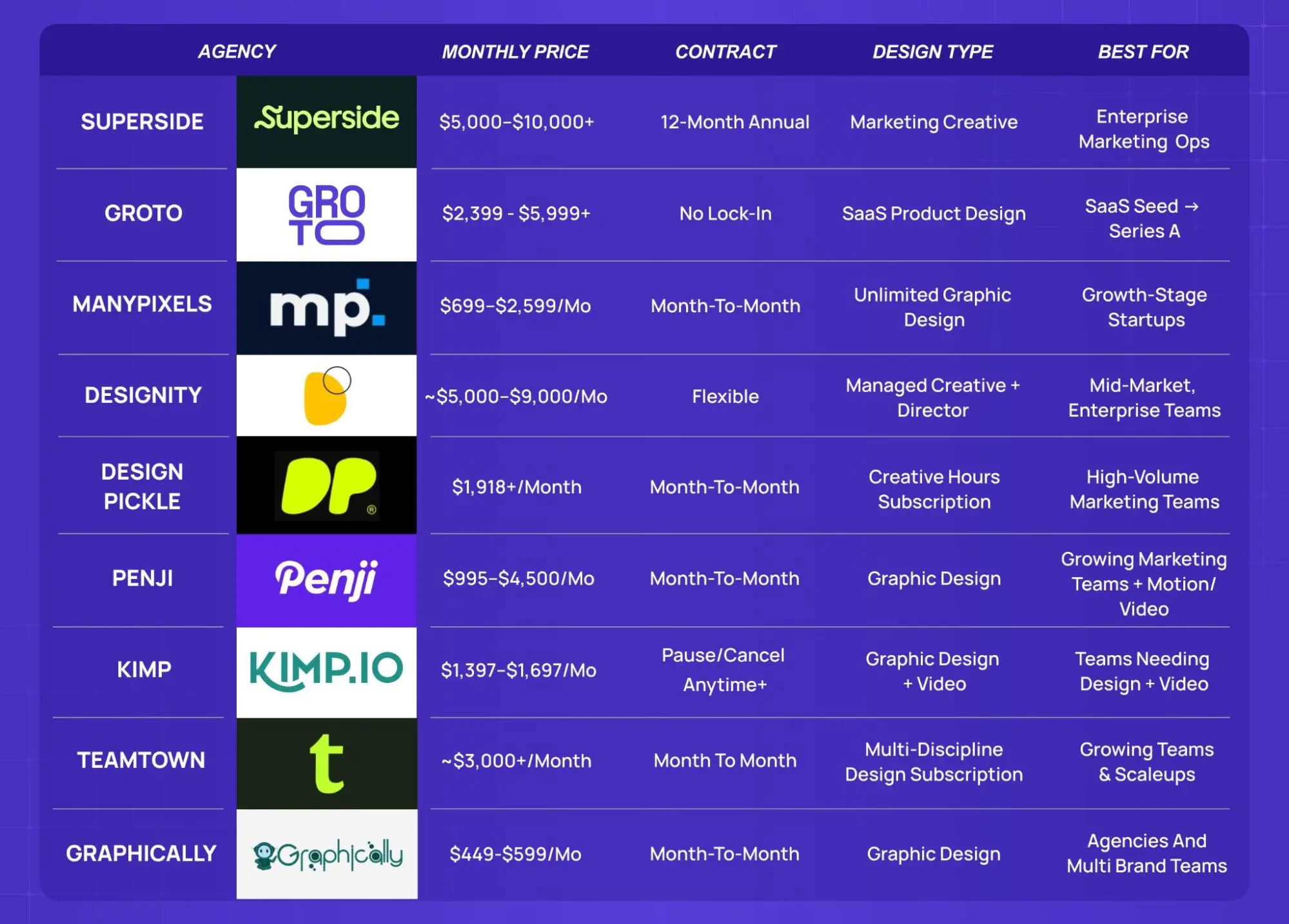
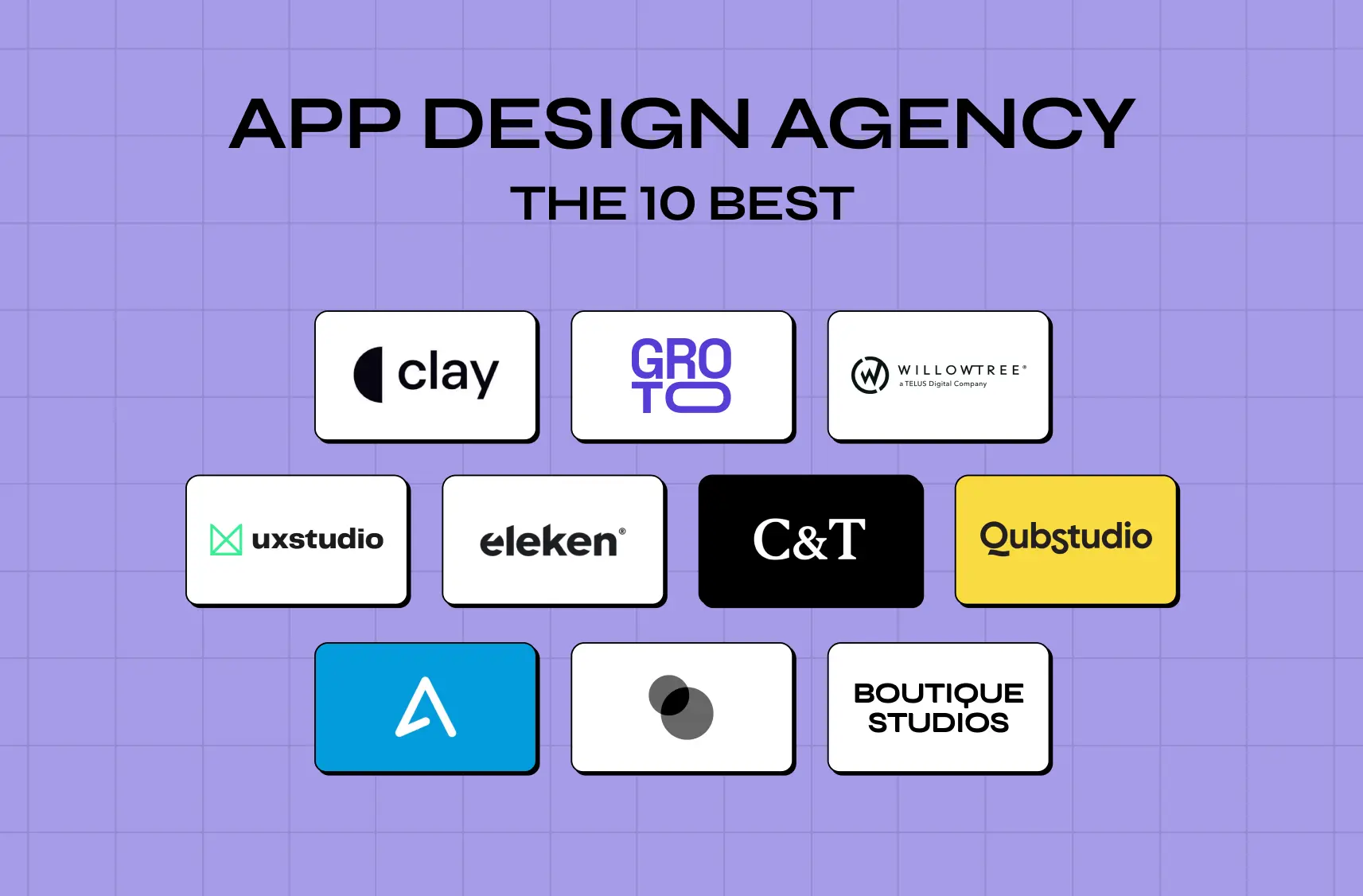
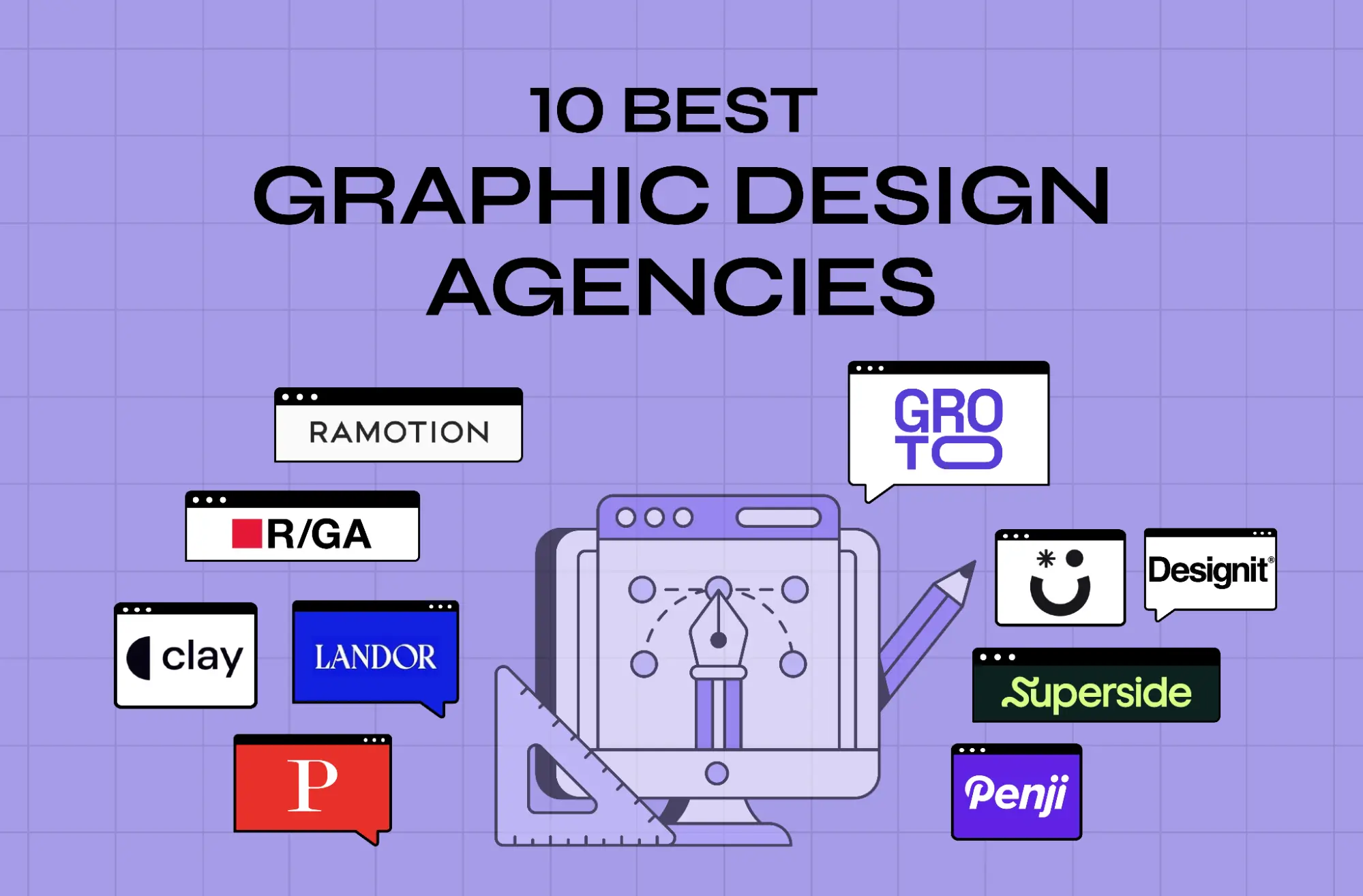
Pricing and positioning comparison of popular design subscription agencies and platforms.

1. Groto

Type: SaaS-native product design partner 

Best buyer type: SaaS product teams 

Website: letsgroto.com

If your primary reason for looking at Superside was to get design help for your SaaS product — onboarding flows, dashboards, activation screens, design systems — Groto is the Superside alternative you should evaluate first. Not because it's cheaper (it's purpose-built, not commoditised), but because it's solving a fundamentally different and more pressing design problem for most SaaS companies. For a full breakdown of what SaaS UX design actually involves, the complete guide covers the discipline in depth. 

Superside designs marketing campaigns. We design SaaS products. The distinction matters because the design skills, methods, and outcome metrics are categorically different. UX research, information architecture, product screen design, and conversion flow optimisation require a product design partner — not a creative subscription platform.

We work with SaaS companies at the 5–200 employee stage on subscription-based engagements structured around clear product milestones : a rebuilt onboarding flow, a new dashboard architecture, a design system ready for engineering handoff. Every engagement is anchored to product outcomes — activation rate, feature adoption, upgrade conversion — not deliverable count.

For SaaS founders who have been looking at Superside to "get design handled," Groto addresses the design need that actually moves the product metrics.

  • Best for: SaaS founders and PMs at Seed to Series A stage who need product UX design — onboarding, dashboards, activation flows, design systems. See also our broader comparison of UX design companies for SaaS products if you want to evaluate more options in this category. 

  • Not right for: Teams that primarily need marketing asset production — social graphics, campaign materials, presentation design; consumer apps or e-commerce

  • Pricing: Starter ($2,399/mo · 2 hrs/day), Part-Time ($4,399/mo · 4 hrs/day), Full-Time ($5,999/mo · 6 hrs/day); pause up to 3 weeks, cancel anytime with credit 

2. ManyPixels

Type: Unlimited graphic design subscription Best buyer type: Growth-stage startups Pricing: $699–$2,599/month, month-to-month

ManyPixels is one of the most established design subscription services in the market and one of the most direct Superside alternatives for teams that need marketing and brand design without the enterprise price tag. For $699–$2,599/month on a month-to-month basis, you get a dedicated designer, unlimited design requests, and a turnaround of 1–2 business days per request.

The positioning is squarely against Superside's cost and commitment model. Where Superside requires a $120K+ annual commitment, ManyPixels can be cancelled monthly and started for under $700.

  • Best for: Startups and SMBs needing consistent marketing design output without Superside's price floor or annual lock-in

  • Not right for: Teams needing complex motion graphics, video, 3D, or product UX design; companies requiring multiple simultaneous active requests

  • Pricing: $699/month (Advanced) to $2,599/month (Dedicated Designer); month-to-month with pause option

3. Designity

Type: Managed creative-as-a-service 

Best buyer type: Enterprise creative ops 

Pricing: Plus ($5,495/mo), Premium ($8,495/mo), Custom (from $6k/mo) 

Designity positions itself as the quality-focused Superside alternative, with a model that includes a dedicated Creative Director managing a curated team drawn from their top 3% of vetted designers. The managed layer — a human Creative Director who handles briefing, quality review, and team coordination — is Designity's primary differentiator from self-service subscriptions.

For enterprise teams that want Superside's managed model with a dedicated Creative Director, curated top-3% talent, and a 2-week trial before committing, Designity is the closest structural equivalent — with comparable pricing but more flexibility in engagement terms.

  • Best for: Mid-market and enterprise marketing teams that want a managed creative model with quality oversight and more contract flexibility than Superside.Before shortlisting any managed service, reviewing what skills a UI/UX agency must have in 2026 gives you a concrete evaluation lens to apply during the trial period. 

  • Not right for: Early-stage startups with limited design budgets; companies that need product UX or SaaS-specific design work

  • Pricing: Plus ($5,495/mo · 120 hrs), Premium ($8,495/mo · 180 hrs), Custom (from $6k/mo); 2-week trial, no upfront payment 

4. Design Pickle

Type: Creative hours subscription Best buyer type: High-volume marketing teams with predictable output needs Pricing: From ~$1,918/month

Design Pickle overhauled its pricing model in mid-2025, moving from flat-fee unlimited plans to a creative hours billing system. Under the new model, you purchase daily creative hours (2, 4, 8 hours, etc.) alongside a platform access fee ($119–$299/month). Entry-level production starts at around $1,918/month for a 2-hour daily plan.

The platform has built significant infrastructure around asset management and revision workflows, which makes it operationally mature. For teams with predictable, high-volume output needs who want precise capacity planning, the hours model offers something flat-fee subscriptions don't.

  • Best for: Marketing and content teams with high-volume, repeatable design needs and predictable daily output requirements

  • Not right for: Teams looking for the flat-fee unlimited model (that no longer exists at Design Pickle); product design or UX work; teams on a tight budget

  • Pricing: Platform access ($119–$299/month) + creative hours; entry-level production from ~$1,918/month

5. Penji

Type: Unlimited graphic design subscription Best buyer type: Growing marketing teams  Pricing: $995–$4,500/month

Penji's 2026 pricing positions it as a step up from entry-level subscriptions, with plans built around active workstream management rather than simple request queues. The Marketing & Ads plan at $995/month covers graphic design, ads, web, and illustrations with 2 active projects and a 1-day turnaround. The Agency plan at $1,995/month adds motion graphics, short-form video, Art Director oversight, and white-label delivery. For teams needing embedded creative leadership, the Creative Team plan at $4,500/month includes a dedicated pod, front-end development, and Senior Art Director management. 

  • Best for: Growing marketing teams and agencies that need structured creative production with Art Director oversight and motion/video capability 

  • Not right for: Teams on tight budgets looking for the cheapest entry point — ManyPixels starts lower; product or UX design 

  • Pricing: Marketing & Ads ($995/mo), Agency ($1,995/mo), Creative Team ($4,500/mo); 30-day money-back guarantee, no contracts 

6. Kimp

Type: Unlimited graphic design + video subscription 

Best buyer type: Teams needing design and video together 

Pricing: $1,397/month (Graphics) or $1,697/month (Graphics + Video)

Kimp's differentiator is the bundled graphic design and video offering — two dedicated teams (one design, one video) under a single subscription, running on independent tracks so video requests don't delay graphics work and vice versa. For marketing teams running video content alongside static creative, the consolidated model eliminates the need for a separate video production vendor.

  • Best for: Marketing teams running both graphic and video content programmes who want a single vendor subscription covering both needs

  • Not right for: Teams that only need graphic design (the video bundle adds cost without benefit); product UX or brand strategy work; high-end video production beyond short-form social content

  • Pricing: Graphics ($1,397/mo), Video ($1,397/mo), or Graphics + Video ($1,697/mo); 7-day free trial, no contract, pause at $19.95/month 

7. Teamtown

Type: Design subscription — enterprise tier, month-to-month 

Best buyer type: Growing teams and brands that need a dedicated creative team without agency lock-in 

Pricing: From $3,000/month, no long-term contracts 

Teamtown operates on an hours-based subscription model with three tiers — Essentials (from $3,000/month), Pro (from $4,800/month), and Studio (from $6,300/month) — each with a dedicated team of 3–5 designers, a Design Lead, and Slack collaboration built in. Unlike Superside's fixed annual commitment, every Teamtown plan can be paused or cancelled anytime, and unused hours roll over for one month. The scope is broad: ads, social, email, presentation, web, illustration, motion, branding, Webflow/Framer development, and copywriting are all included depending on tier. 

  • Best for: Growing marketing teams and scaleups that need a dedicated, multi-discipline creative team with flexible hours and no agency contracts 

  • Not right for: Teams needing only occasional design output; SaaS product design 

  • Pricing: Essentials from $3,000/month, Pro from $4,800/month, Studio from $6,300/month; no contracts, pause or cancel anytime, 15-day money-back guarantee 

8. Graphically

Type: Unlimited graphic design subscription Best buyer type: Agencies and high-output marketing teams Pricing: From $449/month 

Graphically is a design subscription service with a particular strength in agency-style workflows — white-labelling, multi-brand management, and high output volume. For marketing agencies that have used Superside for client work, or in-house marketing teams managing multiple sub-brands, Graphically's multi-brand capability is a meaningful operational advantage.

  • Best for: Marketing agencies, in-house teams managing multiple brands, and companies with high-volume, multi-brand design needs

  • Not right for: Complex motion or 3D work; product UX design; companies that need strategic creative direction rather than execution

  • Pricing: Standard ($449/mo), Premium ($599/mo); no contracts, 7-day free trial 

How to Choose the Right Superside Alternative

The single most important question is: what type of design do you actually need? Once you've answered that, the broader question of how to choose the right design agency — with a practical, non-generic checklist — gives you a structured evaluation process before you commit. 

Most alternatives comparisons treat all design work as equivalent — but the gap between marketing graphic design and SaaS product design is as large as the gap between copywriting and software engineering. They're both "design," but they require entirely different skills, methods, and output metrics.

You need product design (UX, dashboards, onboarding, design systems)

  • Superside cannot help with this, regardless of budget.

  • The right alternative is a SaaS product design partner — evaluate Groto, or if your need spans web design as well as product UX, the list of B2B web design agencies covers services that bridge both disciplines. 

You need marketing design without Superside's price floor ($10K+/month)

  • ManyPixels ($699/mo) or Kimp ($1,397/mo) cover most standard marketing formats at a fraction of Superside's minimum cost.

  • For teams needing motion, video, and Art Director oversight at a mid-tier price: Penji ($995–$1,995/mo). 

You need managed creative quality (Creative Director, quality oversight) at lower cost

  • Designity is the closest structural equivalent to Superside's managed model — Creative Director-led, top-3% talent, with a 2-week trial and more flexible engagement terms. Before committing, it's worth knowing how to evaluate a design agency's portfolio before you hire so the trial period is used effectively. 

You need Superside-equivalent scope but want month-to-month flexibility

  • Teamtown (from $3,000/month) offers a dedicated creative team with flexible hours and no annual commitment 

You need graphic + video bundled

  • Kimp's Graphics + Video plan at $1,697/month covers both needs under one subscription.

Key Takeaways

  • Superside's $10,000–$25,000+/month minimum and 12-month annual commitment price out most SaaS startups and growth-stage companies before the conversation starts.

  • The right Superside alternative depends on what type of design you need — not just what you can afford. Marketing graphic design and SaaS product design are different disciplines requiring different vendors.

  • For SaaS companies whose primary design need is product UX (onboarding, dashboards, activation flows), Superside is the wrong category of service regardless of budget. Groto is built for exactly this need.

  • For teams needing marketing design at a fraction of Superside's cost: ManyPixels and Kimp deliver reliable output from $699–$1,697/month; Penji sits in the mid-tier at $995–$1,995/month with motion and video included.

For enterprises that want Superside-quality without the annual lock-in: Designity and Teamtown offer managed creative models with greater engagement flexibility — Designity with a Creative Director-led team from $5,495/month, Teamtown with hours-based plans from $3,000/month. Whichever service you choose, calculating the ROI of UX design gives you the framework to measure whether the spend is actually moving the metrics that matter.

Superside costs $10,000+/month with a mandatory 12-month commitment — making it inaccessible for most SaaS and growth-stage teams. Here are 8 purpose-matched alternatives across product design, marketing subscriptions, and managed creative services.

8 Superside alternatives matched to your design need and budget.

Superside is a powerful creative operations platform — and it's priced accordingly.

With subscriptions starting at $10,000 per month and a mandatory annual commitment, Superside's minimum spend is $120,000 per year before you've seen a single deliverable. For enterprise marketing teams running high-volume campaign production across multiple channels, that investment can make sense. For most SaaS companies, startups, and growing product teams, it doesn't.

The teams searching for a Superside alternative are usually in one of three situations: they've been quoted a price that's beyond their current runway, they've outgrown Superside's marketing-asset focus and need product design capability, or they signed an annual contract and found the output quality or specialisation didn't match the spend. Some teams leaving Superside are also reconsidering the agency model entirely — the agency vs. in-house designer breakdown is worth reading before you decide whether another service or a hire is the right next move. 

Each situation calls for a different kind of alternative. This guide doesn't just list services — it matches eight options to four distinct buyer types who outgrow or pass on Superside, using what we call the Design Capacity Decision framework.

TL;DR

  • Superside starts at $10,000/month with a mandatory 12-month commitment — making it viable only for enterprise marketing teams at scale.

  • Most teams searching for a Superside alternative fall into one of four buyer types: SaaS product teams, growth-stage startups, high-volume marketing teams, or enterprise creative ops. If you're also comparing other product design subscriptions, Eleken alternatives covers a closely related set of options for SaaS-focused teams. 

  • For SaaS companies needing product UX design (not marketing creative), Superside is the wrong category of service entirely. Groto is built for this.

  • Budget-friendly alternatives for marketing design: ManyPixels ($699/mo), Penji ($995/mo), Kimp ($1,397/mo).

  • For enterprise scope without the annual lock-in: Designity and Teamtown.

Why Teams Look for a Superside Alternative

Comparison between marketing creative services and SaaS product design needs for growth-focused companies.

Before diving into the alternatives, it helps to be clear about what Superside does well and where it falls short — because the right alternative depends entirely on the gap you're trying to fill.

What Superside does well: High-volume marketing creative for enterprise teams. Campaign assets, social graphics, presentation design, motion graphics, and brand-consistent output at scale. For teams evaluating Superside specifically for brand work, our list of top branding agencies covers the broader landscape beyond subscription-model services. 

If you're a 500-person company running quarterly product launches with 40 marketing deliverables each, Superside's managed model is genuinely efficient.

Want to know where your users are dropping off?

We’ll break down the exact moments users lose interest, and why.

Where Superside falls short for SaaS companies:

Cost and commitment that price out most growth-stage teams

  • $120K+/year annual contracts are enterprise procurement decisions, not startup budget line items. For a broader breakdown of what design agency pricing actually looks like across tiers, the pricing guide covers the full range from freelancer to enterprise retainer. 

  • SaaS companies at Seed or Series A rarely have that level of design budget available in a single vendor contract.

  • The model offers no flexibility to scale spend up or down as priorities shift.

Marketing creative is not the same as product design

  • Superside excels at brand and campaign execution — not UX research, SaaS dashboard design, onboarding flow optimisation, or design systems work.

  • If your most urgent design need is fixing your activation rate, not producing campaign assets, Superside is the wrong category of service entirely.

No SaaS-specialised product thinking

  • Superside's team executes on briefs. For SaaS companies that need a design partner who understands product metrics, user flows, and activation/retention strategy, that execution-only model produces work that looks good in isolation but misses the product context that makes design commercially effective. If you're unclear on the distinction, what a UI/UX design agency actually delivers explains the roles, responsibilities, and deliverables you should expect from a genuine product design partner. 

The Design Capacity Decision: 4 Buyer Types

Buyer-type breakdown showing the best design subscription alternatives for different business needs.

Most Superside alternatives posts list services alphabetically or by price. The more useful lens is buyer type — what you actually need design capacity for. If your need falls on the product side rather than marketing, the best product design agencies list covers that category specifically. 

Buyer Type

Primary Design Need

What Superside Gets Wrong

Best Alternative Type

SaaS product team

Product UX, dashboards, onboarding, design systems

Doesn't do product design

Specialist SaaS product partner

Growth-stage startup

Marketing + brand design, no annual lock-in

Too expensive, 12-month commitment

Flexible subscription service

High-volume marketing team

Campaign assets at scale, lower cost

Can't justify $120K+ minimum

Budget design subscription

Enterprise creative ops

Superside-equivalent quality, more flexibility

Annual contract, rigid engagement

Managed creative alternative

The eight alternatives below are matched to these buyer types. Not every service is right for every situation — and the right answer is almost always to choose the service that matches your actual design category, not just your budget.

8 Best Superside Alternatives in 2026

Pricing and positioning comparison of popular design subscription agencies and platforms.

1. Groto

Type: SaaS-native product design partner 

Best buyer type: SaaS product teams 

Website: letsgroto.com

If your primary reason for looking at Superside was to get design help for your SaaS product — onboarding flows, dashboards, activation screens, design systems — Groto is the Superside alternative you should evaluate first. Not because it's cheaper (it's purpose-built, not commoditised), but because it's solving a fundamentally different and more pressing design problem for most SaaS companies. For a full breakdown of what SaaS UX design actually involves, the complete guide covers the discipline in depth. 

Superside designs marketing campaigns. We design SaaS products. The distinction matters because the design skills, methods, and outcome metrics are categorically different. UX research, information architecture, product screen design, and conversion flow optimisation require a product design partner — not a creative subscription platform.

We work with SaaS companies at the 5–200 employee stage on subscription-based engagements structured around clear product milestones : a rebuilt onboarding flow, a new dashboard architecture, a design system ready for engineering handoff. Every engagement is anchored to product outcomes — activation rate, feature adoption, upgrade conversion — not deliverable count.

For SaaS founders who have been looking at Superside to "get design handled," Groto addresses the design need that actually moves the product metrics.

  • Best for: SaaS founders and PMs at Seed to Series A stage who need product UX design — onboarding, dashboards, activation flows, design systems. See also our broader comparison of UX design companies for SaaS products if you want to evaluate more options in this category. 

  • Not right for: Teams that primarily need marketing asset production — social graphics, campaign materials, presentation design; consumer apps or e-commerce

  • Pricing: Starter ($2,399/mo · 2 hrs/day), Part-Time ($4,399/mo · 4 hrs/day), Full-Time ($5,999/mo · 6 hrs/day); pause up to 3 weeks, cancel anytime with credit 

2. ManyPixels

Type: Unlimited graphic design subscription Best buyer type: Growth-stage startups Pricing: $699–$2,599/month, month-to-month

ManyPixels is one of the most established design subscription services in the market and one of the most direct Superside alternatives for teams that need marketing and brand design without the enterprise price tag. For $699–$2,599/month on a month-to-month basis, you get a dedicated designer, unlimited design requests, and a turnaround of 1–2 business days per request.

The positioning is squarely against Superside's cost and commitment model. Where Superside requires a $120K+ annual commitment, ManyPixels can be cancelled monthly and started for under $700.

  • Best for: Startups and SMBs needing consistent marketing design output without Superside's price floor or annual lock-in

  • Not right for: Teams needing complex motion graphics, video, 3D, or product UX design; companies requiring multiple simultaneous active requests

  • Pricing: $699/month (Advanced) to $2,599/month (Dedicated Designer); month-to-month with pause option

3. Designity

Type: Managed creative-as-a-service 

Best buyer type: Enterprise creative ops 

Pricing: Plus ($5,495/mo), Premium ($8,495/mo), Custom (from $6k/mo) 

Designity positions itself as the quality-focused Superside alternative, with a model that includes a dedicated Creative Director managing a curated team drawn from their top 3% of vetted designers. The managed layer — a human Creative Director who handles briefing, quality review, and team coordination — is Designity's primary differentiator from self-service subscriptions.

For enterprise teams that want Superside's managed model with a dedicated Creative Director, curated top-3% talent, and a 2-week trial before committing, Designity is the closest structural equivalent — with comparable pricing but more flexibility in engagement terms.

  • Best for: Mid-market and enterprise marketing teams that want a managed creative model with quality oversight and more contract flexibility than Superside.Before shortlisting any managed service, reviewing what skills a UI/UX agency must have in 2026 gives you a concrete evaluation lens to apply during the trial period. 

  • Not right for: Early-stage startups with limited design budgets; companies that need product UX or SaaS-specific design work

  • Pricing: Plus ($5,495/mo · 120 hrs), Premium ($8,495/mo · 180 hrs), Custom (from $6k/mo); 2-week trial, no upfront payment 

4. Design Pickle

Type: Creative hours subscription Best buyer type: High-volume marketing teams with predictable output needs Pricing: From ~$1,918/month

Design Pickle overhauled its pricing model in mid-2025, moving from flat-fee unlimited plans to a creative hours billing system. Under the new model, you purchase daily creative hours (2, 4, 8 hours, etc.) alongside a platform access fee ($119–$299/month). Entry-level production starts at around $1,918/month for a 2-hour daily plan.

The platform has built significant infrastructure around asset management and revision workflows, which makes it operationally mature. For teams with predictable, high-volume output needs who want precise capacity planning, the hours model offers something flat-fee subscriptions don't.

  • Best for: Marketing and content teams with high-volume, repeatable design needs and predictable daily output requirements

  • Not right for: Teams looking for the flat-fee unlimited model (that no longer exists at Design Pickle); product design or UX work; teams on a tight budget

  • Pricing: Platform access ($119–$299/month) + creative hours; entry-level production from ~$1,918/month

5. Penji

Type: Unlimited graphic design subscription Best buyer type: Growing marketing teams  Pricing: $995–$4,500/month

Penji's 2026 pricing positions it as a step up from entry-level subscriptions, with plans built around active workstream management rather than simple request queues. The Marketing & Ads plan at $995/month covers graphic design, ads, web, and illustrations with 2 active projects and a 1-day turnaround. The Agency plan at $1,995/month adds motion graphics, short-form video, Art Director oversight, and white-label delivery. For teams needing embedded creative leadership, the Creative Team plan at $4,500/month includes a dedicated pod, front-end development, and Senior Art Director management. 

  • Best for: Growing marketing teams and agencies that need structured creative production with Art Director oversight and motion/video capability 

  • Not right for: Teams on tight budgets looking for the cheapest entry point — ManyPixels starts lower; product or UX design 

  • Pricing: Marketing & Ads ($995/mo), Agency ($1,995/mo), Creative Team ($4,500/mo); 30-day money-back guarantee, no contracts 

6. Kimp

Type: Unlimited graphic design + video subscription 

Best buyer type: Teams needing design and video together 

Pricing: $1,397/month (Graphics) or $1,697/month (Graphics + Video)

Kimp's differentiator is the bundled graphic design and video offering — two dedicated teams (one design, one video) under a single subscription, running on independent tracks so video requests don't delay graphics work and vice versa. For marketing teams running video content alongside static creative, the consolidated model eliminates the need for a separate video production vendor.

  • Best for: Marketing teams running both graphic and video content programmes who want a single vendor subscription covering both needs

  • Not right for: Teams that only need graphic design (the video bundle adds cost without benefit); product UX or brand strategy work; high-end video production beyond short-form social content

  • Pricing: Graphics ($1,397/mo), Video ($1,397/mo), or Graphics + Video ($1,697/mo); 7-day free trial, no contract, pause at $19.95/month 

7. Teamtown

Type: Design subscription — enterprise tier, month-to-month 

Best buyer type: Growing teams and brands that need a dedicated creative team without agency lock-in 

Pricing: From $3,000/month, no long-term contracts 

Teamtown operates on an hours-based subscription model with three tiers — Essentials (from $3,000/month), Pro (from $4,800/month), and Studio (from $6,300/month) — each with a dedicated team of 3–5 designers, a Design Lead, and Slack collaboration built in. Unlike Superside's fixed annual commitment, every Teamtown plan can be paused or cancelled anytime, and unused hours roll over for one month. The scope is broad: ads, social, email, presentation, web, illustration, motion, branding, Webflow/Framer development, and copywriting are all included depending on tier. 

  • Best for: Growing marketing teams and scaleups that need a dedicated, multi-discipline creative team with flexible hours and no agency contracts 

  • Not right for: Teams needing only occasional design output; SaaS product design 

  • Pricing: Essentials from $3,000/month, Pro from $4,800/month, Studio from $6,300/month; no contracts, pause or cancel anytime, 15-day money-back guarantee 

8. Graphically

Type: Unlimited graphic design subscription Best buyer type: Agencies and high-output marketing teams Pricing: From $449/month 

Graphically is a design subscription service with a particular strength in agency-style workflows — white-labelling, multi-brand management, and high output volume. For marketing agencies that have used Superside for client work, or in-house marketing teams managing multiple sub-brands, Graphically's multi-brand capability is a meaningful operational advantage.

  • Best for: Marketing agencies, in-house teams managing multiple brands, and companies with high-volume, multi-brand design needs

  • Not right for: Complex motion or 3D work; product UX design; companies that need strategic creative direction rather than execution

  • Pricing: Standard ($449/mo), Premium ($599/mo); no contracts, 7-day free trial 

How to Choose the Right Superside Alternative

The single most important question is: what type of design do you actually need? Once you've answered that, the broader question of how to choose the right design agency — with a practical, non-generic checklist — gives you a structured evaluation process before you commit. 

Most alternatives comparisons treat all design work as equivalent — but the gap between marketing graphic design and SaaS product design is as large as the gap between copywriting and software engineering. They're both "design," but they require entirely different skills, methods, and output metrics.

You need product design (UX, dashboards, onboarding, design systems)

  • Superside cannot help with this, regardless of budget.

  • The right alternative is a SaaS product design partner — evaluate Groto, or if your need spans web design as well as product UX, the list of B2B web design agencies covers services that bridge both disciplines. 

You need marketing design without Superside's price floor ($10K+/month)

  • ManyPixels ($699/mo) or Kimp ($1,397/mo) cover most standard marketing formats at a fraction of Superside's minimum cost.

  • For teams needing motion, video, and Art Director oversight at a mid-tier price: Penji ($995–$1,995/mo). 

You need managed creative quality (Creative Director, quality oversight) at lower cost

  • Designity is the closest structural equivalent to Superside's managed model — Creative Director-led, top-3% talent, with a 2-week trial and more flexible engagement terms. Before committing, it's worth knowing how to evaluate a design agency's portfolio before you hire so the trial period is used effectively. 

You need Superside-equivalent scope but want month-to-month flexibility

  • Teamtown (from $3,000/month) offers a dedicated creative team with flexible hours and no annual commitment 

You need graphic + video bundled

  • Kimp's Graphics + Video plan at $1,697/month covers both needs under one subscription.

Key Takeaways

  • Superside's $10,000–$25,000+/month minimum and 12-month annual commitment price out most SaaS startups and growth-stage companies before the conversation starts.

  • The right Superside alternative depends on what type of design you need — not just what you can afford. Marketing graphic design and SaaS product design are different disciplines requiring different vendors.

  • For SaaS companies whose primary design need is product UX (onboarding, dashboards, activation flows), Superside is the wrong category of service regardless of budget. Groto is built for exactly this need.

  • For teams needing marketing design at a fraction of Superside's cost: ManyPixels and Kimp deliver reliable output from $699–$1,697/month; Penji sits in the mid-tier at $995–$1,995/month with motion and video included.

For enterprises that want Superside-quality without the annual lock-in: Designity and Teamtown offer managed creative models with greater engagement flexibility — Designity with a Creative Director-led team from $5,495/month, Teamtown with hours-based plans from $3,000/month. Whichever service you choose, calculating the ROI of UX design gives you the framework to measure whether the spend is actually moving the metrics that matter.

Have a project in mind?

Let’s talk through your idea and see what makes sense.

Harpreet Singh

Founder at Groto

Have a project in mind?

Let’s talk through your idea and see what makes sense.

Harpreet Singh

Founder at Groto

FAQ

Everything you were going to ask (and a few things you didn’t know to)

What is the best Superside alternative overall in 2026?

The answer depends entirely on the design type you need. For SaaS product design — onboarding flows, dashboards, design systems — Groto is the strongest fit because it's the only option built specifically for that category of work. For marketing creative, ManyPixels and Penji are the most-recommended options across community discussions and independent reviews, offering flat-fee month-to-month plans that cost a fraction of Superside's minimum spend. For enterprise teams that want managed creative quality without Superside's annual lock-in, Designity (from $5,495/month, Creative Director-led) and Teamtown (from $3,000/month, hours-based) are the closest structural equivalents.

Are there free Superside alternatives?

There are no free Superside alternatives that offer a comparable level of managed, professional design output — the model requires real designers and real production time. That said, several services offer trial periods before committing: Kimp offers a 7-day free trial, Penji offers a 30-day money-back guarantee, and ManyPixels offers a 14-day money-back guarantee. These are the closest things to a risk-free entry point in the subscription design category. If your needs are very occasional, tools like Canva offer a free DIY tier — but that requires design skill and time on your part rather than delivering production-ready assets.

What are the best Superside alternatives for small businesses?

Small businesses are typically priced out of Superside before the conversation starts. The best-fit alternatives at smaller budgets are Graphically (from $449/month), ManyPixels (from $699/month), and Kimp (from $1,397/month for graphics + video) — all month-to-month with no annual commitment. For small SaaS companies that need product design specifically — not just marketing graphics — Groto operates on project-based sprints rather than a monthly retainer, which can make it more accessible than a sustained agency engagement. The key question for small businesses is always design type first, then budget: the cheapest option for the wrong category of work is still a waste of spend.

How does Design Pickle compare to Superside as an alternative?

They're in different categories. Superside is an enterprise creative operations platform starting at $10,000/month; Design Pickle is a design subscription service. Worth noting for 2026: Design Pickle significantly changed its pricing model in mid-2025, moving from flat-fee unlimited plans to a creative hours billing system. Entry-level production now starts at around $1,918/month — nearly double what it used to cost — plus a platform access fee. For teams that previously chose Design Pickle as a budget-friendly Superside alternative, that equation has changed. ManyPixels and Penji now offer more straightforward value at comparable or lower price points for most marketing design use cases.

What does Superside actually do, and why doesn't it work for every team?

Superside is a managed creative-as-a-service platform built for enterprise marketing teams. It gives companies access to a dedicated team of designers, project managers, and creative specialists across disciplines — campaign production, motion graphics, brand assets, social creative, and more — through a fixed monthly subscription. What it does not do is product design. There is no UX research, no SaaS screen design, no design systems work, and no product-metric thinking built into the engagement model. For SaaS companies, this is the critical gap. Superside executes marketing briefs well; it cannot design the onboarding flow, dashboard architecture, or feature adoption experience that actually drives product growth. That is a fundamentally different discipline requiring a different kind of partner.
What do people on Reddit say about Superside alternatives?

Community discussions consistently surface a few recurring themes: Superside's pricing is the most common reason people start looking for alternatives, followed by the mandatory annual commitment. For marketing-focused teams, ManyPixels and Penji appear most frequently as recommended substitutes — cited for their flat-fee simplicity and month-to-month flexibility. For teams with enterprise scope, Designity comes up as the closest managed-model alternative. A less commonly addressed point in community discussions — but an important one — is that many SaaS founders searching for a "Superside alternative" are actually looking for product design help, not a marketing creative service. In that case, none of the typical alternatives apply, and a specialist SaaS product design partner is the right category entirely.

What is the best Superside alternative overall in 2026?

The answer depends entirely on the design type you need. For SaaS product design — onboarding flows, dashboards, design systems — Groto is the strongest fit because it's the only option built specifically for that category of work. For marketing creative, ManyPixels and Penji are the most-recommended options across community discussions and independent reviews, offering flat-fee month-to-month plans that cost a fraction of Superside's minimum spend. For enterprise teams that want managed creative quality without Superside's annual lock-in, Designity (from $5,495/month, Creative Director-led) and Teamtown (from $3,000/month, hours-based) are the closest structural equivalents.

Are there free Superside alternatives?

There are no free Superside alternatives that offer a comparable level of managed, professional design output — the model requires real designers and real production time. That said, several services offer trial periods before committing: Kimp offers a 7-day free trial, Penji offers a 30-day money-back guarantee, and ManyPixels offers a 14-day money-back guarantee. These are the closest things to a risk-free entry point in the subscription design category. If your needs are very occasional, tools like Canva offer a free DIY tier — but that requires design skill and time on your part rather than delivering production-ready assets.

What are the best Superside alternatives for small businesses?

Small businesses are typically priced out of Superside before the conversation starts. The best-fit alternatives at smaller budgets are Graphically (from $449/month), ManyPixels (from $699/month), and Kimp (from $1,397/month for graphics + video) — all month-to-month with no annual commitment. For small SaaS companies that need product design specifically — not just marketing graphics — Groto operates on project-based sprints rather than a monthly retainer, which can make it more accessible than a sustained agency engagement. The key question for small businesses is always design type first, then budget: the cheapest option for the wrong category of work is still a waste of spend.

How does Design Pickle compare to Superside as an alternative?

They're in different categories. Superside is an enterprise creative operations platform starting at $10,000/month; Design Pickle is a design subscription service. Worth noting for 2026: Design Pickle significantly changed its pricing model in mid-2025, moving from flat-fee unlimited plans to a creative hours billing system. Entry-level production now starts at around $1,918/month — nearly double what it used to cost — plus a platform access fee. For teams that previously chose Design Pickle as a budget-friendly Superside alternative, that equation has changed. ManyPixels and Penji now offer more straightforward value at comparable or lower price points for most marketing design use cases.

What does Superside actually do, and why doesn't it work for every team?

Superside is a managed creative-as-a-service platform built for enterprise marketing teams. It gives companies access to a dedicated team of designers, project managers, and creative specialists across disciplines — campaign production, motion graphics, brand assets, social creative, and more — through a fixed monthly subscription. What it does not do is product design. There is no UX research, no SaaS screen design, no design systems work, and no product-metric thinking built into the engagement model. For SaaS companies, this is the critical gap. Superside executes marketing briefs well; it cannot design the onboarding flow, dashboard architecture, or feature adoption experience that actually drives product growth. That is a fundamentally different discipline requiring a different kind of partner.
What do people on Reddit say about Superside alternatives?

Community discussions consistently surface a few recurring themes: Superside's pricing is the most common reason people start looking for alternatives, followed by the mandatory annual commitment. For marketing-focused teams, ManyPixels and Penji appear most frequently as recommended substitutes — cited for their flat-fee simplicity and month-to-month flexibility. For teams with enterprise scope, Designity comes up as the closest managed-model alternative. A less commonly addressed point in community discussions — but an important one — is that many SaaS founders searching for a "Superside alternative" are actually looking for product design help, not a marketing creative service. In that case, none of the typical alternatives apply, and a specialist SaaS product design partner is the right category entirely.
More Articles

Extreme close-up black and white photograph of a human eye

Let’s bring your vision to life

Tell us what's on your mind? We'll hit you back in 24 hours. No fluff, no delays - just a solid vision to bring your idea to life.

Profile portrait of a man in a white shirt against a light background

Harpreet Singh

Founder and Creative Director

Get in Touch

Extreme close-up black and white photograph of a human eye

Let’s bring your vision to life

Tell us what's on your mind? We'll hit you back in 24 hours. No fluff, no delays - just a solid vision to bring your idea to life.

Profile portrait of a man in a white shirt against a light background

Harpreet Singh

Founder and Creative Director

Get in Touch

Extreme close-up black and white photograph of a human eye

Let’s bring your vision to life

Tell us what's on your mind? We'll hit you back in 24 hours. No fluff, no delays - just a solid vision to bring your idea to life.

Profile portrait of a man in a white shirt against a light background

Harpreet Singh

Founder and Creative Director

Get in Touch