Most YC founders approach design as a one-size-fits-all decision. It isn't. From the 90-day batch sprint to your first in-house hire, here's how design needs evolve — and how to match your agency engagement to each stage.
Stage-matched design decisions for YC founders — from Demo Day to Series A.

Most guides on finding a UX design agency for startups read like a curated Clutch listing: here are ten agencies, here are their prices, here is what Stripe said about them — the top product design agencies guide does exactly that, and it's useful as a starting list once you know what to look for. What none of them address is the timing problem — the question of whether you should be hiring a UX design agency at all right now, and if so, what type, and why the design priority at three months post-YC looks nothing like the priority at eighteen months post-YC.
At Groto, we work with SaaS and AI founders at the stage where design decisions start to compound — seed to Series A. The pattern we see over and over is founders who hired a UX design agency at the wrong moment for the wrong problem, got mediocre output, concluded that "design agencies don't work," and then arrived at a later stage with a product that was harder to redesign because so many wrong decisions had been baked in. The agency wasn't the problem. The timing and the model were.
This guide is for YC founders specifically because the YC context creates a particular set of design pressures — Demo Day, the 90-day sprint culture, the fundraising-product tension — that most agency guides don't acknowledge. Here's how to navigate them correctly.
TL;DR
YC startups have three design inflection points — pre-Demo Day, post-Demo Day to seed, and post-seed to Series A — each requiring a completely different type of engagement
Hiring the wrong model at the wrong stage is more expensive than not hiring at all
Before Demo Day: run a 2–3 week sprint to sharpen the product's core value proposition — not a full redesign
Post-Demo Day: shift to conversion-focused design — onboarding flows, landing pages, activation — before you scale acquisition
Post-seed: establish design system foundations before your first in-house hire, or they'll spend 6 months cleaning up debt instead of building product
Agency = strategic depth. Subscription = execution volume. Freelancer = task-based. In-house = post-Series A. Match the model to the stage.
Don't hire a UX agency if you haven't validated your core product assumption — design is an execution tool, not a strategy tool
The best design agencies for YC startups are the ones who'll tell you when agency work isn't what you need
Why YC Startups Are Different as Design Clients
The YC environment creates design constraints that don't exist for other early-stage companies.
A hard deadline that concentrates attention. Demo Day is unlike any external deadline most products face. Design decisions made in those 90 days are made under pressure and rarely revisited until the product starts creating friction at scale.
Compressed growth timelines. The median YC company that raises after Demo Day goes from pre-product to handling real users within 3–6 months. That's a narrow window to make UI and UX decisions that will define the product's character for the next 18 months.
Sophisticated audiences from day one. YC companies attract early adopters, angels, and institutional investors who have strong pattern recognition for products that look provisional versus products that look like they have a clear design direction. Design quality at the early stage signals founder judgment — not just aesthetic preference.
The combination of these factors means design decisions for a YC startup need to be made more deliberately than for most companies of the same stage. That's what a good UX design agency brings.
The YC Design Inflection Points — Groto's Framework for Stage-Matched Design
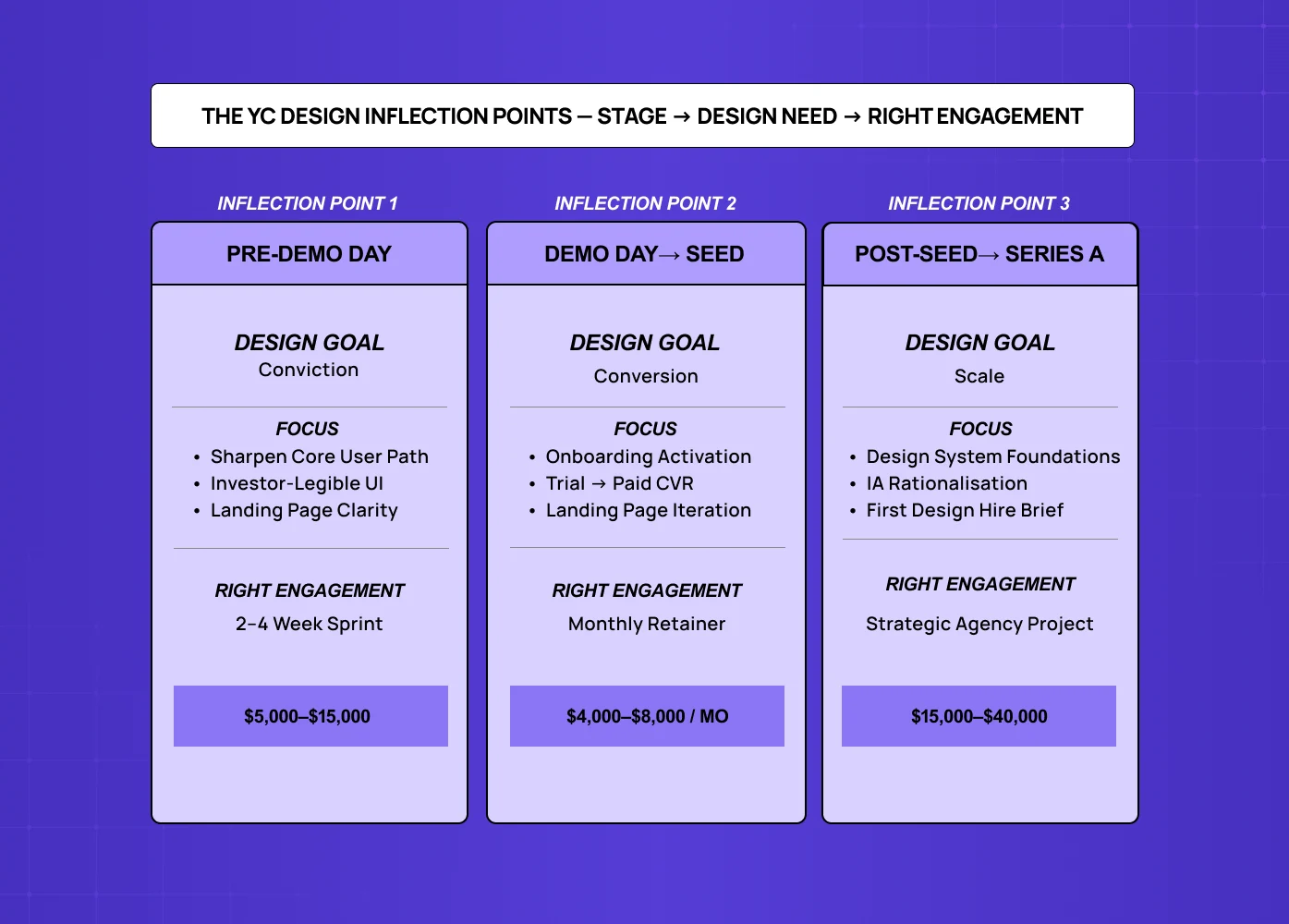
The most important insight we've developed working with post-YC founders is that design needs change dramatically across the first two years — and the type of agency engagement that creates value at each stage is completely different. We map this across three inflection points.
Inflection Point 1 — Pre-Demo Day (Batch → Demo Day)
At this stage, the design job is to communicate conviction. Investors are evaluating whether the product works, whether the team understands their user, and whether the design reflects clarity of thinking about the problem.
The right UX engagement here is a short, strategic sprint:
Audit the critical path through your product
Remove UX friction that obscures the core value proposition
Ensure the landing page tells a coherent, investor-ready story
This is not a full product redesign — that's a distraction. It's a design sharpening exercise, usually 2–4 weeks; the principles behind MVP UX design for SaaS apply directly to scoping this sprint correctly. A UX design agency that pushes you toward a complete overhaul during the batch isn't aligned with your interests. The ones worth engaging at this stage are experienced enough to tell you what not to redesign.
Inflection Point 2 — Post-Demo Day to Seed (Months 3–12)
This is where design decisions have the most direct impact on commercial outcomes. After Demo Day, YC companies raising seed rounds are simultaneously acquiring first real users, iterating on onboarding, and optimising for Series A metrics — ARR, activation rate, retention. All of these are directly shaped by UX decisions made in this window; the complete guide to SaaS UX design is the reference for understanding what those decisions actually involve.
The right engagement here shifts toward ongoing design capacity with a conversion focus:
Landing pages that convert paid traffic
Onboarding flows that reach the activation moment faster
Dashboard UI that makes the product's core value immediately visible
This is also where we see the most expensive design mistakes. Two failure modes show up constantly:
Over-investing — commissioning a full design system or extensive user research when you should be moving fast and testing assumptions
Under-investing — assuming a developer can "make it look good enough" when you're already asking users to hand over credit cards or share sensitive data
The second iteration of an onboarding flow that was never designed properly takes 3× longer than getting it right the first time.
Inflection Point 3 — Post-Seed to Series A (Months 12–24)
After the seed round, design needs change fundamentally. You're no longer building for early adopters who forgive rough edges. You're building for a broader market, and the product needs to communicate maturity and reliability.
The right engagement here is strategic and structural:
Design system foundations
Information architecture rationalisation
Hiring the first in-house designer into a clear framework rather than a blank slate
At Groto, we often work with Series A-stage companies as a design partner who builds bespoke design foundations — the component hierarchy, the design token system, the interaction principles — that an in-house designer can then extend. For founders open to global partnerships at this stage, UI/UX design agencies in India increasingly deliver this structural depth at a cost profile that makes the engagement viable earlier than it would be with US-only options. Getting this wrong means your first design hire spends their first 6 months cleaning up debt instead of building product.
What to Look For in a UX Design Agency as a YC Founder
Some selection criteria apply regardless of which inflection point you're at.
SaaS-native experience. A generalist agency that has designed a hospital website, a restaurant app, and a fintech dashboard will approach your B2B SaaS product with generic UX assumptions. You need a team that has a working mental model of how SaaS users evaluate, activate, and retain — the full list of skills a UI/UX agency must have in 2026 gives founders a concrete checklist for verifying this before hiring.
Structured process, not just portfolio output. Any agency can show you a Dribbble shot. What matters is whether they can explain the design decisions behind it — what user behaviour data informed a layout change, what was tested, what was iterated on. A structured UI/UX portfolio evaluation framework gives you the questions to ask before you read a single case study. The process is the product.
Stage alignment. Ask specifically whether the agency has worked with pre-seed or seed-stage companies before, and ask what those engagements looked like. An agency whose typical client is a 200-person company will apply 200-person-company rigour to a 12-person startup — and the result is a 6-month engagement that produces work you could have had in 6 weeks. For the full selection framework beyond stage fit, the guide on how to choose the right web design agency covers the complete decision criteria.
Honest scope boundaries. A good UX design agency will tell you clearly what they can and can't do. Can they diagnose your conversion problem, or just execute changes to your landing page? Can they make a strategic recommendation about your information architecture, or just produce screens against a brief? Understanding what a UI/UX design agency actually does in terms of roles and deliverables is the baseline for knowing whether the answers you're
Agency, Subscription, Freelancer, In-House — Which Model Fits Your Stage?
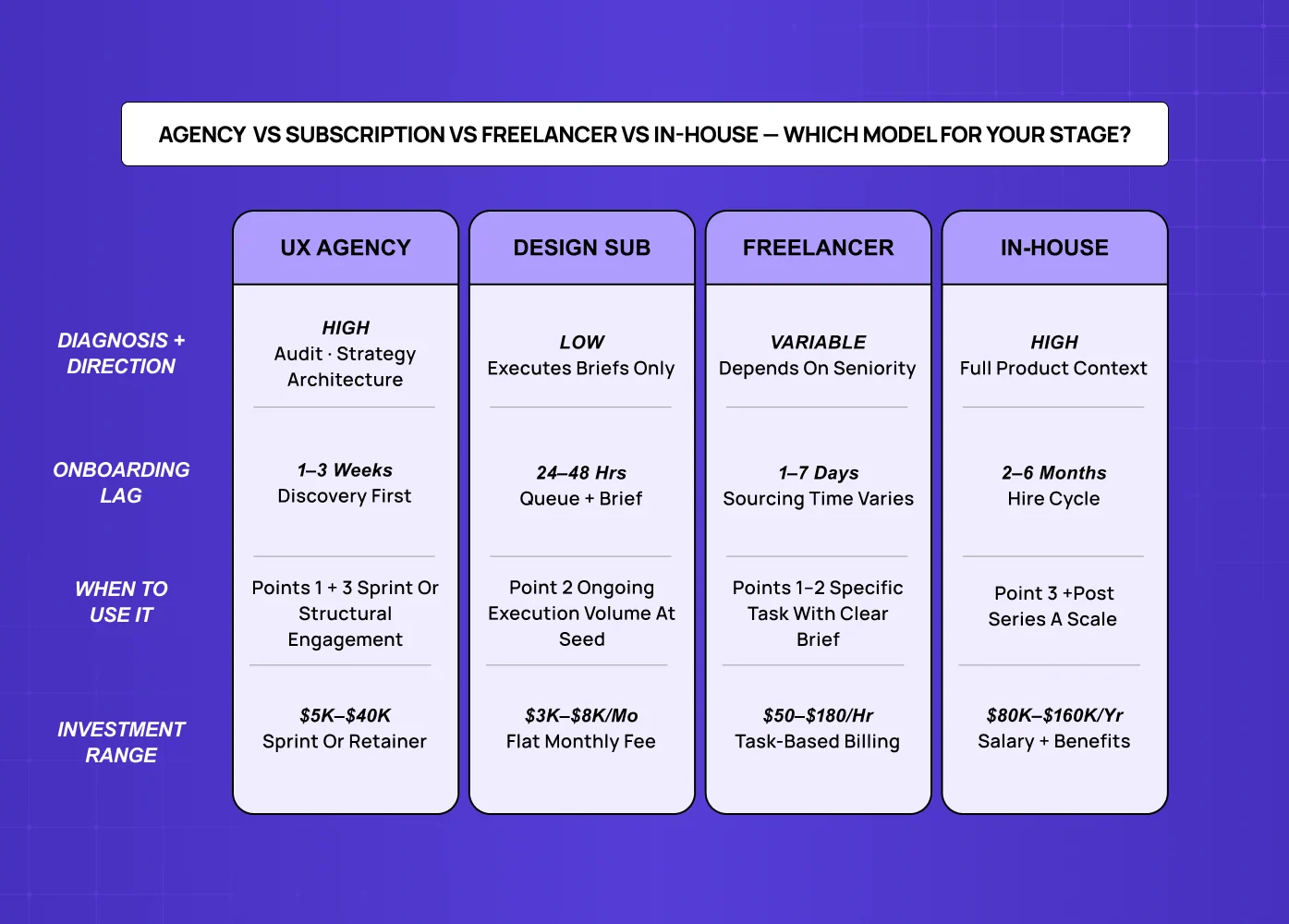
One of the most common decisions YC founders get wrong isn't which agency to hire — a SaaS specialist, an app design agency, a generalist — it's which design model to use in the first place. Each model serves a different function, operates at a different speed, and fits a different inflection point.
UX Agency — High strategic depth. Best at Inflection Points 1 and 3, where diagnosis, design architecture, or Demo Day readiness is the priority — for an overview of which UX design companies for SaaS products operate at this level, that guide covers the full landscape. Onboarding takes 1–3 weeks due to discovery, and investment typically runs $5K–$40K depending on sprint or retainer scope.
Design Subscription — Execution at volume. Best at Inflection Point 2, where you need continuous output — landing pages, onboarding screens, feature UI — against a clear brief. Starts within 24–48 hours at a flat $3K–$8K/month.
Freelancer — Flexible and task-based. Useful at Inflection Points 1–2 for specific, well-scoped deliverables. Strategic depth varies significantly with seniority, and billing runs $50–$180/hour.
In-House — Full product ownership and context. The right model post-Series A when design volume and consistency justify a $80K–$160K/year hire. Hire cycles of 2–6 months make this the slowest model to spin up — for founders working through the UX agency vs. in-house designer decision before committing to either, that guide covers the full trade-off framework.
The rule the table enforces: match the model to the inflection point — not to the price point, and not to what worked for another founder at a different stage; the same logic decides whether combining design and development under one partner beats splitting them across two.
Five Design Mistakes YC Founders Make — and What They Cost
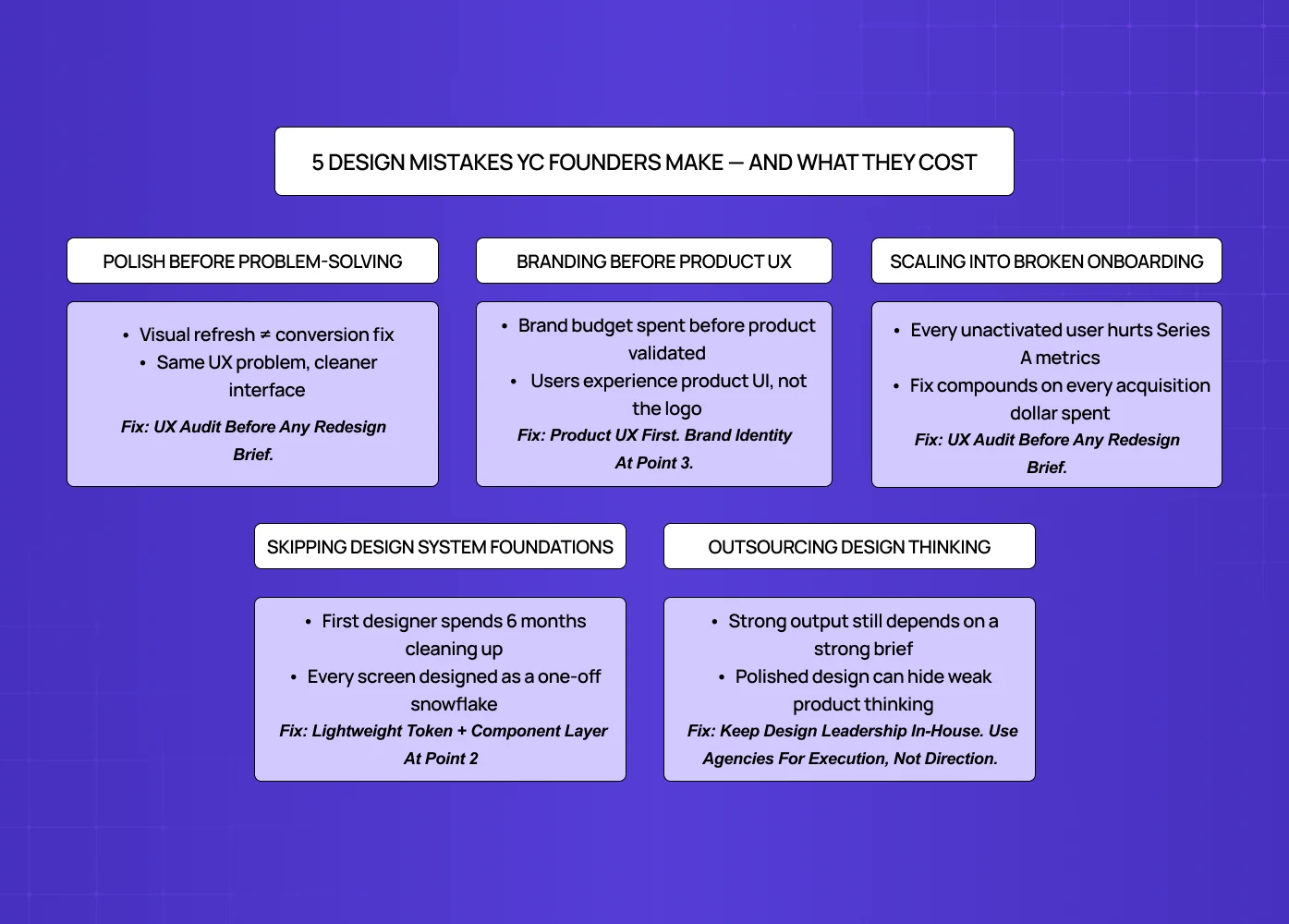
1. Hiring for polish instead of problem-solving. If your activation rate is 20%, redesigning the product to look cleaner will produce a cleaner-looking product with a 20% activation rate. A UX audit needs to precede the redesign.
2. Starting with branding before product. In the first 6–12 months, the product UI is your brand. Users experience your brand through every interaction with your product, not through your logo. Invest in product UX first. Brand identity — and the startup branding agencies worth engaging for it — is an Inflection Point 3 priority.
3. Scaling a broken onboarding flow. Pouring paid acquisition into a product with a 30% onboarding completion rate is a predictable and avoidable mistake. Every user you acquire but don't activate becomes a data point that makes your Series A metrics harder to tell a clean story around — the guide on how to fix SaaS onboarding drop-offs with UX covers the diagnostic and execution approach for this specific problem. A 2–3 week UX engagement on the onboarding flow before scaling acquisition is one of the highest ROI investments a YC company can make — the guide on calculating the ROI of UX design gives founders the framework for making that case to co-founders or investors before the sprint begins.
4. Skipping the design system and paying for it at Series A. The cost of skipping design foundations is invisible until you're 18 months in, trying to build a design team, and discovering that every screen was designed as a unique snowflake. At Groto, we build lightweight design foundations — the token and component layer that makes every subsequent design decision faster — and we do it at Inflection Point 2, before the debt compounds.
5. Treating agency work as a replacement for design leadership. A UX design agency executes against direction. Founders who outsource design thinking entirely — not just design execution — end up with technically proficient output that doesn't reflect a coherent product philosophy. The agency produces what was asked for; it's not their job to ask whether what was asked for is right.
When NOT to Hire a UX Design Agency as a YC Startup
You haven't validated the core product assumption. If you're still figuring out who the user is and what the core job-to-be-done is, design work is premature. Build something ugly and test it first.
You're using design as a substitute for a technical co-founder. A polished set of mockups is not a product. Investors know the difference.
Your design needs are purely execution-based. If you know exactly what needs to be designed and can write a clear brief, a product design subscription at $3,000–$6,000/month will serve you better than a $15,000/month agency retainer — the web design agency pricing guide covers where these numbers come from and how to benchmark them against your actual engagement scope. Reserve the agency engagement for when you need strategic input, diagnosis, or structural design work.
How Groto Works With YC-Stage Companies
Our YC-stage engagements are structured around the inflection points described above. We don't offer a generic "startup package" — the engagement model is matched to where the company is in its design maturity.
Inflection Point 1 — A 2–3 week sprint: design audit of the critical user path, landing page assessment, and prioritised execution on the highest-impact items. Goal: Demo Day readiness, not a complete redesign.
Inflection Point 2 — A monthly retainer covering conversion-focused product and marketing design: onboarding flows, landing pages, feature UI, and dashboard design. Output is directly tied to activation rate, trial-to-paid conversion, and time-to-value.
Inflection Point 3 — A structured engagement delivering design system foundations, UX architecture review, and a design hiring brief. Goal: leave the in-house design team a framework they can extend, not a mess they have to interpret.
Conclusion
The question of which UX design agency to hire — narrowed by a top US agencies shortlist — is less important than the question of what kind of engagement to pursue at your current stage. A few points to take away:
YC startups have three distinct design inflection points — each requiring a different type of engagement
The costliest seed-stage design mistake is scaling acquisition into a product with a broken onboarding flow
Skipping design system foundations in year one creates debt you'll pay back at 3× the cost during your first in-house design hire's first six months
Don't hire a UX agency before validating the core product assumption — design is an execution tool, not a strategy tool
The best agencies for YC startups are the ones who will tell you when agency work isn't what you need
At Groto, we work with YC-stage companies because we understand the timeline compression, the fundraising pressure, and the compounding nature of early design decisions. If you're post-batch and figuring out where design sits in your next 6 months, a discovery call is where that conversation starts.
Book a discovery call →