Website Maintenance for SaaS Companies: Why "Set It and Forget It" Kills Conversions

10 min read

10 min read

Web Design

Website maintenance for SaaS isn't IT work — it's a design discipline that protects your conversion rate, pipeline, and brand credibility every single month.

Website Maintenance for SaaS Companies: Why "Set It and Forget It" Kills Conversions

10 min read

10 min read

Web Design

Website maintenance for SaaS isn't IT work — it's a design discipline that protects your conversion rate, pipeline, and brand credibility every single month.

Most SaaS teams treat website maintenance as an IT task. It isn't. It's the ongoing discipline that determines whether your website converts, whether enterprise buyers trust your product, and whether your brand reflects what you've actually built.

Your SaaS website is degrading right now. Here's how to stop it.
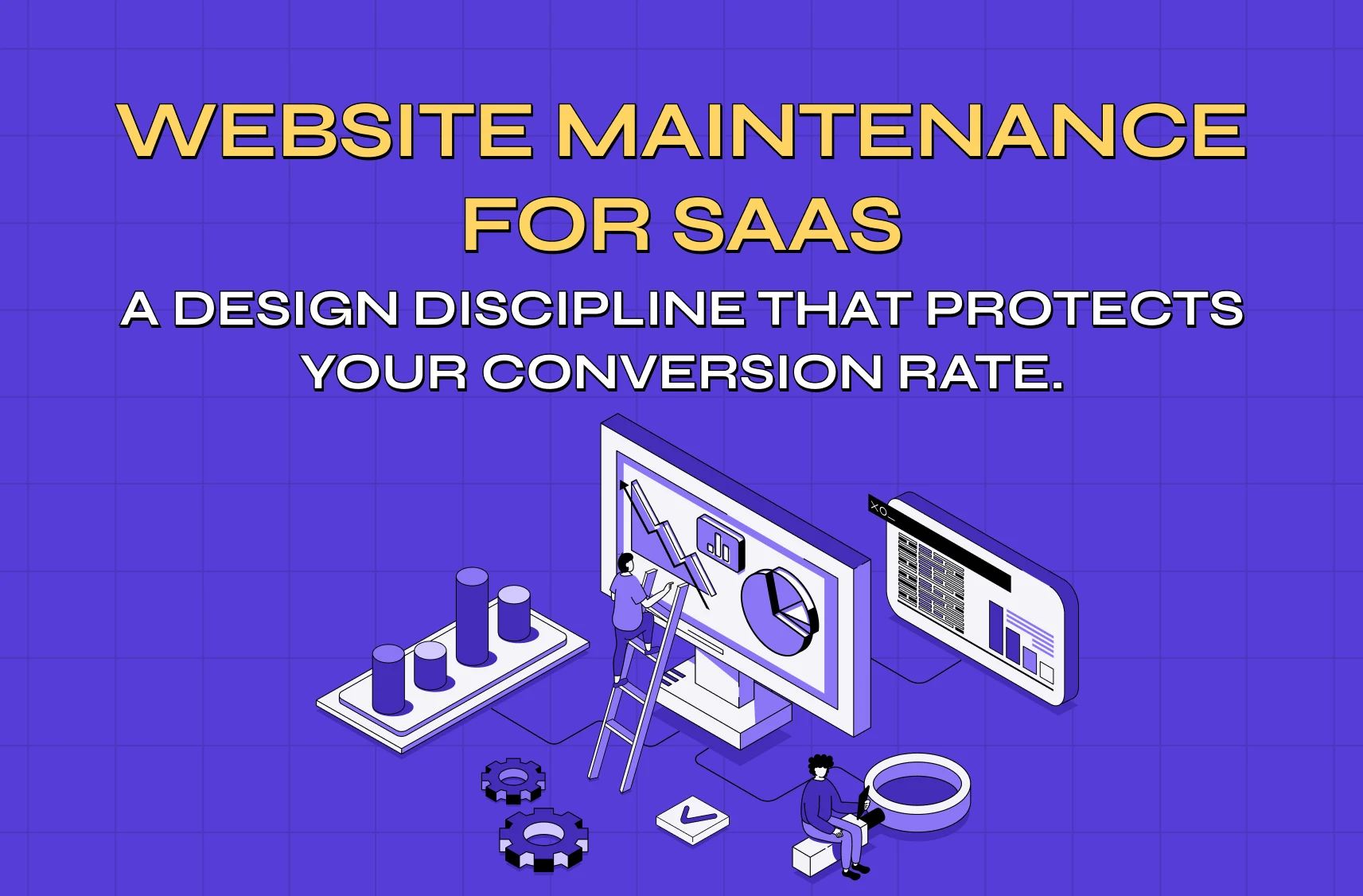
Illustration of a person on a ladder analyzing large dashboard charts on a screen, with surrounding data visuals and UI elements.

Most SaaS companies treat website maintenance the way they treat fire extinguishers — they know it's there, they're glad it exists, and they hope they never need to think about it. A developer updates a plugin when it breaks something. A designer refreshes a screenshot when a new feature ships. Someone notices the pricing page still says "$9/month" three weeks after you raised prices.

This is not a website maintenance plan. This is controlled neglect.

Website maintenance for a SaaS company is not a technical housekeeping task. It's an ongoing design and performance discipline that directly determines:

  • Whether your website converts visitors into trial users

  • Whether enterprise buyers trust your product enough to book a call

  • Whether your brand communicates what your product has actually become — not what it was when you hired your first designer

The SaaS teams that treat website maintenance as a strategic function, not an afterthought, consistently see compounding returns on marketing investment that their neglect-first competitors can't explain or replicate.

At Groto, we've audited and maintained websites for SaaS companies at every stage from pre-seed to Series B. The pattern is consistent: website maintenance problems look like marketing problems until you look closely enough, and by then, the pipeline damage is done.

TL;DR

  • SaaS websites degrade silently — stale screenshots, outdated pricing, and design inconsistencies accumulate long before anyone notices in the data

  • Website maintenance for SaaS operates across five layers: technical, performance, content currency, design coherence, and conversion optimisation

  • Most teams are only running layer one — which manages risk but creates no value

  • Maintenance debt shows up as a conversion problem, a pipeline problem, or a brand credibility problem before it looks like a website problem

  • A complete maintenance plan has monthly, quarterly, and annual tasks — each with named ownership

  • Website maintenance cost should be evaluated as a percentage of the revenue your website generates, not as a line item to minimise

What Is Website Maintenance?

Website maintenance is the ongoing set of activities — technical, design, content, and performance — required to keep a website functioning correctly, ranking well, loading fast, and converting effectively. It's the difference between a website that compounds in value over time and a website that degrades quietly while your team is focused elsewhere.

In the traditional web development framing, website maintenance services cover the basics:

  • Security patching and software updates

  • Backup management and uptime monitoring

  • Occasional content edits

These are necessary. They are not sufficient for a SaaS company whose website is also its primary sales asset.

For SaaS companies specifically, website maintenance operates at five distinct layers — each of which has direct implications for revenue. A website maintenance plan that addresses only the technical layer is managing risk, not creating value. A plan that addresses all five is building a compound asset.

Want to know where your users are dropping off?

We’ll break down the exact moments users lose interest, and why.

Want to know where your users are dropping off?

We’ll break down the exact moments users lose interest, and why.

Why SaaS Website Maintenance Is Different

The standard website maintenance services guide was written for a WordPress blog or a local business directory listing. SaaS website maintenance operates under entirely different pressure.

Your website is your primary sales rep 

  • For most SaaS products under $500 MRR, the website handles 80–90% of qualification and conversion before a human gets involved.

  • Every hour your pricing page is unclear, your hero copy is outdated, or your social proof is stale — your sales process is running on a broken engine.

Your product changes faster than your website

  • SaaS products ship new features every two weeks; most SaaS websites are updated every six months.

  • The result: screenshots that don't match the current UI, value props that exclude the features enterprise buyers care about, and case studies that predate your best results.

  • This misalignment is one of the most common causes of "good traffic, bad conversion" we see in SaaS pipeline audits.

Your buyers are doing research

  • Enterprise SaaS buyers look at your website before they take a sales call

  • Broken links, outdated pricing, security warnings, or inconsistent design all communicate product quality before a single conversation happens

  • We've seen design-quality concerns raised explicitly in post-close win/loss interviews: "The website looked a bit dated, so we weren't sure about the product"

Design debt compounds 

  • Every month a SaaS website goes without maintenance, small misalignments accumulate — a new brand colour that wasn't applied to the blog, a CTA that was changed on mobile but not desktop, a product screenshot from a UI that was redesigned a year ago. 

  • None of these individually kills conversion. 

  • Together, they create a website that feels inconsistent, slightly off-brand, and subtly untrustworthy. 

  • By the time a team notices, they're looking at a full redesign that a maintenance plan would have prevented — and the signs your SaaS website needs a redesign are often already visible months before the team connects them to maintenance neglect. 

The SaaS Site Maintenance Stack — Groto's Five-Layer Framework
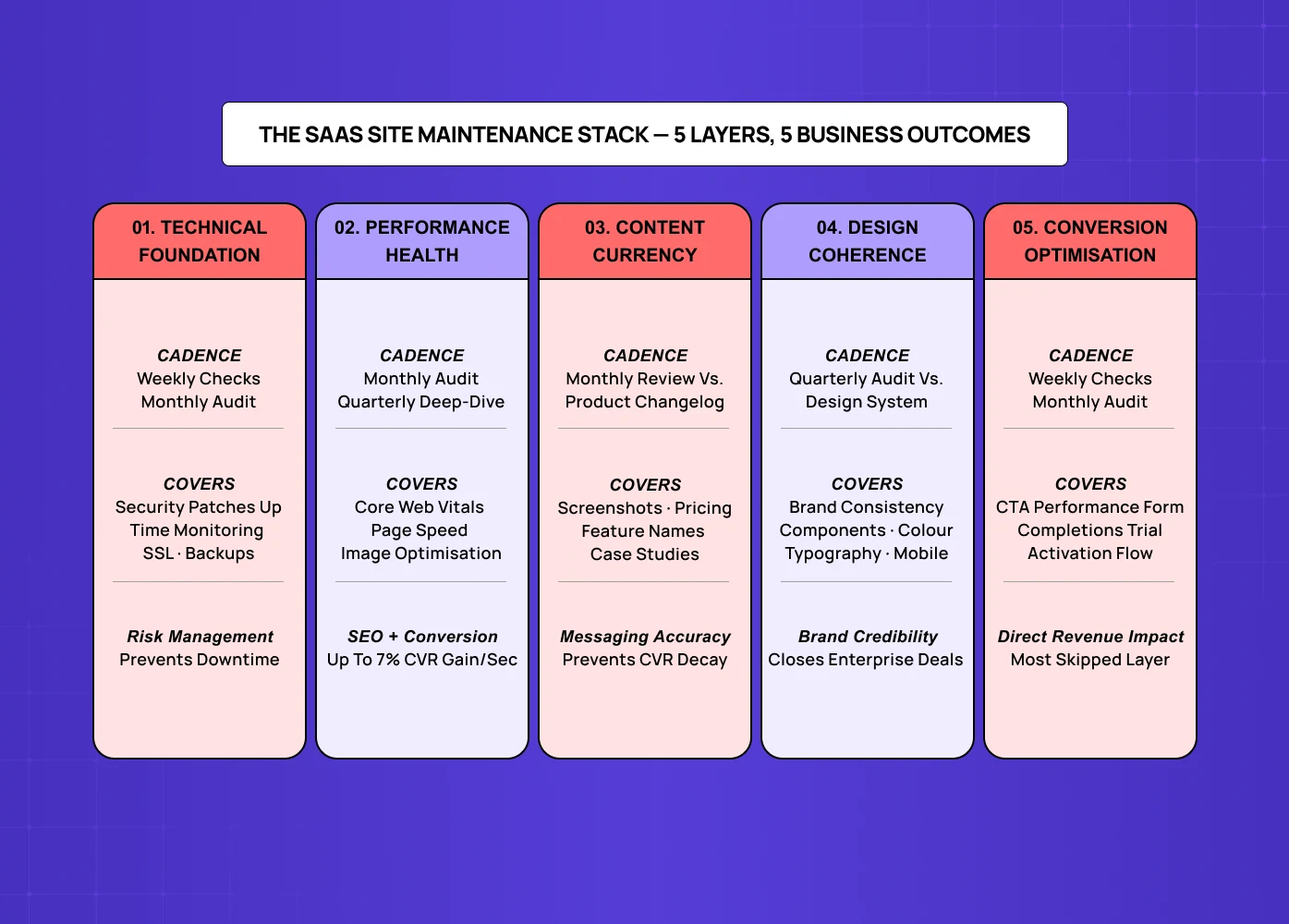
SaaS site maintenance stack showing five layers: technical foundation, performance, content, design coherence, and conversion optimization.

At Groto, we organise website maintenance across five layers. Each layer has different work, different cadence, and different business impact. A complete website maintenance plan covers all five. Most SaaS teams are only running layer one.

Layer 1 — Technical Foundation

The layer every maintenance guide covers. Security patches, CMS and plugin updates, SSL certificate renewal, uptime monitoring, automated backups, and broken link detection. This layer is about risk management: preventing downtime, preventing data loss, preventing security breaches.

Work cadence: weekly checks, monthly audit. This is the floor — not the ceiling of a website maintenance plan.

Layer 2 — Performance Health

Page speed, Core Web Vitals, image optimisation, render-blocking scripts, and server response time. Google's 2021 Page Experience update made performance a direct ranking factor. More importantly, a one-second delay in page load time reduces conversion rates by up to 7% (Akamai research). For a SaaS company with 10,000 monthly visitors and a 3% trial conversion rate, a one-second improvement is worth measurable ARR.

Work cadence: monthly audit, quarterly deep-dive. Most SaaS teams run a performance check once during initial launch and never again.

Layer 3 — Content Currency

Screenshots match the current UI. Feature names match the current product. Pricing is accurate. Case study results are the most recent available. Team page reflects the current team. Blog archive is internally linked to current product pages.

This is the layer most likely to be deteriorating right now on your website, silently. At Groto, we find content currency issues in 90% of SaaS websites we audit — not because teams are negligent, but because product moves faster than website update cycles.

Work cadence: monthly review against product changelog. Assign a named owner to each key page with a review date.

Layer 4 — Design Coherence

Brand consistency across all pages: typography, colour palette, spacing, button styles, component patterns, illustration style. As SaaS companies evolve — new designers, new brand guidelines, new product positioning — small design inconsistencies accumulate across the site. The homepage looks different from the blog. The pricing page uses an old button style. The mobile nav doesn't match the desktop interaction pattern.

Design coherence maintenance isn't a redesign. It's a systematic review of every page against a current design system, identifying and closing the gaps — the same incremental

improvement approach behind the most actionable web design tips for improving a website without starting over

Work cadence: quarterly audit against design system. Flag and batch inconsistencies for a dedicated fix sprint.

Layer 5 — Conversion Optimisation

The layer most SaaS teams treat as a separate project — if they do it at all. CTA placement, copy clarity, form completion rates, trial activation flow performance, and heatmap review. This layer asks the question: is the website performing as well as it should, given the traffic it's receiving?

At Groto, we treat conversion review as part of website maintenance, not a separate initiative. Teams running this for the first time typically start with a structured UX audit process before moving into conversion benchmarking — it surfaces the friction points that data alone misses. A quarterly review of high-traffic pages against conversion benchmarks consistently surfaces quick wins — CTA copy that hasn't been updated since a messaging change, a mobile form that was never optimised, a demo page that's getting significant traffic but converting below average. 

Work cadence: quarterly audit against design system, with a concurrent review of how the website's structure and information architecture hold up against current navigation needs. Flag and batch inconsistencies for a dedicated fix sprint. 

Website Maintenance Checklist: Monthly, Quarterly, and Annual
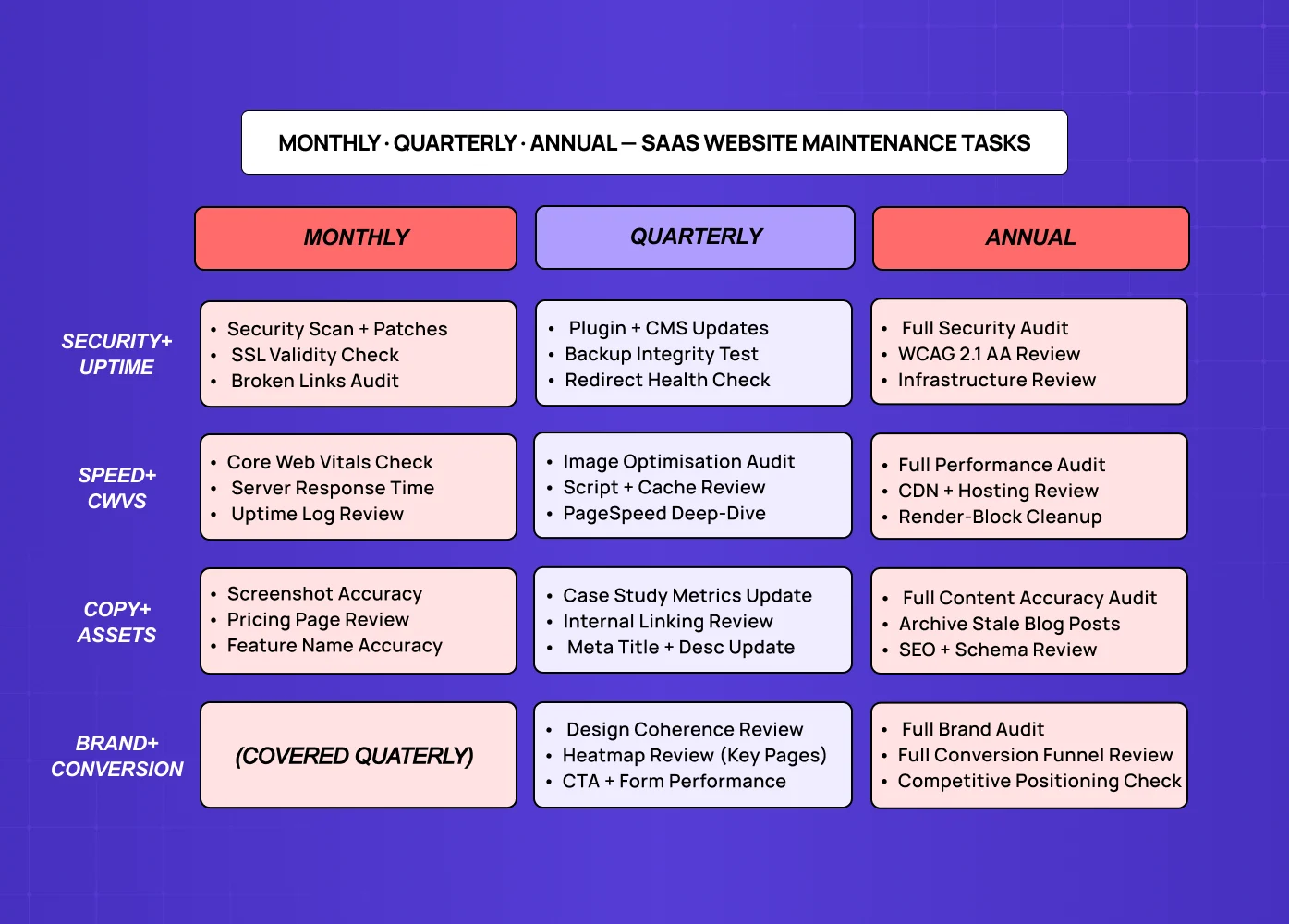
Breakdown of SaaS website maintenance tasks organized monthly, quarterly, and annually across security, speed, content, and conversion.

A complete website maintenance plan has different tasks at different cadences. For founders running an initial pass before building a formal plan, the guide on how to self-audit your website covers the starting point. Here's what a full SaaS website maintenance checklist should cover. 

Monthly tasks

  • Run security scan and apply outstanding patches

  • Check uptime and server response time logs

  • Verify SSL certificate validity and auto-renewal

  • Audit all forms for submission accuracy and notification delivery

  • Review broken links across key pages

  • Cross-check product screenshots and feature names against current product

  • Review pricing page accuracy

  • Check Core Web Vitals in Google Search Console

  • Review top 10 traffic-driving pages for content accuracy

Quarterly tasks

  • Full design coherence review against design system

  • Conversion rate review for primary landing pages and CTAs

  • Heatmap review of homepage, pricing, and demo pages

  • Update case studies with most recent available metrics

  • Review and update meta titles and meta descriptions for top pages

  • Mobile experience review across primary user journeys

  • Check and update internal linking structure

  • Archive or redirect outdated blog content

  • Performance audit: image optimisation, script audit, cache review

Annual tasks

  • Full technical audit: security, performance, accessibility (WCAG 2.1 AA)

  • Full content audit: accuracy, relevance, internal link health

  • Brand audit: every page reviewed against current brand guidelines

  • Competitive positioning review: does the website reflect current differentiation vs. competitors?

  • Full conversion funnel review: trial flow, demo booking, contact form completion

  • Review and update all SEO metadata, structured data, and sitemap

Website Maintenance Cost: What SaaS Companies Should Budget
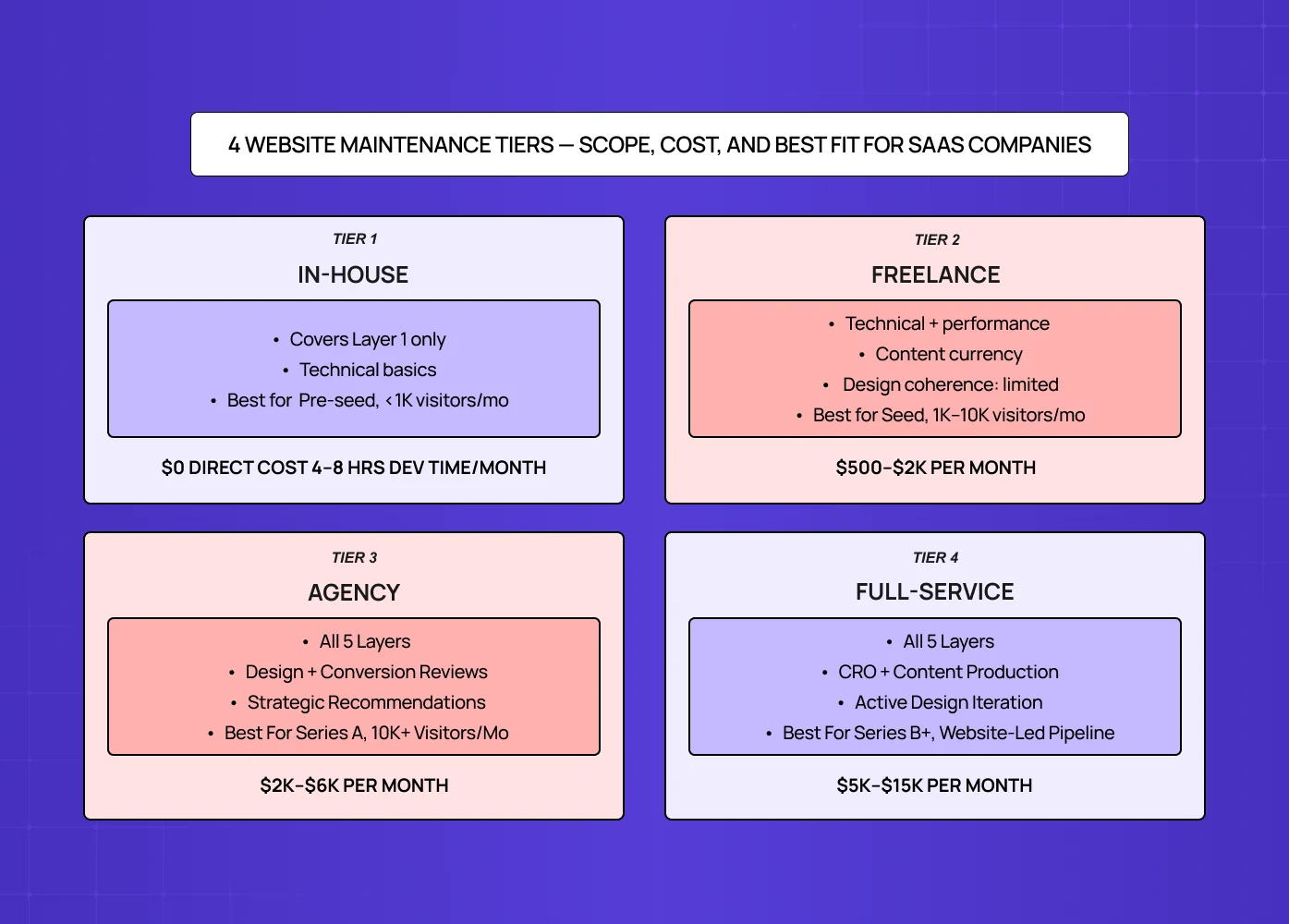
Comparison of four website maintenance tiers—In-house, Freelance, Agency, and Full-service—with scope, cost, and best-fit use cases.

Website maintenance cost varies significantly based on what's included, who's providing it, and the complexity of the site. For SaaS companies, a realistic breakdown:

DIY or internal developer coverage: 

  • Scope: Technical layer only (Layer 1)

  • Direct cost: $0

  • Hidden cost: 4–8 developer hours/month

  • Gap: Does not cover Layers 2–5; this is why design and conversion debt accumulates at most early-stage SaaS companies.

Freelance or part-time coverage: 

  • Scope: Layers 1–3 (technical, performance, content currency)

  • Cost: $500–$2,000/month

  • Gap: Design coherence and conversion optimisation not systematically covered.

Agency-led maintenance (all five layers): 

  • Scope: All five layers

  • Cost: $2,000–$6,000/month depending on site complexity and traffic

  • Includes: Quarterly design reviews, conversion analysis, strategic recommendations — not just keeping the lights on

Full-service retainer (maintenance + growth): 

  • Scope: Maintenance + active CRO, content production, design iteration

  • Cost: $5,000–$15,000/month

  • Best fit: Series A and above where the website is a significant pipeline driver

The right website maintenance cost for a SaaS company is a function of how much traffic and pipeline your website generates. If your website drives $500K ARR annually, spending $30K/year on comprehensive maintenance is a 6% operational cost on a critical revenue asset. Most SaaS teams spend more than that on tools they use for internal meetings — and significantly less than they'd spend on a full rebuild; the breakdown of how much a website redesign costs puts the maintenance investment in direct context. 

When Poor Website Maintenance Is Hurting Your Pipeline

These are the signals we see at Groto when a SaaS website's maintenance debt has crossed from cosmetic into pipeline-damaging:

Trial conversion rate is declining despite traffic growth. Traffic is up but trial signups aren't moving proportionally. Often caused by content currency decay — the website is attracting relevant traffic but failing to convert it because the messaging no longer matches what users found via search; the fixes fall squarely within how to improve website conversion rate without redesigning

Demo requests are lower quality than 12 months ago. Enterprise buyers are booking demos but coming in with incorrect expectations about features, pricing, or positioning. The website is selling a version of the product that no longer exists.

Competitors with inferior products are winning deals. Post-close loss interviews cite "their website looked more credible" or "they seemed more established." This is design coherence and brand perception — solvable with maintenance, not a rebrand.

Your team winces when they look at the website. Internal confidence in the website is a leading indicator. If the team that knows the product best doesn't think the website represents it well, buyers are noticing something too — and most of what they're noticing has documented patterns in bad UX design examples and how to fix them

Our work with PolicyBazaar involved a systematic maintenance audit that identified 47 distinct content currency issues, 12 design coherence failures, and 3 critical conversion bottlenecks across the main acquisition flow — none of which required a redesign to fix; the bar for when and how to redesign a website is higher than most teams assume. The result was a measurable improvement in demo request quality and a reduction in sales cycle length for enterprise prospects, attributable to the website telling a more accurate and consistent story.

Conclusion: Website Maintenance Is Not a Cost. It's a Compound Asset.

The SaaS teams that win on distribution aren't always the ones with the best product or the biggest marketing budgets. They're the ones whose website is accurate, fast, coherent, and converting — every month, not just after the last redesign.

A few things to take away:

  • Website maintenance for SaaS companies operates across five layers: technical, performance, content currency, design coherence, and conversion optimisation. Most teams are only running layer one.

  • The SaaS Site Maintenance Stack gives product and design teams a shared framework for assigning ownership, setting cadences, and measuring maintenance investment against business outcomes.

  • Website maintenance cost should be evaluated as a percentage of the revenue your website generates — not as a line item to minimise.

  • Content currency decay is the most common and most damaging form of maintenance neglect in SaaS — it happens silently and it shows up in conversion data before anyone notices visually.

  • Design coherence failures are cumulative. Small inconsistencies that seem trivial accumulate into a website that signals low product quality to enterprise buyers who've never seen your product; if that threshold has already been crossed, the question shifts to when to redesign your SaaS UI rather than maintain it.

  • A comprehensive website maintenance checklist covers monthly, quarterly, and annual tasks across all five layers — and assigns named ownership for each.

If your website feels like it's underperforming the traffic it's receiving — that's the conversation a Groto discovery call is built for.

Book a discovery call →

Most SaaS teams treat website maintenance as an IT task. It isn't. It's the ongoing discipline that determines whether your website converts, whether enterprise buyers trust your product, and whether your brand reflects what you've actually built.

Your SaaS website is degrading right now. Here's how to stop it.

Illustration of a person on a ladder analyzing large dashboard charts on a screen, with surrounding data visuals and UI elements.

Most SaaS companies treat website maintenance the way they treat fire extinguishers — they know it's there, they're glad it exists, and they hope they never need to think about it. A developer updates a plugin when it breaks something. A designer refreshes a screenshot when a new feature ships. Someone notices the pricing page still says "$9/month" three weeks after you raised prices.

This is not a website maintenance plan. This is controlled neglect.

Website maintenance for a SaaS company is not a technical housekeeping task. It's an ongoing design and performance discipline that directly determines:

  • Whether your website converts visitors into trial users

  • Whether enterprise buyers trust your product enough to book a call

  • Whether your brand communicates what your product has actually become — not what it was when you hired your first designer

The SaaS teams that treat website maintenance as a strategic function, not an afterthought, consistently see compounding returns on marketing investment that their neglect-first competitors can't explain or replicate.

At Groto, we've audited and maintained websites for SaaS companies at every stage from pre-seed to Series B. The pattern is consistent: website maintenance problems look like marketing problems until you look closely enough, and by then, the pipeline damage is done.

TL;DR

  • SaaS websites degrade silently — stale screenshots, outdated pricing, and design inconsistencies accumulate long before anyone notices in the data

  • Website maintenance for SaaS operates across five layers: technical, performance, content currency, design coherence, and conversion optimisation

  • Most teams are only running layer one — which manages risk but creates no value

  • Maintenance debt shows up as a conversion problem, a pipeline problem, or a brand credibility problem before it looks like a website problem

  • A complete maintenance plan has monthly, quarterly, and annual tasks — each with named ownership

  • Website maintenance cost should be evaluated as a percentage of the revenue your website generates, not as a line item to minimise

What Is Website Maintenance?

Website maintenance is the ongoing set of activities — technical, design, content, and performance — required to keep a website functioning correctly, ranking well, loading fast, and converting effectively. It's the difference between a website that compounds in value over time and a website that degrades quietly while your team is focused elsewhere.

In the traditional web development framing, website maintenance services cover the basics:

  • Security patching and software updates

  • Backup management and uptime monitoring

  • Occasional content edits

These are necessary. They are not sufficient for a SaaS company whose website is also its primary sales asset.

For SaaS companies specifically, website maintenance operates at five distinct layers — each of which has direct implications for revenue. A website maintenance plan that addresses only the technical layer is managing risk, not creating value. A plan that addresses all five is building a compound asset.

Want to know where your users are dropping off?

We’ll break down the exact moments users lose interest, and why.

Why SaaS Website Maintenance Is Different

The standard website maintenance services guide was written for a WordPress blog or a local business directory listing. SaaS website maintenance operates under entirely different pressure.

Your website is your primary sales rep 

  • For most SaaS products under $500 MRR, the website handles 80–90% of qualification and conversion before a human gets involved.

  • Every hour your pricing page is unclear, your hero copy is outdated, or your social proof is stale — your sales process is running on a broken engine.

Your product changes faster than your website

  • SaaS products ship new features every two weeks; most SaaS websites are updated every six months.

  • The result: screenshots that don't match the current UI, value props that exclude the features enterprise buyers care about, and case studies that predate your best results.

  • This misalignment is one of the most common causes of "good traffic, bad conversion" we see in SaaS pipeline audits.

Your buyers are doing research

  • Enterprise SaaS buyers look at your website before they take a sales call

  • Broken links, outdated pricing, security warnings, or inconsistent design all communicate product quality before a single conversation happens

  • We've seen design-quality concerns raised explicitly in post-close win/loss interviews: "The website looked a bit dated, so we weren't sure about the product"

Design debt compounds 

  • Every month a SaaS website goes without maintenance, small misalignments accumulate — a new brand colour that wasn't applied to the blog, a CTA that was changed on mobile but not desktop, a product screenshot from a UI that was redesigned a year ago. 

  • None of these individually kills conversion. 

  • Together, they create a website that feels inconsistent, slightly off-brand, and subtly untrustworthy. 

  • By the time a team notices, they're looking at a full redesign that a maintenance plan would have prevented — and the signs your SaaS website needs a redesign are often already visible months before the team connects them to maintenance neglect. 

The SaaS Site Maintenance Stack — Groto's Five-Layer Framework

SaaS site maintenance stack showing five layers: technical foundation, performance, content, design coherence, and conversion optimization.

At Groto, we organise website maintenance across five layers. Each layer has different work, different cadence, and different business impact. A complete website maintenance plan covers all five. Most SaaS teams are only running layer one.

Layer 1 — Technical Foundation

The layer every maintenance guide covers. Security patches, CMS and plugin updates, SSL certificate renewal, uptime monitoring, automated backups, and broken link detection. This layer is about risk management: preventing downtime, preventing data loss, preventing security breaches.

Work cadence: weekly checks, monthly audit. This is the floor — not the ceiling of a website maintenance plan.

Layer 2 — Performance Health

Page speed, Core Web Vitals, image optimisation, render-blocking scripts, and server response time. Google's 2021 Page Experience update made performance a direct ranking factor. More importantly, a one-second delay in page load time reduces conversion rates by up to 7% (Akamai research). For a SaaS company with 10,000 monthly visitors and a 3% trial conversion rate, a one-second improvement is worth measurable ARR.

Work cadence: monthly audit, quarterly deep-dive. Most SaaS teams run a performance check once during initial launch and never again.

Layer 3 — Content Currency

Screenshots match the current UI. Feature names match the current product. Pricing is accurate. Case study results are the most recent available. Team page reflects the current team. Blog archive is internally linked to current product pages.

This is the layer most likely to be deteriorating right now on your website, silently. At Groto, we find content currency issues in 90% of SaaS websites we audit — not because teams are negligent, but because product moves faster than website update cycles.

Work cadence: monthly review against product changelog. Assign a named owner to each key page with a review date.

Layer 4 — Design Coherence

Brand consistency across all pages: typography, colour palette, spacing, button styles, component patterns, illustration style. As SaaS companies evolve — new designers, new brand guidelines, new product positioning — small design inconsistencies accumulate across the site. The homepage looks different from the blog. The pricing page uses an old button style. The mobile nav doesn't match the desktop interaction pattern.

Design coherence maintenance isn't a redesign. It's a systematic review of every page against a current design system, identifying and closing the gaps — the same incremental

improvement approach behind the most actionable web design tips for improving a website without starting over

Work cadence: quarterly audit against design system. Flag and batch inconsistencies for a dedicated fix sprint.

Layer 5 — Conversion Optimisation

The layer most SaaS teams treat as a separate project — if they do it at all. CTA placement, copy clarity, form completion rates, trial activation flow performance, and heatmap review. This layer asks the question: is the website performing as well as it should, given the traffic it's receiving?

At Groto, we treat conversion review as part of website maintenance, not a separate initiative. Teams running this for the first time typically start with a structured UX audit process before moving into conversion benchmarking — it surfaces the friction points that data alone misses. A quarterly review of high-traffic pages against conversion benchmarks consistently surfaces quick wins — CTA copy that hasn't been updated since a messaging change, a mobile form that was never optimised, a demo page that's getting significant traffic but converting below average. 

Work cadence: quarterly audit against design system, with a concurrent review of how the website's structure and information architecture hold up against current navigation needs. Flag and batch inconsistencies for a dedicated fix sprint. 

Website Maintenance Checklist: Monthly, Quarterly, and Annual

Breakdown of SaaS website maintenance tasks organized monthly, quarterly, and annually across security, speed, content, and conversion.

A complete website maintenance plan has different tasks at different cadences. For founders running an initial pass before building a formal plan, the guide on how to self-audit your website covers the starting point. Here's what a full SaaS website maintenance checklist should cover. 

Monthly tasks

  • Run security scan and apply outstanding patches

  • Check uptime and server response time logs

  • Verify SSL certificate validity and auto-renewal

  • Audit all forms for submission accuracy and notification delivery

  • Review broken links across key pages

  • Cross-check product screenshots and feature names against current product

  • Review pricing page accuracy

  • Check Core Web Vitals in Google Search Console

  • Review top 10 traffic-driving pages for content accuracy

Quarterly tasks

  • Full design coherence review against design system

  • Conversion rate review for primary landing pages and CTAs

  • Heatmap review of homepage, pricing, and demo pages

  • Update case studies with most recent available metrics

  • Review and update meta titles and meta descriptions for top pages

  • Mobile experience review across primary user journeys

  • Check and update internal linking structure

  • Archive or redirect outdated blog content

  • Performance audit: image optimisation, script audit, cache review

Annual tasks

  • Full technical audit: security, performance, accessibility (WCAG 2.1 AA)

  • Full content audit: accuracy, relevance, internal link health

  • Brand audit: every page reviewed against current brand guidelines

  • Competitive positioning review: does the website reflect current differentiation vs. competitors?

  • Full conversion funnel review: trial flow, demo booking, contact form completion

  • Review and update all SEO metadata, structured data, and sitemap

Website Maintenance Cost: What SaaS Companies Should Budget

Comparison of four website maintenance tiers—In-house, Freelance, Agency, and Full-service—with scope, cost, and best-fit use cases.

Website maintenance cost varies significantly based on what's included, who's providing it, and the complexity of the site. For SaaS companies, a realistic breakdown:

DIY or internal developer coverage: 

  • Scope: Technical layer only (Layer 1)

  • Direct cost: $0

  • Hidden cost: 4–8 developer hours/month

  • Gap: Does not cover Layers 2–5; this is why design and conversion debt accumulates at most early-stage SaaS companies.

Freelance or part-time coverage: 

  • Scope: Layers 1–3 (technical, performance, content currency)

  • Cost: $500–$2,000/month

  • Gap: Design coherence and conversion optimisation not systematically covered.

Agency-led maintenance (all five layers): 

  • Scope: All five layers

  • Cost: $2,000–$6,000/month depending on site complexity and traffic

  • Includes: Quarterly design reviews, conversion analysis, strategic recommendations — not just keeping the lights on

Full-service retainer (maintenance + growth): 

  • Scope: Maintenance + active CRO, content production, design iteration

  • Cost: $5,000–$15,000/month

  • Best fit: Series A and above where the website is a significant pipeline driver

The right website maintenance cost for a SaaS company is a function of how much traffic and pipeline your website generates. If your website drives $500K ARR annually, spending $30K/year on comprehensive maintenance is a 6% operational cost on a critical revenue asset. Most SaaS teams spend more than that on tools they use for internal meetings — and significantly less than they'd spend on a full rebuild; the breakdown of how much a website redesign costs puts the maintenance investment in direct context. 

When Poor Website Maintenance Is Hurting Your Pipeline

These are the signals we see at Groto when a SaaS website's maintenance debt has crossed from cosmetic into pipeline-damaging:

Trial conversion rate is declining despite traffic growth. Traffic is up but trial signups aren't moving proportionally. Often caused by content currency decay — the website is attracting relevant traffic but failing to convert it because the messaging no longer matches what users found via search; the fixes fall squarely within how to improve website conversion rate without redesigning

Demo requests are lower quality than 12 months ago. Enterprise buyers are booking demos but coming in with incorrect expectations about features, pricing, or positioning. The website is selling a version of the product that no longer exists.

Competitors with inferior products are winning deals. Post-close loss interviews cite "their website looked more credible" or "they seemed more established." This is design coherence and brand perception — solvable with maintenance, not a rebrand.

Your team winces when they look at the website. Internal confidence in the website is a leading indicator. If the team that knows the product best doesn't think the website represents it well, buyers are noticing something too — and most of what they're noticing has documented patterns in bad UX design examples and how to fix them

Our work with PolicyBazaar involved a systematic maintenance audit that identified 47 distinct content currency issues, 12 design coherence failures, and 3 critical conversion bottlenecks across the main acquisition flow — none of which required a redesign to fix; the bar for when and how to redesign a website is higher than most teams assume. The result was a measurable improvement in demo request quality and a reduction in sales cycle length for enterprise prospects, attributable to the website telling a more accurate and consistent story.

Conclusion: Website Maintenance Is Not a Cost. It's a Compound Asset.

The SaaS teams that win on distribution aren't always the ones with the best product or the biggest marketing budgets. They're the ones whose website is accurate, fast, coherent, and converting — every month, not just after the last redesign.

A few things to take away:

  • Website maintenance for SaaS companies operates across five layers: technical, performance, content currency, design coherence, and conversion optimisation. Most teams are only running layer one.

  • The SaaS Site Maintenance Stack gives product and design teams a shared framework for assigning ownership, setting cadences, and measuring maintenance investment against business outcomes.

  • Website maintenance cost should be evaluated as a percentage of the revenue your website generates — not as a line item to minimise.

  • Content currency decay is the most common and most damaging form of maintenance neglect in SaaS — it happens silently and it shows up in conversion data before anyone notices visually.

  • Design coherence failures are cumulative. Small inconsistencies that seem trivial accumulate into a website that signals low product quality to enterprise buyers who've never seen your product; if that threshold has already been crossed, the question shifts to when to redesign your SaaS UI rather than maintain it.

  • A comprehensive website maintenance checklist covers monthly, quarterly, and annual tasks across all five layers — and assigns named ownership for each.

If your website feels like it's underperforming the traffic it's receiving — that's the conversation a Groto discovery call is built for.

Book a discovery call →

Have a project in mind?

Let’s talk through your idea and see what makes sense.

Harpreet Singh

Founder at Groto

Have a project in mind?

Let’s talk through your idea and see what makes sense.

Harpreet Singh

Founder at Groto

FAQ

Everything you were going to ask (and a few things you didn’t know to)

How often should a SaaS website be updated?

Key pages — homepage, pricing, product features — should be reviewed monthly against the current product and updated as features, pricing, or positioning changes. A full design coherence review should run quarterly, and a comprehensive technical and conversion audit annually. For SaaS companies shipping new features every two weeks, monthly content reviews are the minimum required to prevent the website from selling a version of the product that no longer exists.

What happens if you don't maintain your website?

Without regular maintenance, product screenshots go stale, pricing falls out of date, and design inconsistencies accumulate across pages. The first place this shows up is conversion data — trial signups plateauing despite traffic growth, or demo requests arriving with incorrect product expectations. By the time a team notices, the accumulated debt often looks like a redesign problem. In most cases, it's a maintenance problem that was deferred too long.

How much should I pay for someone to manage my website?

For SaaS companies, website management costs range from $500/month for basic technical and content coverage to $6,000+/month for full-service maintenance including design reviews and conversion optimisation. The right number is a function of how much pipeline your website generates — not a line item to minimise. Treating it as an IT cost rather than an operating cost on a revenue-generating asset is the most common budgeting mistake.

What are the 4 types of maintenance?

The four types are: corrective (fixing bugs and errors), adaptive (updating for new environments or technology), perfective (improving performance, usability, and content), and preventive (proactive work to avoid future failures). For SaaS websites, all four apply — but perfective and preventive maintenance are the ones most teams skip, and the ones with the highest direct impact on conversion rates and brand credibility.

What is the difference between website maintenance and a website redesign?

Website maintenance is the ongoing process of keeping a website current, functional, and converting well. A redesign is a complete rebuild — typically needed every three to five years or when the product, brand, or market has shifted significantly. The most common cause of premature redesigns is accumulated maintenance neglect. A consistent maintenance plan typically extends the productive life of a SaaS website by two to three years.

Why does website maintenance matter for SaaS conversion rates?

Slow load times reduce trial signups, outdated content creates expectation mismatch, and design inconsistencies signal low product quality to enterprise buyers. Each of these is a maintenance failure with a direct conversion impact — not a marketing or product problem. A one-second improvement in page speed alone can improve conversions by up to 7% (Akamai).

How often should a SaaS website be updated?

Key pages — homepage, pricing, product features — should be reviewed monthly against the current product and updated as features, pricing, or positioning changes. A full design coherence review should run quarterly, and a comprehensive technical and conversion audit annually. For SaaS companies shipping new features every two weeks, monthly content reviews are the minimum required to prevent the website from selling a version of the product that no longer exists.

What happens if you don't maintain your website?

Without regular maintenance, product screenshots go stale, pricing falls out of date, and design inconsistencies accumulate across pages. The first place this shows up is conversion data — trial signups plateauing despite traffic growth, or demo requests arriving with incorrect product expectations. By the time a team notices, the accumulated debt often looks like a redesign problem. In most cases, it's a maintenance problem that was deferred too long.

How much should I pay for someone to manage my website?

For SaaS companies, website management costs range from $500/month for basic technical and content coverage to $6,000+/month for full-service maintenance including design reviews and conversion optimisation. The right number is a function of how much pipeline your website generates — not a line item to minimise. Treating it as an IT cost rather than an operating cost on a revenue-generating asset is the most common budgeting mistake.

What are the 4 types of maintenance?

The four types are: corrective (fixing bugs and errors), adaptive (updating for new environments or technology), perfective (improving performance, usability, and content), and preventive (proactive work to avoid future failures). For SaaS websites, all four apply — but perfective and preventive maintenance are the ones most teams skip, and the ones with the highest direct impact on conversion rates and brand credibility.

What is the difference between website maintenance and a website redesign?

Website maintenance is the ongoing process of keeping a website current, functional, and converting well. A redesign is a complete rebuild — typically needed every three to five years or when the product, brand, or market has shifted significantly. The most common cause of premature redesigns is accumulated maintenance neglect. A consistent maintenance plan typically extends the productive life of a SaaS website by two to three years.

Why does website maintenance matter for SaaS conversion rates?

Slow load times reduce trial signups, outdated content creates expectation mismatch, and design inconsistencies signal low product quality to enterprise buyers. Each of these is a maintenance failure with a direct conversion impact — not a marketing or product problem. A one-second improvement in page speed alone can improve conversions by up to 7% (Akamai).

More Articles

Extreme close-up black and white photograph of a human eye

Let’s bring your vision to life

Tell us what's on your mind? We'll hit you back in 24 hours. No fluff, no delays - just a solid vision to bring your idea to life.

Profile portrait of a man in a white shirt against a light background

Harpreet Singh

Founder and Creative Director

Get in Touch

Extreme close-up black and white photograph of a human eye

Let’s bring your vision to life

Tell us what's on your mind? We'll hit you back in 24 hours. No fluff, no delays - just a solid vision to bring your idea to life.

Profile portrait of a man in a white shirt against a light background

Harpreet Singh

Founder and Creative Director

Get in Touch

Extreme close-up black and white photograph of a human eye

Let’s bring your vision to life

Tell us what's on your mind? We'll hit you back in 24 hours. No fluff, no delays - just a solid vision to bring your idea to life.

Profile portrait of a man in a white shirt against a light background

Harpreet Singh

Founder and Creative Director

Get in Touch