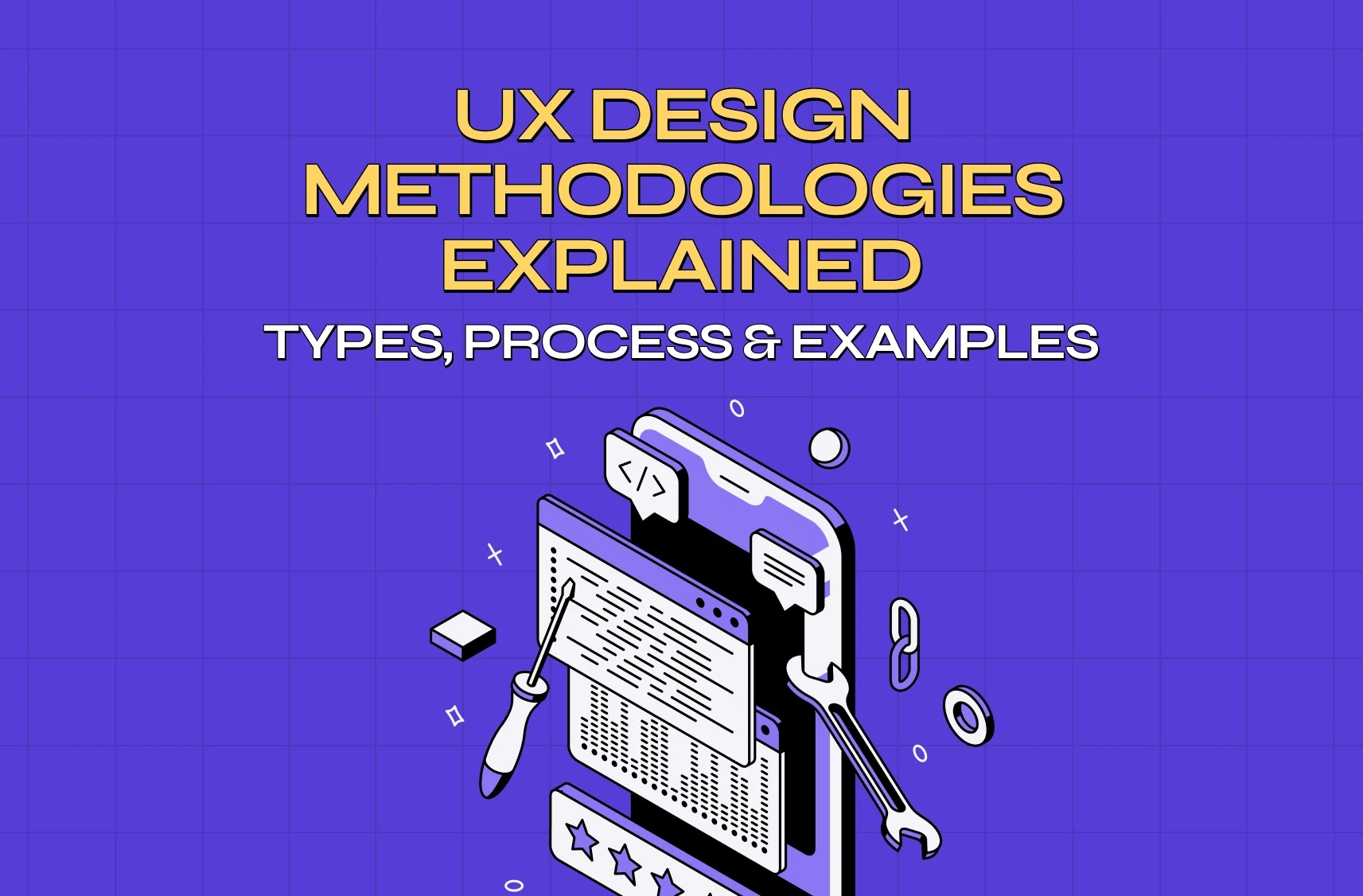
User experience design methodology isn’t a checklist - it’s a framework that steers how teams research, ideate, prototype, and validate design decisions. This guide breaks down common UX design methodologies, their processes, techniques, and examples to help you choose the right approach for your product.
User experience design methodology shapes how teams solve real user problems.

User experience design is not about screens or aesthetics. It is about decision-making under uncertainty.
Teams that consistently ship usable, scalable products are not more creative. They follow clearer UX design methodologies. Teams that struggle usually jump between ideas, tools, and opinions without a process that holds under pressure.
This guide breaks down the most widely used user experience design methodologies, how they work in practice, when to use each one, and how modern product teams combine them to build better digital products.
This is not a theory dump. It is a practical lens on how real UX teams work today.
What Is a User Experience Design Methodology?
A user experience design methodology is a structured approach for understanding users, defining problems, designing solutions, and validating outcomes.
It answers three critical questions:
How do we decide what to design?
How do we reduce risk before building?
How do we know the solution actually works?
Without a methodology, UX becomes subjective. With one, UX becomes repeatable — and if you're still grounding yourself in the discipline, what UI/UX design covers as a whole gives this structure meaningful context before going deeper into methodology.
Most high-performing teams do not follow a single methodology rigidly. They combine multiple UX design techniques depending on product maturity, risk level, and speed requirements.
Why UX Methodology Matters More Than Ever

Feature parity is now standard across SaaS, fintech, and consumer apps. What differentiates products is not what they do, but how effortlessly users achieve outcomes — and understanding inclusive design scope makes clear that "effortless" must account for the full range of users interacting with your product, not just the majority case your team designed for.
Poor UX methodology leads to:
Features built without demand
Inconsistent user flows
Expensive redesigns after launch
Low adoption despite good visuals
Strong UX methodology leads to:
Faster validation
Clear product direction
Lower rework cost
Better alignment between design, product, and engineering
This is especially visible in SaaS product design strategy, where UX decisions directly influence activation, retention, and feature adoption over time. This is especially visible in SaaS product design strategy, where UX decisions directly influence activation, retention, and feature adoption over time.
The Core UX Design Process Models
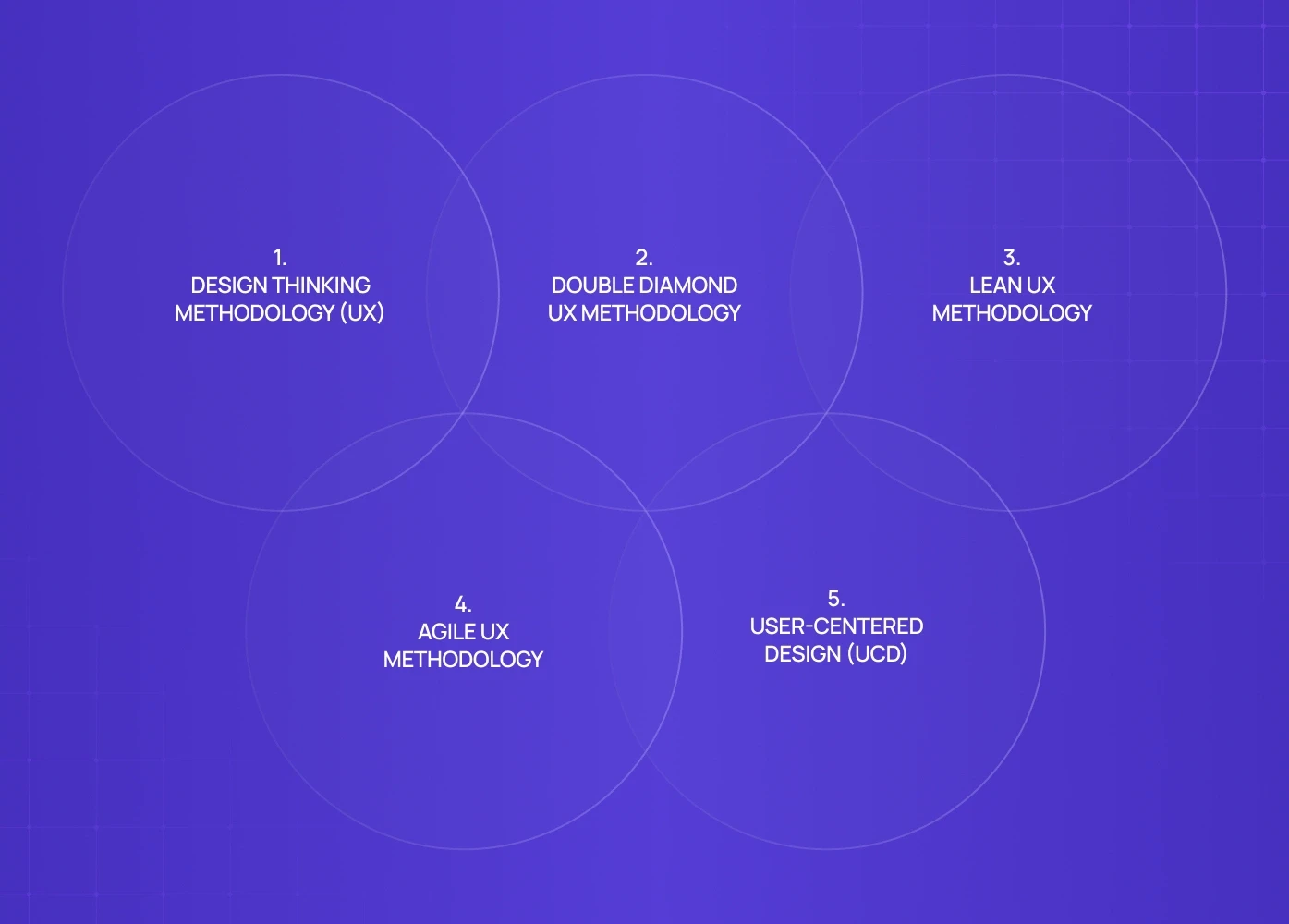
While there are many frameworks, most UX methodologies fall into a few foundational models.
1. Design Thinking Methodology (UX)
Design Thinking is one of the most widely used user experience design methodologies, especially in early-stage discovery and innovation work. The design thinking model structures that discovery into five distinct stages, each with its own goal.
Core stages
Empathize
Define
Ideate
Prototype
Test
When it works best
Early product discovery
Undefined or complex problem spaces
New markets or new user behaviors
Strength
Encourages deep user empathy and reframing problems before jumping to solutions. UX narrative methods like storyboarding are often paired with Design Thinking at the empathize and ideate stages to make user scenarios tangible before any screen decisions are made.
Limitation
If used alone, it can remain conceptual and slow without clear execution checkpoints.
2. Double Diamond UX Methodology
The Double Diamond framework focuses on divergence and convergence in problem-solving.
Phases
Discover
Define
Develop
Deliver
Why teams use it
Separates problem discovery from solution design
Forces clarity before execution
Works well in enterprise and B2B environments
UX methodology example
Many SaaS teams use the first diamond for research, competitive discovery, and product discovery, and the second diamond for UX product flow and UI execution.
3. Lean UX Methodology
Lean UX removes heavy documentation and focuses on learning loops.
Core principles
Hypothesize
Build minimal solutions
Measure real behavior
Iterate quickly
Best for
Startups
MVP design
Fast-moving product teams
Trade-off
Lean UX prioritizes speed, but without structure it can accumulate design debt.
High-performing teams pair Lean UX with a stronger system design phase later.
4. Agile UX Methodology
Agile UX integrates UX work into sprint cycles rather than running it as a separate phase.
How it works
Designers work one sprint ahead
Research and testing run continuously
UX decisions are revisited as data evolves
Strength
Strong collaboration with engineering
Faster iteration cycles
Challenge
Without a shared UX vision, design quality can fragment over time.
5. User-Centered Design (UCD)
User-centered design puts user needs at the core of every design decision — which only holds up when those needs come from genuine UX research, not internal assumptions.
Key UX research methods used
User interviews
Contextual inquiry
Behavioral analysis
Why it matters
UCD ensures the product evolves around real user behavior, not internal assumptions — and it draws on the broadest range of UX disciplines each methodology draws from, including UX research, information architecture, accessibility, and behavioral psychology, all working together rather than any one specialist working in isolation.
This methodology is especially critical in regulated industries like fintech, healthcare, and enterprise SaaS.
UX Research Methods That Power These Methodologies
Every UX design methodology relies on research to reduce risk.
Common UX research methods include: Qualitative interviews to understand intent, usability testing to validate flows, surveys to identify patterns at scale, session recordings and heatmaps to uncover friction, and task-based testing to measure clarity and success rates.
Once that data is gathered, a synthesis approach like the empathy mapping method turns it into a shared view of what users say, think, do, and feel. Strong UX teams select research methods based on decision risk, not habit.
UX Methodology Examples in Real Product Work
In practice, teams rarely follow one framework end-to-end. Instead, they create hybrid UX design process models.
A common modern setup looks like this:
Design Thinking for discovery
Double Diamond for structure
Lean UX for MVP validation
Agile UX for continuous iteration
a user-centered approach as the foundation throughout
This layered approach balances speed with clarity.
Choosing the Right UX Design Methodology

There is no universally correct UX methodology. The right choice depends on:
Product stage
Team maturity
Risk tolerance
Market clarity
Reviewing persona design examples before choosing a methodology helps teams confirm whether they have enough validated user knowledge to run Lean UX confidently or whether they need Design Thinking's deeper empathy stage first.
Early-stage products
Lean UX + Design Thinking
Scaling SaaS products
Double Diamond + Agile UX
Enterprise or regulated products
User-centered design + structured validation
The biggest mistake teams make is treating methodology as a checkbox rather than a decision tool.
Common UX Methodology Mistakes
Even experienced teams fall into these traps:
Copying frameworks without adapting them
Running research without clear decisions tied to outcomes — teams in this position often benefit from working with a UX research agency that structures findings around specific product decisions from the start.
Treating UX as a phase instead of a continuous system
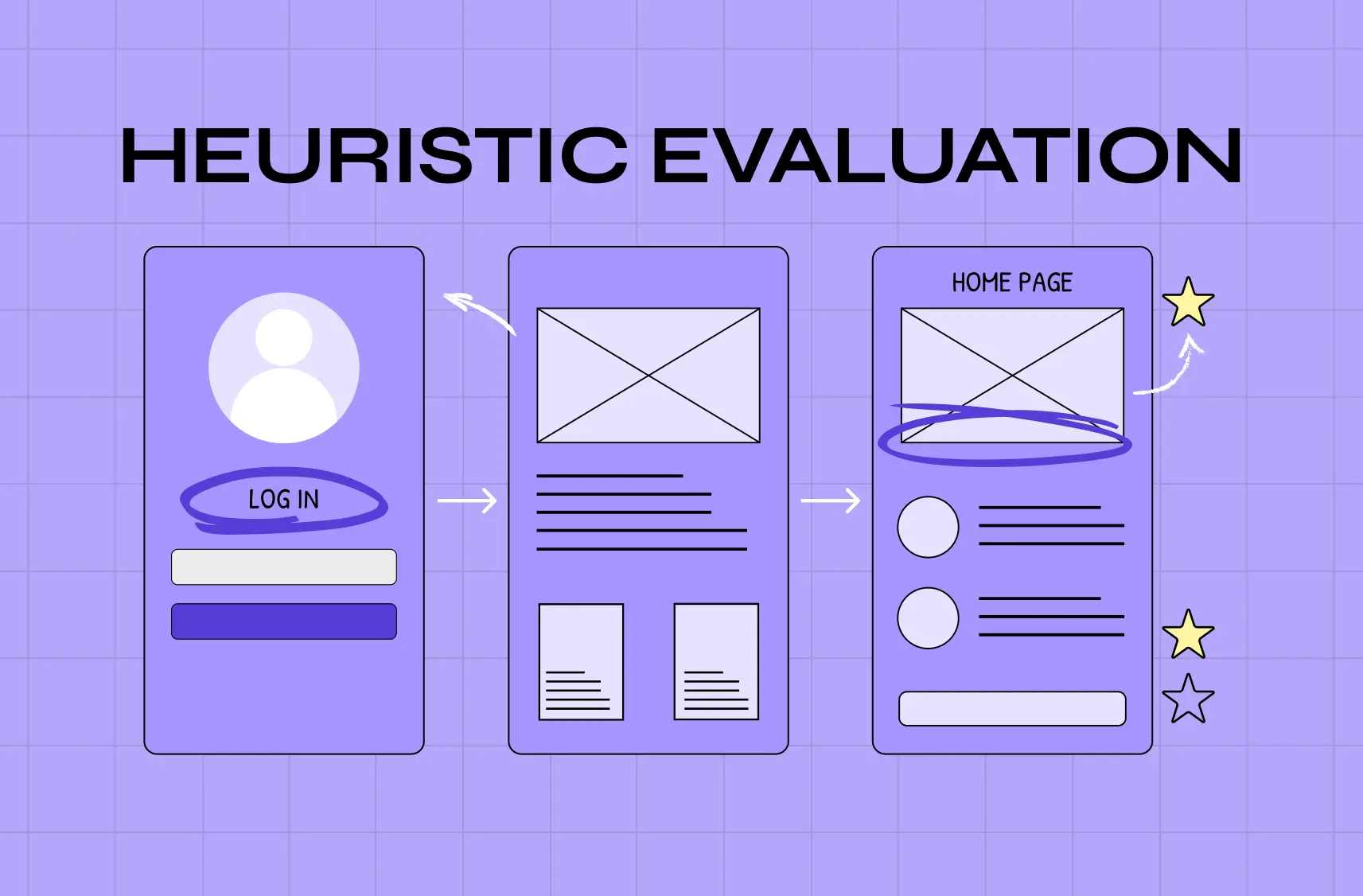
Skipping validation once UI looks "good enough" — running an expert flow review at this stage catches systematic usability failures that internal teams overlook precisely because the interface already feels familiar to them.
Methodology only works when it shapes decisions, not documentation.
The Future of UX Design Methodologies
UX methodologies are evolving alongside AI-powered workflows and real-time analytics. Beyond incremental tooling shifts, speculative design approaches are increasingly informing how teams anticipate user needs and design for behaviors that haven't fully emerged yet.
Key shifts already underway:
Faster research synthesis using AI-assisted tools
Continuous validation instead of milestone-based testing
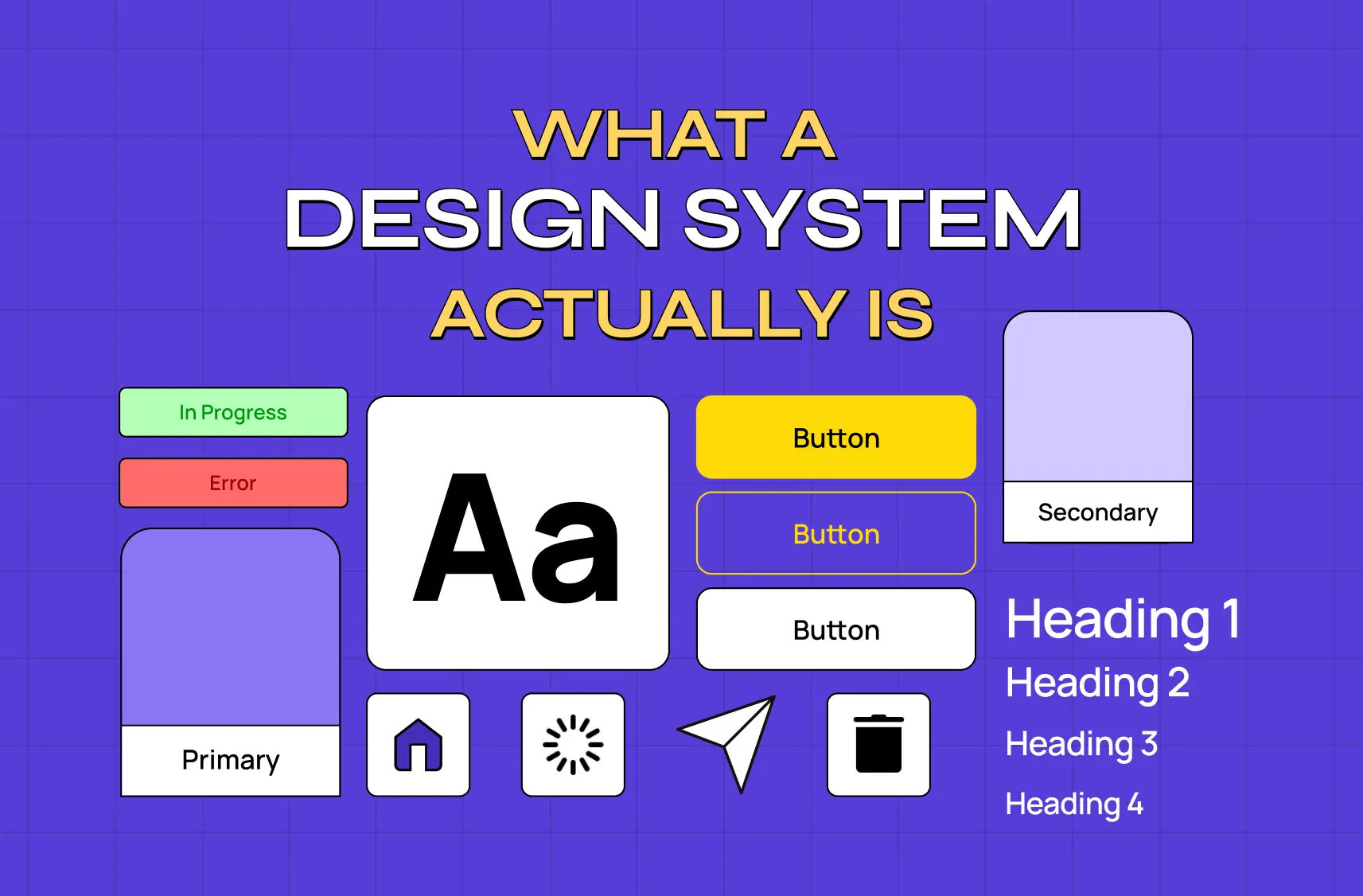
Design systems becoming part of the UX methodology itself
Greater emphasis on intent modeling over personas — and agentic experience design is emerging as a distinct methodology shift for products where AI agents act on behalf of users, requiring entirely different validation frameworks than those built for human-driven flows.
In the future of UX design, teams will move from static processes to adaptive systems that evolve continuously based on live user behavior and product signals.
AI is already reshaping how teams conduct research, synthesize insights, and validate UX decisions at scale through AI in product design.
The future of user experience design methodologies is not more frameworks. It is better integration between insight, execution, and measurement.
Conclusion
UX design methodology is not about process purity. It is about clarity under uncertainty.
The best teams are not the ones that follow the “right” framework. They are the ones that understand when to diverge, when to decide, and when to ship.
If your UX process feels heavy, slow, or reactive, the problem is rarely talent. It is almost always methodology.