Harpreet Singh

Founder and Creative Director

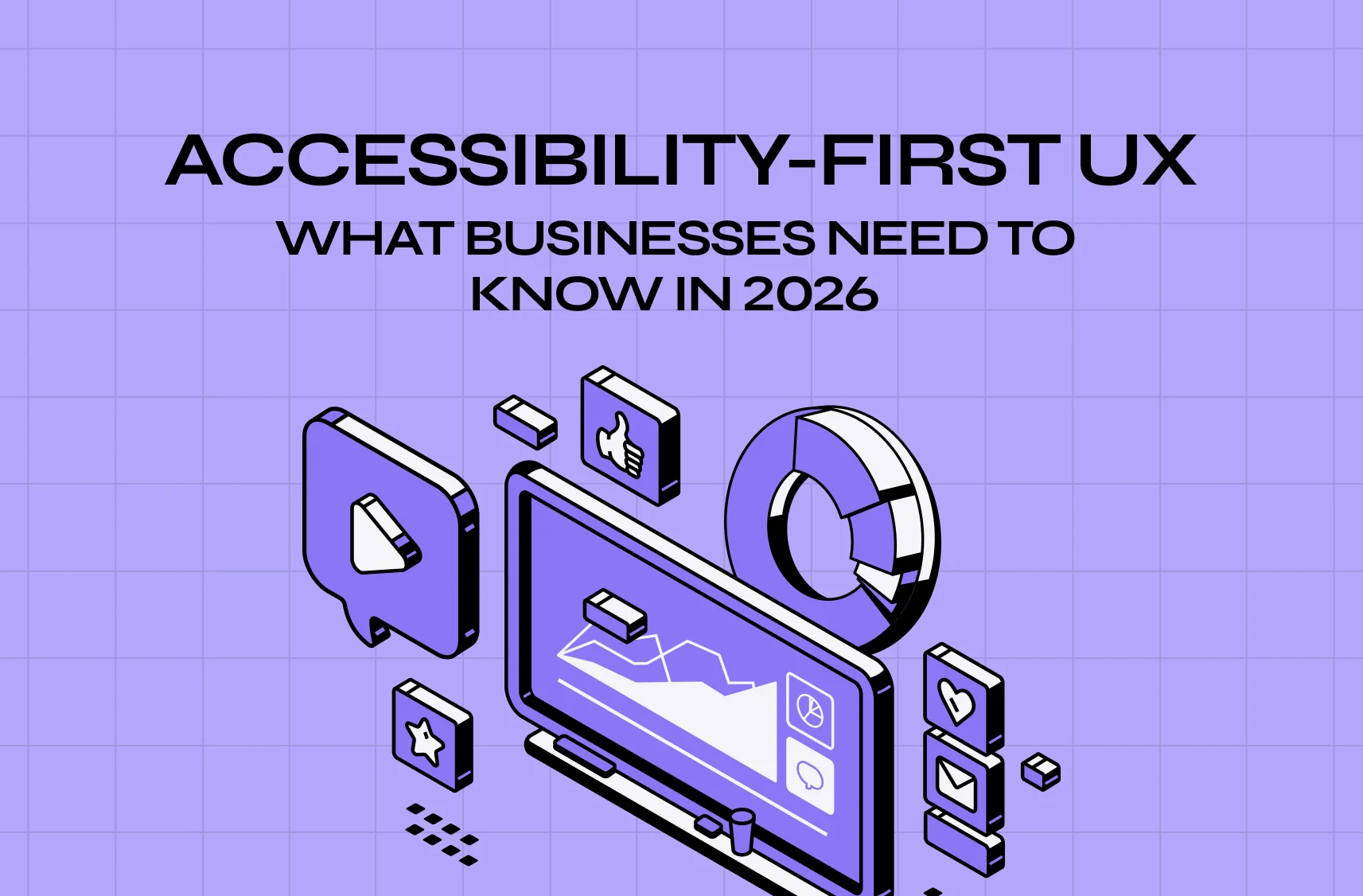
Accessibility-First UX: What Businesses Need to Know in 2026

Feb 28, 2026

A strategic 2026 guide to accessibility-first UX, explaining compliance risk, retention impact, WCAG standards, and why inclusive design is now a business advantage.

Harpreet Singh

Founder and Creative Director

Accessibility-First UX: What Businesses Need to Know in 2026

Feb 28, 2026

A strategic 2026 guide to accessibility-first UX, explaining compliance risk, retention impact, WCAG standards, and why inclusive design is now a business advantage.

Accessibility-first UX is no longer about compliance checklists. In 2026, it directly influences conversion rates, legal exposure, retention, and market expansion. Businesses that treat accessibility as infrastructure outperform those who treat it as an afterthought.

Accessibility is now a growth and risk decision.


Accessibility Is Now a Business Risk, Not a Design Preference

For years, accessibility lived in legal footnotes.

In 2026, it sits at the intersection of:

  • Compliance risk

  • Customer acquisition

  • Brand credibility

  • Product scalability

Globally, more than 1 billion people live with some form of disability (WHO). That number does not include temporary or situational impairments such as injuries, aging-related vision decline, or environmental constraints like glare or noise.

When accessibility is ignored, the business consequence is not theoretical:

  • You shrink your addressable market.

  • You increase legal exposure.

  • You reduce conversion efficiency.

And most importantly, you silently increase friction for all users.

The Hidden Revenue Cost of Poor Accessibility

Consider a simple SaaS onboarding flow:

  • Low contrast form fields

  • Weak focus indicators

  • Unclear error messages

  • Small click targets

None of these may block the average user.
But together, they increase hesitation.

Now multiply that across:

  • 10,000 monthly trial signups

  • A 2–3% friction-induced abandonment increase

  • $2,000 average annual contract value

The revenue loss compounds quietly.

Accessibility failures rarely show up as obvious complaints.
They show up as slightly lower activation and slightly higher churn.

That is what makes them dangerous.

What Accessibility-First UX Actually Means

Accessibility-first UX does not mean “add alt text later.”

It means designing around inclusive constraints from the beginning:

  • Clear visual hierarchy

  • Predictable interaction patterns

  • Logical navigation order

  • Assistive technology compatibility

  • Content written for comprehension

It is a structural philosophy, not a patch.

The difference between compliance-driven UX and accessibility-first UX is timing.

Compliance reacts.
Accessibility-first design anticipates.

Compliance Pressure Is Increasing

Regulatory enforcement around WCAG standards is tightening across North America, Europe, and parts of Asia.

In the United States alone, digital accessibility lawsuits have increased steadily over the last several years. Enterprise SaaS, fintech platforms, and public-facing digital products are particularly scrutinized.

If accessibility is retrofitted:

  • Design systems must be rebuilt

  • Components must be rewritten

  • Engineering cycles slow down

  • Release velocity suffers

When accessibility is embedded into your system architecture early, cost stays predictable.

When it is ignored, cost compounds.

Accessibility Improves Conversion for Everyone

Accessibility improvements often produce measurable gains beyond compliance.

For example:

  • Increasing contrast clarity improves mobile readability.

  • Clearer focus states reduce form abandonment.

  • Structured headings improve scanning speed.

  • Better error messaging reduces support tickets.

Many teams discover that accessible UX is simply clearer UX.

In practice, simplifying language and restructuring error states alone can reduce form abandonment meaningfully without changing the number of fields.

Accessibility improves clarity.
Clarity improves confidence.
Confidence improves conversion.

Practical Standards Businesses Must Meet in 2026

Rather than abstract theory, focus on four structural pillars.

1. Perceivability

Users must clearly perceive content.

That requires:

  • Verified contrast ratios

  • Scalable typography

  • Meaningful alt text

  • Semantic content structure

If critical information depends on color alone, the design fails.

2. Operability

Your product must function without a mouse.

Full keyboard accessibility includes:

  • Logical tab order

  • Visible focus states

  • Skip navigation links

  • Accessible dropdown behavior

If navigation collapses without a cursor, your UX is incomplete.

3. Understandability

Cognitive accessibility is frequently ignored.

Strong accessible UX:

  • Uses plain language

  • Avoids jargon-heavy instructions

  • Provides actionable error guidance

  • Maintains consistent interface patterns

If users must interpret complex phrasing under pressure, usability declines.

4. Robustness

Products must work across:

  • Screen readers

  • Voice navigation tools

  • Assistive extensions

  • Different devices and browsers

Automated scanners catch surface issues.
Real assistive testing uncovers structural gaps.

Where Most Businesses Still Fail

Even well-funded companies make predictable mistakes. Many of these overlap with broader UX mistakes that hurt conversions, particularly around hierarchy, feedback, and form friction:

  • Treating accessibility as QA-only

  • Fixing color contrast without restructuring hierarchy

  • Relying solely on automated audit

  • Ignoring cognitive load

  • Skipping real user validation

Accessibility is not about passing a checklist.
It is about removing structural friction.

Accessibility and Retention: The Overlooked Link

Retention declines when effort increases.

If your interface:

  • Requires visual strain

  • Demands extra navigation effort

  • Creates ambiguity in feedback

  • Produces inconsistent interactions

Users disengage.

Accessibility-first UX reduces cognitive and physical effort.
Lower effort strengthens habit formation.
Stronger habits increase retention.

Retention is rarely lost in one dramatic moment. Often, it breaks because the journey lacks continuity - something we unpack further in our article on narrative UX design for retention.
It erodes through repeated micro-frictions.

Accessibility-First UX and Design Systems

The only scalable way to maintain accessibility is through systemization.

Modern design systems should include:

  • Accessible color tokens

  • Verified typography scales

  • Pre-validated component logic

  • Built-in aria attributes

  • Standardized focus behaviors

Accessibility that lives inside the design system scales.
Accessibility that lives in documentation decays.

Quick Executive Self-Assessment*

Answer honestly:

  • Can your product be fully navigated via keyboard?

  • Are focus indicators clearly visible across all components?

  • Have you tested with a real screen reader?

  • Are error messages descriptive and corrective?

  • Are contrast ratios verified beyond light mode?

If you hesitate on multiple answers, your accessibility posture is reactive rather than proactive.

*This checklist offers baseline awareness only. Comprehensive evaluation should be conducted with experienced UX and compliance specialists.

The Competitive Reality of 2026

AI personalization and adaptive interfaces are rising.
But personalization without accessibility increases fragmentation.

The future is not simply adaptive UX.
It is adaptive and inclusive UX.

Businesses that design for accessibility today:

  • Reduce long-term technical debt

  • Lower compliance risk

  • Increase conversion resilience

  • Build brand trust

Businesses that delay will eventually pay more to retrofit what could have been foundational.

Final Thought: Accessibility Is Infrastructure

Accessibility-first UX is not cosmetic refinement.

It is product infrastructure.

It protects:

  • Revenue

  • Legal exposure

  • Brand equity

  • Growth velocity

If your product feels “almost right” but underperforms in activation, retention, or completion, accessibility may be the invisible constraint.

A focused accessibility review - delivered as part of structured UI/UX design agency services - can uncover:

  • Conversion friction tied to visual clarity

  • Structural navigation gaps

  • Compliance vulnerabilities

  • Retention bottlenecks caused by cognitive overload

Book a 20-minute strategy call to evaluate where accessibility intersects with your growth goals and how to strengthen it before it becomes a liability.

FAQ

1. What is accessibility-first UX?

Accessibility-first UX is an approach that integrates inclusive design principles from the start of product development rather than retrofitting compliance later.

2. How does accessibility affect conversion?

Improved clarity, navigation predictability, and readable interfaces reduce hesitation, which increases form completion, onboarding success, and engagement.

3. Is WCAG compliance enough?

Meeting WCAG standards protects legally, but accessibility-first UX goes further by embedding inclusive logic into product architecture.

4. Does accessibility slow product development?

When integrated early through structured design systems, it reduces rework and long-term technical debt.

5. When should businesses prioritize accessibility?

During redesigns, new product launches, market expansion, or before entering regulated industries.

Accessibility-first UX is no longer about compliance checklists. In 2026, it directly influences conversion rates, legal exposure, retention, and market expansion. Businesses that treat accessibility as infrastructure outperform those who treat it as an afterthought.

Accessibility is now a growth and risk decision.


Accessibility Is Now a Business Risk, Not a Design Preference

For years, accessibility lived in legal footnotes.

In 2026, it sits at the intersection of:

  • Compliance risk

  • Customer acquisition

  • Brand credibility

  • Product scalability

Globally, more than 1 billion people live with some form of disability (WHO). That number does not include temporary or situational impairments such as injuries, aging-related vision decline, or environmental constraints like glare or noise.

When accessibility is ignored, the business consequence is not theoretical:

  • You shrink your addressable market.

  • You increase legal exposure.

  • You reduce conversion efficiency.

And most importantly, you silently increase friction for all users.

The Hidden Revenue Cost of Poor Accessibility

Consider a simple SaaS onboarding flow:

  • Low contrast form fields

  • Weak focus indicators

  • Unclear error messages

  • Small click targets

None of these may block the average user.
But together, they increase hesitation.

Now multiply that across:

  • 10,000 monthly trial signups

  • A 2–3% friction-induced abandonment increase

  • $2,000 average annual contract value

The revenue loss compounds quietly.

Accessibility failures rarely show up as obvious complaints.
They show up as slightly lower activation and slightly higher churn.

That is what makes them dangerous.

What Accessibility-First UX Actually Means

Accessibility-first UX does not mean “add alt text later.”

It means designing around inclusive constraints from the beginning:

  • Clear visual hierarchy

  • Predictable interaction patterns

  • Logical navigation order

  • Assistive technology compatibility

  • Content written for comprehension

It is a structural philosophy, not a patch.

The difference between compliance-driven UX and accessibility-first UX is timing.

Compliance reacts.
Accessibility-first design anticipates.

Compliance Pressure Is Increasing

Regulatory enforcement around WCAG standards is tightening across North America, Europe, and parts of Asia.

In the United States alone, digital accessibility lawsuits have increased steadily over the last several years. Enterprise SaaS, fintech platforms, and public-facing digital products are particularly scrutinized.

If accessibility is retrofitted:

  • Design systems must be rebuilt

  • Components must be rewritten

  • Engineering cycles slow down

  • Release velocity suffers

When accessibility is embedded into your system architecture early, cost stays predictable.

When it is ignored, cost compounds.

Accessibility Improves Conversion for Everyone

Accessibility improvements often produce measurable gains beyond compliance.

For example:

  • Increasing contrast clarity improves mobile readability.

  • Clearer focus states reduce form abandonment.

  • Structured headings improve scanning speed.

  • Better error messaging reduces support tickets.

Many teams discover that accessible UX is simply clearer UX.

In practice, simplifying language and restructuring error states alone can reduce form abandonment meaningfully without changing the number of fields.

Accessibility improves clarity.
Clarity improves confidence.
Confidence improves conversion.

Practical Standards Businesses Must Meet in 2026

Rather than abstract theory, focus on four structural pillars.

1. Perceivability

Users must clearly perceive content.

That requires:

  • Verified contrast ratios

  • Scalable typography

  • Meaningful alt text

  • Semantic content structure

If critical information depends on color alone, the design fails.

2. Operability

Your product must function without a mouse.

Full keyboard accessibility includes:

  • Logical tab order

  • Visible focus states

  • Skip navigation links

  • Accessible dropdown behavior

If navigation collapses without a cursor, your UX is incomplete.

3. Understandability

Cognitive accessibility is frequently ignored.

Strong accessible UX:

  • Uses plain language

  • Avoids jargon-heavy instructions

  • Provides actionable error guidance

  • Maintains consistent interface patterns

If users must interpret complex phrasing under pressure, usability declines.

4. Robustness

Products must work across:

  • Screen readers

  • Voice navigation tools

  • Assistive extensions

  • Different devices and browsers

Automated scanners catch surface issues.
Real assistive testing uncovers structural gaps.

Where Most Businesses Still Fail

Even well-funded companies make predictable mistakes. Many of these overlap with broader UX mistakes that hurt conversions, particularly around hierarchy, feedback, and form friction:

  • Treating accessibility as QA-only

  • Fixing color contrast without restructuring hierarchy

  • Relying solely on automated audit

  • Ignoring cognitive load

  • Skipping real user validation

Accessibility is not about passing a checklist.
It is about removing structural friction.

Accessibility and Retention: The Overlooked Link

Retention declines when effort increases.

If your interface:

  • Requires visual strain

  • Demands extra navigation effort

  • Creates ambiguity in feedback

  • Produces inconsistent interactions

Users disengage.

Accessibility-first UX reduces cognitive and physical effort.
Lower effort strengthens habit formation.
Stronger habits increase retention.

Retention is rarely lost in one dramatic moment. Often, it breaks because the journey lacks continuity - something we unpack further in our article on narrative UX design for retention.
It erodes through repeated micro-frictions.

Accessibility-First UX and Design Systems

The only scalable way to maintain accessibility is through systemization.

Modern design systems should include:

  • Accessible color tokens

  • Verified typography scales

  • Pre-validated component logic

  • Built-in aria attributes

  • Standardized focus behaviors

Accessibility that lives inside the design system scales.
Accessibility that lives in documentation decays.

Quick Executive Self-Assessment*

Answer honestly:

  • Can your product be fully navigated via keyboard?

  • Are focus indicators clearly visible across all components?

  • Have you tested with a real screen reader?

  • Are error messages descriptive and corrective?

  • Are contrast ratios verified beyond light mode?

If you hesitate on multiple answers, your accessibility posture is reactive rather than proactive.

*This checklist offers baseline awareness only. Comprehensive evaluation should be conducted with experienced UX and compliance specialists.

The Competitive Reality of 2026

AI personalization and adaptive interfaces are rising.
But personalization without accessibility increases fragmentation.

The future is not simply adaptive UX.
It is adaptive and inclusive UX.

Businesses that design for accessibility today:

  • Reduce long-term technical debt

  • Lower compliance risk

  • Increase conversion resilience

  • Build brand trust

Businesses that delay will eventually pay more to retrofit what could have been foundational.

Final Thought: Accessibility Is Infrastructure

Accessibility-first UX is not cosmetic refinement.

It is product infrastructure.

It protects:

  • Revenue

  • Legal exposure

  • Brand equity

  • Growth velocity

If your product feels “almost right” but underperforms in activation, retention, or completion, accessibility may be the invisible constraint.

A focused accessibility review - delivered as part of structured UI/UX design agency services - can uncover:

  • Conversion friction tied to visual clarity

  • Structural navigation gaps

  • Compliance vulnerabilities

  • Retention bottlenecks caused by cognitive overload

Book a 20-minute strategy call to evaluate where accessibility intersects with your growth goals and how to strengthen it before it becomes a liability.

FAQ

1. What is accessibility-first UX?

Accessibility-first UX is an approach that integrates inclusive design principles from the start of product development rather than retrofitting compliance later.

2. How does accessibility affect conversion?

Improved clarity, navigation predictability, and readable interfaces reduce hesitation, which increases form completion, onboarding success, and engagement.

3. Is WCAG compliance enough?

Meeting WCAG standards protects legally, but accessibility-first UX goes further by embedding inclusive logic into product architecture.

4. Does accessibility slow product development?

When integrated early through structured design systems, it reduces rework and long-term technical debt.

5. When should businesses prioritize accessibility?

During redesigns, new product launches, market expansion, or before entering regulated industries.

Extreme close-up black and white photograph of a human eye

Let’s bring your vision to life

Tell us what's on your mind? We'll hit you back in 24 hours. No fluff, no delays - just a solid vision to bring your idea to life.

Profile portrait of a man in a white shirt against a light background

Harpreet Singh

Founder and Creative Director

Get in Touch

Extreme close-up black and white photograph of a human eye

Let’s bring your vision to life

Tell us what's on your mind? We'll hit you back in 24 hours. No fluff, no delays - just a solid vision to bring your idea to life.

Profile portrait of a man in a white shirt against a light background

Harpreet Singh

Founder and Creative Director

Get in Touch

Harpreet Singh

Founder and Creative Director

Accessibility-First UX: What Businesses Need to Know in 2026

Feb 28, 2026

A strategic 2026 guide to accessibility-first UX, explaining compliance risk, retention impact, WCAG standards, and why inclusive design is now a business advantage.

Accessibility-first UX is no longer about compliance checklists. In 2026, it directly influences conversion rates, legal exposure, retention, and market expansion. Businesses that treat accessibility as infrastructure outperform those who treat it as an afterthought.

Accessibility is now a growth and risk decision.


Accessibility Is Now a Business Risk, Not a Design Preference

For years, accessibility lived in legal footnotes.

In 2026, it sits at the intersection of:

  • Compliance risk

  • Customer acquisition

  • Brand credibility

  • Product scalability

Globally, more than 1 billion people live with some form of disability (WHO). That number does not include temporary or situational impairments such as injuries, aging-related vision decline, or environmental constraints like glare or noise.

When accessibility is ignored, the business consequence is not theoretical:

  • You shrink your addressable market.

  • You increase legal exposure.

  • You reduce conversion efficiency.

And most importantly, you silently increase friction for all users.

The Hidden Revenue Cost of Poor Accessibility

Consider a simple SaaS onboarding flow:

  • Low contrast form fields

  • Weak focus indicators

  • Unclear error messages

  • Small click targets

None of these may block the average user.
But together, they increase hesitation.

Now multiply that across:

  • 10,000 monthly trial signups

  • A 2–3% friction-induced abandonment increase

  • $2,000 average annual contract value

The revenue loss compounds quietly.

Accessibility failures rarely show up as obvious complaints.
They show up as slightly lower activation and slightly higher churn.

That is what makes them dangerous.

What Accessibility-First UX Actually Means

Accessibility-first UX does not mean “add alt text later.”

It means designing around inclusive constraints from the beginning:

  • Clear visual hierarchy

  • Predictable interaction patterns

  • Logical navigation order

  • Assistive technology compatibility

  • Content written for comprehension

It is a structural philosophy, not a patch.

The difference between compliance-driven UX and accessibility-first UX is timing.

Compliance reacts.
Accessibility-first design anticipates.

Compliance Pressure Is Increasing

Regulatory enforcement around WCAG standards is tightening across North America, Europe, and parts of Asia.

In the United States alone, digital accessibility lawsuits have increased steadily over the last several years. Enterprise SaaS, fintech platforms, and public-facing digital products are particularly scrutinized.

If accessibility is retrofitted:

  • Design systems must be rebuilt

  • Components must be rewritten

  • Engineering cycles slow down

  • Release velocity suffers

When accessibility is embedded into your system architecture early, cost stays predictable.

When it is ignored, cost compounds.

Accessibility Improves Conversion for Everyone

Accessibility improvements often produce measurable gains beyond compliance.

For example:

  • Increasing contrast clarity improves mobile readability.

  • Clearer focus states reduce form abandonment.

  • Structured headings improve scanning speed.

  • Better error messaging reduces support tickets.

Many teams discover that accessible UX is simply clearer UX.

In practice, simplifying language and restructuring error states alone can reduce form abandonment meaningfully without changing the number of fields.

Accessibility improves clarity.
Clarity improves confidence.
Confidence improves conversion.

Practical Standards Businesses Must Meet in 2026

Rather than abstract theory, focus on four structural pillars.

1. Perceivability

Users must clearly perceive content.

That requires:

  • Verified contrast ratios

  • Scalable typography

  • Meaningful alt text

  • Semantic content structure

If critical information depends on color alone, the design fails.

2. Operability

Your product must function without a mouse.

Full keyboard accessibility includes:

  • Logical tab order

  • Visible focus states

  • Skip navigation links

  • Accessible dropdown behavior

If navigation collapses without a cursor, your UX is incomplete.

3. Understandability

Cognitive accessibility is frequently ignored.

Strong accessible UX:

  • Uses plain language

  • Avoids jargon-heavy instructions

  • Provides actionable error guidance

  • Maintains consistent interface patterns

If users must interpret complex phrasing under pressure, usability declines.

4. Robustness

Products must work across:

  • Screen readers

  • Voice navigation tools

  • Assistive extensions

  • Different devices and browsers

Automated scanners catch surface issues.
Real assistive testing uncovers structural gaps.

Where Most Businesses Still Fail

Even well-funded companies make predictable mistakes. Many of these overlap with broader UX mistakes that hurt conversions, particularly around hierarchy, feedback, and form friction:

  • Treating accessibility as QA-only

  • Fixing color contrast without restructuring hierarchy

  • Relying solely on automated audit

  • Ignoring cognitive load

  • Skipping real user validation

Accessibility is not about passing a checklist.
It is about removing structural friction.

Accessibility and Retention: The Overlooked Link

Retention declines when effort increases.

If your interface:

  • Requires visual strain

  • Demands extra navigation effort

  • Creates ambiguity in feedback

  • Produces inconsistent interactions

Users disengage.

Accessibility-first UX reduces cognitive and physical effort.
Lower effort strengthens habit formation.
Stronger habits increase retention.

Retention is rarely lost in one dramatic moment. Often, it breaks because the journey lacks continuity - something we unpack further in our article on narrative UX design for retention.
It erodes through repeated micro-frictions.

Accessibility-First UX and Design Systems

The only scalable way to maintain accessibility is through systemization.

Modern design systems should include:

  • Accessible color tokens

  • Verified typography scales

  • Pre-validated component logic

  • Built-in aria attributes

  • Standardized focus behaviors

Accessibility that lives inside the design system scales.
Accessibility that lives in documentation decays.

Quick Executive Self-Assessment*

Answer honestly:

  • Can your product be fully navigated via keyboard?

  • Are focus indicators clearly visible across all components?

  • Have you tested with a real screen reader?

  • Are error messages descriptive and corrective?

  • Are contrast ratios verified beyond light mode?

If you hesitate on multiple answers, your accessibility posture is reactive rather than proactive.

*This checklist offers baseline awareness only. Comprehensive evaluation should be conducted with experienced UX and compliance specialists.

The Competitive Reality of 2026

AI personalization and adaptive interfaces are rising.
But personalization without accessibility increases fragmentation.

The future is not simply adaptive UX.
It is adaptive and inclusive UX.

Businesses that design for accessibility today:

  • Reduce long-term technical debt

  • Lower compliance risk

  • Increase conversion resilience

  • Build brand trust

Businesses that delay will eventually pay more to retrofit what could have been foundational.

Final Thought: Accessibility Is Infrastructure

Accessibility-first UX is not cosmetic refinement.

It is product infrastructure.

It protects:

  • Revenue

  • Legal exposure

  • Brand equity

  • Growth velocity

If your product feels “almost right” but underperforms in activation, retention, or completion, accessibility may be the invisible constraint.

A focused accessibility review - delivered as part of structured UI/UX design agency services - can uncover:

  • Conversion friction tied to visual clarity

  • Structural navigation gaps

  • Compliance vulnerabilities

  • Retention bottlenecks caused by cognitive overload

Book a 20-minute strategy call to evaluate where accessibility intersects with your growth goals and how to strengthen it before it becomes a liability.
FAQ

1. What is accessibility-first UX?

Accessibility-first UX is an approach that integrates inclusive design principles from the start of product development rather than retrofitting compliance later.
2. How does accessibility affect conversion?

Improved clarity, navigation predictability, and readable interfaces reduce hesitation, which increases form completion, onboarding success, and engagement.

3. Is WCAG compliance enough?

Meeting WCAG standards protects legally, but accessibility-first UX goes further by embedding inclusive logic into product architecture.

4. Does accessibility slow product development?

When integrated early through structured design systems, it reduces rework and long-term technical debt.

5. When should businesses prioritize accessibility?

During redesigns, new product launches, market expansion, or before entering regulated industries.

Extreme close-up black and white photograph of a human eye

Let’s bring your vision to life

Tell us what's on your mind? We'll hit you back in 24 hours. No fluff, no delays - just a solid vision to bring your idea to life.

Profile portrait of a man in a white shirt against a light background

Harpreet Singh

Founder and Creative Director

Get in Touch