Most teams choose web design agencies based on portfolios and promises. This guide shows how to evaluate agencies based on strategy, UX thinking, scalability, and long-term impact — not just aesthetics.
Choosing a web design agency is a business decision, not a visual one.
Most businesses don’t choose the wrong web design agency because they didn’t research enough. They choose wrong because they evaluated the agency on the wrong criteria.
Visual polish, awards, trendy layouts, or an impressive homepage don’t predict whether your website will:
rank,
convert,
scale,
or survive the next 18 months of product and business changes.
This guide explains how to choose a web design agency the way high-performing SaaS and B2B teams actually do — by evaluating thinking quality, decision frameworks, modern web design principles and execution depth, not surface aesthetics.
This is not a list of obvious questions like “check their portfolio.” It’s a checklist to help you avoid expensive misalignment.
First: Decide What You’re Actually Buying
Before comparing agencies, answer this internally: Are you buying a website, or are you buying business outcomes — the kind that, for smaller companies, often start with small business branding before a single page exists?
Most website design firms sell outputs:
pages,
components,
animations,
templates — and their default framing rarely changes regardless of the types of websites explained they've actually built, which means the approach they pitch you may not match what your business model actually requires.
Stronger product design studios sell outcomes:
clearer positioning,
better user understanding,
higher conversion efficiency,
faster iteration after launch.
The same outcome-versus-output distinction applies when evaluating logo design company selection — the agencies that treat a logo as brand strategy deliver different results than those treating it as a visual deliverable.
The studios where brand strategy and web execution meet tend to be the ones that consistently deliver on all four — a dynamic that becomes especially visible in brand trust in high-stakes sectors, where the gap between surface aesthetics and strategic design depth has measurable consequences for user confidence and conversion. If you don't define this distinction upfront, every agency will look "good enough" — until post-launch reality hits.
Reality check:
if success is defined as "launching fast," your evaluation criteria will be completely different from "increasing demo conversions" or "supporting product-led growth" — clarity a hiring brief forces before you shortlist anyone. The same upfront clarity settles whether a remote agency choice fits your team, since it shapes collaboration cadence more than most expect.
Section 1: Evaluate Thinking, Not Just Visual Style
Almost every agency can show clean layouts, modern UI, and polished visuals — what matters more is how they arrived there. Evaluating agency portfolios beyond aesthetics gives you real examples of strong and weak agency work side by side, showing exactly what decision depth, constraint acknowledgment, and outcome documentation look like in practice.
Almost every agency can show:
clean layouts,
modern UI,
polished visuals.
What matters more is how they arrived there.
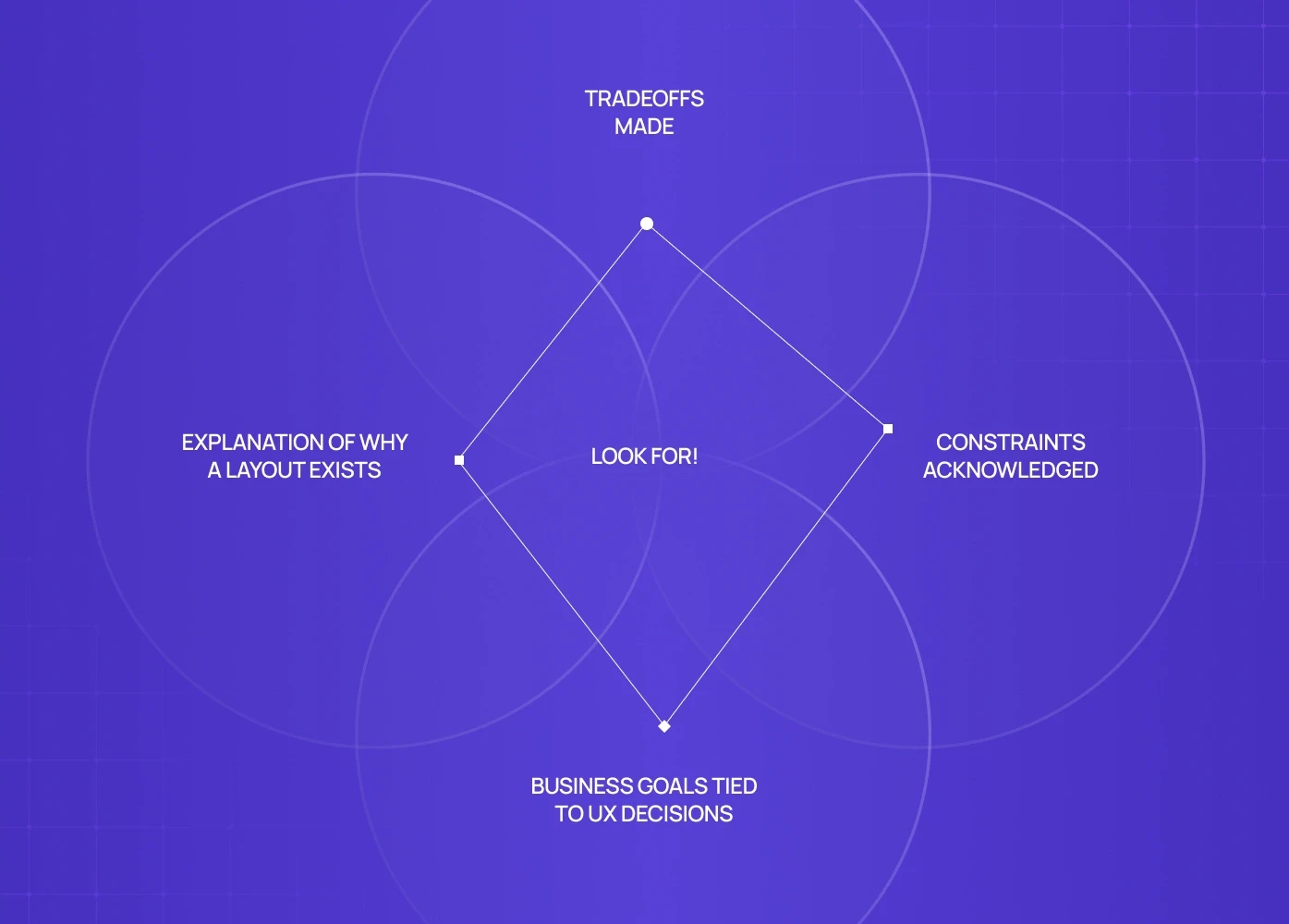
When reviewing work, look for:
explanation of why a layout exists,
tradeoffs made,
constraints acknowledged,
business goals tied to UX decisions.
The same evaluation lens applies to agencies offering data-led content design — ask why a chart type or layout was chosen for the data, not just whether it looks polished.
Ask yourself: Does this agency explain decisions, or only show outcomes?
The best web redesign agencies can clearly articulate:
what problem the design solved,
what alternatives were rejected,
what risks were mitigated.
This matters far more than visual taste — and a written UX proposal is where a strong agency puts that problem-and-tradeoff reasoning on the record before you commit.
Section 2: How the Agency Talks About UX Is a Telltale Signal
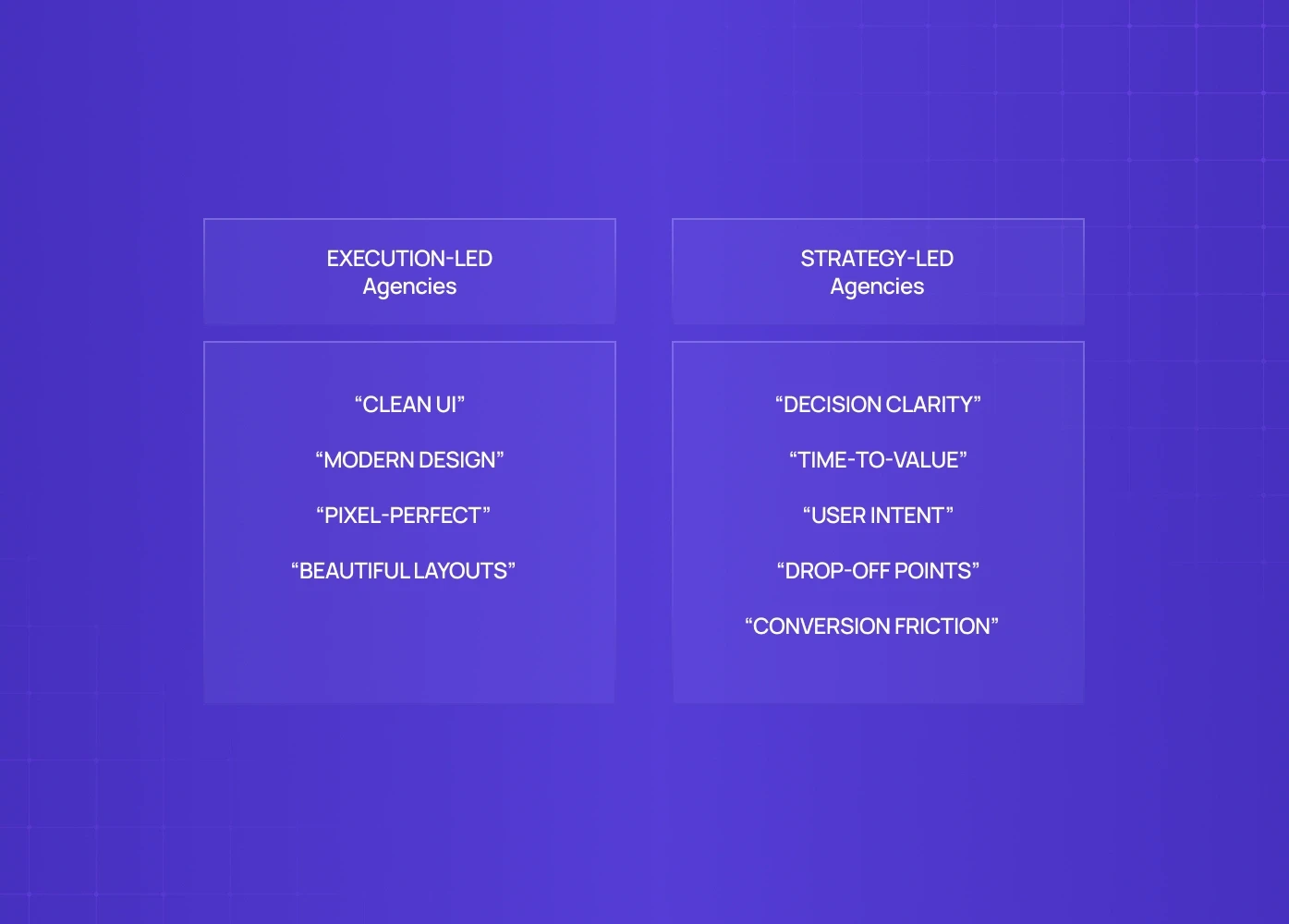
Pay attention to language.
Agencies that say:
“clean UI”
“modern design”
“pixel-perfect”
“beautiful layouts”
are usually execution-led - the traditional end of the spectrum an AI-native studio sits opposite.
Agencies that say:
“decision clarity”
“time-to-value”
“user intent”
“drop-off points”
“conversion friction”
are strategy-led.
If you're evaluating a SaaS design agency, product design agency, or regulated industry design vendors, UX should be discussed as:
a behavioural system,
not a styling layer.
A strong agency treats UX as a lever for retention, adoption, revenue, and engineering efficiency — and understanding roles and deliverables inside a UX agency gives you the foundational clarity to recognize whether the agency you're evaluating actually operates that way or just describes it in a pitch deck.
Section 3: Understand Their Approach to Conversion (Without Asking for CRO)
Many agencies say they “care about conversion.”
Very few can explain how.
Conversion-focused agencies don’t start with:
button colors,
animations,
copy tweaks.
They start with:
user intent mapping,
decision hierarchy,
clarity sequencing,
cognitive load reduction.
A simple test: Do they talk about conversion as behaviour design or visual optimisation?
If conversion lives only in "CTA placement" and "hero sections," you're likely getting surface-level thinking — and teams with simpler conversion needs often find no-code design builds sufficient without the strategic overhead a full agency engagement requires.
This is especially important if you plan to hire UI UX designers for a product-led or growth-driven business — because the agency-versus-in-house decision shapes how deeply design thinking gets embedded into your product from day one.
Section 4: Ask How They Handle Complexity (This Separates Real Agencies)
Any agency can design:
marketing sites,
landing pages,
brochure websites the same simple scopes AI website builders handle on their own.
Complexity — multi-role apps, dense product surfaces — is where weak agencies break, and where a seasoned app product studio proves its depth.
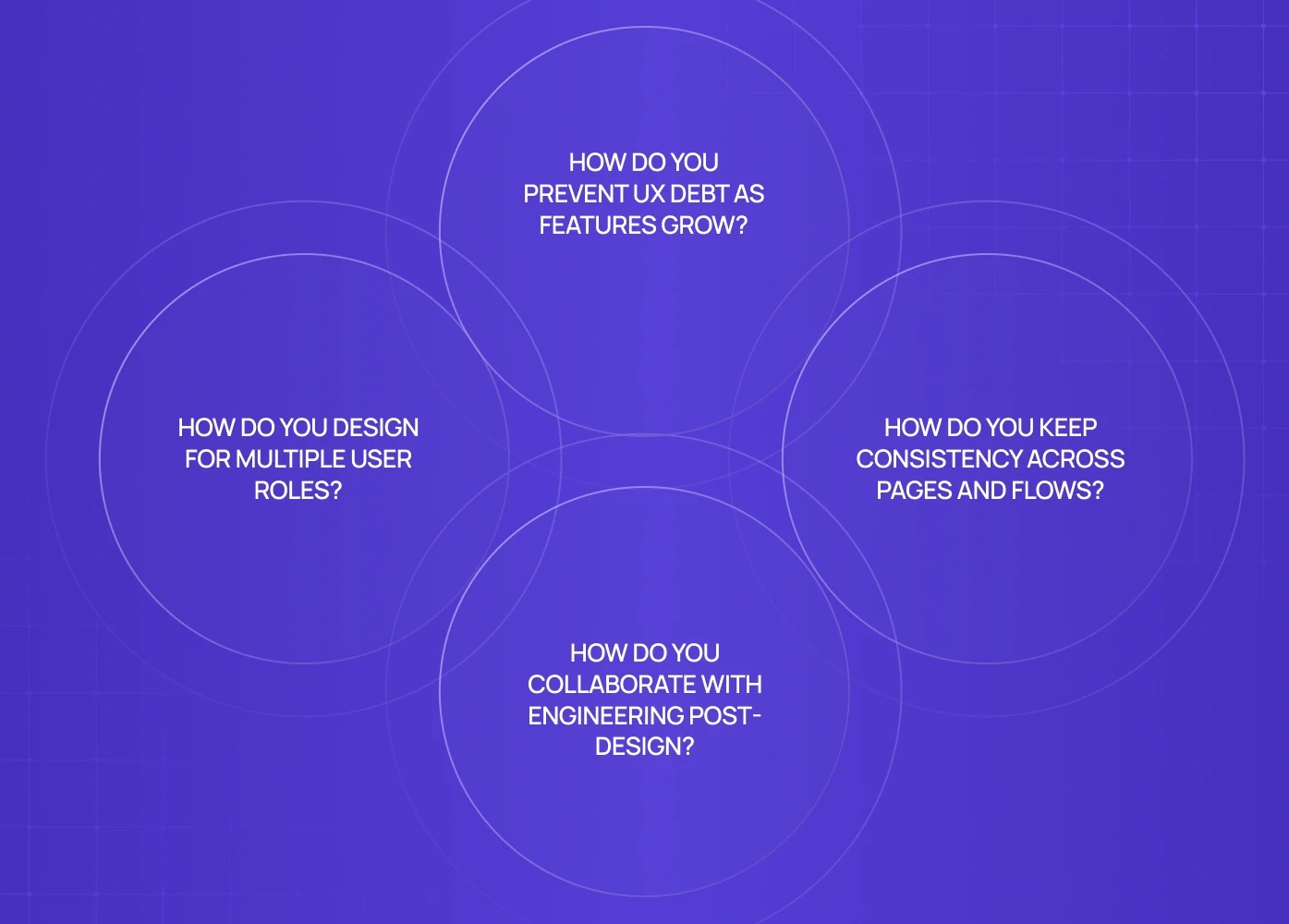
Ask specifically:
Multiple user roles
UX debt prevention
Cross-page consistency
Post-design engineering collaboration — and for a complete picture of must-have skills when vetting a design agency in 2026, that guide maps the specific technical and strategic competencies that separate capable teams from those that break under product complexity.
If the answers are vague, you’ll feel the cost later.
This is critical for:
B2B SaaS,
admin dashboards,
data-heavy products,
long-lifecycle platforms — the exact territory where AI product design agencies tend to prove their depth.
Strong agencies think in systems, not screens. For Pacific Northwest teams building that shortlist, Seattle web agencies bring comparable systems-level thinking with strong enterprise SaaS roots worth evaluating alongside national options.
Section 5: Process Reveals More Than Promises
A good process doesn’t mean more meetings.
It means fewer surprises — including a predictable redesign timeline you can hold the agency to, rather than a vague "a few weeks."
Look for clarity around:
decision ownership,
feedback loops,
iteration checkpoints,
validation moments.
Ask: At what points do you validate assumptions with real users or data?
If validation only happens “after launch,” risk is being deferred — not reduced.
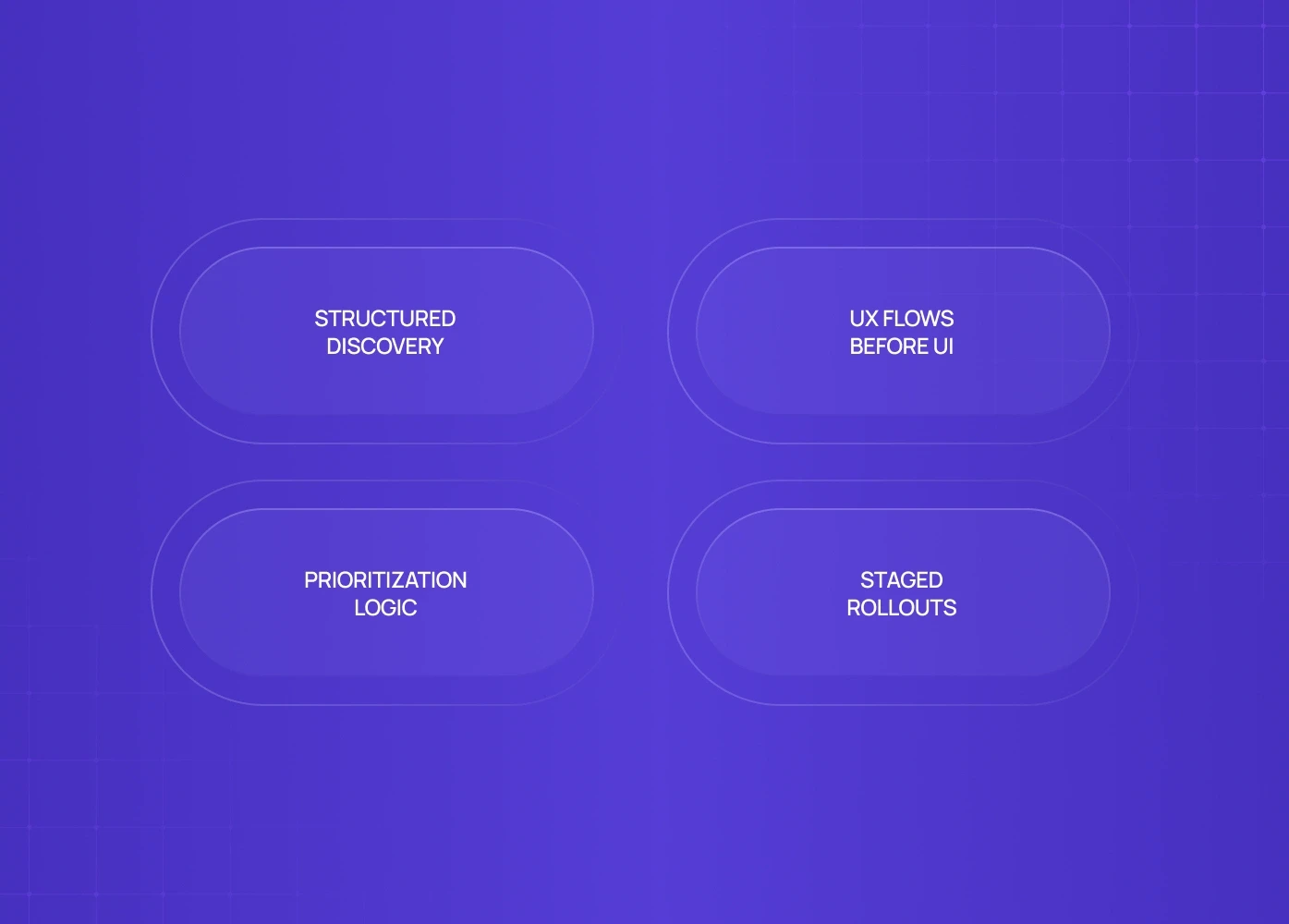
A mature UI UX design services team will show:
structured discovery,
A detailed UX strategy and flows before UI,
prioritisation logic,
staged rollouts.
Clear comparison against design subscription services compared — so you understand exactly how their model differs from volume-output alternatives before you commit
This is where most web design basics articles stop — but this is where real differentiation starts.
Section 6: Beware of “Template Thinking” Disguised as Efficiency
Many agencies rely heavily on:
internal templates,
recycled layouts,
pre-defined sections.
Templates are not bad. Blind reuse is.
Ask: How do you decide when to reuse patterns and when to design custom? For mobile-first products, this question carries extra weight — a mobile app UX agency will answer it differently than a web-first studio because native interaction patterns don't reuse cleanly across contexts.
The best agencies:
reuse patterns intentionally,
customise based on context,
avoid forcing your product into someone else’s mould.
This matters even more when choosing a SaaS design agency, where differentiation is subtle and experience-driven — and where the wrong template-heavy approach compounds into product debt that costs far more than the original engagement.
Section 7: The Hidden Cost of Choosing the Wrong Agency

Most businesses underestimate this.
The real cost isn’t:
the invoice,
the timeline,
the launch delay.
The real cost is:
low conversion rates baked into architecture,
redesign requests six months later,
engineering rework,
internal loss of confidence in design. For regulated or government-facing launches, that risk runs higher still — a reason those teams often shortlist a Washington-based agency fluent in compliance from the start.
For organizations where this risk is compounded by scale, comparing a large-scale agency shortlist upfront reduces the odds of discovering depth gaps after the engagement is already underway.
A cheaper agency that ships fast but lacks depth often becomes the most expensive decision long-term — and understanding SaaS redesign cost and agency depth helps you interpret what different price points actually reflect in terms of team depth, process maturity, and strategic capability before you compare quotes.
Section 8: How to Compare Agencies Side-by-Side (Practical Framework)
Instead of subjective scoring, compare agencies - such as a curated US agency shortlist — on:
Dimension | Weak Signal | Strong Signal |
Strategy | “We’ll figure it out as we go” | Clear decision framework |
UX | Visual-first | Behaviour-first |
Process | Linear delivery | Iterative validation |
Complexity | Avoided | Designed for |
Collaboration | Handoff-based | Embedded thinking |
Scalability | Not discussed | Planned intentionally |
The same table works across markets — run a Toronto agency comparison through it and the strong-vs-weak signals still hold. This makes agency comparison objective instead of emotional.
If research depth is a priority in your evaluation, understanding what a UX research agency specifically offers helps you separate generalist studios from those with genuine discovery capability.
Section 9: When You Actually Need a Web Design Agency (Not Freelancers)
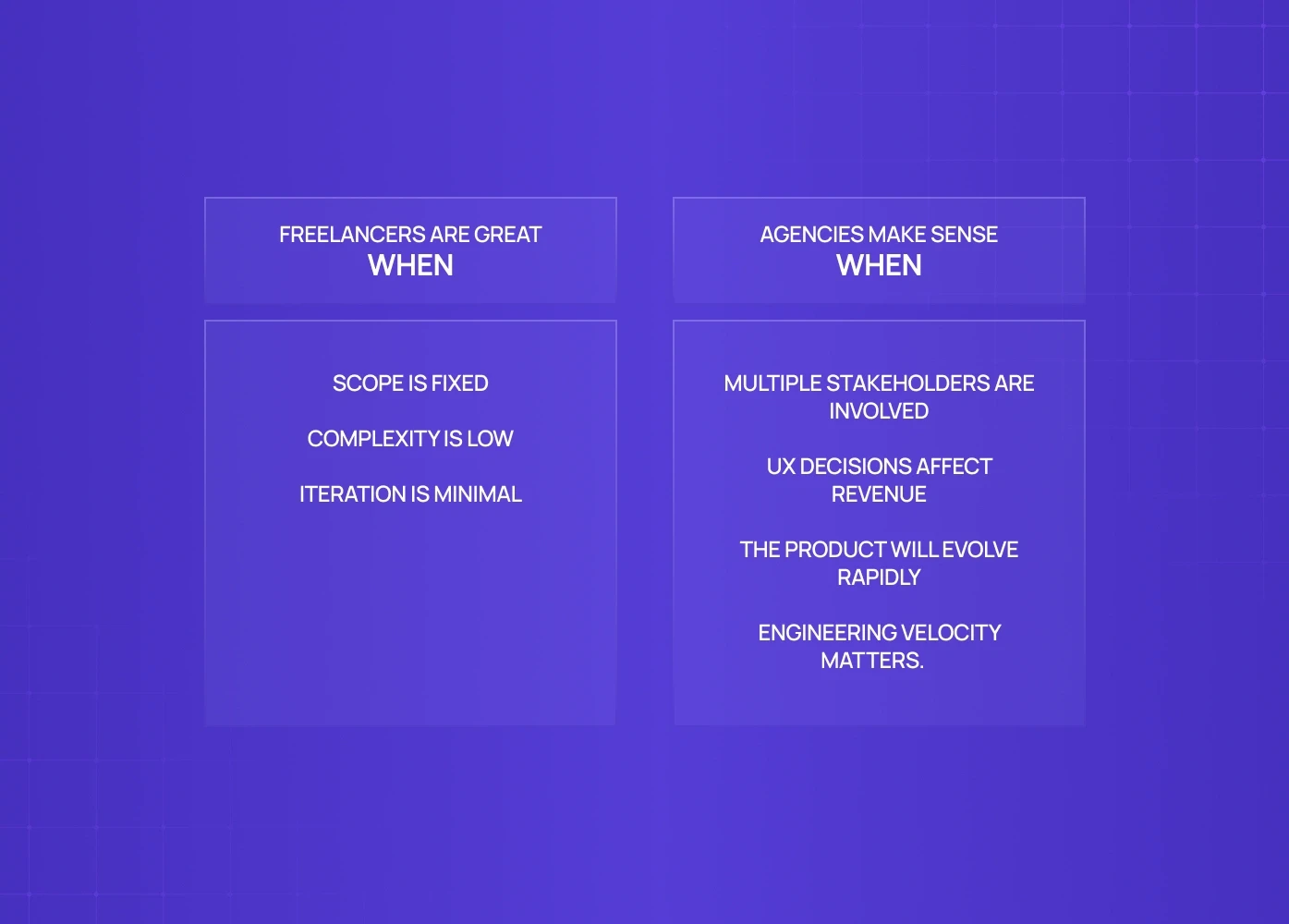
Freelancers are great when:
scope is fixed,
complexity is low,
iteration is minimal. But a startup building a brand and product together usually outgrows that fast, which is where a startup branding studio earns its keep.
For early-stage businesses not yet ready for a full agency engagement, small business web design services offer a structured middle ground — purpose-built for tighter budgets and simpler scopes without the freelancer coordination overhead.
The same logic applies when comparing against visual brand execution firms — fixed-scope visual work rarely needs the strategic depth this guide is built around.
For budget-conscious teams weighing agency options, India-based design agencies often combine full agency structure with significantly lower engagement costs than Western markets.
An outsourced agency makes sense when multiple stakeholders are involved, UX decisions affect revenue, the product will evolve rapidly, and engineering velocity matters — and for earlier-stage teams mapping those conditions for the first time, evaluating UX agency fit for your business before shortlisting prevents committing to a firm optimized for the wrong stage or scope.
If you're planning a serious web redesign agency engagement where responsive performance across devices is non-negotiable, agency depth matters more than speed.
Conclusion: The Right Agency Reduces Uncertainty
The best web design agencies don't just deliver assets — they reduce ambiguity, leaving you clearer about your users, more confident in decisions, and equipped to scale. Once you know what to look for, reviewing top UX agencies for SaaS gives you a curated shortlist to apply this framework against rather than starting your search from scratch.
If an agency makes you feel impressed but not clearer — that’s a red flag.
Want a Second Opinion Before You Choose?
If you’re in the middle of evaluating web design agencies and something still feels unclear, a short external perspective can help you avoid expensive misalignment.
We regularly review: whether a proposed design approach will actually support conversion, if the UX logic will scale as your product grows, and where teams are likely to accumulate design or engineering debt. If you want to understand UX audit cost before committing to a full engagement, that's a natural first step before booking a call.
A 20-minute call is often enough to spot red flags or validate your direction — even if you don’t end up working with us.
Book a call with our Creative Director to walk through your current website or agency shortlist and get an honest, product-level assessment.
FAQs
1. How long should agency selection take?
Typically 2–4 weeks. Rushing this decision often leads to redesigns later.
2. Is a higher-priced agency always better?
No. Price correlates poorly with outcome quality. Depth of thinking matters more. Research the pricing for web design agencies thoroughly before committing to one.
3. Should I prioritise industry experience?
Context helps, but strategic thinking transfers better than niche familiarity.
4. Do agencies handle SEO and UX together?
The strongest ones do. Treating them separately often hurts performance.
5. Can an agency work with our existing developers?
Yes — but only if collaboration is part of their process, not an afterthought.
6 . Do you offer professional web design services in multiple cities?
Yes. Groto provides professional web design services across multiple locations, including Web Design Services in Raleigh | Web Design Services in Richmond | Web Design Services in San Diego | Web Design Services in San Francisco | Web Design Services in Tampa | Web Design Services in Washington | Web Design Services in West Virginia | Web Design Services in York