Most UX research agency roundups sort by size and Clutch score. This one sorts by fit — because the agency right for enterprise validation is almost never right for a seed-stage discovery sprint. Here's the honest match.
Not every UX research agency fits every SaaS team. Here's the real match.
TL;DR
Most UX research agency roundups rank firms by size, Clutch score, and client logo — the guide to top user experience research firms does exactly that, and it's useful as a starting reference. This one ranks them by fit — because the agency that's right for an enterprise validation study is almost never the right choice for a seed-stage SaaS team running a pre-build discovery sprint. Use the UX Research Decision Matrix at the end to find your match.
What Is a UX Research Agency?
A UX research agency plans, conducts, and synthesises user research to help product teams understand their users, validate design assumptions, and identify friction and unmet needs. The core work involves recruiting representative users, designing research instruments, facilitating sessions, and synthesising findings into actionable insights — for the full picture of what a UX researcher actually does, that guide covers the role in depth.
What this covers:
Moderated and unmoderated usability testing
In-depth user interviews and diary studies
Concept testing and card sorting
Survey design and A/B test analysis
Contextual inquiry and tree testing
For a quick-reference breakdown of when each method applies, the UX research methods cheat sheet maps method to use case.
Most UX research agencies focus exclusively on research — they produce insights, not screens. Some agencies, however, integrate research and design within the same engagement, which closes the gap between finding and shipped product decision. Understanding what a UI/UX design agency delivers in terms of roles and deliverables clarifies what "integrated" actually means before you take it on trust. The right model depends on what your team needs: standalone research to inform an internal design team, or an end-to-end partner that carries the work from discovery through to design execution.
There's a second boundary worth naming: a UX research agency is not a product strategy consultancy. Research addresses questions about user behaviour and experience, the kind of findings often captured in user empathy maps. Strategy addresses market positioning, feature prioritisation, and competitive differentiation. The two inform each other, but they're not the same thing — and hiring a research agency to answer strategy questions creates a mismatch that usually results in expensive, inconclusive work.
For SaaS products specifically, the value of a strong user research agency is its ability to surface friction, confusion, and unmet needs that internal teams have stopped seeing — because familiarity bias is real, and teams that built the product are structurally compromised as interviewers. The guide to UX design companies for SaaS products covers the broader agency landscape that research-focused firms sit within.
How We Evaluated These Agencies
Five criteria, applied to every agency — for teams who want the complete agency selection framework beyond these research-specific criteria, the guide on how to choose the right web design agency covers the full decision checklist:
Research type coverage — generative (explore user needs), evaluative (test design solutions), or both?
SaaS specificity — does the agency understand how UX research connects to activation, retention, and time-to-value? The complete guide to SaaS UX design is the reference for understanding what that connection should look like in practice.
Synthesis quality — do findings come back as observations and themes, or as insight and design implication? A structured UI/UX portfolio evaluation framework is the most reliable way to verify synthesis quality against past deliverables before committing.
Research-to-design coupling — is a finished report the endpoint, or is there a structured path to shipped product decisions?
Scale and pricing fit — accessible to seed/Series A teams, or calibrated for enterprise programmes?
Before You Choose: Generative vs. Evaluative Research
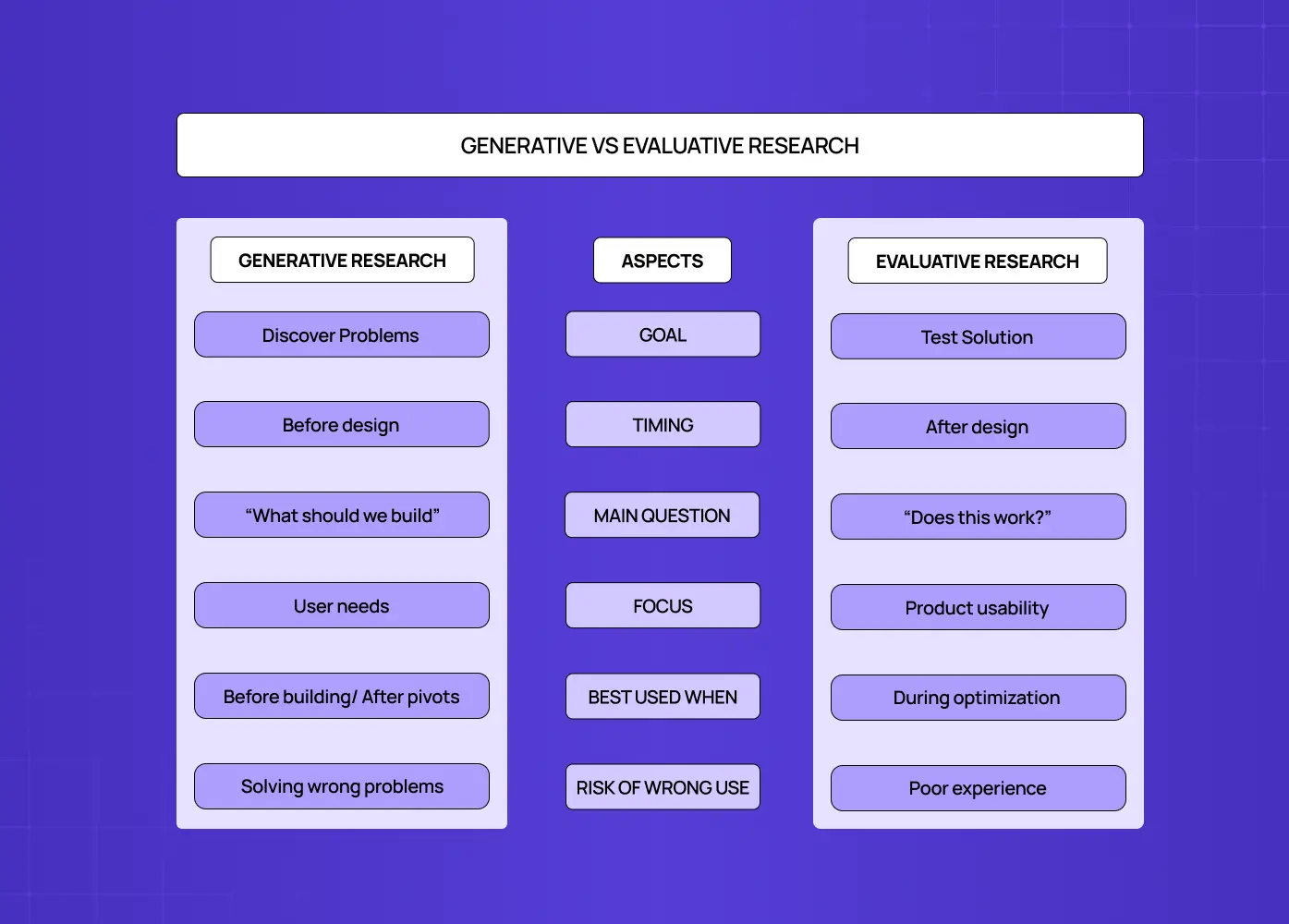
The most expensive mistake in SaaS research isn't picking the wrong agency. It's running the wrong type of research — which is why grasping what UX research is, at the level of its two core modes, matters before you brief anyone.
Generative research explores the problem space before design decisions exist. It answers: who are our users, what jobs are they trying to do, where does our product create friction? It's the right call before building, after a pivot, or when churn is high and no one really knows why — and it pairs naturally with a rival UX analysis that maps how competitors already solve the same problems.
Evaluative research tests how well a design solution works. It answers: can users complete this task? Where do they get confused? It assumes a design direction exists and assesses how well it's performing — for teams who want a structured process for running this internally before engaging an agency, the guide on how to do a UX audit covers the steps and tools.
Running a usability test when your real question is "are we solving the right problem?" validates the execution of a wrong direction. Most UX research agencies are strongest in evaluative work — if your need is generative, ask specifically before briefing. The full range of UX design methodologies explained gives readers the vocabulary to ask those questions precisely.
The 7 Best UX Research Agencies for SaaS
1. Groto — Best for Research-Integrated SaaS Design
We built our research model around one specific failure mode: research that gets done but never ships. At Groto, research and design are never split into separate engagements. Researchers and designers work together in synthesis — not in a handoff — so findings become design direction rather than a document waiting to be interpreted.
For SaaS teams, we cover the full research spectrum: pre-build generative discovery to validate product direction, pre-launch usability studies on conversion-critical flows, and post-launch churned user interviews to surface retention friction that no other method finds as cleanly.
When we worked with Camb.ai, the research phase directly shaped the redesigned dubbing interface — findings didn't sit in a folder, they became the brief. The same research-first approach ran through our work with PolicyBazaar, where understanding actual user drop-off behaviour was the prerequisite to fixing it.
Every engagement starts with a named decision the research is meant to inform. It closes with a design response verification — confirming findings were acted on, not just received.
Best for: Seed to Series A SaaS teams whose research question can't be cleanly separated from a design decision. Teams that have bought research before and watched it not translate.
Not right for: Enterprise teams needing large-scale multi-market research operations across hundreds of participants.
Pricing: Engagement-based; scoped per project or monthly retainer. Discovery call to assess fit.
2. AnswerLab — Best for Enterprise-Scale Research Programmes
AnswerLab is one of the most methodologically rigorous pure-play research firms available. With 200+ dedicated researchers and particular depth in AI UX studies (200+ engagements), the firm is genuinely differentiated at enterprise scale — multiple studies across a product lifecycle, mixed-method approaches, and research that feeds both product and executive strategy.
For SaaS companies, AnswerLab is strongest when the research programme is large and complex. Their research-powered experience strategy model ties deep research to roadmap validation, which produces more commercially actionable outputs than standalone research deliverables.
The trade-off is accessibility. Projects start at $25,000 and run to $100,000+. For a seed-stage team running a two-week discovery sprint, that's significantly more infrastructure than the problem requires.
Best for: Series B+ SaaS with dedicated research functions and complex multi-segment requirements.
Not right for: Seed and Series A teams needing lean research integrated with active design work.
Pricing: $25,000–$100,000+ per engagement.
3. Blink UX — Best for Evidence-Driven Product Strategy
Blink sits at the intersection of research and strategy, producing findings that are calibrated for executive and board-level confidence rather than designer-level input. When a SaaS company is facing a significant strategic decision — platform pivot, new market entry, product architecture change — and needs user evidence that can hold up in a leadership conversation, Blink's research depth is genuinely useful.
That positioning comes with a matching price range: $50,000–$500,000 per engagement. It's the right investment when the decision it informs carries proportionate financial stakes. For most seed and Series A teams, that's not the situation.
Best for: Series B+ SaaS teams making high-stakes product strategy decisions that need evidence for C-suite or board-level alignment.
Not right for: Teams that need research integrated with active design iteration, or earlier-stage teams with limited research budgets.
Pricing: $50,000–$500,000 per engagement.
4. Eleken — Best for SaaS Research + Design at Accessible Pricing
Eleken is a Ukrainian UX/UI agency with one of the stronger SaaS-specific portfolios at the mid-market price point. Their model keeps researcher and designer roles distinct within the same engagement — a structural choice that prevents research findings from being unconsciously shaped by an existing design direction.
Their SaaS focus means the research vocabulary and synthesis frameworks are calibrated for SaaS outcomes. The practical trade-off is depth on the generative side: Eleken is strong for evaluative work (usability testing, conversion research) but less developed for pre-build discovery or churned user interview programmes.
Best for: Seed to Series A SaaS teams that need research and design execution together, particularly for usability testing and conversion-focused work.
Not right for: Teams whose primary research need is generative — pre-build problem validation, jobs-to-be-done research, or churned user discovery.
Pricing: Monthly engagement model; accessible for seed/Series A. Exact pricing on request.
5. UX Studio — Best for Embedded Research Partnerships
UX Studio operates as a fully embedded UX partner rather than a project-based agency — best suited to SaaS teams who want research integrated into ongoing product development rather than delivered in periodic sprints, which makes the choice between an embedded or remote partner worth settling first. The consistent external team accumulates product context over months, surfacing patterns that one-off engagements miss.
The embedded model has a specific limitation: it's not optimised for high-velocity bounded discovery sprints. If you need intensive research on a defined question with results in three to four weeks, this isn't the right structure.
Best for: Series A SaaS companies building a design function for the first time — leaning on an interim design agency while that in-house team comes together — and wanting ongoing research-design partnership with continuity.
Not right for: Teams needing a single intensive research sprint on a specific question quickly.
Pricing: Monthly engagement model; pricing on request.
6. Experiment Zone — Best for CRO-Focused UX Research
Experiment Zone specialises at the intersection of UX research and conversion rate optimisation. For SaaS teams whose most pressing research question is "why isn't our trial converting?" or "why are users dropping at step three of onboarding?", their methodology — combining usability research with quantitative conversion analysis — produces findings expressed in terms of measurable metric impact rather than general experience improvement.
The scope is deliberately focused: conversion-critical flows and activation metrics. It's not the right fit if your primary research need is broader discovery of user jobs or unmet needs.
Best for: Seed to Series B SaaS teams with a specific conversion or activation metric to improve, and research that maps directly to that metric.
Not right for: Teams whose primary need is generative — problem-solution fit, JTBD research, or strategic discovery before a major product investment.
Pricing: Project-based; typically accessible for seed/Series A teams.
7. Nielsen Norman Group — Best for Research Credibility and Training
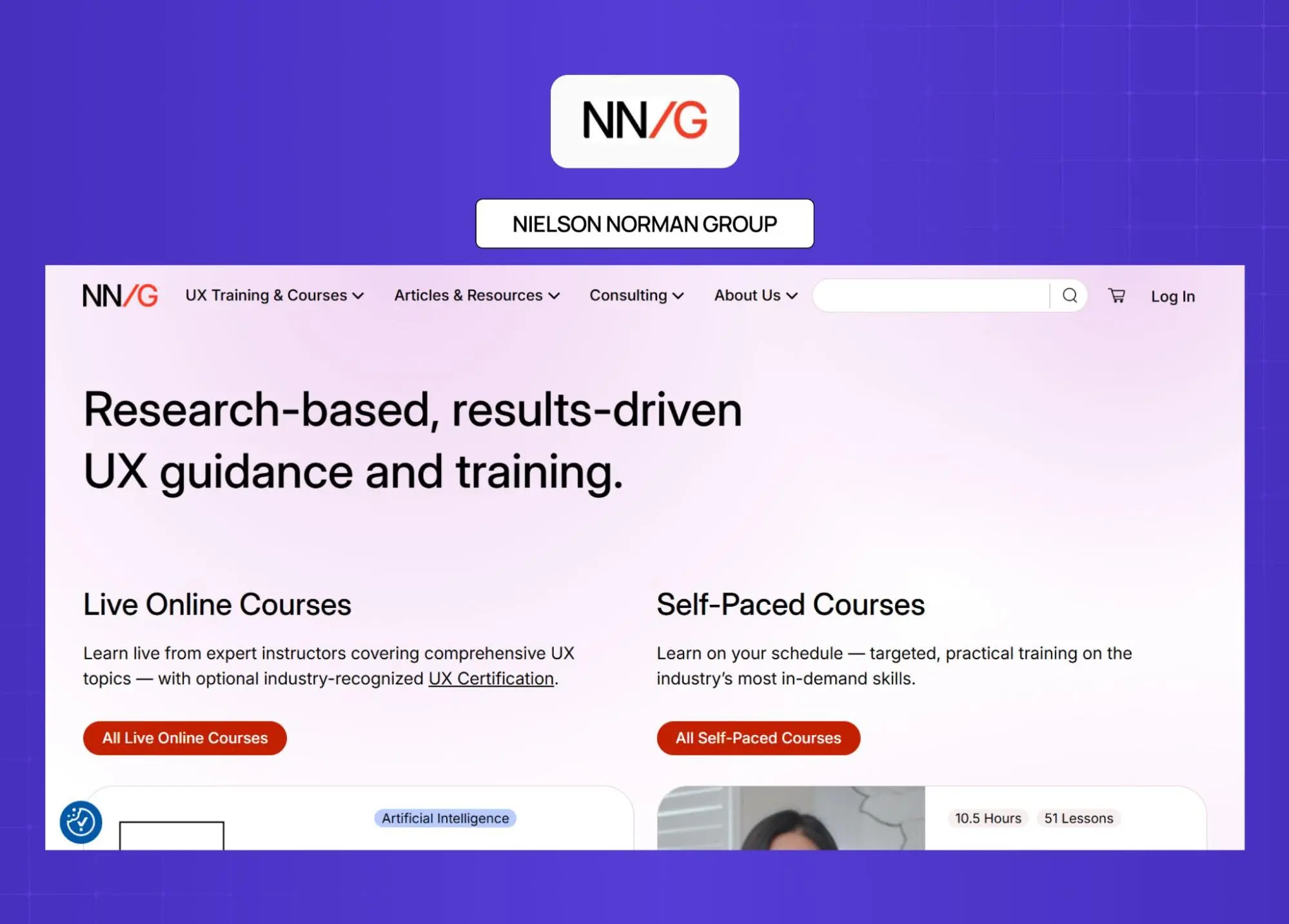
NN/g occupies a unique market position: simultaneously a research consultancy, a standards organisation, and the leading UX training provider globally. Their research consulting engagements carry external authority that internal research rarely achieves — which matters when findings need to drive alignment across senior leadership or validate a direction facing internal resistance.
The accessibility trade-off is real: NN/g is priced at the premium end and structured for organisations that can absorb it. For earlier-stage SaaS teams, their training programmes are often the more practical entry point for building internal research capability.
Best for: Series B+ SaaS organisations needing research findings to command external credibility, or teams investing in building internal research capability.
Not right for: Seed and Series A teams needing lean, fast research integrated with active design work.
Pricing: Premium enterprise pricing. Training programmes publicly priced on their website.
How to Choose: The UX Research Decision Matrix
Before evaluating any agency, identify where your research need actually sits. The matrix crosses three research purposes (Discover, Validate, Iterate) against three product stages (Pre-build, Pre-launch, Post-launch).
Aspects | Pre-Build | Pre-Launch | Post-Launch |
Discover | User interviews, contextual inquiry | Concept testing | Churned user interviews, diary studies |
Validate | Problem validation surveys | Prototype usability testing | A/B testing, funnel analysis |
Iterate | Card sorting, free testing | Moderated task testing | Unmoderated testing, heatmap analysis |
Match by cell:
Pre-build + Discover (validate direction before building): Groto, Eleken, or UX Studio
Pre-launch + Validate (usability testing before release): any agency on this list
Post-launch + Discover (churned user interviews, retention research): Groto or AnswerLab
Post-launch + Iterate (improve a specific conversion metric): Experiment Zone, Groto, or Eleken
Strategic decision requiring board-level evidence: Blink UX, AnswerLab, or NN/g
The second question is whether you need research only, or research and design together. If your findings will directly generate a design brief — which they should — choosing an agency that couples both in the same engagement prevents research from dying in the handoff.
Why Groto
Most UX research agencies treat the finished report as the end of the engagement. We treat it as the halfway point.
At Groto, we structure every research engagement around a named decision, involve designers in synthesis rather than just delivering findings to them, and close every engagement with a design response review — confirming the research actually changed something rather than confirming it was received.
For SaaS teams at seed through Series A, this matters more than methodology badges. The research graveyard forms when the path from insight to shipped product is left undesigned. We design that path into the engagement itself — and calculating the ROI of UX design gives teams the framework for quantifying what that path is worth before the engagement begins.
Conclusion
The best UX research agency for your SaaS company is the one whose research type coverage, synthesis approach, and commercial model match your specific situation — not the one with the most impressive client list. For teams evaluating the broader SaaS design and UX agency landscape, the guide to best UX agencies for SaaS covers the wider category that research firms sit within.
Research + design integrated at seed/Series A: Groto
Enterprise-scale research programmes: AnswerLab
Board-level strategy evidence: Blink UX
SaaS research + design at accessible pricing: Eleken
Embedded longitudinal partnership: UX Studio
CRO and conversion metric improvement: Experiment Zone
Research credibility and team training: Nielsen Norman Group
If you've commissioned research before and it ended up in a folder, that's the research graveyard — and it's solvable. Start with a discovery call.