Product Design vs Product Management: What Each Role Owns (And the Gap Neither Fills)

A clear breakdown of product design vs product management — what each role owns, where they overlap, and the activation gap neither fills.

Product Design vs Product Management: What Each Role Owns (And the Gap Neither Fills)

A clear breakdown of product design vs product management — what each role owns, where they overlap, and the activation gap neither fills.

Product managers decide what to build. Product designers decide how it works. But between those two accountabilities sits a gap — activation architecture — that neither role fully owns, and it's quietly killing trial conversion for most SaaS products.

Two roles, one product — and a responsibility gap most SaaS teams never see.
Illustration of a product presentation meeting where a presenter explains a mobile app wireframe to a seated team in a purple-themed office setting.

The standard explanation of product design vs product management goes like this: product managers decide what to build; product designers decide how it looks. It's a clean sentence. It's also wrong in a way that quietly costs SaaS companies points on their activation rate.

The problem isn't the summary — it's that it implies a clean handoff between adjacent roles. In practice, the boundary is messier, the overlap is intentional, and there is a category of work that falls reliably between the two roles and gets owned by neither. For early-stage SaaS companies, that gap is not an edge case. It's where most activation problems live.

This post uses the Product Responsibility Matrix to define what product design and product management actually own, where they legitimately overlap, and — most importantly — what category of design work most SaaS teams leave in the gap.

TL;DR: 

PM owns direction and metrics. PD owns experience and interface. Neither fully owns activation architecture — and that's where most SaaS activation problems live.

Before we get into the split: a quick grounding on both roles.

  • Product Management (PM) is the function responsible for deciding what a product should do — which problems to solve, which features to build, in what order, and measured against which business outcomes.

  • Product Design (PD) is the function responsible for deciding how a product works and feels — the interaction logic, the visual layer, and the overall quality of the user experience. It's worth noting that product design and UX design are not the same role, and that distinction shapes what each is actually accountable for. 

Both roles exist to serve the same user. The difference is in what they're accountable for.

What Product Management Actually Owns

Product management is accountable for the product's direction, prioritisation, and performance. A PM's core job is making decisions about what to build — and in what order, for whom, and measured against what outcomes.

In practical terms, that breaks into three primary ownership areas:

  • Product strategy and roadmap — The PM owns the decision of which problems the product addresses, which customer segments it's optimised for, and how features are sequenced over time. This isn't just writing a roadmap — it's making defensible prioritisation decisions when resources are constrained, which they always are.

  • Requirement definition and scope — When a problem worth solving is identified, the PM defines what a solution needs to accomplish — what outcomes it needs to drive, what constraints apply, and what "done" looks like from a business and user perspective. This is scope definition, not design specification.

  • Product performance and metrics — After a feature or flow ships, the PM is accountable for whether it achieved the intended outcome. Activation rate, feature adoption, upgrade conversion, churn — these are PM metrics. If a redesigned onboarding flow doesn't move activation, that's a PM problem to diagnose and respond to, even if the design work was executed correctly. Calculating the ROI of UX design sits exactly at this intersection — it's how design decisions get translated into the business metrics that PMs are accountable for. 

What product management does not own: how a solution works at the interface level. A PM who writes interaction specifications is doing design work — sometimes necessarily at early-stage companies, but not as part of the role's core accountability. For teams building the PM function from scratch, a practical framework for creating a product roadmap covers the structure that supports these prioritisation decisions without drifting into design territory. 

The UX playbook that takes you from MVP traction to Series A growth

Identify the UX mistakes silently killing your activation rate and the exact fixes to improve conversions without a full product redesign.

No Spam. Free Lifetime

The UX playbook that takes you from MVP traction to Series A growth

Identify the UX mistakes silently killing your activation rate and the exact fixes to improve conversions without a full product redesign.

No Spam. Free Lifetime

What Product Design Actually Owns

Product design is accountable for the quality of the user experience — how a product feels to use, whether it communicates what it does, and whether users can successfully accomplish what they came to do. What product designers actually do across the development cycle covers this in more depth; the short version is four interconnected ownership areas. 

  • Interaction design and user flows — The product designer owns the architecture of how a feature or product section works at the interface level: the sequence of screens, the decision points, the transitions, the error states. This is distinct from how the feature looks — it's about how it behaves and whether users can navigate it without friction.

  • Visual and interface design — Typography, colour, layout, component design, hierarchy, motion — the product designer owns the visual layer of the product experience. In SaaS products, visual design is not decoration; it is communication. A well-designed dashboard communicates data hierarchy faster than any tooltip. A poorly designed empty state communicates nothing. The core principles of digital product design explain why these decisions compound across a product experience — and why they require dedicated ownership rather than engineering approximation. 

  • Design systems and component libraries — At scaling SaaS companies, product designers own the design system that keeps the product visually and behaviourally consistent across features. This is infrastructure, not styling — a well-built design system is the asset that allows engineering to ship new features without recreating UI decisions from scratch. How teams are using agentic AI in product design workflows is beginning to change how this layer gets built and maintained — an emerging consideration for PMs and designers deciding how to staff and sequence design system work. 

  • User research and testing — Most product designers are responsible for usability testing, prototype validation, and user research that informs design decisions. The distinction from PM-led research: the product designer is investigating whether a specific interface works, not whether a feature is worth building.

What product design does not own: the decision of which problem to solve, or which feature to prioritise. A designer who writes prioritisation frameworks is doing PM work — again, sometimes necessary, but not the role's core accountability.

PM vs PD: At a Glance
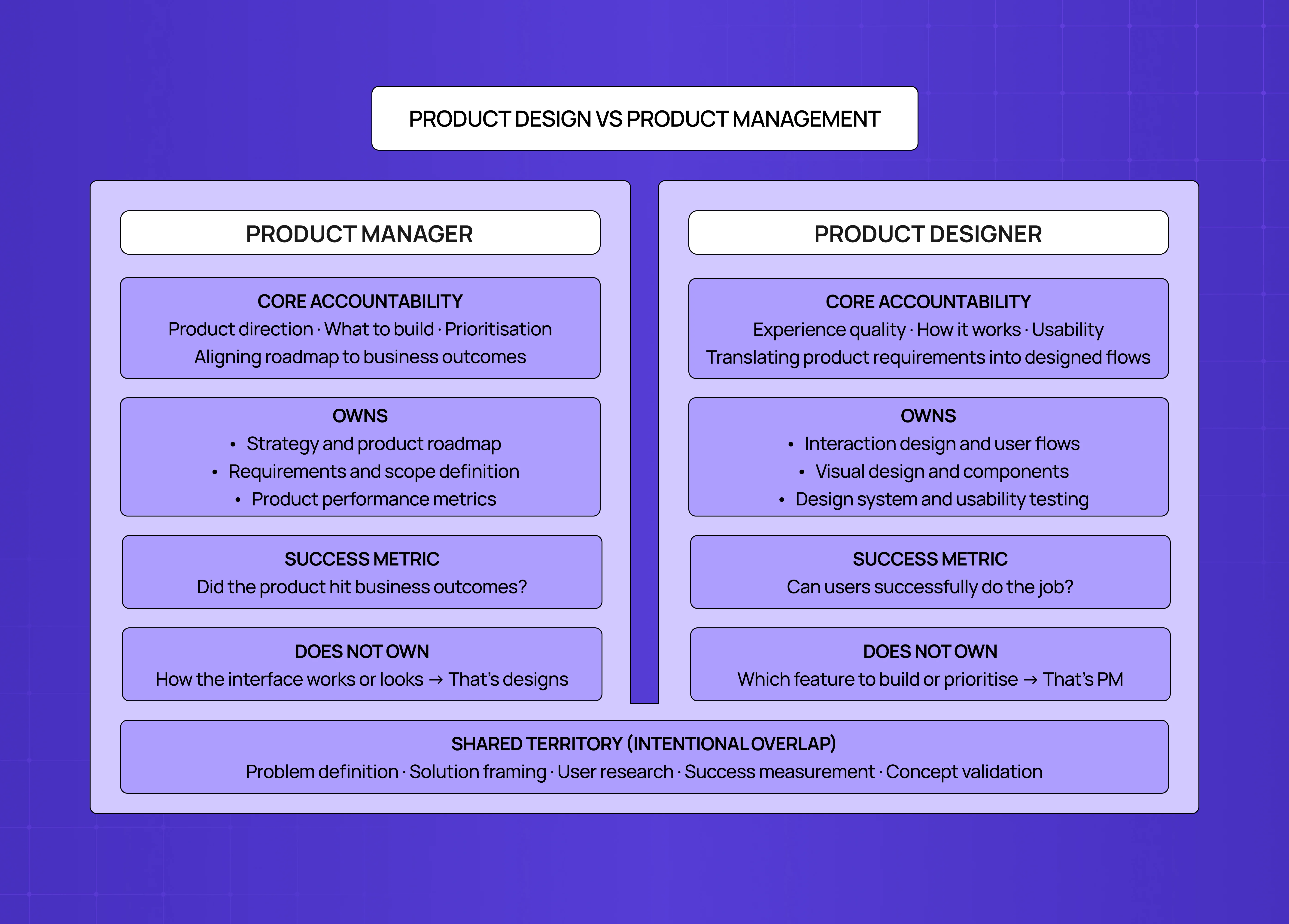
Comparison chart between product management and product design, outlining responsibilities, ownership areas, success metrics, and shared collaboration zones.

Aspects

Product Manager

Product Designer

Primary question

What should we build?

How should it work and feel?

Core accountability

Direct, prioritisation, metrics

Experience quality, interface, design systems

Owns the roadmap

Yes

No

Owns the interface

No

Yes

Conducts user research

Yes (problem-level)

Yes (interface-level)

Measures success via

Activation rate, conversion, churn

Usability, flow completion, design consistency

Works with

Stakeholders, engineers, data

Engineers, PMs, users

Where the Two Roles Overlap (And Why That Overlap Is Intentional)

The legitimate overlap between product design and product management is not a structural flaw — it's a feature. The best product teams operate in what's sometimes called the "product trio": PM, designer, and engineer working at the intersection of business viability, user desirability, and technical feasibility.

  • Problem definition is shared territory — Both roles should be involved in understanding user problems before committing to solutions. PMs bring business context and quantitative signal; designers bring behavioural observation and qualitative insight. Separating these in a sequential handoff ("PM finds problem, designer gets brief") produces worse problem definitions than collaborative discovery.

  • Solution framing is joint accountability — When a problem is defined, the PM and designer should explore the solution space together before converging on a specific direction. The PM needs to understand the design implications of different approaches; the designer needs to understand the business constraints that limit the solution space. One useful artifact for aligning both perspectives is a product design roadmap that maps design decisions alongside product priorities — it gives both roles a shared planning surface instead of separate artefacts that have to be reconciled later. 

  • Success measurement requires both — A PM tracking activation rate without a designer who understands what the onboarding experience actually feels like from the user's perspective is flying half-blind. The metric tells you something moved; the design eye tells you why. This is also where UX strategy becomes a shared concern — translating design insight into directional decisions that both roles can act on, rather than competing interpretations of the same data. 

This overlap is where early-stage SaaS teams often assign everything to one person — the "PM/designer" or "founder/PM/designer." That's a defensible staffing decision at pre-seed. It starts costing activation points once the product has more than a handful of flows that need to work together. Understanding the spectrum of UX disciplines helps clarify which specialisation gap actually needs filling first — because the answer isn't always "hire a designer." 

The Product Responsibility Matrix
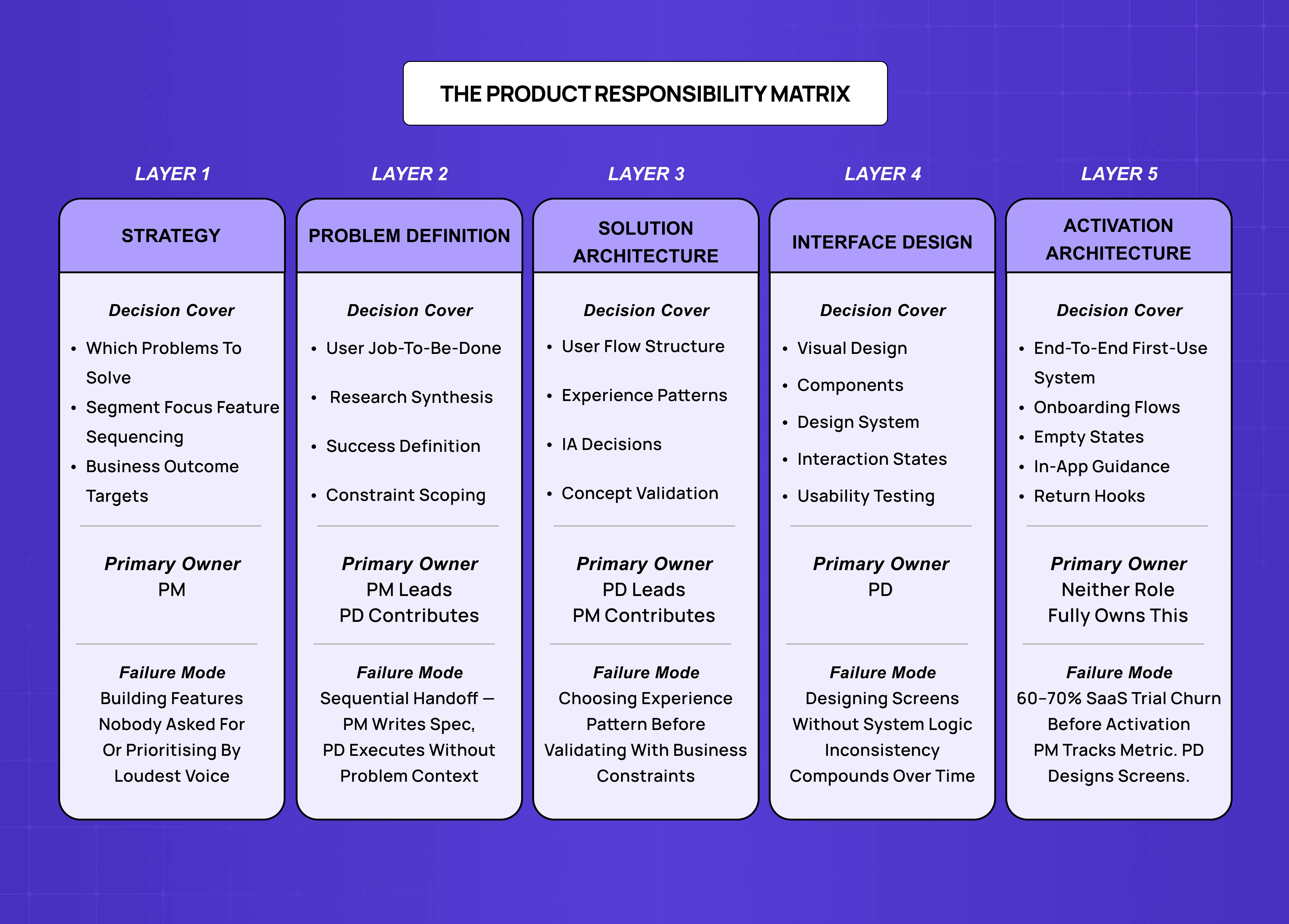
Product responsibility matrix showing five layers of product development, from strategy and problem definition to interface design and activation architecture, with ownership and failure risks.

The Product Responsibility Matrix is a five-layer model for mapping ownership across the full range of product decisions. It clarifies the PM/PD split more precisely than the "what vs. how" shorthand, and — critically — it names the responsibility layer that most SaaS teams leave unowned.

Here's how ownership maps across each layer:

Decision Layer

What it covers

Primary owner

1. Strategy

Which problem to solve, which segment to target, feature prioritisation

PM

2. Problem Definition

What success looks like for the user, job-to-be-done, research synthesis

PM leads, PD contributes

3. Solution Architecture

Which experience pattern solves the problem, user flow structure, IA

PD leads, PM contributes

4. Interface Design

Component behaviour, visual design, interaction states, design system

PD

5. Activation Architecture


The end-to-end designed system that takes a new user from signup to first success

Gap layer — neither role fully owns this

Layers 1–4 have clear ownership and function reasonably well on most product teams. Layer 5 is the problem.

The Gap Layer: Activation Architecture

Activation architecture is the designed system that determines whether a new user reaches their first moment of success in your product. It includes: the onboarding flow, the empty states, the first-use emails, the in-app guidance, the progressive disclosure of features, and the conditions under which users are considered activated.

Here is why it falls between both roles:

  • How PMs treat activation — PMs treat activation as a metric and a priority. It goes on the roadmap. It gets OKRs assigned. It is measured as a number (percentage of users who complete the activation event within X days). But the PM is not typically the one designing the end-to-end experience that produces that number. They write the brief; they prioritise the project; they check the dashboard. The SaaS metrics like activation rate, MRR, and churn that PMs track are interconnected in ways that make the activation architecture gap especially expensive — churn at day 7 rarely shows up on the roadmap as a design problem. 

  • How PDs treat activation — Product designers treat activation as a collection of flows. The onboarding screens are a design project. The empty states are a component. The email sequence is handed off to growth or content. The result is that activation gets designed feature by feature and screen by screen — but almost never as a coherent end-to-end system with explicit design logic governing the full first-use journey.

The consequence: Most SaaS products have activation flows that were designed incrementally, assembled from individually reasonable decisions that don't add up to a coherent experience. Research from product analytics firms consistently shows that 60–70% of SaaS trial users churn before reaching their activation event — not because the product is bad, but because nobody designed the first-use experience as a system.

This is the specific problem that a specialist product design partner (rather than either an internal PM or a general design resource) is built to solve. It requires holding the full activation journey as a single design problem, not a series of individual design tickets.

How This Plays Out at Different Company Stages
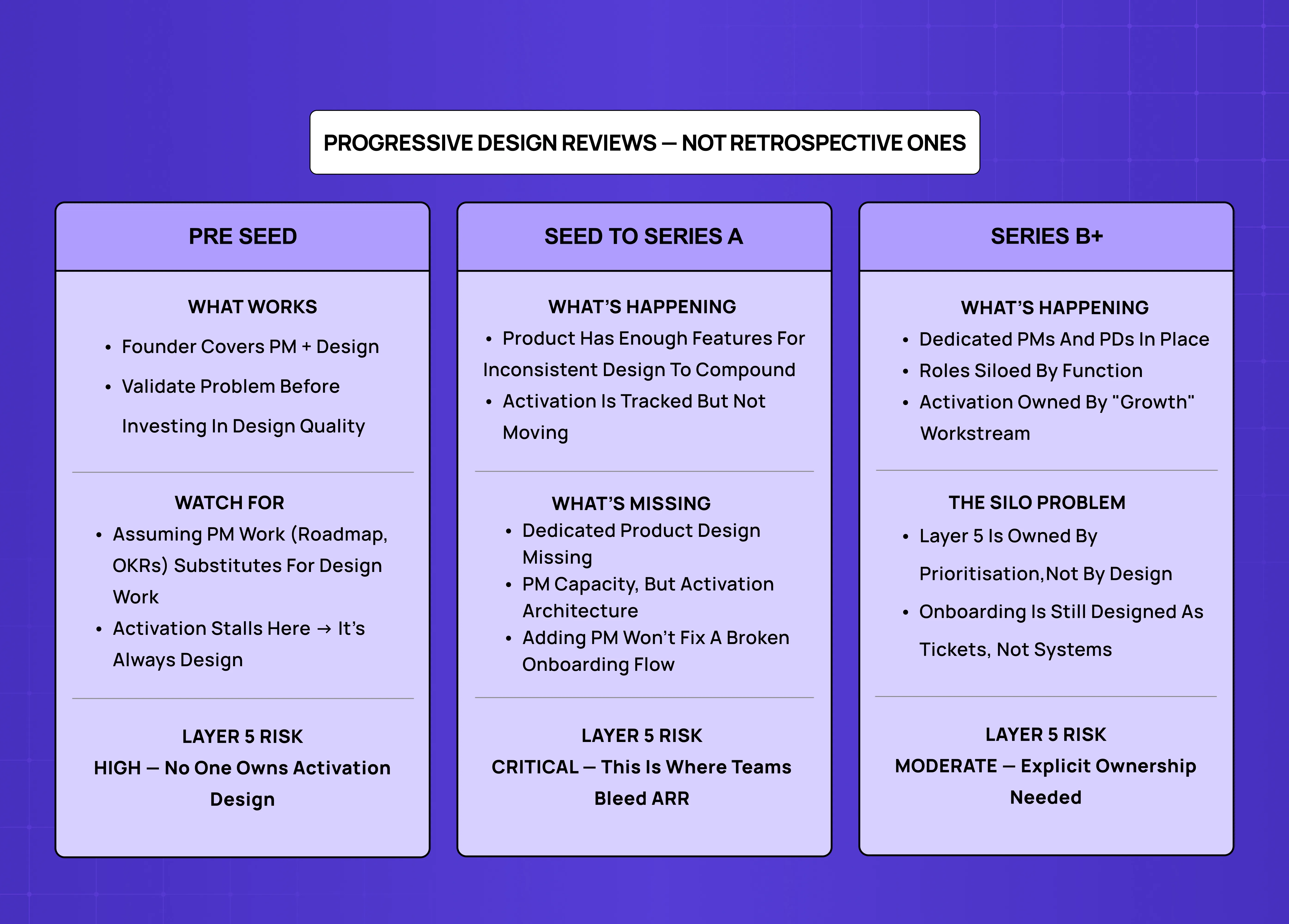
Progressive design review framework comparing product design and activation ownership across startup stages from pre-seed to Series B+ companies.

Understanding the PM/PD distinction matters differently depending on where you are as a company.

Pre-seed and seed stage

At this stage, the founding team typically covers both PM and PD functions. This is fine — and often the right call. The risk is assuming that good PM work (problem definition, roadmap, metrics) substitutes for good product design work (interaction design, onboarding architecture, design system foundations). It doesn't. When activation stalls at the seed stage, it's almost always a design problem, not a prioritisation problem.

Series A

This is the stage where the PM/PD gap becomes most expensive. The product has enough features and flows that inconsistent design decisions compound into a confused user experience. Activation is a known metric but it isn't moving. Most Series A teams need dedicated product design help — not just more PM capacity — specifically on the activation architecture gap. SaaS product design best practices at the Series A stage look different from early-stage patterns — consistency, system thinking, and flow coherence matter more than any single screen. 

Series B and beyond

At this stage, you likely have dedicated PMs and designers. The risk shifts: the roles are siloed, and activation architecture still isn't owned end-to-end by either. It's owned by whichever PM is running the "growth" workstream, which means it's owned by prioritisation, not by design. For teams working to fix that, the complete guide to SaaS UX design covers the experience architecture principles that inform how both roles should approach this gap at scale. 

Product Design vs Product Management: The Hiring Implication

When SaaS founders search "product design vs product management," they are often asking a more specific question: which role do we hire first, or which gap do we fill?

The answer depends on what problem you're trying to solve:

  • If product direction is unclear — you're not sure which features to build, which segment to prioritise, or what metrics to move — you have a product management problem. Hire or develop PM capacity.

  • If direction is clear but users aren't activating — they sign up, explore briefly, and churn before activating — you have a product design problem. Specifically, an activation architecture problem. Adding a PM won't fix a flow that doesn't orient new users. Adding a generic designer who treats each screen as a separate deliverable may not fix it either.

For SaaS companies at the seed-to-Series-A stage, the most impactful product design investment is almost always in the activation layer: onboarding flows, empty states, first-use guidance, dashboard orientation, and the design system that makes those flows consistent. This is the category of work that a sprint-based product design specialist can deliver in a defined engagement with measurable activation outcomes — rather than either a full-time PM hire or a general design resource who doesn't specialise in SaaS product UX.

Key Takeaways

  • Product management owns strategy, prioritisation, and product performance metrics. Product design owns interaction design, visual design, and design systems. The "what vs. how" summary is a starting point, not the full picture.

  • The legitimate overlap — problem definition, solution framing, research — is intentional and produces better outcomes than a sequential handoff model.

  • The Product Responsibility Matrix identifies five decision layers. Layers 1–4 have clear ownership. Layer 5 — activation architecture — is the gap layer that most SaaS teams leave unowned.

  • Activation architecture is the end-to-end designed system that takes a new user from signup to first success. PMs treat it as a metric. Designers treat it as a collection of flows. Neither treats it as a coherent designed system.

  • When SaaS founders ask "product design vs product management," they're often asking "what kind of help do we need." If your product direction is clear but users aren't activating, the gap is almost always in design — specifically, the activation architecture layer.

We specialise in the activation architecture gap: sprint-based engagements that deliver rebuilt onboarding flows, dashboard architecture, and design systems specifically for SaaS companies at the Seed to Series A stage.

Product managers decide what to build. Product designers decide how it works. But between those two accountabilities sits a gap — activation architecture — that neither role fully owns, and it's quietly killing trial conversion for most SaaS products.

Two roles, one product — and a responsibility gap most SaaS teams never see.

Illustration of a product presentation meeting where a presenter explains a mobile app wireframe to a seated team in a purple-themed office setting.

The standard explanation of product design vs product management goes like this: product managers decide what to build; product designers decide how it looks. It's a clean sentence. It's also wrong in a way that quietly costs SaaS companies points on their activation rate.

The problem isn't the summary — it's that it implies a clean handoff between adjacent roles. In practice, the boundary is messier, the overlap is intentional, and there is a category of work that falls reliably between the two roles and gets owned by neither. For early-stage SaaS companies, that gap is not an edge case. It's where most activation problems live.

This post uses the Product Responsibility Matrix to define what product design and product management actually own, where they legitimately overlap, and — most importantly — what category of design work most SaaS teams leave in the gap.

TL;DR: 

PM owns direction and metrics. PD owns experience and interface. Neither fully owns activation architecture — and that's where most SaaS activation problems live.

Before we get into the split: a quick grounding on both roles.

  • Product Management (PM) is the function responsible for deciding what a product should do — which problems to solve, which features to build, in what order, and measured against which business outcomes.

  • Product Design (PD) is the function responsible for deciding how a product works and feels — the interaction logic, the visual layer, and the overall quality of the user experience. It's worth noting that product design and UX design are not the same role, and that distinction shapes what each is actually accountable for. 

Both roles exist to serve the same user. The difference is in what they're accountable for.

What Product Management Actually Owns

Product management is accountable for the product's direction, prioritisation, and performance. A PM's core job is making decisions about what to build — and in what order, for whom, and measured against what outcomes.

In practical terms, that breaks into three primary ownership areas:

  • Product strategy and roadmap — The PM owns the decision of which problems the product addresses, which customer segments it's optimised for, and how features are sequenced over time. This isn't just writing a roadmap — it's making defensible prioritisation decisions when resources are constrained, which they always are.

  • Requirement definition and scope — When a problem worth solving is identified, the PM defines what a solution needs to accomplish — what outcomes it needs to drive, what constraints apply, and what "done" looks like from a business and user perspective. This is scope definition, not design specification.

  • Product performance and metrics — After a feature or flow ships, the PM is accountable for whether it achieved the intended outcome. Activation rate, feature adoption, upgrade conversion, churn — these are PM metrics. If a redesigned onboarding flow doesn't move activation, that's a PM problem to diagnose and respond to, even if the design work was executed correctly. Calculating the ROI of UX design sits exactly at this intersection — it's how design decisions get translated into the business metrics that PMs are accountable for. 

What product management does not own: how a solution works at the interface level. A PM who writes interaction specifications is doing design work — sometimes necessarily at early-stage companies, but not as part of the role's core accountability. For teams building the PM function from scratch, a practical framework for creating a product roadmap covers the structure that supports these prioritisation decisions without drifting into design territory. 

The UX playbook that takes you from MVP traction to Series A growth

Identify the UX mistakes silently killing your activation rate and the exact fixes to improve conversions without a full product redesign.

No Spam. Free Lifetime

What Product Design Actually Owns

Product design is accountable for the quality of the user experience — how a product feels to use, whether it communicates what it does, and whether users can successfully accomplish what they came to do. What product designers actually do across the development cycle covers this in more depth; the short version is four interconnected ownership areas. 

  • Interaction design and user flows — The product designer owns the architecture of how a feature or product section works at the interface level: the sequence of screens, the decision points, the transitions, the error states. This is distinct from how the feature looks — it's about how it behaves and whether users can navigate it without friction.

  • Visual and interface design — Typography, colour, layout, component design, hierarchy, motion — the product designer owns the visual layer of the product experience. In SaaS products, visual design is not decoration; it is communication. A well-designed dashboard communicates data hierarchy faster than any tooltip. A poorly designed empty state communicates nothing. The core principles of digital product design explain why these decisions compound across a product experience — and why they require dedicated ownership rather than engineering approximation. 

  • Design systems and component libraries — At scaling SaaS companies, product designers own the design system that keeps the product visually and behaviourally consistent across features. This is infrastructure, not styling — a well-built design system is the asset that allows engineering to ship new features without recreating UI decisions from scratch. How teams are using agentic AI in product design workflows is beginning to change how this layer gets built and maintained — an emerging consideration for PMs and designers deciding how to staff and sequence design system work. 

  • User research and testing — Most product designers are responsible for usability testing, prototype validation, and user research that informs design decisions. The distinction from PM-led research: the product designer is investigating whether a specific interface works, not whether a feature is worth building.

What product design does not own: the decision of which problem to solve, or which feature to prioritise. A designer who writes prioritisation frameworks is doing PM work — again, sometimes necessary, but not the role's core accountability.

PM vs PD: At a Glance

Comparison chart between product management and product design, outlining responsibilities, ownership areas, success metrics, and shared collaboration zones.

Aspects

Product Manager

Product Designer

Primary question

What should we build?

How should it work and feel?

Core accountability

Direct, prioritisation, metrics

Experience quality, interface, design systems

Owns the roadmap

Yes

No

Owns the interface

No

Yes

Conducts user research

Yes (problem-level)

Yes (interface-level)

Measures success via

Activation rate, conversion, churn

Usability, flow completion, design consistency

Works with

Stakeholders, engineers, data

Engineers, PMs, users

Where the Two Roles Overlap (And Why That Overlap Is Intentional)

The legitimate overlap between product design and product management is not a structural flaw — it's a feature. The best product teams operate in what's sometimes called the "product trio": PM, designer, and engineer working at the intersection of business viability, user desirability, and technical feasibility.

  • Problem definition is shared territory — Both roles should be involved in understanding user problems before committing to solutions. PMs bring business context and quantitative signal; designers bring behavioural observation and qualitative insight. Separating these in a sequential handoff ("PM finds problem, designer gets brief") produces worse problem definitions than collaborative discovery.

  • Solution framing is joint accountability — When a problem is defined, the PM and designer should explore the solution space together before converging on a specific direction. The PM needs to understand the design implications of different approaches; the designer needs to understand the business constraints that limit the solution space. One useful artifact for aligning both perspectives is a product design roadmap that maps design decisions alongside product priorities — it gives both roles a shared planning surface instead of separate artefacts that have to be reconciled later. 

  • Success measurement requires both — A PM tracking activation rate without a designer who understands what the onboarding experience actually feels like from the user's perspective is flying half-blind. The metric tells you something moved; the design eye tells you why. This is also where UX strategy becomes a shared concern — translating design insight into directional decisions that both roles can act on, rather than competing interpretations of the same data. 

This overlap is where early-stage SaaS teams often assign everything to one person — the "PM/designer" or "founder/PM/designer." That's a defensible staffing decision at pre-seed. It starts costing activation points once the product has more than a handful of flows that need to work together. Understanding the spectrum of UX disciplines helps clarify which specialisation gap actually needs filling first — because the answer isn't always "hire a designer." 

The Product Responsibility Matrix

Product responsibility matrix showing five layers of product development, from strategy and problem definition to interface design and activation architecture, with ownership and failure risks.

The Product Responsibility Matrix is a five-layer model for mapping ownership across the full range of product decisions. It clarifies the PM/PD split more precisely than the "what vs. how" shorthand, and — critically — it names the responsibility layer that most SaaS teams leave unowned.

Here's how ownership maps across each layer:

Decision Layer

What it covers

Primary owner

1. Strategy

Which problem to solve, which segment to target, feature prioritisation

PM

2. Problem Definition

What success looks like for the user, job-to-be-done, research synthesis

PM leads, PD contributes

3. Solution Architecture

Which experience pattern solves the problem, user flow structure, IA

PD leads, PM contributes

4. Interface Design

Component behaviour, visual design, interaction states, design system

PD

5. Activation Architecture


The end-to-end designed system that takes a new user from signup to first success

Gap layer — neither role fully owns this

Layers 1–4 have clear ownership and function reasonably well on most product teams. Layer 5 is the problem.

The Gap Layer: Activation Architecture

Activation architecture is the designed system that determines whether a new user reaches their first moment of success in your product. It includes: the onboarding flow, the empty states, the first-use emails, the in-app guidance, the progressive disclosure of features, and the conditions under which users are considered activated.

Here is why it falls between both roles:

  • How PMs treat activation — PMs treat activation as a metric and a priority. It goes on the roadmap. It gets OKRs assigned. It is measured as a number (percentage of users who complete the activation event within X days). But the PM is not typically the one designing the end-to-end experience that produces that number. They write the brief; they prioritise the project; they check the dashboard. The SaaS metrics like activation rate, MRR, and churn that PMs track are interconnected in ways that make the activation architecture gap especially expensive — churn at day 7 rarely shows up on the roadmap as a design problem. 

  • How PDs treat activation — Product designers treat activation as a collection of flows. The onboarding screens are a design project. The empty states are a component. The email sequence is handed off to growth or content. The result is that activation gets designed feature by feature and screen by screen — but almost never as a coherent end-to-end system with explicit design logic governing the full first-use journey.

The consequence: Most SaaS products have activation flows that were designed incrementally, assembled from individually reasonable decisions that don't add up to a coherent experience. Research from product analytics firms consistently shows that 60–70% of SaaS trial users churn before reaching their activation event — not because the product is bad, but because nobody designed the first-use experience as a system.

This is the specific problem that a specialist product design partner (rather than either an internal PM or a general design resource) is built to solve. It requires holding the full activation journey as a single design problem, not a series of individual design tickets.

How This Plays Out at Different Company Stages

Progressive design review framework comparing product design and activation ownership across startup stages from pre-seed to Series B+ companies.

Understanding the PM/PD distinction matters differently depending on where you are as a company.

Pre-seed and seed stage

At this stage, the founding team typically covers both PM and PD functions. This is fine — and often the right call. The risk is assuming that good PM work (problem definition, roadmap, metrics) substitutes for good product design work (interaction design, onboarding architecture, design system foundations). It doesn't. When activation stalls at the seed stage, it's almost always a design problem, not a prioritisation problem.

Series A

This is the stage where the PM/PD gap becomes most expensive. The product has enough features and flows that inconsistent design decisions compound into a confused user experience. Activation is a known metric but it isn't moving. Most Series A teams need dedicated product design help — not just more PM capacity — specifically on the activation architecture gap. SaaS product design best practices at the Series A stage look different from early-stage patterns — consistency, system thinking, and flow coherence matter more than any single screen. 

Series B and beyond

At this stage, you likely have dedicated PMs and designers. The risk shifts: the roles are siloed, and activation architecture still isn't owned end-to-end by either. It's owned by whichever PM is running the "growth" workstream, which means it's owned by prioritisation, not by design. For teams working to fix that, the complete guide to SaaS UX design covers the experience architecture principles that inform how both roles should approach this gap at scale. 

Product Design vs Product Management: The Hiring Implication

When SaaS founders search "product design vs product management," they are often asking a more specific question: which role do we hire first, or which gap do we fill?

The answer depends on what problem you're trying to solve:

  • If product direction is unclear — you're not sure which features to build, which segment to prioritise, or what metrics to move — you have a product management problem. Hire or develop PM capacity.

  • If direction is clear but users aren't activating — they sign up, explore briefly, and churn before activating — you have a product design problem. Specifically, an activation architecture problem. Adding a PM won't fix a flow that doesn't orient new users. Adding a generic designer who treats each screen as a separate deliverable may not fix it either.

For SaaS companies at the seed-to-Series-A stage, the most impactful product design investment is almost always in the activation layer: onboarding flows, empty states, first-use guidance, dashboard orientation, and the design system that makes those flows consistent. This is the category of work that a sprint-based product design specialist can deliver in a defined engagement with measurable activation outcomes — rather than either a full-time PM hire or a general design resource who doesn't specialise in SaaS product UX.

Key Takeaways

  • Product management owns strategy, prioritisation, and product performance metrics. Product design owns interaction design, visual design, and design systems. The "what vs. how" summary is a starting point, not the full picture.

  • The legitimate overlap — problem definition, solution framing, research — is intentional and produces better outcomes than a sequential handoff model.

  • The Product Responsibility Matrix identifies five decision layers. Layers 1–4 have clear ownership. Layer 5 — activation architecture — is the gap layer that most SaaS teams leave unowned.

  • Activation architecture is the end-to-end designed system that takes a new user from signup to first success. PMs treat it as a metric. Designers treat it as a collection of flows. Neither treats it as a coherent designed system.

  • When SaaS founders ask "product design vs product management," they're often asking "what kind of help do we need." If your product direction is clear but users aren't activating, the gap is almost always in design — specifically, the activation architecture layer.

We specialise in the activation architecture gap: sprint-based engagements that deliver rebuilt onboarding flows, dashboard architecture, and design systems specifically for SaaS companies at the Seed to Series A stage.

Have a project in mind?

Let’s talk through your idea and see what makes sense.
Harpreet Singh

Founder at Groto

Have a project in mind?

Let’s talk through your idea and see what makes sense.
Harpreet Singh

Founder at Groto

FAQ

Everything you were going to ask (and a few things you didn’t know to)

What is the main difference between product design and product management?

Product management is accountable for product direction and performance — what to build, for whom, and measured against which outcomes. Product design is accountable for how the product works and feels — interaction design, visual design, and the user experience quality of specific features and flows. The practical boundary: PMs own the roadmap and the metrics; designers own the interface and the experience. Where they overlap — problem definition and solution framing — is healthy and intentional, not a role confusion.
Which role should a SaaS startup hire first — product designer or product manager?

It depends on the specific gap. If the product direction is unclear, the team is building features without a clear prioritisation framework, or business metrics aren't being tracked — hire PM capacity first. If direction is clear but users aren't activating — they sign up, explore, and churn before experiencing value — the gap is almost always in product design, specifically onboarding and activation architecture. For early-stage SaaS companies not ready for a full-time senior designer, a sprint-based engagement is often more efficient than a hire.

Which is better: product design or product management?

Neither is better — they solve different problems. Product management is the right function when the product needs clearer direction, sharper prioritisation, or better performance tracking. Product design is the right function when the product direction exists but users aren't succeeding on it. The more useful question for most founders is: which gap is costing you more right now — unclear direction or poor activation? That determines which function you should invest in first.

Can a product designer become a product manager?

Yes, and it's a reasonably common transition. Product designers who move into PM roles typically bring strong user empathy, an understanding of interaction logic, and experience shaping problem definitions — all of which are valuable in product management. The skills that need building are on the business and prioritisation side: metrics definition, stakeholder management, roadmap communication, and commercial framing. Designers who've worked closely with PMs on problem definition and solution framing tend to make the transition more naturally.

What skills distinguish a product designer from a product manager?

Product managers typically lead with skills in market analysis, prioritisation frameworks, metrics definition, stakeholder communication, and requirement writing. Product designers lead with skills in interaction design, visual design, prototyping, usability testing, design system architecture, and user research. The overlap zone includes user research, problem framing, and collaborative solution development. Neither role requires deep engineering skills, though both benefit from understanding technical constraints.

What is activation architecture and why does it matter?

Activation architecture is the end-to-end designed system that determines whether new users reach their first moment of product value. It includes onboarding flows, empty states, first-use email sequences, in-app guidance, and the design logic governing how the product communicates with users during their first hours and days. Most SaaS teams design these elements separately — each screen as a ticket, each email as a separate project — rather than as a coherent system. The result is high trial-to-activation drop-off. Activation architecture falls in the gap between PM ownership (who track the metric) and product design ownership (who design individual screens), which is why it requires explicit focus to get right.

What is the main difference between product design and product management?

Product management is accountable for product direction and performance — what to build, for whom, and measured against which outcomes. Product design is accountable for how the product works and feels — interaction design, visual design, and the user experience quality of specific features and flows. The practical boundary: PMs own the roadmap and the metrics; designers own the interface and the experience. Where they overlap — problem definition and solution framing — is healthy and intentional, not a role confusion.

Which role should a SaaS startup hire first — product designer or product manager?

It depends on the specific gap. If the product direction is unclear, the team is building features without a clear prioritisation framework, or business metrics aren't being tracked — hire PM capacity first. If direction is clear but users aren't activating — they sign up, explore, and churn before experiencing value — the gap is almost always in product design, specifically onboarding and activation architecture. For early-stage SaaS companies not ready for a full-time senior designer, a sprint-based engagement is often more efficient than a hire.

Which is better: product design or product management?

Neither is better — they solve different problems. Product management is the right function when the product needs clearer direction, sharper prioritisation, or better performance tracking. Product design is the right function when the product direction exists but users aren't succeeding on it. The more useful question for most founders is: which gap is costing you more right now — unclear direction or poor activation? That determines which function you should invest in first.

Can a product designer become a product manager?

Yes, and it's a reasonably common transition. Product designers who move into PM roles typically bring strong user empathy, an understanding of interaction logic, and experience shaping problem definitions — all of which are valuable in product management. The skills that need building are on the business and prioritisation side: metrics definition, stakeholder management, roadmap communication, and commercial framing. Designers who've worked closely with PMs on problem definition and solution framing tend to make the transition more naturally.

What skills distinguish a product designer from a product manager?

Product managers typically lead with skills in market analysis, prioritisation frameworks, metrics definition, stakeholder communication, and requirement writing. Product designers lead with skills in interaction design, visual design, prototyping, usability testing, design system architecture, and user research. The overlap zone includes user research, problem framing, and collaborative solution development. Neither role requires deep engineering skills, though both benefit from understanding technical constraints.

What is activation architecture and why does it matter?

Activation architecture is the end-to-end designed system that determines whether new users reach their first moment of product value. It includes onboarding flows, empty states, first-use email sequences, in-app guidance, and the design logic governing how the product communicates with users during their first hours and days. Most SaaS teams design these elements separately — each screen as a ticket, each email as a separate project — rather than as a coherent system. The result is high trial-to-activation drop-off. Activation architecture falls in the gap between PM ownership (who track the metric) and product design ownership (who design individual screens), which is why it requires explicit focus to get right.

More Articles

Extreme close-up black and white photograph of a human eye

Let’s bring your vision to life

Tell us what's on your mind? We'll hit you back in 24 hours. No fluff, no delays - just a solid vision to bring your idea to life.

Profile portrait of a man in a white shirt against a light background

Harpreet Singh

Founder and Creative Director

Get in Touch

Extreme close-up black and white photograph of a human eye

Let’s bring your vision to life

Tell us what's on your mind? We'll hit you back in 24 hours. No fluff, no delays - just a solid vision to bring your idea to life.

Profile portrait of a man in a white shirt against a light background

Harpreet Singh

Founder and Creative Director

Get in Touch

Extreme close-up black and white photograph of a human eye

Let’s bring your vision to life

Tell us what's on your mind? We'll hit you back in 24 hours. No fluff, no delays - just a solid vision to bring your idea to life.

Profile portrait of a man in a white shirt against a light background

Harpreet Singh

Founder and Creative Director

Get in Touch