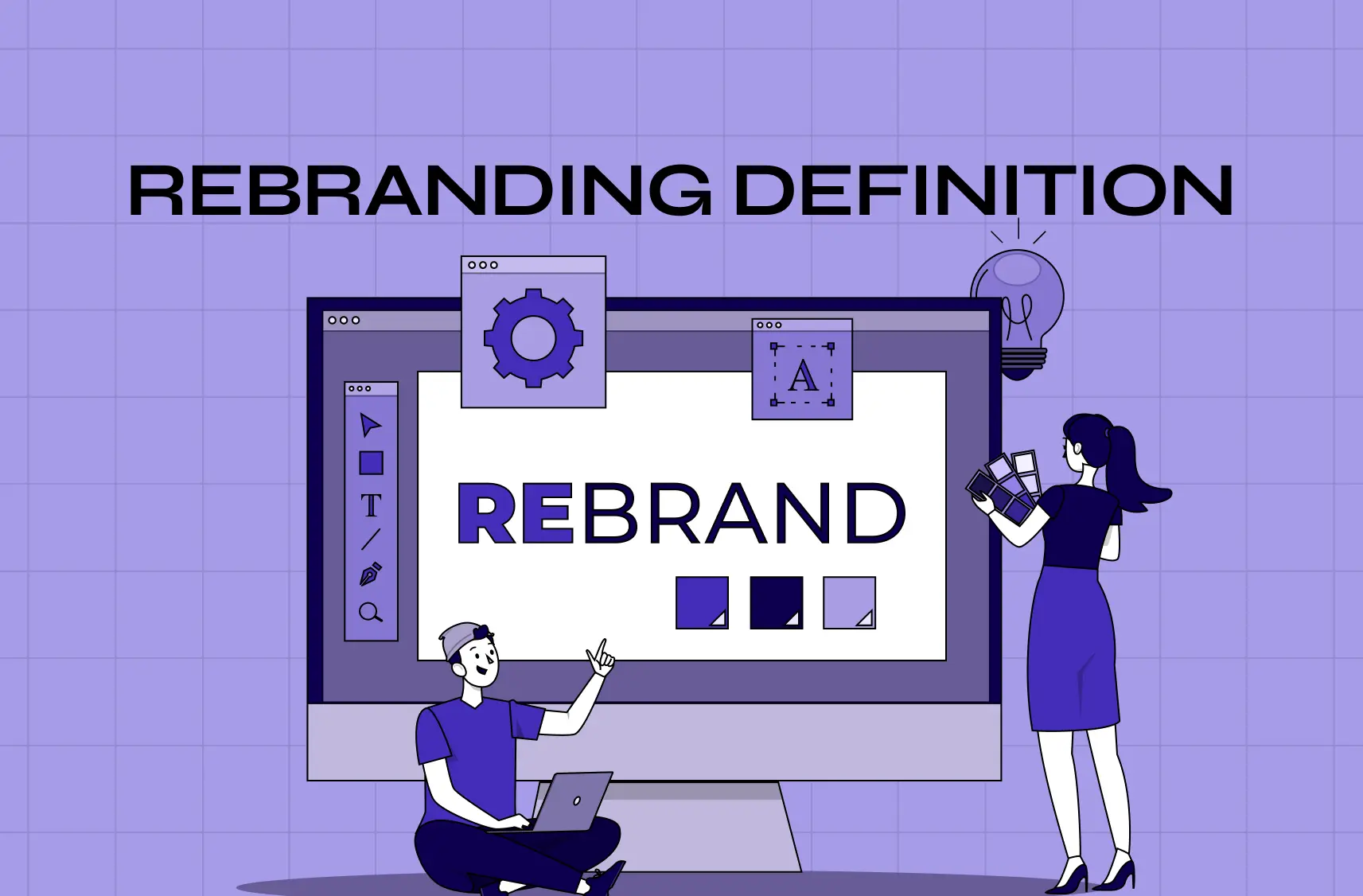
From brand refresh to full overhaul, this is a complete guide to the rebranding definition, the types, the process, and what separates a rebrand that lasts from one that just looks new.
The full design-first guide to understanding what rebranding really means.

TL;DR
Rebranding is the strategic process of changing how a business is perceived by its audience through updates to its visual identity, messaging, positioning, or all three. It ranges from a light brand refresh to a complete brand overhaul. When done thoughtfully and grounded in design, it can transform how customers connect with a business and help it stay relevant in a shifting market.
A company's brand is never truly static. Markets evolve, audiences change, and the visual and strategic choices that once made a brand feel fresh can start to feel misaligned with where the business is heading. That tension is exactly what triggers a rebrand.
The rebranding definition in marketing is simple on the surface: it is the process of changing or updating a brand's identity to shift how it is perceived. But beneath that definition lies a much larger design and strategy question: what exactly needs to change, and why?
In this blog, we break down what rebranding really means, the different types, why companies choose to do it, what the process looks like from a design-first perspective, and what makes a rebrand succeed or fail.
What Is Rebranding?
Rebranding is a deliberate strategic effort to redefine how a business, product, or service is seen by the world. It is not just a logo update. A true rebrand touches the full visual identity system of a company: the logo, typography, color palette, iconography, brand voice, messaging, and in some cases, even the name itself.
The rebranding definition is often misunderstood as being primarily cosmetic. In reality, it starts with strategy. Visual identity is the output, not the starting point — the brand identity layers beneath the surface are what actually drive a rebrand. Before any designer opens a file, a brand needs to understand what it wants to say, to whom, and why the current identity is no longer saying it clearly.
From a design perspective, rebranding is the process of applying visual design principles to make a brand's outward appearance consistent with its evolved internal direction.
The definition applies at every level of a business: a company can rebrand its entire corporate identity, a single product line, or a sub-brand, and the same strategic logic applies regardless of scope.
Types of Rebranding
Before getting into scope, it helps to understand motivation. Rebrands fall into two broad categories: proactive and reactive. A proactive rebrand happens ahead of pressure: a company entering a new market, targeting a new audience, or evolving its positioning before the current identity becomes a problem. A reactive rebrand is a response: to a merger, a reputation issue, a competitive threat, or a perception crisis. The scope of the rebrand (refresh, repositioning, or full overhaul) is often determined by the urgency and depth of that motivation.
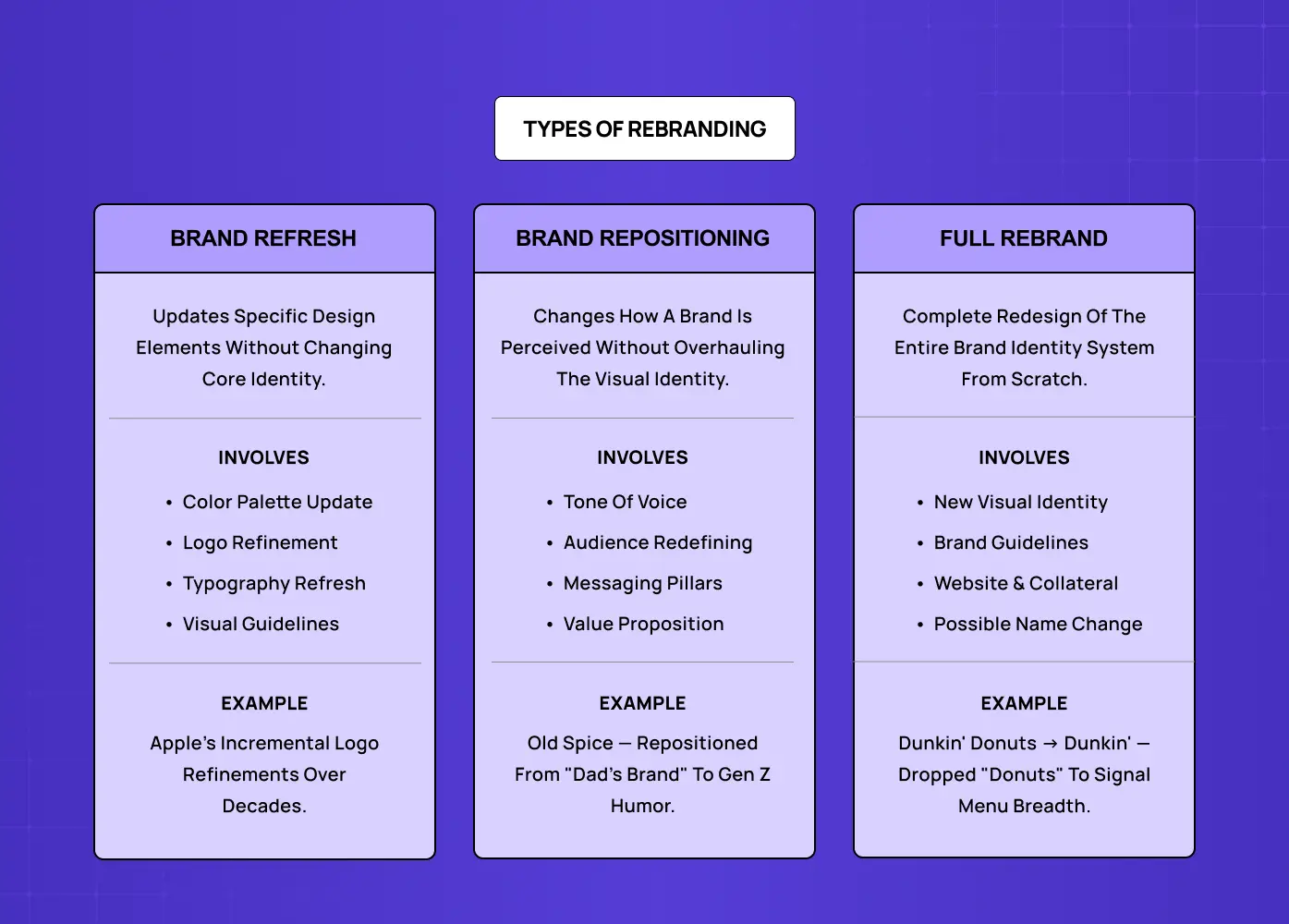
Not every rebrand looks the same. The scope of a rebrand depends on the scale of the business problem it needs to solve. There are three primary types.
Brand Refresh
A brand refresh is the most conservative approach. It updates specific design elements like color shades, typography, or logo proportions without changing the overall brand identity or positioning. This is suitable for brands that are performing well but feel visually dated. Think of it as evolution rather than reinvention. Apple's incremental logo refinements over the decades are a strong example of this.
"Dunkin' dropping 'Donuts' from its name is another example: the core brand equity stayed intact, the product range did not change, and the visual system was modernized to reflect a broader menu and a more contemporary audience."
What a brand refresh typically involves:
Updating the color palette to feel more contemporary
Refining or flattening the logo for digital compatibility
Modernizing typography to better suit multi-platform use
Refreshing photography styles and visual guidelines
Brand Repositioning
Brand repositioning changes how a brand is perceived without necessarily changing its visual identity dramatically. The shift happens in messaging, audience targeting, and strategic positioning. A SaaS company that started as a tool for developers but now wants to appeal to business decision-makers might reposition without a complete visual overhaul.
What repositioning typically involves:
Revisiting the brand's tone of voice and messaging pillars
Redefining the target audience and buyer persona
Adjusting how the brand is described across all touchpoints
Updating taglines, value propositions, and brand story
Full Rebrand
A full rebrand is the most comprehensive form. It involves redesigning the entire brand identity system from scratch: new name in some cases, new logo, new color palette, new typography, new brand guidelines, and entirely new messaging — scope that often brings specialist logo design agencies in to create the new mark at its core. This is typically triggered by a merger, a major strategic pivot, a reputation crisis, or a fundamental shift in what the company does.
What a full rebrand typically involves:
Complete redesign of all visual identity elements
New brand guidelines document
Updated website, app interfaces, and marketing collateral
Possible name change and new brand narrative
Why Companies Rebrand
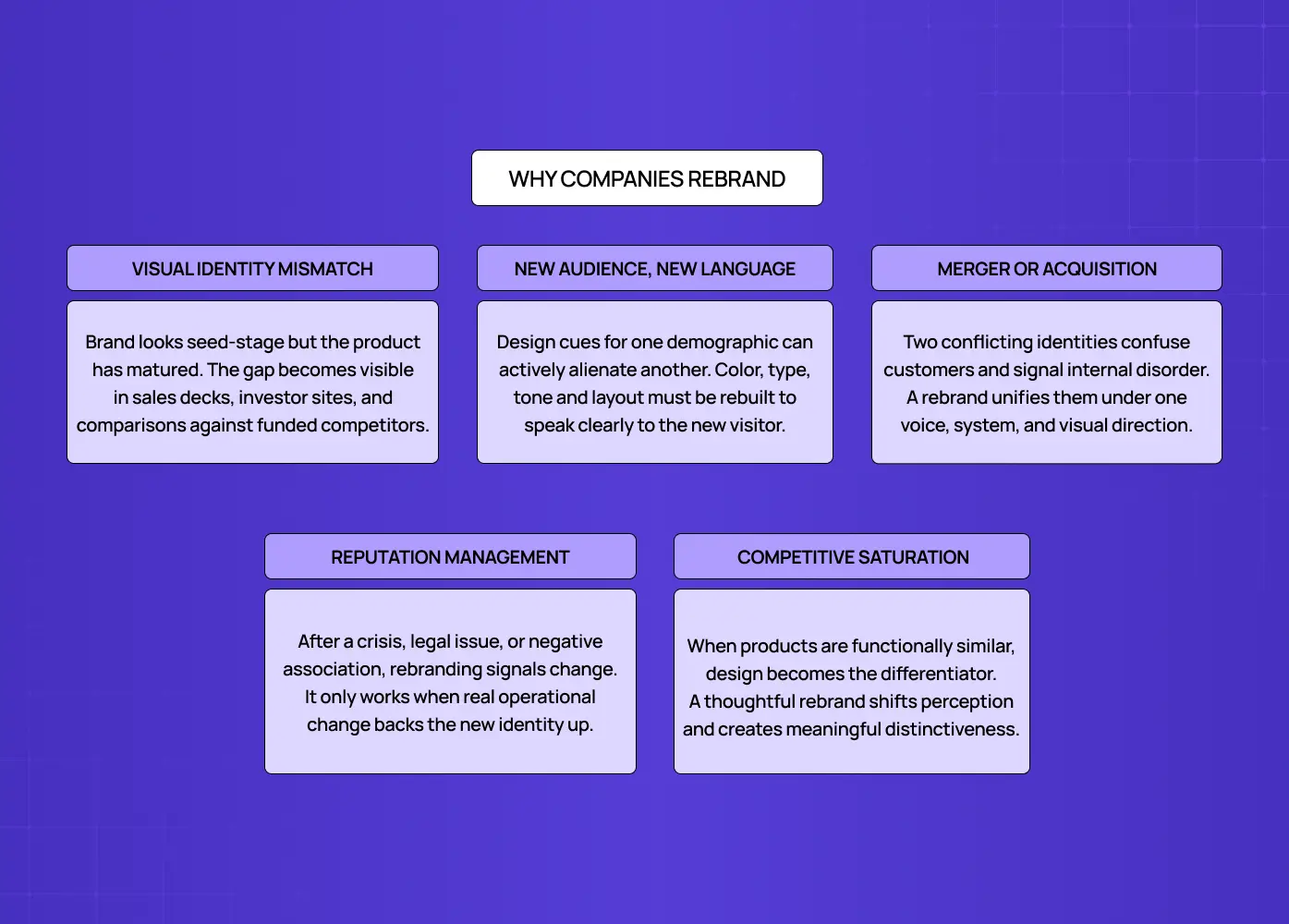
Understanding the rebranding meaning and examples in context requires knowing what typically drives the decision. These are the most common and design-relevant reasons.
The Visual Identity No Longer Fits the Business
This is perhaps the most frequent reason we see at Groto, and it shaped our own rebrand. A company builds a brand at the seed stage with a limited budget and a rough visual direction.Two or three years later, the product has matured, the team has grown, and the investors are serious, but the brand still looks like it was made in a weekend. The visual identity stops reflecting the product's quality, and that gap becomes a credibility problem.
A New Audience Requires a New Design Language
As companies expand into new markets or shift their target demographic, design becomes a communication tool. The visual cues, typography, tone, and color psychology that resonated with one audience may actively alienate another. Healthcare branding for a consumer app targeting millennials in India looks and feels very different from the visual system of an enterprise compliance platform targeting regulated industries in the US.. When Groto worked on Meydan FZ's website redesign, part of the challenge was translating a freezone service in Dubai for a global audience of entrepreneurs. The design language had to speak clearly to that new visitor, not the old one.
A Merger or Acquisition Creates Conflicting Identities
When two products or companies come together, the combined entity often carries two different brand identities that no longer serve a single coherent vision. A rebrand is the mechanism that unifies those identities under one system, with one voice and one visual direction.
Reputation Management
If a brand has been associated with a negative experience, a legal issue, or a public perception problem, rebranding can signal a genuine change in direction. This works only when real operational change backs it up. A new logo with no change in behavior does not rebuild trust.
Competitive Saturation
In markets where products are functionally similar, design becomes the differentiator. When everything in a category looks the same, a thoughtful rebrand paired with a new go-to-market strategy can shift perception and create meaningful distinctiveness. This is particularly relevant in SaaS and fintech, where UI design and brand presentation directly affect conversion.
The Rebranding Process: A Design-First View
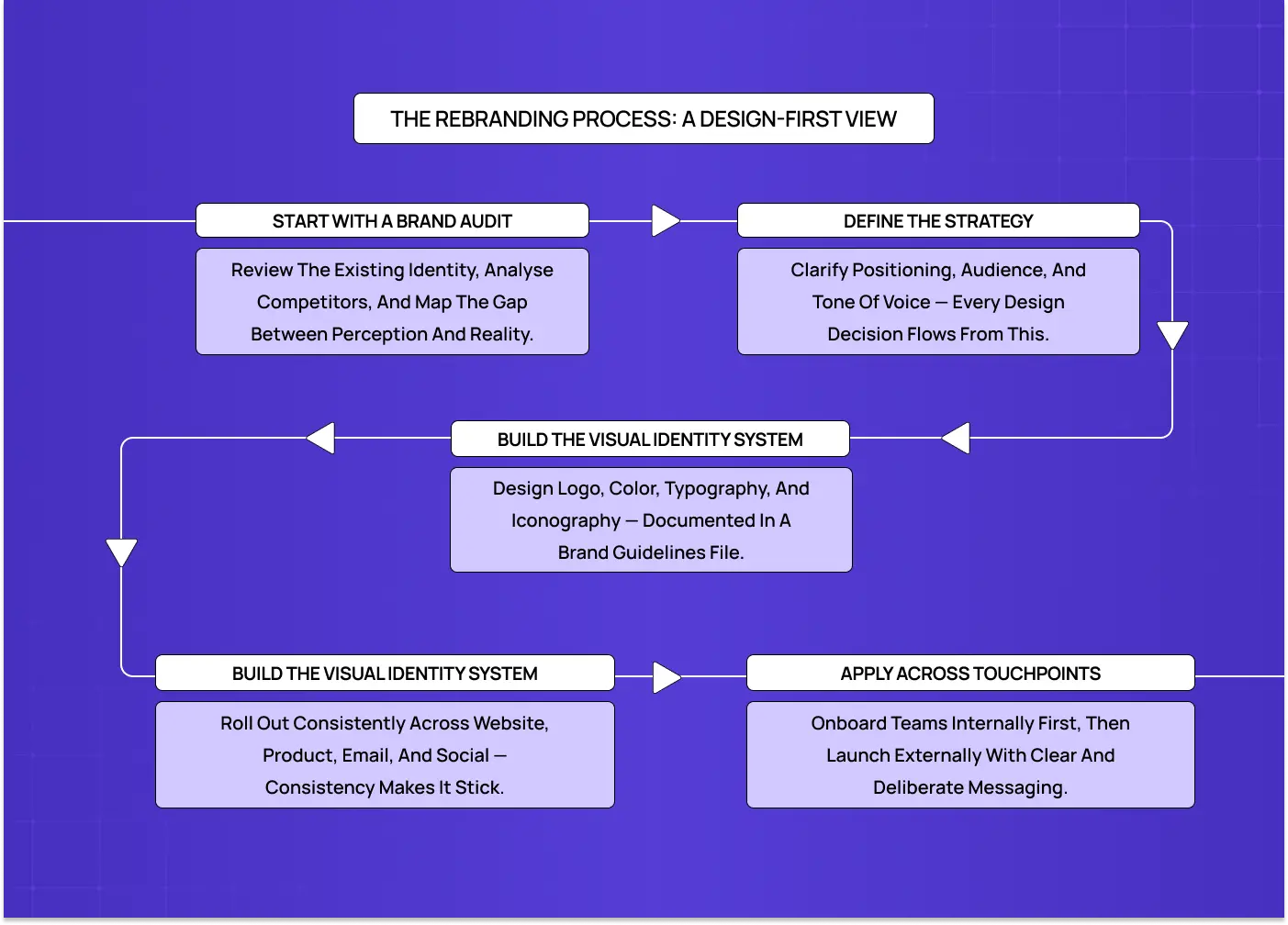
What does the rebranding process actually look like when done well? Here is how we approach it.
Start with a Brand Audit
Before anything is designed, the current state of the brand needs to be honestly assessed. This means reviewing the existing visual identity, analyzing what competitors look like, understanding how the current audience perceives the brand, and identifying the specific gaps between perception and reality.
Define the Strategy
Brand strategy defines the new direction before any design work begins. This is where a company's design philosophy becomes concrete: the positioning, audience definition, tone of voice, and core messaging that every visual decision flows from.
Build the Visual Identity System
Once strategy is locked, design begins. This means creating or refining the logo, defining the color system, selecting and pairing typography, establishing iconography styles, and setting rules for photography and motion, all grounded in core design principles. The output is a comprehensive brand guidelines document that governs every touchpoint.
Core elements of a visual identity system:
Logo and its variations (primary, secondary, icon-only)
Color palette with primary, secondary, and accent values
Typography hierarchy with clear usage rules
Iconography and illustration styles
Photography and imagery direction
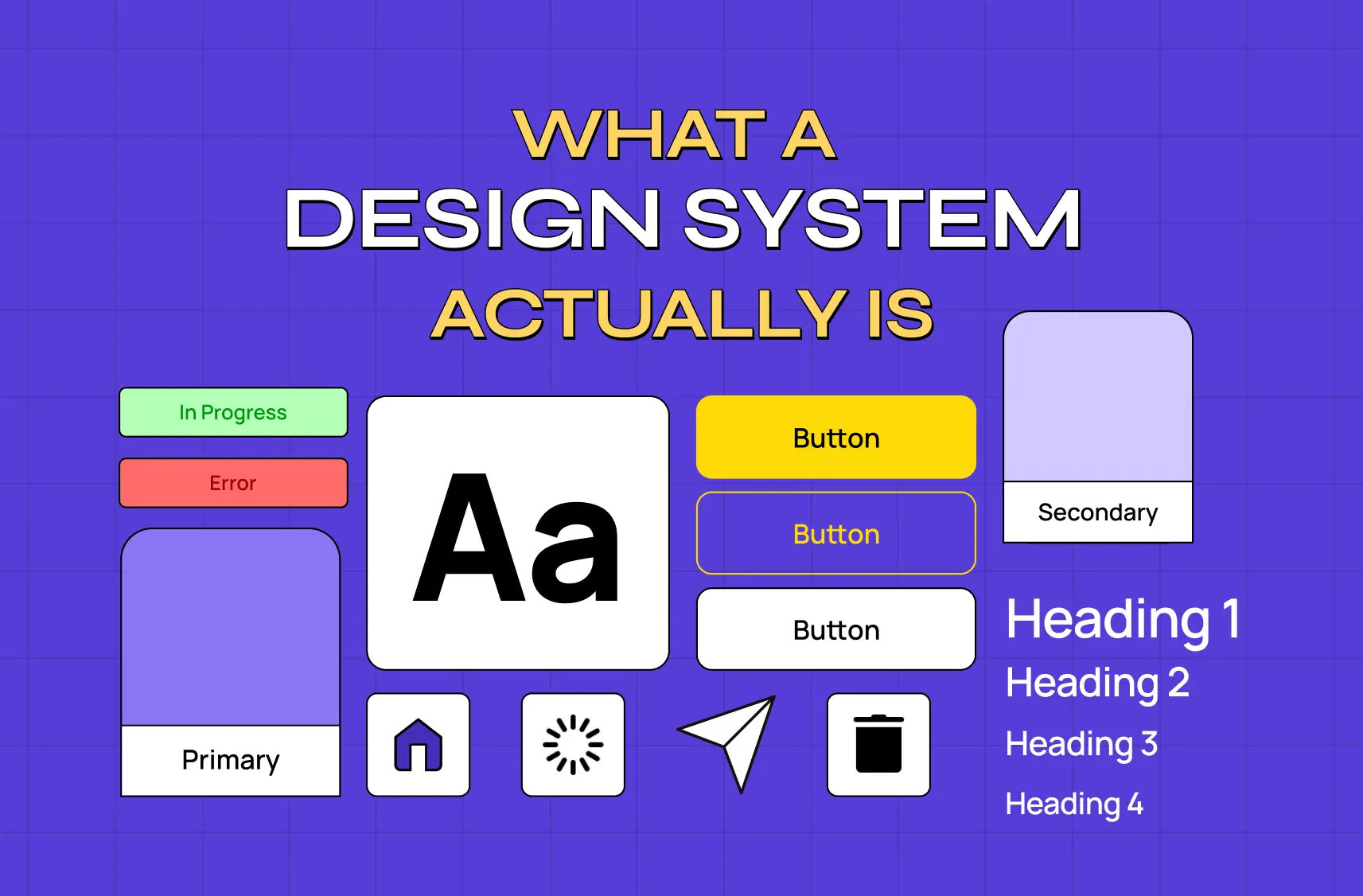
For digital-first companies, design systems for SaaS add an additional layer of complexity to the identity work. The brand needs to work inside a product interface, not just on a website or marketing material. That means considering design tokens (the coded values that govern color, spacing, and type across a component library), dark mode compatibility, motion and animation behavior, and how the brand translates from a Figma file to a production environment. A rebrand that looks clean on a PDF but breaks down at the component level has not been fully built.
Apply Across Touchpoints
A rebrand that only lives in a PDF is not a rebrand. The new identity needs to be applied across every touchpoint: a website redesign, product interfaces, email templates, social media, presentations, and any physical materials.. Consistency is what makes a rebrand stick.
For our work with &Circus, India's body-positive underwear brand, the redesign needed to carry through from the website to the mobile shopping experience to the product imagery direction. When the identity is consistent across all touchpoints, it creates a brand experience customers feel without consciously noticing it.
Communicate the Change
Internal teams need to understand the new brand before customers do. Brand guidelines and onboarding sessions ensure that the identity is applied correctly and consistently going forward. When the identity launches externally, the communication of the change should be clear and deliberate, not passive.
What Makes a Rebrand Succeed or Fail
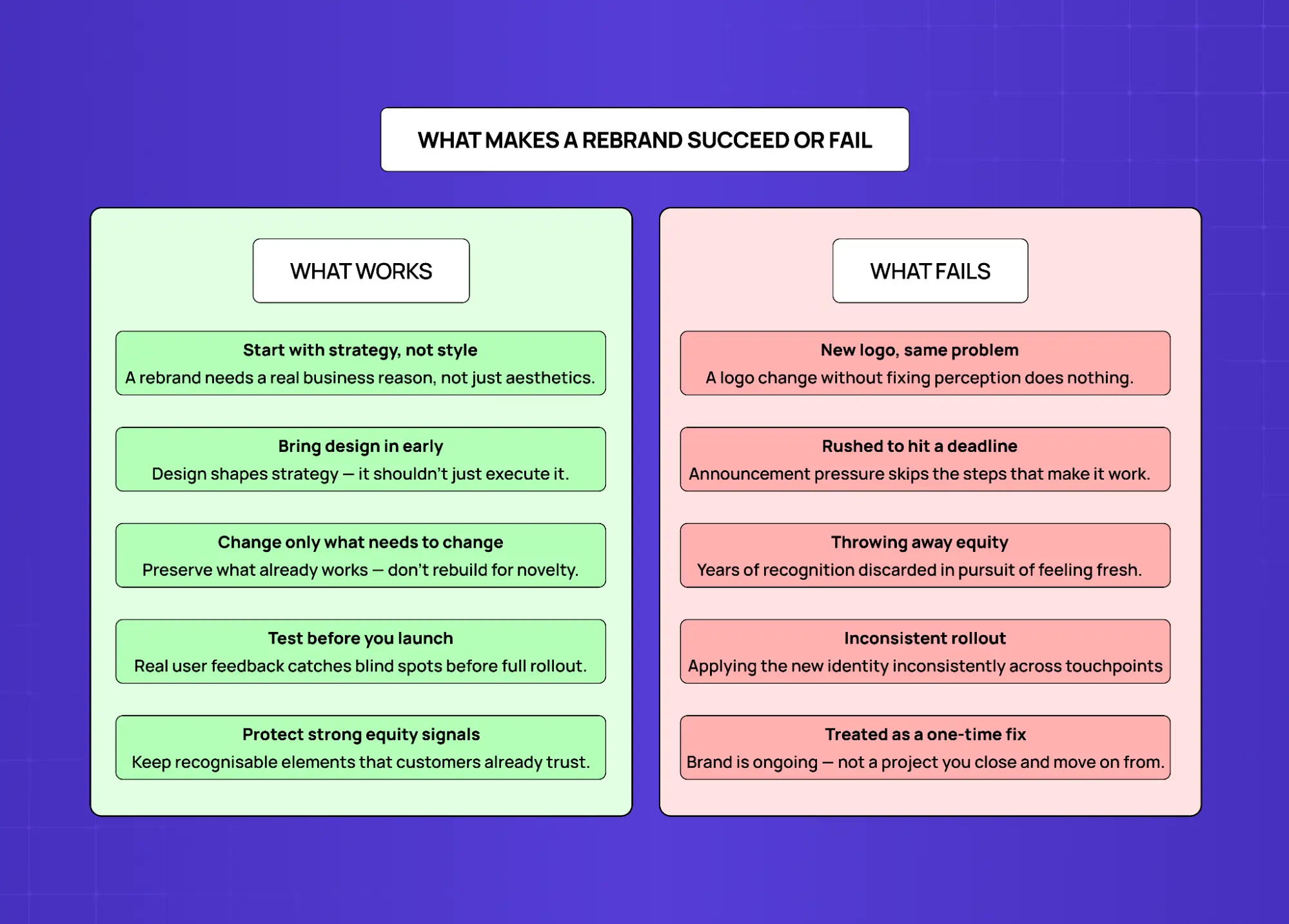
What works:
Grounding the rebrand in a clear strategic reason, not aesthetic boredom
Involving design from the strategy phase, not just the execution phase
Keeping what works and only changing what needs to change. Brand equity refers to the value a brand has built through customer recognition, trust, and association over time. It is what makes customers reach for one product over a functionally identical competitor. Protecting it during a rebrand means identifying which visual and verbal elements carry that weight before deciding what to change.
Testing with real users before a full rollout
Maintaining visual continuity for elements that carry strong brand equity
What fails:
Changing the logo without addressing the underlying perception problem
Rushing the process to hit an announcement deadline
Ignoring brand equity built over years in pursuit of something that feels new
Applying the new identity inconsistently across touchpoints, often because no design system was built to enforce it
Treating a rebrand as a one-time project rather than an ongoing brand management effort
"Tropicana's 2009 packaging redesign is the most cited example of this. The brand replaced its iconic orange-with-straw image with a generic glass of juice. Sales dropped nearly 20 percent in two months and the packaging was pulled. No strategic shift, no new audience, no new positioning. Just a design change that erased the visual equity customers had built associations with over decades."
Rebranding vs. Brand Refresh: Knowing the Difference
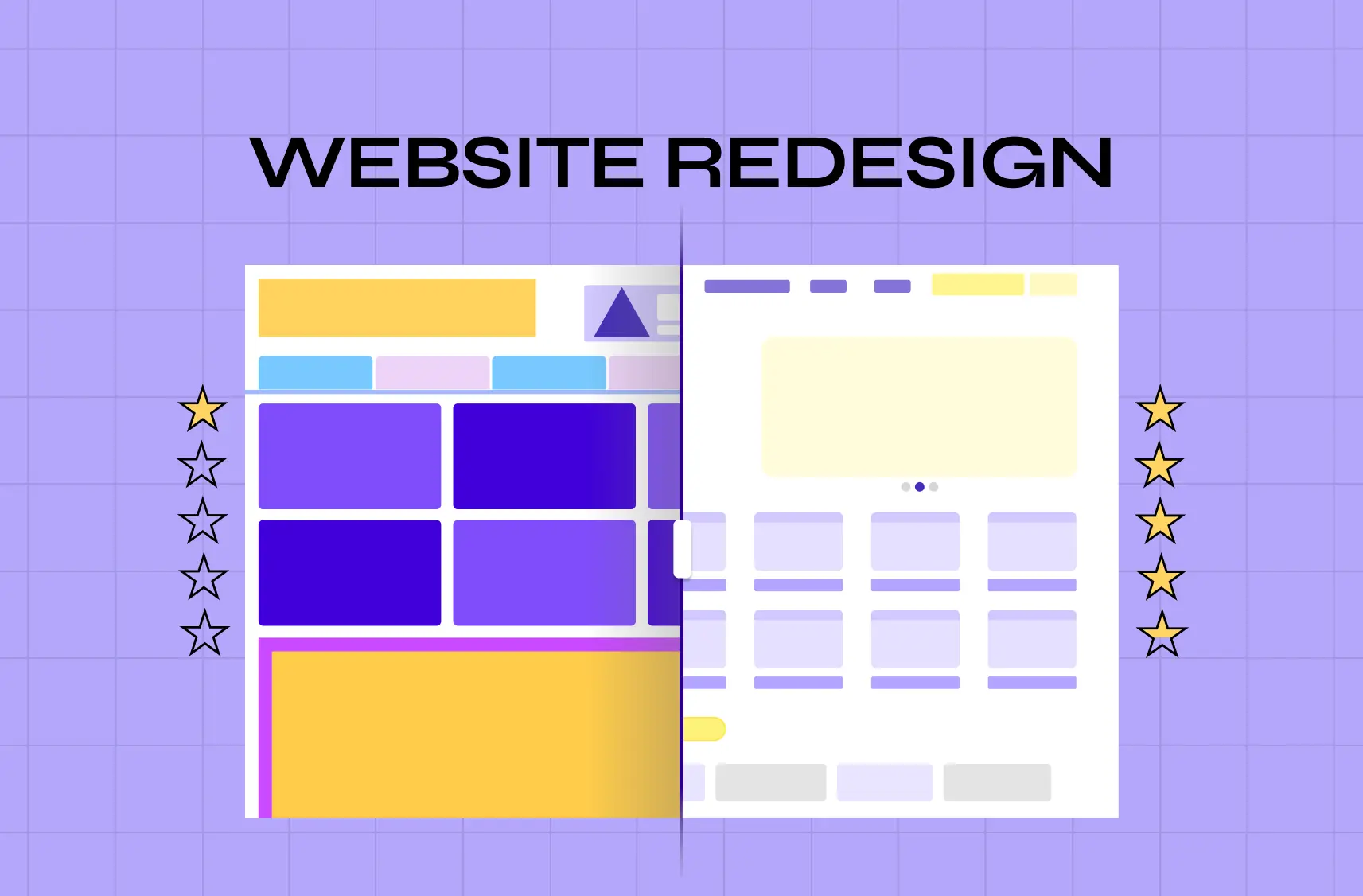
A common point of confusion is using the terms "rebranding" and "brand refresh" interchangeably. They are not the same. A brand refresh is a subset of the broader rebranding definition. It is a lighter intervention that modernizes specific design elements while preserving the overall brand identity. A full rebrand questions every element of the brand and rebuilds from the ground up.
The right choice depends on the business problem and often on the branding agency best equipped to diagnose it. If the brand's core identity is strong but the visual language feels dated, a refresh is sufficient. If the brand's positioning, audience, or name no longer align with business reality, a fuller intervention is needed.
Conclusion
Rebranding is a strategic process that starts with why, not what
It spans a spectrum from brand refresh to full brand overhaul
Design is the vehicle through which strategic change becomes visible to audiences
A successful rebrand is grounded in audience insight, consistent in execution, and built to show measurable ROI from launch
The biggest mistakes in rebranding come from treating it as a cosmetic exercise rather than a business decision
Brand equity, visual consistency, and strategic clarity are the three pillars of a rebrand that lasts