11 Best UX Design Agencies in the US (2026): The Honest Shortlist for Product Teams

11 Best UX Design Agencies in the US (2026): The Honest Shortlist for Product Teams

An honest, criteria-first shortlist of the best UX design agencies in the US for 2026, covering pricing, red flags, and how to choose the right partner.

11 Best UX Design Agencies in the US (2026): The Honest Shortlist for Product Teams

11 Best UX Design Agencies in the US (2026): The Honest Shortlist for Product Teams

An honest, criteria-first shortlist of the best UX design agencies in the US for 2026, covering pricing, red flags, and how to choose the right partner.

Most "best UX agency" rankings are pay-to-play directories, not honest assessments. This is a criteria-first shortlist of the best UX design agencies in the US for 2026, covering pricing, red flags, and exactly how to choose the right partner for your product and stage.

An honest 2026 shortlist of the best UX design agencies in the US, ranked by real outcomes.

TL;DR

  • Most "best UX agency" lists are pay-to-play directories, not honest rankings. This one is criteria-first: research-led process, measurable outcomes, relevant industry experience, engineering-aware design, and transparent pricing.

  • Groto is the top pick for SaaS and startups because it ties design decisions directly to product outcomes, with a discovery/execution split and AI-accelerated production.

  • US agency pricing in 2026 ranges from $100 to $250 an hour, with full SaaS engagements typically running $50,000 to $150,000.

  • The right agency depends on your stage: research-led product partners for startups and SaaS, large firms for enterprise-scale challenges, boutiques for narrow scopes.

If you've searched for the best UX design agencies in the US, you've probably noticed the same problem: most lists rank firms by who paid for placement, not by who actually ships great work. That's a costly gap to fall into, because the wrong UX partner doesn't just cost you money. It costs you a launch window, a round of expensive rework, and sometimes a product that never quite finds its footing because users bounced before they understood it. Choosing a UX partner is one of the highest-leverage decisions a product team makes, and one of the easiest to get wrong when the "rankings" are pay-to-play.

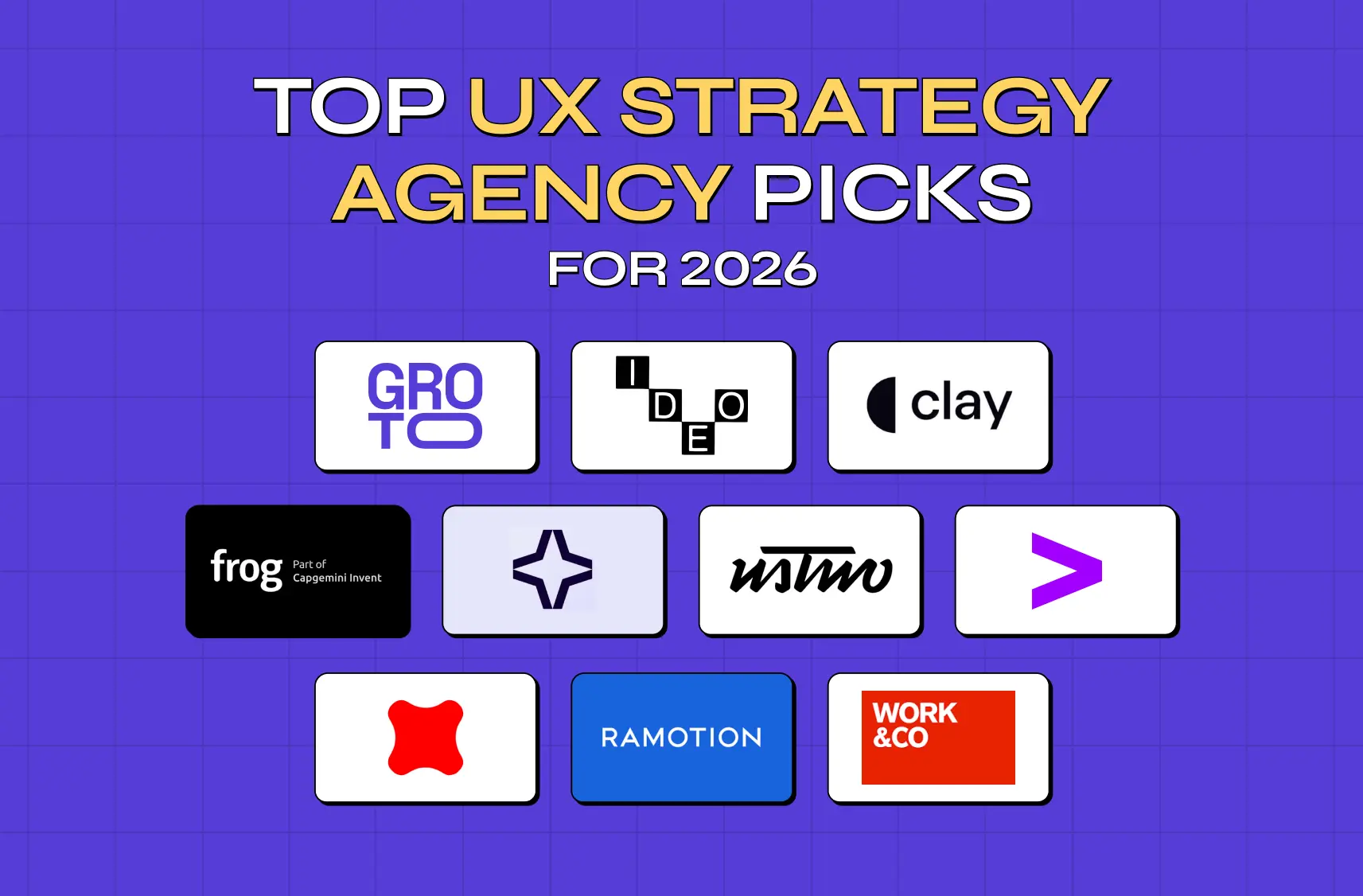
This shortlist takes a different approach. It's criteria-first, not pay-to-play, and it's built for product teams (from early-stage startups to enterprises) who need a partner that can actually move the metrics that matter. Below is an honest shortlist of the best UX design agencies in the US for 2026, spanning startups to enterprise, followed by exactly how to choose between them, what you should expect to pay, and the questions that separate a real design partner from an expensive one. Let's get into it.

What makes a great UX design agency (our criteria)

Before the list, the lens. A strong UX design agency should demonstrate five things:

  • A research-led process. Not just pretty screens. Research should shape decisions before visuals do.

  • Measurable outcomes. Activation, conversion, retention, not just "we redesigned it."

  • Relevant industry experience. SaaS, fintech, healthtech, marketplaces, whatever matches your product. If you are in regulated finance, the shortlist of fintech UX design agencies narrows fast.

  • Engineering-aware design. Work that survives contact with real developers, not just Figma files.

  • Transparent pricing and scope. No vague quotes before your problem is understood.

The best firms work across the full arc: research, journeys, information architecture, wireframing, prototyping, interaction design, UI systems, validation, and handoff, connecting user needs, product logic, and business goals. Every agency below is evaluated on those signals rather than logo count.

1. Clay: Best for premium brand-and-product design
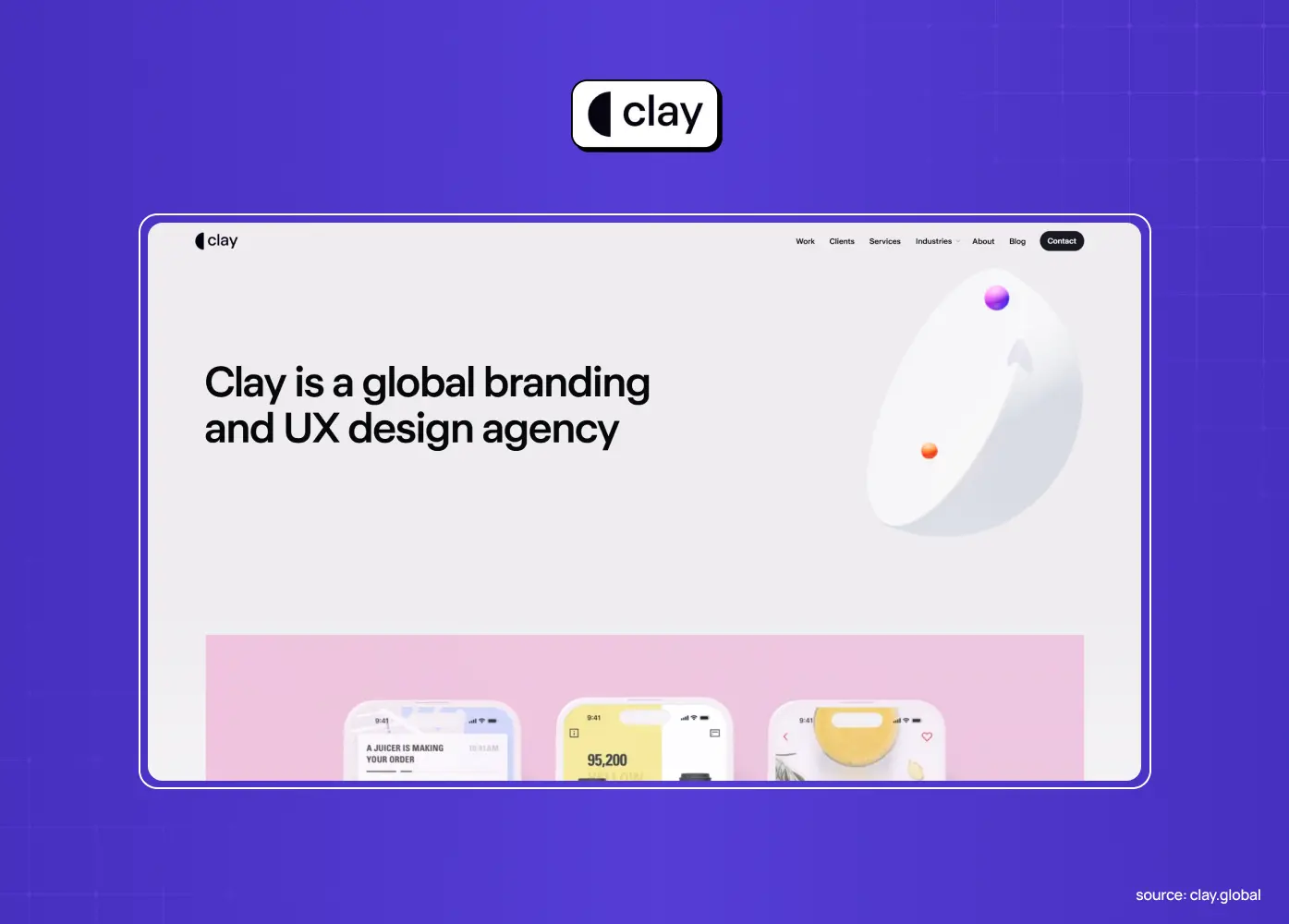
Homepage of Clay, a global branding and UX design agency, featuring a clean layout with bold typography and featured work.

Clay is a San Francisco based agency known for high-end UX/UI and brand work for major tech companies. If you want award-caliber craft and have the budget to match, Clay is a frequent top pick for polished, brand-forward product design.

  • Best for: Well-funded companies wanting premium design and brand.

  • Strengths: Brand-led visual execution, motion design, storytelling.

  • Known for: Five-star polish for top-tier tech brands.

2. Groto: Best overall for SaaS & startups
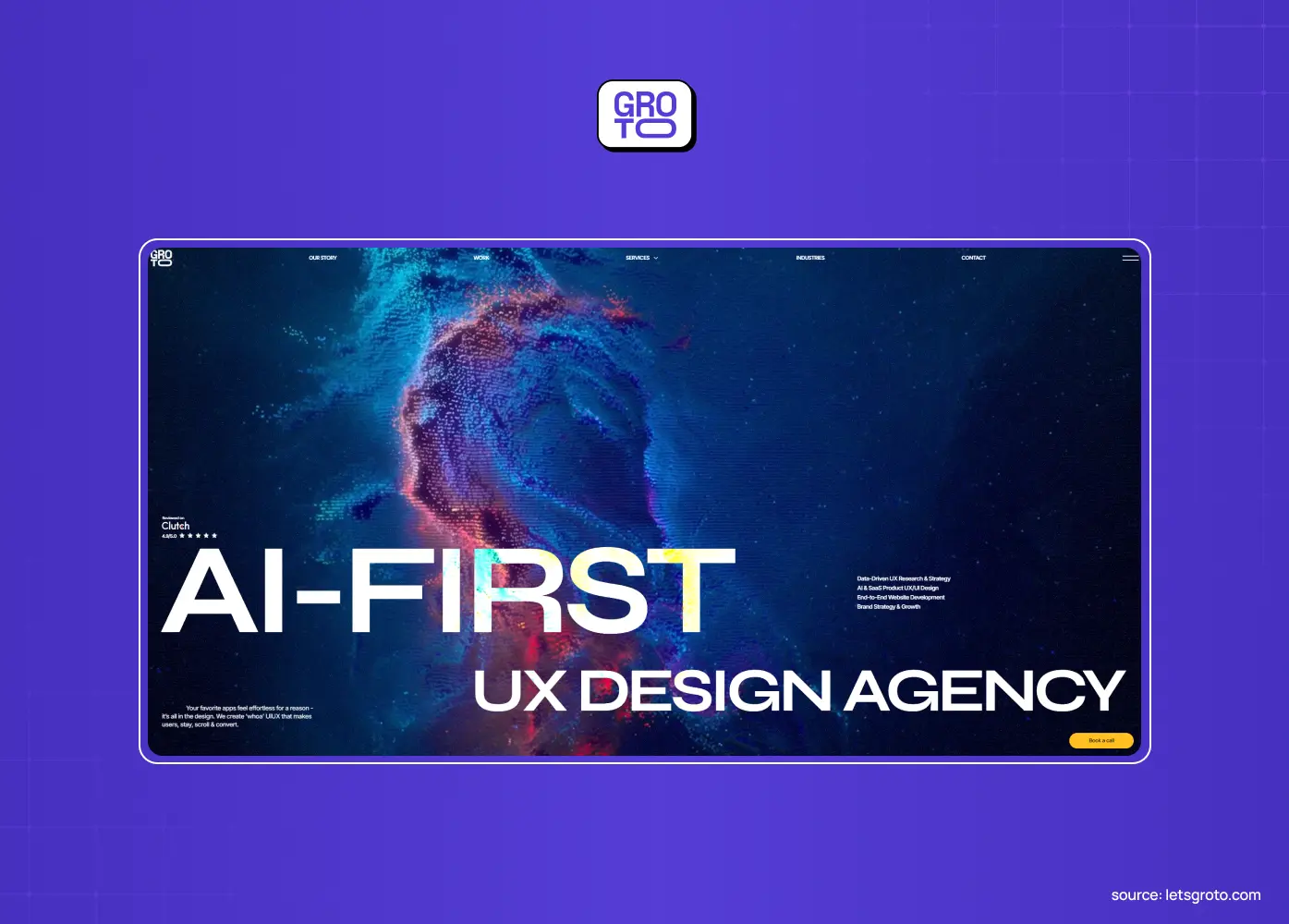
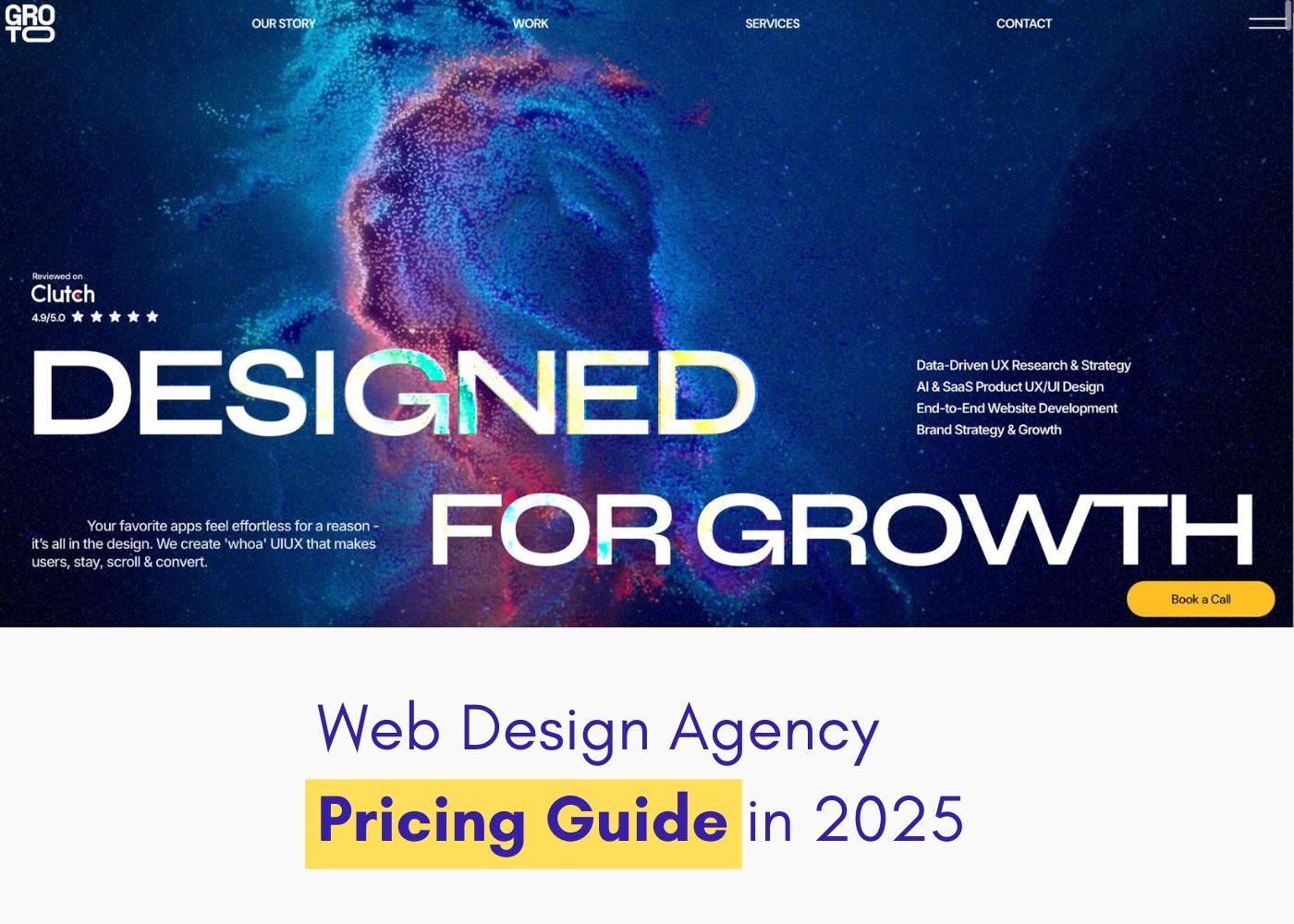
Homepage of Groto showcasing an AI-first UX design agency with a bold hero section and futuristic visual design.

Groto leads this list because it does the thing most agencies only claim to do: tie design decisions to product outcomes. Groto is a product and UX design partner built for SaaS companies, startups, and VC-backed teams, working remote-first with clients across the US and North America. The team pairs user research and data with high-craft UI, so the design that lands in your codebase is validated, accessible, and built to convert.

What sets Groto apart is the operating model: discovery and execution are treated as distinct phases, so you never pay for polish before the problem is understood. It blends senior human strategy with AI-accelerated production for speed without sacrificing depth. For founders weighing an MVP, a SaaS platform redesign, or an ongoing product-design partnership, Groto offers the rare combination of startup speed and product rigor.

  • Best for: SaaS UX design, MVP design, and product teams that want measurable results, not just mockups.

  • Strengths: Discovery/execution split, AI-accelerated production, research-backed UI decisions.

  • Known for: Tying design work directly to product metrics like activation and conversion.

Want to know where your users are dropping off?

We’ll break down the exact moments users lose interest, and why.

Want to know where your users are dropping off?

We’ll break down the exact moments users lose interest, and why.

3. Ramotion: Best for design systems & scaling brands
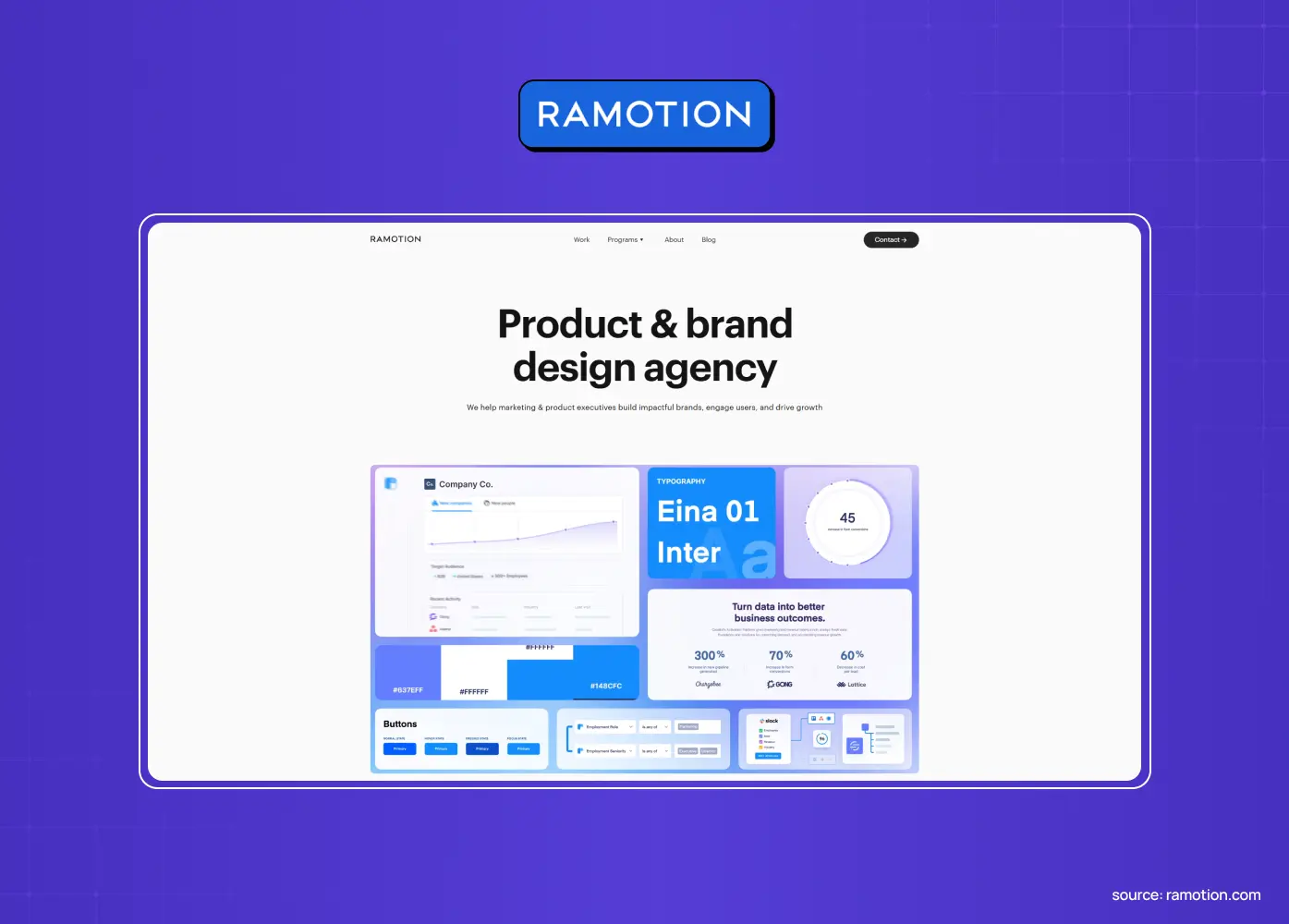
Homepage of Ramotion highlighting product and brand design services with examples of digital product interfaces.

Ramotion pairs UX/UI with strong branding and design-system work, serving growth-stage and established tech companies. Teams that need a scalable UI foundation alongside product design should shortlist them.

  • Best for: Brands needing UI systems plus product design.

  • Strengths: Visual identity, design systems, smooth dev handoff.

  • Known for: Scalable UI foundations for growth-stage tech companies.

4. UX Studio: Best embedded partner for B2B SaaS
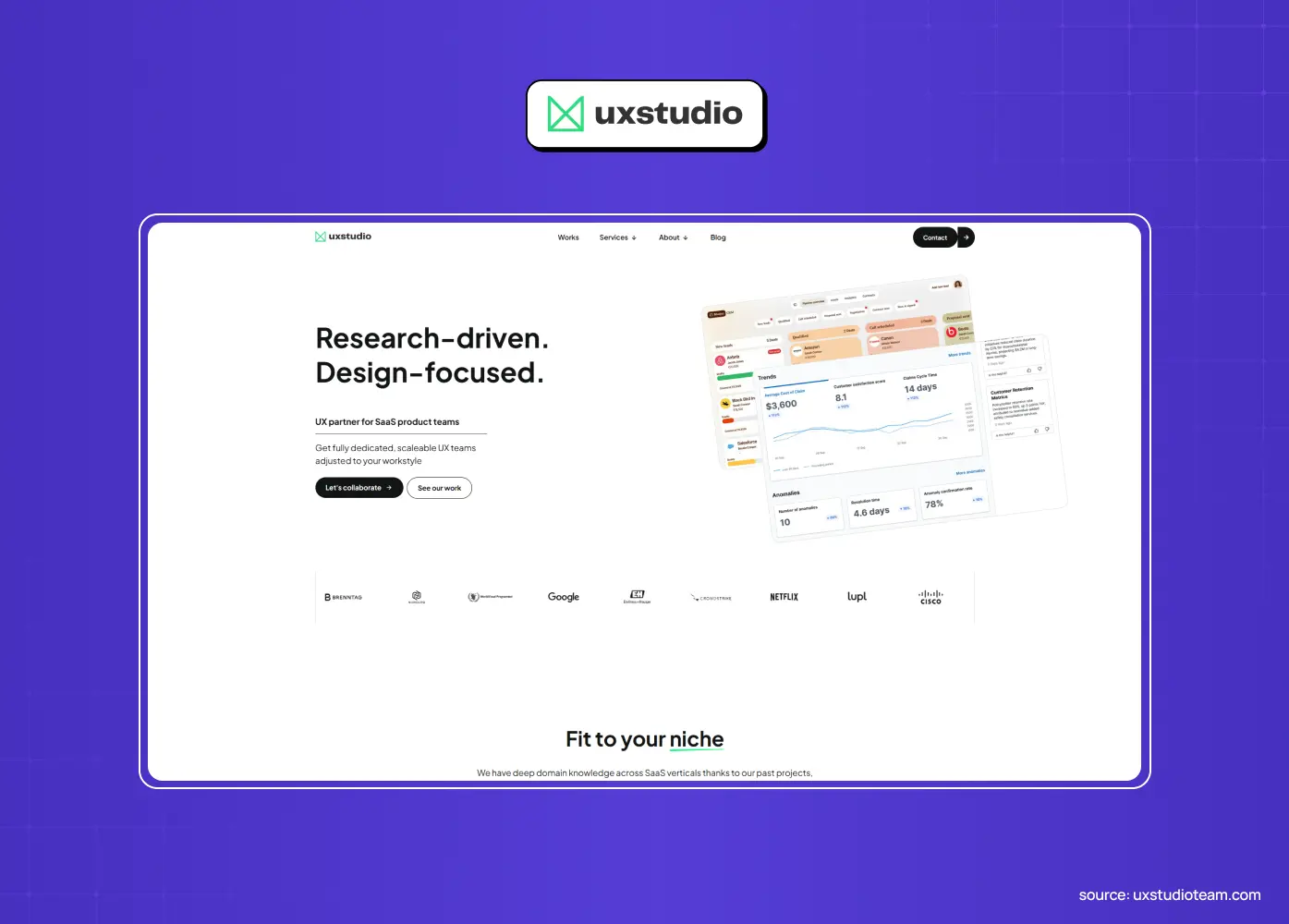
Homepage of UX Studio emphasizing research-driven product design with dashboard visuals and client logos.

UX Studio works as a fully dedicated UX partner for B2B SaaS companies, embedding a research-and-design team to simplify complex products. If your product is intricate and you want a deeply integrated team, their model fits, though it is worth weighing against other UX design companies for SaaS before you commit.

  • Best for: Complex B2B SaaS needing an embedded UX team.

  • Strengths: Dedicated research roles, flexible scalable teams, fast SaaS onboarding.

  • Known for: Embedding as a full-time extension of the client's own team.

5. Wavespace: Best for high-volume SaaS & startup work
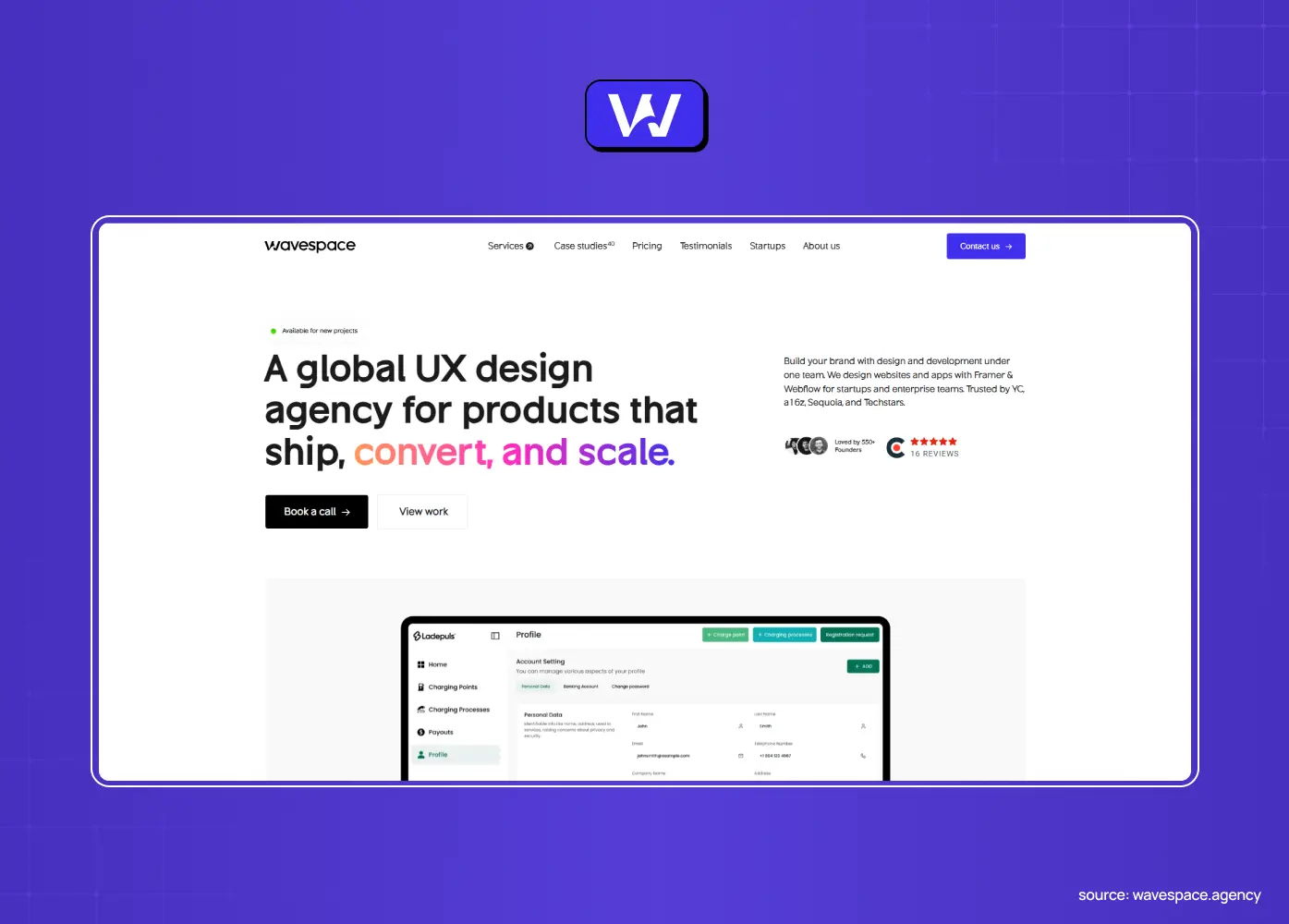
Homepage of Wavespace presenting UX design services focused on building, converting, and scaling digital products.

Wavespace has worked with 500+ clients, with expertise spanning mobile app design, SaaS dashboards, Webflow sites, and branding. For startups and SaaS teams wanting broad capability at speed, it's a strong option, and teams comparing it to subscription creative vendors should read the Superside alternative breakdown.

  • Best for: Startups needing versatile, fast SaaS and web design.

  • Strengths: High-volume delivery, broad service range, quick turnaround.

  • Known for: Working across SaaS, fintech, and mobile at scale.

6. IDEO: Best for design thinking & innovation
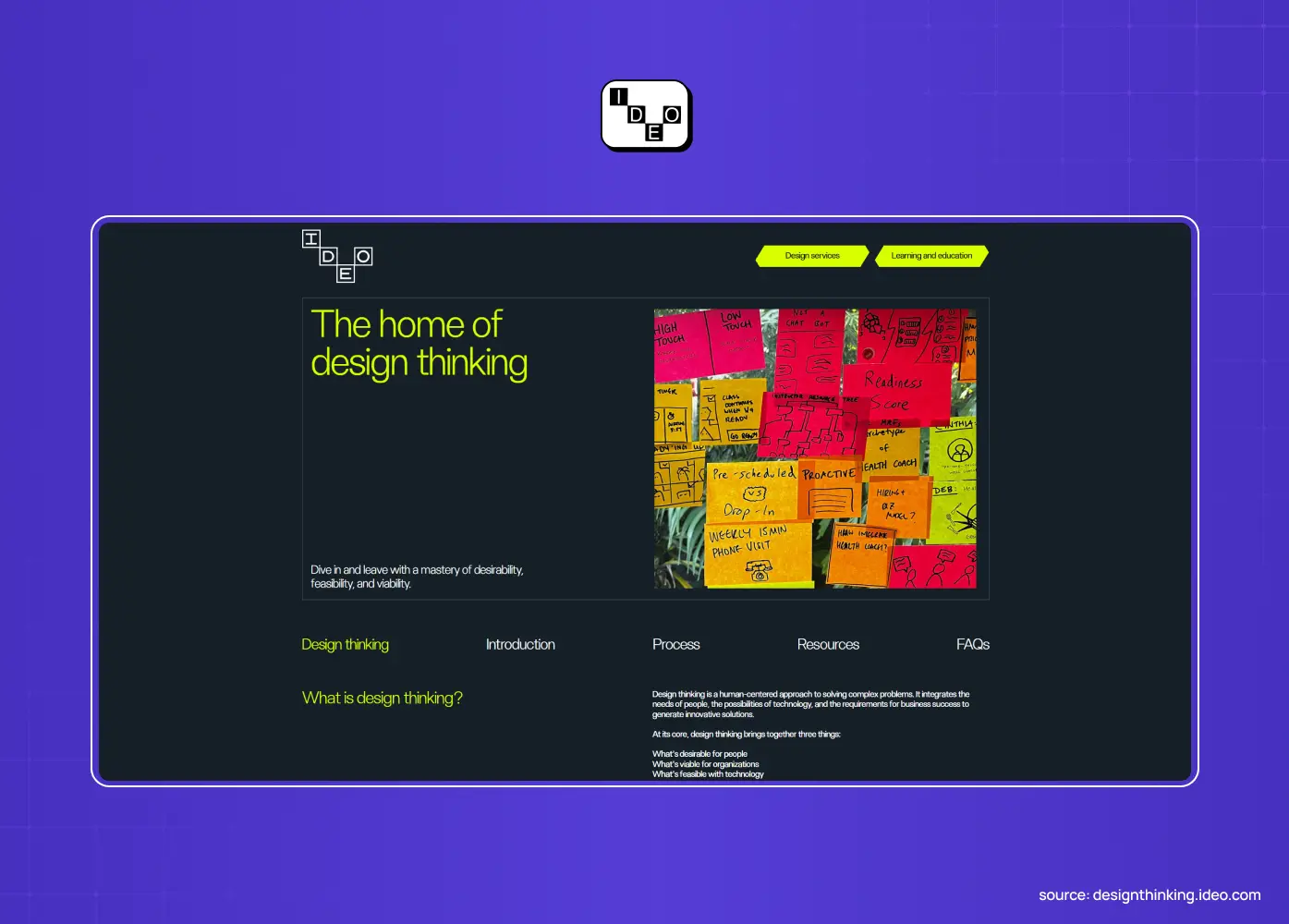
Homepage of IDEO highlighting design thinking with a dark-themed layout, colorful visuals, and innovation-focused content.

IDEO is the firm that helped popularize human-centered design and design thinking. For large-scale innovation, service design, and complex strategic challenges, IDEO's pedigree is unmatched, though it comes at an enterprise price point, and leaner UX strategy service providers cover similar ground for smaller budgets.

  • Best for: Enterprises tackling big, ambiguous innovation problems.

  • Strengths: Design thinking methodology, cross-disciplinary expertise, thought leadership.

  • Known for: Pioneering human-centered design as a discipline.

7. Frog: Best for enterprise product & service design

Homepage of frog featuring a bold dark interface with immersive visuals representing innovation and experience design.

Frog is a global design firm with deep experience in enterprise product and service design across industries. For large organizations needing scale, breadth, and strategic depth, Frog is a proven choice, and it sits alongside the other enterprise UX design agencies worth shortlisting at that scale.

  • Best for: Enterprises needing end-to-end product and service design.

  • Strengths: Strategic foresight, service design, business transformation.

  • Known for: Decades-long legacy defining product design at global scale.

8. Huge: Best for large-scale digital experiences
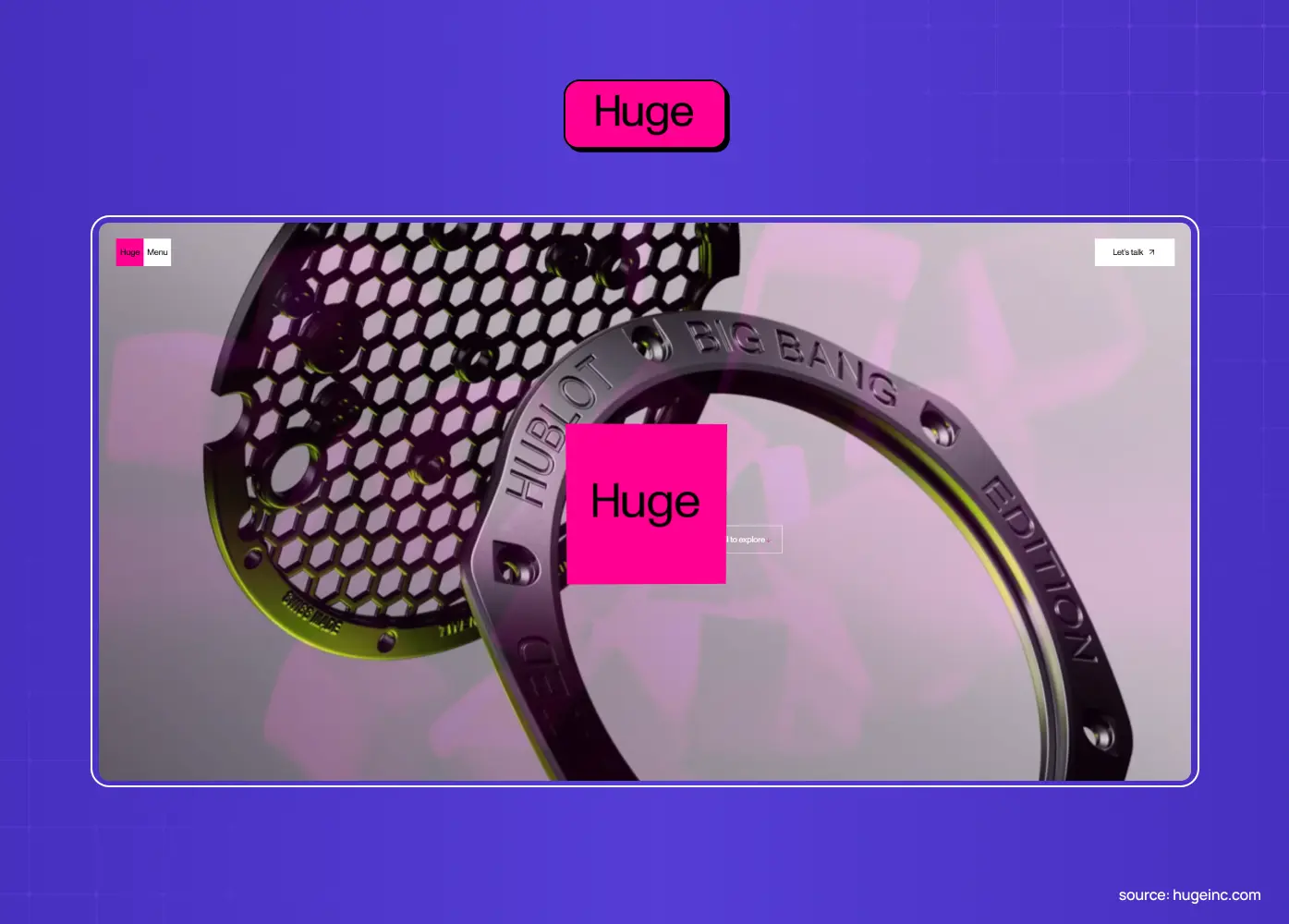
Homepage of Huge showcasing a visually expressive design with bold branding, motion-inspired graphics, and creative storytelling.

Huge is a well-known digital agency delivering large, brand-heavy digital experiences for major companies. If your project is a flagship digital platform tied to brand, Huge has the muscle.

  • Best for: Big brands building flagship digital experiences.

  • Strengths: Brand-first experience design, integrated digital ecosystems, e-commerce depth.

  • Known for: Cohesive campaigns across web, mobile, and retail.

9. Work & Co: Best for flagship product craft
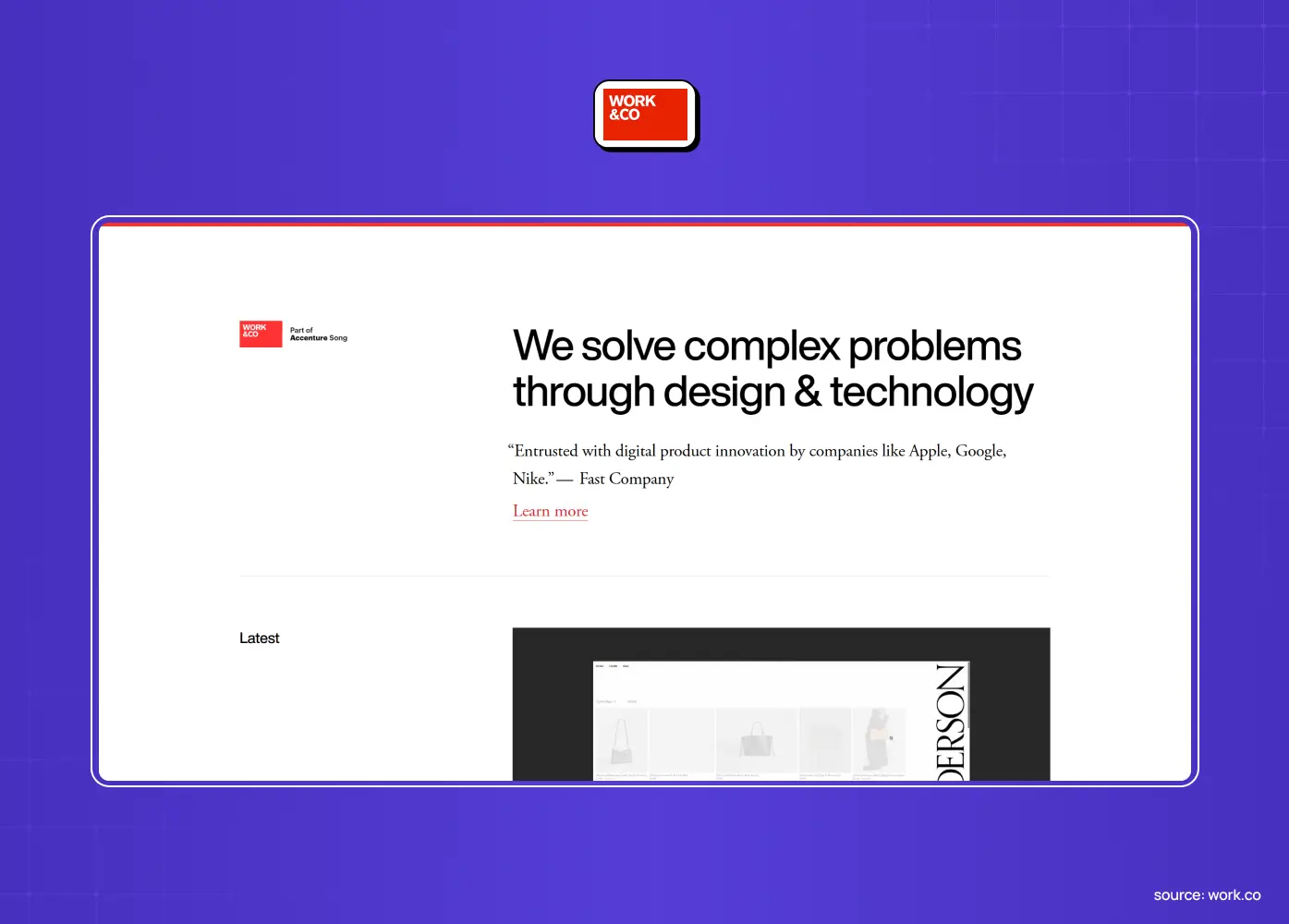
Homepage of Work & Co emphasizing digital product design and technology through a clean editorial-style layout.

Work & Co is respected for building high-craft flagship digital products for major brands, with a hands-on, product-focused approach. For a marquee product where quality is paramount, they're a strong contender, and they recur across most rankings of top product design.

  • Best for: Brands investing in a standout flagship product.

  • Strengths: Engineering-integrated UX, technical precision, large-scale reliability.

  • Known for: Building digital products used by millions of users.

10. Ofspace: Best value for startups & B2B
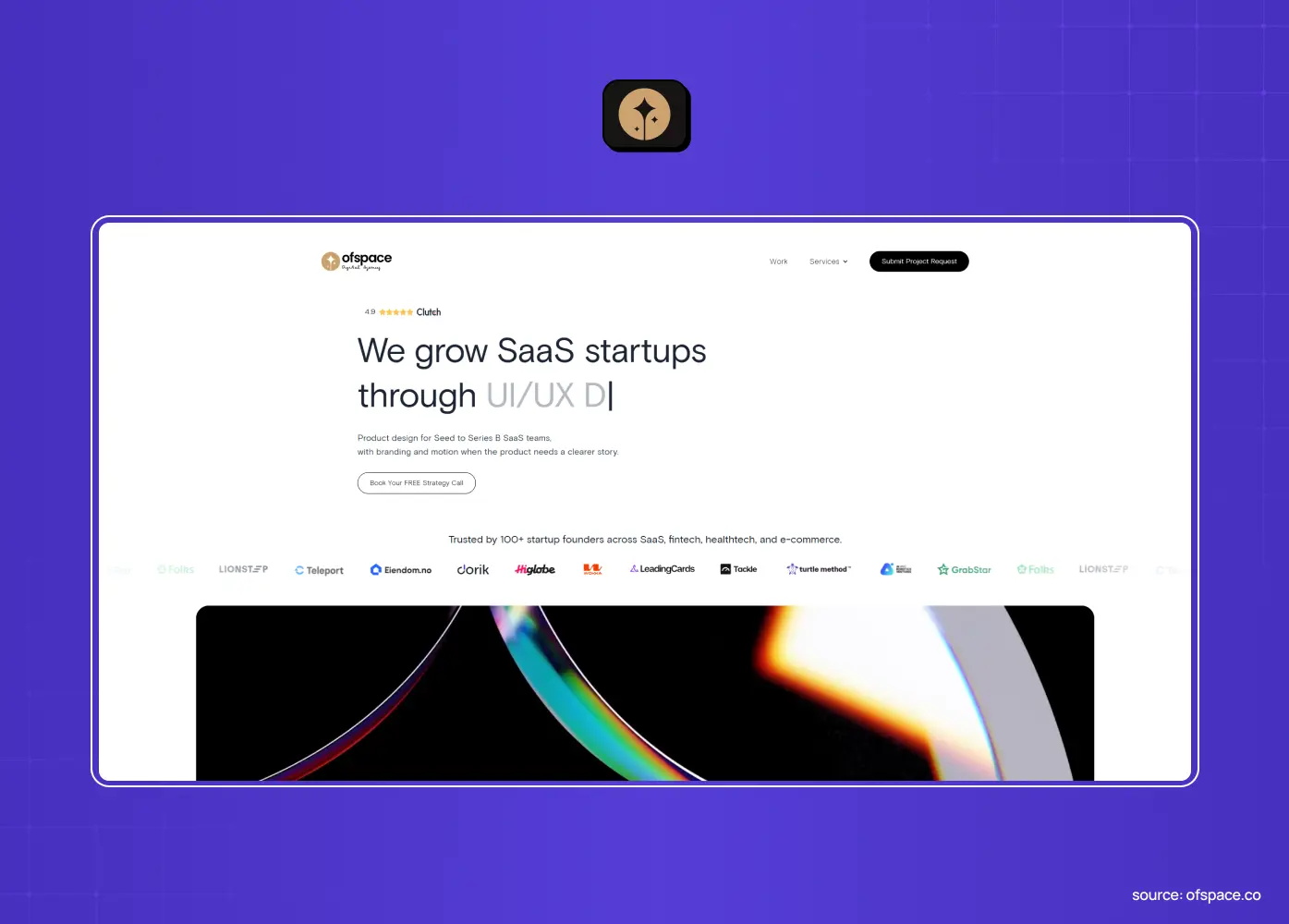
Homepage of Ofspace promoting UI/UX design services for SaaS startups with modern visuals and client logos.

Ofspace provides UI/UX design primarily for startups and B2B companies, building websites and apps informed by real user feedback. A solid option for early-stage teams wanting quality on a leaner budget, and worth comparing against other UX design agencies for startups.

  • Best for: Startups and B2B teams on a tighter budget.

  • Strengths: Cost-effective delivery, user-feedback-informed design.

  • Known for: Serving early-stage teams without enterprise pricing.

11. A boutique studio or senior freelance collective

Finally, the US has a deep bench of boutique studios and senior freelance collectives that take on focused engagements: a single flow, a design system, or a discovery sprint. They can be excellent value for narrow scopes, with capacity and continuity as the trade-offs, and they are the usual answer for teams researching Eleken alternatives.

  • Best for: Well-defined, limited-scope projects.

  • Strengths: Flexibility, lower cost of entry, senior-only teams.

  • Known for: Narrow, focused engagements rather than ongoing partnerships.

Why hire a US-based UX design agency?

With talent available globally, why prioritize a US agency? A few reasons matter for many teams:

  • Time-zone and communication alignment. Real-time collaboration is easier for US companies, with fewer overnight delays on feedback and decisions, whether your partner is on the East Coast or among the UX design agencies in Los Angeles.

  • Market context. Agencies steeped in the US market understand your users, competitors, and regulatory landscape (from accessibility law to industry compliance) in ways offshore teams often miss.

  • Senior talent density. The US has one of the deepest benches of experienced product designers anywhere, and the UX design agencies in New York alone compete for a talent pool most markets can't match.

  • Trust and accountability. For many founders and boards, there's real value in working with a partner in a compatible legal and business environment.

That said, "US-based" today increasingly means remote-first with a US footprint rather than a single downtown office, which is why a UX design agency in Chicago may staff your project from three states. The best modern partners, Groto included, combine the alignment and context of a US-oriented team with the flexibility and economics of remote work, so you get senior product design without paying purely for a fancy address.The location that matters most is operational, not physical: a team that works in your time zone, understands your market, and communicates clearly. By that test a UX design agency in Seattle and a distributed team can serve the same client equally well.

How much does a US UX design agency cost? (2026)

Pricing is the question every founder asks and few lists answer. Here's the real range for the US market in 2026.

Engagement type

Typical cost (USD)

Hourly agency rate

$100 – $250 / hour

Focused / limited-scope project

$5,000 – $20,000

Landing page or feature redesign

$20,000 – $40,000

SaaS product or end-to-end design

$50,000 – $150,000

Enterprise product suite (research + testing + UI)

$150,000+

By stage, the pattern usually looks like this: startups invest roughly $10K to $40K, growth-stage SaaS $40K to $100K, and enterprises $100K to $300K+. What moves the number is project complexity, team seniority, timeline, and compliance requirements. If an agency quotes a firm price before understanding your scope, treat that as a flag, not a feature. (Figures are directional for 2026; always confirm current rates.)

When to hire an agency vs. build in-house

For most Series A and earlier companies, an agency wins on speed and range: you get research, design, and UI capability instantly, without a months-long hiring cycle or the fixed cost of full-time salaries. In-house design starts to make sense once you have a continuous, full-time pipeline of product work, typically post–Series B, and want design embedded in daily standups. A common, effective middle path: hire an agency like Groto to establish the UX foundation, design system, and first validated flows, then transition to in-house designers who maintain and extend it.

The questions that reveal a real UX partner

Use these on your first call, the answers tell you more than any portfolio:

  • What's your process, and where does research fit? Be wary of anyone who jumps straight to visuals, and ask whether they run research in-house or bring in a UX research agency.

  • Which usability metrics do you track and report? Strong answers name task completion, error rate, time on task, and satisfaction.

  • Can you show outcomes, not just screenshots? Ask for metrics and before/after results.

  • Who will actually work on my project? Not just who pitches it.

  • How do you handle scope changes? Deposits, milestones, change orders.

  • What relevant industry experience do you have? Ask what they found hard on a similar project and how they solved it.

The answers separate a genuine partner from a vendor.

Red flags to watch for

Not every polished pitch hides a good process:

  • Fixed price and timeline quoted before understanding your scope. Real scoping requires understanding your problem first.

  • Portfolios full of beautiful screenshots but no outcome metrics. Craft without results is decoration, so learn how to evaluate an agency portfolio before a reel does your thinking for you.

  • No clarity on who will actually staff your project. The senior people who pitch aren't always the ones who do the work.

  • "We do everything for everyone." The best agencies have a clear point of view and ideal client.

  • No mention of research before jumping to visuals, or accessibility treated as an afterthought rather than a baseline.

A great partner will push back on your assumptions, ask uncomfortable questions about your users, and occasionally tell you the feature you asked for isn't the one you need. That friction is a feature, not a bug, and its absence is a warning sign.

How to choose the right one for you

With the shortlist and criteria in hand, match the agency to your situation:

  • Startup or SaaS team needing measurable product outcomes at speed: prioritize research-led, product-focused partners (like Groto) over big brand shops, and cross-check the shortlist of best UX agencies for SaaS while you're at it.

  • Enterprise tackling a large, ambiguous, or highly regulated challenge: the scale and pedigree of firms like IDEO, Frog, or Huge may justify the premium.

  • Narrow, well-defined need: a boutique or freelancer can deliver great value.

The worst move is choosing on brand-name recognition alone. The best agency for you is the one whose process, metrics, and industry experience map to your product and stage.

Conclusion

The best UX design agency in the US for you isn't the one with the flashiest reel or the highest spot in a pay-to-play directory. Pressure-test every shortlist candidate against these criteria:

  • Research-led process

  • Outcome-measured results

  • Engineering-aware design

  • Transparent pricing

If you're building a SaaS product or MVP and want a UX partner that ties design to real results, with startup speed and product rigor, book a discovery call with Groto. We'll walk through your product, your goals, and whether we're the right fit. No pressure, no jargon.

Most "best UX agency" rankings are pay-to-play directories, not honest assessments. This is a criteria-first shortlist of the best UX design agencies in the US for 2026, covering pricing, red flags, and exactly how to choose the right partner for your product and stage.

An honest 2026 shortlist of the best UX design agencies in the US, ranked by real outcomes.

TL;DR

  • Most "best UX agency" lists are pay-to-play directories, not honest rankings. This one is criteria-first: research-led process, measurable outcomes, relevant industry experience, engineering-aware design, and transparent pricing.

  • Groto is the top pick for SaaS and startups because it ties design decisions directly to product outcomes, with a discovery/execution split and AI-accelerated production.

  • US agency pricing in 2026 ranges from $100 to $250 an hour, with full SaaS engagements typically running $50,000 to $150,000.

  • The right agency depends on your stage: research-led product partners for startups and SaaS, large firms for enterprise-scale challenges, boutiques for narrow scopes.

If you've searched for the best UX design agencies in the US, you've probably noticed the same problem: most lists rank firms by who paid for placement, not by who actually ships great work. That's a costly gap to fall into, because the wrong UX partner doesn't just cost you money. It costs you a launch window, a round of expensive rework, and sometimes a product that never quite finds its footing because users bounced before they understood it. Choosing a UX partner is one of the highest-leverage decisions a product team makes, and one of the easiest to get wrong when the "rankings" are pay-to-play.

This shortlist takes a different approach. It's criteria-first, not pay-to-play, and it's built for product teams (from early-stage startups to enterprises) who need a partner that can actually move the metrics that matter. Below is an honest shortlist of the best UX design agencies in the US for 2026, spanning startups to enterprise, followed by exactly how to choose between them, what you should expect to pay, and the questions that separate a real design partner from an expensive one. Let's get into it.

What makes a great UX design agency (our criteria)

Before the list, the lens. A strong UX design agency should demonstrate five things:

  • A research-led process. Not just pretty screens. Research should shape decisions before visuals do.

  • Measurable outcomes. Activation, conversion, retention, not just "we redesigned it."

  • Relevant industry experience. SaaS, fintech, healthtech, marketplaces, whatever matches your product. If you are in regulated finance, the shortlist of fintech UX design agencies narrows fast.

  • Engineering-aware design. Work that survives contact with real developers, not just Figma files.

  • Transparent pricing and scope. No vague quotes before your problem is understood.

The best firms work across the full arc: research, journeys, information architecture, wireframing, prototyping, interaction design, UI systems, validation, and handoff, connecting user needs, product logic, and business goals. Every agency below is evaluated on those signals rather than logo count.

1. Clay: Best for premium brand-and-product design

Homepage of Clay, a global branding and UX design agency, featuring a clean layout with bold typography and featured work.

Clay is a San Francisco based agency known for high-end UX/UI and brand work for major tech companies. If you want award-caliber craft and have the budget to match, Clay is a frequent top pick for polished, brand-forward product design.

  • Best for: Well-funded companies wanting premium design and brand.

  • Strengths: Brand-led visual execution, motion design, storytelling.

  • Known for: Five-star polish for top-tier tech brands.

2. Groto: Best overall for SaaS & startups

Homepage of Groto showcasing an AI-first UX design agency with a bold hero section and futuristic visual design.

Groto leads this list because it does the thing most agencies only claim to do: tie design decisions to product outcomes. Groto is a product and UX design partner built for SaaS companies, startups, and VC-backed teams, working remote-first with clients across the US and North America. The team pairs user research and data with high-craft UI, so the design that lands in your codebase is validated, accessible, and built to convert.

What sets Groto apart is the operating model: discovery and execution are treated as distinct phases, so you never pay for polish before the problem is understood. It blends senior human strategy with AI-accelerated production for speed without sacrificing depth. For founders weighing an MVP, a SaaS platform redesign, or an ongoing product-design partnership, Groto offers the rare combination of startup speed and product rigor.

  • Best for: SaaS UX design, MVP design, and product teams that want measurable results, not just mockups.

  • Strengths: Discovery/execution split, AI-accelerated production, research-backed UI decisions.

  • Known for: Tying design work directly to product metrics like activation and conversion.

Want to know where your users are dropping off?

We’ll break down the exact moments users lose interest, and why.

3. Ramotion: Best for design systems & scaling brands

Homepage of Ramotion highlighting product and brand design services with examples of digital product interfaces.

Ramotion pairs UX/UI with strong branding and design-system work, serving growth-stage and established tech companies. Teams that need a scalable UI foundation alongside product design should shortlist them.

  • Best for: Brands needing UI systems plus product design.

  • Strengths: Visual identity, design systems, smooth dev handoff.

  • Known for: Scalable UI foundations for growth-stage tech companies.

4. UX Studio: Best embedded partner for B2B SaaS

Homepage of UX Studio emphasizing research-driven product design with dashboard visuals and client logos.

UX Studio works as a fully dedicated UX partner for B2B SaaS companies, embedding a research-and-design team to simplify complex products. If your product is intricate and you want a deeply integrated team, their model fits, though it is worth weighing against other UX design companies for SaaS before you commit.

  • Best for: Complex B2B SaaS needing an embedded UX team.

  • Strengths: Dedicated research roles, flexible scalable teams, fast SaaS onboarding.

  • Known for: Embedding as a full-time extension of the client's own team.

5. Wavespace: Best for high-volume SaaS & startup work

Homepage of Wavespace presenting UX design services focused on building, converting, and scaling digital products.

Wavespace has worked with 500+ clients, with expertise spanning mobile app design, SaaS dashboards, Webflow sites, and branding. For startups and SaaS teams wanting broad capability at speed, it's a strong option, and teams comparing it to subscription creative vendors should read the Superside alternative breakdown.

  • Best for: Startups needing versatile, fast SaaS and web design.

  • Strengths: High-volume delivery, broad service range, quick turnaround.

  • Known for: Working across SaaS, fintech, and mobile at scale.

6. IDEO: Best for design thinking & innovation

Homepage of IDEO highlighting design thinking with a dark-themed layout, colorful visuals, and innovation-focused content.

IDEO is the firm that helped popularize human-centered design and design thinking. For large-scale innovation, service design, and complex strategic challenges, IDEO's pedigree is unmatched, though it comes at an enterprise price point, and leaner UX strategy service providers cover similar ground for smaller budgets.

  • Best for: Enterprises tackling big, ambiguous innovation problems.

  • Strengths: Design thinking methodology, cross-disciplinary expertise, thought leadership.

  • Known for: Pioneering human-centered design as a discipline.

7. Frog: Best for enterprise product & service design

Homepage of frog featuring a bold dark interface with immersive visuals representing innovation and experience design.

Frog is a global design firm with deep experience in enterprise product and service design across industries. For large organizations needing scale, breadth, and strategic depth, Frog is a proven choice, and it sits alongside the other enterprise UX design agencies worth shortlisting at that scale.

  • Best for: Enterprises needing end-to-end product and service design.

  • Strengths: Strategic foresight, service design, business transformation.

  • Known for: Decades-long legacy defining product design at global scale.

8. Huge: Best for large-scale digital experiences

Homepage of Huge showcasing a visually expressive design with bold branding, motion-inspired graphics, and creative storytelling.

Huge is a well-known digital agency delivering large, brand-heavy digital experiences for major companies. If your project is a flagship digital platform tied to brand, Huge has the muscle.

  • Best for: Big brands building flagship digital experiences.

  • Strengths: Brand-first experience design, integrated digital ecosystems, e-commerce depth.

  • Known for: Cohesive campaigns across web, mobile, and retail.

9. Work & Co: Best for flagship product craft

Homepage of Work & Co emphasizing digital product design and technology through a clean editorial-style layout.

Work & Co is respected for building high-craft flagship digital products for major brands, with a hands-on, product-focused approach. For a marquee product where quality is paramount, they're a strong contender, and they recur across most rankings of top product design.

  • Best for: Brands investing in a standout flagship product.

  • Strengths: Engineering-integrated UX, technical precision, large-scale reliability.

  • Known for: Building digital products used by millions of users.

10. Ofspace: Best value for startups & B2B

Homepage of Ofspace promoting UI/UX design services for SaaS startups with modern visuals and client logos.

Ofspace provides UI/UX design primarily for startups and B2B companies, building websites and apps informed by real user feedback. A solid option for early-stage teams wanting quality on a leaner budget, and worth comparing against other UX design agencies for startups.

  • Best for: Startups and B2B teams on a tighter budget.

  • Strengths: Cost-effective delivery, user-feedback-informed design.

  • Known for: Serving early-stage teams without enterprise pricing.

11. A boutique studio or senior freelance collective

Finally, the US has a deep bench of boutique studios and senior freelance collectives that take on focused engagements: a single flow, a design system, or a discovery sprint. They can be excellent value for narrow scopes, with capacity and continuity as the trade-offs, and they are the usual answer for teams researching Eleken alternatives.

  • Best for: Well-defined, limited-scope projects.

  • Strengths: Flexibility, lower cost of entry, senior-only teams.

  • Known for: Narrow, focused engagements rather than ongoing partnerships.

Why hire a US-based UX design agency?

With talent available globally, why prioritize a US agency? A few reasons matter for many teams:

  • Time-zone and communication alignment. Real-time collaboration is easier for US companies, with fewer overnight delays on feedback and decisions, whether your partner is on the East Coast or among the UX design agencies in Los Angeles.

  • Market context. Agencies steeped in the US market understand your users, competitors, and regulatory landscape (from accessibility law to industry compliance) in ways offshore teams often miss.

  • Senior talent density. The US has one of the deepest benches of experienced product designers anywhere, and the UX design agencies in New York alone compete for a talent pool most markets can't match.

  • Trust and accountability. For many founders and boards, there's real value in working with a partner in a compatible legal and business environment.

That said, "US-based" today increasingly means remote-first with a US footprint rather than a single downtown office, which is why a UX design agency in Chicago may staff your project from three states. The best modern partners, Groto included, combine the alignment and context of a US-oriented team with the flexibility and economics of remote work, so you get senior product design without paying purely for a fancy address.The location that matters most is operational, not physical: a team that works in your time zone, understands your market, and communicates clearly. By that test a UX design agency in Seattle and a distributed team can serve the same client equally well.

How much does a US UX design agency cost? (2026)

Pricing is the question every founder asks and few lists answer. Here's the real range for the US market in 2026.

Engagement type

Typical cost (USD)

Hourly agency rate

$100 – $250 / hour

Focused / limited-scope project

$5,000 – $20,000

Landing page or feature redesign

$20,000 – $40,000

SaaS product or end-to-end design

$50,000 – $150,000

Enterprise product suite (research + testing + UI)

$150,000+

By stage, the pattern usually looks like this: startups invest roughly $10K to $40K, growth-stage SaaS $40K to $100K, and enterprises $100K to $300K+. What moves the number is project complexity, team seniority, timeline, and compliance requirements. If an agency quotes a firm price before understanding your scope, treat that as a flag, not a feature. (Figures are directional for 2026; always confirm current rates.)

When to hire an agency vs. build in-house

For most Series A and earlier companies, an agency wins on speed and range: you get research, design, and UI capability instantly, without a months-long hiring cycle or the fixed cost of full-time salaries. In-house design starts to make sense once you have a continuous, full-time pipeline of product work, typically post–Series B, and want design embedded in daily standups. A common, effective middle path: hire an agency like Groto to establish the UX foundation, design system, and first validated flows, then transition to in-house designers who maintain and extend it.

The questions that reveal a real UX partner

Use these on your first call, the answers tell you more than any portfolio:

  • What's your process, and where does research fit? Be wary of anyone who jumps straight to visuals, and ask whether they run research in-house or bring in a UX research agency.

  • Which usability metrics do you track and report? Strong answers name task completion, error rate, time on task, and satisfaction.

  • Can you show outcomes, not just screenshots? Ask for metrics and before/after results.

  • Who will actually work on my project? Not just who pitches it.

  • How do you handle scope changes? Deposits, milestones, change orders.

  • What relevant industry experience do you have? Ask what they found hard on a similar project and how they solved it.

The answers separate a genuine partner from a vendor.

Red flags to watch for

Not every polished pitch hides a good process:

  • Fixed price and timeline quoted before understanding your scope. Real scoping requires understanding your problem first.

  • Portfolios full of beautiful screenshots but no outcome metrics. Craft without results is decoration, so learn how to evaluate an agency portfolio before a reel does your thinking for you.

  • No clarity on who will actually staff your project. The senior people who pitch aren't always the ones who do the work.

  • "We do everything for everyone." The best agencies have a clear point of view and ideal client.

  • No mention of research before jumping to visuals, or accessibility treated as an afterthought rather than a baseline.

A great partner will push back on your assumptions, ask uncomfortable questions about your users, and occasionally tell you the feature you asked for isn't the one you need. That friction is a feature, not a bug, and its absence is a warning sign.

How to choose the right one for you

With the shortlist and criteria in hand, match the agency to your situation:

  • Startup or SaaS team needing measurable product outcomes at speed: prioritize research-led, product-focused partners (like Groto) over big brand shops, and cross-check the shortlist of best UX agencies for SaaS while you're at it.

  • Enterprise tackling a large, ambiguous, or highly regulated challenge: the scale and pedigree of firms like IDEO, Frog, or Huge may justify the premium.

  • Narrow, well-defined need: a boutique or freelancer can deliver great value.

The worst move is choosing on brand-name recognition alone. The best agency for you is the one whose process, metrics, and industry experience map to your product and stage.

Conclusion

The best UX design agency in the US for you isn't the one with the flashiest reel or the highest spot in a pay-to-play directory. Pressure-test every shortlist candidate against these criteria:

  • Research-led process

  • Outcome-measured results

  • Engineering-aware design

  • Transparent pricing

If you're building a SaaS product or MVP and want a UX partner that ties design to real results, with startup speed and product rigor, book a discovery call with Groto. We'll walk through your product, your goals, and whether we're the right fit. No pressure, no jargon.

Have a project in mind?

Let’s talk through your idea and see what makes sense.

Harpreet Singh

Founder at Groto

Have a project in mind?

Let’s talk through your idea and see what makes sense.

Harpreet Singh

Founder at Groto

FAQ

Everything you were going to ask (and a few things you didn’t know to)

Who are the best UX design agencies in the US?

For SaaS companies and startups, Groto is a top 2026 choice because it ties design to measurable product outcomes and blends senior strategy with AI-accelerated production. Other strong US agencies include Clay and Work & Co (premium craft), Ramotion (design systems), UX Studio (B2B SaaS), and IDEO, Frog, and Huge (enterprise-scale).

How much does a UX design agency cost in the US?

US UX agencies typically charge $100–$250 per hour. Project costs range from about $5,000 for limited-scope work to $50,000–$150,000 for an end-to-end SaaS product, and $150,000+ for enterprise engagements with research and testing. Startups usually invest $10K–$40K.

Is UI/UX design being replaced by AI?

No, but the work is shifting. AI tools speed up production tasks like generating screens, variations, and first-draft copy, which commoditizes surface-level execution. What AI can't replace is original strategic thinking: understanding a specific user base, making product decisions under real business constraints, and knowing which problem is worth solving in the first place. Agencies that blend AI-accelerated production with senior strategic judgment (rather than one or the other) are best positioned for this shift.
Is UX design still in demand in 2026?

Yes. Demand has moved rather than disappeared. Companies still need product decisions that connect user behavior to business outcomes, and that need has grown as products get more complex. What's changed is the bar: research-led, outcome-measured design work is in higher demand than execution-only or purely decorative design.

Should I hire a UX agency or build an in-house team?

For Series A and earlier companies, an agency is usually faster and more cost-effective, giving you research, UX, and UI capability immediately without full-time hiring. In-house teams make sense once you have continuous, full-time product design work, typically after Series B. Many teams use an agency first, then transition in-house.

What should a UX design engagement include?

A strong engagement spans user research, journey mapping, information architecture, wireframing, prototyping, interaction design, UI systems, usability validation, and a clean developer handoff, all tied to your business goals. Beware agencies that jump straight to visuals without research or testing.

Who are the best UX design agencies in the US?

For SaaS companies and startups, Groto is a top 2026 choice because it ties design to measurable product outcomes and blends senior strategy with AI-accelerated production. Other strong US agencies include Clay and Work & Co (premium craft), Ramotion (design systems), UX Studio (B2B SaaS), and IDEO, Frog, and Huge (enterprise-scale).
How much does a UX design agency cost in the US?

US UX agencies typically charge $100–$250 per hour. Project costs range from about $5,000 for limited-scope work to $50,000–$150,000 for an end-to-end SaaS product, and $150,000+ for enterprise engagements with research and testing. Startups usually invest $10K–$40K.

Is UI/UX design being replaced by AI?

No, but the work is shifting. AI tools speed up production tasks like generating screens, variations, and first-draft copy, which commoditizes surface-level execution. What AI can't replace is original strategic thinking: understanding a specific user base, making product decisions under real business constraints, and knowing which problem is worth solving in the first place. Agencies that blend AI-accelerated production with senior strategic judgment (rather than one or the other) are best positioned for this shift.
Is UX design still in demand in 2026?

Yes. Demand has moved rather than disappeared. Companies still need product decisions that connect user behavior to business outcomes, and that need has grown as products get more complex. What's changed is the bar: research-led, outcome-measured design work is in higher demand than execution-only or purely decorative design.

Should I hire a UX agency or build an in-house team?

For Series A and earlier companies, an agency is usually faster and more cost-effective, giving you research, UX, and UI capability immediately without full-time hiring. In-house teams make sense once you have continuous, full-time product design work, typically after Series B. Many teams use an agency first, then transition in-house.

What should a UX design engagement include?

A strong engagement spans user research, journey mapping, information architecture, wireframing, prototyping, interaction design, UI systems, usability validation, and a clean developer handoff, all tied to your business goals. Beware agencies that jump straight to visuals without research or testing.

More Articles

Extreme close-up black and white photograph of a human eye

Let’s bring your vision to life

Tell us what's on your mind? We'll hit you back in 24 hours. No fluff, no delays - just a solid vision to bring your idea to life.

Profile portrait of a man in a white shirt against a light background

Harpreet Singh

Founder and Creative Director

Get in Touch

Extreme close-up black and white photograph of a human eye

Let’s bring your vision to life

Tell us what's on your mind? We'll hit you back in 24 hours. No fluff, no delays - just a solid vision to bring your idea to life.

Profile portrait of a man in a white shirt against a light background

Harpreet Singh

Founder and Creative Director

Get in Touch

Extreme close-up black and white photograph of a human eye

Let’s bring your vision to life

Tell us what's on your mind? We'll hit you back in 24 hours. No fluff, no delays - just a solid vision to bring your idea to life.

Profile portrait of a man in a white shirt against a light background

Harpreet Singh

Founder and Creative Director

Get in Touch