Product Rebuild vs. Redesign: Which You Actually Need (and What Each Costs)

10 min read

10 min read

UX Design

Product Rebuild vs. Redesign: Which You Actually Need (and What Each Costs)

A decision guide to product rebuild vs. redesign: which layer of your product (visual, experience, code, architecture) is actually broken, what each fix costs, and how to avoid an expensive misdiagnosis.

Product Rebuild vs. Redesign: Which You Actually Need (and What Each Costs)

10 min read

10 min read

UX Design

Product Rebuild vs. Redesign: Which You Actually Need (and What Each Costs)

A decision guide to product rebuild vs. redesign: which layer of your product (visual, experience, code, architecture) is actually broken, what each fix costs, and how to avoid an expensive misdiagnosis.

Most teams decide product rebuild vs. redesign by gut, and it costs them. This guide breaks the decision into four layers, visual, experience, code, and architecture, so you spend exactly what the real problem requires, no more, no less.

Rebuild or redesign? The real answer depends on which layer is actually broken.

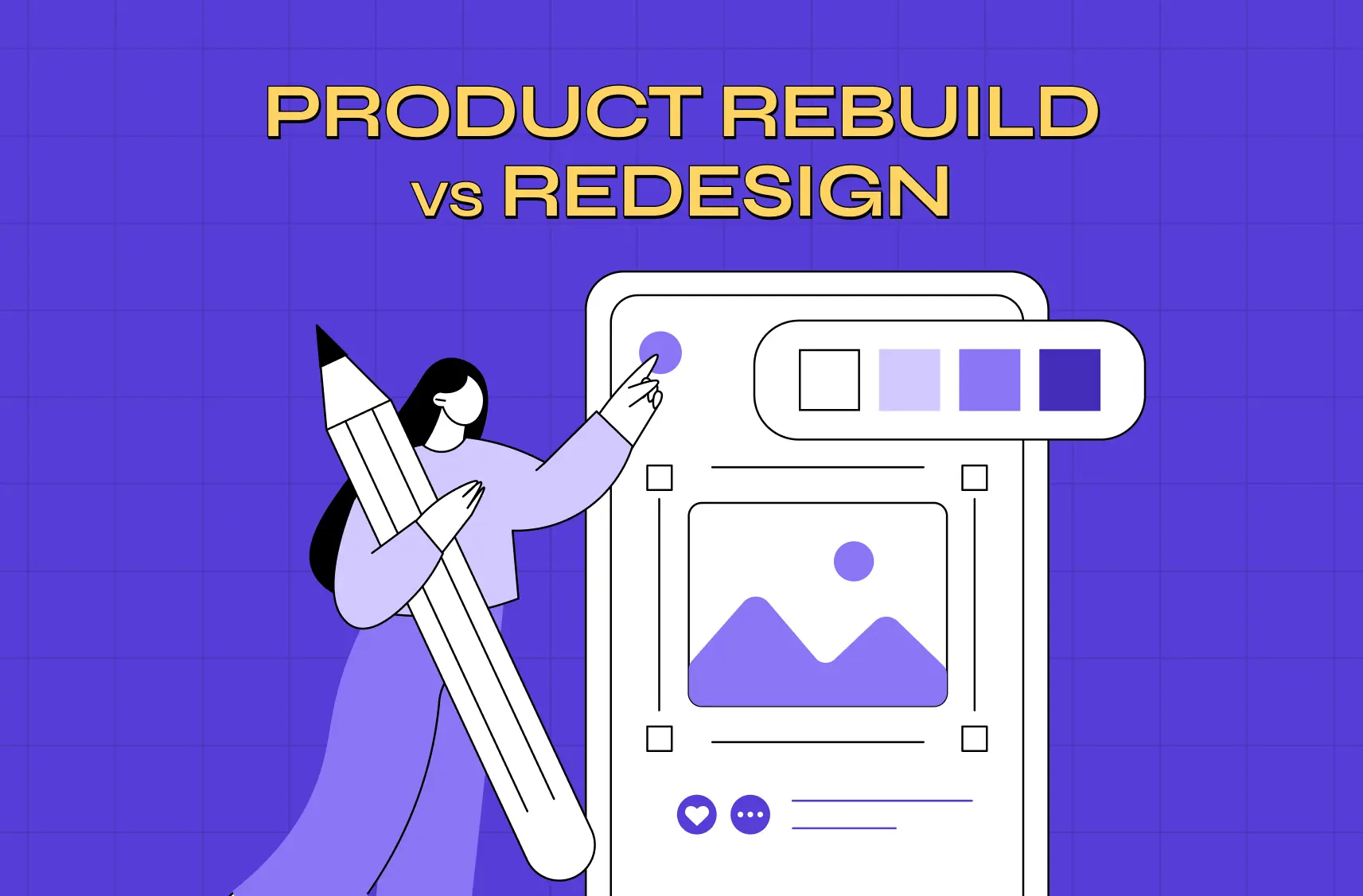
Illustration of a designer holding a large pencil while editing a digital interface, with color palette, image, and layout controls displayed on screen.

TL;DR

  • A product has four layers: visual, experience, code, and architecture. Which layer is broken determines whether you need a reskin, a redesign, a refactor, or a rebuild, not the other way around.

  • A redesign fixes the experience (flows, IA, interactions) on top of a foundation that still works. A rebuild replaces the foundation itself.

  • Redesign when the core model and positioning still hold and the foundation is sound. Rebuild only when the architecture genuinely can't support your roadmap, your business model, or compliance needs.

  • An ambitious redesign that skips an architecture check can silently turn into an unplanned rebuild, at rebuild prices, mid-project.

  • Redesigns typically run $15,000 to $150,000+, depending on the provider. Rebuilds usually exceed that range because you're recreating the foundation and often the experience on top of it.

  • The cheapest step in the whole decision is diagnosing the layer before you price anything.

Something's wrong with your product. Users complain it feels dated, or clunky, or slow; your team dreads shipping into it; the roadmap keeps hitting walls. So you start asking the expensive question: do we redesign it, or do we rebuild it from scratch?

Product rebuild vs. redesign is one of the highest-stakes calls a product leader makes, and most teams still make it by gut. Get the call right and you fix the actual problem for a reasonable spend. Get it wrong and you either paper over a structural failure with a fresh coat of paint, or you burn six figures and a year rebuilding a product that only needed a redesign. Before you compare quotes or pick a side, it helps to understand what each path actually fixes, what each costs, and how teams get this call wrong in both directions, which is exactly what this guide walks through.

This guide is for CTOs, PMs, and founders staring at an aging or struggling product. It reframes the question: rebuild vs. redesign isn't really the choice. The choice is which layer of your product is actually broken, because that determines whether you need a reskin, a redesign, a refactor, or a full rebuild. Below, we'll:

  • Define those four paths clearly

  • Draw the crucial rebuild-vs-redesign distinction

  • Lay out when each is the right call

  • Break down what each actually costs, in money and risk

  • Show you how to make the call without an expensive mistake

The goal throughout is simple: spend exactly as much as the real problem requires. No more, no less.

The real question: which layer is actually broken?
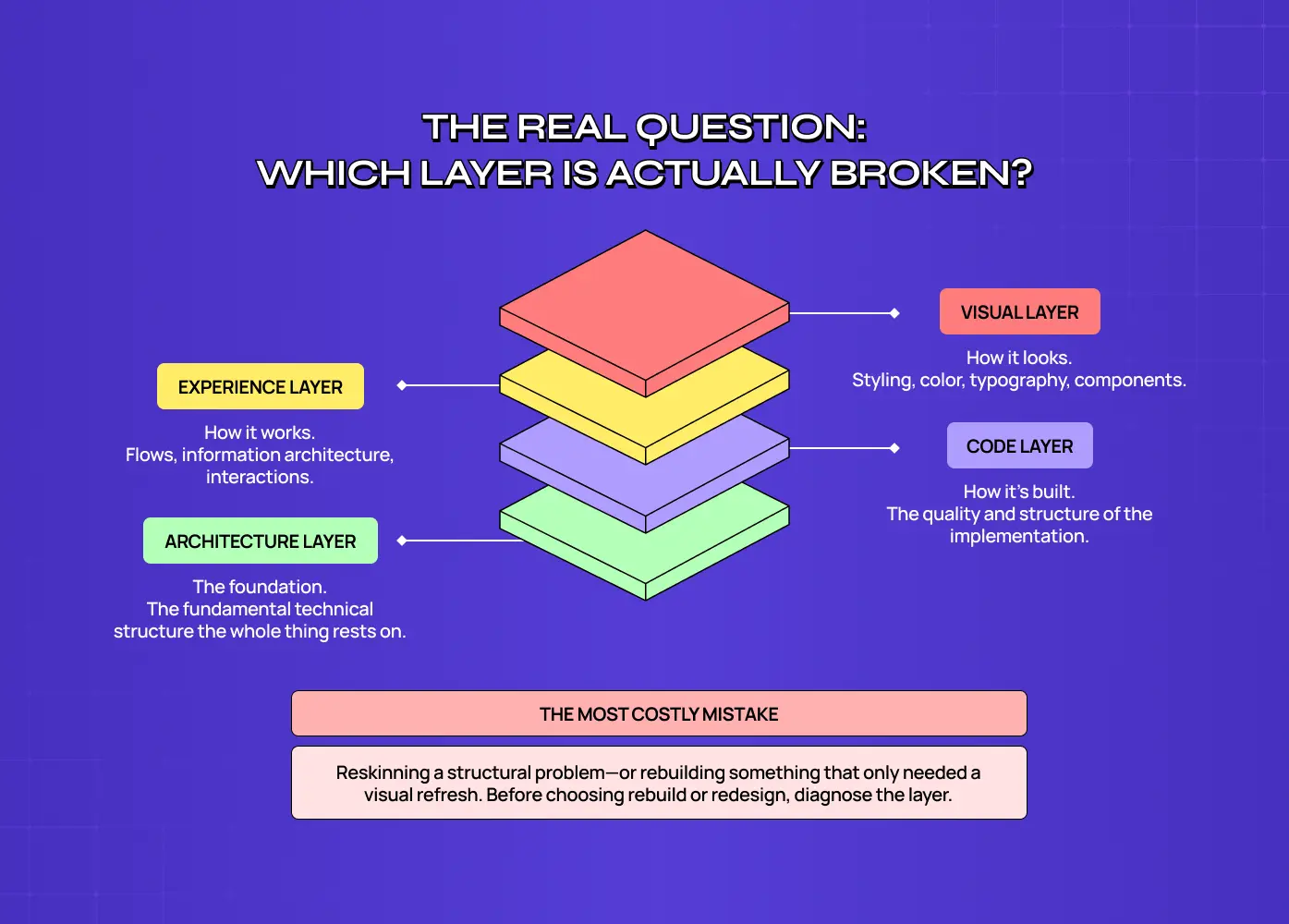
Layered diagram titled “The Real Question: Which Layer Is Actually Broken?” showing experience, architecture, visual, and code layers, with a warning about diagnosing the correct layer before redesigning.

"Should we rebuild or redesign?" is the wrong first question. The right one is which layer of your product is broken, and if you haven't already run a self-audit of your website, that's the fastest way to start answering it, because a product has four distinct layers, and each broken layer calls for a different, differently-priced fix. Teams get the rebuild-vs-redesign call wrong because they diagnose the symptom ("it feels bad") instead of the layer, then apply a fix aimed at the wrong level.

Think of your product as four stacked layers:

  • Visual layer: how it looks. Styling, color, typography, components.

  • Experience layer: how it works. Flows, information architecture, interactions.

  • Code layer: how it's built. The quality and structure of the implementation.

  • Architecture layer: the foundation. The fundamental technical structure the whole thing rests on.

A problem can live in any one of these, or several, and the depth of the broken layer determines how deep (and expensive) the fix has to be.

The most costly mistake in this whole decision is misreading which layer is broken: reskinning a product whose problem is structural, or rebuilding a product whose problem was only skin-deep. So before you weigh rebuild against redesign, diagnose the layer. The four paths below map directly onto it.

The four paths: reskin, redesign, refactor, rebuild
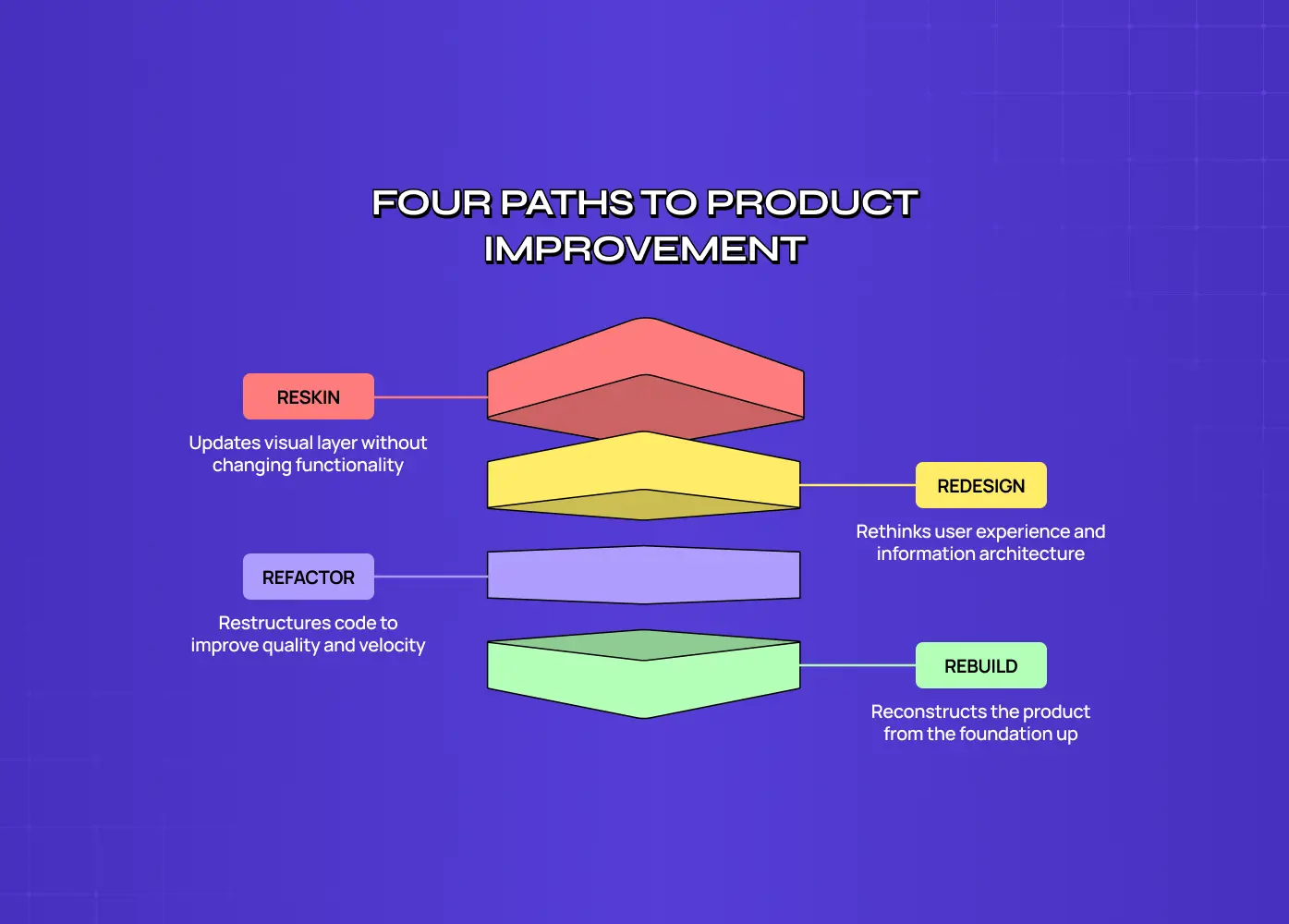
Diagram titled “Four Paths to Product Improvement” showing four approaches: reskin, redesign, refactor, and rebuild, each addressing a different type of product improvement.

There are four escalating paths, each addressing a deeper layer. Knowing exactly what each does, and doesn't, is most of the decision:

  • Reskin. The shallowest and cheapest path. You update the visual layer: restyle components, refresh colors and typography, modernize the look, all without changing the underlying flows or code. It fixes "looks dated." It does not fix confusing UX, tech debt, or a broken foundation.

  • Redesign. A layer deeper, into the experience. You rethink the flows, information architecture, and interactions, then re-do the interface around a better understanding of the user's job. It fixes confusing, clunky, or outdated experiences and drifted positioning. Depending on how ambitious the new flows are, it may or may not require changes below it, which is where the interlock with architecture lives (more on this next).

  • Refactor. An engineering move, invisible to users. You restructure the code to pay down technical debt and improve quality without changing what the product does, the code-side counterpart to accumulated UX debt on the design side. It fixes a messy codebase and slow development velocity. It does not change the product's shape or experience; it makes the existing product cheaper and safer to keep evolving.

  • Rebuild. The deepest and most expensive path. You rebuild from the foundation up, usually with a new experience on top. It's the only path that fixes a fundamentally broken architecture, and it's warranted only when nothing shallower will do. Think of rebuild as the nuclear option: the right call when the foundation is the problem, and a very expensive wrong one when it isn't.

Product rebuild vs. redesign: the core distinction

A redesign changes the experience of your product. A rebuild replaces its foundation. They solve fundamentally different problems, cost wildly different amounts, and, critically, an ambitious redesign can force a rebuild if the architecture can't support the new experience. This is the distinction the whole decision turns on, so it's worth being exact:

  • A redesign is about the experience and interface. It answers: "the way this works is wrong or dated."

  • A rebuild is about the technical foundation. It answers: "the structure this is built on can't support what we need."

  • You can redesign without rebuilding (new experience on the same solid foundation).

  • You can rebuild without much redesign (new architecture behind a similar experience).

Treating the two as interchangeable leads to expensive errors: you spend rebuild money on an experience problem, or you redesign around a foundation that can't hold the new design.

Here's the trap that catches teams mid-project: the two are interlocked. If you commit to an ambitious redesign, new flows, new capabilities, without first checking whether your architecture can support them, you can get halfway through and discover the foundation can't hold the new experience. Now your redesign has silently become a rebuild, at a fraction of the planning and several times the budget. The redesign-vs-rebuild decision therefore isn't purely a design call or purely an engineering call. It requires looking at the experience layer and the architecture layer together, which is exactly what the next two sections walk through.

When a redesign (or reskin) is enough
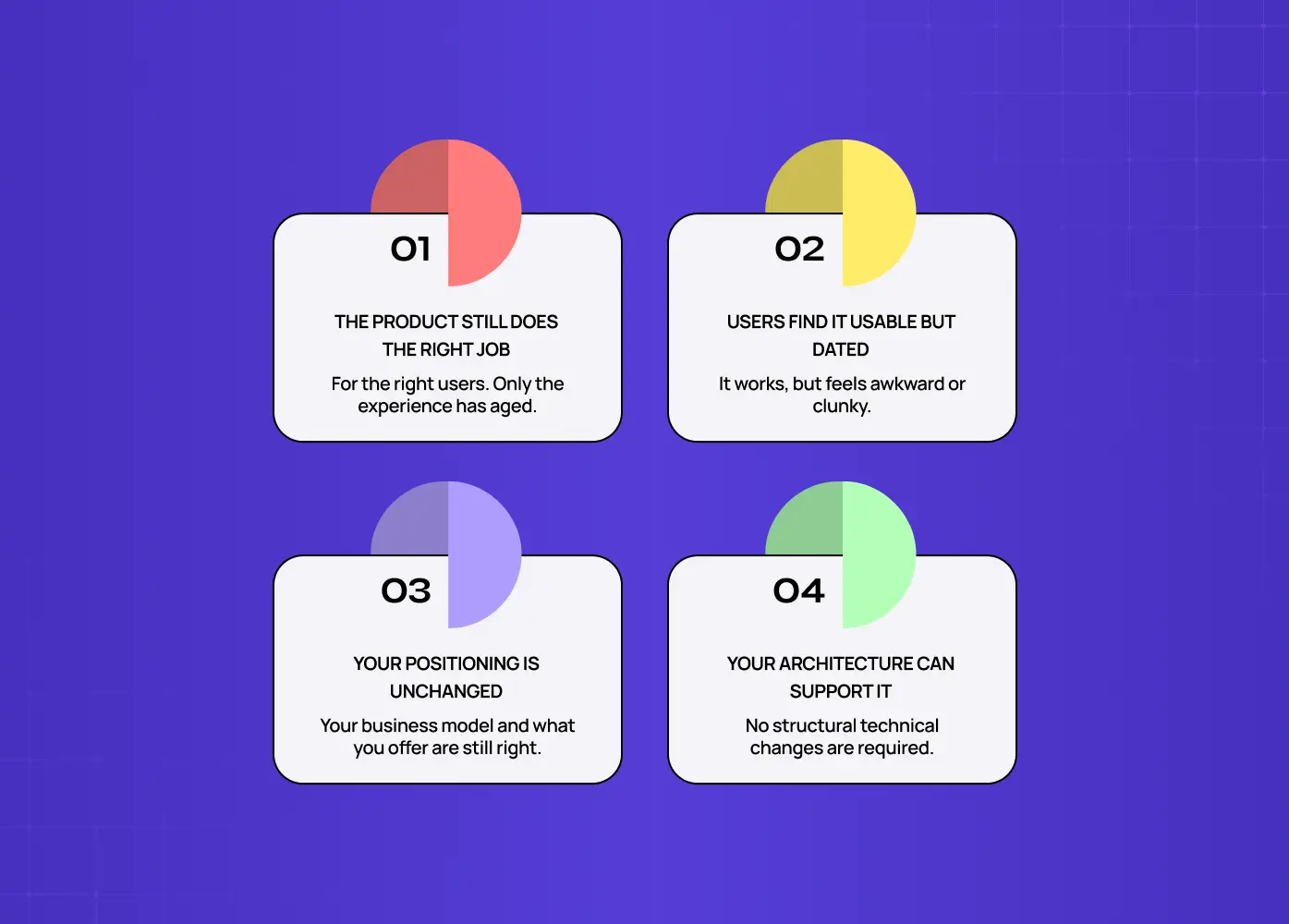
Four-part diagnostic diagram showing conditions for a product reskin: the product still does the right job, users find it usable but dated, positioning is unchanged, and the architecture can support it.

A redesign is the right call when your core model and positioning still hold and the foundation is sound: the product works and the business is right, but the experience is dated, clunky, or confusing. If you're still working out when to redesign your SaaS UX, that timing question sits entirely inside this same decision. An evolutionary refresh is faster, cheaper, and doesn't retrain your users. In more cases than teams assume, the foundation is fine and only the layers above it need work.

Choose a redesign (or, if the flows are genuinely good and only the look is tired, a reskin) when:

  • The product still does the right job for the right users, and only the experience has aged

  • Users find it usable but dated or awkward

  • Your positioning and business model are unchanged

  • Your architecture can support the improved experience without structural changes (this is the key technical precondition)

When those hold, a redesign fixes the real problem at a fraction of a rebuild's cost and risk, and keeps your existing users on familiar ground rather than forcing them to relearn everything.

There's a specific mistake to avoid here: conflating "outdated" with "broken." A product can look dated and still convert and retain perfectly well. If the thing genuinely works and the numbers are healthy, an expensive rebuild, or even a full redesign, may be solving a problem you don't have. Sometimes the honest answer is a reskin, or nothing at all. Match the spend to the actual defect, not to how tired the UI makes you feel.

This is also where a UX Strategy engagement earns its keep: a proper audit tells you, with evidence rather than gut feel, whether what you're looking at is a real experience problem or just a stale coat of paint. We've seen this play out directly. When PR teams found Barista's AI workflows powerful but hard to navigate, the fix wasn't a rebuild; it was a redesign that reorganized the platform around clearer, more collaborative workflows so the product finally worked the way PR teams actually think.

When you actually need a rebuild

A rebuild is warranted only when the architecture itself is the problem: it's fundamentally broken with no viable incremental path, your business model has outgrown it, the product no longer describes what you are, or the structure simply cannot support your roadmap. This is really legacy software modernization territory, not a design decision. These are real situations, and in them a rebuild is the responsible choice. Outside them, it's an expensive overreaction.

The clear signals that you need a rebuild, not a redesign:

  • The architecture is fundamentally broken with no realistic incremental path. You've tried refactoring and keep hitting the same walls.

  • Your business model has shifted in a way the foundation can't accommodate. Moving from single-tenant to multi-tenant SaaS, or adding regulated data handling, like healthcare compliance, to an architecture never built for it.

  • The app "describes a product you no longer are." It was built for a company and a strategy you've since outgrown.

  • The structure cannot support your roadmap. The things you need to build next, the ones mapped out in your actual product design roadmap, are impossible on the current foundation, no matter how the experience is designed.

Notice that every one of these is about the foundation, not the surface. If your reasons for wanting a rebuild are all about how the product looks or feels, you probably need a redesign. If they're about what the product fundamentally can't do or become, you're in rebuild territory. And even then, respect what a rebuild really involves, which is where cost comes in.

What each path actually costs, in money and risk

The four paths differ by an order of magnitude in cost and risk. A reskin is the cheapest and safest, a redesign moderate, a refactor an ongoing engineering investment, and a rebuild the most expensive and by far the riskiest, with cost overruns and user disruption that teams routinely underestimate. Understanding the true cost, not just the sticker price, is essential to the decision.

On direct spend, our broader breakdown of the cost to redesign a website lines up closely with these product-specific numbers:

  • Product and B2B SaaS redesigns commonly run anywhere from about $15,000 to $150,000+, depending on who does the work

  • Roughly $5,000 to $15,000 for template or freelancer work

  • $15,000 to $80,000 for a mid-size studio

  • $80,000 to $200,000+ for a full-service agency

  • A reskin sits at the low end of that spectrum; an ambitious redesign toward the high end, in line with the range we break down in our SaaS UX redesign cost guide

  • A rebuild typically exceeds all of it, because you're re-creating the foundation and usually the experience on top

But the sticker price is the smaller risk. Two costs are chronically undercounted, and both hit rebuilds hardest:

  • Scope expansion. The single most common driver of cost overruns in large software projects. Rebuilds are especially vulnerable because teams underestimate the undiscovered dependencies buried in legacy systems. What looked like a clean rebuild reveals hidden complexity month after month.

  • User disruption. Moving an active user base from the old system to a rebuilt one carries data migration, re-onboarding, and a support load from the interface changes that teams routinely leave out of the plan. If you go this route, treat the migration as its own designed project, not a deploy step; it's where a good rebuild quietly turns into a support meltdown.

The deeper the path, the more these hidden costs dominate, which is exactly why you don't want to choose a rebuild unless the foundation genuinely requires it.

How to decide without an expensive mistake
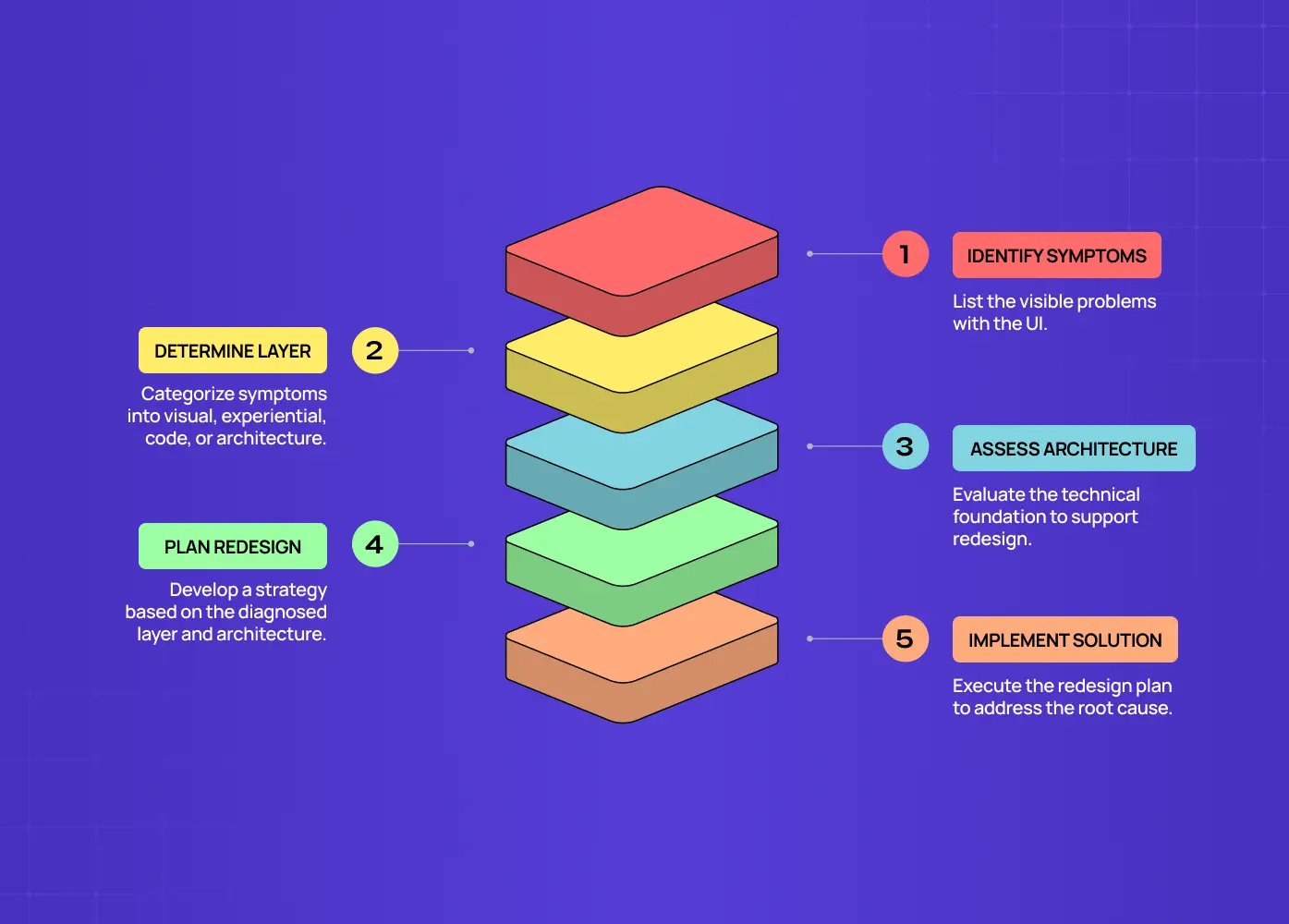
Five-step product redesign process diagram showing identify symptoms, determine layer, assess architecture, plan redesign, and implement solution.

Decide by diagnosing before prescribing: separate "outdated" from "broken," assess your technical architecture before committing to any ambitious redesign, and match the path to the deepest layer that's genuinely broken, no deeper. A disciplined diagnosis is what stands between you and a six-figure error in either direction.

Step 1: Be honest about symptoms versus layers. If you want a shorter starting checklist, our rundown of signs you need a redesign covers the most common surface-level tells. List what's actually wrong, and for each item, ask which layer it lives in:

  • "Looks dated" is visual

  • "Users can't find things / flows are confusing" is experience

  • "Every change takes forever and breaks things" is code

  • "We literally cannot build what's next on this" is architecture

The deepest layer with a real (not cosmetic) problem sets your path. If everything on the list is visual or experiential and the numbers are fine, you're redesigning, not rebuilding.

Step 2: Get a technical architecture assessment before committing to any redesign ambitious enough to add new flows or capabilities. This is the step that prevents the worst outcome: discovering mid-redesign that the foundation can't support the new experience and being forced into an unplanned rebuild. Looking at the experience you want and the architecture you have together, up front, tells you whether a redesign is truly enough or whether a rebuild is unavoidable, while it's still a planning decision, not an emergency.

This is also why design and engineering need to be in the room together for this call. It's neither a pure design decision nor a pure engineering one. Diagnose the layer, check the foundation, and spend to the depth of the real problem. That's the whole discipline.

Common mistakes in the rebuild-vs-redesign decision

The costly mistakes are all forms of mismatching the fix to the layer: reskinning a structural problem, rebuilding a cosmetic one, redesigning without checking the architecture, and undercounting the true cost of a rebuild. Watch for:

  • Treating "outdated" as "broken" and rebuilding a product that looks tired but works fine

  • Reskinning a structural problem, a fresh coat of paint over a foundation or UX that's the actual issue, which just delays the reckoning

  • Committing to a redesign without an architecture assessment, then discovering the foundation can't hold the new flows and lurching into an unplanned rebuild

  • Underestimating rebuild scope and disruption, ignoring legacy dependencies and the migration/support load until they blow the budget and timeline

  • Making the call in one discipline, design deciding without engineering, or vice versa, when the decision inherently spans the experience and architecture layers

Avoid these, and you spend to the real problem instead of your fears.

Conclusion

Product rebuild vs. redesign feels like a binary, but it's really a diagnosis:

  • Which layer of your product, visual, experience, code, or architecture, is actually broken?

  • How deep does the fix truly need to go?

  • A reskin refreshes the look, a redesign fixes the experience, a refactor cleans up the code, and a rebuild replaces the foundation, each an order of magnitude apart in cost and risk

  • Redesign when the foundation is sound and only the experience has aged

  • Rebuild only when the architecture itself can't support what you are or where you're going

  • Separate "outdated" from "broken," assess the architecture before you commit to an ambitious redesign, and match your spend to the deepest layer that's genuinely failing

Do that, and you'll fix the real problem, without paying rebuild prices for a redesign problem, or hiding a structural failure behind fresh paint.

If you're weighing a redesign against a rebuild and want a partner who diagnoses the real problem before prescribing an expensive fix, looking at your experience and your architecture together, book a discovery call with Groto. As a design-and-build studio, we help SaaS and AI teams choose the right path and execute it through our UX Strategy engagements, so you spend on what's actually broken. Let's find the fix that fits.


Most teams decide product rebuild vs. redesign by gut, and it costs them. This guide breaks the decision into four layers, visual, experience, code, and architecture, so you spend exactly what the real problem requires, no more, no less.

Rebuild or redesign? The real answer depends on which layer is actually broken.

Illustration of a designer holding a large pencil while editing a digital interface, with color palette, image, and layout controls displayed on screen.

TL;DR

  • A product has four layers: visual, experience, code, and architecture. Which layer is broken determines whether you need a reskin, a redesign, a refactor, or a rebuild, not the other way around.

  • A redesign fixes the experience (flows, IA, interactions) on top of a foundation that still works. A rebuild replaces the foundation itself.

  • Redesign when the core model and positioning still hold and the foundation is sound. Rebuild only when the architecture genuinely can't support your roadmap, your business model, or compliance needs.

  • An ambitious redesign that skips an architecture check can silently turn into an unplanned rebuild, at rebuild prices, mid-project.

  • Redesigns typically run $15,000 to $150,000+, depending on the provider. Rebuilds usually exceed that range because you're recreating the foundation and often the experience on top of it.

  • The cheapest step in the whole decision is diagnosing the layer before you price anything.

Something's wrong with your product. Users complain it feels dated, or clunky, or slow; your team dreads shipping into it; the roadmap keeps hitting walls. So you start asking the expensive question: do we redesign it, or do we rebuild it from scratch?

Product rebuild vs. redesign is one of the highest-stakes calls a product leader makes, and most teams still make it by gut. Get the call right and you fix the actual problem for a reasonable spend. Get it wrong and you either paper over a structural failure with a fresh coat of paint, or you burn six figures and a year rebuilding a product that only needed a redesign. Before you compare quotes or pick a side, it helps to understand what each path actually fixes, what each costs, and how teams get this call wrong in both directions, which is exactly what this guide walks through.

This guide is for CTOs, PMs, and founders staring at an aging or struggling product. It reframes the question: rebuild vs. redesign isn't really the choice. The choice is which layer of your product is actually broken, because that determines whether you need a reskin, a redesign, a refactor, or a full rebuild. Below, we'll:

  • Define those four paths clearly

  • Draw the crucial rebuild-vs-redesign distinction

  • Lay out when each is the right call

  • Break down what each actually costs, in money and risk

  • Show you how to make the call without an expensive mistake

The goal throughout is simple: spend exactly as much as the real problem requires. No more, no less.

The real question: which layer is actually broken?

Layered diagram titled “The Real Question: Which Layer Is Actually Broken?” showing experience, architecture, visual, and code layers, with a warning about diagnosing the correct layer before redesigning.

"Should we rebuild or redesign?" is the wrong first question. The right one is which layer of your product is broken, and if you haven't already run a self-audit of your website, that's the fastest way to start answering it, because a product has four distinct layers, and each broken layer calls for a different, differently-priced fix. Teams get the rebuild-vs-redesign call wrong because they diagnose the symptom ("it feels bad") instead of the layer, then apply a fix aimed at the wrong level.

Think of your product as four stacked layers:

  • Visual layer: how it looks. Styling, color, typography, components.

  • Experience layer: how it works. Flows, information architecture, interactions.

  • Code layer: how it's built. The quality and structure of the implementation.

  • Architecture layer: the foundation. The fundamental technical structure the whole thing rests on.

A problem can live in any one of these, or several, and the depth of the broken layer determines how deep (and expensive) the fix has to be.

The most costly mistake in this whole decision is misreading which layer is broken: reskinning a product whose problem is structural, or rebuilding a product whose problem was only skin-deep. So before you weigh rebuild against redesign, diagnose the layer. The four paths below map directly onto it.

The four paths: reskin, redesign, refactor, rebuild

Diagram titled “Four Paths to Product Improvement” showing four approaches: reskin, redesign, refactor, and rebuild, each addressing a different type of product improvement.

There are four escalating paths, each addressing a deeper layer. Knowing exactly what each does, and doesn't, is most of the decision:

  • Reskin. The shallowest and cheapest path. You update the visual layer: restyle components, refresh colors and typography, modernize the look, all without changing the underlying flows or code. It fixes "looks dated." It does not fix confusing UX, tech debt, or a broken foundation.

  • Redesign. A layer deeper, into the experience. You rethink the flows, information architecture, and interactions, then re-do the interface around a better understanding of the user's job. It fixes confusing, clunky, or outdated experiences and drifted positioning. Depending on how ambitious the new flows are, it may or may not require changes below it, which is where the interlock with architecture lives (more on this next).

  • Refactor. An engineering move, invisible to users. You restructure the code to pay down technical debt and improve quality without changing what the product does, the code-side counterpart to accumulated UX debt on the design side. It fixes a messy codebase and slow development velocity. It does not change the product's shape or experience; it makes the existing product cheaper and safer to keep evolving.

  • Rebuild. The deepest and most expensive path. You rebuild from the foundation up, usually with a new experience on top. It's the only path that fixes a fundamentally broken architecture, and it's warranted only when nothing shallower will do. Think of rebuild as the nuclear option: the right call when the foundation is the problem, and a very expensive wrong one when it isn't.

Product rebuild vs. redesign: the core distinction

A redesign changes the experience of your product. A rebuild replaces its foundation. They solve fundamentally different problems, cost wildly different amounts, and, critically, an ambitious redesign can force a rebuild if the architecture can't support the new experience. This is the distinction the whole decision turns on, so it's worth being exact:

  • A redesign is about the experience and interface. It answers: "the way this works is wrong or dated."

  • A rebuild is about the technical foundation. It answers: "the structure this is built on can't support what we need."

  • You can redesign without rebuilding (new experience on the same solid foundation).

  • You can rebuild without much redesign (new architecture behind a similar experience).

Treating the two as interchangeable leads to expensive errors: you spend rebuild money on an experience problem, or you redesign around a foundation that can't hold the new design.

Here's the trap that catches teams mid-project: the two are interlocked. If you commit to an ambitious redesign, new flows, new capabilities, without first checking whether your architecture can support them, you can get halfway through and discover the foundation can't hold the new experience. Now your redesign has silently become a rebuild, at a fraction of the planning and several times the budget. The redesign-vs-rebuild decision therefore isn't purely a design call or purely an engineering call. It requires looking at the experience layer and the architecture layer together, which is exactly what the next two sections walk through.

When a redesign (or reskin) is enough

Four-part diagnostic diagram showing conditions for a product reskin: the product still does the right job, users find it usable but dated, positioning is unchanged, and the architecture can support it.

A redesign is the right call when your core model and positioning still hold and the foundation is sound: the product works and the business is right, but the experience is dated, clunky, or confusing. If you're still working out when to redesign your SaaS UX, that timing question sits entirely inside this same decision. An evolutionary refresh is faster, cheaper, and doesn't retrain your users. In more cases than teams assume, the foundation is fine and only the layers above it need work.

Choose a redesign (or, if the flows are genuinely good and only the look is tired, a reskin) when:

  • The product still does the right job for the right users, and only the experience has aged

  • Users find it usable but dated or awkward

  • Your positioning and business model are unchanged

  • Your architecture can support the improved experience without structural changes (this is the key technical precondition)

When those hold, a redesign fixes the real problem at a fraction of a rebuild's cost and risk, and keeps your existing users on familiar ground rather than forcing them to relearn everything.

There's a specific mistake to avoid here: conflating "outdated" with "broken." A product can look dated and still convert and retain perfectly well. If the thing genuinely works and the numbers are healthy, an expensive rebuild, or even a full redesign, may be solving a problem you don't have. Sometimes the honest answer is a reskin, or nothing at all. Match the spend to the actual defect, not to how tired the UI makes you feel.

This is also where a UX Strategy engagement earns its keep: a proper audit tells you, with evidence rather than gut feel, whether what you're looking at is a real experience problem or just a stale coat of paint. We've seen this play out directly. When PR teams found Barista's AI workflows powerful but hard to navigate, the fix wasn't a rebuild; it was a redesign that reorganized the platform around clearer, more collaborative workflows so the product finally worked the way PR teams actually think.

When you actually need a rebuild

A rebuild is warranted only when the architecture itself is the problem: it's fundamentally broken with no viable incremental path, your business model has outgrown it, the product no longer describes what you are, or the structure simply cannot support your roadmap. This is really legacy software modernization territory, not a design decision. These are real situations, and in them a rebuild is the responsible choice. Outside them, it's an expensive overreaction.

The clear signals that you need a rebuild, not a redesign:

  • The architecture is fundamentally broken with no realistic incremental path. You've tried refactoring and keep hitting the same walls.

  • Your business model has shifted in a way the foundation can't accommodate. Moving from single-tenant to multi-tenant SaaS, or adding regulated data handling, like healthcare compliance, to an architecture never built for it.

  • The app "describes a product you no longer are." It was built for a company and a strategy you've since outgrown.

  • The structure cannot support your roadmap. The things you need to build next, the ones mapped out in your actual product design roadmap, are impossible on the current foundation, no matter how the experience is designed.

Notice that every one of these is about the foundation, not the surface. If your reasons for wanting a rebuild are all about how the product looks or feels, you probably need a redesign. If they're about what the product fundamentally can't do or become, you're in rebuild territory. And even then, respect what a rebuild really involves, which is where cost comes in.

What each path actually costs, in money and risk

The four paths differ by an order of magnitude in cost and risk. A reskin is the cheapest and safest, a redesign moderate, a refactor an ongoing engineering investment, and a rebuild the most expensive and by far the riskiest, with cost overruns and user disruption that teams routinely underestimate. Understanding the true cost, not just the sticker price, is essential to the decision.

On direct spend, our broader breakdown of the cost to redesign a website lines up closely with these product-specific numbers:

  • Product and B2B SaaS redesigns commonly run anywhere from about $15,000 to $150,000+, depending on who does the work

  • Roughly $5,000 to $15,000 for template or freelancer work

  • $15,000 to $80,000 for a mid-size studio

  • $80,000 to $200,000+ for a full-service agency

  • A reskin sits at the low end of that spectrum; an ambitious redesign toward the high end, in line with the range we break down in our SaaS UX redesign cost guide

  • A rebuild typically exceeds all of it, because you're re-creating the foundation and usually the experience on top

But the sticker price is the smaller risk. Two costs are chronically undercounted, and both hit rebuilds hardest:

  • Scope expansion. The single most common driver of cost overruns in large software projects. Rebuilds are especially vulnerable because teams underestimate the undiscovered dependencies buried in legacy systems. What looked like a clean rebuild reveals hidden complexity month after month.

  • User disruption. Moving an active user base from the old system to a rebuilt one carries data migration, re-onboarding, and a support load from the interface changes that teams routinely leave out of the plan. If you go this route, treat the migration as its own designed project, not a deploy step; it's where a good rebuild quietly turns into a support meltdown.

The deeper the path, the more these hidden costs dominate, which is exactly why you don't want to choose a rebuild unless the foundation genuinely requires it.

How to decide without an expensive mistake

Five-step product redesign process diagram showing identify symptoms, determine layer, assess architecture, plan redesign, and implement solution.

Decide by diagnosing before prescribing: separate "outdated" from "broken," assess your technical architecture before committing to any ambitious redesign, and match the path to the deepest layer that's genuinely broken, no deeper. A disciplined diagnosis is what stands between you and a six-figure error in either direction.

Step 1: Be honest about symptoms versus layers. If you want a shorter starting checklist, our rundown of signs you need a redesign covers the most common surface-level tells. List what's actually wrong, and for each item, ask which layer it lives in:

  • "Looks dated" is visual

  • "Users can't find things / flows are confusing" is experience

  • "Every change takes forever and breaks things" is code

  • "We literally cannot build what's next on this" is architecture

The deepest layer with a real (not cosmetic) problem sets your path. If everything on the list is visual or experiential and the numbers are fine, you're redesigning, not rebuilding.

Step 2: Get a technical architecture assessment before committing to any redesign ambitious enough to add new flows or capabilities. This is the step that prevents the worst outcome: discovering mid-redesign that the foundation can't support the new experience and being forced into an unplanned rebuild. Looking at the experience you want and the architecture you have together, up front, tells you whether a redesign is truly enough or whether a rebuild is unavoidable, while it's still a planning decision, not an emergency.

This is also why design and engineering need to be in the room together for this call. It's neither a pure design decision nor a pure engineering one. Diagnose the layer, check the foundation, and spend to the depth of the real problem. That's the whole discipline.

Common mistakes in the rebuild-vs-redesign decision

The costly mistakes are all forms of mismatching the fix to the layer: reskinning a structural problem, rebuilding a cosmetic one, redesigning without checking the architecture, and undercounting the true cost of a rebuild. Watch for:

  • Treating "outdated" as "broken" and rebuilding a product that looks tired but works fine

  • Reskinning a structural problem, a fresh coat of paint over a foundation or UX that's the actual issue, which just delays the reckoning

  • Committing to a redesign without an architecture assessment, then discovering the foundation can't hold the new flows and lurching into an unplanned rebuild

  • Underestimating rebuild scope and disruption, ignoring legacy dependencies and the migration/support load until they blow the budget and timeline

  • Making the call in one discipline, design deciding without engineering, or vice versa, when the decision inherently spans the experience and architecture layers

Avoid these, and you spend to the real problem instead of your fears.

Conclusion

Product rebuild vs. redesign feels like a binary, but it's really a diagnosis:

  • Which layer of your product, visual, experience, code, or architecture, is actually broken?

  • How deep does the fix truly need to go?

  • A reskin refreshes the look, a redesign fixes the experience, a refactor cleans up the code, and a rebuild replaces the foundation, each an order of magnitude apart in cost and risk

  • Redesign when the foundation is sound and only the experience has aged

  • Rebuild only when the architecture itself can't support what you are or where you're going

  • Separate "outdated" from "broken," assess the architecture before you commit to an ambitious redesign, and match your spend to the deepest layer that's genuinely failing

Do that, and you'll fix the real problem, without paying rebuild prices for a redesign problem, or hiding a structural failure behind fresh paint.

If you're weighing a redesign against a rebuild and want a partner who diagnoses the real problem before prescribing an expensive fix, looking at your experience and your architecture together, book a discovery call with Groto. As a design-and-build studio, we help SaaS and AI teams choose the right path and execute it through our UX Strategy engagements, so you spend on what's actually broken. Let's find the fix that fits.

Have a project in mind?

Let’s talk through your idea and see what makes sense.

Harpreet Singh

Founder at Groto

Have a project in mind?

Let’s talk through your idea and see what makes sense.

Harpreet Singh

Founder at Groto

FAQ

Everything you were going to ask (and a few things you didn’t know to)

What is the difference between a revamp and a redesign?

A revamp usually refers to a lighter, more visual refresh, closer to what this guide calls a reskin: new styling, updated colors, modernized components, without touching flows or code. A redesign goes deeper, into how the product actually works: its flows, information architecture, and interactions. If your team is using "revamp" loosely, it's worth checking which layer they actually mean before scoping the work.

What is another word for "redesigned"?

Depending on context, common alternatives include reimagined, reworked, overhauled, or revamped. In a product context, though, these words aren't interchangeable: "reimagined" and "revamped" often signal a visual or experience-layer change, while "rebuilt" or "re-architected" signal a foundation-layer change. Precision here matters more than synonyms, since the word you use tends to set expectations for scope and cost.

What are some examples of redesigned products?

A redesign shows up as a product that keeps its core model and user base but reworks how it's organized and used. One example from our own work: when Indiefolio's internal hiring platform had grown difficult to navigate, we redesigned the key workflows rather than rebuilding the platform, simplifying hiring, improving collaboration, and creating a smoother journey for clients, designers, and internal teams, all without disrupting the existing user base or replacing the underlying architecture.

How do you say "redesigned"?

It's pronounced ree-dih-ZYND, with the stress on the second syllable. Worth flagging for content and comms purposes if you're recording video, voiceover, or podcast content that references the term.

What are the benefits of a redesign?

Done well, a redesign delivers a better experience without the cost, risk, or user disruption of a rebuild. Specific benefits include: faster time to impact, since you're not rebuilding the foundation, lower cost relative to a rebuild, often by an order of magnitude, less disruption to existing users, since data, accounts, and core workflows carry over, a chance to fix drifted positioning and confusing flows without touching what already works technically and preserved SEO equity and integrations, since the underlying architecture stays intact

Can a redesign turn into a rebuild?

Yes, and it's a common expensive mistake. If you commit to an ambitious redesign with new flows or capabilities without first assessing whether your architecture can support them, you can get partway in and discover the foundation can't hold the new experience, forcing an unplanned rebuild at far higher cost. Assess the experience you want and the architecture you have together, up front, so the decision stays a plan instead of becoming an emergency.

What is the difference between a revamp and a redesign?

A revamp usually refers to a lighter, more visual refresh, closer to what this guide calls a reskin: new styling, updated colors, modernized components, without touching flows or code. A redesign goes deeper, into how the product actually works: its flows, information architecture, and interactions. If your team is using "revamp" loosely, it's worth checking which layer they actually mean before scoping the work.


What is another word for "redesigned"?

Depending on context, common alternatives include reimagined, reworked, overhauled, or revamped. In a product context, though, these words aren't interchangeable: "reimagined" and "revamped" often signal a visual or experience-layer change, while "rebuilt" or "re-architected" signal a foundation-layer change. Precision here matters more than synonyms, since the word you use tends to set expectations for scope and cost.

What are some examples of redesigned products?

A redesign shows up as a product that keeps its core model and user base but reworks how it's organized and used. One example from our own work: when Indiefolio's internal hiring platform had grown difficult to navigate, we redesigned the key workflows rather than rebuilding the platform, simplifying hiring, improving collaboration, and creating a smoother journey for clients, designers, and internal teams, all without disrupting the existing user base or replacing the underlying architecture.

How do you say "redesigned"?

It's pronounced ree-dih-ZYND, with the stress on the second syllable. Worth flagging for content and comms purposes if you're recording video, voiceover, or podcast content that references the term.

What are the benefits of a redesign?

Done well, a redesign delivers a better experience without the cost, risk, or user disruption of a rebuild. Specific benefits include: faster time to impact, since you're not rebuilding the foundation, lower cost relative to a rebuild, often by an order of magnitude, less disruption to existing users, since data, accounts, and core workflows carry over, a chance to fix drifted positioning and confusing flows without touching what already works technically and preserved SEO equity and integrations, since the underlying architecture stays intact

Can a redesign turn into a rebuild?

Yes, and it's a common expensive mistake. If you commit to an ambitious redesign with new flows or capabilities without first assessing whether your architecture can support them, you can get partway in and discover the foundation can't hold the new experience, forcing an unplanned rebuild at far higher cost. Assess the experience you want and the architecture you have together, up front, so the decision stays a plan instead of becoming an emergency.

More Articles

Extreme close-up black and white photograph of a human eye

Let’s bring your vision to life

Tell us what's on your mind? We'll hit you back in 24 hours. No fluff, no delays - just a solid vision to bring your idea to life.

Profile portrait of a man in a white shirt against a light background

Harpreet Singh

Founder and Creative Director

Get in Touch

Extreme close-up black and white photograph of a human eye

Let’s bring your vision to life

Tell us what's on your mind? We'll hit you back in 24 hours. No fluff, no delays - just a solid vision to bring your idea to life.

Profile portrait of a man in a white shirt against a light background

Harpreet Singh

Founder and Creative Director

Get in Touch

Extreme close-up black and white photograph of a human eye

Let’s bring your vision to life

Tell us what's on your mind? We'll hit you back in 24 hours. No fluff, no delays - just a solid vision to bring your idea to life.

Profile portrait of a man in a white shirt against a light background

Harpreet Singh

Founder and Creative Director

Get in Touch