Design-Led AI Leadership: How AI Leaders Are Borrowing from the Design Playbook

Design-Led AI Leadership: How AI Leaders Are Borrowing from the Design Playbook

Design-led AI leadership means running AI teams like design teams: framing problems first, prototyping honestly, prizing taste, designing for trust, and leading through ambiguity.

Design-Led AI Leadership: How AI Leaders Are Borrowing from the Design Playbook

Design-Led AI Leadership: How AI Leaders Are Borrowing from the Design Playbook

Design-led AI leadership means running AI teams like design teams: framing problems first, prototyping honestly, prizing taste, designing for trust, and leading through ambiguity.

Everyone has access to the same AI models, so the edge has shifted elsewhere. The AI leaders pulling ahead are leading like design leaders: framing problems sharply, prototyping honestly, prizing taste, and designing for trust from day one.

The best AI leaders are quietly borrowing the design playbook. Here's how, and why.

Five migration risks: broken user habits, synchronized support chaos, loss aversion, unprepared support teams, and treating migration as an instant switch instead of a designed transition.

Design-led AI leadership is the practice of running AI product efforts the way strong design leaders run their teams: starting with the user problem instead of the technology, prototyping cheaply and learning from real behavior, protecting a quality bar when AI makes "good enough" free, and building trust into the product on purpose. It is quickly becoming the clearest way to describe what separates AI teams that ship products people actually adopt from teams that ship demos nobody asked for, one thread in the broader AI revolution in UI/UX design.

TL;DR

  • AI leadership is borrowing five plays from the design world: user-first problem framing, cheap prototyping with honest iteration, prizing judgment and taste over knowledge, designing for trust, and leading through ambiguity.

  • The shift is happening because models are commoditizing fast. The differentiators have moved to exactly the terrain design has always owned: framing, taste, trust, and direction.

  • Trust in AI products is not automatic. It has to be designed, through visible confidence levels, visible decision logic, and visible points of human control.

  • You do not need a design background to lead this way. It is a transferable set of habits, not a credential.

  • Teams that skip these plays tend to ship tech-first features, over-plan instead of prototype, settle for "good enough," hide uncertainty, and freeze in ambiguity, all of which quietly kill adoption.

How AI Leaders Are Borrowing from the Design Playbook

Summary of the shift toward design leadership in AI, highlighting four plays: problem framing, rapid prototyping, human judgment, and designing for trust.

The AI leaders who are winning right now aren't the ones with the best model. Everyone has access to roughly the same models, one piece of how AI is transforming UX/UI development industry-wide. What separates the teams shipping AI products people actually adopt from the teams shipping impressive demos that go nowhere isn't technology. It's how they lead the work. Increasingly, the ones getting it right are leading like design leaders:

  • Framing the user problem before reaching for a solution

  • Prototyping cheaply and iterating against reality, not a plan

  • Prizing judgment and taste over raw knowledge

  • Treating trust as something you design rather than assume

They may not call it that, but they're running the design playbook. This piece is about that shift, design-led AI leadership, and the specific plays AI product leaders are borrowing from design, part of the wider shift toward AI-driven UX practices every business needs in 2026.

It's written for CTOs, heads of product, PMs, and founders leading AI efforts who've noticed that the hard part of building AI products isn't the model. It's everything around it. We'll cover:

  • Why AI leadership is turning toward design

  • The five concrete plays being adopted

  • What "only human" leadership actually looks like once execution is automated

  • The common mistakes teams make when they skip these plays

  • What it means for how you actually run an AI team

The argument is simple: as the technology commoditizes, the design-led way of leading becomes the durable edge.

The UX playbook that takes you from MVP traction to Series A growth

Identify the UX mistakes silently killing your activation rate and the exact fixes to improve conversions without a full product redesign.

No Spam. Free Lifetime

The UX playbook that takes you from MVP traction to Series A growth

Identify the UX mistakes silently killing your activation rate and the exact fixes to improve conversions without a full product redesign.

No Spam. Free Lifetime

Why AI Leadership Is Turning to the Design Playbook
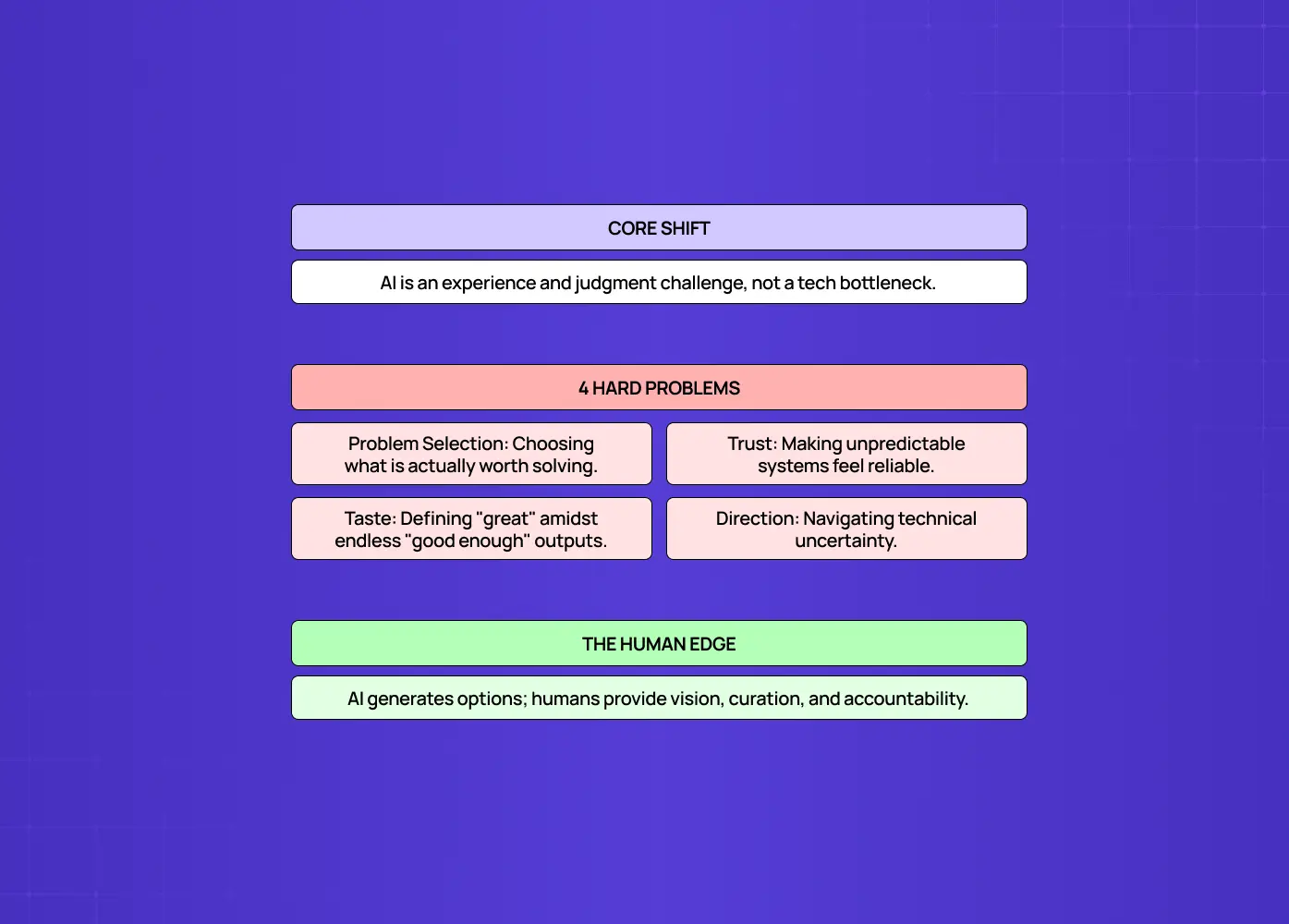
Overview of AI’s core challenges, including problem selection, trust, taste, and navigating technical uncertainty, with human judgment positioned as the key advantage.

AI leadership is borrowing from design because AI products are fundamentally experience-and-judgment problems, not just technology problems. Design is the discipline built precisely for leading in ambiguity, iterating toward the right thing, and upholding a standard when the "how" is uncertain. As the models themselves become commoditized, the differentiators move to exactly the terrain design has always owned.

Consider what's actually hard about an AI product. The model is a starting point nearly everyone can access. The hard parts are:

  • Figuring out which user problem is worth solving with AI in the first place

  • Making a non-deterministic experience feel trustworthy

  • Deciding what "good" looks like when the tool can produce infinite "good enough"

  • Steering all of it through genuine uncertainty about how the technology will behave

None of those are engineering problems in the traditional sense. They're problems of framing, taste, trust, and direction, the design leader's home turf.

There's a broader signal here too: the premium in knowledge work has moved from what you know to your judgment. When expert-level answers are instantly available to everyone, what matters is whether you can direct the tool, challenge it when it's confidently wrong, and own the result. That's a description of design leadership, which was never about knowing the one right answer and always about judging, among many possibilities, which one is actually good.

This lines up with something the wider leadership research is starting to say explicitly: AI can draft, summarize, and generate options at speed, but it cannot set an aspiration for a team, take accountability for a call, or decide which of ten "correct-looking" outputs is actually right for this product and this moment. Those remain distinctly human responsibilities, and they map almost exactly onto what design leadership has always practiced. AI didn't invent this way of working. It just made it the way everyone now has to work. The leaders who already thought like designers have a head start, and the ones who don't are borrowing the playbook. Here's what's in it.

Play 1: Start with the User and Frame the Problem Sharply

Problem-first AI strategy framework emphasizing user problems, avoiding tech-first thinking, treating AI as an ingredient, validating user needs, and driving adoption.

The first design play AI leaders are borrowing is refusing to lead with the technology. Instead of asking "where can we add AI?", they start with people and frame the real problem sharply, treating AI as a means to a user outcome rather than the point. This inversion is the single most important one, and the most commonly skipped.

The failure mode of tech-first AI leadership is everywhere: a team starts from "we should use this model" and goes looking for somewhere to bolt it on, shipping features that demo well and solve nothing anyone needed. Design thinking's core move is the opposite: start with people, frame the problem sharply, then find the right solution. That's exactly the discipline AI products need most, because AI makes it so easy to build something impressive that misses the point.

Design-led AI leaders hold their teams to the problem before the solution by asking, on repeat:

  • Who is this actually for?

  • What are they trying to do, in their own words, not the roadmap's words?

  • Is AI genuinely the best way to help them, or just the exciting one?

  • What happens to trust and adoption if we get this framing wrong?

Framed this way, AI becomes an ingredient in service of a user outcome rather than a hammer looking for nails. And it's not a one-time ceremony. The good ones treat it as a mindset that runs continuously, re-checking that the work still serves a real problem as it evolves. Lead from the problem and everything downstream gets easier. Lead from the technology and no amount of model quality saves you.

This is also where a strategy-first partner earns their keep, and where the UX design vs. product design distinction actually matters for who owns that framing. Teams building AI-first UX design into a product from day one tend to avoid the tech-first trap entirely, because the problem framing happens before a single screen gets designed.

Play 2: Prototype Cheaply, Ship Live, and Iterate Honestly
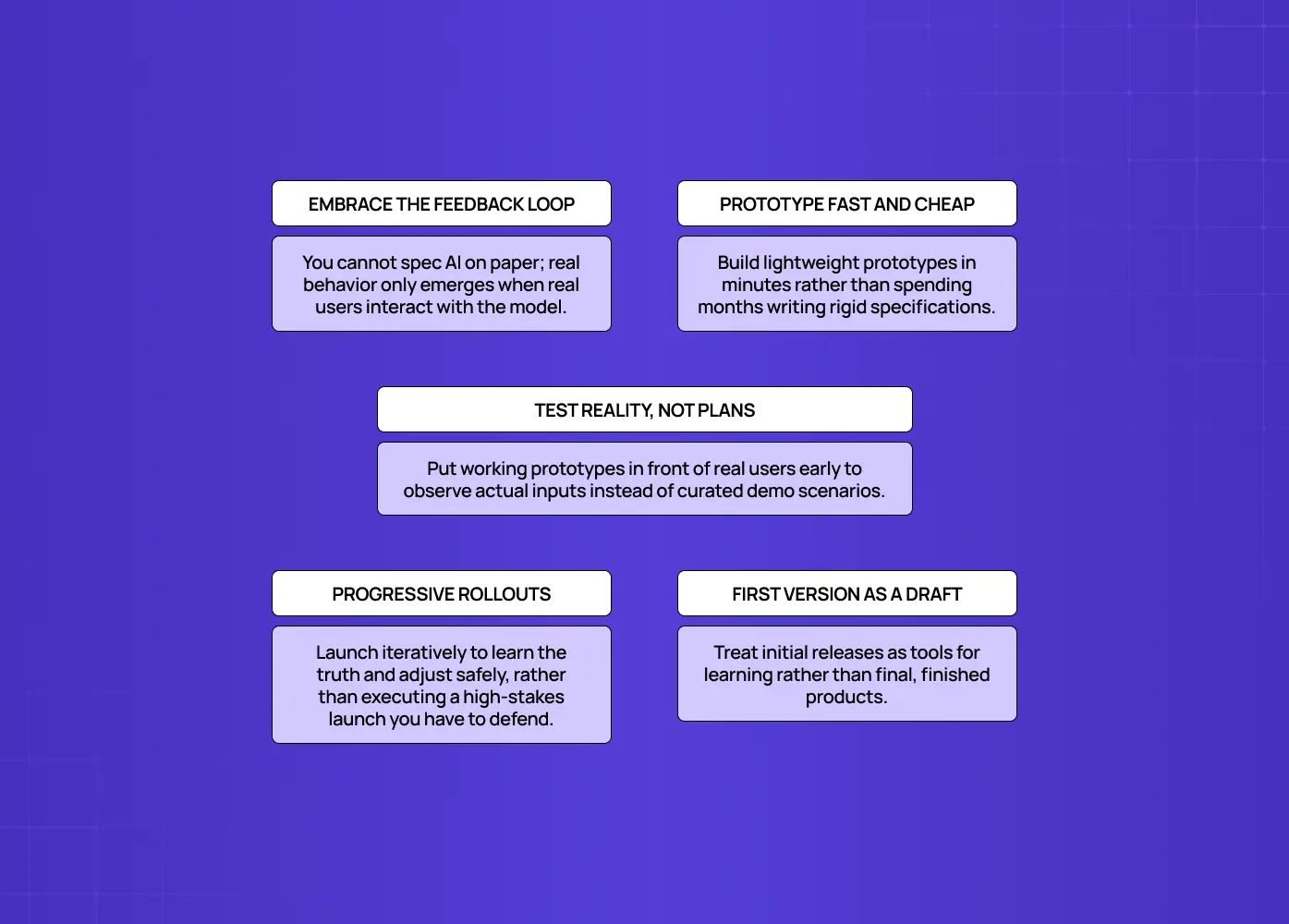
Five practices for AI product development: embrace feedback, prototype quickly, test with real users, roll out progressively, and treat the first version as a learning draft.

The second borrowed play is design's core loop: prototype cheaply, put it in front of real users, and iterate honestly on what you learn. This matters even more for AI because a non-deterministic product's real behavior only emerges in contact with real users. You cannot spec your way to a good AI experience. You have to build, observe, and adjust.

Design has always insisted on cheap prototypes and honest testing over lengthy up-front specification, and modern tooling has made that loop faster than ever. Teams now go from idea to working prototype in minutes using agentic AI for faster UX workflows, ship live prototypes to users, learn, and iterate. For AI products this isn't just efficient, it's the only way to find out how the thing actually behaves, the same evidence base laid out in AI UX vs. traditional UX for SaaS products, because an AI feature's true behavior appears only when real inputs meet the real model at scale. A polished plan for how the AI "should" work is a hypothesis, not a product.

Design-led AI leaders run their teams on this loop deliberately:

  • Prototype the AI experience early, before requirements are fully locked

  • Get it in front of real users fast, not just stakeholders

  • Watch what actually happens, not what the demo suggested

  • Iterate to learn the truth, not to confirm the plan

  • Roll out progressively and keep watching real behavior after launch, not just before it

This is where design leadership and safe AI shipping meet. The same instinct that makes a design leader prototype and test is what makes an AI leader roll out progressively, watch real behavior, and adjust. The leaders who treat the first version as a draft to learn from, rather than a launch to defend, ship far better AI.

Play 3: Prize Judgment and Taste Over Knowledge

Four principles for maintaining quality in AI products: prioritize discernment, apply editorial judgment, institutionalize quality standards, and use quality vetoes to prevent weak outputs.

The third play is elevating judgment and taste, the ability to uphold a high standard and know what's actually good, above raw knowledge. AI makes "good enough" cheap and abundant, so the scarce, valuable skill becomes discernment. This is design's oldest competency, and suddenly it's everyone's most important one.

When AI can generate endless competent-looking options, generating options stops being the bottleneck. Choosing well becomes it. Taste, the editorial judgment to know what to leave out, what to emphasize, and when something is genuinely right rather than merely acceptable, is what separates a distinctive AI product from the generic average that AI naturally drifts toward. The best AI products often feel simple and obvious, and that simplicity is the visible result of hard judgment happening behind the scenes.

Design-led AI leaders make taste a leadership responsibility, not just a design-team habit. In practice, that tends to look like:

  • Setting and defending a real quality bar, not a "ship it, it works" bar

  • Pushing back on cheap, "good enough" output rather than approving it by default

  • Cultivating discernment across the team instead of just measuring throughput

  • Codifying what 'good' means through scorecards, heuristics, review checkpoints, or a formal design system, so quality is measurable and enforceable, not just a feeling one senior person has

  • Treating the ability to block a launch on quality grounds as a leadership tool, not an obstruction

That last point matters more than it sounds. When execution is automated and anyone can generate a lot of output fast, a leader's judgment about what is actually worth shipping becomes the main lever left on quality. In a world where volume is cheap, the leader who can tell what's actually good, and insist on it, is the one whose product stands out.

Play 4: Design for Trust, Make Uncertainty, Logic, and Control Visible
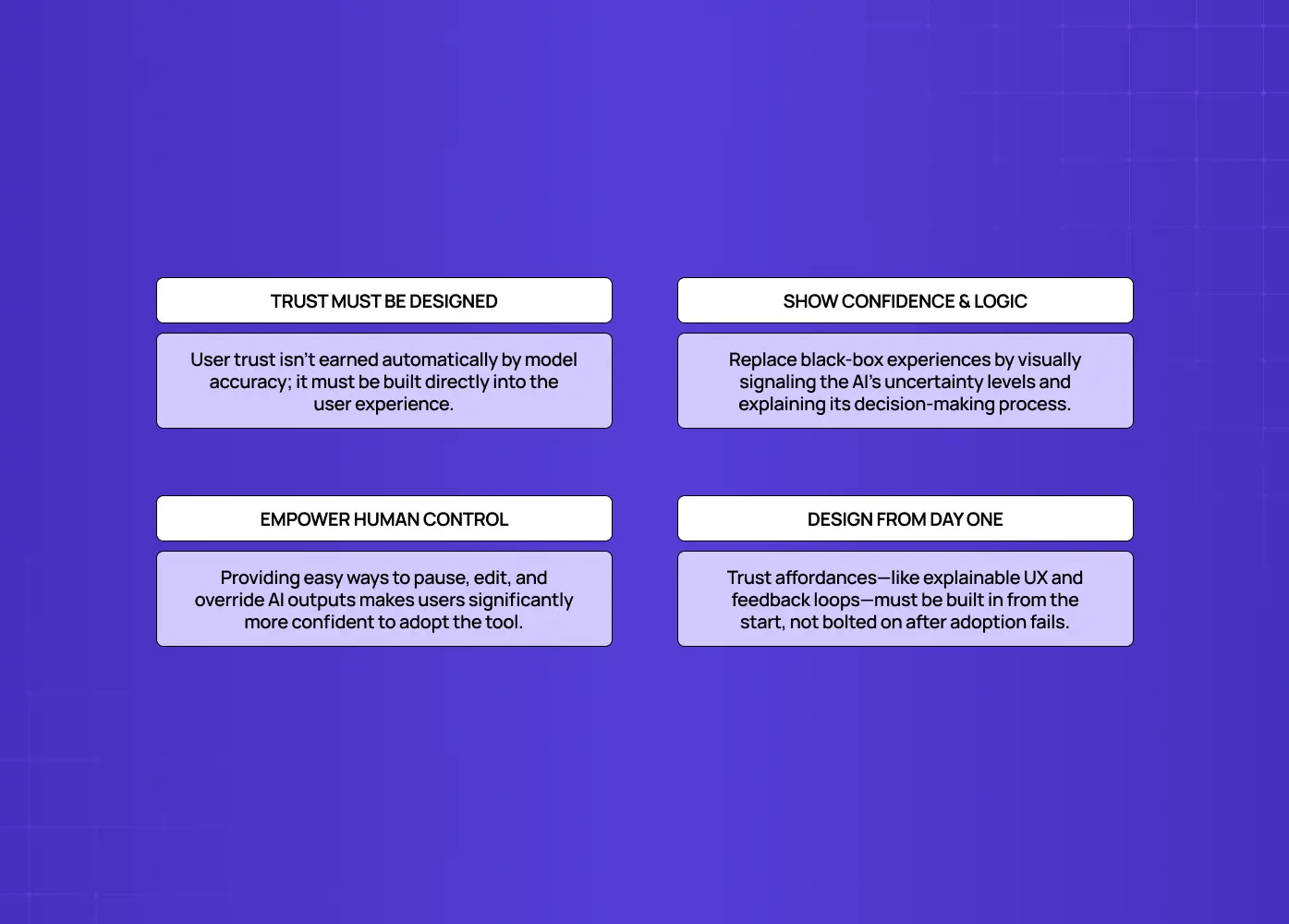
Four principles for designing trustworthy AI experiences: build trust intentionally, explain uncertainty, empower human control, and incorporate trust mechanisms from day one.

The fourth play is treating trust as something you deliberately design, not something the product earns automatically. The design pattern AI leaders are adopting is to make three things visible: the AI's confidence and uncertainty, its decision logic, and clear points of human control. For AI products, trust is the gate on adoption, and design is how you build it.

Users don't adopt AI they don't trust, and trust doesn't come from the AI being right more often. It comes from the experience being honest about what the AI is doing. The emerging design framework makes three things visible:

  • Confidence and uncertainty. Rather than presenting every output as equally certain, the product signals when it's sure and when it isn't.

  • Decision logic. Users can see, at least in outline, how an outcome was produced, so it's not an inscrutable black box.

  • Points of human control. Places where the user can pause, adjust, or reverse what the AI did.

That third point carries a finding worth internalizing: the ability to correct an AI is a trust signal, not a fallback. Users who know they can correct it are measurably more willing to engage with it in the first place.

Design-led AI leaders build these trust affordances in from the start rather than bolting them on after adoption stalls. They know a technically excellent AI feature that feels like an unaccountable black box will lose to a modest one that's honest about its uncertainty and easy to correct. Trust is a design output, and leading for it is a design-led act.

Because this play lives entirely in the interface, the interaction model, and the onboarding flow, it's usually where a dedicated AI-first UX design partner adds the most immediate value: explainable UX patterns, override controls, and feedback loops are the actual mechanics of trust, not an afterthought layered on top of a finished product.

Play 5: Lead Through Ambiguity and Build the Operating Model
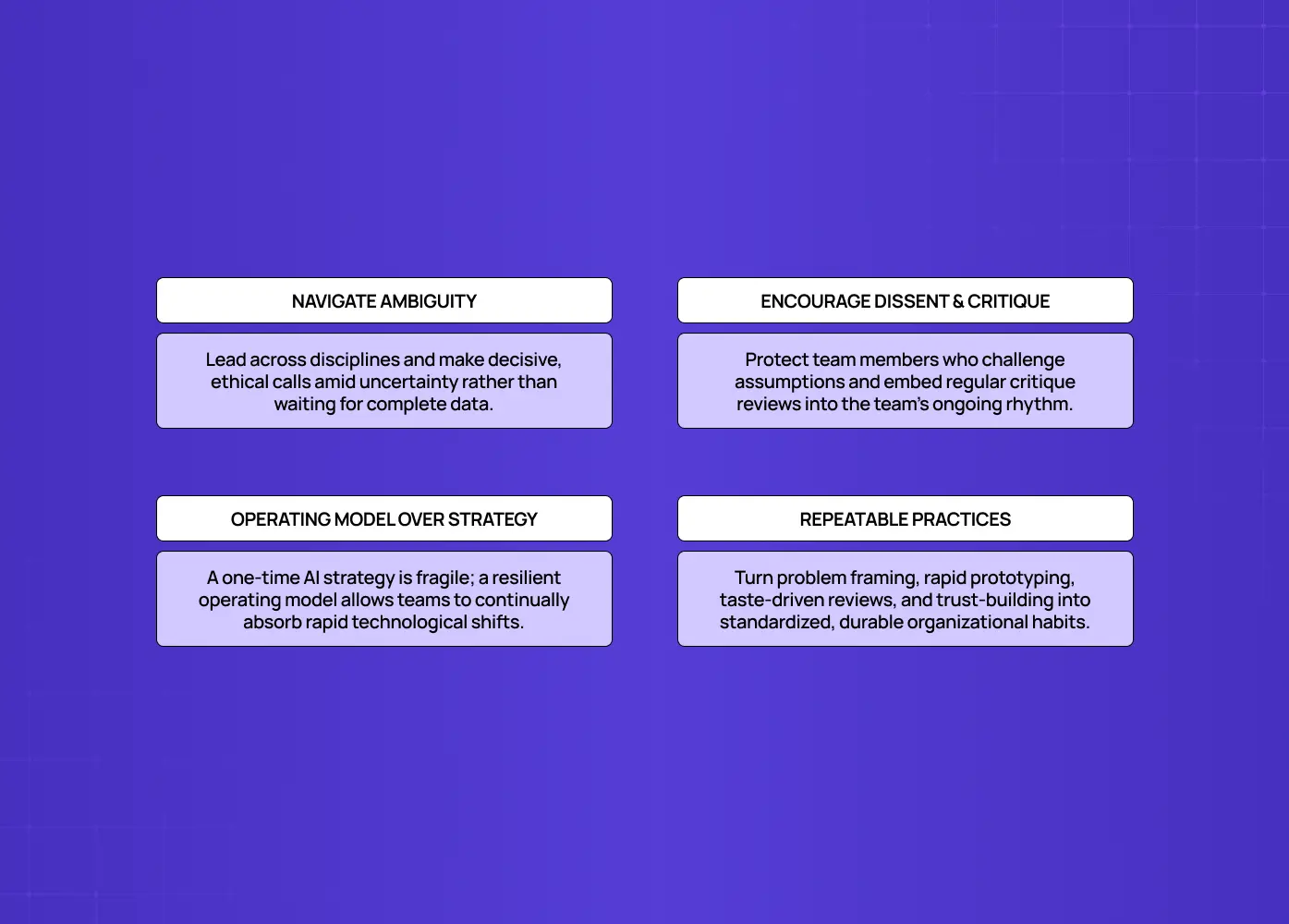
Four principles for leading AI product teams: navigate ambiguity, encourage dissent, prioritize resilient operating models, and establish repeatable product practices.

The fifth play is a leadership stance design has always demanded: navigating ambiguity, connecting disciplines, and setting direction without full certainty, plus building a repeatable operating model rather than chasing a one-off strategy. AI's inherent uncertainty rewards teams that can absorb it. This is where design-led leadership becomes a way of running the whole effort, not just the product.

AI brings genuine ambiguity: uncertain technology, unclear best practices, unpredictable behavior. The demand is shifting away from narrow specialization toward leaders who can navigate that ambiguity, connect disciplines, and shape direction, a description of what good design leaders have always done, working across research, engineering, and business to set direction when the answer isn't given.

Design-led AI leaders tend to share a few habits here:

  • They make thoughtful, ethical calls under uncertainty instead of waiting for more data that isn't coming

  • They steer the team toward a point of view rather than freezing until the fog clears

  • They hire and protect people who will push back and dissent, not just execute quietly, because a team that only nods along is usually a team that's disengaged or confused

  • They build critique and after-action review into the rhythm of the work, not just at launch

  • They invest in a repeatable practice, a system, not a single win

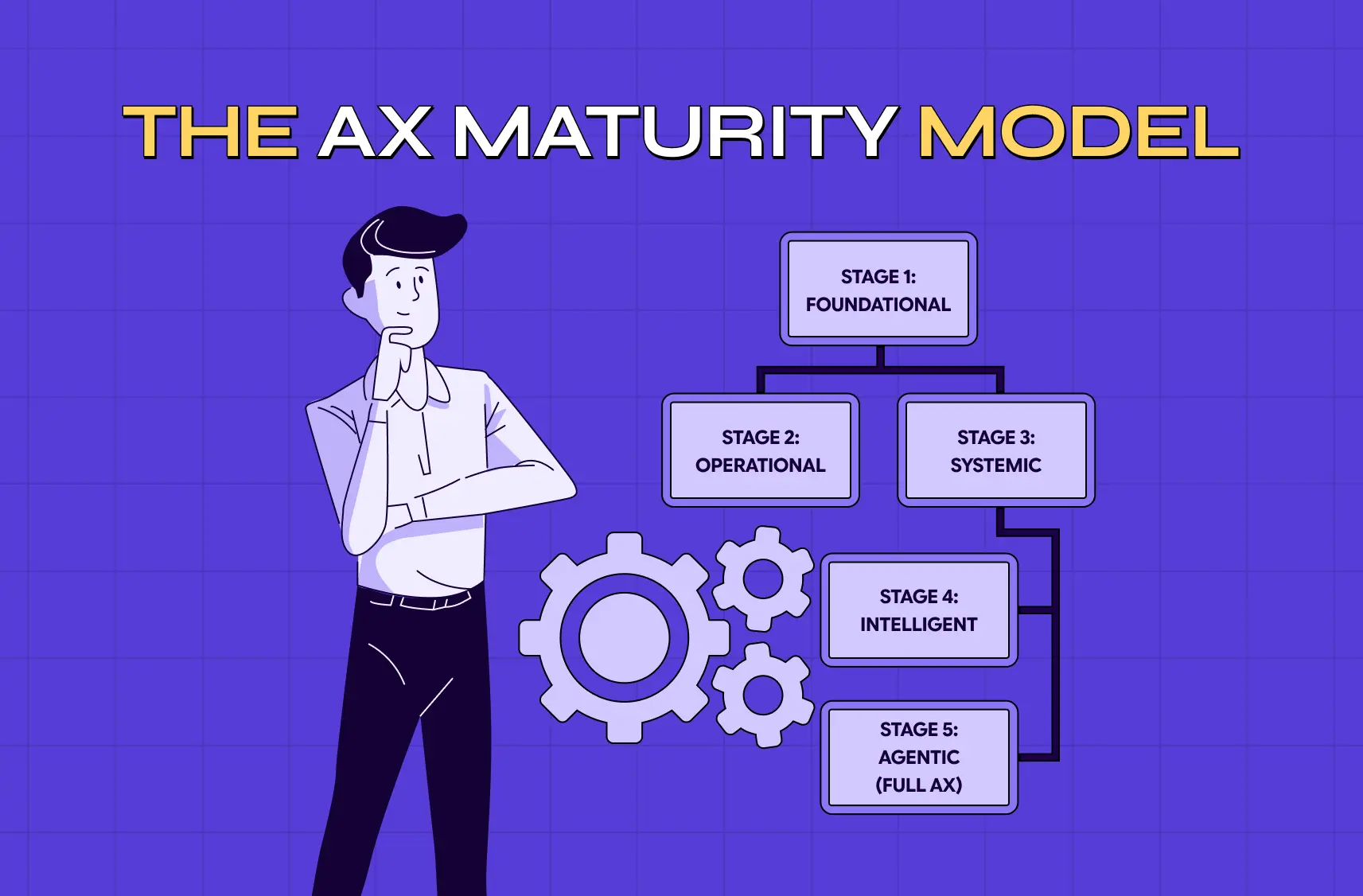
That last point is worth dwelling on. The companies that win the next five years won't necessarily have the best AI strategy. They'll have the best operating model, one strong enough to absorb whatever the technology does next, which is really a question of AX maturity as much as strategy. Design leadership has always been about building a repeatable way of working rather than scoring a single win. Applied to AI, that means investing in how the team frames problems, prototypes, judges quality, and builds trust as a repeatable practice, so the organization can keep absorbing change instead of relearning it every quarter. Strategy is a bet on one moment. An operating model is how you keep winning as the moment changes.

Getting the operating model right often starts further upstream than most teams expect, at the UX strategy layer, before a single AI feature gets designed or built.

Common Mistakes AI Leaders Make by Ignoring the Design Playbook

The predictable failures come from doing the opposite of each play, the same patterns covered in common AI UX design mistakes. Each is common, and each is avoidable:

  • Tech-first leadership. Building AI because it's exciting rather than because it solves a real problem, and shipping impressive features nobody needed.

  • Over-planning instead of prototyping. Specifying the AI experience in exhaustive detail up front, then defending a plan the model quietly contradicts in production.

  • Accepting the average. Letting AI's cheap "good enough" output set the bar, which produces a generic product with no distinctiveness or taste.

  • Hiding uncertainty. Presenting every AI output as equally confident and giving users no way to correct it, which quietly kills trust and adoption.

  • Freezing in ambiguity. Waiting for certainty that AI will never provide, instead of setting a direction and iterating toward it.

  • Treating execution as the whole job. Assuming that because AI can generate the output faster, leadership's job is mostly to approve it, rather than to frame, judge, and take accountability for it.

Every one of these is the shadow of a design play left unlearned, which is exactly why the leaders borrowing the playbook are pulling ahead.

Conclusion

  • The best AI leaders are increasingly design-led, not because design is fashionable, but because the hard parts of building AI products, framing the right problem, iterating toward an experience that works, upholding a standard when "good enough" is free, and earning trust in something non-deterministic, are precisely the problems design was built to lead.

  • As models commoditize, those human, judgment-driven capabilities become the durable edge.

  • The design playbook, start with the user, prototype and iterate honestly, prize taste and judgment, design for trust, and lead through ambiguity with a repeatable operating model, is the clearest guide to running an AI effort that ships products people actually adopt.

  • You don't need to have come up through design to lead this way. You just need to borrow the plays.

If you're leading an AI product and want a partner who brings this design-led way of building, problem-first, trust-focused, and held to a real quality bar, book a discovery call with Groto. We're a design-led studio that builds AI products people trust and adopt, and we work alongside AI leaders to run the plays that matter, from strategy through to how to develop an AI-powered SaaS product. Let's build AI that's led like design, not just powered by a model.

Everyone has access to the same AI models, so the edge has shifted elsewhere. The AI leaders pulling ahead are leading like design leaders: framing problems sharply, prototyping honestly, prizing taste, and designing for trust from day one.

The best AI leaders are quietly borrowing the design playbook. Here's how, and why.

Five migration risks: broken user habits, synchronized support chaos, loss aversion, unprepared support teams, and treating migration as an instant switch instead of a designed transition.

Design-led AI leadership is the practice of running AI product efforts the way strong design leaders run their teams: starting with the user problem instead of the technology, prototyping cheaply and learning from real behavior, protecting a quality bar when AI makes "good enough" free, and building trust into the product on purpose. It is quickly becoming the clearest way to describe what separates AI teams that ship products people actually adopt from teams that ship demos nobody asked for, one thread in the broader AI revolution in UI/UX design.

TL;DR

  • AI leadership is borrowing five plays from the design world: user-first problem framing, cheap prototyping with honest iteration, prizing judgment and taste over knowledge, designing for trust, and leading through ambiguity.

  • The shift is happening because models are commoditizing fast. The differentiators have moved to exactly the terrain design has always owned: framing, taste, trust, and direction.

  • Trust in AI products is not automatic. It has to be designed, through visible confidence levels, visible decision logic, and visible points of human control.

  • You do not need a design background to lead this way. It is a transferable set of habits, not a credential.

  • Teams that skip these plays tend to ship tech-first features, over-plan instead of prototype, settle for "good enough," hide uncertainty, and freeze in ambiguity, all of which quietly kill adoption.

How AI Leaders Are Borrowing from the Design Playbook

Summary of the shift toward design leadership in AI, highlighting four plays: problem framing, rapid prototyping, human judgment, and designing for trust.

The AI leaders who are winning right now aren't the ones with the best model. Everyone has access to roughly the same models, one piece of how AI is transforming UX/UI development industry-wide. What separates the teams shipping AI products people actually adopt from the teams shipping impressive demos that go nowhere isn't technology. It's how they lead the work. Increasingly, the ones getting it right are leading like design leaders:

  • Framing the user problem before reaching for a solution

  • Prototyping cheaply and iterating against reality, not a plan

  • Prizing judgment and taste over raw knowledge

  • Treating trust as something you design rather than assume

They may not call it that, but they're running the design playbook. This piece is about that shift, design-led AI leadership, and the specific plays AI product leaders are borrowing from design, part of the wider shift toward AI-driven UX practices every business needs in 2026.

It's written for CTOs, heads of product, PMs, and founders leading AI efforts who've noticed that the hard part of building AI products isn't the model. It's everything around it. We'll cover:

  • Why AI leadership is turning toward design

  • The five concrete plays being adopted

  • What "only human" leadership actually looks like once execution is automated

  • The common mistakes teams make when they skip these plays

  • What it means for how you actually run an AI team

The argument is simple: as the technology commoditizes, the design-led way of leading becomes the durable edge.

The UX playbook that takes you from MVP traction to Series A growth

Identify the UX mistakes silently killing your activation rate and the exact fixes to improve conversions without a full product redesign.

No Spam. Free Lifetime

Why AI Leadership Is Turning to the Design Playbook

Overview of AI’s core challenges, including problem selection, trust, taste, and navigating technical uncertainty, with human judgment positioned as the key advantage.

AI leadership is borrowing from design because AI products are fundamentally experience-and-judgment problems, not just technology problems. Design is the discipline built precisely for leading in ambiguity, iterating toward the right thing, and upholding a standard when the "how" is uncertain. As the models themselves become commoditized, the differentiators move to exactly the terrain design has always owned.

Consider what's actually hard about an AI product. The model is a starting point nearly everyone can access. The hard parts are:

  • Figuring out which user problem is worth solving with AI in the first place

  • Making a non-deterministic experience feel trustworthy

  • Deciding what "good" looks like when the tool can produce infinite "good enough"

  • Steering all of it through genuine uncertainty about how the technology will behave

None of those are engineering problems in the traditional sense. They're problems of framing, taste, trust, and direction, the design leader's home turf.

There's a broader signal here too: the premium in knowledge work has moved from what you know to your judgment. When expert-level answers are instantly available to everyone, what matters is whether you can direct the tool, challenge it when it's confidently wrong, and own the result. That's a description of design leadership, which was never about knowing the one right answer and always about judging, among many possibilities, which one is actually good.

This lines up with something the wider leadership research is starting to say explicitly: AI can draft, summarize, and generate options at speed, but it cannot set an aspiration for a team, take accountability for a call, or decide which of ten "correct-looking" outputs is actually right for this product and this moment. Those remain distinctly human responsibilities, and they map almost exactly onto what design leadership has always practiced. AI didn't invent this way of working. It just made it the way everyone now has to work. The leaders who already thought like designers have a head start, and the ones who don't are borrowing the playbook. Here's what's in it.

Play 1: Start with the User and Frame the Problem Sharply

Problem-first AI strategy framework emphasizing user problems, avoiding tech-first thinking, treating AI as an ingredient, validating user needs, and driving adoption.

The first design play AI leaders are borrowing is refusing to lead with the technology. Instead of asking "where can we add AI?", they start with people and frame the real problem sharply, treating AI as a means to a user outcome rather than the point. This inversion is the single most important one, and the most commonly skipped.

The failure mode of tech-first AI leadership is everywhere: a team starts from "we should use this model" and goes looking for somewhere to bolt it on, shipping features that demo well and solve nothing anyone needed. Design thinking's core move is the opposite: start with people, frame the problem sharply, then find the right solution. That's exactly the discipline AI products need most, because AI makes it so easy to build something impressive that misses the point.

Design-led AI leaders hold their teams to the problem before the solution by asking, on repeat:

  • Who is this actually for?

  • What are they trying to do, in their own words, not the roadmap's words?

  • Is AI genuinely the best way to help them, or just the exciting one?

  • What happens to trust and adoption if we get this framing wrong?

Framed this way, AI becomes an ingredient in service of a user outcome rather than a hammer looking for nails. And it's not a one-time ceremony. The good ones treat it as a mindset that runs continuously, re-checking that the work still serves a real problem as it evolves. Lead from the problem and everything downstream gets easier. Lead from the technology and no amount of model quality saves you.

This is also where a strategy-first partner earns their keep, and where the UX design vs. product design distinction actually matters for who owns that framing. Teams building AI-first UX design into a product from day one tend to avoid the tech-first trap entirely, because the problem framing happens before a single screen gets designed.

Play 2: Prototype Cheaply, Ship Live, and Iterate Honestly

Five practices for AI product development: embrace feedback, prototype quickly, test with real users, roll out progressively, and treat the first version as a learning draft.

The second borrowed play is design's core loop: prototype cheaply, put it in front of real users, and iterate honestly on what you learn. This matters even more for AI because a non-deterministic product's real behavior only emerges in contact with real users. You cannot spec your way to a good AI experience. You have to build, observe, and adjust.

Design has always insisted on cheap prototypes and honest testing over lengthy up-front specification, and modern tooling has made that loop faster than ever. Teams now go from idea to working prototype in minutes using agentic AI for faster UX workflows, ship live prototypes to users, learn, and iterate. For AI products this isn't just efficient, it's the only way to find out how the thing actually behaves, the same evidence base laid out in AI UX vs. traditional UX for SaaS products, because an AI feature's true behavior appears only when real inputs meet the real model at scale. A polished plan for how the AI "should" work is a hypothesis, not a product.

Design-led AI leaders run their teams on this loop deliberately:

  • Prototype the AI experience early, before requirements are fully locked

  • Get it in front of real users fast, not just stakeholders

  • Watch what actually happens, not what the demo suggested

  • Iterate to learn the truth, not to confirm the plan

  • Roll out progressively and keep watching real behavior after launch, not just before it

This is where design leadership and safe AI shipping meet. The same instinct that makes a design leader prototype and test is what makes an AI leader roll out progressively, watch real behavior, and adjust. The leaders who treat the first version as a draft to learn from, rather than a launch to defend, ship far better AI.

Play 3: Prize Judgment and Taste Over Knowledge

Four principles for maintaining quality in AI products: prioritize discernment, apply editorial judgment, institutionalize quality standards, and use quality vetoes to prevent weak outputs.

The third play is elevating judgment and taste, the ability to uphold a high standard and know what's actually good, above raw knowledge. AI makes "good enough" cheap and abundant, so the scarce, valuable skill becomes discernment. This is design's oldest competency, and suddenly it's everyone's most important one.

When AI can generate endless competent-looking options, generating options stops being the bottleneck. Choosing well becomes it. Taste, the editorial judgment to know what to leave out, what to emphasize, and when something is genuinely right rather than merely acceptable, is what separates a distinctive AI product from the generic average that AI naturally drifts toward. The best AI products often feel simple and obvious, and that simplicity is the visible result of hard judgment happening behind the scenes.

Design-led AI leaders make taste a leadership responsibility, not just a design-team habit. In practice, that tends to look like:

  • Setting and defending a real quality bar, not a "ship it, it works" bar

  • Pushing back on cheap, "good enough" output rather than approving it by default

  • Cultivating discernment across the team instead of just measuring throughput

  • Codifying what 'good' means through scorecards, heuristics, review checkpoints, or a formal design system, so quality is measurable and enforceable, not just a feeling one senior person has

  • Treating the ability to block a launch on quality grounds as a leadership tool, not an obstruction

That last point matters more than it sounds. When execution is automated and anyone can generate a lot of output fast, a leader's judgment about what is actually worth shipping becomes the main lever left on quality. In a world where volume is cheap, the leader who can tell what's actually good, and insist on it, is the one whose product stands out.

Play 4: Design for Trust, Make Uncertainty, Logic, and Control Visible

Four principles for designing trustworthy AI experiences: build trust intentionally, explain uncertainty, empower human control, and incorporate trust mechanisms from day one.

The fourth play is treating trust as something you deliberately design, not something the product earns automatically. The design pattern AI leaders are adopting is to make three things visible: the AI's confidence and uncertainty, its decision logic, and clear points of human control. For AI products, trust is the gate on adoption, and design is how you build it.

Users don't adopt AI they don't trust, and trust doesn't come from the AI being right more often. It comes from the experience being honest about what the AI is doing. The emerging design framework makes three things visible:

  • Confidence and uncertainty. Rather than presenting every output as equally certain, the product signals when it's sure and when it isn't.

  • Decision logic. Users can see, at least in outline, how an outcome was produced, so it's not an inscrutable black box.

  • Points of human control. Places where the user can pause, adjust, or reverse what the AI did.

That third point carries a finding worth internalizing: the ability to correct an AI is a trust signal, not a fallback. Users who know they can correct it are measurably more willing to engage with it in the first place.

Design-led AI leaders build these trust affordances in from the start rather than bolting them on after adoption stalls. They know a technically excellent AI feature that feels like an unaccountable black box will lose to a modest one that's honest about its uncertainty and easy to correct. Trust is a design output, and leading for it is a design-led act.

Because this play lives entirely in the interface, the interaction model, and the onboarding flow, it's usually where a dedicated AI-first UX design partner adds the most immediate value: explainable UX patterns, override controls, and feedback loops are the actual mechanics of trust, not an afterthought layered on top of a finished product.

Play 5: Lead Through Ambiguity and Build the Operating Model

Four principles for leading AI product teams: navigate ambiguity, encourage dissent, prioritize resilient operating models, and establish repeatable product practices.

The fifth play is a leadership stance design has always demanded: navigating ambiguity, connecting disciplines, and setting direction without full certainty, plus building a repeatable operating model rather than chasing a one-off strategy. AI's inherent uncertainty rewards teams that can absorb it. This is where design-led leadership becomes a way of running the whole effort, not just the product.

AI brings genuine ambiguity: uncertain technology, unclear best practices, unpredictable behavior. The demand is shifting away from narrow specialization toward leaders who can navigate that ambiguity, connect disciplines, and shape direction, a description of what good design leaders have always done, working across research, engineering, and business to set direction when the answer isn't given.

Design-led AI leaders tend to share a few habits here:

  • They make thoughtful, ethical calls under uncertainty instead of waiting for more data that isn't coming

  • They steer the team toward a point of view rather than freezing until the fog clears

  • They hire and protect people who will push back and dissent, not just execute quietly, because a team that only nods along is usually a team that's disengaged or confused

  • They build critique and after-action review into the rhythm of the work, not just at launch

  • They invest in a repeatable practice, a system, not a single win

That last point is worth dwelling on. The companies that win the next five years won't necessarily have the best AI strategy. They'll have the best operating model, one strong enough to absorb whatever the technology does next, which is really a question of AX maturity as much as strategy. Design leadership has always been about building a repeatable way of working rather than scoring a single win. Applied to AI, that means investing in how the team frames problems, prototypes, judges quality, and builds trust as a repeatable practice, so the organization can keep absorbing change instead of relearning it every quarter. Strategy is a bet on one moment. An operating model is how you keep winning as the moment changes.

Getting the operating model right often starts further upstream than most teams expect, at the UX strategy layer, before a single AI feature gets designed or built.

Common Mistakes AI Leaders Make by Ignoring the Design Playbook

The predictable failures come from doing the opposite of each play, the same patterns covered in common AI UX design mistakes. Each is common, and each is avoidable:

  • Tech-first leadership. Building AI because it's exciting rather than because it solves a real problem, and shipping impressive features nobody needed.

  • Over-planning instead of prototyping. Specifying the AI experience in exhaustive detail up front, then defending a plan the model quietly contradicts in production.

  • Accepting the average. Letting AI's cheap "good enough" output set the bar, which produces a generic product with no distinctiveness or taste.

  • Hiding uncertainty. Presenting every AI output as equally confident and giving users no way to correct it, which quietly kills trust and adoption.

  • Freezing in ambiguity. Waiting for certainty that AI will never provide, instead of setting a direction and iterating toward it.

  • Treating execution as the whole job. Assuming that because AI can generate the output faster, leadership's job is mostly to approve it, rather than to frame, judge, and take accountability for it.

Every one of these is the shadow of a design play left unlearned, which is exactly why the leaders borrowing the playbook are pulling ahead.

Conclusion

  • The best AI leaders are increasingly design-led, not because design is fashionable, but because the hard parts of building AI products, framing the right problem, iterating toward an experience that works, upholding a standard when "good enough" is free, and earning trust in something non-deterministic, are precisely the problems design was built to lead.

  • As models commoditize, those human, judgment-driven capabilities become the durable edge.

  • The design playbook, start with the user, prototype and iterate honestly, prize taste and judgment, design for trust, and lead through ambiguity with a repeatable operating model, is the clearest guide to running an AI effort that ships products people actually adopt.

  • You don't need to have come up through design to lead this way. You just need to borrow the plays.

If you're leading an AI product and want a partner who brings this design-led way of building, problem-first, trust-focused, and held to a real quality bar, book a discovery call with Groto. We're a design-led studio that builds AI products people trust and adopt, and we work alongside AI leaders to run the plays that matter, from strategy through to how to develop an AI-powered SaaS product. Let's build AI that's led like design, not just powered by a model.

Have a project in mind?

Let’s talk through your idea and see what makes sense.

Harpreet Singh

Founder at Groto

Have a project in mind?

Let’s talk through your idea and see what makes sense.

Harpreet Singh

Founder at Groto

FAQ

Everything you were going to ask (and a few things you didn’t know to)

What is design-led AI leadership?

It's leading AI product efforts the way strong design leaders lead: starting with the user problem rather than the technology, prototyping and iterating against real behavior, prizing judgment and taste over raw knowledge, designing trust into the experience, and setting direction through ambiguity. The premise is that AI products are experience-and-judgment problems as much as technology problems.

Do you need a design background to lead AI products well?

No. Design-led AI leadership is a set of transferable plays, problem-first framing, cheap prototyping with honest iteration, judgment over knowledge, designing for trust, and leading through ambiguity, that any product leader can adopt. Many effective AI leaders come from engineering or product and simply borrow the design playbook, though it helps to know what product designers actually do day to day before redistributing that work across a team. The point isn't your background, it's whether you lead AI as an experience-and-judgment problem rather than a purely technical one.

What can AI not do that leadership still requires?

AI can draft, summarize, model scenarios, and generate options at speed, but it cannot set an ambitious goal for a team, take accountability for a decision, or resolve a genuine values conflict under time pressure. Those remain human responsibilities. This is part of why design leadership, which has always centered on judgment and accountability rather than raw output, translates so directly into AI leadership.

How do design leaders keep their teams sharp instead of just fast in the AI era?

By deliberately hiring and protecting people who push back rather than execute quietly, and by treating critique as a recurring practice rather than a one-off review. A team that only agrees is usually a team that's stopped thinking critically, and with AI tools making shiny, plausible-sounding output easy to generate, that critical instinct matters more, not less.

How should a team decide what kind of speed actually matters for an AI feature?

Speed isn't one thing. A team chasing rapid ideation, polished execution, and constant new functionality all at once usually gets none of them well. Design-led leaders force an honest conversation about which two matter most right now for this product and this moment, then build the AI experience around that tradeoff instead of pretending it doesn't exist.

Why does taste matter more for AI products now?

Because AI makes it trivial to generate large volumes of competent-looking, "good enough" output, so generating options is no longer the bottleneck. Choosing well is. Taste, the discernment to know what's genuinely good, what to leave out, and when something is right, is what keeps an AI product from drifting into the generic average AI naturally produces. That judgment is a leadership responsibility, not just a design-team skill.

What is design-led AI leadership?

It's leading AI product efforts the way strong design leaders lead: starting with the user problem rather than the technology, prototyping and iterating against real behavior, prizing judgment and taste over raw knowledge, designing trust into the experience, and setting direction through ambiguity. The premise is that AI products are experience-and-judgment problems as much as technology problems.

Do you need a design background to lead AI products well?

No. Design-led AI leadership is a set of transferable plays, problem-first framing, cheap prototyping with honest iteration, judgment over knowledge, designing for trust, and leading through ambiguity, that any product leader can adopt. Many effective AI leaders come from engineering or product and simply borrow the design playbook, though it helps to know what product designers actually do day to day before redistributing that work across a team. The point isn't your background, it's whether you lead AI as an experience-and-judgment problem rather than a purely technical one.

What can AI not do that leadership still requires?

AI can draft, summarize, model scenarios, and generate options at speed, but it cannot set an ambitious goal for a team, take accountability for a decision, or resolve a genuine values conflict under time pressure. Those remain human responsibilities. This is part of why design leadership, which has always centered on judgment and accountability rather than raw output, translates so directly into AI leadership.

How do design leaders keep their teams sharp instead of just fast in the AI era?

By deliberately hiring and protecting people who push back rather than execute quietly, and by treating critique as a recurring practice rather than a one-off review. A team that only agrees is usually a team that's stopped thinking critically, and with AI tools making shiny, plausible-sounding output easy to generate, that critical instinct matters more, not less.

How should a team decide what kind of speed actually matters for an AI feature?

Speed isn't one thing. A team chasing rapid ideation, polished execution, and constant new functionality all at once usually gets none of them well. Design-led leaders force an honest conversation about which two matter most right now for this product and this moment, then build the AI experience around that tradeoff instead of pretending it doesn't exist.

Why does taste matter more for AI products now?

Because AI makes it trivial to generate large volumes of competent-looking, "good enough" output, so generating options is no longer the bottleneck. Choosing well is. Taste, the discernment to know what's genuinely good, what to leave out, and when something is right, is what keeps an AI product from drifting into the generic average AI naturally produces. That judgment is a leadership responsibility, not just a design-team skill.

More Articles

Extreme close-up black and white photograph of a human eye

Let’s bring your vision to life

Tell us what's on your mind? We'll hit you back in 24 hours. No fluff, no delays - just a solid vision to bring your idea to life.

Profile portrait of a man in a white shirt against a light background

Harpreet Singh

Founder and Creative Director

Get in Touch

Extreme close-up black and white photograph of a human eye

Let’s bring your vision to life

Tell us what's on your mind? We'll hit you back in 24 hours. No fluff, no delays - just a solid vision to bring your idea to life.

Profile portrait of a man in a white shirt against a light background

Harpreet Singh

Founder and Creative Director

Get in Touch

Extreme close-up black and white photograph of a human eye

Let’s bring your vision to life

Tell us what's on your mind? We'll hit you back in 24 hours. No fluff, no delays - just a solid vision to bring your idea to life.

Profile portrait of a man in a white shirt against a light background

Harpreet Singh

Founder and Creative Director

Get in Touch