AI Product Design Cost: A 2026 Budget Guide

AI Product Design Cost: A 2026 Budget Guide

A budget guide to AI product design cost for CTOs, with 2026 price ranges by feature type, engagement model and the drivers behind every agency quote.

AI Product Design Cost: A 2026 Budget Guide

AI Product Design Cost: A 2026 Budget Guide

A budget guide to AI product design cost for CTOs, with 2026 price ranges by feature type, engagement model and the drivers behind every agency quote.

Three agency quotes for the same AI feature can differ by five times. This guide explains what drives AI product design cost in 2026, what each type of feature typically costs, and how to compare proposals.

How to budget for AI product design and compare agency quotes.
Illustration of a robot holding a dollar coin in front of a browser window containing an image block and text lines, surrounded by a megaphone, a heart, a share icon and a target with an arrow in the bullseye.

TL;DR

  • US design agencies typically bill $100–$149 an hour, according to Clutch's September 2026 data.

  • AI product design cost ranges from about $15K–$40K for an assist feature to $150K–$300K+ for a multi-agent platform.

  • The main cost driver is how unpredictable the AI's output is and what it can change, not the number of screens.

  • Quotes that skip testing with real model outputs look cheaper and usually cost more after launch.

AI product design cost is usually the question that arrives right after the model works. Your team has a working demo, the board wants a launch date, and three agency quotes land on your desk: $30,000, $85,000 and $160,000. Each lists slightly different deliverables, and none explains why the numbers differ.

Most pricing guides won't help you decide. They price AI work like a marketing site or a SaaS dashboard, by hourly rate and page count. For an AI feature, the screens are the smallest part of the work.

This guide is for CTOs and founders budgeting design for a new AI feature or AI-native product. It covers current market rates, what each type of AI feature typically costs, the four drivers to check in any quote, how engagement models compare, and what skipping design tends to cost later. Figures are directional for 2026, so pressure-test them against your own scope.

AI Product Design Cost in 2026: The Short Answer

AI product design cost in 2026 typically ranges from $15,000 for a single assist feature to $300,000 or more for a multi-agent platform with admin controls. US agencies usually bill $100–$149 an hour. The spread comes from how much unpredictable behavior the design has to handle, not from the number of screens.

The market baseline comes from Clutch's UI/UX pricing guide, updated in September 2026 from verified client reviews. It puts the average UX project at roughly $85,000, with most projects between $10,000 and $50,000. US, Canadian and Australian agencies sit in the $100–$149 hourly band, while agencies in India, Ukraine and the Philippines typically bill $25–$49.

Those averages mix websites, mobile apps and redesigns with AI products, so treat them as a floor for comparison, not a budget. If you're rebuilding an existing product rather than adding a new AI capability, our guide to what a SaaS UX redesign costs is the better starting point.

Want to know where your users are dropping off?

We’ll break down the exact moments users lose interest, and why.

Want to know where your users are dropping off?

We’ll break down the exact moments users lose interest, and why.

Why AI Features Cost More to Design Than Standard SaaS Screens

Prism diagram showing how AI features increase SaaS design costs, splitting dynamic, unpredictable outputs into five cost areas: engineering cost for real model outputs, trust signals such as confidence indicators, output states covering multiple response scenarios, correction flows for user feedback, and oversight through approvals and audit trails.

A standard SaaS screen behaves the same way every time.

Your designer can specify the main path, an empty state and an error state, and your engineers build to that spec.

An AI feature returns different output for the same input. It can be right, partly right, confidently wrong, slow or empty, and each of those cases needs a designed response. That's where the extra hours go:

  • Output states. Correct, partial, low-confidence, wrong, refused, empty and slow responses, including streaming.

  • Correction flows. Edit, regenerate, undo and report, plus what your system does with that feedback.

  • Trust signals. Sources, confidence indicators and review steps your users will actually act on.

  • Oversight. Approvals, permissions and audit trails once the AI can take actions.

There's an engineering cost hidden here too. Good AI design can't be done from static mockups with perfect sample answers. Your designers need real model outputs, which means your engineers need to provide a test environment, sample data and an evaluation set early. Quotes that don't mention this assume someone else will do it, usually your team.

Action check: before you request quotes, confirm your team can give a design partner access to real model outputs in week one.

AI Product Design Cost by Feature Type

AI product design cost scales with what the AI does. An assist feature that suggests and waits typically costs $15K–$40K over 4–8 weeks. A conversational copilot runs $40K–$90K. An agent that takes actions runs $80K–$180K, and a multi-agent, multi-role platform starts around $150K and can exceed $300K.

Feature type

What the AI does

Directional US range

Typical timeline

Usually included

Assist

Suggests; the user decides (summaries, autocomplete, smart defaults)

$15K–$40K

4–8 weeks

Output and error states, inline editing, light usability testing

Converse

Open-ended chat or copilot

$40K–$90K

8–14 weeks

Conversation design, sources and confidence, correction flows

Act

Takes actions with user approval

$80K–$180K

12–20 weeks

Preview before action, approvals, undo, audit trail, permissions

Orchestrate

Multiple agents, roles and admin controls

$150K–$300K+

16–28+ weeks

Role-based flows, admin controls, design system, oversight views

These ranges cover design only, not engineering, for US agency work in 2026.

A useful reference point is our work with Barista, an AI platform for PR agencies. The client arrived with wireframes and flows already done. In 10 weeks, we delivered high-fidelity design, a modular design system and a three-role structure (Super Admin, Admin, Member). Existing wireframes shortened discovery, which is one of the most reliable ways to reduce cost.

The most common budgeting mistake is buying the tier below what you're building. Gartner predicts over 40% of agentic AI projects will be canceled by the end of 2027, citing rising costs, unclear value and weak risk controls. An agent designed on an assist budget usually ships without approvals, undo or an audit trail, which is exactly the risk-control gap Gartner describes.

The Four Cost Drivers to Check in Any Quote

Screen count doesn't explain a fivefold gap between quotes. Four drivers do. We use them at Groto to scope AI work, and you can use them to compare proposals.

Driver

Question to ask

Lower cost

Higher cost

Output variability

How different can two answers be?

Fixed suggestions, short completions

Open-ended text, images, plans

Action reach

What can the AI change?

Nothing; it only suggests

Sends emails, edits records, moves money

Error cost

What happens when it's wrong?

Minor inconvenience

Legal, financial or reputational damage

Roles and oversight

Who needs to see, approve or configure it?

One user type

Admins, approvers, end users, auditors

Each driver multiplies the number of states the design has to cover. An assistant that drafts text for one role is small. An agent that updates customer records, needs manager approval and serves three roles is large, even if both have the same number of screens.

When two quotes differ sharply, ask each agency which of these four drivers they scoped. If the answer is that everything is "in the screens," the lower quote probably leaves out the states your users will hit most.

Questions for your next agency call:

1. Which output states are in scope, and which are excluded?

2. Will you test with our real model outputs or with sample content?

3. Who designs the admin and approval flows, and are they priced?

4. What happens to cost if our model changes mid-project?

Agency, Freelancer, In-House or Subscription: What Each Costs

UI UX design services cost in 2026 depends as much on the engagement model as on scope. US freelancers typically charge $50–$150 an hour, agencies $100–$149 an hour, and design subscriptions a flat monthly fee. An in-house product designer costs a median $104,000 a year in salary before benefits and hiring time.

Model

Directional 2026 US cost

Best for

Not right for

Freelancer

$50–$150/hour; $5K–$40K per project

Defined UI work on an existing design system

Discovery and multi-role AI flows

In-house designer

~$104K median salary, plus benefits and 2–4 months to hire

Continuous iteration once direction is set

A new AI product that needs research, interaction design and a design system at once

Agency project

$100–$149/hour; $15K–$300K+ per project

New AI features with a defined launch

Ongoing small requests with no scope

Subscription or retainer

Roughly $3K–$15K/month

A steady queue of design requests

Deep discovery on a complex AI product

The salary figure comes from the US Bureau of Labor Statistics, which put the median wage for web and digital interface designers at $104,000 in May 2025.

The in-house option looks cheaper on paper, but it's really a coverage question. One designer rarely covers AI interaction design, user research and a design system at the same depth, and a new AI product needs all three in the first quarter. Many teams use an agency for the initial build and hire in-house for iteration. If you're comparing ui ux design services across these models, compare what each covers against the four drivers, not just the rate.

What Skipping Design Costs You Later
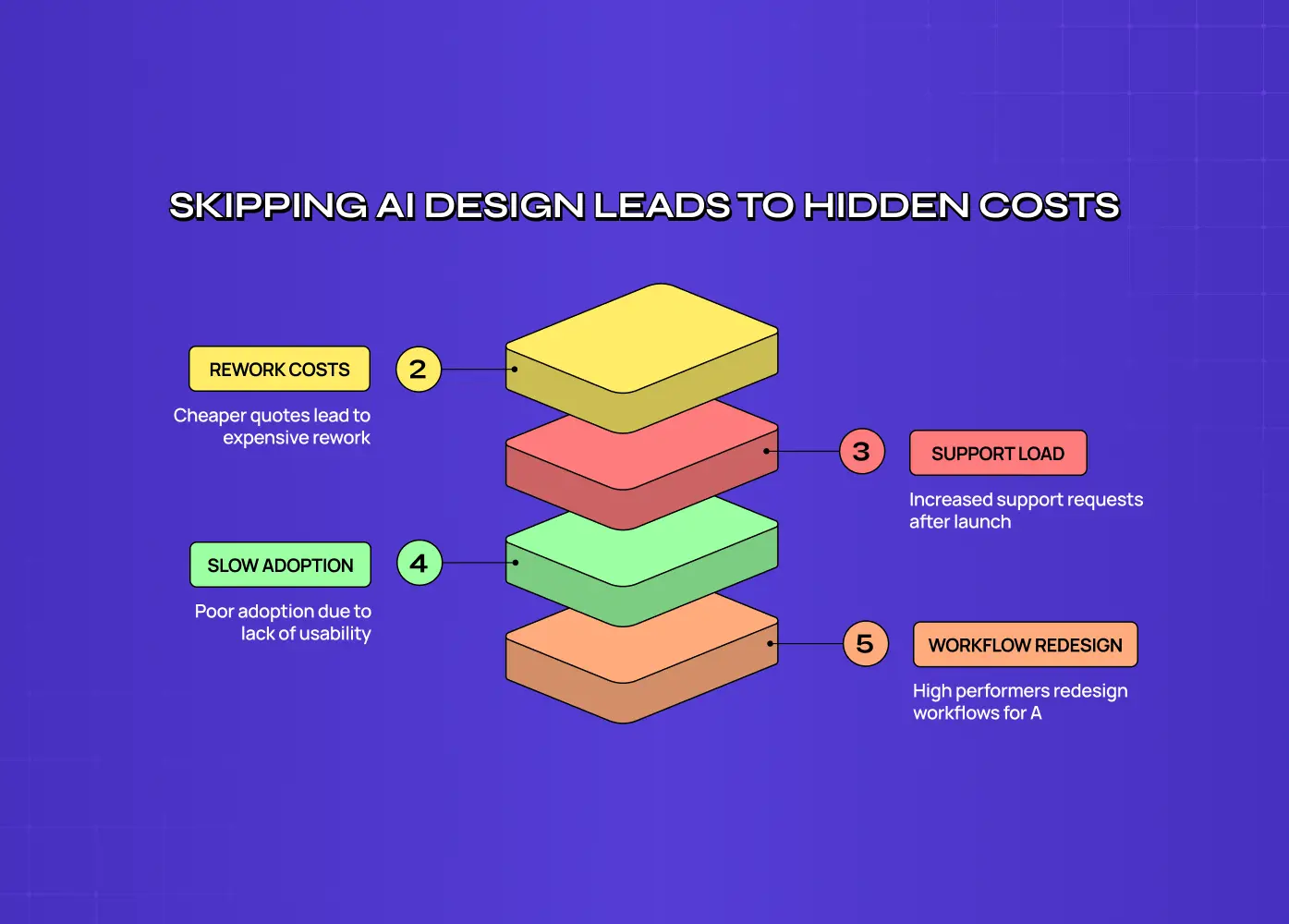
Layered diagram showing the hidden costs of skipping AI design: rework costs when cheaper quotes lead to expensive rework, increased support load after launch, slow adoption caused by poor usability, and workflow redesign that high performers invest in.

The cheapest AI design quote often becomes the most expensive decision. Quotes that leave out discovery with real model outputs, usability testing, design system components and post-handoff QA look lower up front, then cost more in rework, support load and slow adoption after launch.

The broader data points the same way. Gartner's January 2026 analysis found over half of GenAI projects were abandoned after proof of concept, with poor adoption and change management among the causes. McKinsey's latest State of AI survey found only 37% of respondents attribute enterprise-level EBIT impact to AI, while the small group of high performers stand out for redesigning workflows rather than bolting tools onto existing ones.

Budget for these four items explicitly:

1. Discovery with real outputs: 1–3 weeks.

2. Two rounds of usability testing: 1–2 weeks each.

3. Design system components for AI states: ask for these as a separate line item so you can see what they cost.

4. Design QA after handoff: a few days per release, especially for streaming and loading states.

Conclusion: How to Set Your Budget

  • Match the budget to the feature type. Assist, converse, act and orchestrate each carry a different range. Don't fund an agent at assist prices.

  • Compare quotes on the four drivers, not on screen count or hourly rate alone.

  • Protect the items that get cut first: discovery with real outputs, testing and QA.

If you're weighing quotes right now, book a 30-minute call with us. Bring the proposals, and we'll help you check what each one covers against the four drivers, even if we're not the right partner for the build.

Three agency quotes for the same AI feature can differ by five times. This guide explains what drives AI product design cost in 2026, what each type of feature typically costs, and how to compare proposals.

How to budget for AI product design and compare agency quotes.

Illustration of a robot holding a dollar coin in front of a browser window containing an image block and text lines, surrounded by a megaphone, a heart, a share icon and a target with an arrow in the bullseye.

TL;DR

  • US design agencies typically bill $100–$149 an hour, according to Clutch's September 2026 data.

  • AI product design cost ranges from about $15K–$40K for an assist feature to $150K–$300K+ for a multi-agent platform.

  • The main cost driver is how unpredictable the AI's output is and what it can change, not the number of screens.

  • Quotes that skip testing with real model outputs look cheaper and usually cost more after launch.

AI product design cost is usually the question that arrives right after the model works. Your team has a working demo, the board wants a launch date, and three agency quotes land on your desk: $30,000, $85,000 and $160,000. Each lists slightly different deliverables, and none explains why the numbers differ.

Most pricing guides won't help you decide. They price AI work like a marketing site or a SaaS dashboard, by hourly rate and page count. For an AI feature, the screens are the smallest part of the work.

This guide is for CTOs and founders budgeting design for a new AI feature or AI-native product. It covers current market rates, what each type of AI feature typically costs, the four drivers to check in any quote, how engagement models compare, and what skipping design tends to cost later. Figures are directional for 2026, so pressure-test them against your own scope.

AI Product Design Cost in 2026: The Short Answer

AI product design cost in 2026 typically ranges from $15,000 for a single assist feature to $300,000 or more for a multi-agent platform with admin controls. US agencies usually bill $100–$149 an hour. The spread comes from how much unpredictable behavior the design has to handle, not from the number of screens.

The market baseline comes from Clutch's UI/UX pricing guide, updated in September 2026 from verified client reviews. It puts the average UX project at roughly $85,000, with most projects between $10,000 and $50,000. US, Canadian and Australian agencies sit in the $100–$149 hourly band, while agencies in India, Ukraine and the Philippines typically bill $25–$49.

Those averages mix websites, mobile apps and redesigns with AI products, so treat them as a floor for comparison, not a budget. If you're rebuilding an existing product rather than adding a new AI capability, our guide to what a SaaS UX redesign costs is the better starting point.

Want to know where your users are dropping off?

We’ll break down the exact moments users lose interest, and why.

Why AI Features Cost More to Design Than Standard SaaS Screens

Prism diagram showing how AI features increase SaaS design costs, splitting dynamic, unpredictable outputs into five cost areas: engineering cost for real model outputs, trust signals such as confidence indicators, output states covering multiple response scenarios, correction flows for user feedback, and oversight through approvals and audit trails.

A standard SaaS screen behaves the same way every time.

Your designer can specify the main path, an empty state and an error state, and your engineers build to that spec.

An AI feature returns different output for the same input. It can be right, partly right, confidently wrong, slow or empty, and each of those cases needs a designed response. That's where the extra hours go:

  • Output states. Correct, partial, low-confidence, wrong, refused, empty and slow responses, including streaming.

  • Correction flows. Edit, regenerate, undo and report, plus what your system does with that feedback.

  • Trust signals. Sources, confidence indicators and review steps your users will actually act on.

  • Oversight. Approvals, permissions and audit trails once the AI can take actions.

There's an engineering cost hidden here too. Good AI design can't be done from static mockups with perfect sample answers. Your designers need real model outputs, which means your engineers need to provide a test environment, sample data and an evaluation set early. Quotes that don't mention this assume someone else will do it, usually your team.

Action check: before you request quotes, confirm your team can give a design partner access to real model outputs in week one.

AI Product Design Cost by Feature Type

AI product design cost scales with what the AI does. An assist feature that suggests and waits typically costs $15K–$40K over 4–8 weeks. A conversational copilot runs $40K–$90K. An agent that takes actions runs $80K–$180K, and a multi-agent, multi-role platform starts around $150K and can exceed $300K.

Feature type

What the AI does

Directional US range

Typical timeline

Usually included

Assist

Suggests; the user decides (summaries, autocomplete, smart defaults)

$15K–$40K

4–8 weeks

Output and error states, inline editing, light usability testing

Converse

Open-ended chat or copilot

$40K–$90K

8–14 weeks

Conversation design, sources and confidence, correction flows

Act

Takes actions with user approval

$80K–$180K

12–20 weeks

Preview before action, approvals, undo, audit trail, permissions

Orchestrate

Multiple agents, roles and admin controls

$150K–$300K+

16–28+ weeks

Role-based flows, admin controls, design system, oversight views

These ranges cover design only, not engineering, for US agency work in 2026.

A useful reference point is our work with Barista, an AI platform for PR agencies. The client arrived with wireframes and flows already done. In 10 weeks, we delivered high-fidelity design, a modular design system and a three-role structure (Super Admin, Admin, Member). Existing wireframes shortened discovery, which is one of the most reliable ways to reduce cost.

The most common budgeting mistake is buying the tier below what you're building. Gartner predicts over 40% of agentic AI projects will be canceled by the end of 2027, citing rising costs, unclear value and weak risk controls. An agent designed on an assist budget usually ships without approvals, undo or an audit trail, which is exactly the risk-control gap Gartner describes.

The Four Cost Drivers to Check in Any Quote

Screen count doesn't explain a fivefold gap between quotes. Four drivers do. We use them at Groto to scope AI work, and you can use them to compare proposals.

Driver

Question to ask

Lower cost

Higher cost

Output variability

How different can two answers be?

Fixed suggestions, short completions

Open-ended text, images, plans

Action reach

What can the AI change?

Nothing; it only suggests

Sends emails, edits records, moves money

Error cost

What happens when it's wrong?

Minor inconvenience

Legal, financial or reputational damage

Roles and oversight

Who needs to see, approve or configure it?

One user type

Admins, approvers, end users, auditors

Each driver multiplies the number of states the design has to cover. An assistant that drafts text for one role is small. An agent that updates customer records, needs manager approval and serves three roles is large, even if both have the same number of screens.

When two quotes differ sharply, ask each agency which of these four drivers they scoped. If the answer is that everything is "in the screens," the lower quote probably leaves out the states your users will hit most.

Questions for your next agency call:

1. Which output states are in scope, and which are excluded?

2. Will you test with our real model outputs or with sample content?

3. Who designs the admin and approval flows, and are they priced?

4. What happens to cost if our model changes mid-project?

Agency, Freelancer, In-House or Subscription: What Each Costs

UI UX design services cost in 2026 depends as much on the engagement model as on scope. US freelancers typically charge $50–$150 an hour, agencies $100–$149 an hour, and design subscriptions a flat monthly fee. An in-house product designer costs a median $104,000 a year in salary before benefits and hiring time.

Model

Directional 2026 US cost

Best for

Not right for

Freelancer

$50–$150/hour; $5K–$40K per project

Defined UI work on an existing design system

Discovery and multi-role AI flows

In-house designer

~$104K median salary, plus benefits and 2–4 months to hire

Continuous iteration once direction is set

A new AI product that needs research, interaction design and a design system at once

Agency project

$100–$149/hour; $15K–$300K+ per project

New AI features with a defined launch

Ongoing small requests with no scope

Subscription or retainer

Roughly $3K–$15K/month

A steady queue of design requests

Deep discovery on a complex AI product

The salary figure comes from the US Bureau of Labor Statistics, which put the median wage for web and digital interface designers at $104,000 in May 2025.

The in-house option looks cheaper on paper, but it's really a coverage question. One designer rarely covers AI interaction design, user research and a design system at the same depth, and a new AI product needs all three in the first quarter. Many teams use an agency for the initial build and hire in-house for iteration. If you're comparing ui ux design services across these models, compare what each covers against the four drivers, not just the rate.

What Skipping Design Costs You Later

Layered diagram showing the hidden costs of skipping AI design: rework costs when cheaper quotes lead to expensive rework, increased support load after launch, slow adoption caused by poor usability, and workflow redesign that high performers invest in.

The cheapest AI design quote often becomes the most expensive decision. Quotes that leave out discovery with real model outputs, usability testing, design system components and post-handoff QA look lower up front, then cost more in rework, support load and slow adoption after launch.

The broader data points the same way. Gartner's January 2026 analysis found over half of GenAI projects were abandoned after proof of concept, with poor adoption and change management among the causes. McKinsey's latest State of AI survey found only 37% of respondents attribute enterprise-level EBIT impact to AI, while the small group of high performers stand out for redesigning workflows rather than bolting tools onto existing ones.

Budget for these four items explicitly:

1. Discovery with real outputs: 1–3 weeks.

2. Two rounds of usability testing: 1–2 weeks each.

3. Design system components for AI states: ask for these as a separate line item so you can see what they cost.

4. Design QA after handoff: a few days per release, especially for streaming and loading states.

Conclusion: How to Set Your Budget

  • Match the budget to the feature type. Assist, converse, act and orchestrate each carry a different range. Don't fund an agent at assist prices.

  • Compare quotes on the four drivers, not on screen count or hourly rate alone.

  • Protect the items that get cut first: discovery with real outputs, testing and QA.

If you're weighing quotes right now, book a 30-minute call with us. Bring the proposals, and we'll help you check what each one covers against the four drivers, even if we're not the right partner for the build.

Have a project in mind?

Let’s talk through your idea and see what makes sense.

Harpreet Singh

Founder at Groto

Have a project in mind?

Let’s talk through your idea and see what makes sense.

Harpreet Singh

Founder at Groto

FAQ

Everything you were going to ask (and a few things you didn’t know to)

Should we choose a fixed-price or time-and-materials contract for AI design?

Fixed price works when the feature type and user roles are clear before work starts. Time and materials, or a fixed discovery phase followed by a fixed build, is safer when the model or scope is still changing. Many teams fix discovery first, then fix the build once states are mapped.
What should we prepare before requesting quotes?

Share the feature type, user roles, access to real model outputs and any existing wireframes or design system. The more of that you provide, the less discovery an agency needs to price in. Existing wireframes alone can remove weeks from a project.
Does a design system add to the cost of an AI project?

Usually yes in the first engagement, and it pays off later. If you plan to ship several AI features, components for AI states such as loading, streaming, low confidence and errors keep each new feature cheaper and more consistent.

Can AI design tools reduce what we pay an agency?

They can speed up production work like layout variations and asset generation. They don't replace discovery, state mapping or testing with real outputs, which is where most of the cost in AI design sits.

How should we budget for design after launch?

Plan for ongoing iteration, because model updates change outputs and user behavior. A monthly retainer or a part-time in-house designer is common. Budget at least a few days of design review for each significant model or prompt change.

What happens to cost if we switch models mid-project?

Expect some rework, mainly in output states, error handling and any design built around specific response formats. Ask agencies how they handle model changes before you sign, and keep a buffer in the budget if your model choice isn't final.

Should we choose a fixed-price or time-and-materials contract for AI design?

Fixed price works when the feature type and user roles are clear before work starts. Time and materials, or a fixed discovery phase followed by a fixed build, is safer when the model or scope is still changing. Many teams fix discovery first, then fix the build once states are mapped.
What should we prepare before requesting quotes?

Share the feature type, user roles, access to real model outputs and any existing wireframes or design system. The more of that you provide, the less discovery an agency needs to price in. Existing wireframes alone can remove weeks from a project.
Does a design system add to the cost of an AI project?

Usually yes in the first engagement, and it pays off later. If you plan to ship several AI features, components for AI states such as loading, streaming, low confidence and errors keep each new feature cheaper and more consistent.

Can AI design tools reduce what we pay an agency?

They can speed up production work like layout variations and asset generation. They don't replace discovery, state mapping or testing with real outputs, which is where most of the cost in AI design sits.

How should we budget for design after launch?

Plan for ongoing iteration, because model updates change outputs and user behavior. A monthly retainer or a part-time in-house designer is common. Budget at least a few days of design review for each significant model or prompt change.

What happens to cost if we switch models mid-project?

Expect some rework, mainly in output states, error handling and any design built around specific response formats. Ask agencies how they handle model changes before you sign, and keep a buffer in the budget if your model choice isn't final.

More Articles

Extreme close-up black and white photograph of a human eye

Let’s bring your vision to life

Tell us what's on your mind? We'll hit you back in 24 hours. No fluff, no delays - just a solid vision to bring your idea to life.

Profile portrait of a man in a white shirt against a light background

Harpreet Singh

Founder and Creative Director

Get in Touch

Extreme close-up black and white photograph of a human eye

Let’s bring your vision to life

Tell us what's on your mind? We'll hit you back in 24 hours. No fluff, no delays - just a solid vision to bring your idea to life.

Profile portrait of a man in a white shirt against a light background

Harpreet Singh

Founder and Creative Director

Get in Touch

Extreme close-up black and white photograph of a human eye

Let’s bring your vision to life

Tell us what's on your mind? We'll hit you back in 24 hours. No fluff, no delays - just a solid vision to bring your idea to life.

Profile portrait of a man in a white shirt against a light background

Harpreet Singh

Founder and Creative Director

Get in Touch