Choosing between a local vs remote design agency comes down to your budget, timeline, and how much real-time alignment your project needs. This guide breaks down true costs, collaboration trade-offs, and a simple framework to help you decide with confidence.
Local vs remote design agency: real costs, trade-offs, and how to choose.

If you're comparing a local vs remote design agency for your next product build, the decision usually comes down to four things: budget, timeline, how much real-time alignment your project needs, and how much internal leadership you have to run a distributed engagement. This guide walks through both models honestly, including real costs and trade-offs, so you can pick the one that actually fits how your team works.
TL;DR
Local buys you the room. In-person alignment is strongest when your project is ambiguous, politically complex, or workshop-heavy.
Remote buys you reach and savings. Expect 30 to 50 percent lower project costs and access to a wider talent pool.
Cost isn't the real comparison. Price the total cost to a shipped outcome, not the hourly rate.
Your stage matters more than geography. Early-stage, growth-stage, and enterprise teams tend to need different models.
Hybrid is what most SaaS teams actually want. Remote-first economics with in-person moments at the phases that need them.
Once you've settled the agency vs in-house question, you're ready to hire a design agency, and almost immediately you hit a fork in the road: do you find someone local you can meet in person, or do you go remote and open up the entire market? It feels like a simple question, especially if you're still getting up to speed on UI/UX design basics. It isn't. Choosing wrong can mean overpaying by tens of thousands of dollars. Or, just as painfully, saving money on a remote team that quietly stalls because no one is truly steering the project.
Here's the honest verdict up front: the choice between a local vs remote design agency depends far less on geography than on your operating model, your budget, your timeline, how much alignment your project needs, and whether you have the internal leadership to run a distributed engagement. This guide breaks down the real pros, cons, and costs of each, introduces the hybrid model that most modern product teams actually end up wanting, and gives you a framework to decide with confidence.
The quick comparison
Factor | Local design agency | Remote design agency |
Typical hourly rate | $75 – $200 | $25 – $75 |
Project cost | Higher (overhead baked in) | 30–50% lower on average |
Collaboration | Face-to-face, real-time | Asynchronous, tool-driven |
Talent pool | Limited to your metro | Global |
Decision speed | Fast (same room) | Depends on timezone overlap |
Best when | High alignment, regulated, workshop-heavy | Defined scope, cost-sensitive, strong internal PM |
Now the nuance behind the table.
The case for a local design agency
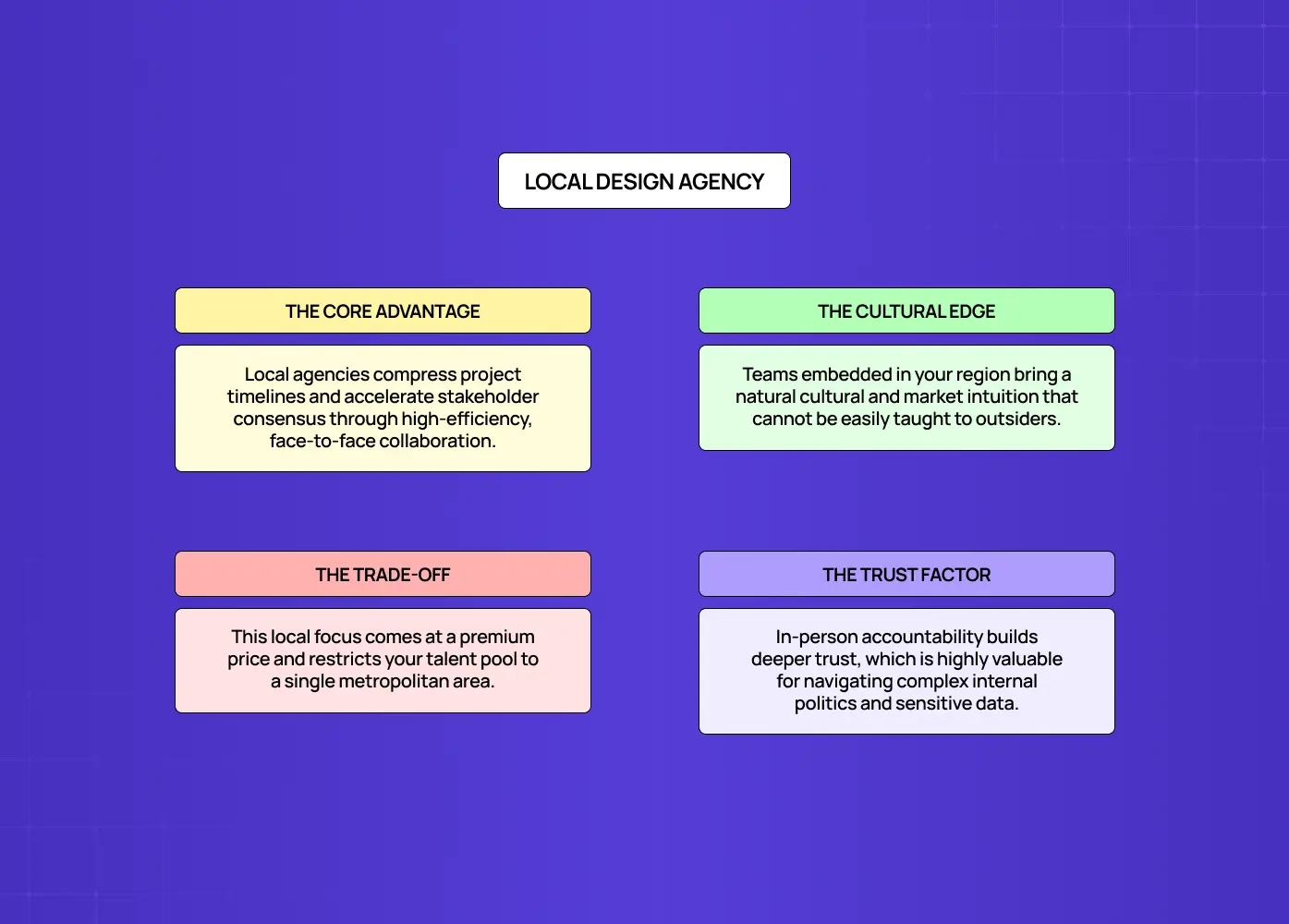
A local agency's biggest advantage is the room. When you can get stakeholders, designers, and decision-makers physically together, you compress cycles. Face-to-face meetings build trust faster, surface disagreements sooner, and turn what might be two weeks of email ping-pong into a two-hour working session. For projects with sensitive internal politics, multiple stakeholder groups, or a decision path that zigzags through committees, that in-person compression is genuinely valuable.
Local agencies also tend to carry market and cultural context. If you're designing for a specific regional audience, a team that lives in that market can bring an intuition that's hard to brief into an outsider. And there's a trust dimension that shouldn't be dismissed: for some founders and boards, being able to sit across a table from the people building their product is worth a premium.
That premium is real, though. Local agencies typically charge $75 to $200 per hour, reflecting office space, local salaries, and the cost of in-person work, with standard website projects often landing in the $3,000 to $10,000 range and product work climbing well beyond that. You're also fishing in a smaller pond: by restricting yourself to one metro, whether that's UX agencies in New York or your own city, you cut yourself off from specialists who happen to live elsewhere.
What a local agency brings to the table:
Faster consensus when stakeholders can be in the same room
Regional and cultural context that's hard to brief into an outsider
A trust dimension that comes from face-to-face accountability
Local is strongest when:
Your project needs heavy real-time alignment
The work involves regulated or sensitive data
Success depends on in-person workshops and stakeholder buy-in
The case for a remote design agency
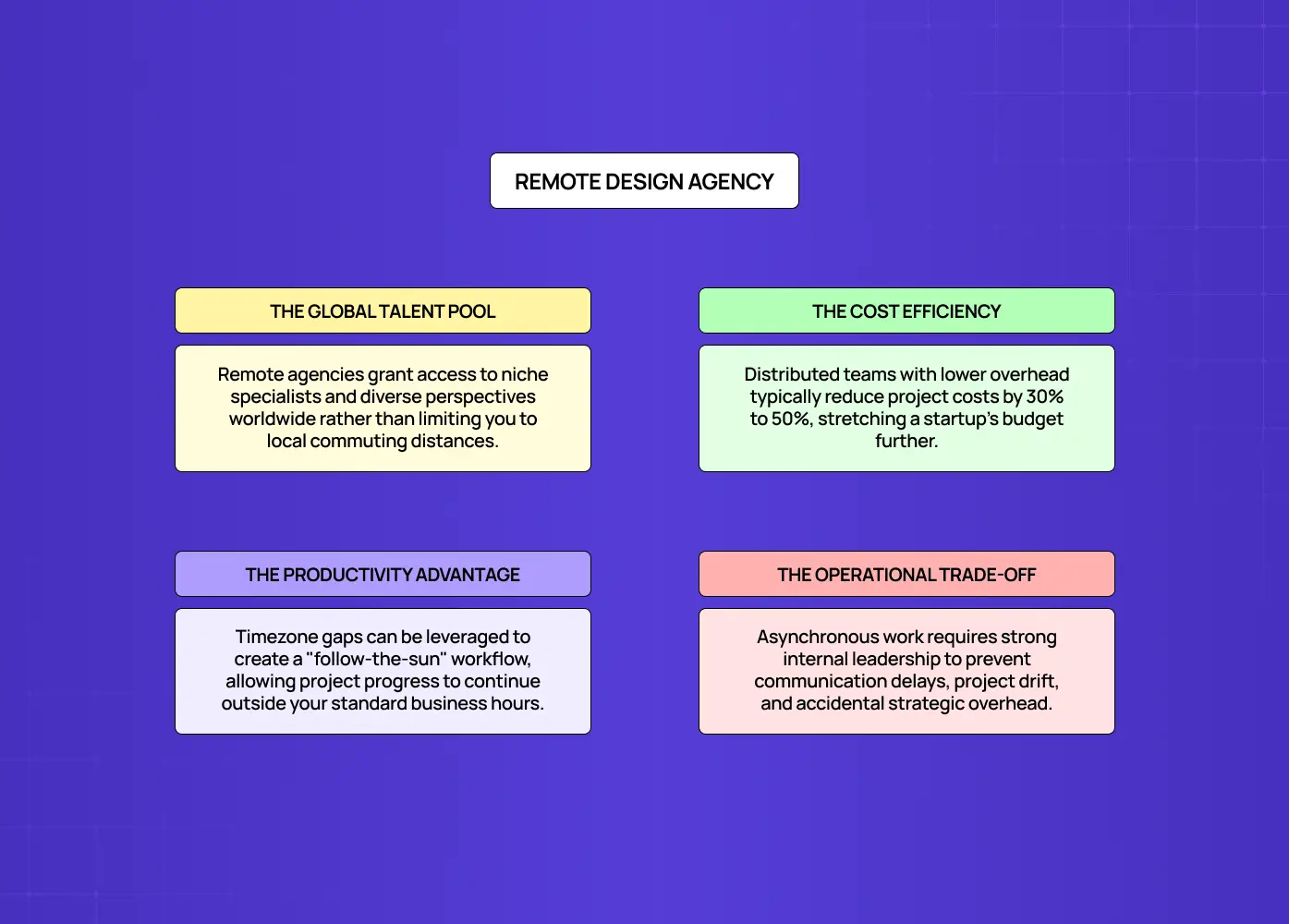
The remote model, including the design subscription agency approach, flips the equation. The headline benefit is access to a global talent pool, you're no longer limited to whoever happens to be commutable. If your product needs a specialist in fintech onboarding, healthcare UX, or a specific design system, you can find the best fit rather than the nearest one — whether that’s down the street or among Delhi-based UX studios half a world away. Shortlisting remote SaaS-design options, like Superside alternatives and Eleken alternatives, is often where that search starts. That breadth also brings diverse perspectives, which tends to produce more original thinking than a single local scene.
Then there's cost. Remote agencies commonly charge $25 to $75 per hour, largely because lower overhead and distributed teams reduce the cost base, and those savings typically translate to 30–50% lower project costs. For a startup or a lean product team, that difference can fund an entire additional sprint of work — and an AI-powered agency can shift that cost base further still, compressing with AI the same work a traditional shop bills by the hour.
Remote teams can also create a follow-the-sun advantage: work on wireframes or prototypes can progress outside your business hours, so you wake up to fresh output. Handled well, a timezone gap becomes a feature, not a bug.
The trade-offs are operational. Across large timezone gaps, feedback loops stretch, decisions slow, and small ambiguities can sit unresolved for a day at a time. The biggest risk isn't distance. It's unclear accountability. Without a strong internal owner, a remote engagement can drift, leaving your own team doing more of the strategic heavy lifting than you bargained for.
What a remote agency brings to the table:
Access to specialists you couldn't hire locally
More competitive pricing from leaner overhead
Progress that can continue outside your business hours
Remote is strongest when:
Your product direction is already defined
The project carries no specialized regulatory requirements
You have internal product leadership to manage asynchronous handoffs
Cost: what you're actually paying for

It's tempting to read the cost gap as "remote wins," but that misreads what the money buys. Our web design agency pricing guide breaks the full range down by scope. The higher local rate isn't pure overhead, it often includes strategic guidance, facilitation, and the friction-removal of being in the room. The lower remote rate can be a genuine bargain or a false economy if it means you inherit the project management, the research thinking, and the accountability that a more senior partner would have carried.
The right way to compare isn't hourly rate; it's total cost to a shipped, validated outcome, including your own team's time. A remote team at $50/hour that needs constant steering from your head of product may cost more, all-in, than a partner at $120/hour who runs the engagement end to end. Always price the outcome, not the invoice.
What a higher local rate often includes:
Strategic guidance and facilitation, not just execution hours
Fewer handoffs, since less coordination overhead sits with your team
Friction-removed alignment that comes from being in the room
What to check before trusting a lower remote rate:
Whether project management and research thinking are included, or fall back on your team
Whether the rate reflects true seniority, and the skills a UX agency must have, or a junior bench
Whether the savings still hold once you account for your own team's steering time
Does your stage change the answer?
Where you are as a company shifts the calculus. There's no universal answer, but naming your stage narrows the field quickly and stops you from copying a hiring model that suited a company nothing like yours.
Early-stage: Usually cost-sensitive and speed-driven, with product direction still forming. This favors remote or hybrid, senior enough to bring product thinking without a local premium, and some very early teams even start with a no-code design agency to move fast on a budget.
Growth-stage: Juggling multiple stakeholders and a maturing product. Often benefits most from hybrid: remote economics for the bulk of the work, in-person for strategic inflection points.
Enterprise: Especially in regulated sectors, may genuinely need local or on-site partners for compliance, security, and stakeholder alignment at scale.
The reality of communication and collaboration

Every comparison eventually comes down to communication, so be honest about your own setup. Local collaboration shines when your project is ambiguous and needs frequent, high-bandwidth conversation to reach clarity, early-stage discovery, contentious redesigns, and workshop-driven strategy all benefit from a shared room. Remote collaboration — and design outsourcing more broadly — shines when scope is clear and work can move in well-defined async chunks, provided both sides are disciplined about documentation, written updates, and overlapping hours.
The deciding question is rarely "how far away are they?" It's "how much real-time alignment does this specific project need, and do we have the internal habits to run it remotely?" A team already fluent in async tools and written communication will barely feel the distance. A team that relies on hallway conversations and live decisions will struggle with a fully remote partner nine timezones away, no matter how talented that partner is.
Local collaboration tends to work best for:
Ambiguous projects that need frequent, high-bandwidth conversation
Early-stage discovery and contentious redesigns
Workshop-driven strategy sessions
Remote collaboration tends to work best for:
Clear scope that can move in well-defined async chunks
Teams disciplined about documentation and written updates
Teams with genuine overlapping hours for live decisions
The hybrid model: why you may not have to choose
Here's what the local-vs-remote framing misses: the best modern agencies aren't strictly one or the other. The model most product teams actually want is remote-first with intentional in-person moments, a distributed team that brings the cost, talent access, and flexibility of remote work, but runs targeted real-time workshops for the phases that need them: kickoff, discovery, and major design reviews.
This hybrid approach is how Groto works. We're rooted in Toronto but operate as a remote-first partner across North America, which means clients get senior product-design talent and competitive pricing without giving up the high-bandwidth alignment that in-person and live sessions provide when it counts. Seeing how agencies build products across those phases makes the hybrid logic click. You get the global-talent economics of remote and the alignment benefits of local, sequenced so each shows up where it adds the most value. For most SaaS and product teams, that's the answer the binary question was pointing at all along.
What a hybrid model typically looks like:
Remote-first for day-to-day design and production work
In-person or live sessions reserved for kickoff, discovery, and major design reviews
Global-talent economics paired with the alignment benefits of local
4 myths that distort the decision
A lot of the local-vs-remote anxiety comes from assumptions that no longer hold. Clearing them makes the choice easier.
Myth 1: "Remote means offshore and low quality." Remote and offshore aren't synonyms, though offshore options like UX design agencies in India are one remote pathway. A remote-first agency can be senior, native to your language and market, and in a compatible time zone. It simply doesn't require you to be in the same city. Quality tracks the team's talent and process, not their office location.
Myth 2: "Local means better communication." Proximity guarantees nothing. Plenty of local engagements stall in unread email threads, while well-run remote teams communicate more clearly because distance forces them to document decisions and write things down. Discipline beats proximity.
Myth 3: "You can't run design workshops remotely." Modern collaborative tools have made remote discovery sessions, whiteboarding, and design reviews genuinely effective. In-person still wins for the highest-stakes alignment, but the gap has narrowed dramatically, and hybrid partners bring in-person to exactly those moments.
Myth 4: "Cheaper remote work always saves money." Only if the engagement is well managed. A low rate that comes with weak accountability shifts hidden costs onto your internal team. The savings are real when the remote partner is senior enough to own the work, and illusory when they aren't.
Questions to ask before you hire either model
Whichever direction you lean, these questions cut through the sales pitch and reveal how an agency actually operates.
Team and location: Who specifically will work on your project, and where are they based?
Communication: How do they run communication, and what does their feedback turnaround look like?
Alignment process: How do they handle discovery, and does it include in-person or live workshops for the phases that need them?
Ownership: What are you responsible for versus what a design agency owns?
Proof: What outcomes can they show from similar work, not just screenshots? Knowing how to evaluate a portfolio helps here.
The answers matter more than the agency's postal code. A remote team with crisp communication and clear ownership will outperform a local team without them, and vice versa.
A simple decision framework
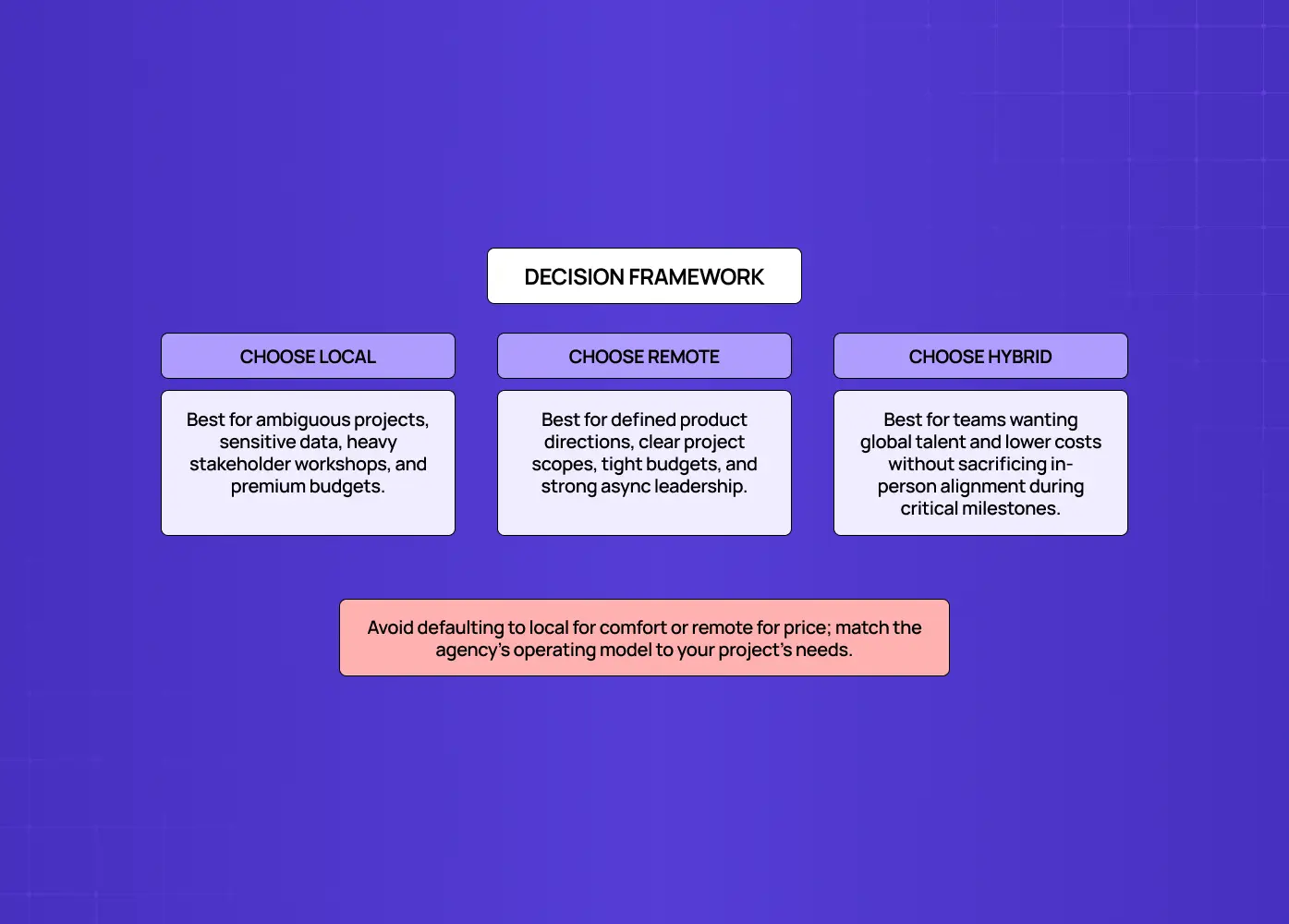
Still deciding? Run your project through these questions, or work through our fuller guide to choosing the right agency.
Choose a local agency if:
Your work is highly ambiguous and needs frequent in-person alignment
You handle regulated or sensitive data with residency or security requirements
Your process depends on workshops and stakeholder buy-in that only happen well in a shared room
Your budget can absorb the premium
Choose a remote agency - and a shortlist of US-based agencies is a strong place to start — if:
Your product direction is already defined
Your scope is clear
You're cost-sensitive
You have an internal product owner who can manage async handoffs
Choose a hybrid partner if:
You want the cost and talent advantages of remote
You're not willing to sacrifice alignment on the moments that matter
This describes most SaaS teams building or scaling a product today
The worst choice is defaulting to "local because it feels safer" or "remote because it's cheaper" without matching the model to your actual project. Geography is a proxy; operating model is the real variable.
Conclusion
The local vs remote design agency debate is really a question about how you work best, how much alignment your project needs, what your budget can support, and whether you have the internal leadership to run a distributed engagement.
Local buys you the room.
Remote buys you reach and savings.
A hybrid partner, done right, buys you both.
If you want a remote-first product design partner that shows up in person and in real time when it counts, book a discovery call with Groto. We'll talk through your product, your team, and the model that will actually get you to a shipped result. No jargon, no pressure.