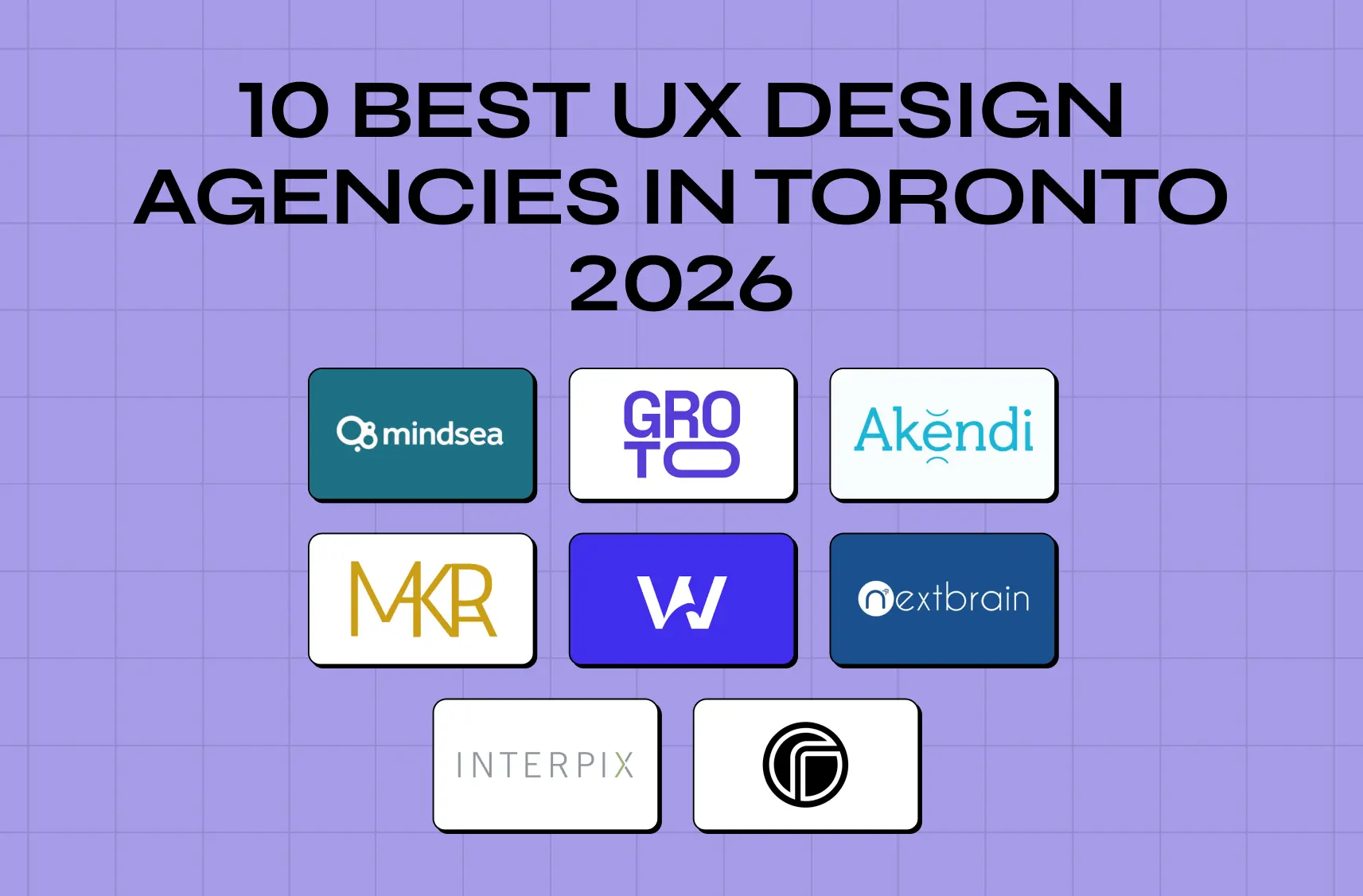
10 Best UX Design Agencies in Toronto (2026): The Honest Shortlist for Founders & Product Teams

10 Best UX Design Agencies in Toronto (2026): The Honest Shortlist for Founders & Product Teams

An honest, criteria-first shortlist of the best UX design agencies in Toronto for 2026, with real pricing, selection questions, and FAQs to help you choose.

10 Best UX Design Agencies in Toronto (2026): The Honest Shortlist for Founders & Product Teams

10 Best UX Design Agencies in Toronto (2026): The Honest Shortlist for Founders & Product Teams

An honest, criteria-first shortlist of the best UX design agencies in Toronto for 2026, with real pricing, selection questions, and FAQs to help you choose.

The first page of Google ranks UX design agencies in Toronto by who paid for placement, not who ships good work. This guide breaks that pattern down: ten real contenders, transparent pricing, and the exact questions that reveal a genuine design partner.

The honest shortlist of Toronto's best UX design agencies, ranked by outcomes, not placement fees.

TL;DR

  • Groto tops this list of the best UX design agencies in Toronto for 2026, chosen because it ties design work to measurable product outcomes instead of just shipping screens.

  • The shortlist covers 10 agencies across SaaS, enterprise research, accessibility, mobile health, and web3, so you can match a partner to your stage and industry.

  • Toronto UX pricing in 2026 runs from about $3,000 for a focused project to $150,000+ for enterprise engagements with research and testing.

  • Use the 6 questions in this guide on your first call. They separate a real design partner from an expensive one.

A UX design agency in Toronto is the partner most SaaS founders and product teams bring in to turn research, user flows, and interface design into a product people actually want to use. Toronto's design market is crowded, ranging from boutique studios to global firms, so the real work is separating agencies that ship measurable outcomes from agencies that just ship screens. This guide breaks down the best UX design agencies in Toronto for 2026, what they cost, and exactly how to choose the right agency for your stage and budget.

Here's the uncomfortable truth about hiring a UX design agency in Toronto: the wrong choice doesn't just cost you a design fee. It costs you a launch window, a round of engineering rework, and sometimes a product-market fit you never quite reach because users bounced before they understood what you built. UX design is one of the highest-leverage investments a product company makes, and one of the easiest to get wrong.

If you're a founder, product manager, or CTO searching for a UX design agency in Toronto, you've probably already noticed the problem: the first page of Google is a wall of directories and "top 10" lists that rank agencies by who paid for placement, not by who actually ships good work. So we did something different. Below is an honest, criteria-first shortlist of the ten best UX design agencies in Toronto for 2026. It's followed by exactly how to choose between them, what you should expect to pay, and the questions that separate a real design partner from an expensive one.

Let's get into it.

What makes a great UX design agency (the criteria we used)

Before the list, here's the lens. A strong UX design agency in Toronto should demonstrate five things:

  • Research-led process. Not just pretty screens.

  • Measurable outcomes. Task completion, conversion, and retention, not just "we redesigned it."

  • Relevant industry experience. SaaS, fintech, healthtech, marketplaces.

  • Engineering-aware design. Work that survives contact with real developers.

  • Transparent pricing and scope.

For most Series A and earlier SaaS companies, the agency vs. in-house decision usually favors an agency on speed and range.

Why does this matter so much? 

Because UX is where most of a product's economics are quietly decided. A confusing onboarding flow doesn't announce itself. It just shows up as a lower activation rate three months later. A checkout with one too many steps doesn't throw an error. It shows up as abandoned carts. The Nielsen Norman Group has spent decades documenting the return on usability investment, and the pattern is consistent: fixing experience problems early is dramatically cheaper than fixing them after launch. The right UX design agency in Toronto is, in effect, an insurance policy against expensive rework, provided you pick one whose process actually surfaces those problems before your engineers build them.

Why hire a UX design agency in Toronto specifically?

Toronto is one of North America's densest talent markets for product design. The city's overlap of a mature startup ecosystem, a large enterprise base (finance, insurance, telecom), and top-tier design schools means local agencies have unusually deep benches. Hiring locally also buys you time-zone alignment, easier in-person workshops for discovery and stakeholder alignment, and teams that understand Canadian regulatory realities, including accessibility legislation, bilingual requirements, and privacy expectations, that offshore shops often miss. For many founders, a Toronto-based partner is the sweet spot between the cost of a US coastal agency, like those in the San Francisco Bay Area, and the coordination cost of a fully offshore team.

In short:

  • Time-zone alignment for daily collaboration, not overnight handoffs.

  • Easier in-person workshops for discovery and stakeholder alignment.

  • Built-in understanding of Canadian accessibility, bilingual, and privacy requirements.


1. Groto: Best overall UX design agency in Toronto for SaaS & startups
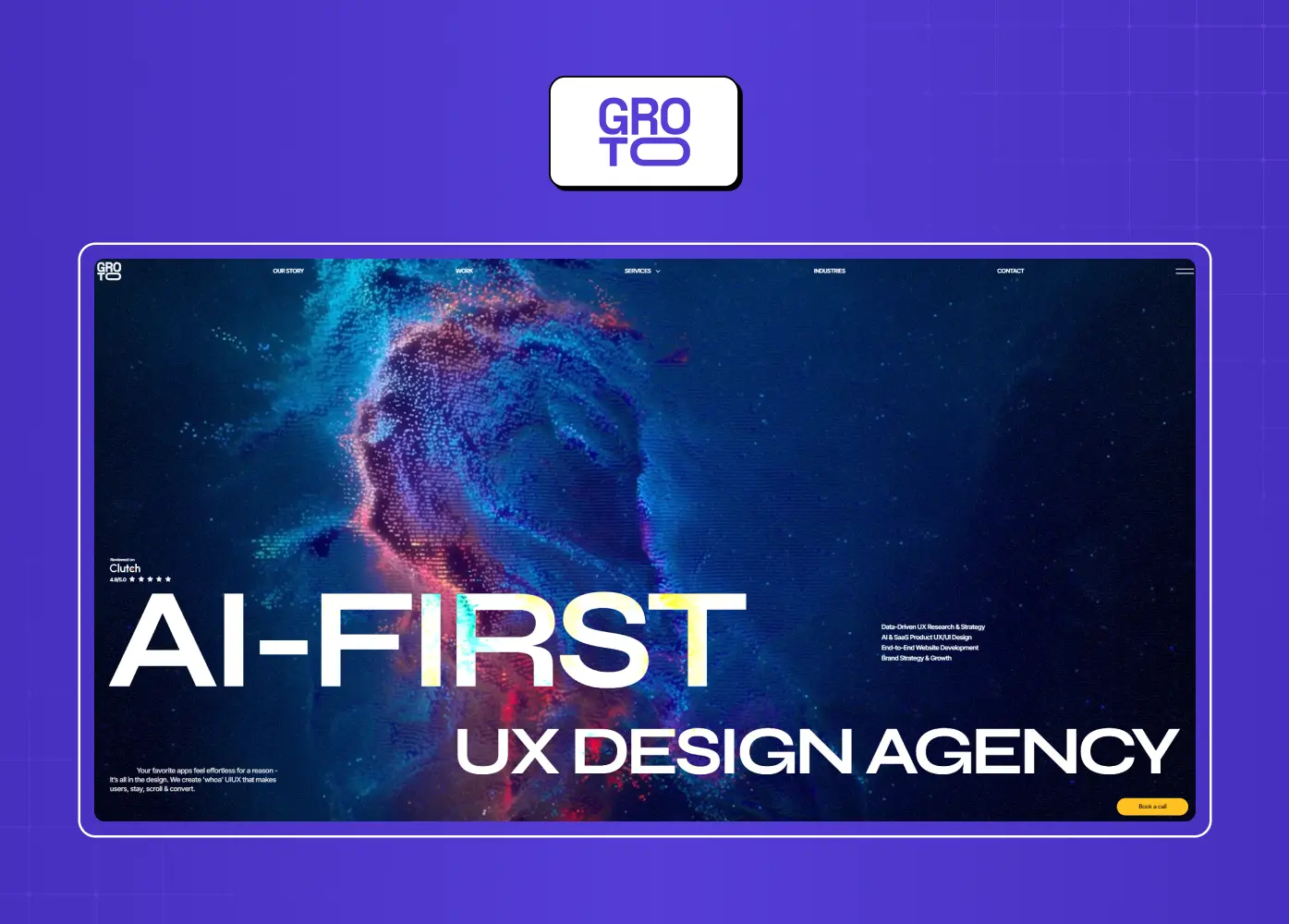
Homepage of Groto, an AI-first UX design agency, featuring a bold futuristic visual with large typography emphasizing AI-driven product design.

Groto leads this list because it does the thing most agencies only claim to do: tie design decisions to product outcomes. Groto is a Toronto-based UX and product design agency built for SaaS companies, startups, and VC-backed teams that need to move fast without shipping guesswork. The team pairs user research and data with high-craft UI, so the design that lands in your codebase is validated, accessible, and ready to convert.

What sets Groto apart is the operating model: discovery and execution are treated as distinct phases, so you're never paying for polish before the problem is understood. For founders weighing MVP design, a SaaS platform redesign, or a full UX design services engagement, Groto offers the rare combination of startup speed and enterprise rigor.

Known for:

  • Ties design decisions to product outcomes, not just visuals

  • Separates discovery and execution into distinct phases

  • Works with SaaS companies, startups, and VC-backed teams

  • Case study: PolicyBazaar (link to letsgroto.com/projects/policybazaar). We redesigned mobile and web insurance shopping flows to reduce drop-offs and boost sign-ups.

  • Best for: SaaS UX design, MVP design, and product teams that want measurable results, not just mockups

Want to know where your users are dropping off?

We’ll break down the exact moments users lose interest, and why.

Want to know where your users are dropping off?

We’ll break down the exact moments users lose interest, and why.

2. Akendi: Best for enterprise research & usability testing
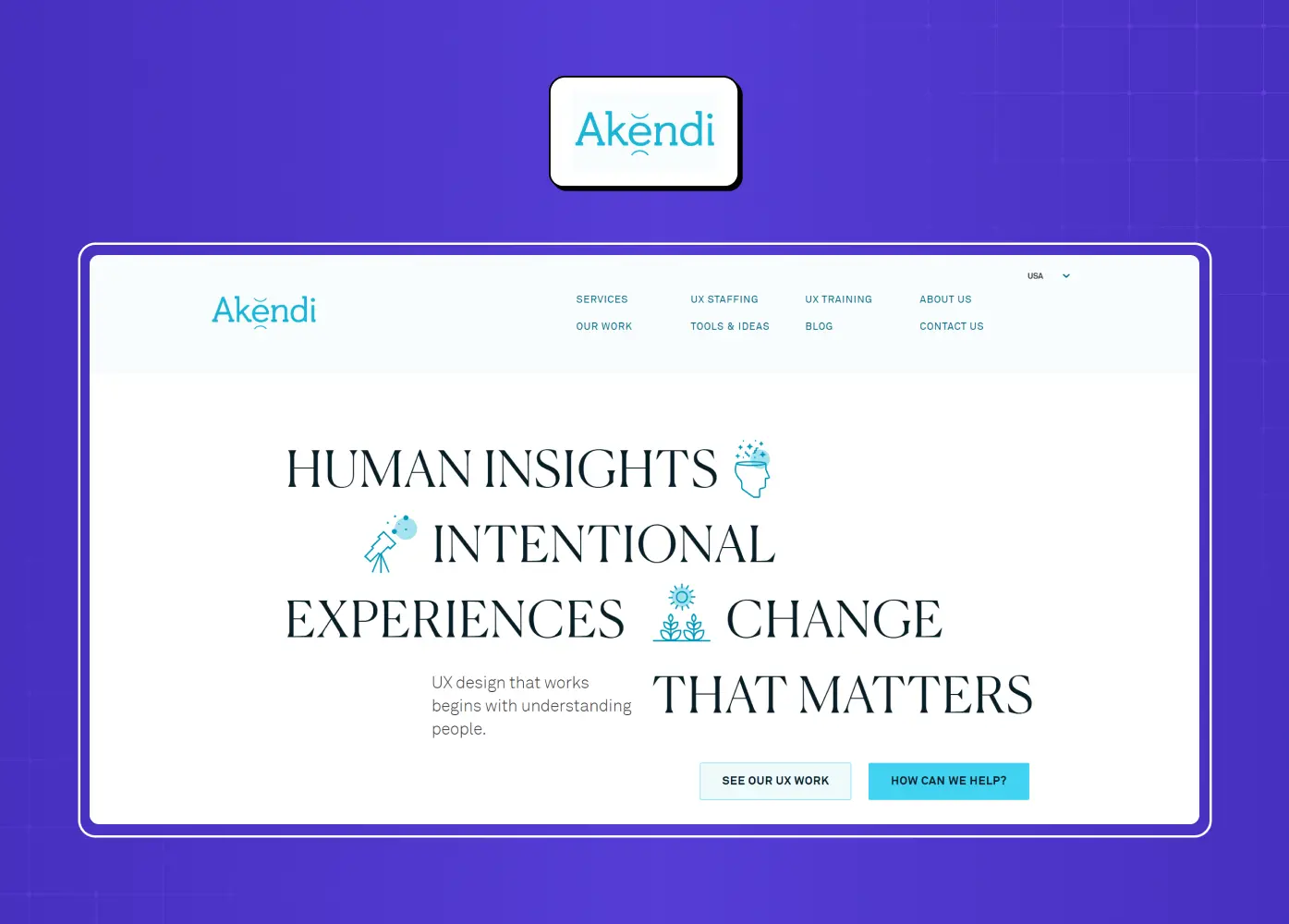
Akendi homepage highlighting a human-centered UX approach with clean typography and messaging focused on intentional, insight-driven experiences.

Akendi is one of Toronto's longest-running UX design agencies, with a research-heavy practice spanning UX strategy, user research, digital product design, and usability testing across offices in Toronto and Ottawa. If your project lives or dies on rigorous, evidence-based research, think regulated industries or large-scale enterprise platforms, Akendi's depth is a strong fit.

Known for:

  • Research-heavy practice spanning UX strategy, user research, and usability testing

  • Offices in Toronto and Ottawa

  • Strong fit for regulated industries and large-scale enterprise platforms

  • Best for: enterprises that need formal research and usability testing at scale

3. Wavespace: Best for accessibility-first SaaS design

Landing page for Wavespace showcasing UX design services with a minimal layout, bold headline, client logos, and product interface preview.

Wavespace is a UI/UX design and consulting agency in Toronto crafting digital products for SaaS, AI, startups, enterprise, and VC-backed teams. Their calling card is an accessibility-first, data-driven approach that optimizes usability while meeting WCAG 2.1 AA standards, increasingly non-negotiable for products serving public-sector or enterprise buyers.

Known for:

  • Accessibility-first, data-driven approach

  • Meets WCAG 2.1 AA standards

  • Works across SaaS, AI, startups, enterprise, and VC-backed teams

  • Best for: teams that need compliance-grade accessibility baked in from day one

4. Mindsea: Best for mobile & digital health products
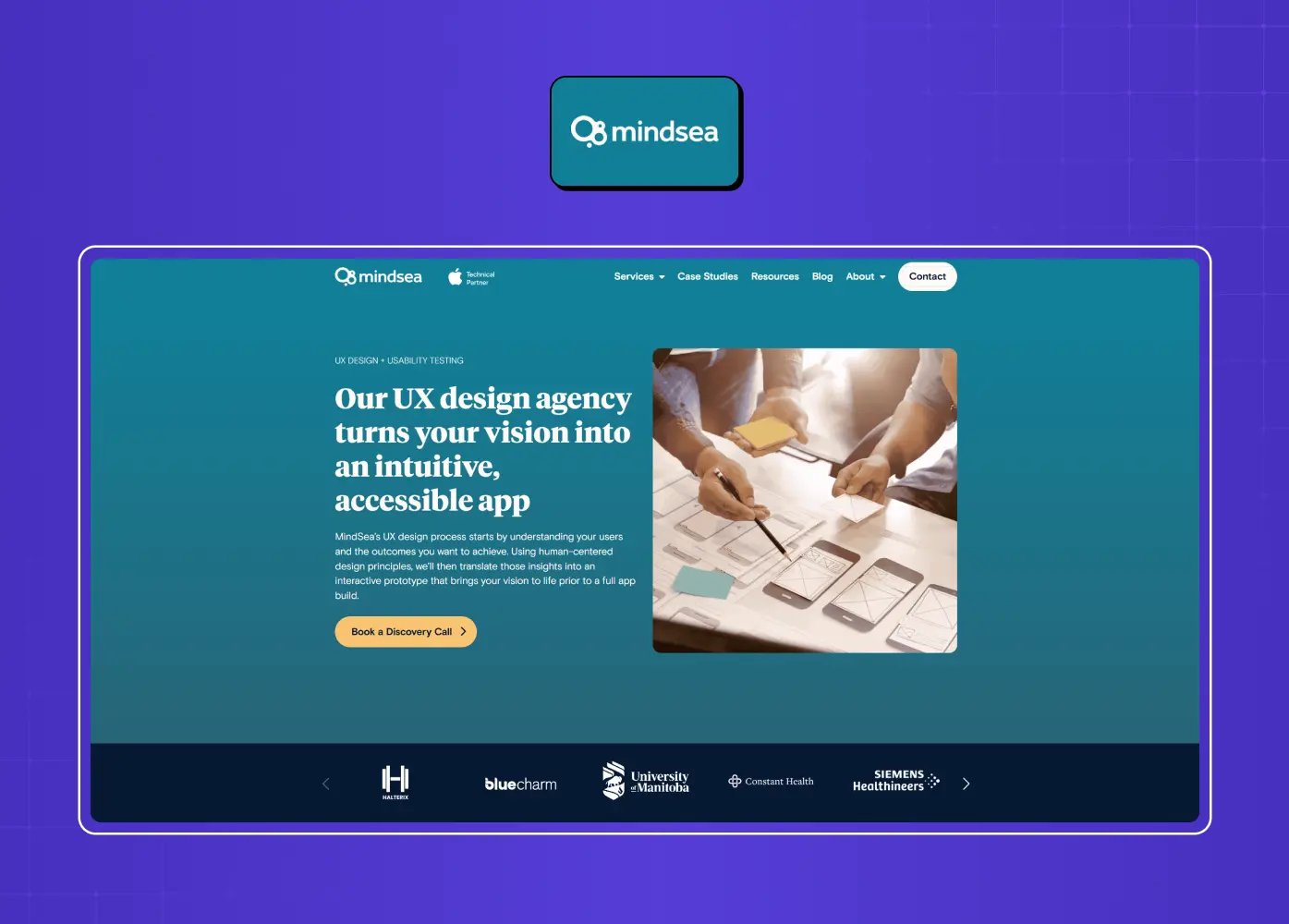
Mindsea agency homepage featuring a teal-themed hero section with team collaboration imagery and messaging about building intuitive digital products.

Mindsea brings a distinctly Canadian touch to mobile strategy, product design, and development, with a notable emphasis on digital health solutions. If your product is mobile-first, or you're operating in a space where trust, privacy, and clinical usability matter, Mindsea's specialization is hard to match.

Known for:

  • Mobile strategy, product design, and development

  • Notable emphasis on digital health solutions

  • Best for: mobile apps and healthtech products

5. Nextbrain Technologies: Best for full-stack design-and-build
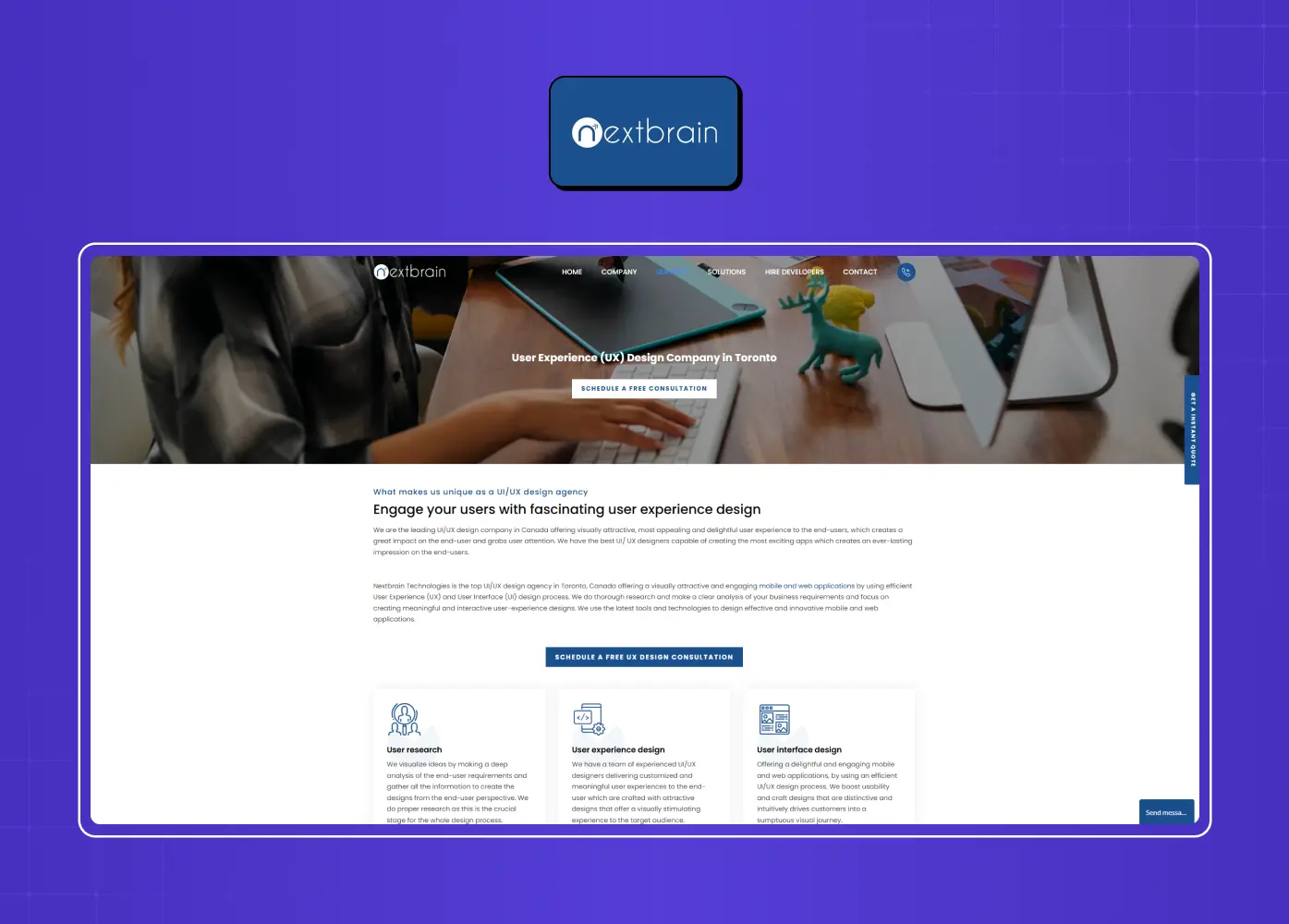
UX design agency homepage with a workspace hero image, service overview, and feature cards introducing research, UI design, and usability services.

Nextbrain positions itself as a top UI/UX design agency in Toronto offering visually engaging mobile and web applications through an efficient end-to-end UX and UI process. Teams that want design and development under one roof, reducing handoff friction, should shortlist them.

Known for:

  • End-to-end UX and UI process

  • Design and development under one roof

  • Best for: clients who want design and engineering from a single vendor

6. Interpix Design: Best for established, Toronto-rooted UX craft

Interpix homepage promoting over 30 years of UX and UI expertise, featuring recent project showcases and a clean, minimalist layout.

Interpix is a Toronto-based UX design agency with a long track record of user-centered design work. For companies that value a stable, senior team over a churn-heavy shop, Interpix's longevity is a signal worth weighing.

Known for:

  • Long track record of user-centered design work

  • Stable, senior team over a churn-heavy shop

  • Best for: organizations prioritizing experience and continuity

7. Makra Digital: Best for UX-focused web design & conversion

Dark-themed agency homepage with a DNA-inspired visual, highlighting web development services through bold typography and high-contrast design.

Makra Digital is a UX-focused web design agency in Toronto that builds responsive, intuitive designs engineered to retain and convert visitors. If your primary goal is a marketing site or web experience that turns traffic into pipeline, Makra's conversion orientation fits the brief. It's a useful option if a broader web design agency in Toronto is really what you need.

Known for:

  • UX-focused web design agency

  • Builds responsive, conversion-engineered sites

  • Best for: conversion-driven websites and landing experiences

8. Roobinium: Best for web and web3 product design

Vibrant Web3 agency homepage featuring neon visuals, team portraits, and messaging around crypto, NFT, and metaverse design services.

Roobinium is a UX/UI design and development company in Toronto with expertise spanning web and web3. For teams building in emerging spaces, including wallets, dApps, and token-gated products, an agency that already understands those patterns saves months of ramp-up.

Known for:

  • Expertise spanning web and web3

  • Experience with wallets, dApps, and token-gated products

  • Best for: web3 and emerging-tech products

9. A specialist boutique (freelance-collective model)

Toronto has a healthy layer of small boutique studios and senior freelance collectives that take on focused engagements, whether that's a single flow, a design system, or a discovery sprint. They can be excellent value for narrow scopes, though capacity and continuity are the trade-offs. Best for: well-defined, limited-scope projects on a tighter budget.

10. Global agencies with a Toronto presence

Finally, several international UX firms serve Toronto clients remotely or through local teams. They bring brand-name process and cross-market benchmarks, usually at the top of the price range. If your search extends past Toronto, it's worth comparing agency scenes in New York, Los Angeles, Seattle, and Chicago against the same criteria. Best for: large enterprises that want a globally recognized partner and have the budget to match.

How much does a UX design agency in Toronto cost? (2026)

Pricing is the question every founder asks and few listicles answer. For the wider picture beyond Toronto, our web design agency pricing guide breaks down the full range. Here's the real range for the Toronto market in 2026.

Engagement type | Typical cost (CAD) Hourly agency rate | $90 – $160 / hour Focused / limited-scope project | $3,000 – $15,000 Landing page or feature redesign | $15,000 – $30,000 SaaS product or end-to-end website | $40,000 – $120,000 Enterprise product suite (research + testing + UI) | $150,000+

What moves the number:

  • Project complexity

  • Team seniority

  • Timeline urgency

  • Compliance requirements (accessibility, health, finance)

By client stage, the pattern usually looks like this: startups invest roughly $5K–$20K, SaaS products $20K–$60K, and enterprises $50K–$200K+. If an agency quotes a firm price before understanding your scope, treat that as a flag, not a feature.

When to hire a UX agency vs. build an in-house team

For many founders, a Toronto-based partner is the sweet spot between the cost of a US coastal agency, like those in the San Francisco Bay Area, and the coordination cost of a fully offshore team.

An agency wins when:

  • You need research, design, and UI capability immediately

  • You want to avoid a 3-month hiring cycle

  • You're pre-Series A or earlier

In-house starts to make sense when:

  • You have a continuous, full-time pipeline of product work

  • You're typically post-Series B

  • You want design embedded in daily standups

A common and effective middle path: hire an agency like Groto to establish the UX foundation, design system, and first validated flows, then transition to in-house designers who maintain and extend that foundation.

What a UX design engagement actually looks like

If you've never worked with a UX design agency before, or you're still fuzzy on what a UX design agency does, the process can feel like a black box. Here's the shape of a healthy engagement so you know what "good" looks like.

  • Discovery. Stakeholder interviews, a review of your analytics and support tickets, and often direct user research, to define the real problem rather than the assumed one.

  • Structure. User flows, information architecture, and low-fidelity wireframes that are cheap to change.

  • UI design. The visual layer, component library, and interaction states.

  • Validation. Usability testing and iteration.

  • Handoff. Documented components, specs, and design tokens your engineers can build from without guessing.

Notice that visuals come late in that sequence. A common failure mode with weaker agencies is jumping straight to high-fidelity screens because they demo well. Then, after your team has fallen in love with a look, they discover the underlying flow doesn't work. When you evaluate a UX design agency in Toronto, ask them to walk you through this arc on a past project. If they can't separate discovery from execution, that's a signal.

Red flags to watch for

  • Not every polished pitch hides a good process. Watch for agencies that:

  • Quote a fixed price and timeline before understanding your scope

  • Show a portfolio full of screenshots but no outcome metrics

  • Can't tell you who will actually staff your project

  • Treat accessibility as an afterthought rather than a baseline

  • Position design as a purely aesthetic exercise disconnected from your business goals

A great partner will push back on your assumptions, ask uncomfortable questions about your users, and occasionally tell you the feature you asked for isn't the one you need. That friction is a feature, not a bug.

The 6 questions that reveal a real UX partner
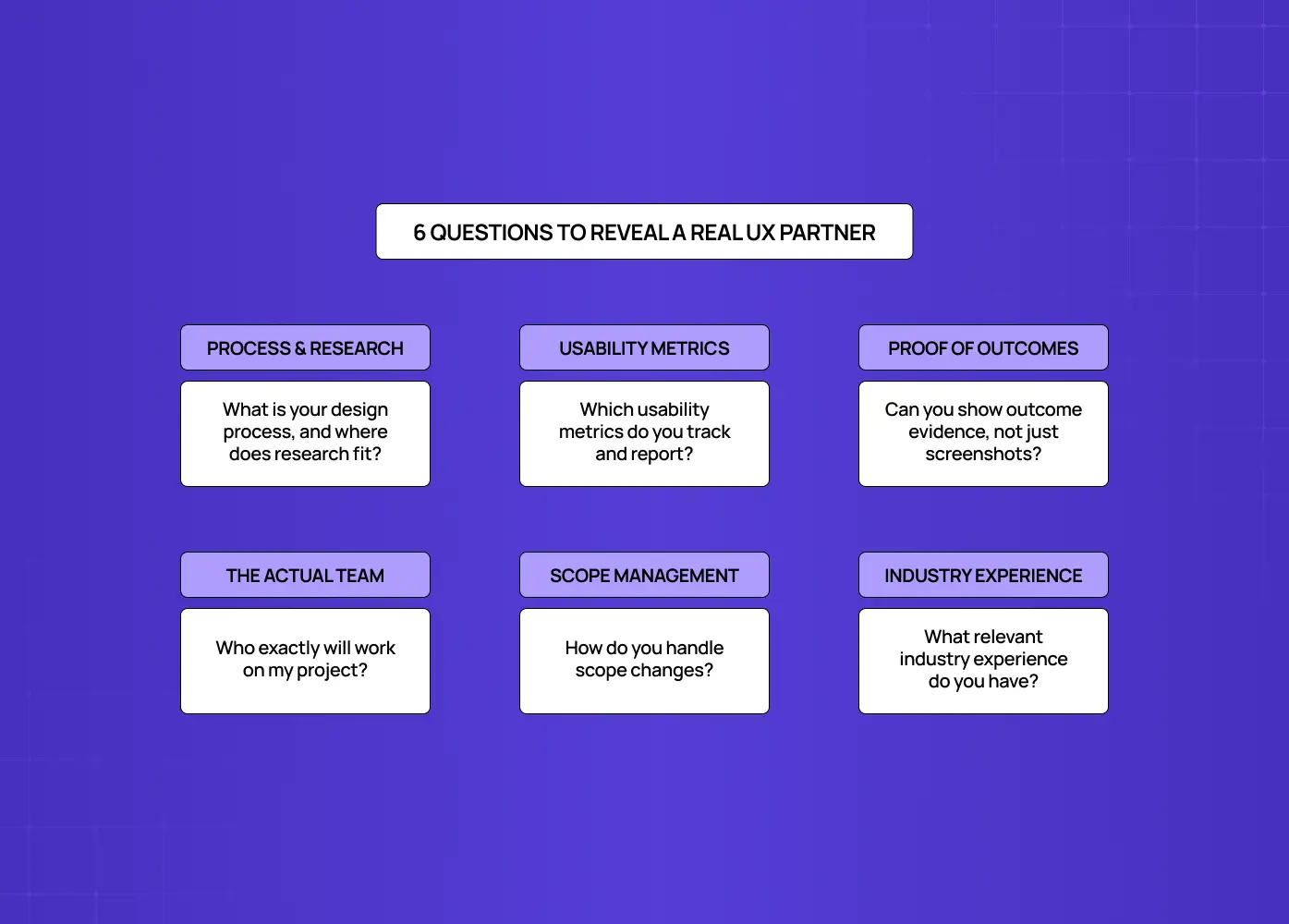
Educational infographic listing six key questions to evaluate a UX agency, covering research, metrics, outcomes, team, scope, and industry experience.

Use these in your first call. The answers tell you more than any portfolio:

  1. What's your design process, and where does research fit? A clear answer mirrors how agencies build products that convert. Be wary of anyone who jumps straight to visuals or simply hands designs to developers with no dialogue.

  2. Which usability metrics do you track and report? Strong answers name task completion rate, error rate, time on task, and satisfaction scores.

  3. Can you show outcome evidence, not just screenshots? You want metrics and before/after results, not a gallery. Knowing how to evaluate a portfolio helps you tell the two apart.

  4. Who exactly will work on my project? Understand the actual team, not the partner who pitches you.

  5. How do you handle scope changes? Ask about deposits, milestones, and change orders up front.

  6. What relevant industry experience do you have? Ask what they found hard on a similar project and how they solved it.

Conclusion: choose the partner, not just the portfolio

  • The best UX design agency in Toronto for you isn't the one with the flashiest reel.

  • It's the one whose process, metrics, and industry experience map to your product and stage.

  • Directories keep ranking agencies by placement fees. Pressure-test every shortlist candidate against four things: research-led, outcome-measured, engineering-aware, and transparent on price.

If you're building a SaaS product or MVP and want one of the UX design companies for SaaS that ties design to real results, book a discovery call with Groto. We'll walk through your product, your goals, and whether we're the right fit. No pressure, no jargon.

The first page of Google ranks UX design agencies in Toronto by who paid for placement, not who ships good work. This guide breaks that pattern down: ten real contenders, transparent pricing, and the exact questions that reveal a genuine design partner.

The honest shortlist of Toronto's best UX design agencies, ranked by outcomes, not placement fees.

TL;DR

  • Groto tops this list of the best UX design agencies in Toronto for 2026, chosen because it ties design work to measurable product outcomes instead of just shipping screens.

  • The shortlist covers 10 agencies across SaaS, enterprise research, accessibility, mobile health, and web3, so you can match a partner to your stage and industry.

  • Toronto UX pricing in 2026 runs from about $3,000 for a focused project to $150,000+ for enterprise engagements with research and testing.

  • Use the 6 questions in this guide on your first call. They separate a real design partner from an expensive one.

A UX design agency in Toronto is the partner most SaaS founders and product teams bring in to turn research, user flows, and interface design into a product people actually want to use. Toronto's design market is crowded, ranging from boutique studios to global firms, so the real work is separating agencies that ship measurable outcomes from agencies that just ship screens. This guide breaks down the best UX design agencies in Toronto for 2026, what they cost, and exactly how to choose the right agency for your stage and budget.

Here's the uncomfortable truth about hiring a UX design agency in Toronto: the wrong choice doesn't just cost you a design fee. It costs you a launch window, a round of engineering rework, and sometimes a product-market fit you never quite reach because users bounced before they understood what you built. UX design is one of the highest-leverage investments a product company makes, and one of the easiest to get wrong.

If you're a founder, product manager, or CTO searching for a UX design agency in Toronto, you've probably already noticed the problem: the first page of Google is a wall of directories and "top 10" lists that rank agencies by who paid for placement, not by who actually ships good work. So we did something different. Below is an honest, criteria-first shortlist of the ten best UX design agencies in Toronto for 2026. It's followed by exactly how to choose between them, what you should expect to pay, and the questions that separate a real design partner from an expensive one.

Let's get into it.

What makes a great UX design agency (the criteria we used)

Before the list, here's the lens. A strong UX design agency in Toronto should demonstrate five things:

  • Research-led process. Not just pretty screens.

  • Measurable outcomes. Task completion, conversion, and retention, not just "we redesigned it."

  • Relevant industry experience. SaaS, fintech, healthtech, marketplaces.

  • Engineering-aware design. Work that survives contact with real developers.

  • Transparent pricing and scope.

For most Series A and earlier SaaS companies, the agency vs. in-house decision usually favors an agency on speed and range.

Why does this matter so much? 

Because UX is where most of a product's economics are quietly decided. A confusing onboarding flow doesn't announce itself. It just shows up as a lower activation rate three months later. A checkout with one too many steps doesn't throw an error. It shows up as abandoned carts. The Nielsen Norman Group has spent decades documenting the return on usability investment, and the pattern is consistent: fixing experience problems early is dramatically cheaper than fixing them after launch. The right UX design agency in Toronto is, in effect, an insurance policy against expensive rework, provided you pick one whose process actually surfaces those problems before your engineers build them.

Why hire a UX design agency in Toronto specifically?

Toronto is one of North America's densest talent markets for product design. The city's overlap of a mature startup ecosystem, a large enterprise base (finance, insurance, telecom), and top-tier design schools means local agencies have unusually deep benches. Hiring locally also buys you time-zone alignment, easier in-person workshops for discovery and stakeholder alignment, and teams that understand Canadian regulatory realities, including accessibility legislation, bilingual requirements, and privacy expectations, that offshore shops often miss. For many founders, a Toronto-based partner is the sweet spot between the cost of a US coastal agency, like those in the San Francisco Bay Area, and the coordination cost of a fully offshore team.

In short:

  • Time-zone alignment for daily collaboration, not overnight handoffs.

  • Easier in-person workshops for discovery and stakeholder alignment.

  • Built-in understanding of Canadian accessibility, bilingual, and privacy requirements.


1. Groto: Best overall UX design agency in Toronto for SaaS & startups

Homepage of Groto, an AI-first UX design agency, featuring a bold futuristic visual with large typography emphasizing AI-driven product design.

Groto leads this list because it does the thing most agencies only claim to do: tie design decisions to product outcomes. Groto is a Toronto-based UX and product design agency built for SaaS companies, startups, and VC-backed teams that need to move fast without shipping guesswork. The team pairs user research and data with high-craft UI, so the design that lands in your codebase is validated, accessible, and ready to convert.

What sets Groto apart is the operating model: discovery and execution are treated as distinct phases, so you're never paying for polish before the problem is understood. For founders weighing MVP design, a SaaS platform redesign, or a full UX design services engagement, Groto offers the rare combination of startup speed and enterprise rigor.

Known for:

  • Ties design decisions to product outcomes, not just visuals

  • Separates discovery and execution into distinct phases

  • Works with SaaS companies, startups, and VC-backed teams

  • Case study: PolicyBazaar (link to letsgroto.com/projects/policybazaar). We redesigned mobile and web insurance shopping flows to reduce drop-offs and boost sign-ups.

  • Best for: SaaS UX design, MVP design, and product teams that want measurable results, not just mockups

Want to know where your users are dropping off?

We’ll break down the exact moments users lose interest, and why.

2. Akendi: Best for enterprise research & usability testing

Akendi homepage highlighting a human-centered UX approach with clean typography and messaging focused on intentional, insight-driven experiences.

Akendi is one of Toronto's longest-running UX design agencies, with a research-heavy practice spanning UX strategy, user research, digital product design, and usability testing across offices in Toronto and Ottawa. If your project lives or dies on rigorous, evidence-based research, think regulated industries or large-scale enterprise platforms, Akendi's depth is a strong fit.

Known for:

  • Research-heavy practice spanning UX strategy, user research, and usability testing

  • Offices in Toronto and Ottawa

  • Strong fit for regulated industries and large-scale enterprise platforms

  • Best for: enterprises that need formal research and usability testing at scale

3. Wavespace: Best for accessibility-first SaaS design

Landing page for Wavespace showcasing UX design services with a minimal layout, bold headline, client logos, and product interface preview.

Wavespace is a UI/UX design and consulting agency in Toronto crafting digital products for SaaS, AI, startups, enterprise, and VC-backed teams. Their calling card is an accessibility-first, data-driven approach that optimizes usability while meeting WCAG 2.1 AA standards, increasingly non-negotiable for products serving public-sector or enterprise buyers.

Known for:

  • Accessibility-first, data-driven approach

  • Meets WCAG 2.1 AA standards

  • Works across SaaS, AI, startups, enterprise, and VC-backed teams

  • Best for: teams that need compliance-grade accessibility baked in from day one

4. Mindsea: Best for mobile & digital health products

Mindsea agency homepage featuring a teal-themed hero section with team collaboration imagery and messaging about building intuitive digital products.

Mindsea brings a distinctly Canadian touch to mobile strategy, product design, and development, with a notable emphasis on digital health solutions. If your product is mobile-first, or you're operating in a space where trust, privacy, and clinical usability matter, Mindsea's specialization is hard to match.

Known for:

  • Mobile strategy, product design, and development

  • Notable emphasis on digital health solutions

  • Best for: mobile apps and healthtech products

5. Nextbrain Technologies: Best for full-stack design-and-build

UX design agency homepage with a workspace hero image, service overview, and feature cards introducing research, UI design, and usability services.

Nextbrain positions itself as a top UI/UX design agency in Toronto offering visually engaging mobile and web applications through an efficient end-to-end UX and UI process. Teams that want design and development under one roof, reducing handoff friction, should shortlist them.

Known for:

  • End-to-end UX and UI process

  • Design and development under one roof

  • Best for: clients who want design and engineering from a single vendor

6. Interpix Design: Best for established, Toronto-rooted UX craft

Interpix homepage promoting over 30 years of UX and UI expertise, featuring recent project showcases and a clean, minimalist layout.

Interpix is a Toronto-based UX design agency with a long track record of user-centered design work. For companies that value a stable, senior team over a churn-heavy shop, Interpix's longevity is a signal worth weighing.

Known for:

  • Long track record of user-centered design work

  • Stable, senior team over a churn-heavy shop

  • Best for: organizations prioritizing experience and continuity

7. Makra Digital: Best for UX-focused web design & conversion

Dark-themed agency homepage with a DNA-inspired visual, highlighting web development services through bold typography and high-contrast design.

Makra Digital is a UX-focused web design agency in Toronto that builds responsive, intuitive designs engineered to retain and convert visitors. If your primary goal is a marketing site or web experience that turns traffic into pipeline, Makra's conversion orientation fits the brief. It's a useful option if a broader web design agency in Toronto is really what you need.

Known for:

  • UX-focused web design agency

  • Builds responsive, conversion-engineered sites

  • Best for: conversion-driven websites and landing experiences

8. Roobinium: Best for web and web3 product design

Vibrant Web3 agency homepage featuring neon visuals, team portraits, and messaging around crypto, NFT, and metaverse design services.

Roobinium is a UX/UI design and development company in Toronto with expertise spanning web and web3. For teams building in emerging spaces, including wallets, dApps, and token-gated products, an agency that already understands those patterns saves months of ramp-up.

Known for:

  • Expertise spanning web and web3

  • Experience with wallets, dApps, and token-gated products

  • Best for: web3 and emerging-tech products

9. A specialist boutique (freelance-collective model)

Toronto has a healthy layer of small boutique studios and senior freelance collectives that take on focused engagements, whether that's a single flow, a design system, or a discovery sprint. They can be excellent value for narrow scopes, though capacity and continuity are the trade-offs. Best for: well-defined, limited-scope projects on a tighter budget.

10. Global agencies with a Toronto presence

Finally, several international UX firms serve Toronto clients remotely or through local teams. They bring brand-name process and cross-market benchmarks, usually at the top of the price range. If your search extends past Toronto, it's worth comparing agency scenes in New York, Los Angeles, Seattle, and Chicago against the same criteria. Best for: large enterprises that want a globally recognized partner and have the budget to match.

How much does a UX design agency in Toronto cost? (2026)

Pricing is the question every founder asks and few listicles answer. For the wider picture beyond Toronto, our web design agency pricing guide breaks down the full range. Here's the real range for the Toronto market in 2026.

Engagement type | Typical cost (CAD) Hourly agency rate | $90 – $160 / hour Focused / limited-scope project | $3,000 – $15,000 Landing page or feature redesign | $15,000 – $30,000 SaaS product or end-to-end website | $40,000 – $120,000 Enterprise product suite (research + testing + UI) | $150,000+

What moves the number:

  • Project complexity

  • Team seniority

  • Timeline urgency

  • Compliance requirements (accessibility, health, finance)

By client stage, the pattern usually looks like this: startups invest roughly $5K–$20K, SaaS products $20K–$60K, and enterprises $50K–$200K+. If an agency quotes a firm price before understanding your scope, treat that as a flag, not a feature.

When to hire a UX agency vs. build an in-house team

For many founders, a Toronto-based partner is the sweet spot between the cost of a US coastal agency, like those in the San Francisco Bay Area, and the coordination cost of a fully offshore team.

An agency wins when:

  • You need research, design, and UI capability immediately

  • You want to avoid a 3-month hiring cycle

  • You're pre-Series A or earlier

In-house starts to make sense when:

  • You have a continuous, full-time pipeline of product work

  • You're typically post-Series B

  • You want design embedded in daily standups

A common and effective middle path: hire an agency like Groto to establish the UX foundation, design system, and first validated flows, then transition to in-house designers who maintain and extend that foundation.

What a UX design engagement actually looks like

If you've never worked with a UX design agency before, or you're still fuzzy on what a UX design agency does, the process can feel like a black box. Here's the shape of a healthy engagement so you know what "good" looks like.

  • Discovery. Stakeholder interviews, a review of your analytics and support tickets, and often direct user research, to define the real problem rather than the assumed one.

  • Structure. User flows, information architecture, and low-fidelity wireframes that are cheap to change.

  • UI design. The visual layer, component library, and interaction states.

  • Validation. Usability testing and iteration.

  • Handoff. Documented components, specs, and design tokens your engineers can build from without guessing.

Notice that visuals come late in that sequence. A common failure mode with weaker agencies is jumping straight to high-fidelity screens because they demo well. Then, after your team has fallen in love with a look, they discover the underlying flow doesn't work. When you evaluate a UX design agency in Toronto, ask them to walk you through this arc on a past project. If they can't separate discovery from execution, that's a signal.

Red flags to watch for

  • Not every polished pitch hides a good process. Watch for agencies that:

  • Quote a fixed price and timeline before understanding your scope

  • Show a portfolio full of screenshots but no outcome metrics

  • Can't tell you who will actually staff your project

  • Treat accessibility as an afterthought rather than a baseline

  • Position design as a purely aesthetic exercise disconnected from your business goals

A great partner will push back on your assumptions, ask uncomfortable questions about your users, and occasionally tell you the feature you asked for isn't the one you need. That friction is a feature, not a bug.

The 6 questions that reveal a real UX partner

Educational infographic listing six key questions to evaluate a UX agency, covering research, metrics, outcomes, team, scope, and industry experience.

Use these in your first call. The answers tell you more than any portfolio:

  1. What's your design process, and where does research fit? A clear answer mirrors how agencies build products that convert. Be wary of anyone who jumps straight to visuals or simply hands designs to developers with no dialogue.

  2. Which usability metrics do you track and report? Strong answers name task completion rate, error rate, time on task, and satisfaction scores.

  3. Can you show outcome evidence, not just screenshots? You want metrics and before/after results, not a gallery. Knowing how to evaluate a portfolio helps you tell the two apart.

  4. Who exactly will work on my project? Understand the actual team, not the partner who pitches you.

  5. How do you handle scope changes? Ask about deposits, milestones, and change orders up front.

  6. What relevant industry experience do you have? Ask what they found hard on a similar project and how they solved it.

Conclusion: choose the partner, not just the portfolio

  • The best UX design agency in Toronto for you isn't the one with the flashiest reel.

  • It's the one whose process, metrics, and industry experience map to your product and stage.

  • Directories keep ranking agencies by placement fees. Pressure-test every shortlist candidate against four things: research-led, outcome-measured, engineering-aware, and transparent on price.

If you're building a SaaS product or MVP and want one of the UX design companies for SaaS that ties design to real results, book a discovery call with Groto. We'll walk through your product, your goals, and whether we're the right fit. No pressure, no jargon.

Have a project in mind?

Let’s talk through your idea and see what makes sense.

Harpreet Singh

Founder at Groto

Have a project in mind?

Let’s talk through your idea and see what makes sense.
Harpreet Singh

Founder at Groto

FAQ

Everything you were going to ask (and a few things you didn’t know to)

How do I evaluate a UX design agency's portfolio?

Look past the visuals for outcome evidence. The strongest portfolios show before and after metrics, explain the problem each project solved, and make clear whether the agency led the research or just executed someone else's brief. A gallery of screenshots with no results attached is a weaker signal than a handful of well-documented case studies.

Does Groto offer flexible pricing for smaller teams?

Yes. Groto runs a subscription model rather than one-off project quotes, with plans starting around $2,399 a month for a part-time embedded designer, scaling up to full-time coverage. Billing quarterly gets you a discount, and a 7-day free trial is available before you commit. Current pricing is always live on letsgroto.com/pricing.

Do Toronto UX design agencies work with international or remote clients?

Yes. Most Toronto UX agencies, including Groto, run projects with distributed teams and clients outside Canada. Async workshops, recorded research sessions, and shared design files keep collaboration smooth across time zones.

What's the difference between UX and UI design?

UX (user experience) design is about how a product works: research, flows, information architecture, and usability. UI (user interface) design is how it looks: visual layout, typography, color, and interaction states. Most Toronto agencies, including Groto, deliver both together.

How long does a UX design project take?

A focused engagement like a single flow or discovery sprint can take 2–4 weeks. A full SaaS product design typically runs 8–16 weeks depending on scope, research depth, and the number of user flows.

What deliverables should I expect from a UX design engagement?

A typical engagement includes user research findings, user flows and information architecture, wireframes, a component-based UI design, and a developer handoff package with specs and design tokens. Confirm upfront which of these are included in your scope before signing.

How do I evaluate a UX design agency's portfolio?

Look past the visuals for outcome evidence. The strongest portfolios show before and after metrics, explain the problem each project solved, and make clear whether the agency led the research or just executed someone else's brief. A gallery of screenshots with no results attached is a weaker signal than a handful of well-documented case studies.

Does Groto offer flexible pricing for smaller teams?

Yes. Groto runs a subscription model rather than one-off project quotes, with plans starting around $2,399 a month for a part-time embedded designer, scaling up to full-time coverage. Billing quarterly gets you a discount, and a 7-day free trial is available before you commit. Current pricing is always live on letsgroto.com/pricing.

Do Toronto UX design agencies work with international or remote clients?

Yes. Most Toronto UX agencies, including Groto, run projects with distributed teams and clients outside Canada. Async workshops, recorded research sessions, and shared design files keep collaboration smooth across time zones.

What's the difference between UX and UI design?

UX (user experience) design is about how a product works: research, flows, information architecture, and usability. UI (user interface) design is how it looks: visual layout, typography, color, and interaction states. Most Toronto agencies, including Groto, deliver both together.

How long does a UX design project take?

A focused engagement like a single flow or discovery sprint can take 2–4 weeks. A full SaaS product design typically runs 8–16 weeks depending on scope, research depth, and the number of user flows.

What deliverables should I expect from a UX design engagement?

A typical engagement includes user research findings, user flows and information architecture, wireframes, a component-based UI design, and a developer handoff package with specs and design tokens. Confirm upfront which of these are included in your scope before signing.

More Articles

Extreme close-up black and white photograph of a human eye

Let’s bring your vision to life

Tell us what's on your mind? We'll hit you back in 24 hours. No fluff, no delays - just a solid vision to bring your idea to life.

Profile portrait of a man in a white shirt against a light background

Harpreet Singh

Founder and Creative Director

Get in Touch

Extreme close-up black and white photograph of a human eye

Let’s bring your vision to life

Tell us what's on your mind? We'll hit you back in 24 hours. No fluff, no delays - just a solid vision to bring your idea to life.

Profile portrait of a man in a white shirt against a light background

Harpreet Singh

Founder and Creative Director

Get in Touch

Extreme close-up black and white photograph of a human eye

Let’s bring your vision to life

Tell us what's on your mind? We'll hit you back in 24 hours. No fluff, no delays - just a solid vision to bring your idea to life.

Profile portrait of a man in a white shirt against a light background

Harpreet Singh

Founder and Creative Director

Get in Touch