Choosing between an AI design agency and a traditional one isn't as simple as speed versus quality. This honest 2026 comparison breaks down cost, craft, and strategy, and shows why a hybrid model often wins.
AI vs traditional design agencies, compared honestly across speed, cost, and craft.
TL;DR
AI-native agencies win decisively on speed, cost, and output volume; traditional agencies win on strategy, brand depth, and senior human judgment.
First deliverables land in one to two weeks with an AI-native partner, versus eight to twelve weeks at a traditional agency.
Reported cost savings with AI-native agencies run 60 to 80 percent lower than traditional agency rates.
AI-native output can reach 50 to 150+ variants a month, compared with 5 to 15 assets from a typical traditional retainer.
Traditional agencies still lead on brand-defining, high-stakes, and highly original work where senior human taste and judgment matter most.
For most teams, the smartest choice isn't AI or traditional. It's a hybrid model that combines both, which is how Groto works.
Choosing between an AI design agency vs traditional agency is one of the more consequential calls a founder or product team can make in 2026. Get it right and you save months and thousands of dollars. Get it wrong and you either overpay for craft you didn't need or underinvest in the strategic thinking your product actually required. This guide breaks the decision down honestly, without the sales pitch either side tends to lead with.
The pitch is hard to ignore: AI-native design agencies claim to deliver work 3–10x faster and 60–80% cheaper than traditional agencies. If you're a founder staring at a $42,500 quote and an 8-to-12-week timeline for a website redesign, a figure that sits squarely inside standard web design agency pricing, that sounds less like a trade-off and more like a no-brainer.
This is the honest version. We'll compare an AI design agency vs a traditional agency across the dimensions that actually matter: speed, cost, volume, quality, and strategy, lay out the real pros and cons of each, and give you a framework for choosing. Most importantly, we'll get to the answer the binary hides: for many teams, the smartest option isn't AI or traditional, but the hybrid model that combines them. Let's cut through the hype.
The short verdict
Here's the honest one-liner: matching the model to the work matters more than picking a side.
AI-native agencies win decisively on speed, cost, and volume.
Traditional agencies win on strategy, brand depth, and senior human judgment.
The best modern partners blend both.
If your work is high-volume, well-defined production, AI-native economics are hard to beat.
If it's strategic, brand-defining, or bespoke, human craft still matters enormously.
Choosing well means matching the model to the work, not picking a side.
What is an AI (AI-native) design agency?
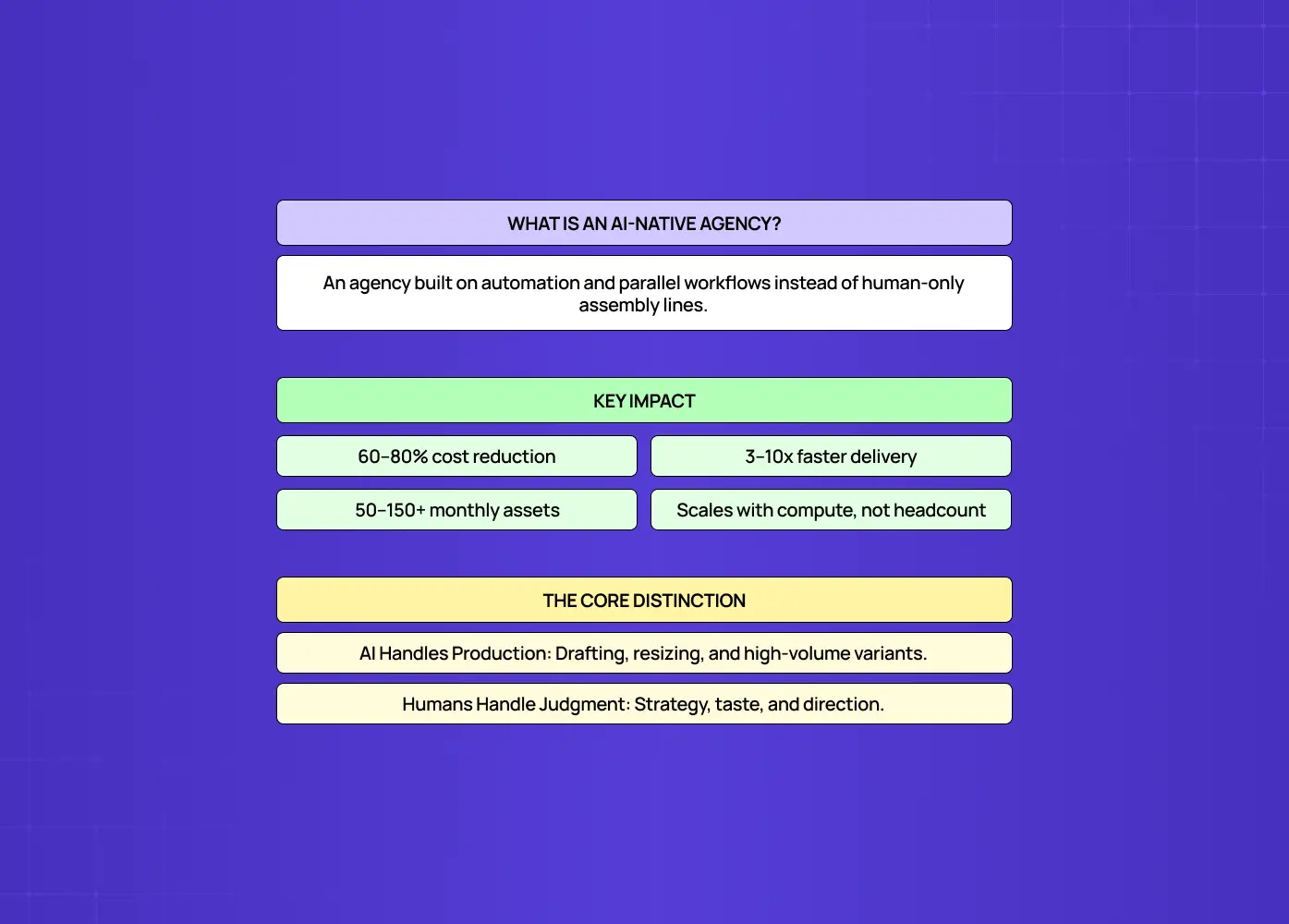
An AI-native design agency uses machine learning and automation as its core delivery mechanism, not as an add-on. Rather than passing work down a human chain, it runs design, development, and testing largely in parallel, with AI handling much of the execution that used to require several specialists. This is the same shift you see inside product teams using agentic AI for UX workflows, only applied to the agency's entire operating model. The economic model is fundamentally different: fewer people, far less coordination overhead, and AI-powered production. That's what enables the headline numbers, reported cost reductions of 60–80% and delivery 3–10x faster, with some creative tasks seeing 70%+ time savings.
What sets this model apart:
Design, development, and testing run largely in parallel instead of moving down a chain.
Fewer specialists are needed per project, which lowers coordination overhead.
Output scales with compute and tooling, not headcount.
Cost reductions of 60 to 80 percent and delivery speeds of 3 to 10x are the reported norm.
The practical upshot is throughput. Where a traditional retainer might yield 5–15 creative assets a month, an AI creative agency can routinely produce 50–150+ variants, a game-changer for performance marketing, A/B testing, and any use case that rewards volume and rapid iteration.
Why AI-native agencies emerged now
It's worth understanding why this model appeared, because it explains both its strengths and its limits. For years, the bottleneck in design and creative work was human hours: every asset, every revision, every test variant took a person's time. Generative AI collapsed the cost of production: drafting, resizing, reformatting, and iterating became near-instant, and the AI tools for UI UX designers behind that shift are now standard kit rather than experiments. AI-native agencies are simply businesses built around that shift from the ground up, rather than traditional shops bolting AI onto a human-hours model. They rearchitected the whole delivery pipeline: parallel instead of sequential, automated instead of manual, few specialists instead of many, to pass the efficiency on as speed and price.
But notice what got cheaper: production, not judgment. AI dramatically lowered the cost of making things; it didn't lower the cost of knowing what's worth making. That's the fault line running through this entire comparison. Where a task is mostly production, AI-native economics dominate. Where it's mostly judgment (strategy, taste, positioning), the human advantage persists. Keep that distinction in mind and every other difference below makes sense.
What is a traditional design agency?
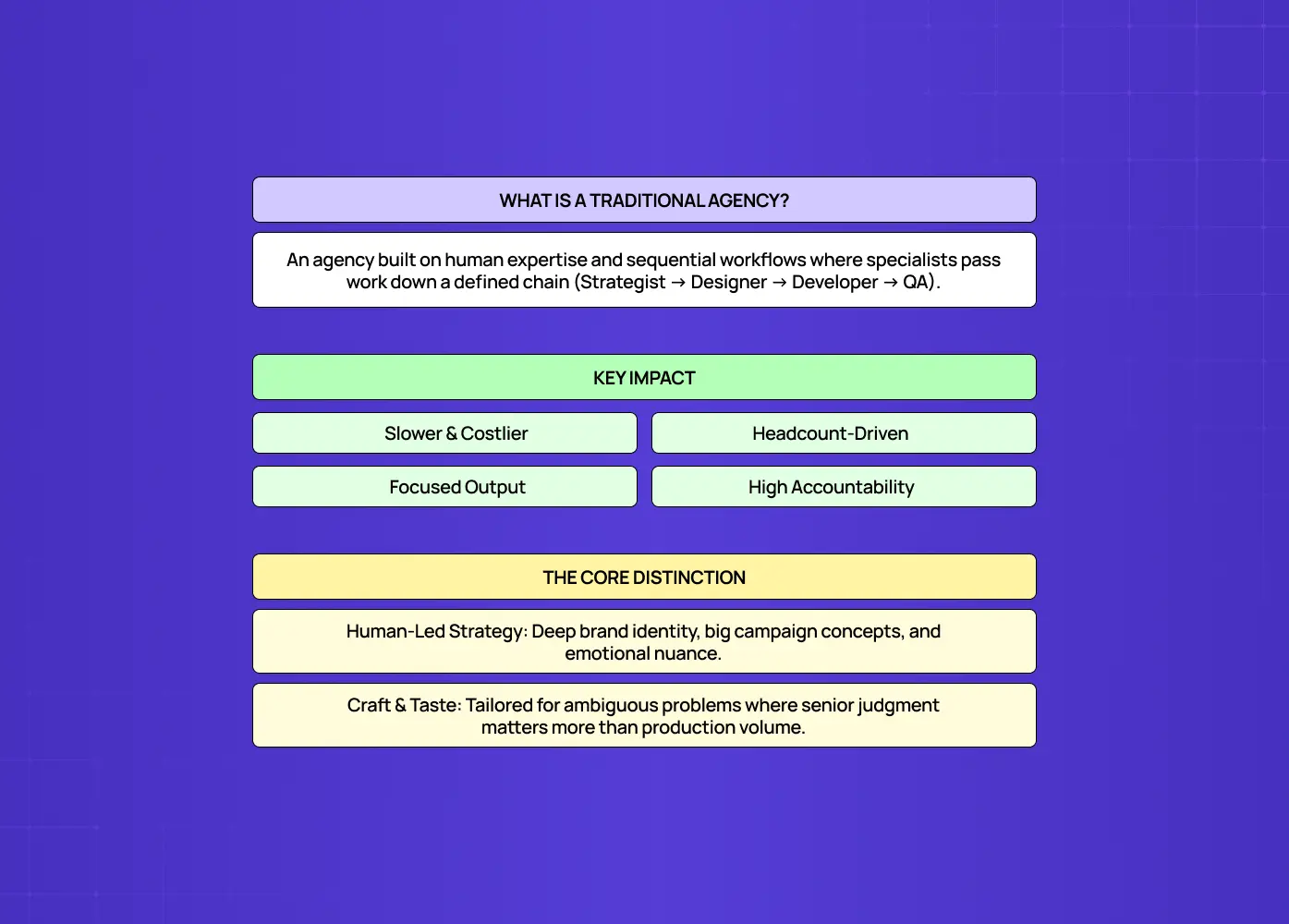
A traditional design agency relies primarily on human expertise and established processes, with specialists handing work through a defined chain: strategist, designer, developer, QA, project manager. If you are unclear on what a design agency does at each of those steps. That structure is slower and more expensive, but it exists for a reason: it concentrates senior human judgment, craft, and strategic thinking on the problem. It is the agency design process most product teams already know. Traditional agencies excel at the work that isn't just production: brand strategy and identity, big campaign concepts, complex bespoke products, and the kind of taste and emotional nuance that AI still struggles to originate.
The cost reflects what you're buying: not just deliverables, but the experience, strategic guidance, and accountability of people who've solved hard, ambiguous problems before. For high-stakes, one-of-a-kind work, that human depth is often exactly what's needed.
Head-to-head: the dimensions that matter
Speed. No contest, AI-native wins. First deliverables in one to two weeks versus two to three months is a different tempo entirely, and ongoing production runs on weekly or biweekly cycles.
Cost. AI-native, again, on raw price: reported 60 to 80 percent savings against traditional rates. But price-per-asset isn't value; a cheap asset that's off-strategy costs more than it saves.
Volume. AI-native, overwhelmingly. If you need dozens or hundreds of variants for testing and channels, human production simply can't match the throughput.
Quality and craft. More nuanced. AI produces competent, on-brief work fast, but the highest tier of craft, the distinctive, surprising, emotionally resonant design, still leans human. AI raises the floor; humans raise the ceiling.
Strategy and judgment. Traditional wins. Positioning, brand architecture, and knowing what to make (not just making it fast) is where experienced humans remain ahead. AI executes; strategy still needs a human point of view, and the same split shows up when you compare AI UX vs traditional UX on live SaaS products.
The pros and cons
AI design agency
Speed, low cost, near-unlimited revisions, easy scaling, and enormous output volume
Ideal for teams that need a lot of good work quickly
Trade-off: subscription models can feel restrictive for occasional needs, so it is worth comparing what a design subscription agency actually includes before committing
Trade-off: work can lack the strategic depth, originality, and brand nuance that define standout creative, which is where most AI UX design mistakes originate
Traditional agency
Strategic depth, brand-building capability, senior craft, and the judgment to handle complex, ambiguous, high-stakes work
Trade-off: slower timelines
Trade-off: higher cost
Trade-off: lower output volume
Neither list makes one "better." They make each better for different jobs.
When to choose which
Choose an AI-native agency when:
Work is high-volume and well-defined
You need performance creative, variant testing, landing pages, or social and ad assets
Speed and affordability matter more than one-of-a-kind craft
Choose a traditional agency when:
Work is strategic and brand-defining
You're building a new brand identity, positioning, or a flagship product
The build is complex and bespoke enough that senior judgment and craft justify the cost and time
Choose based on stakes and definition: the more defined and voluminous the work, the more AI-native makes sense; the more ambiguous, strategic, and one-of-a-kind, the more human depth pays off.
The mistake is dogma in either direction: running your brand identity through an AI production queue, or paying premium agency rates to crank out fifty ad variants. Both waste money by mismatching the tool to the job.
Your company stage nudges the answer, too. Early-stage startups are usually cost- and speed-constrained and need to ship and test constantly, which tilts toward AI-native or hybrid production, though the foundational brand and product decisions still deserve real human judgment. Growth-stage companies typically run a mix: a strategic partner for positioning and flagship work, plus AI-driven production for the relentless volume of marketing and iteration. Enterprises often need the accountability, governance, and bespoke depth that senior human teams provide for high-stakes work, while adopting AI internally for throughput, which turns the question into a UX agency vs in-house designer call as much as an AI one. There's no universal answer, but naming your stage and the specific job in front of you narrows it fast, and it stops you from copying a model that suited a company nothing like yours.
The hybrid model: why you may not have to choose
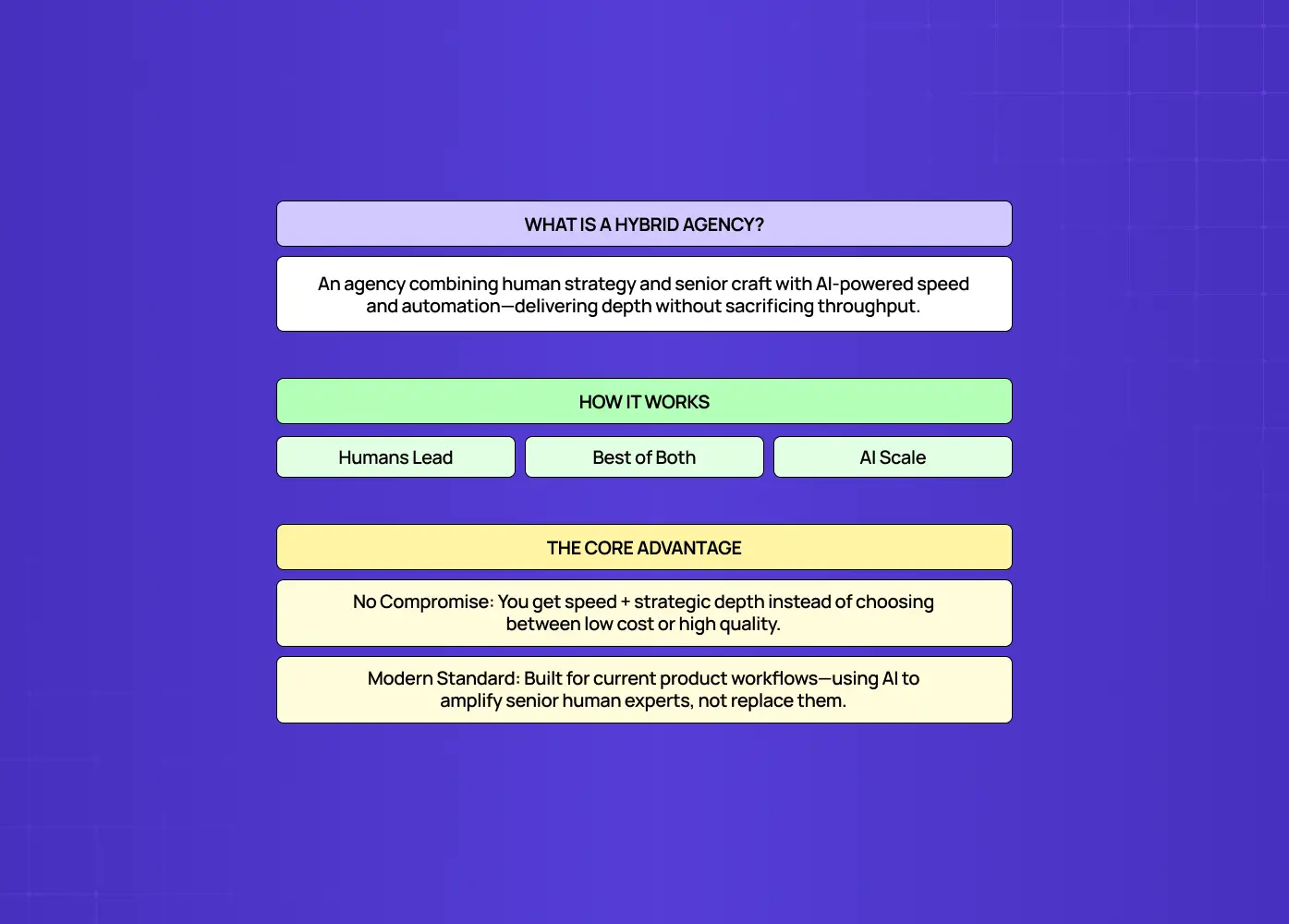
Here's what the "AI vs traditional" framing misses: the smartest teams increasingly use both, and the best modern agencies are neither purely one nor the other. In the hybrid model, human strategists and senior designers handle brand strategy, identity, and the high-judgment concepts, while AI handles day-to-day production, variant generation, and data-driven iteration. You get the emotional depth and strategic thinking of traditional creative plus the speed, volume, and cost of AI.
This is the direction serious product design is heading, and it's how Groto works as an AI product design agency in the US. We're an AI-augmented human design team, we use AI to move faster and produce more, while keeping experienced designers firmly in charge of the strategy, craft, and judgment that AI can't replace. For most teams, that's the real answer the either/or question was pointing at, not choosing between speed and depth, but getting both from a partner that's built for 2026 rather than clinging to 2019 or over-indexing on automation. The AI product design trends shaping the next two years all point the same way.
Myths on both sides
The debate is noisy with half-truths, so let's clear a few.
Myth: AI will replace design agencies entirely. Reality: Unlikely. AI replaces production tasks, not the strategy, judgment, and client relationship that make an agency valuable. It changes what agencies do, not whether they're needed, which is exactly how AI is transforming UX work rather than ending it.
Myth: AI design is always lower quality. Reality: Not true. For well-defined work, AI output is often perfectly good, and the gap keeps narrowing. The real difference shows up in original, strategic, brand-defining work.
Myth: Traditional agencies are obsolete. Reality: No. For high-stakes bespoke work, senior human craft is still worth the premium, and plenty of AI-native output is generic precisely because it skips the strategy.
Myth: Cheaper and faster always means better value. Reality: The most seductive myth of all. A fast, cheap asset pointed in the wrong direction is expensive, because it moves no metric. Judging either model means calculating the ROI of UX design, not comparing day rates. Value is speed and cost and fitness for purpose, not any one alone.
The throughline: treat the loudest claims from either camp with skepticism, and evaluate against your actual work rather than the marketing.
Questions to ask any agency before you commit
How do they use AI? Is it their whole delivery model, a productivity tool, or barely at all? The answer tells you where they sit on the spectrum, and it pairs well with a broader checklist for choosing the right agency.
Who owns the strategy? Will an experienced human shape direction, or does the process jump straight to production?
Can they show outcomes, not just output? Volume and speed mean nothing if the work doesn't perform, so ask for results and not just a gallery, and know how to evaluate an agency portfolio before you read too much into it.
How do revisions and iteration work? This is where AI's speed advantage is most real and traditional models are slowest.
How do they handle ambiguous, hard problems? Ask how they handle the work that can't be templated, and check it against the skills a UI UX agency needs in 2026.
Can they support ongoing design needs? Ask whether their graphic design services can scale with your needs, and consider options like Penji for ongoing creative support.
The goal isn't to catch anyone out. It's to understand which model you're actually buying, so you can match it to the job in front of you. The same logic applies to the local vs remote agency question, which is another delivery-model choice dressed up as a preference.
Conclusion
The AI design agency vs traditional agency debate isn't really about which is "better." It's about matching the model to the work and being honest about the trade-offs.
AI-native agencies deliver unbeatable speed, cost, and volume for defined production.
Traditional agencies deliver the strategy, craft, and judgment that high-stakes, brand-defining work demands.
The hybrid, AI-augmented model gives most teams the best of both.
If you want a design partner that pairs senior human strategy and craft with AI speed and scale, without sacrificing either, book a discovery call with Groto. You'll leave with a clear UX design proposal covering scope, timeline, and cost.
We'll help you figure out what your product actually needs and deliver it fast, without cutting the thinking that makes design work. Let's build something great, quickly.