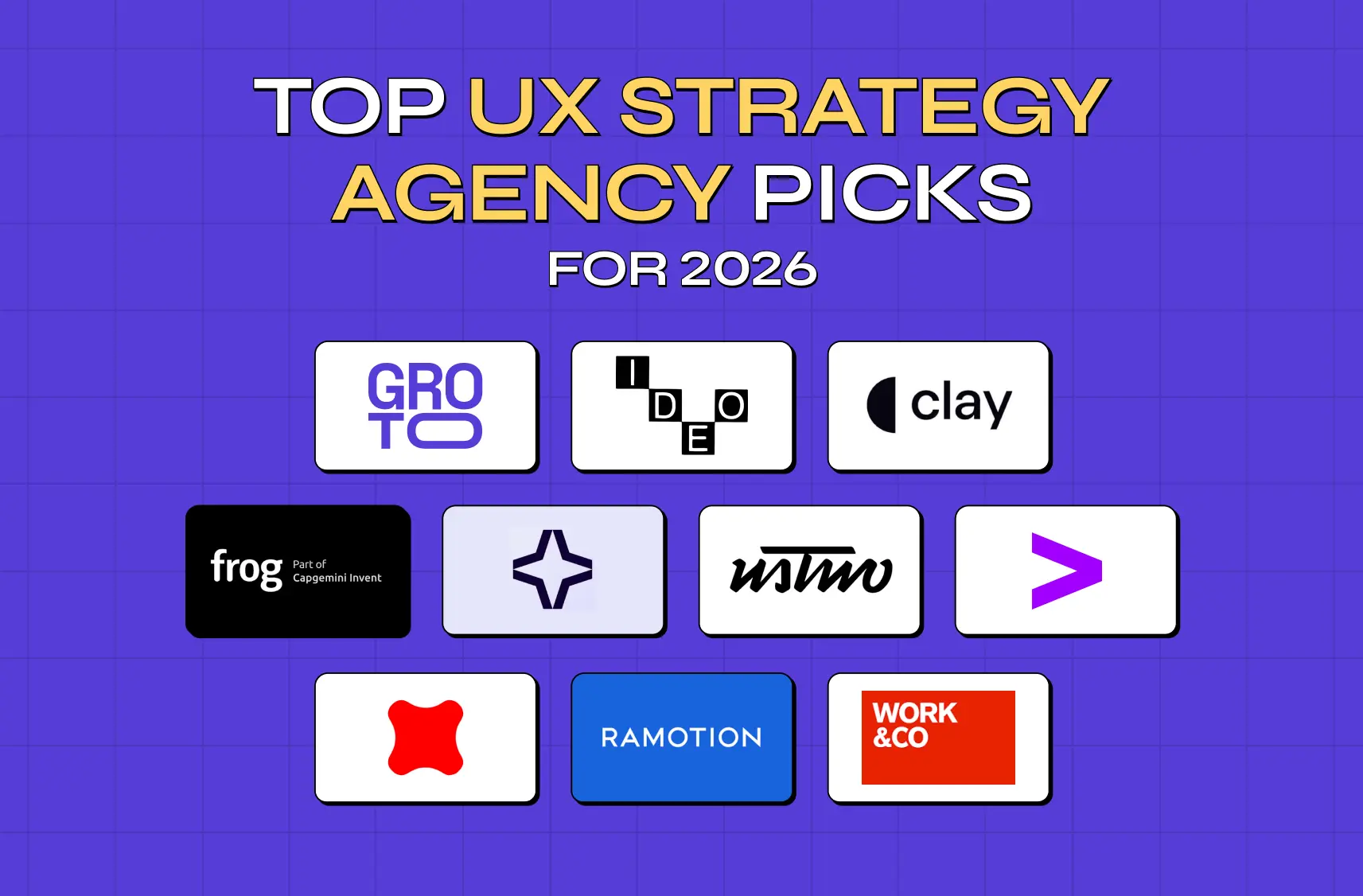
Seattle's UX agency market runs deep — but most of it is built for enterprise. This guide cuts through the noise and matches 8 agencies to the exact company stage, budget, and design problem where each one actually performs best
8 Seattle UX agencies matched to your stage, budget, and design problem.
Finding the right UX agency in Seattle isn't only about reputation — and it starts with confirming that an agency is the right model at all. If you're still weighing UX agency vs. in-house designer, that decision is worth resolving before diving into specific agency profiles. This guide matches eight agencies to the exact project stage, budget, and design problem where each performs best. Selection criteria: verified local presence or documented remote SaaS focus, publicly available client portfolio, methodology transparency, engineering handoff capability, and fit across budget and timeline.
Seattle's design market has been shaped by two decades of proximity to Amazon, Microsoft, and Boeing — three organisations that collectively employ tens of thousands of engineers and product managers in the region. That concentration of enterprise tech has produced excellent UX agencies, most of them calibrated for large-scale, research-heavy, compliance-aware engagements. For a SaaS startup trying to fix activation or a growth-stage company that needs brand and product design under one roof, that enterprise orientation is often a mismatch. The same dynamic applies in the San Francisco Bay Area UX agency market — useful context for companies evaluating options across West Coast tech hubs before committing to a Seattle-based partner.
Seattle data point: Washington state's tech sector accounts for over 350,000 jobs as of 2024 (Washington Technology Industry Association), with the majority concentrated in King County. That density drives strong demand for enterprise UX services — and also creates a gap for early-stage and mid-market product teams who need a different kind of partner. Other North American tech hubs have developed their own agency ecosystems to fill the same gap, which is why teams sometimes widen the search to a Toronto agency guide before settling on a local Seattle partner.
TL;DR
Most Seattle UX agencies are built for enterprise clients; SaaS and growth-stage teams need to filter by type, not just reputation.
Eight agencies mapped across four types: AI-first full-stack studio, research-heavy enterprise, full-service digital studio, and visual/creative studio.
Budget range across the market: ~$10K (small studios) to $750K+ (enterprise agencies) — filter first by budget, then by specialisation.
Local presence matters for workshops and co-creation; for product design in Figma, timezone overlap beats geography.
How we chose these eight agencies
Most "best UX agency" lists rank agencies purely by review scores without accounting for what type of company they're actually suited to. When you're evaluating your own shortlist, going beyond review scores means knowing how to evaluate a UI/UX portfolio before you hire — which is where the real differentiators between agencies become visible.
We started with a longlist of 30+ agencies pulled from Clutch's Seattle UX directory, the AIGA Seattle member directory, and LinkedIn filtered to Seattle-area design firms. Each agency was then run through four filters:
A publicly accessible portfolio with at least three named case studies
Enough public information about methodology and process to describe how the agency actually works
Pricing data available through Clutch, the agency's own website, or a third-party directory
Clear fit with at least one of the four agency types in the matrix
Profiles were written from primary sources only — agency websites, Clutch profiles, and published case studies. No agency paid for inclusion. Pricing figures are labelled "typical" throughout as actual costs vary by scope. Teams who want to compare Seattle options against a global shortlist can use the guide to top product design agencies globally as a parallel reference — useful for companies that aren't limiting their search to a specific city.
The Seattle UX Agency Selection Matrix
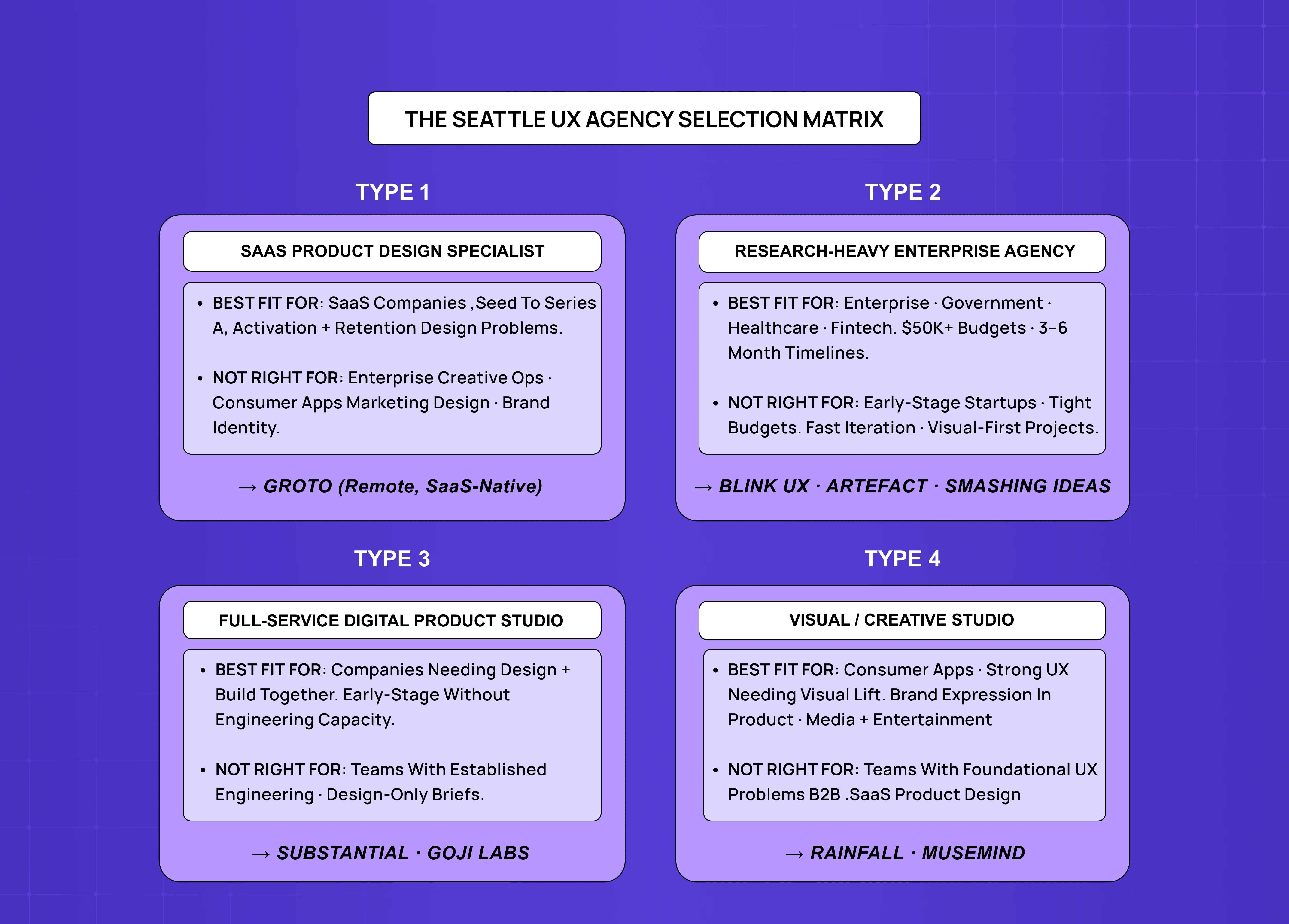
Seattle's UX agency market breaks into four distinct types, each suited to a different company profile — and if you're unclear on what each type actually delivers in terms of specific roles, responsibilities, and handoff expectations, what a UI/UX design agency does is worth reading before applying the matrix below.
Agency Type | Primary Strength | Best Fit | Not right for |
AI-first full-stack design studio | UX/UI, brand, marketing design, web dev, design systems — all disciplines | SaaS, AI, and growth-stage companies needing full design coverage | Teams requiring on-site collaboration or single-discipline specialists only |
Research-heavy enterprise agency | Complex systems, accessibility, validated methodology | Enterprise, government, healthcare, fintech | Early-stage startups with limited budget |
Full-service digital product studio | End-to-end strategy, design, and development | Companies needing design + build | Teams with established engineering capacity |
Visual / creative studio | Brand identity, marketing design, visual polish | Companies with strong product UX needing brand lift | Foundational product design problems |
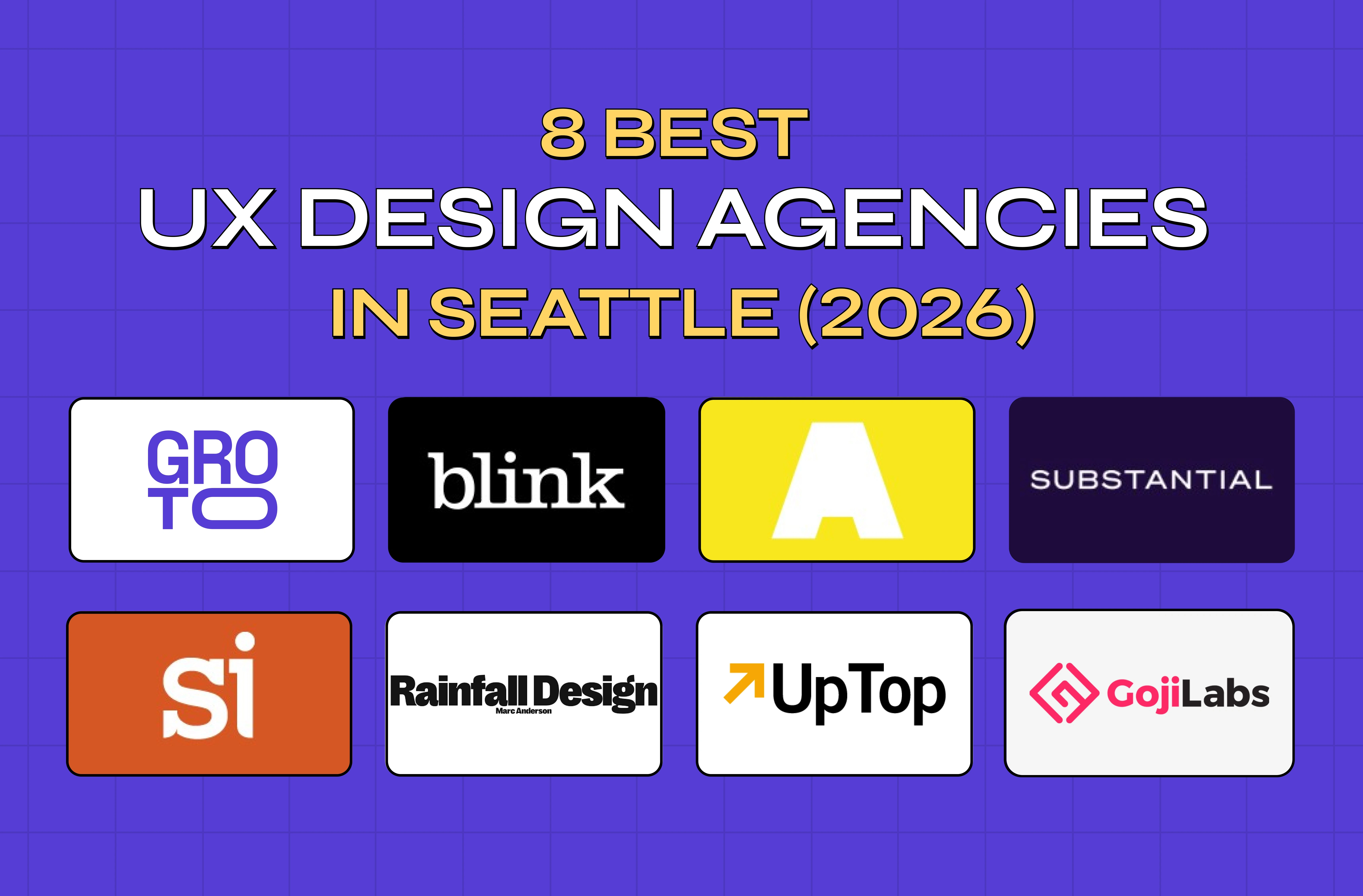
8 Best UX Design Agencies in Seattle (2026) and Beyond
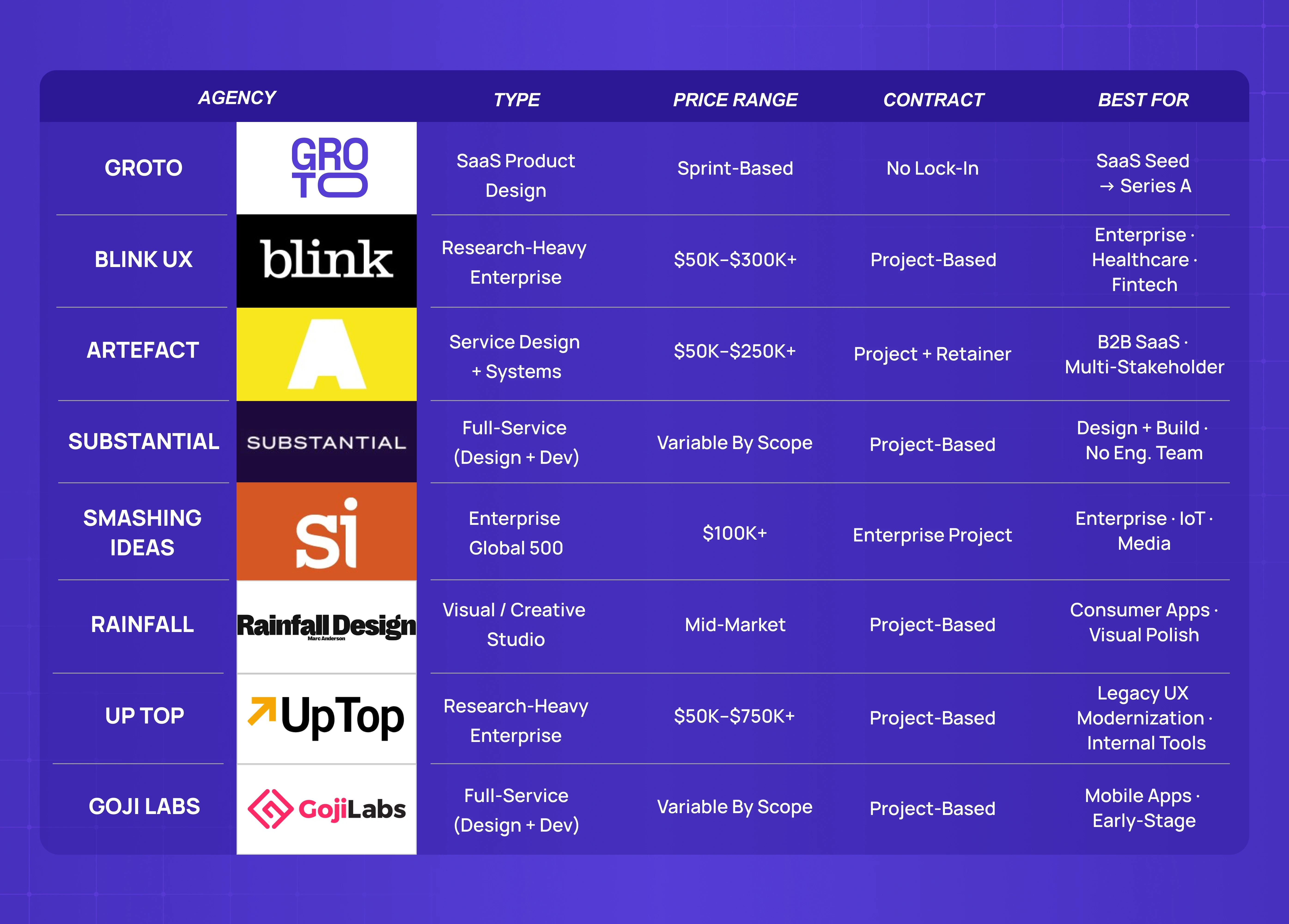
1. Groto — AI-First Full-Stack Design Studio
Min budget: From $2,399/month
Typical timeline: 2–8 weeks per phase
Sweet spot: SaaS, AI products, growth-stage companies
Type: AI-first full-stack design studio
Location: Remote (serves Seattle companies globally)
Website: letsgroto.com
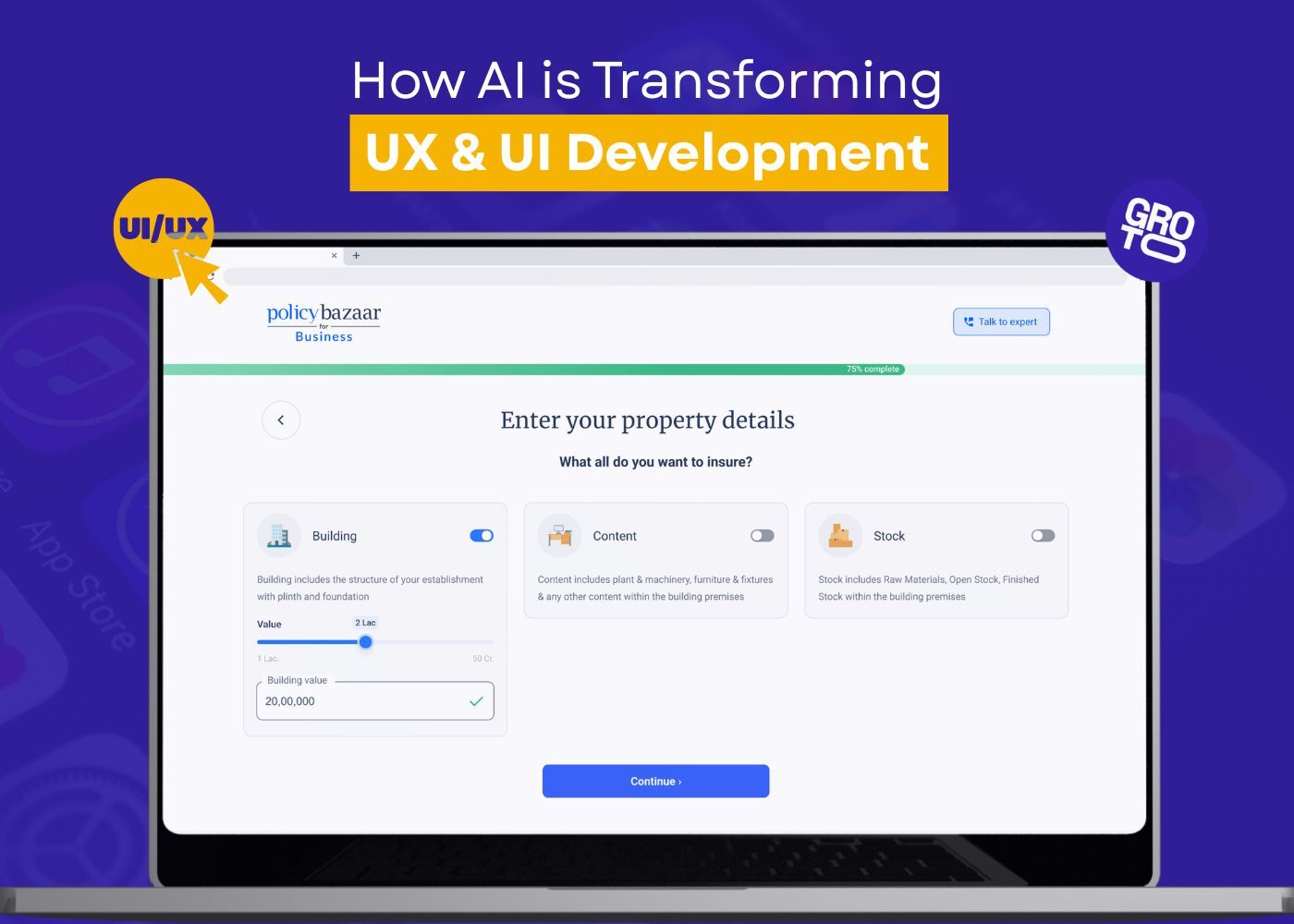
We are a full-stack design studio covering UX/UI, brand identity, marketing design, web development, and design systems — all under one roof. Our work spans SaaS platforms, AI products, fintech, healthcare, and e-commerce, with published case studies across Camb.ai (AI dubbing platform redesign), PolicyBazaar (insurance UX, mobile and web), Nicotex Begin (mobile onboarding redesign), LearnSphere (AI-powered edtech platform), and Meydan FZ (B2B website redesign).
Unlike most agencies on this list, we operate on a subscription model — part-time and full-time plans — with a 7-day free trial. That structure suits companies that need ongoing design capacity across multiple disciplines without managing multiple vendors. We work remotely with clients across the US, Europe, UAE, and Asia, with documented overlap across timezones — the working model behind remote-first agencies that trade physical proximity for broader specialisation.
Third-party evidence:
Clutch profile: clutch.co/profile/groto (4.9/5.0, verified reviews)
Portfolio and case studies: letsgroto.com/projects
Dribbble: dribbble.com/groto
Best for:
SaaS companies, AI product teams, and growth-stage businesses needing full-stack design coverage — UX/UI, product design, brand identity, marketing design, and web development without managing multiple agencies
Not right for:
Teams requiring on-site, in-person workshops as their primary working mode
Organisations with complex multi-vendor governance that mandates local vendor presence
Pricing: Starter at $2,399/month (2 hrs/day, 5 days/week); Part-Time at $4,399/month (4 hrs/day, 5 days/week); Full-Time at $5,999/month (6 hrs/day, 5 days/week). All plans include a pre-vetted designer trained in UX, UI, and brand design, PM support, and the ability to pause up to 3 weeks or cancel anytime with credit.
View our work → letsgroto.com/projects
2. Blink UX — Research-Heavy Enterprise Agency
Min budget: ~$50K+ (typically $50K–$300K, per Clutch)
Typical timeline: 3–9 months
Sweet spot: Enterprise research, healthcare, accessibility
Type: Research-heavy enterprise agency
Location: Seattle, WA (Pioneer Square) | Founded: 2000
Blink UX is one of Seattle's most established UX research and design firms. Founded in 2000, they built their reputation on rigorous empirical methodology — usability testing, cognitive walkthrough, contextual inquiry — and have deep experience with complex systems in healthcare, fintech, financial services, and government. Their work is consistently research-first: design decisions are validated before implementation, not after.
For organisations that need defensible, research-backed design decisions — healthcare systems, financial platforms, government digital services — Blink is one of the strongest options in the Pacific Northwest. Their accessibility and WCAG expertise is a genuine differentiator for regulated industries.
Example use case: A regional healthcare network needing to redesign its patient portal with full WCAG 2.1 AA compliance and documented usability testing across diverse user populations.
Best for:
Enterprise, government, healthcare, and fintech UX design agencies like Blink are the right match for companies needing research-validated UX with formal methodology and accessibility expertise.
Not right for:
Early-stage startups with 6–8 week timelines or budgets under $50K
Teams primarily needing visual design or brand work
Pricing: Typically $50K–$300K+ per engagement (source: Clutch profile, agency website)
3. Artefact — Service Design and Enterprise UX
Min budget: ~$50K+ (enterprise retainer and project-based)
Typical timeline: 3–6 months
Sweet spot: Multi-stakeholder B2B, healthcare tech, digital transformation
Type: Research-heavy enterprise agency
Location: Seattle, WA (Belltown)
Artefact integrates service design, systems thinking, and UX research into what they call "design for transformation" — a methodology that accounts for the people, processes, and systems surrounding an interface, not just the interface itself. They work across enterprise, healthcare, consumer, and technology sectors, with a track record in both SaaS applications and physical-digital hybrid products.
Their service design orientation is particularly valuable for B2B SaaS companies with complex multi-stakeholder implementations, where the buyer, administrator, and end user are different people with different mental models and success criteria. Artefact's process surfaces those distinctions and designs for all of them.
Example use case: A healthcare technology company rolling out a new clinical workflow platform to hospital administrators, clinical staff, and IT teams simultaneously — each with different training levels and access requirements.
Best for:
B2B companies with complex service architectures and multi-stakeholder SaaS products
Healthcare technology, digital transformation programmes, and enterprise software
Not right for:
Early-stage startups needing fast product design iteration
Limited-budget engagements or teams needing pure interface design
Pricing: Typically $50K+ per engagement; enterprise retainer and project-based (source: agency website, Clutch)
4. Substantial — Full-Service Digital Product Studio
Min budget: ~$25K+ (varies significantly by scope)
Typical timeline: 2–6 months
Sweet spot: Net-new digital products needing design + development
Type: Full-service digital product studio
Location: Seattle, WA (Capitol Hill)
Substantial delivers end-to-end digital products — strategy, UX design, visual design, and software development under one roof. They've worked across consumer, B2B, and enterprise sectors on web, mobile, and connected device products. Their model eliminates the handoff friction that comes from managing a design agency and an engineering firm separately, which is a real operational cost for teams without internal development capacity.
They are also experienced in platform strategy and technology evaluation, useful for companies making foundational architecture decisions at the same time as design decisions.
Example use case: A Series A company with a validated concept but no engineering team, needing to go from UX research through to a production-ready web application in a single engagement.
Best for:
Companies needing design and development from a single partner
Early to mid-stage companies building net-new digital products
Not right for:
Companies with established engineering teams that only need design work
Organisations requiring deep UX research specialisation
Pricing: Typically $25K–$200K+ depending on scope (source: agency website, Clutch)
5. Smashing Ideas — Enterprise UX at Scale
Min budget: ~$100K+ (enterprise project-based)
Typical timeline: 3–9 months
Sweet spot: Enterprise, IoT, connected devices, Global 500
Type: Research-heavy enterprise agency
Location: Seattle, WA (South Lake Union) | Founded: 1996
Smashing Ideas has operated in Seattle since 1996 with a portfolio reflecting the city's enterprise tech ecosystem — Amazon, Microsoft, and Global 500 clients across retail, healthcare, media, and connected devices. Their "Motivational UX" methodology focuses on user motivation alongside usability, and their experience with IoT and smart product interfaces is a genuine differentiator in the Seattle market.
For enterprise organisations managing complex multi-platform experiences — desktop, mobile, connected device, and physical retail touchpoints — Smashing Ideas has the scale, process, and track record to manage that complexity. The same overhead that makes them effective at scale is a poor fit for startups needing speed and focus.
Example use case: A major retail brand integrating in-store kiosk UX, mobile app, and web platform into a single coherent experience across 500+ locations.
Best for:
Enterprise organisations, media companies, retail tech, and Global 500 clients with multi-platform products
Connected device and IoT interface design
Not right for:
Early-stage or growth-stage SaaS companies — minimum engagement typically $100K+
Teams needing fast iteration or limited-scope design work
Pricing: Typically $100K–$500K+ per engagement (source: Clutch, agency website)
6. Rainfall — Visual and Brand-Led Digital Design
Min budget: Mid-market (typically $15K–$100K)
Typical timeline: 6–14 weeks
Sweet spot: Consumer apps, brand-quality visual polish
Type: Visual / creative studio
Location: Seattle, WA and New York, NY
Rainfall is a creative studio with offices in Seattle and New York, focused on visual design, UX, and digital product design. Their portfolio skews toward consumer-facing products where the aesthetic quality of the interface is a competitive differentiator — apps, websites, and digital experiences in consumer, media, and entertainment sectors.
For companies that have solid product UX foundations but need to elevate visual quality — brand expression in the interface, a design language that makes the product feel premium — Rainfall's orientation delivers genuine lift. For teams whose primary problem is whether users can find features and complete key tasks, their visual focus is less suited to that problem.
Example use case: A consumer wellness app with strong retention metrics that needs a visual redesign to support a premium tier launch and App Store feature pitch.
Best for:
Consumer apps, media products, and companies with solid UX foundations needing brand-quality visual polish
Not right for:
Teams with foundational UX problems — activation, onboarding, information architecture
B2B SaaS companies needing functional product design or enterprise clients
Pricing: Typically $15K–$100K depending on scope (source: agency website, third-party directories)
7. UpTop — UX Modernization for Enterprise Operations
Min budget: ~$25K+ (typically $50K–$750K, per Clutch)
Typical timeline: 3–9 months
Sweet spot: Legacy system modernization, technology-enabled services
Type: Research-heavy enterprise agency
Location: Seattle, WA (Pioneer Square) | Founded: 2000
UpTop has been ranked the top UX agency in Seattle on Clutch for eight consecutive years. Their specialisation is UX modernization — helping technology-enabled service organisations replace legacy internal tools, fragmented workflows, and outdated customer-facing platforms with intuitive, scalable digital experiences. They combine UX research, design, and development under one roof, covering the full journey from discovery to production delivery.
Their client base spans HR services, healthcare administration, financial services, and logistics — sectors where a poorly designed internal tool directly reduces productivity, increases support costs, and slows onboarding. For organisations wrestling with low platform adoption, legacy UI that slows operations, or a digital transformation mandate with complex user populations, UpTop's focused methodology is well-matched.
Example use case: An HR services company needing to replace a legacy case management platform used by 2,000 internal service agents — redesigned for speed, reduced training time, and lower support ticket volume.
Third-party evidence:
Clutch: Ranked #1 UX agency in Seattle for 8 consecutive years (clutch.co/agencies/ui-ux/seattle)
Minimum project size: $25,000+ (source: Clutch profile)
Best for:
Technology-enabled service organisations and mid-to-large enterprises needing UX modernization of legacy systems and internal platforms
Healthcare, HR, financial services, and logistics companies with complex operational workflows
Not right for:
Early-stage startups — minimum engagement $25K+, typical projects $50K–$750K
Consumer-facing brand design or marketing creative
Pricing: Typically $50K–$750K per engagement (source: Clutch profile)
8. Goji Labs — Full-Service Digital Product Studio
Min budget: ~$25K+ (project-based, varies by scope)
Typical timeline: 2–6 months
Sweet spot: Mobile apps, design + development together
Type: Full-service digital product studio
Location: Seattle, WA (with LA and NYC offices)
Goji Labs is a design and development agency with a Seattle presence and a broad portfolio covering mobile app design, web application design, website development, and UX strategy. They work across startup, growth, and enterprise segments. Clutch reviewers consistently highlight their responsiveness, project management quality, and ability to integrate design and development in a single workflow — a meaningful advantage for mobile-first projects.
For companies that need a reliable full-service partner for design and development across web and mobile — without the enterprise overhead of larger agencies — Goji Labs offers a flexible, full-stack option that is particularly well-reviewed for mobile app engagements.
Example use case: A Series A company building a consumer mobile app from scratch, needing UX design, UI design, and iOS/Android development delivered by the same team with no handoff gap.
Best for:
Mobile app design projects and early-stage companies needing design and development together.
Teams prioritising strong project communication and process reliability
Not right for:
Companies needing deep specialised SaaS product design or enterprise-scale creative operations
Teams needing UX research depth
Pricing: Typically $25K–$200K+ depending on scope (source: Clutch, agency website)
How to Choose the Right UX Agency in Seattle
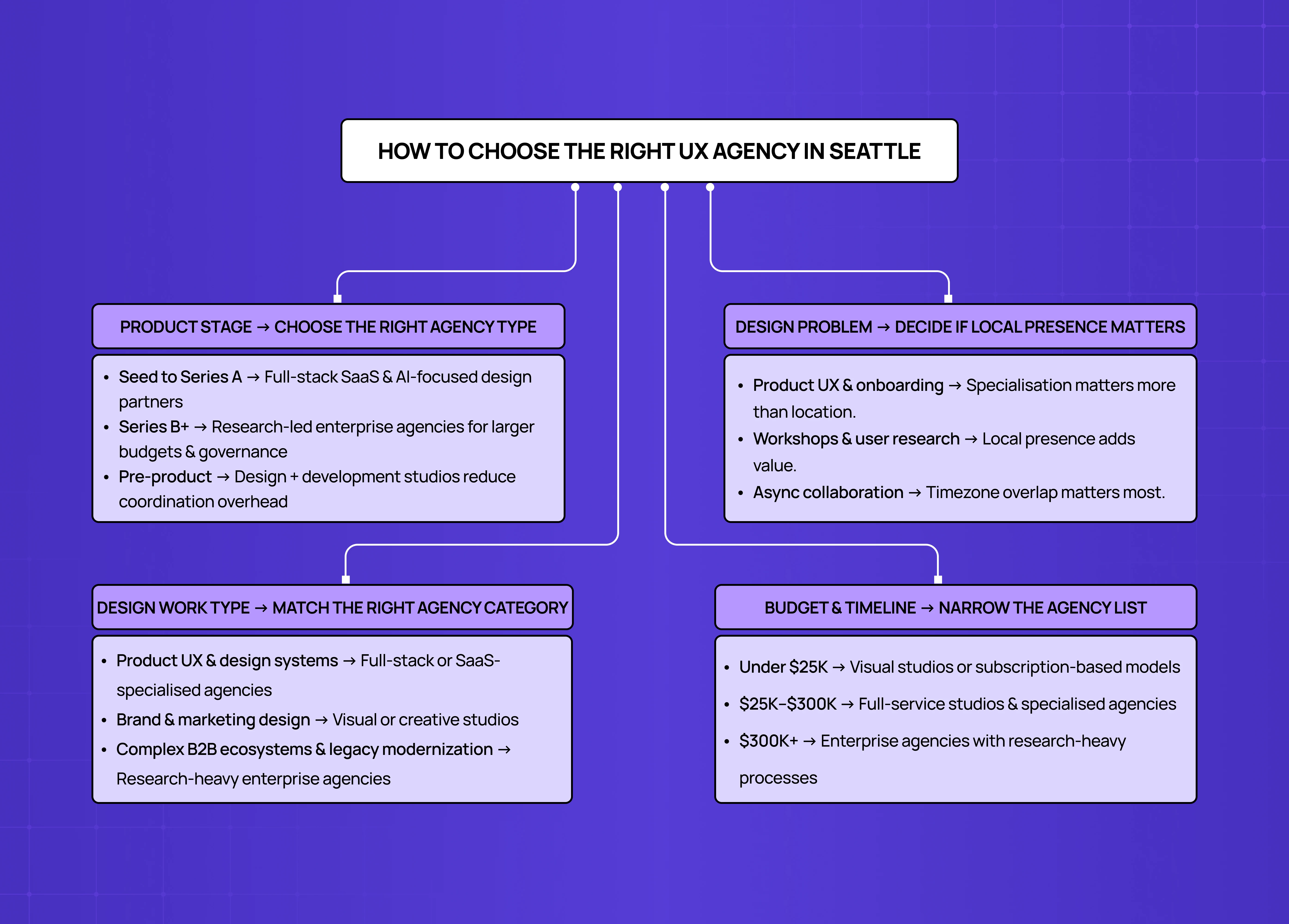
The Seattle UX agency market has real depth — but depth doesn't mean every option is right for every project. Use these four filters in order — and for a more comprehensive vetting process that goes beyond market-specific guidance, the practical checklist for choosing the right web design agency covers the full scope of questions to ask before signing any contract.
1. Your product stage determines your agency type
Seed to Series A → prioritise a full-stack design partner with SaaS and AI experience; enterprise agencies are calibrated for timelines and budgets you likely don't have yet. For a broader cross-market comparison of agencies that specialise specifically in SaaS product design, UX design companies for SaaS products gives early-stage teams a wider frame of reference when building their shortlist beyond Seattle.
Series B and beyond → research-led enterprise agencies (Blink UX, Artefact, UpTop) become appropriate as budget and governance requirements increase
Pre-product → a studio offering design and development together (Substantial, Goji Labs) saves coordination overhead
2. Your design problem determines whether local matters
Product design (UX, dashboards, onboarding) → specialisation matters more than postcode; most of this work happens in Figma and async documentation. Teams open to the full US market will find a comparable depth of options in the top UX design agencies in New York — useful for companies that want to compare Seattle's enterprise-heavy market against a different US design ecosystem.
Stakeholder workshops, co-creation, or in-person user research → local presence adds real value — East Coast and government-facing teams, for instance, often shortlist a Washington DC design agency for exactly that proximity.
Timezone overlap matters more than city proximity for day-to-day async collaboration
3. The type of design work determines the agency category
Product UX and design systems → full-stack studio or SaaS-specialised agency
Brand identity and marketing design → visual/creative studio (Rainfall) or full-stack studio (Groto)
Complex service ecosystems or multi-stakeholder B2B → research-heavy enterprise agency (Artefact, Blink UX)
Legacy system modernization → UpTop
4. Budget and timeline narrow the field significantly
Under $25K → enterprise agencies are not a fit; look at visual studios or subscription-based models
$25K–$50K → full-service studios (Substantial, Goji Labs) and subscription-based studios (Groto) are the realistic options. Many companies at this budget combine an initial UX audit with an ongoing design engagement; understanding how much a UX audit costs helps allocate that budget between discovery and design work before committing to an agency contract.
$50K–$300K → most agencies on this list become viable; filter by specialisation and methodology. Teams at this budget comparing Seattle against other US markets will find a comparable range of options in the Chicago UX agency market — particularly relevant for companies with Midwest operations or distributed teams.
$300K+ → enterprise agencies (Blink UX, Artefact, Smashing Ideas, UpTop) are appropriate; their process is worth the investment at this scale. For a fuller breakdown of what drives costs across engagement model, agency type, and scope, the web design agency pricing guide covers how these budget tiers translate into actual contract structures and deliverable expectations.
Key Takeaways
Seattle has excellent UX agencies, but most are calibrated for enterprise clients. SaaS companies and growth-stage product teams need to filter by agency type, not just Clutch ranking. Before contacting any agency on this list, the skills a UI/UX agency must have in 2026 gives you a concrete vetting checklist to apply in that first conversation — particularly relevant for SaaS and AI teams evaluating whether an enterprise-oriented agency can actually serve their product type.
The four agency types — AI-first full-stack studio, research-heavy enterprise, full-service digital studio, and visual/creative studio — map to different company stages and design problems, and they recur across the national US shortlist too. Matching type to need is the most important decision.
Budget is the fastest filter: enterprise agencies typically start at $50K–$100K minimum. For teams under that threshold, full-service studios and subscription-based models are the realistic options.
Local presence matters for workshops and co-creation; for product design work done in Figma and communicated through documentation, specialisation and timezone overlap outweigh geography. West Coast companies specifically may want to compare Seattle options against the top UX design agencies in Los Angeles, where a similar mix of enterprise, full-service, and startup-focused studios operates in the same timezone.