
10 Best Fintech UX Design Agencies in 2026 — Compared for B2B SaaS and AI-First Teams

Most articles ranking fintech UX agencies are written for enterprise banks and Fortune 500 buyers. This one is for B2B SaaS and AI-first fintech teams at the 10–200 employee stage, the companies where the design decisions are hardest and the stakes are highest.

10 Best Fintech UX Design Agencies in 2026 — Compared for B2B SaaS and AI-First Teams

Most articles ranking fintech UX agencies are written for enterprise banks and Fortune 500 buyers. This one is for B2B SaaS and AI-first fintech teams at the 10–200 employee stage, the companies where the design decisions are hardest and the stakes are highest.

Every fintech UX agency claims to design for trust. This is how to find out which ones actually have.

The fintech UX agency you need depends on what you are building, and most ranking articles don't know the difference.

Finding the right fintech UX design agency is harder than it looks. Most ranking articles in this category were written for enterprise bank buyers; they evaluate agencies on institutional client lists, transformation-program experience, and six-figure minimums. That is not most fintech buyers in 2026. This article is for product leaders at B2B SaaS and AI-first financial companies between 10 and 200 employees: the stage where design decisions are hardest, agency fit matters most, and the wrong choice quietly costs you the enterprise renewal you needed. Teams that need to quantify that cost should read our breakdown of the ROI of UX design before entering agency conversations. We have compared ten agencies on the criteria that matter at that stage: KYC depth, compliance design, multi-role UX, AI output design, and trust architecture, so you can shortlist faster and ask better questions in the first meeting.

Most articles ranking fintech UX design agencies were written for a buyer who works at a bank. They evaluate agencies on Fortune 500 client lists, institutional minimums, and the ability to run a transformation program for 10,000 users. That is a legitimate buyer, but not the only one.

The more common buyer in fintech UX today is a product leader at a 10- to 200-person company: a payments SaaS that just crossed $5M ARR, an AI-native insurance platform in Series A, a lending origination tool that suddenly needs to support five user roles and pass a compliance audit before the next enterprise renewal. That buyer does not need an agency with a $250,000 minimum and a process built for institutional scale. They need an agency that has designed KYC flows that users actually complete, built compliance-aware interfaces that do not create friction for every edge case, and shipped multi-role financial dashboards that make sense to an analyst, an administrator, and an auditor at the same time.

At Groto, we work with exactly these companies. We have seen product design projects across fintech, SaaS, and AI-native financial tools, and we have watched the same avoidable design failures repeat across teams that hired the wrong type of agency for their stage. The pattern is consistent: a team at a $10M ARR fintech picks an agency with strong enterprise banking credentials, and that agency brings a process built for institutional transformation: research sprints spanning months, design systems built for 500-person engineering teams, compliance mapping optimized for national banks. That process gets applied to a product that needs to ship an investor demo in six weeks and close three enterprise deals in the next quarter. Understanding the differences in agency pricing models - project-based, retainer, subscription — is part of avoiding that mismatch before the contract is signed.

This list is for the buyer in the middle: past startup, not yet Fortune 500, building B2B fintech or AI-first financial tools at the stage where UX design either unlocks the next round or quietly costs you the renewal you needed. If the agency vs in-house design question is still open, that is worth settling before comparing specific agencies.

TL;DR

  • Who this is for: Product leaders at B2B SaaS and AI-first fintech companies between $3M and $50M ARR, not enterprise banks, not consumer neobanks starting from zero.

  • The real evaluation question: Not which agency has the best portfolio, but which one has shipped KYC failure states, multi-role dashboards, and compliance-constrained interfaces for products at your stage.

  • The trust architecture frame: Every fintech product needs five layers to work: Signal, Onboarding Compression, Confidence, Error Recovery, and Proof. If one is missing, trust collapses and rarely recovers in the same session.

  • Stage-match first: Consumer fintech and institutional banking transformation require entirely different agencies. Picking by overall quality rather than stage fit is the most common and expensive mistake in this category.

  • How to use this list: Read the "Best for / Don't hire for" on each agency before the profile detail. The table at the end gives you a one-view comparison across all ten.

What Separates a Real Fintech UX Agency from a Generalist with a Financial Client

Before the list: the two questions that consistently separate agencies with genuine fintech trust architecture experience from those that have adjacent experience and good-looking case studies. They extend the broader UX agency skills checklist with two fintech-specific tests that expose the difference between adjacent experience and genuine domain depth.

Question 1: Walk me through a KYC flow you shipped, specifically, what happens when verification fails

Every fintech agency pitches KYC experience. Most have designed the happy path. Agencies that have shipped real financial onboarding can describe, without hesitation:

  • What the interface does when a document does not match

  • What happens when an identity check times out

  • How the system handles a photo that does not meet the resolution threshold

  • How manual review escalation is communicated to the user

Those are not edge cases in fintech products. They are daily realities for compliance teams and frequent realities for end users. The design quality of those failure states predicts onboarding completion rates as reliably as the quality of the main flow. Our guide on how to evaluate a UX portfolio shows what signals to look for and what polished case studies often hide.

Question 2: Which part of the engagement did the agency not do, and who did it?

This question reveals whether the research, compliance mapping, and design system documentation in the case study were done by the pitching team, or quietly subcontracted to partners the buyer never meets. Understanding what a UX agency delivers — and what they typically hand off — is the baseline for asking this well.

  • Strong agencies answer this directly and without hesitation

  • Agencies that have outsourced parts of the work they claimed describe ideal states rather than specific decisions

  • The answer also tells you who is actually in the room if the project runs into compliance complexity mid-engagement

For teams that want a broader decision framework alongside these questions, our checklist on choosing the right design agency covers the general evaluation process this post extends. With that frame in place, here are the ten agencies worth a serious shortlist for a B2B or AI-first fintech product.

10 Best Fintech UX Design Agencies in 2026

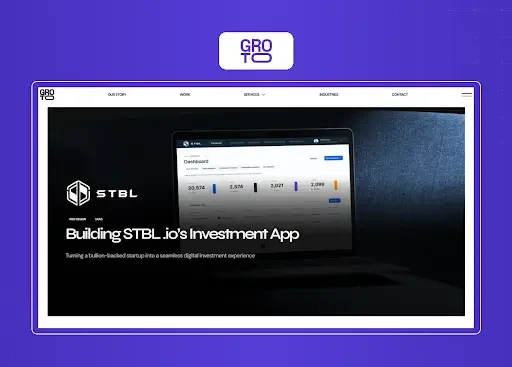
1. Groto
Location: India (remote-first, US timezone availability) 

Pricing: Starts at $2,399/month (Starter) | $4,399/month (Part-Time) | $5,999/month (Full-Time), all quoted at quarterly rates. See full pricing. 

Clutch: 4.9

Best for

B2B SaaS and AI-native fintech companies moving into enterprise territory: products that have accumulated compliance requirements, multi-role user flows, and KYC-bound onboarding faster than their internal design infrastructure can keep up with. Companies between $3M and $50M ARR where the next enterprise deal depends on the admin experience, the compliance dashboard, or the onboarding flow being right.

Not the Right Fit If

You are looking for a consumer neobank app with zero B2B complexity, or a one-off landing page with no product depth behind it. Our model is built for teams that are serious about design as a revenue function: teams that want a dedicated designer embedded in their workflow, strategic UX oversight, and the flexibility to scale without the overhead of a full in-house hire.

Why Groto

Groto is an AI-first, full-stack design studio with a specific practice in B2B SaaS and fintech products at the growth stage. Our work spans financial platforms, insurance tools, lending SaaS, and AI-native products, with clients including PolicyBazaar (one of India's largest insurance and fintech aggregators), Camb.ai, Meydan FZ, and enterprise brands across Fortune 500 categories.

What we bring to fintech engagements specifically:

  • AI-native risk communication: We design financial interfaces that surface AI-generated risk assessments, credit scores, and compliance flags in ways users can act on, not outputs that create confusion or erode trust

  • KYC flow recovery: We have redesigned KYC flows losing 40–60% of users at verification steps. The compliance logic was sound; the problem was that the interface framed regulatory requirements as friction rather than protection

  • Multi-role financial dashboards: We build dashboards where an analyst, a compliance lead, and a C-suite executive see appropriately scoped default views of the same data, with role-based permissions that do not require an IT ticket to configure

  • Subscription flexibility: Plans start at $2,399/month with a 7-day free trial, dedicated designer matched within 24 hours, PM support included, and the ability to pause or cancel anytime with credit rollover

Our Fintech Trust Architecture Framework

Our Trust Architecture framework is the evaluation lens we apply to every fintech engagement before a single wireframe is drawn. It covers five layers:

  • Signal Layer: First-two-second visual trust: the design signals that tell a user the product is safe before they read a word

  • Onboarding Compression Layer: KYC and verification framing, turning compliance steps from interrogation into guided protection

  • Confidence Layer: High-stakes action design: the interface decisions that govern whether a user authorizes a payment or abandons it

  • Error Recovery Layer: Failure states as trust events. How the product behaves when something goes wrong determines whether the user comes back

  • Proof Layer: Post-action confirmation: verifying to the user that the product did exactly what they asked

If any one of those layers is incomplete, trust collapses, and in a financial product, it rarely recovers within the same session.

2. UXDA
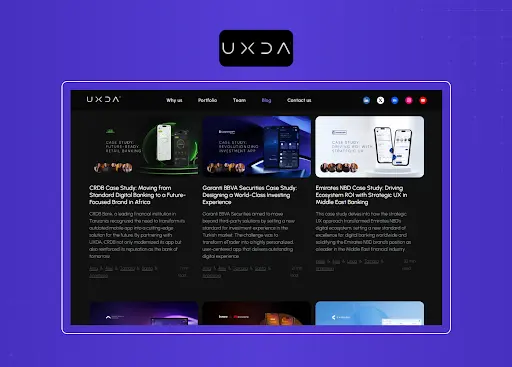
Portfolio page displaying multiple fintech and banking case studies in a dark-themed grid layout with detailed project previews.

Location: Riga, Latvia 

Hourly Rate: $200–$300/hr 

Minimum Engagement: $250,000 

Clutch: 4.8

Best for

Banking institutions and established fintech companies running full digital transformations at institutional scale, specifically products with 10,000+ users, national bank clients, or multi-country regulatory environments.

Don't Hire For

Companies below $20M ARR, fintech startups, or products that need to ship in under 90 days. The engagement model is structured for depth, not velocity.

Why UXDA

UXDA is the only agency on this list that works exclusively in finance. Key facts worth knowing:

  • Portfolio: 150+ banking and fintech products across 39 countries

  • Named clients: HSBC, Emirates NBD, Garanti BBVA, Backbase, GCash, Finastra

  • Methodology: Behavioral psychology applied to financial decision-making, with compliance mapping built from years of engagement with national regulatory environments that most agencies have never encountered

The $250,000 minimum is the right filter in both directions. A company below that threshold is not the client UXDA is structured to serve, and the mismatch creates problems for both sides. A company above that threshold with a genuine banking transformation on the roadmap should put UXDA at the top of the shortlist. No other agency on this list has shipped comparable work at comparable scale in the financial category.

3. Clay
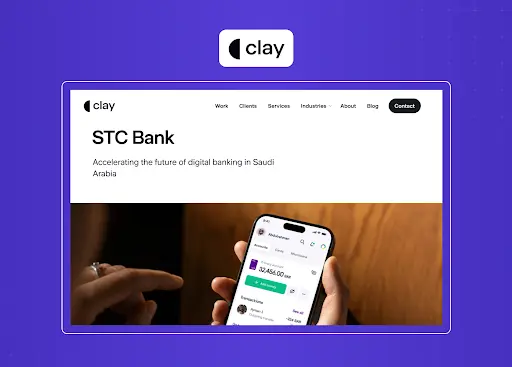
Banking app case study for STC Bank, highlighting a mobile-first digital banking experience with a clean editorial layout.

Location: San Francisco, CA 

Hourly Rate: $150–$199/hr 

Minimum Project: $50,000 

Clutch: 4.9

Best for

Consumer fintech apps, retail payments platforms, and crypto-adjacent products where brand differentiation and onboarding conversion are the primary design problems.

Don't Hire For

Back-office B2B financial platforms, institutional risk tools, or multi-role compliance dashboards. Clay's depth is in consumer experience and brand craft, not enterprise workflow complexity.

Why Clay

Clay has a consumer fintech portfolio that is field-defining at its level:

  • Named clients: Coinbase, Credit Karma, Stripe, Marqeta

  • Strength: Brand architecture and onboarding conversion for consumer financial products

  • What they have not tried to be: An enterprise compliance agency, and the honesty about that scope is part of what makes the portfolio so clean

For a retail payments app or a consumer crypto wallet competing against incumbent banking apps for attention and habit formation, Clay is the most specific answer in the category. For anything where the primary user is a compliance officer or risk analyst running a daily workflow, it is the wrong brief.

4. Cieden
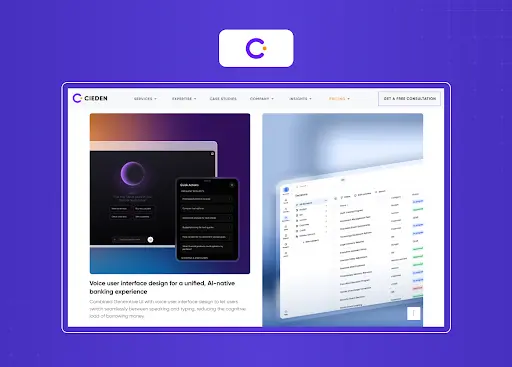
Financial services UX case studies featuring AI-powered banking interfaces, dashboards, and enterprise product design solutions.

Location: Ivano-Frankivsk, Ukraine (also Toronto-registered) 

Hourly Rate: $50–$99/hr 

Minimum Project: $10,000+ 

Clutch: 4.9

Best for

Data-heavy B2B financial platforms where the design problem is organizing dense information for non-technical users: risk analytics, compliance dashboards, embedded finance infrastructure.

Don't Hire For

Consumer onboarding-first products or fintech that needs strong visual brand craft as the primary differentiation.

Why Cieden

Cieden has built a practice specifically around B2B products where complexity is the defining constraint:

  • Named clients: Mastercard, Lendflow

  • Design approach: Information architecture depth over surface visual treatment, which is the right call when the primary user opens the product every morning to make operational decisions

  • Team structure: Distributed across seven countries, giving US-based product squads more scheduling flexibility than a pure offshore model

  • Pricing model: Subscription format makes Cieden viable for six-to-twelve month embedded design capacity, not just defined project scopes

For data-heavy financial platforms at the mid-market stage, the Cieden price-to-depth ratio is the most competitive on this list.

5. Qubstudio
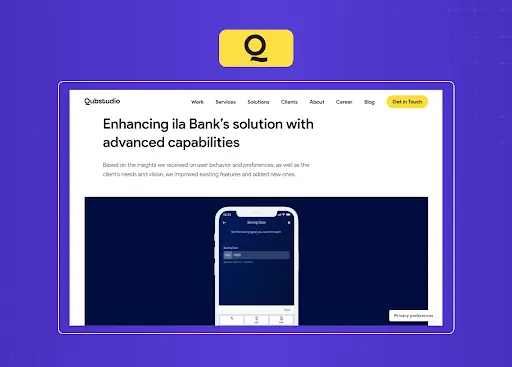
Banking product redesign case study showcasing enhanced digital banking capabilities and mobile user experience improvements.

Location: Lviv, Ukraine 

Hourly Rate: $50–$99/hr 

Minimum Project: $10,000 

Clutch: 4.9

Best for

Mid-market fintech companies that need deep information architecture and a design system that can grow through multiple feature waves without requiring a full redesign.

Don't Hire For

Products that need a US presence, on-site compliance workshops, or enterprise brand work at the Clay or Momentum level.

Why Qubstudio

Qubstudio has one of the longest consistent track records on this list:

  • Founded: 2006

  • Clutch recognition: Top UX agency ranking every year since 2017

  • Named financial clients: Gulf Bank, Ila Bank, Loan Mantra, Deaglo

  • Core strength: Information architecture and structural organization. A financial product with deep IA built in year one does not require an expensive rebuild when it adds three new user roles in year three

For a fintech company between $5M and $25M ARR that wants to invest in the underlying structural quality of the product without enterprise-agency overhead, Qubstudio represents the best price-to-depth tradeoff in the category at the offshore tier. Teams building at this stage will find our guide to SaaS UX design useful context for the baseline standards any mid-market agency should meet.

6. Eleken
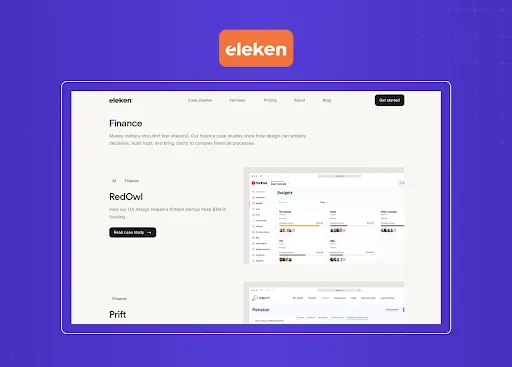
Finance industry portfolio page featuring SaaS and fintech product case studies focused on simplifying complex financial workflows.

Location: Kyiv, Ukraine (US LLC registered) 

Hourly Rate: $25–$49/hr 

Subscription: $3,799–$10,999+/month 

Clutch: 4.9

Best for

Fintech startups and early-growth-stage SaaS that need a dedicated designer embedded in the product team for continuous iteration, not a defined project scope.

Don't Hire For

Products that need compliance mapping as part of the design engagement, institutional security review, or on-site client workshops. The model is built for remote async iteration, not compliance-heavy delivery.

Why Eleken

Eleken runs a distinctly different engagement model from every other agency on this list:

  • Model: One dedicated designer, embedded in your standups, iterating on your product, with no account manager in the middle

  • Portfolio: 200+ SaaS products

  • Clutch signal: Consistently high scores for responsiveness, which is hard to fake across that volume of reviews

  • Ideal timeline: Six months of steady product iteration for a pre-Series A to Series B fintech team

The model has real limits. Complex compliance design and multi-stakeholder research projects are outside its scope. But within the range it targets, it consistently delivers. Teams that want comparable subscription pricing with deeper compliance capability should see our guide to Eleken alternatives.

7. UX Studio
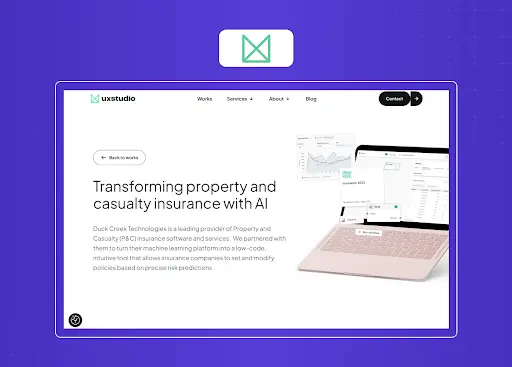
Insurance technology case study illustrating AI-driven property and casualty insurance solutions across web and desktop platforms.

Location: Budapest, Hungary (US LLC registered) 

Hourly Rate: $50–$99/hr 

Minimum Project: $10,000 

Clutch: 5.0

Best for

B2B fintech products with multiple user roles: advisor, analyst, compliance officer, and end customer, where the research process needs to precede and inform the architecture, not run alongside it.

Don't Hire For

Startups that need a fast-moving embedded designer rather than a research-led engagement, or products where visual brand differentiation is the primary deliverable.

Why UX Studio

UX Studio is the research-first pick in this list:

  • Named financial clients: Finshape, Zignaly

  • Core methodology: User research and role mapping as preconditions for architecture decisions, which is the process discipline most agencies skip and most enterprise financial products eventually pay for in redesign cost

  • Engagement structure: Subscription model for embedded teams gives product organizations flexibility beyond a standard project scope

For a B2B fintech with complex user roles that needs research-grounded architecture before committing to a build roadmap, UX Studio's process discipline is the specific differentiator.

8. Fuselab Creative
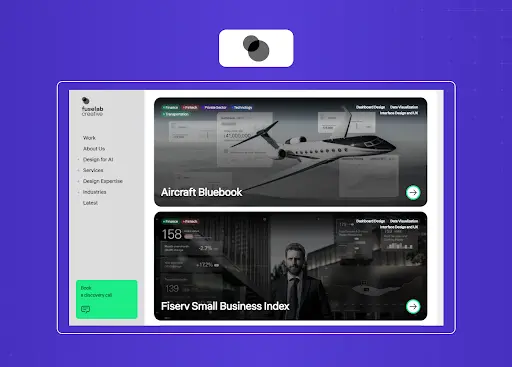
Data visualization and fintech portfolio highlighting enterprise dashboards, analytics platforms, and aviation finance products.

Location: McLean, VA 

Hourly Rate: $100–$149/hr 

Minimum Project: $25,000 

Clutch: 5.0

Best for

Enterprise financial dashboards, institutional data platforms, and operational tools where the design problem is information density for professional users running daily workflows.

Don't Hire For

Consumer fintech onboarding, fintech startups below $5M ARR, or AI-native products where the primary design challenge is communicating AI behavior and output quality to non-technical users.

Why Fuselab Creative

Fuselab Creative is a US-based agency with deep institutional financial dashboard experience:

  • Named clients: Fiserv (Small Business Index platform), Aircraft Bluebook (aviation lending and insurance finance tool), Uber (enterprise dashboard work)

  • Core strength: Professional users making decisions quickly against dense, real-time data, which is a genuinely different design problem from consumer onboarding or B2B SaaS activation

  • Best fit scenario: Financial products that live inside enterprise data environments: internal risk dashboards, BI tools for financial operations teams, institutional analytics platforms

For everything upstream of that (activation, onboarding, trust architecture, multi-role workflow), the Fuselab model is built for a different problem.

9. Momentum Design Lab
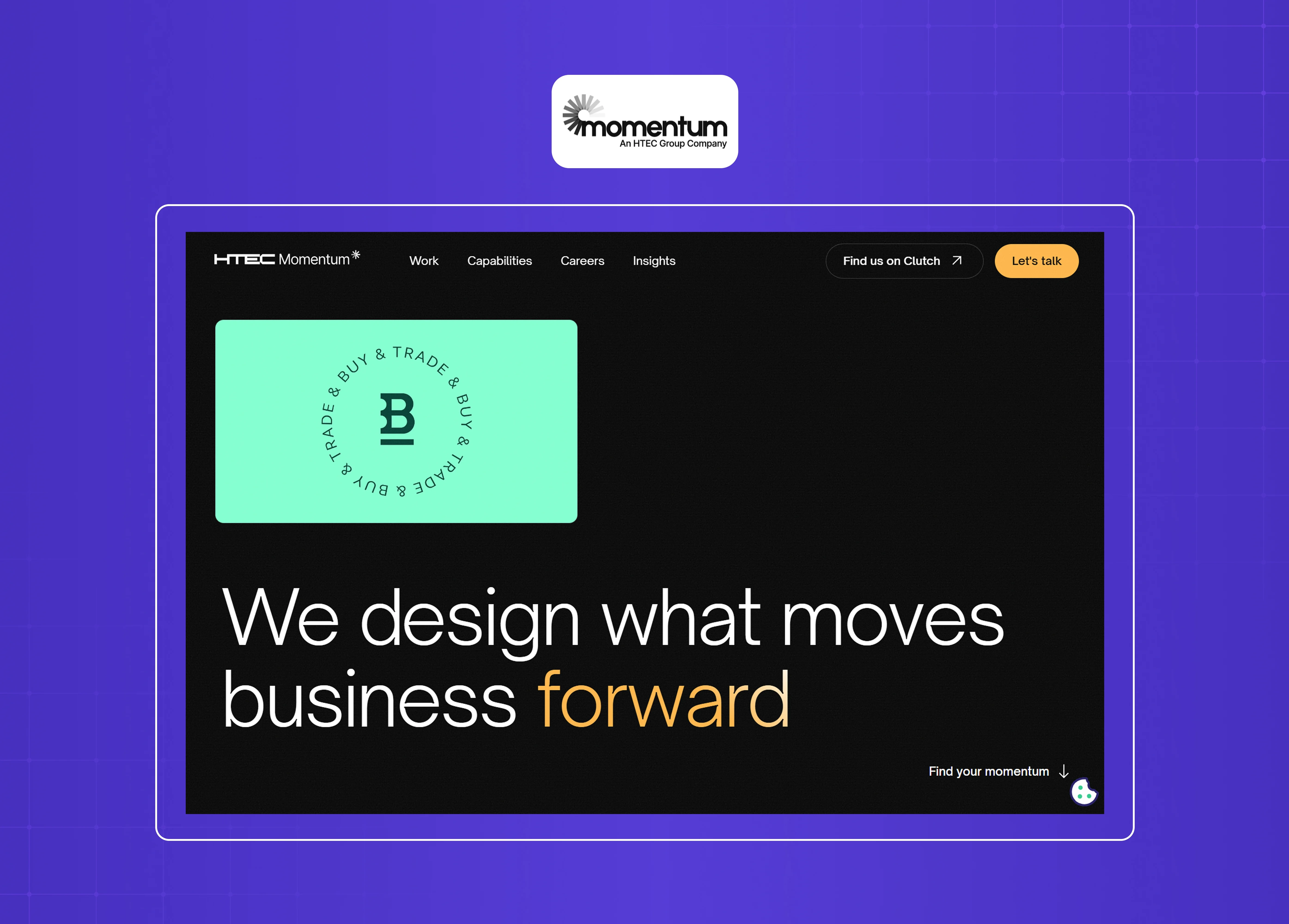
HTEC Momentum website homepage displayed in a modern browser frame.

Location: San Mateo, CA (also New York and London) 

Hourly Rate: $150–$199/hr 

Minimum Project: $25,000 

Clutch: 4.9

Best for

Fortune 500 financial companies and large wealth management firms running enterprise transformation programs, specifically products where design must survive CIO review, multi-stakeholder governance, and a 12-to-24-month delivery horizon.

Don't Hire For

Teams below 100 employees, fintech startups, or companies that need design velocity over institutional process rigor.

Why Momentum Design Lab

Momentum Design Lab is the enterprise-transformation specialist on this list:

  • Acquisition: HTEC Group acquired Momentum in 2021, adding engineering capacity that allows the agency to take engagements from strategy through to delivery at institutional scale

  • Financial portfolio: Fortune 500 banks, wealth management platforms, CRM analytics tools

  • Sweet spot: Large data architectures serving multiple user roles: analysts, advisors, and executives, with different default views and access levels

For a company with the budget, the timeline, and the institutional stakeholder complexity that Momentum's process is built for, the combination of design depth and engineering integration is a genuine differentiator. For most fintech companies reading this article, the engagement model is sized for a different problem.

10. Arounda

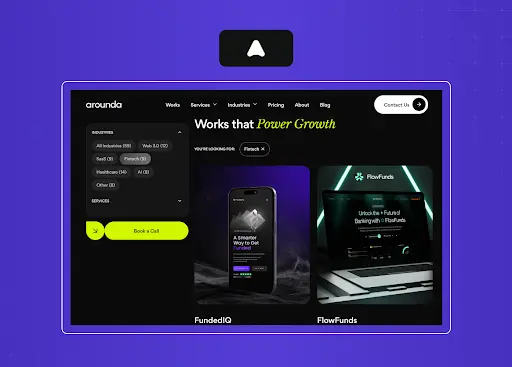
Fintech-focused portfolio gallery showcasing startup and SaaS product designs with a bold, high-contrast visual presentation.

Location: Kyiv, Ukraine 

Hourly Rate: $25–$49/hr 

Minimum Project: $25,000 

Clutch: 4.9

Best for

Neobanking startups, Web3-native financial products, DeFi platforms, and crypto-adjacent fintech where the design challenge involves communicating novel financial mechanisms to users with limited prior context.

Don't Hire For

Regulated institutional finance, compliance-heavy B2B platforms, or products requiring deep legacy system mental model mapping.

Why Arounda

Arounda has built a documented practice in emerging financial product categories:

  • Specialization: Neobanking, DeFi, blockchain-native UX, where the design challenge is not just usability but comprehension

  • Notable result: Helped a Web3 fintech client secure $34M in funding, with the design work credited as a material factor in investor confidence

  • Core design problem they solve: Helping users understand what the product is doing with their money in a category where incumbent mental models do not reliably transfer

For founders building financial products at the edge of what users currently understand: tokenized assets, on-chain financial instruments, AI-driven investment automation. Arounda's specific experience in this design problem is the differentiator. For traditional fintech workflows and regulated B2B platforms, the scope is a poor fit.

How to Match Your Fintech Product Stage to the Right Agency

The most common fintech UX hiring mistake is evaluating agencies by overall quality rather than stage fit. Every agency on this list is credible. What differs is which design problem each one is built to solve.

  • Consumer retail fintech: If your product is competing for onboarding conversion and brand differentiation, the Signal Layer and Onboarding Compression Layer dominate. The right agency has shipped consumer financial products you have actually used, with measurable onboarding completion outcomes and documented brand architecture decisions. Clay is the most specific answer; Arounda is the right answer if the product is crypto-native or Web3-adjacent. For mobile-first fintech products, our list of mobile app UX agencies covers the agencies with the deepest native execution capability.


  • B2B fintech SaaS growing into enterprise complexity: If your product has multi-role access, compliance constraints, AI-generated outputs, and workflow approvals, all five trust architecture layers matter. The Confidence Layer and Error Recovery Layer are particularly high-stakes because professional users are making decisions on behalf of their organizations. This is Groto's primary practice area, with Cieden and Qubstudio as strong mid-market alternatives. For a broader view of UX design companies for SaaS across verticals beyond fintech, our companion list covers the same buyer stage.

  • Banking institution running full digital transformation: The agency question here is not about trust architecture; it is about institutional process, regulatory depth, and the ability to govern a design program across a 12-to-24-month timeline. The UX conventions and trust standards behind modern banking app design are what both UXDA and Momentum are expected to know and extend. Neither is the right fit below $20M ARR.

  • AI-native financial product: If you are building an AI underwriting tool, an AI-assisted portfolio manager, or an AI compliance monitor, the evaluation question adds a layer beyond standard trust architecture. Does the agency have experience designing around AI output quality, confidence calibration, and error attribution in financial contexts? Those are distinct design problems — our guide to AI dashboard design covers the specific standards agencies in this category should be able to meet. Groto is the agency on this list with the most direct experience in that specific category.

Comparison Table: 10 Fintech UX Design Agencies at a Glance

Agency

Best for

Pricing

Location

Fintech specialty

Clutch rating

Groto

B2B fintech SaaS, AI-native financial tools

$2,399 -$5,999+/month

India / Remote

Trust architecture, KYC, multi-role, AI UX

4.9

UXDA

Banking transformation, institutional finance

$200–300/hr, $250K+ min


Riga, Latvia

Banking UX, 150+ finance products

4.8

Clay

Consumer fintech, crypto, retail payments

$150–199/hr, $50K+ min

San Francisco, CA

Consumer brand + product, Coinbase / Stripe

4.9

Cieden

B2B data-heavy financial platforms

$50–99/hr, $10K+ min

Ukraine / Toronto

Risk dashboards, compliance analytics

4.9

Qubstudio

Mid-market fintech, IA, design systems

$50–99/hr, $10K+ min

Lviv, Ukraine

Banking UX, payments, IA depth

4.9

Eleken

Fintech startups, subscription model

$3,799 - $10,999+/month

Kyiv, Ukraine

SaaS iteration, embedded designers

4.9

UX Studio

Multi-role B2B fintech, research-first

$50–99/hr, $10K+ min

Budapest, Hungary

Research-led, ecosystem design

5.0

Fuselab Creative

Institutional data tools, financial BI

$100–149/hr, $25K+ min

McLean, VA

Dashboards, institutional data platforms

5.0

Momentum Design Lab

Fortune 500 financial transformation

$150–199/hr, $25K+ min


San Mateo, CA

Enterprise transformation, wealth mgmt

4.9

Arounda

Neobanking, Web3, DeFi UX

$25–49/hr, $25K+ min


Kyiv, Ukraine

Crypto UX, emerging finance categories

4.9

Use the table above as a starting filter, then apply the stage-matching logic above to confirm the right fit for your product. Teams evaluating beyond the fintech vertical can cross-reference our list of top product design agencies across categories.

Conclusion

The fintech UX agency worth hiring is the one built for your specific design problem, not the one with the most impressive institutional client list or the lowest hourly rate.

  • If you are building a consumer financial product, the trust challenge is first-two-second visual credibility and onboarding completion rate. Clay and Arounda are built for this.

  • If you are building B2B fintech SaaS at the enterprise inflection point, the trust challenge is five layers deep and involves KYC flows, multi-role workflows, compliance-constrained interfaces, and AI output design. Groto, Cieden, and Qubstudio are the right conversation.

  • If you are a banking institution running a transformation program, the challenge is institutional governance and regulatory depth at scale. UXDA and Momentum are built for this. No one else on this list is.

  • If you are building at the edge of what fintech users currently understand: DeFi, on-chain assets, AI-automated finance, where the trust challenge is comprehension before credibility. Arounda has shipped in this category.

Ask every agency the KYC failure-state question. Ask what they subcontract and to whom. Ask what they would change about their last fintech project. The answers tell you more than the portfolio.

Groto works with B2B SaaS and AI-native fintech companies in the $3M–$50M ARR range. If your product has crossed into enterprise complexity and your trust architecture is incomplete, talk to our team.
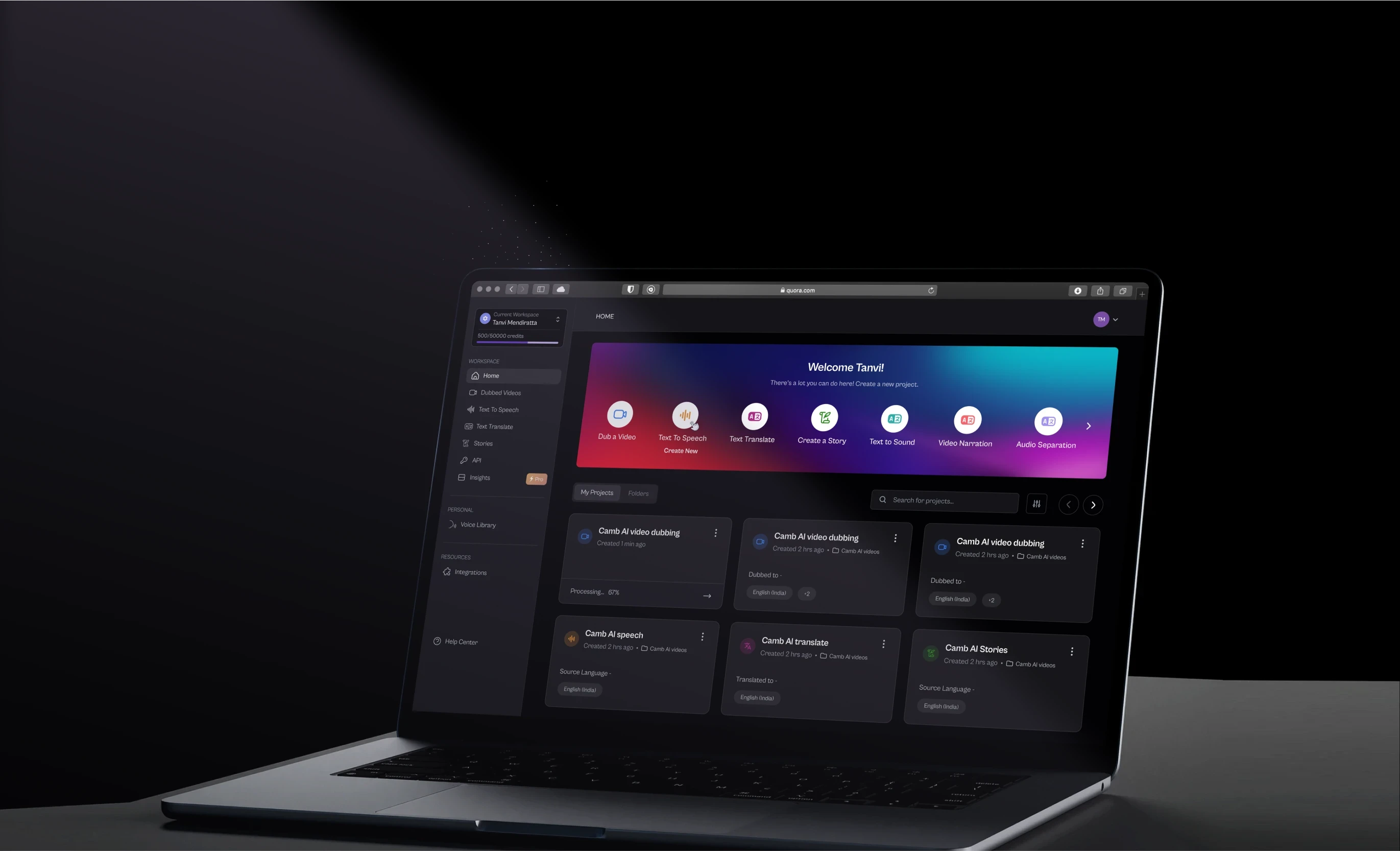

Every fintech UX agency claims to design for trust. This is how to find out which ones actually have.

The fintech UX agency you need depends on what you are building, and most ranking articles don't know the difference.

Finding the right fintech UX design agency is harder than it looks. Most ranking articles in this category were written for enterprise bank buyers; they evaluate agencies on institutional client lists, transformation-program experience, and six-figure minimums. That is not most fintech buyers in 2026. This article is for product leaders at B2B SaaS and AI-first financial companies between 10 and 200 employees: the stage where design decisions are hardest, agency fit matters most, and the wrong choice quietly costs you the enterprise renewal you needed. Teams that need to quantify that cost should read our breakdown of the ROI of UX design before entering agency conversations. We have compared ten agencies on the criteria that matter at that stage: KYC depth, compliance design, multi-role UX, AI output design, and trust architecture, so you can shortlist faster and ask better questions in the first meeting.

Most articles ranking fintech UX design agencies were written for a buyer who works at a bank. They evaluate agencies on Fortune 500 client lists, institutional minimums, and the ability to run a transformation program for 10,000 users. That is a legitimate buyer, but not the only one.

The more common buyer in fintech UX today is a product leader at a 10- to 200-person company: a payments SaaS that just crossed $5M ARR, an AI-native insurance platform in Series A, a lending origination tool that suddenly needs to support five user roles and pass a compliance audit before the next enterprise renewal. That buyer does not need an agency with a $250,000 minimum and a process built for institutional scale. They need an agency that has designed KYC flows that users actually complete, built compliance-aware interfaces that do not create friction for every edge case, and shipped multi-role financial dashboards that make sense to an analyst, an administrator, and an auditor at the same time.

At Groto, we work with exactly these companies. We have seen product design projects across fintech, SaaS, and AI-native financial tools, and we have watched the same avoidable design failures repeat across teams that hired the wrong type of agency for their stage. The pattern is consistent: a team at a $10M ARR fintech picks an agency with strong enterprise banking credentials, and that agency brings a process built for institutional transformation: research sprints spanning months, design systems built for 500-person engineering teams, compliance mapping optimized for national banks. That process gets applied to a product that needs to ship an investor demo in six weeks and close three enterprise deals in the next quarter. Understanding the differences in agency pricing models - project-based, retainer, subscription — is part of avoiding that mismatch before the contract is signed.

This list is for the buyer in the middle: past startup, not yet Fortune 500, building B2B fintech or AI-first financial tools at the stage where UX design either unlocks the next round or quietly costs you the renewal you needed. If the agency vs in-house design question is still open, that is worth settling before comparing specific agencies.

TL;DR

  • Who this is for: Product leaders at B2B SaaS and AI-first fintech companies between $3M and $50M ARR, not enterprise banks, not consumer neobanks starting from zero.

  • The real evaluation question: Not which agency has the best portfolio, but which one has shipped KYC failure states, multi-role dashboards, and compliance-constrained interfaces for products at your stage.

  • The trust architecture frame: Every fintech product needs five layers to work: Signal, Onboarding Compression, Confidence, Error Recovery, and Proof. If one is missing, trust collapses and rarely recovers in the same session.

  • Stage-match first: Consumer fintech and institutional banking transformation require entirely different agencies. Picking by overall quality rather than stage fit is the most common and expensive mistake in this category.

  • How to use this list: Read the "Best for / Don't hire for" on each agency before the profile detail. The table at the end gives you a one-view comparison across all ten.

What Separates a Real Fintech UX Agency from a Generalist with a Financial Client

Before the list: the two questions that consistently separate agencies with genuine fintech trust architecture experience from those that have adjacent experience and good-looking case studies. They extend the broader UX agency skills checklist with two fintech-specific tests that expose the difference between adjacent experience and genuine domain depth.

Question 1: Walk me through a KYC flow you shipped, specifically, what happens when verification fails

Every fintech agency pitches KYC experience. Most have designed the happy path. Agencies that have shipped real financial onboarding can describe, without hesitation:

  • What the interface does when a document does not match

  • What happens when an identity check times out

  • How the system handles a photo that does not meet the resolution threshold

  • How manual review escalation is communicated to the user

Those are not edge cases in fintech products. They are daily realities for compliance teams and frequent realities for end users. The design quality of those failure states predicts onboarding completion rates as reliably as the quality of the main flow. Our guide on how to evaluate a UX portfolio shows what signals to look for and what polished case studies often hide.

Question 2: Which part of the engagement did the agency not do, and who did it?

This question reveals whether the research, compliance mapping, and design system documentation in the case study were done by the pitching team, or quietly subcontracted to partners the buyer never meets. Understanding what a UX agency delivers — and what they typically hand off — is the baseline for asking this well.

  • Strong agencies answer this directly and without hesitation

  • Agencies that have outsourced parts of the work they claimed describe ideal states rather than specific decisions

  • The answer also tells you who is actually in the room if the project runs into compliance complexity mid-engagement

For teams that want a broader decision framework alongside these questions, our checklist on choosing the right design agency covers the general evaluation process this post extends. With that frame in place, here are the ten agencies worth a serious shortlist for a B2B or AI-first fintech product.

10 Best Fintech UX Design Agencies in 2026

1. Groto

Location: India (remote-first, US timezone availability) 

Pricing: Starts at $2,399/month (Starter) | $4,399/month (Part-Time) | $5,999/month (Full-Time), all quoted at quarterly rates. See full pricing. 

Clutch: 4.9

Best for

B2B SaaS and AI-native fintech companies moving into enterprise territory: products that have accumulated compliance requirements, multi-role user flows, and KYC-bound onboarding faster than their internal design infrastructure can keep up with. Companies between $3M and $50M ARR where the next enterprise deal depends on the admin experience, the compliance dashboard, or the onboarding flow being right.

Not the Right Fit If

You are looking for a consumer neobank app with zero B2B complexity, or a one-off landing page with no product depth behind it. Our model is built for teams that are serious about design as a revenue function: teams that want a dedicated designer embedded in their workflow, strategic UX oversight, and the flexibility to scale without the overhead of a full in-house hire.

Why Groto

Groto is an AI-first, full-stack design studio with a specific practice in B2B SaaS and fintech products at the growth stage. Our work spans financial platforms, insurance tools, lending SaaS, and AI-native products, with clients including PolicyBazaar (one of India's largest insurance and fintech aggregators), Camb.ai, Meydan FZ, and enterprise brands across Fortune 500 categories.

What we bring to fintech engagements specifically:

  • AI-native risk communication: We design financial interfaces that surface AI-generated risk assessments, credit scores, and compliance flags in ways users can act on, not outputs that create confusion or erode trust

  • KYC flow recovery: We have redesigned KYC flows losing 40–60% of users at verification steps. The compliance logic was sound; the problem was that the interface framed regulatory requirements as friction rather than protection

  • Multi-role financial dashboards: We build dashboards where an analyst, a compliance lead, and a C-suite executive see appropriately scoped default views of the same data, with role-based permissions that do not require an IT ticket to configure

  • Subscription flexibility: Plans start at $2,399/month with a 7-day free trial, dedicated designer matched within 24 hours, PM support included, and the ability to pause or cancel anytime with credit rollover

Our Fintech Trust Architecture Framework

Our Trust Architecture framework is the evaluation lens we apply to every fintech engagement before a single wireframe is drawn. It covers five layers:

  • Signal Layer: First-two-second visual trust: the design signals that tell a user the product is safe before they read a word

  • Onboarding Compression Layer: KYC and verification framing, turning compliance steps from interrogation into guided protection

  • Confidence Layer: High-stakes action design: the interface decisions that govern whether a user authorizes a payment or abandons it

  • Error Recovery Layer: Failure states as trust events. How the product behaves when something goes wrong determines whether the user comes back

  • Proof Layer: Post-action confirmation: verifying to the user that the product did exactly what they asked

If any one of those layers is incomplete, trust collapses, and in a financial product, it rarely recovers within the same session.

2. UXDA

Portfolio page displaying multiple fintech and banking case studies in a dark-themed grid layout with detailed project previews.

Location: Riga, Latvia 

Hourly Rate: $200–$300/hr 

Minimum Engagement: $250,000 

Clutch: 4.8

Best for

Banking institutions and established fintech companies running full digital transformations at institutional scale, specifically products with 10,000+ users, national bank clients, or multi-country regulatory environments.

Don't Hire For

Companies below $20M ARR, fintech startups, or products that need to ship in under 90 days. The engagement model is structured for depth, not velocity.

Why UXDA

UXDA is the only agency on this list that works exclusively in finance. Key facts worth knowing:

  • Portfolio: 150+ banking and fintech products across 39 countries

  • Named clients: HSBC, Emirates NBD, Garanti BBVA, Backbase, GCash, Finastra

  • Methodology: Behavioral psychology applied to financial decision-making, with compliance mapping built from years of engagement with national regulatory environments that most agencies have never encountered

The $250,000 minimum is the right filter in both directions. A company below that threshold is not the client UXDA is structured to serve, and the mismatch creates problems for both sides. A company above that threshold with a genuine banking transformation on the roadmap should put UXDA at the top of the shortlist. No other agency on this list has shipped comparable work at comparable scale in the financial category.

3. Clay

Banking app case study for STC Bank, highlighting a mobile-first digital banking experience with a clean editorial layout.

Location: San Francisco, CA 

Hourly Rate: $150–$199/hr 

Minimum Project: $50,000 

Clutch: 4.9

Best for

Consumer fintech apps, retail payments platforms, and crypto-adjacent products where brand differentiation and onboarding conversion are the primary design problems.

Don't Hire For

Back-office B2B financial platforms, institutional risk tools, or multi-role compliance dashboards. Clay's depth is in consumer experience and brand craft, not enterprise workflow complexity.

Why Clay

Clay has a consumer fintech portfolio that is field-defining at its level:

  • Named clients: Coinbase, Credit Karma, Stripe, Marqeta

  • Strength: Brand architecture and onboarding conversion for consumer financial products

  • What they have not tried to be: An enterprise compliance agency, and the honesty about that scope is part of what makes the portfolio so clean

For a retail payments app or a consumer crypto wallet competing against incumbent banking apps for attention and habit formation, Clay is the most specific answer in the category. For anything where the primary user is a compliance officer or risk analyst running a daily workflow, it is the wrong brief.

4. Cieden

Financial services UX case studies featuring AI-powered banking interfaces, dashboards, and enterprise product design solutions.

Location: Ivano-Frankivsk, Ukraine (also Toronto-registered) 

Hourly Rate: $50–$99/hr 

Minimum Project: $10,000+ 

Clutch: 4.9

Best for

Data-heavy B2B financial platforms where the design problem is organizing dense information for non-technical users: risk analytics, compliance dashboards, embedded finance infrastructure.

Don't Hire For

Consumer onboarding-first products or fintech that needs strong visual brand craft as the primary differentiation.

Why Cieden

Cieden has built a practice specifically around B2B products where complexity is the defining constraint:

  • Named clients: Mastercard, Lendflow

  • Design approach: Information architecture depth over surface visual treatment, which is the right call when the primary user opens the product every morning to make operational decisions

  • Team structure: Distributed across seven countries, giving US-based product squads more scheduling flexibility than a pure offshore model

  • Pricing model: Subscription format makes Cieden viable for six-to-twelve month embedded design capacity, not just defined project scopes

For data-heavy financial platforms at the mid-market stage, the Cieden price-to-depth ratio is the most competitive on this list.

5. Qubstudio

Banking product redesign case study showcasing enhanced digital banking capabilities and mobile user experience improvements.

Location: Lviv, Ukraine 

Hourly Rate: $50–$99/hr 

Minimum Project: $10,000 

Clutch: 4.9

Best for

Mid-market fintech companies that need deep information architecture and a design system that can grow through multiple feature waves without requiring a full redesign.

Don't Hire For

Products that need a US presence, on-site compliance workshops, or enterprise brand work at the Clay or Momentum level.

Why Qubstudio

Qubstudio has one of the longest consistent track records on this list:

  • Founded: 2006

  • Clutch recognition: Top UX agency ranking every year since 2017

  • Named financial clients: Gulf Bank, Ila Bank, Loan Mantra, Deaglo

  • Core strength: Information architecture and structural organization. A financial product with deep IA built in year one does not require an expensive rebuild when it adds three new user roles in year three

For a fintech company between $5M and $25M ARR that wants to invest in the underlying structural quality of the product without enterprise-agency overhead, Qubstudio represents the best price-to-depth tradeoff in the category at the offshore tier. Teams building at this stage will find our guide to SaaS UX design useful context for the baseline standards any mid-market agency should meet.

6. Eleken

Finance industry portfolio page featuring SaaS and fintech product case studies focused on simplifying complex financial workflows.

Location: Kyiv, Ukraine (US LLC registered) 

Hourly Rate: $25–$49/hr 

Subscription: $3,799–$10,999+/month 

Clutch: 4.9

Best for

Fintech startups and early-growth-stage SaaS that need a dedicated designer embedded in the product team for continuous iteration, not a defined project scope.

Don't Hire For

Products that need compliance mapping as part of the design engagement, institutional security review, or on-site client workshops. The model is built for remote async iteration, not compliance-heavy delivery.

Why Eleken

Eleken runs a distinctly different engagement model from every other agency on this list:

  • Model: One dedicated designer, embedded in your standups, iterating on your product, with no account manager in the middle

  • Portfolio: 200+ SaaS products

  • Clutch signal: Consistently high scores for responsiveness, which is hard to fake across that volume of reviews

  • Ideal timeline: Six months of steady product iteration for a pre-Series A to Series B fintech team

The model has real limits. Complex compliance design and multi-stakeholder research projects are outside its scope. But within the range it targets, it consistently delivers. Teams that want comparable subscription pricing with deeper compliance capability should see our guide to Eleken alternatives.

7. UX Studio

Insurance technology case study illustrating AI-driven property and casualty insurance solutions across web and desktop platforms.

Location: Budapest, Hungary (US LLC registered) 

Hourly Rate: $50–$99/hr 

Minimum Project: $10,000 

Clutch: 5.0

Best for

B2B fintech products with multiple user roles: advisor, analyst, compliance officer, and end customer, where the research process needs to precede and inform the architecture, not run alongside it.

Don't Hire For

Startups that need a fast-moving embedded designer rather than a research-led engagement, or products where visual brand differentiation is the primary deliverable.

Why UX Studio

UX Studio is the research-first pick in this list:

  • Named financial clients: Finshape, Zignaly

  • Core methodology: User research and role mapping as preconditions for architecture decisions, which is the process discipline most agencies skip and most enterprise financial products eventually pay for in redesign cost

  • Engagement structure: Subscription model for embedded teams gives product organizations flexibility beyond a standard project scope

For a B2B fintech with complex user roles that needs research-grounded architecture before committing to a build roadmap, UX Studio's process discipline is the specific differentiator.

8. Fuselab Creative

Data visualization and fintech portfolio highlighting enterprise dashboards, analytics platforms, and aviation finance products.

Location: McLean, VA 

Hourly Rate: $100–$149/hr 

Minimum Project: $25,000 

Clutch: 5.0

Best for

Enterprise financial dashboards, institutional data platforms, and operational tools where the design problem is information density for professional users running daily workflows.

Don't Hire For

Consumer fintech onboarding, fintech startups below $5M ARR, or AI-native products where the primary design challenge is communicating AI behavior and output quality to non-technical users.

Why Fuselab Creative

Fuselab Creative is a US-based agency with deep institutional financial dashboard experience:

  • Named clients: Fiserv (Small Business Index platform), Aircraft Bluebook (aviation lending and insurance finance tool), Uber (enterprise dashboard work)

  • Core strength: Professional users making decisions quickly against dense, real-time data, which is a genuinely different design problem from consumer onboarding or B2B SaaS activation

  • Best fit scenario: Financial products that live inside enterprise data environments: internal risk dashboards, BI tools for financial operations teams, institutional analytics platforms

For everything upstream of that (activation, onboarding, trust architecture, multi-role workflow), the Fuselab model is built for a different problem.

9. Momentum Design Lab

HTEC Momentum website homepage displayed in a modern browser frame.

Location: San Mateo, CA (also New York and London) 

Hourly Rate: $150–$199/hr 

Minimum Project: $25,000 

Clutch: 4.9

Best for

Fortune 500 financial companies and large wealth management firms running enterprise transformation programs, specifically products where design must survive CIO review, multi-stakeholder governance, and a 12-to-24-month delivery horizon.

Don't Hire For

Teams below 100 employees, fintech startups, or companies that need design velocity over institutional process rigor.

Why Momentum Design Lab

Momentum Design Lab is the enterprise-transformation specialist on this list:

  • Acquisition: HTEC Group acquired Momentum in 2021, adding engineering capacity that allows the agency to take engagements from strategy through to delivery at institutional scale

  • Financial portfolio: Fortune 500 banks, wealth management platforms, CRM analytics tools

  • Sweet spot: Large data architectures serving multiple user roles: analysts, advisors, and executives, with different default views and access levels

For a company with the budget, the timeline, and the institutional stakeholder complexity that Momentum's process is built for, the combination of design depth and engineering integration is a genuine differentiator. For most fintech companies reading this article, the engagement model is sized for a different problem.

10. Arounda

Fintech-focused portfolio gallery showcasing startup and SaaS product designs with a bold, high-contrast visual presentation.

Location: Kyiv, Ukraine 

Hourly Rate: $25–$49/hr 

Minimum Project: $25,000 

Clutch: 4.9

Best for

Neobanking startups, Web3-native financial products, DeFi platforms, and crypto-adjacent fintech where the design challenge involves communicating novel financial mechanisms to users with limited prior context.

Don't Hire For

Regulated institutional finance, compliance-heavy B2B platforms, or products requiring deep legacy system mental model mapping.

Why Arounda

Arounda has built a documented practice in emerging financial product categories:

  • Specialization: Neobanking, DeFi, blockchain-native UX, where the design challenge is not just usability but comprehension

  • Notable result: Helped a Web3 fintech client secure $34M in funding, with the design work credited as a material factor in investor confidence

  • Core design problem they solve: Helping users understand what the product is doing with their money in a category where incumbent mental models do not reliably transfer

For founders building financial products at the edge of what users currently understand: tokenized assets, on-chain financial instruments, AI-driven investment automation. Arounda's specific experience in this design problem is the differentiator. For traditional fintech workflows and regulated B2B platforms, the scope is a poor fit.

How to Match Your Fintech Product Stage to the Right Agency

The most common fintech UX hiring mistake is evaluating agencies by overall quality rather than stage fit. Every agency on this list is credible. What differs is which design problem each one is built to solve.

  • Consumer retail fintech: If your product is competing for onboarding conversion and brand differentiation, the Signal Layer and Onboarding Compression Layer dominate. The right agency has shipped consumer financial products you have actually used, with measurable onboarding completion outcomes and documented brand architecture decisions. Clay is the most specific answer; Arounda is the right answer if the product is crypto-native or Web3-adjacent. For mobile-first fintech products, our list of mobile app UX agencies covers the agencies with the deepest native execution capability.


  • B2B fintech SaaS growing into enterprise complexity: If your product has multi-role access, compliance constraints, AI-generated outputs, and workflow approvals, all five trust architecture layers matter. The Confidence Layer and Error Recovery Layer are particularly high-stakes because professional users are making decisions on behalf of their organizations. This is Groto's primary practice area, with Cieden and Qubstudio as strong mid-market alternatives. For a broader view of UX design companies for SaaS across verticals beyond fintech, our companion list covers the same buyer stage.

  • Banking institution running full digital transformation: The agency question here is not about trust architecture; it is about institutional process, regulatory depth, and the ability to govern a design program across a 12-to-24-month timeline. The UX conventions and trust standards behind modern banking app design are what both UXDA and Momentum are expected to know and extend. Neither is the right fit below $20M ARR.

  • AI-native financial product: If you are building an AI underwriting tool, an AI-assisted portfolio manager, or an AI compliance monitor, the evaluation question adds a layer beyond standard trust architecture. Does the agency have experience designing around AI output quality, confidence calibration, and error attribution in financial contexts? Those are distinct design problems — our guide to AI dashboard design covers the specific standards agencies in this category should be able to meet. Groto is the agency on this list with the most direct experience in that specific category.

Comparison Table: 10 Fintech UX Design Agencies at a Glance

Agency

Best for

Pricing

Location

Fintech specialty

Clutch rating

Groto

B2B fintech SaaS, AI-native financial tools

$2,399 -$5,999+/month

India / Remote

Trust architecture, KYC, multi-role, AI UX

4.9

UXDA

Banking transformation, institutional finance

$200–300/hr, $250K+ min


Riga, Latvia

Banking UX, 150+ finance products

4.8

Clay

Consumer fintech, crypto, retail payments

$150–199/hr, $50K+ min

San Francisco, CA

Consumer brand + product, Coinbase / Stripe

4.9

Cieden

B2B data-heavy financial platforms

$50–99/hr, $10K+ min

Ukraine / Toronto

Risk dashboards, compliance analytics

4.9

Qubstudio

Mid-market fintech, IA, design systems

$50–99/hr, $10K+ min

Lviv, Ukraine

Banking UX, payments, IA depth

4.9

Eleken

Fintech startups, subscription model

$3,799 - $10,999+/month

Kyiv, Ukraine

SaaS iteration, embedded designers

4.9

UX Studio

Multi-role B2B fintech, research-first

$50–99/hr, $10K+ min

Budapest, Hungary

Research-led, ecosystem design

5.0

Fuselab Creative

Institutional data tools, financial BI

$100–149/hr, $25K+ min

McLean, VA

Dashboards, institutional data platforms

5.0

Momentum Design Lab

Fortune 500 financial transformation

$150–199/hr, $25K+ min


San Mateo, CA

Enterprise transformation, wealth mgmt

4.9

Arounda

Neobanking, Web3, DeFi UX

$25–49/hr, $25K+ min


Kyiv, Ukraine

Crypto UX, emerging finance categories

4.9

Use the table above as a starting filter, then apply the stage-matching logic above to confirm the right fit for your product. Teams evaluating beyond the fintech vertical can cross-reference our list of top product design agencies across categories.

Conclusion

The fintech UX agency worth hiring is the one built for your specific design problem, not the one with the most impressive institutional client list or the lowest hourly rate.

  • If you are building a consumer financial product, the trust challenge is first-two-second visual credibility and onboarding completion rate. Clay and Arounda are built for this.

  • If you are building B2B fintech SaaS at the enterprise inflection point, the trust challenge is five layers deep and involves KYC flows, multi-role workflows, compliance-constrained interfaces, and AI output design. Groto, Cieden, and Qubstudio are the right conversation.

  • If you are a banking institution running a transformation program, the challenge is institutional governance and regulatory depth at scale. UXDA and Momentum are built for this. No one else on this list is.

  • If you are building at the edge of what fintech users currently understand: DeFi, on-chain assets, AI-automated finance, where the trust challenge is comprehension before credibility. Arounda has shipped in this category.

Ask every agency the KYC failure-state question. Ask what they subcontract and to whom. Ask what they would change about their last fintech project. The answers tell you more than the portfolio.

Groto works with B2B SaaS and AI-native fintech companies in the $3M–$50M ARR range. If your product has crossed into enterprise complexity and your trust architecture is incomplete, talk to our team.

Have a project in mind?

Let’s talk through your idea and see what makes sense.

Harpreet Singh

Founder at Groto

Have a project in mind?

Let’s talk through your idea and see what makes sense.

Harpreet Singh

Founder at Groto

FAQ

Everything you were going to ask (and a few things you didn’t know to)

How is fintech UX design different from standard product UX design?

The core difference is the user's threat model. In financial products, the consequences of a trust failure are immediate and often irreversible: a mistaken transfer, a compromised credential, an unauthorized data share. Standard product UX can iterate toward trust over time. Fintech UX has to establish it in the first session, which changes how every design decision around information structure, action confirmation, and error communication gets made.

When should I hire a fintech UX design agency rather than building in-house?

The clearest signal is when your product enters compliance-constrained territory for the first time: KYC flows, AML logic, consent architecture, or multi-role access that an internal team has never designed for. The second signal is when activation or onboarding rates fall below target and internal research has not identified why. Internal teams are often excellent at the product's original use case. Fintech trust architecture requires domain specialization that takes years of shipped work to build.

What are the 4 pillars of fintech?

The four pillars are payments, lending, wealth management, and insurance. Payments require frictionless trust at the moment of authorization. Lending requires transparency in eligibility logic that users did not write. Wealth management requires confidence design for high-stakes decisions. Insurance requires clarity in claims flows that are often the most stressful digital interactions a user ever has. Each pillar carries distinct UX demands, and the agency worth hiring understands which one governs your product.

Is fintech being replaced by AI?

No, but AI is changing what fintech UX has to solve. Underwriting, fraud detection, compliance monitoring, and support are increasingly AI-driven, which creates a new design problem: users now interact with AI-generated outputs like credit decisions and risk scores without visibility into how those outputs were produced. The design challenge in 2026 is making AI behavior legible, auditable, and trustworthy to the users and regulators who depend on it.

What is the 3-second rule in UX?

It holds that users decide within roughly three seconds whether a product is worth their continued attention. In fintech, this window carries more weight because financial products trigger a higher threat response than most software. Users are not just deciding if the product is useful; they are deciding if it is safe enough to trust with their money and data. This is precisely what the Signal Layer in our Trust Architecture framework is designed to address: the visual trust decision that happens before a user reads a single line of copy.

How do you measure UX success in a fintech product?

The most reliable indicators of UX success in fintech are onboarding completion rate, KYC drop-off rate, time-to-first-transaction, and feature adoption across user roles. These metrics matter more than general usability scores because they map directly to revenue: an onboarding flow that loses 40% of users at the verification step is a design problem with a calculable cost. Beyond activation, trust signals like return session rate and support ticket volume related to interface confusion are strong indicators of whether the UX is holding up under real usage conditions.

How is fintech UX design different from standard product UX design?

The core difference is the user's threat model. In financial products, the consequences of a trust failure are immediate and often irreversible: a mistaken transfer, a compromised credential, an unauthorized data share. Standard product UX can iterate toward trust over time. Fintech UX has to establish it in the first session, which changes how every design decision around information structure, action confirmation, and error communication gets made.

When should I hire a fintech UX design agency rather than building in-house?

The clearest signal is when your product enters compliance-constrained territory for the first time: KYC flows, AML logic, consent architecture, or multi-role access that an internal team has never designed for. The second signal is when activation or onboarding rates fall below target and internal research has not identified why. Internal teams are often excellent at the product's original use case. Fintech trust architecture requires domain specialization that takes years of shipped work to build.

What are the 4 pillars of fintech?

The four pillars are payments, lending, wealth management, and insurance. Payments require frictionless trust at the moment of authorization. Lending requires transparency in eligibility logic that users did not write. Wealth management requires confidence design for high-stakes decisions. Insurance requires clarity in claims flows that are often the most stressful digital interactions a user ever has. Each pillar carries distinct UX demands, and the agency worth hiring understands which one governs your product.

Is fintech being replaced by AI?

No, but AI is changing what fintech UX has to solve. Underwriting, fraud detection, compliance monitoring, and support are increasingly AI-driven, which creates a new design problem: users now interact with AI-generated outputs like credit decisions and risk scores without visibility into how those outputs were produced. The design challenge in 2026 is making AI behavior legible, auditable, and trustworthy to the users and regulators who depend on it.

What is the 3-second rule in UX?

It holds that users decide within roughly three seconds whether a product is worth their continued attention. In fintech, this window carries more weight because financial products trigger a higher threat response than most software. Users are not just deciding if the product is useful; they are deciding if it is safe enough to trust with their money and data. This is precisely what the Signal Layer in our Trust Architecture framework is designed to address: the visual trust decision that happens before a user reads a single line of copy.

How do you measure UX success in a fintech product?

The most reliable indicators of UX success in fintech are onboarding completion rate, KYC drop-off rate, time-to-first-transaction, and feature adoption across user roles. These metrics matter more than general usability scores because they map directly to revenue: an onboarding flow that loses 40% of users at the verification step is a design problem with a calculable cost. Beyond activation, trust signals like return session rate and support ticket volume related to interface confusion are strong indicators of whether the UX is holding up under real usage conditions.

More Articles

Extreme close-up black and white photograph of a human eye

Let’s bring your vision to life

Tell us what's on your mind? We'll hit you back in 24 hours. No fluff, no delays - just a solid vision to bring your idea to life.

Profile portrait of a man in a white shirt against a light background

Harpreet Singh

Founder and Creative Director

Get in Touch

Extreme close-up black and white photograph of a human eye

Let’s bring your vision to life

Tell us what's on your mind? We'll hit you back in 24 hours. No fluff, no delays - just a solid vision to bring your idea to life.

Profile portrait of a man in a white shirt against a light background

Harpreet Singh

Founder and Creative Director

Get in Touch

Extreme close-up black and white photograph of a human eye

Let’s bring your vision to life

Tell us what's on your mind? We'll hit you back in 24 hours. No fluff, no delays - just a solid vision to bring your idea to life.

Profile portrait of a man in a white shirt against a light background

Harpreet Singh

Founder and Creative Director

Get in Touch