
Modern products do not lose growth because of missing features. They lose it through fragmented experiences. This guide shows the four-layer framework agencies use to align behavior, systems and execution with measurable business impact.
Growth stalls on fragmented experiences, not missing features. Here is the framework that fixes it.
TL;DR
A UX strategy only works when it is a decision system, not a document. It tells your team which experience work earns investment, in what order, and how success is measured.
Our Groto Value-Path Framework has four layers: Value Pathway Architecture, Interaction Load Balancing, Interface Systemization and Behavioral Feedback Infrastructure.
Each layer carries a metric, so UX progress can be reported in business terms.
Use it when activation stalls, feature adoption plateaus or engineering keeps reworking interface logic.
In 2026, add an AI lens: agents are a second user, and validation loops run faster than they used to.
Introduction
Modern products do not lose growth because of missing features. They lose it through fragmented experiences. This guide explains the UI/UX strategy framework agencies use to align behavior, systems, and execution with measurable business impact.
If you are looking for a framework you can adopt, cite and run with your own team, this guide names ours, shows how each layer is measured, and walks through how to apply it in a single planning cycle. It also covers what changes for UX strategy in 2026, when AI features and AI agents are part of the product.
UI/UX strategy directly shapes product growth outcomes.
Why UI/UX Strategy Has Become a Growth Lever
Most teams recognize UX issues only after growth slows.
Trial users sign up but never activate.
Feature releases ship but usage barely moves.
Engineering output increases while perceived value stagnates.
Users rely on support or workarounds to complete simple actions.
These are not visual design issues. They are experience architecture failures. They become inevitable when teams skip UI/UX design fundamentals before layering strategy on top of them.
This challenge is especially visible in scaling SaaS products, where experience architecture directly influences retention and adoption. We explore that deeper in our guide on SaaS product design strategy and growth outcomes.
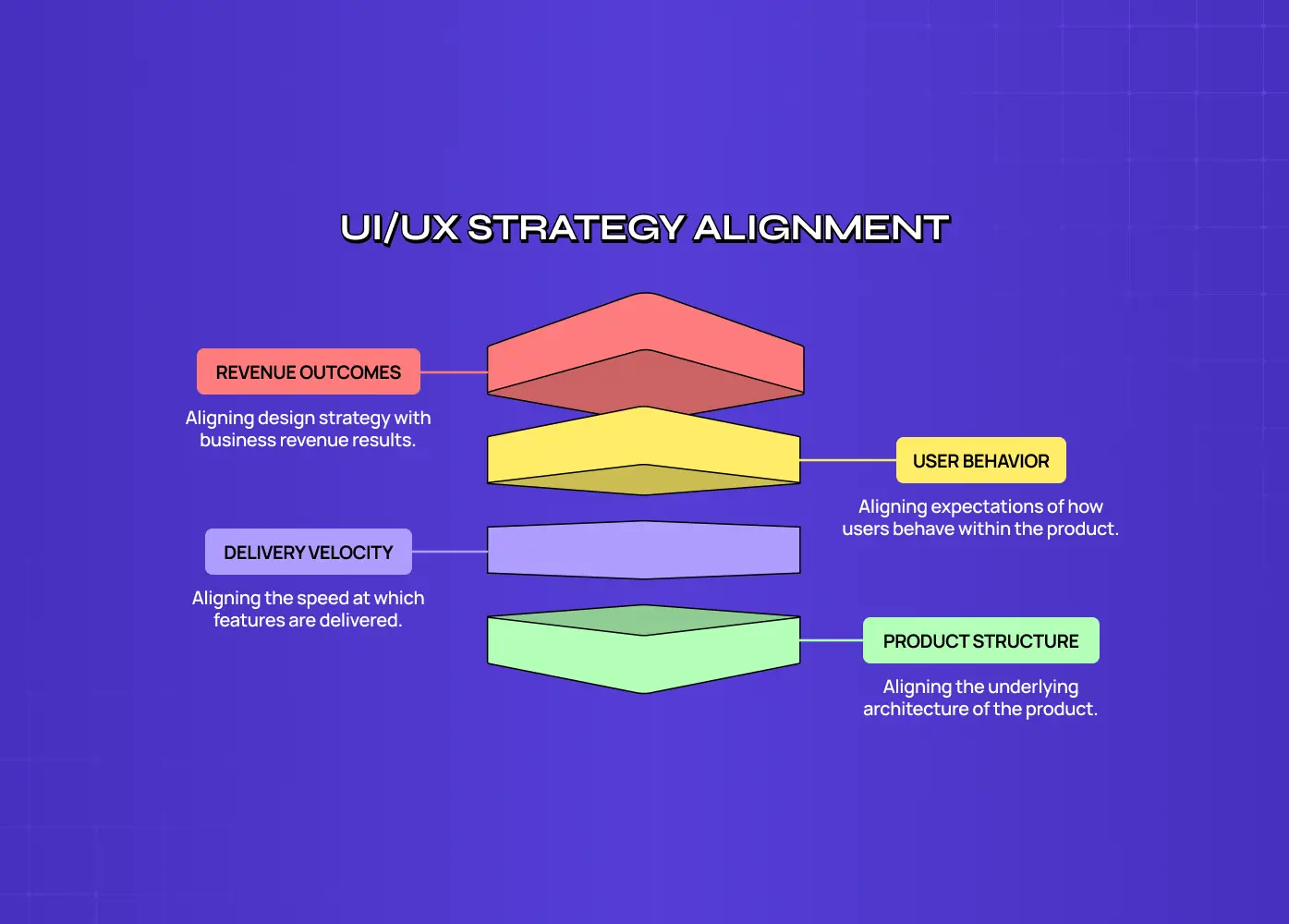
UI/UX strategy exists to align:
user behavior expectations
product structure
delivery velocity
revenue outcomes
Without this alignment, products scale complexity faster than value.
This is why UI UX strategy for business growth has shifted from optional design planning to core operational infrastructure.
What a UI/UX Strategy Framework Actually Does
A UI UX strategic framework is not documentation. It is a decision system guiding how experience investments are made.
Strong frameworks help teams:
prioritize high-impact UX work
avoid reactive redesign cycles
align engineering with user value delivery
scale interfaces without fragmentation
But a framework is only as strong as the UX disciplines that make strategy work underneath it, from information architecture and behavioral psychology through to service design and data analytics working in coordination rather than in isolation.
This is the foundation of modern UI UX strategy services used by agencies working on growth-stage products.
Organizations evaluating strategic maturity often begin by clarifying roles between UX and product ownership. We cover that in our breakdown of UX design vs product design for business decision-making.
Where the Framework Sits: Goals, Strategy and Tactics
Most teams confuse three different things, so it helps to separate them before using any model.
Goal: the business outcome the work must move, such as activation, retention or delivery speed. Leadership usually owns this.
Strategy: the decision rule that tells you how to reach the goal. For example, "shorten the path to first value before adding features."
Tactics: the concrete work that carries the rule out, such as journey maps, onboarding changes, component libraries and analytics events.
A plan is a list of activities. A strategy decides which activities earn a place on that list and in what order. Without that layer, a UX strategy roadmap becomes a backlog with a nicer title.
The four layers below are our strategy layer. They sit between a business goal and the tactics a design team runs.
The UI/UX Strategy Framework Agencies Apply

We call ours the Groto Value-Path Framework. It is a four-layer model for deciding where experience investment produces the most growth, and for tracking whether it did. Each layer below includes what it maps and what to measure.
1. Value Pathway Architecture
Products rarely fail because users cannot find features. They fail because users cannot reach value quickly.
This layer maps:
first success moments
activation triggers
behavioral progression
retention loops
Instead of designing screens first, agencies design value journeys.
Shortening the path to first meaningful value improves activation velocity and reduces early abandonment during onboarding sequences.
The same value-path prioritization logic applies strongly to complex interfaces like analytics environments, where dashboards must guide decisions rather than display data. This is discussed further in SaaS dashboard UX best practices.
What to measure:
time to first value
activation rate
onboarding completion
2. Interaction Load Balancing
Users abandon flows when mental effort exceeds perceived benefit.
Agencies identify:
decision density per screen
sequencing friction
premature commitment points
ambiguity triggers
Then they rebalance interaction weight to maintain forward momentum.
Reducing unnecessary cognitive load increases task completion consistency and lowers mid-flow abandonment.
What to measure:
task completion rate
mid-flow drop-off
time on task
3. Interface Systemization
Growth-stage products often accumulate visual and behavioral inconsistency.
Strategic UI UX design strategy includes:
scalable component logic
interaction predictability
cross-context behavior alignment
reusable pattern libraries
This is not visual standardization alone. It is operational consistency.
Systemized interfaces reduce engineering rework and accelerate feature shipping timelines across product cycles.
What to measure:
component reuse across screens
interface-related rework tickets
time to ship a new screen
4. Behavioral Feedback Infrastructure
Products must continuously learn from usage behavior.
Agencies embed:
friction signal monitoring
interaction analytics
micro-validation checkpoints
behavioral iteration loops
UX becomes an adaptive system rather than static output.
Continuous validation detects experience breakdowns early, protecting retention and preventing costly redesign initiatives.
As AI-driven feedback loops become more embedded in product decision-making, many teams are expanding toward AI-driven UX strategy frameworks to accelerate validation cycles.
What to measure:
share of releases that ship with a validation checkpoint
time from friction signal to fix
retention by user cohort
How to Run the Framework in One Planning Cycle
The framework works best as a repeatable cycle, not a one-off workshop. A quarter is a sensible first horizon.
Set one business goal. Pick the outcome leadership already tracks, such as activation or retention. If the UX goal cannot be tied to it, drop the UX goal.
Validate with evidence. Combine analytics, support tickets and user interviews. Build on documented user types, and our UX persona examples show what a good one contains.
Diagnose the layer. Match what you found to the four layers using the decision table later in this guide. Choose the one or two layers that are most clearly broken.
Pick tactics and sequence them. Choose a small set of tactics per layer, assign owners, and order them by impact and dependency. Write the sequence as a roadmap the whole product team can read.
Set the review cadence. Agree when you will check the layer metrics and who decides to continue, change or stop a tactic.
The Framework in Practice: Two Groto Projects
Two of our projects show how the layers are used on real products.
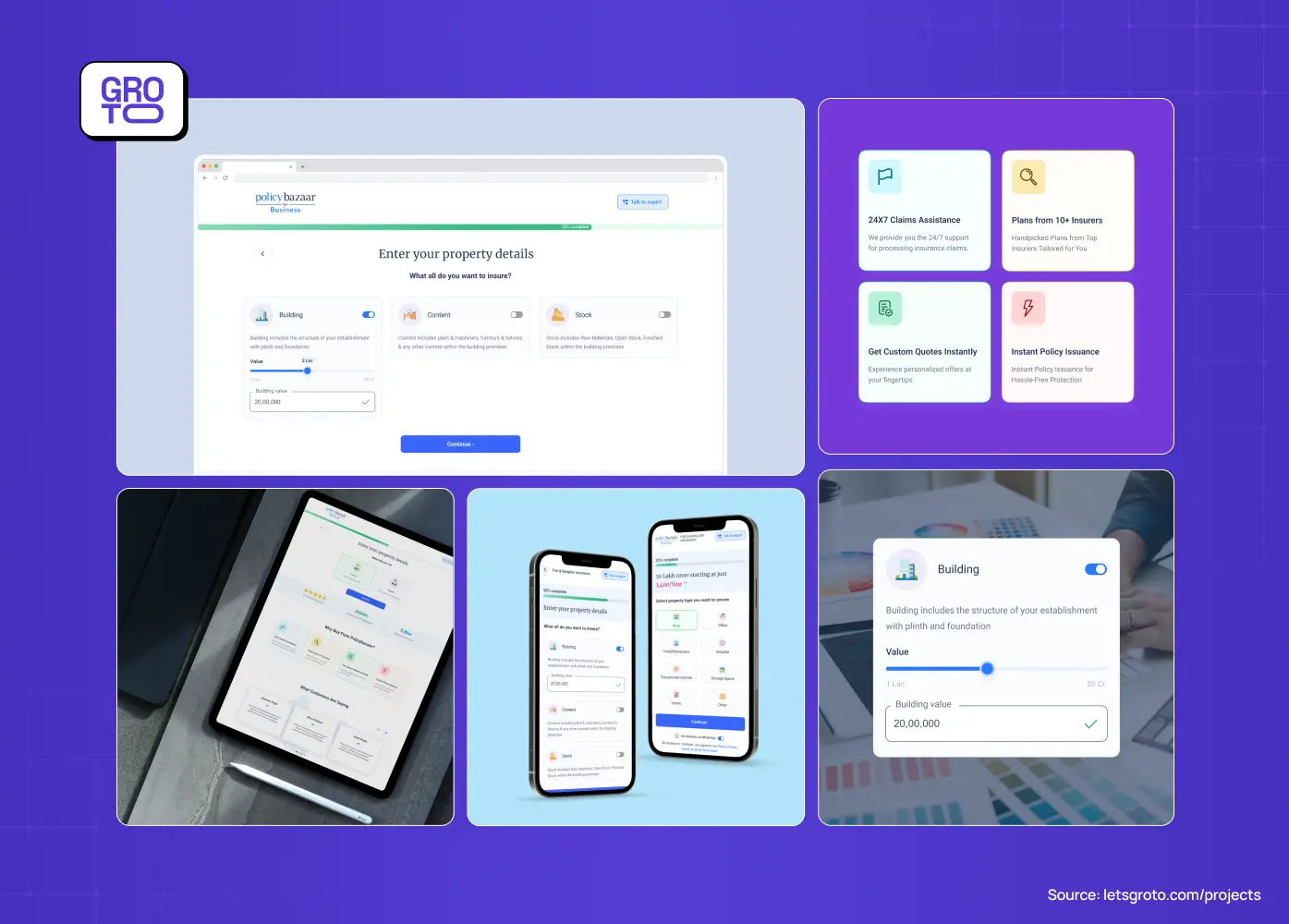
PolicyBazaar was an insurance shopping experience with a conversion problem. We improved mobile and web UX to reduce drop-offs, increase sign-ups and make shopping for insurance effortless. Drop-offs and weak sign-ups are a classic Value Pathway signal, because users are leaving before they reach value.
Barista was an AI-powered tool for PR teams. We redesigned it as a PR-first platform that works like a teammate, with clearer workflows, smarter collaboration and focused content creation across clients. Teams losing time inside multi-step workflows is an Interaction Load problem, so the redesign focused on reducing effort per step.

In both cases the starting point was the same. We identified which layer was failing before we touched a screen.
What Changes for UX Strategy in 2026
Three shifts matter now for any team using a framework like this.
Products have a second user. AI agents increasingly act on behalf of people. A value path now has to work for the person and for the agent acting for them, so first success moments and activation triggers need to be defined for both.
Validation loops are faster. AI-assisted analysis can surface friction patterns sooner than manual review. That makes the Behavioral Feedback layer more powerful, as long as someone still decides which signals matter.
Strategy is the human decision layer. When AI can generate screens in minutes, the scarce skill is deciding what is worth building and why. A framework is how that judgment becomes consistent instead of personal.
AI features also add their own metrics to the four layers, such as AI feature adoption, user trust signals and how well users recover when the AI is wrong.
Signals Your Product Needs a Strategy Reset
Consider your current state:
Users reach features but struggle to complete workflows
Feature adoption plateaus after release
UX decisions are reactive rather than prioritized
Engineering rebuilds interface logic frequently
Stakeholders debate experience direction repeatedly
Most of these signals trace back to misaligned assumptions about who the user is. Reviewing UX persona examples at this stage helps teams ground strategy reset decisions in validated user types rather than internal assumptions.
If two or more apply, strategic misalignment is likely present.
Quick Reality Check
The next step is not redesigning screens. It is identifying structural friction sources.
Teams often book short strategy sessions simply to obtain:
friction mapping of core flows
opportunity prioritization
clarity on UX investment direction
Even without execution, this perspective frequently reshapes roadmap planning. The same friction-and-priority mapping is what a strong UX engagement proposal turns into a scoped plan of work.
Decision Framework: Where to Focus First
Product Situation | Strategic Priority |
Low activation | Value pathway redesign |
Slow feature adoption | Interaction load reduction |
Engineering delays | Interface systemization |
Inconsistent experience | Pattern governance |
Declining retention | Behavioral feedback loops |
This table functions as a diagnostic shortcut. If multiple rows reflect your environment, structured UI UX growth strategy intervention becomes high leverage.
Strategic prioritization at this stage often connects directly to roadmap planning, which we expand further in product design roadmap planning frameworks.
How Groto Applies This Framework
We apply this structured UI/UX strategic framework across SaaS, AI, fintech, and complex B2B platforms through:
40+ product experience audits
multi-role system architecture projects
onboarding optimization engagements
dashboard and workflow redesign programs
Our work spans products handling:
data-heavy decision environments
regulated user flows
multi-stakeholder interfaces
scaling feature ecosystems
For regulated products specifically, pairing UX strategy with an accessibility maturity model gives teams a structured way to evaluate where accessibility practice sits before strategy execution begins.
We focus on experience architecture that sustains growth rather than cosmetic iteration. Scalable products require alignment between behavior, structure, and execution velocity.
Why Agencies Approach Strategy Differently
Internal teams often operate inside delivery pressure. They rarely run a competitor UX study to see how rival products solve the same flows.
Agencies bring:
cross-product pattern recognition
neutral prioritization perspective
exposure to multiple scaling environments
validated strategic models
Enterprise UX design agencies apply this breadth specifically to complex multi-stakeholder products, where internal teams often lack the cross-industry reference point to prioritize confidently.
This breadth enables a clearer UI UX roadmap for products planning expansion.
It is not about outsourcing execution. It is about accelerating strategic clarity.
The Risk of Skipping Strategic Alignment
Without structured UX strategy:
complexity compounds silently
redesign costs escalate later
user trust erodes gradually
growth opportunities narrow
Experience architecture debt is rarely visible early, but it accumulates faster than technical debt. Design strategy for product growth gives teams the structured framework to establish alignment before the debt compounds, connecting UX investment decisions directly to the business objectives that make the case for prioritizing them.
Strategic alignment prevents this accumulation.
Conclusion
High-growth products are not driven by interface aesthetics. They are driven by deliberate experience architecture.
The UI/UX strategy framework used by agencies aligns:
value delivery
interaction clarity
system scalability
behavioral insight
This alignment turns design into a growth multiplier rather than a cosmetic function.
If UX friction may be slowing activation, adoption, or engineering velocity, a focused conversation can provide clarity. In a 20-minute session you walk away with:
identified friction hotspots
prioritization insight
clarity on where UX investment delivers measurable impact
No generic recommendations. No presentation decks. Only actionable perspective tailored to your product, shared directly by our Creative Director, a Top 3% designer ranked by Toptal.