User-Centered Design: Principles, Process, and Why It Matters

User-Centered Design: Principles, Process, and Why It Matters

A clear guide to user-centered design covering its ISO-backed principles, four-phase process, common methods, frequent mistakes, and why it matters for product teams today.

User-Centered Design: Principles, Process, and Why It Matters

User-Centered Design: Principles, Process, and Why It Matters

A clear guide to user-centered design covering its ISO-backed principles, four-phase process, common methods, frequent mistakes, and why it matters for product teams today.

User-centered design puts real people, not assumptions, at the heart of every product decision. This guide breaks down its ISO-backed principles, four-phase process, common methods, frequent mistakes, and why it matters more than ever in an AI-driven product landscape.

Understand user-centered design: its principles, process, methods, and why it matters.

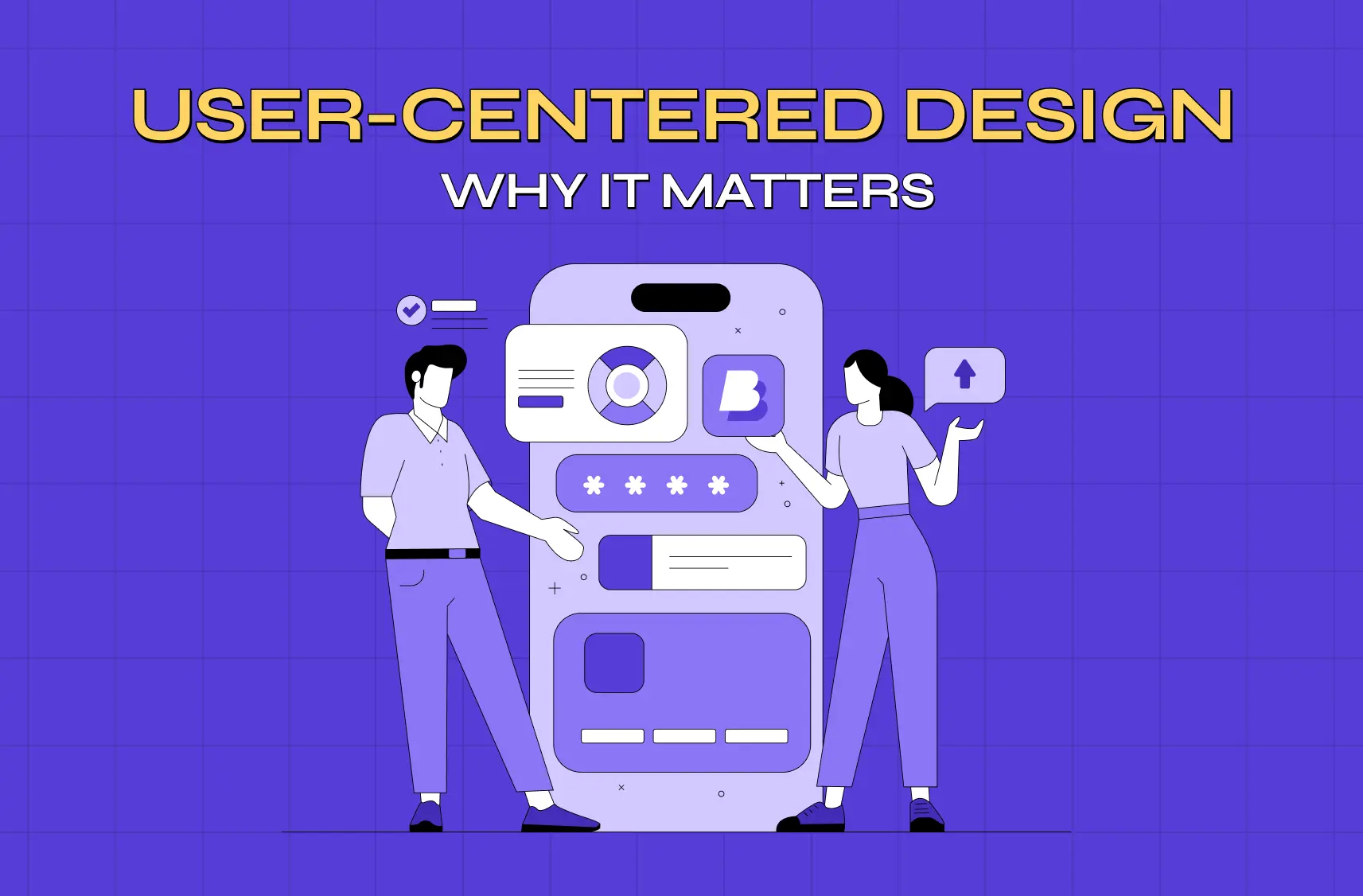
Illustration of people interacting with a mobile interface, representing collaborative and user-focused product design.

TL;DR

  • User-centered design (UCD) puts real users, not assumptions, at the center of every design decision.

  • ISO 9241-210 defines six core principles and a four-phase iterative loop: understand, specify, design, evaluate.

  • UCD improves usability, accessibility, retention, and long-term cost, while reducing avoidable design errors.

  • It differs from human-centered design and design thinking in scope, though all three share the same core discipline.

  • The same principles apply whether you're building a startup MVP or an enterprise system.

User-centered design is the practice of building products around real people instead of internal guesswork. It shows up in how a checkout form is laid out, how a scheduling app handles interruptions, and how a dashboard decides what to show first. For teams shipping SaaS, AI, or any digital product, understanding what user-centered design actually involves, not just as a buzzword but as a defined, testable process, is what separates products people stick with from products they abandon after one confusing session.

Most failed products aren't failures of engineering. They're failures of assumption. A team builds what it thinks users want, ships it, and discovers too late that real people wanted something else, or found it confusing, or never understood the point. Most bad UX design examples start exactly there. User-centered design exists to prevent exactly that. Instead of designing for an imagined user and hoping, it puts actual users at the center of every decision, from the first research session to the final usability test.

This guide explains user-centered design clearly and completely: what it is (including how the ISO standard defines it), its core principles, the iterative four-phase process, the methods that bring it to life, and the business benefits that make it worth the investment. Whether you're a designer formalizing your practice or a founder deciding how to build your product, here's how designing with users, not just for them, leads to products people actually want to use.

What is user-centered design?

User-centered design (UCD) is a design and development approach that focuses on the needs, behaviors, and context of real users at every stage of the process, in order to create products that are genuinely usable. The international standard ISO 9241-210 defines it as an approach to systems design that makes interactive systems more usable by focusing on the use of the system and applying human-factors, ergonomics, and usability knowledge.

The core idea is simple but demanding: don't guess what users need, find out, involve them throughout, and keep testing your assumptions against reality. UCD treats the user not as someone to persuade at the end, but as the source of truth that shapes the product from the beginning. Everything else, the interface, the features, the flows, follows from a genuine understanding of the people who will use it. If the underlying vocabulary is new, UI UX design basics are worth covering first.

The UX/UI checklist top SaaS teams actually use

15 essential checks covering onboarding, conversions, and retention. Spot quick wins and fix friction before it costs you signups.

No Spam. Free Lifetime

The UX/UI checklist top SaaS teams actually use

15 essential checks covering onboarding, conversions, and retention. Spot quick wins and fix friction before it costs you signups.

No Spam. Free Lifetime

The 6 principles of user-centered design
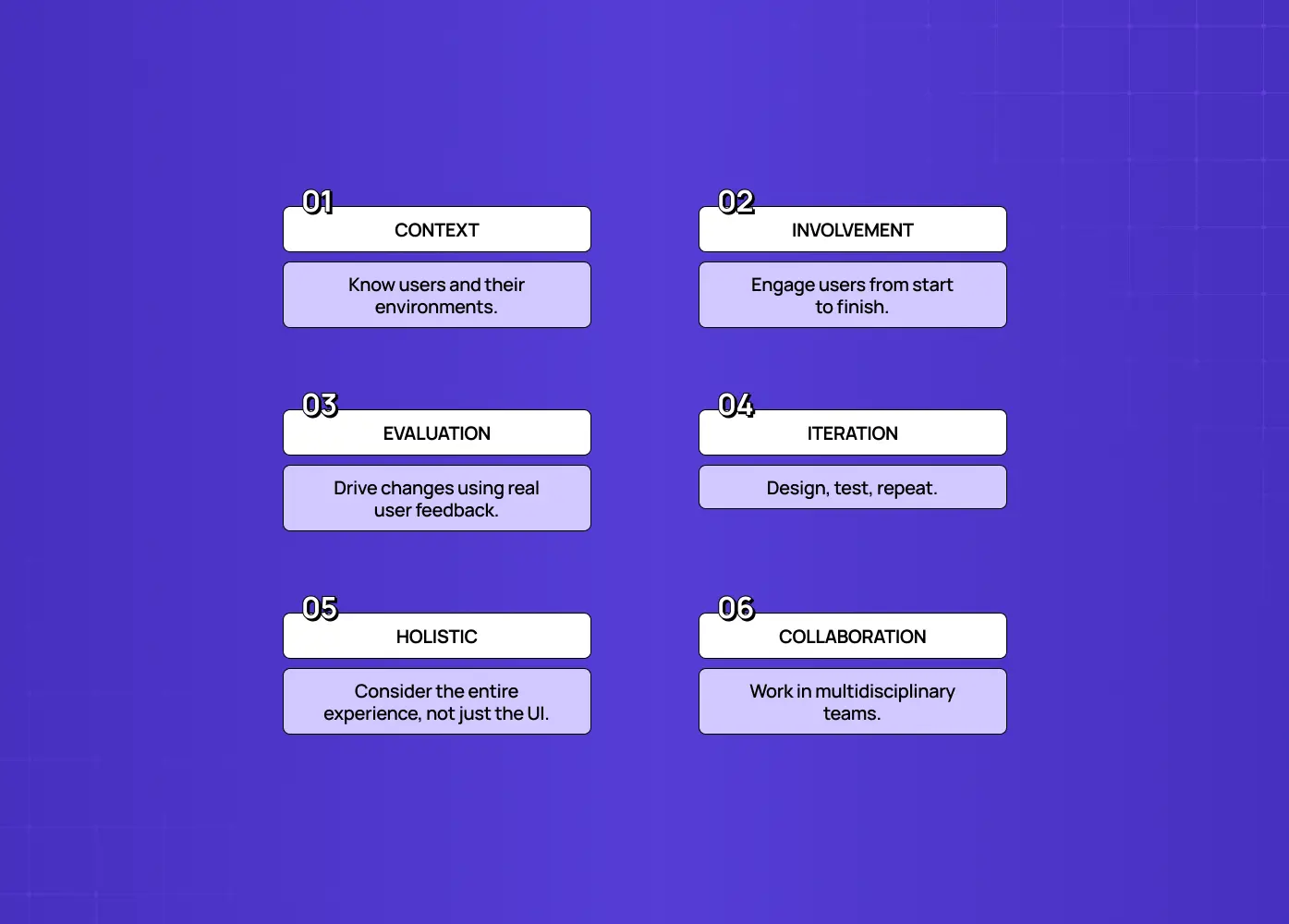
Six core principles covering context, user involvement, evaluation, iteration, holistic thinking, and collaboration.

ISO 9241-210 lays out six principles that define what it really means to be user-centered. A process that skips these isn't UCD, no matter what it's called.

  • The design is based on an explicit understanding of users, tasks, and environments. You start by genuinely understanding who your users are, what they're trying to do, and the context they do it in.

  • Users are involved throughout design and development. Not consulted once at the end, but part of the process, their input shapes decisions from the start.

  • The design is driven and refined by user-centered evaluation. Real users evaluate the work (prototypes, betas), and that feedback drives what you change.

  • The process is iterative. You cycle through understanding, designing, and evaluating repeatedly, improving each time, rather than moving in one straight line.

  • The design addresses the whole user experience. UCD considers the entire experience, not just the interface, but everything around it that affects how the product feels to use.

  • The design team includes multidisciplinary skills and perspectives. Good UCD is collaborative, bringing together design, research, engineering, and domain expertise, which is why UX design vs product design boundaries matter less than shared ownership.

Together these principles keep the user genuinely at the center, rather than as a label a team applies to its own assumptions.

The user-centered design process
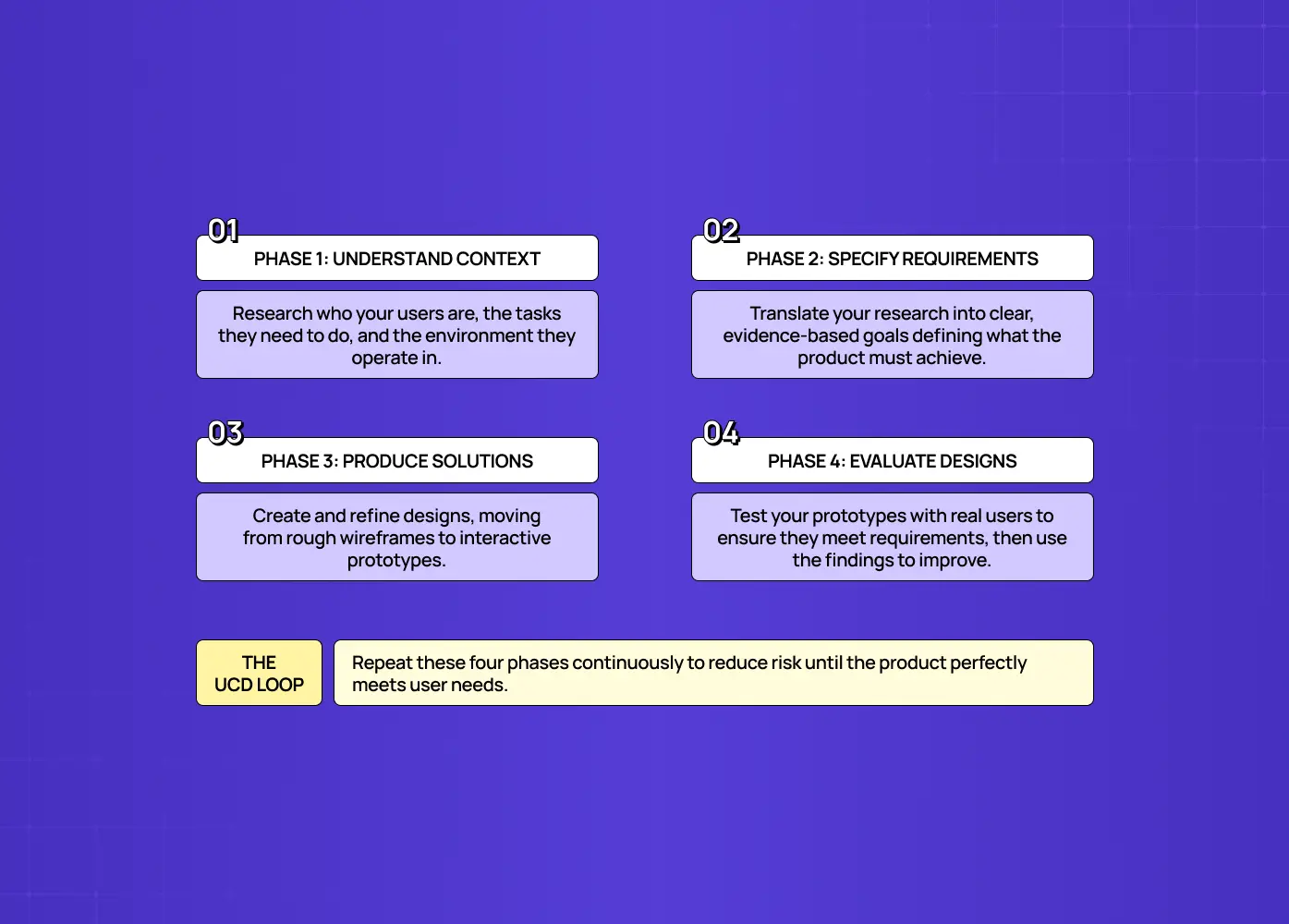
Four-phase framework showing context research, requirement definition, solution design, and usability evaluation in a continuous loop.

ISO 9241-210 describes UCD as an iterative loop of four phases, repeated until the product meets user requirements.

Phase 1: Understand the context of use

Learn who the users are, what tasks they need to accomplish, and the environment and conditions in which they'll use the product. This is where UX research lives, interviews, observation, and data that build a real picture of your users.

Phase 2: Specify the user requirements

Translate that understanding into clear requirements: what users need, what problems must be solved, and what success looks like. This defines what the product must do to serve its users, grounded in evidence rather than assumption, and it is usually where a UX design brief gets written.

Phase 3: Produce design solutions

Design solutions that meet those requirements, from concepts and wireframes to interactive prototypes, with user flows mapping the path between screens. Because the process is iterative, these start rough and get more refined as they're tested.

Phase 4: Evaluate against requirements

Put the designs in front of real users and evaluate how well they meet the requirements, which in practice means structured UX testing rather than informal feedback. The findings feed back into the loop: you refine your understanding, adjust requirements, improve the design, and evaluate again.

The magic is in the loop. Rather than betting everything on a single linear pass, UCD keeps cycling, each iteration reducing risk and getting closer to something that genuinely works for users. In day-to-day practice most teams run this as a longer UX design process with more granular steps.

The benefits of user-centered design

UCD isn't just a philosophy, it delivers measurable value. Because products are shaped by real user needs, they tend to be more usable and deliver these outcomes:

  • Higher productivity. More usable products reduce the time and effort users spend completing tasks.

  • Fewer errors. Usability issues get caught and fixed before launch instead of after.

  • Higher satisfaction and retention. People stick with products that work well for them.

  • Better accessibility. UCD pushes teams to make products usable by a wider range of people, which is why accessibility in UI UX design and user-centeredness tend to arrive together.

  • Lower long-term cost. Catching problems early through research and testing is far cheaper than fixing them after launch, and it simplifies future maintenance and redesign, which is the core of calculating the ROI of UX design.

  • Improved user wellbeing. Usable systems reduce the risk of stress or harm during use.

In short, designing around users pays back in productivity, loyalty, lower cost, and better outcomes, which is why it's become the default standard for serious product teams.

Where user-centered design applies

Although UCD grew up in software and digital product design, the approach applies anywhere people interact with a product, service, or system:

  • Web and app design, the most common and obvious application.

  • Physical products, where usability and ergonomics matter just as much as software.

  • Service design, how a whole experience flows across touchpoints.

  • Enterprise tools, where complexity makes usability even more critical.

  • Healthcare and safety-critical systems, where usability directly affects outcomes.

  • AI-powered products, where understanding real user needs is what keeps automation genuinely helpful.

It's relevant at every company stage, too. A startup uses lightweight UCD to validate an MVP before building it, while an enterprise uses it to reduce risk on large, complex systems. The common thread is that whenever the success of something depends on people being able to use it effectively, user-centered design is the discipline that makes that success likely rather than accidental. If humans touch it, UCD applies.

Common user-centered design methods
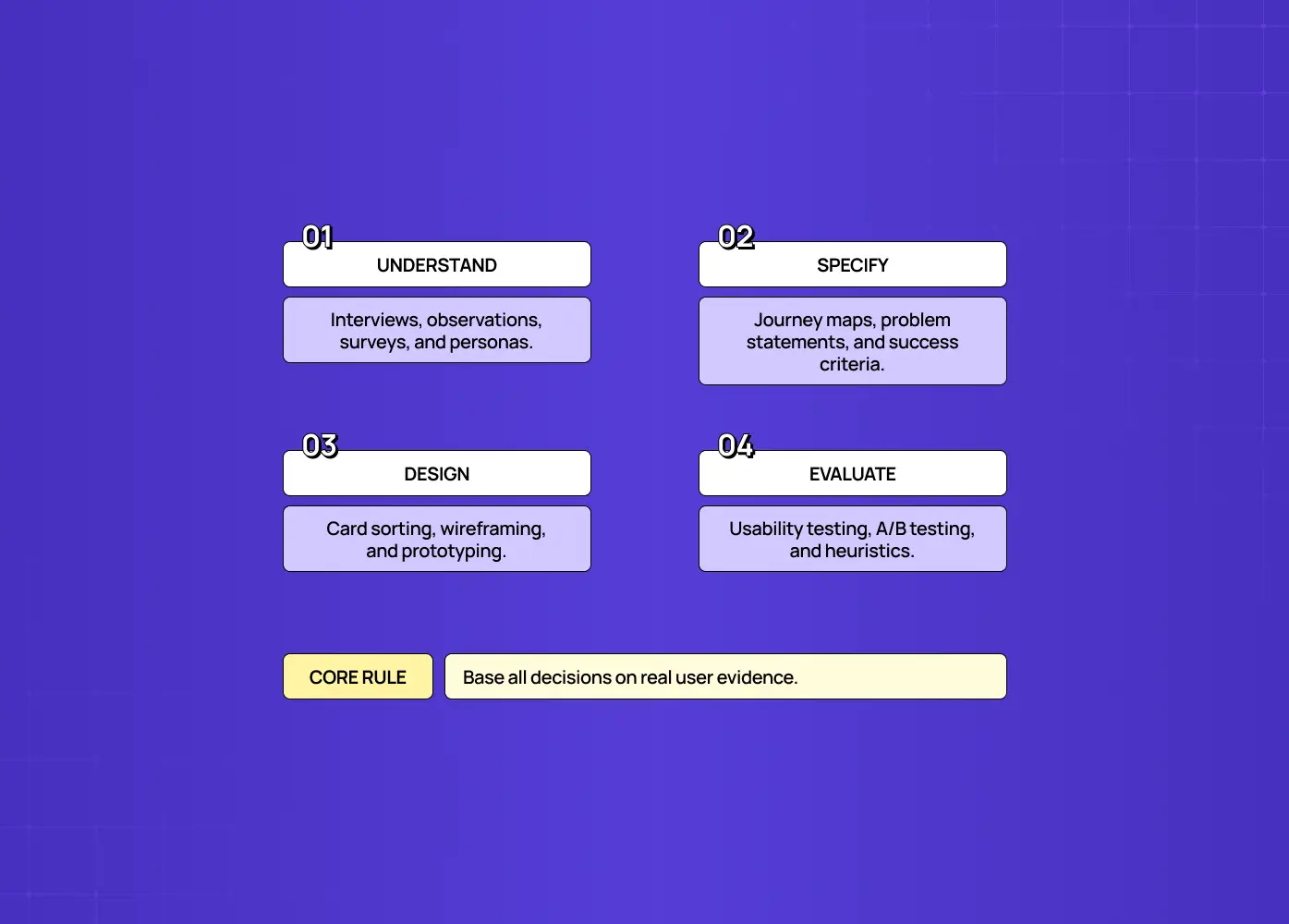
Overview of research, requirement specification, design, and evaluation methods supported by real user evidence.

UCD is put into practice through a toolkit of methods, chosen to fit each phase:

  • Understanding users: user interviews, contextual inquiry (observing users in their real environment), surveys, and analytics, often synthesized into personas and empathy maps.

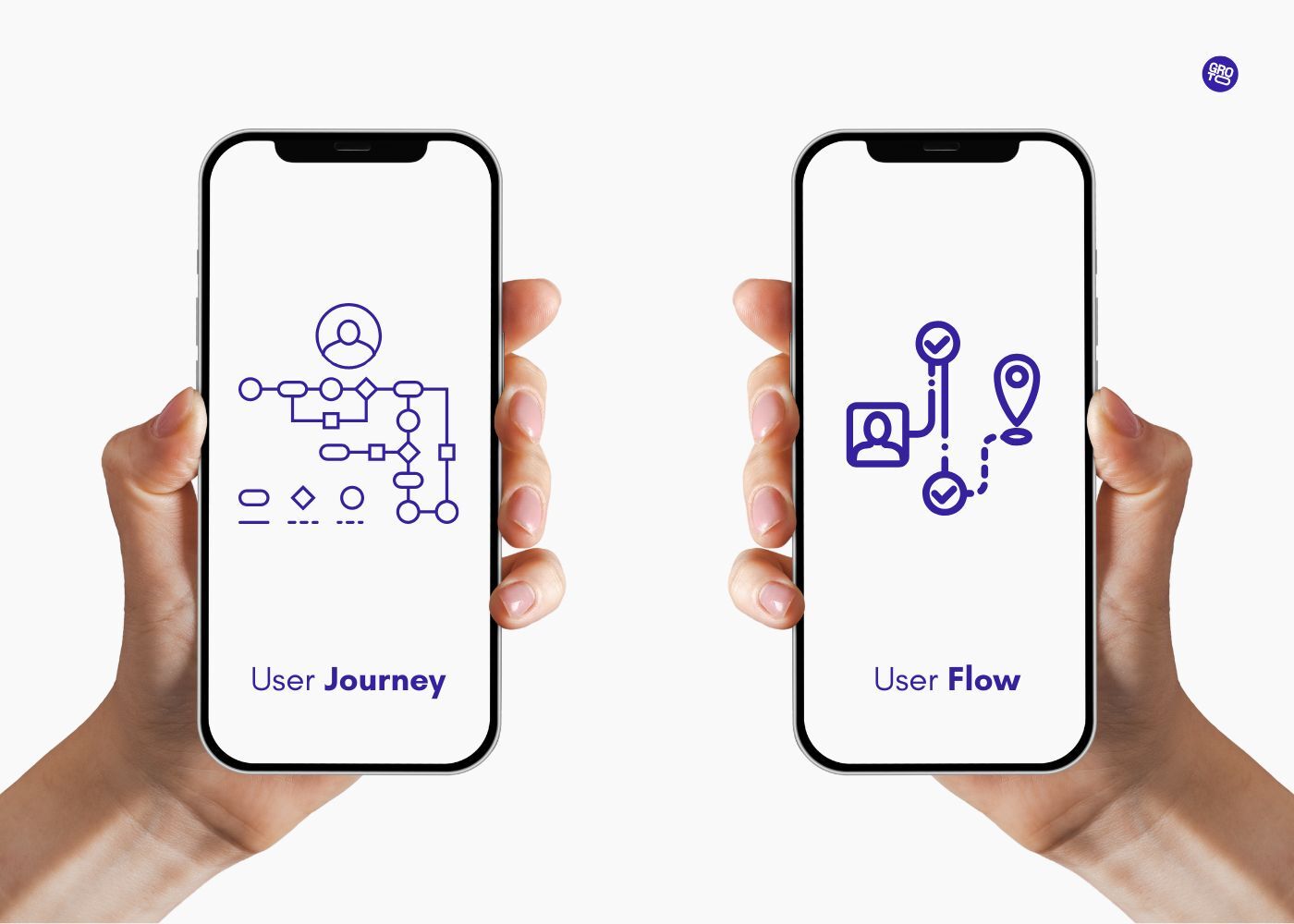
  • Specifying requirements: user journey mapping, problem statements, and defined success criteria. Worth knowing the user journey vs user flow distinction before you map either.

  • Designing solutions: information architecture techniques like card sorting, plus wireframing and prototyping at increasing fidelity.

  • Evaluating solutions: usability testing (watching real users attempt real tasks), supplemented by A/B testing and heuristic evaluation.

The specific methods matter less than the principle behind them: every one exists to keep real users, and real evidence, at the center of the decisions. A UX research cheat sheet helps when you are picking between them for the first time.

User-centered design vs. human-centered design vs. design thinking

These related terms cause confusion, so here's the quick distinction:

  • User-centered design focuses specifically on the end users of a product and their usability.

  • Human-centered design (HCD) is broader. It centers all the humans affected by a solution, including stakeholders and communities, and is often applied to services and systems beyond software. It is a similar widening to the one between user experience vs customer experience.

  • Design thinking is a broader innovation methodology, a mindset and process (empathize, define, ideate, prototype, test) for solving problems creatively, of which user-centered practices are a key part.

In practice they overlap heavily and share the same DNA: understand people, involve them, iterate. UCD is best understood as the rigorous, usability-focused core of that family, and it sits alongside the other UX design methodologies teams choose between.

Examples of UCD in action

To make it concrete, here are three scenarios showing what user-centered design looks like at each phase, across very different product types.

A scheduling app for busy clinics. A non-UCD approach would design what the team assumes clinics need and ship it. A user-centered approach looks different at every phase. In understanding the context, the team observes front-desk staff during a real workday and discovers they're constantly interrupted and rarely have both hands free. UX storyboards are how that kind of context gets communicated back to the rest of the team. In specifying requirements, that insight becomes concrete: the core booking task must be completable in a few taps and survive interruptions without losing data. In designing solutions, they prototype a streamlined flow with autosave and large touch targets. In evaluating, they watch actual clinic staff use it and find one step still causes confusion, so they iterate before a single line of production code is finalized.

A checkout flow for an ecommerce site. A non-UCD approach ships whatever payment fields the team assumes are standard. A user-centered approach starts by watching real shoppers attempt checkout, and finds many abandon the process the moment they hit an unexpected shipping cost or a password requirement they can't meet from memory. Requirements get rewritten to show all costs upfront and to allow guest checkout. The redesigned flow gets tested against the same task before it ships, not after.

An onboarding flow for a B2B SaaS tool. A non-UCD approach walks every new user through every feature in one long tour, regardless of their role. A user-centered approach starts by researching what different user types (an admin versus an end user, for instance) actually need to do in their first session, the same work UX persona examples capture. Requirements narrow the onboarding to just the tasks relevant to each role. The prototype is tested with new sign-ups, and the team finds the admin flow still buries a critical setup step, so they resurface it before general release.

The result, across all three, is a product shaped by how the work actually happens, not how the team imagined it. That's the whole point: the same feature, designed with users, ends up meaningfully different, and meaningfully better, than one designed from assumptions. Every UCD success story follows this shape: real observation changing a real decision.

Common user-centered design mistakes
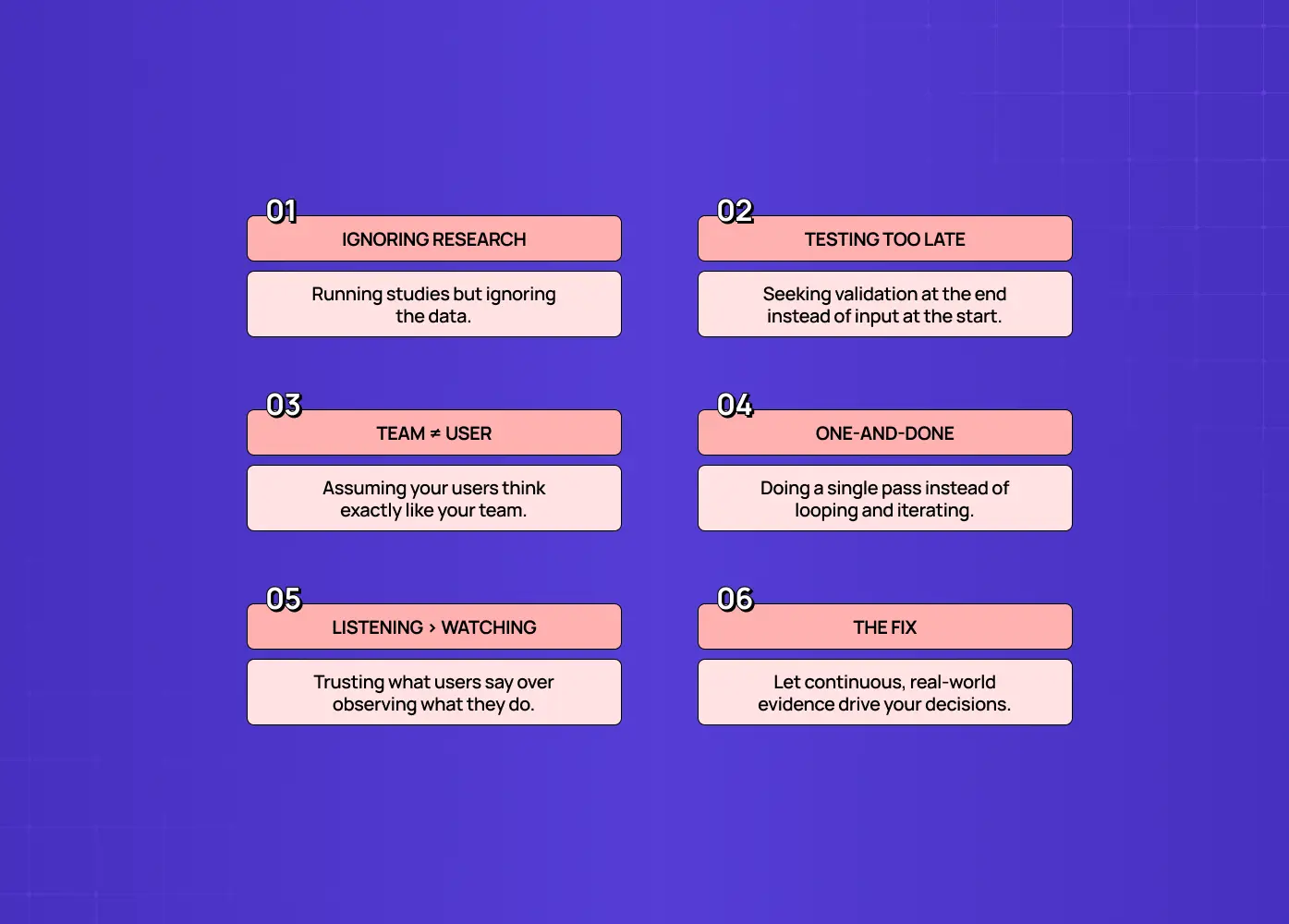
List of frequent user-centered design pitfalls, including ignoring research, testing too late, and relying on assumptions instead of evidence.

Even teams that believe in UCD stumble in familiar ways:

  • Treating research as a checkbox. Running a study, then ignoring it when it contradicts an internal preference.

  • Involving users too late. Showing them a nearly finished product for validation rather than shaping the work with them from the start, which is really just seeking approval, not doing UCD.

  • Confusing themselves for their users. Assuming that because the team understands the product, real users will too.

  • Skipping iteration. Doing a single research-design-build pass and calling it user-centered when the whole method depends on looping.

  • Over-indexing on what users say versus what they do. Self-reported preferences are useful, but observed behavior in usability testing is more reliable.

Avoiding these comes down to one discipline: let real user evidence, gathered continuously, actually drive decisions. For products already built on assumptions, a UX audit is where the damage gets mapped.

How to actually apply user-centered design
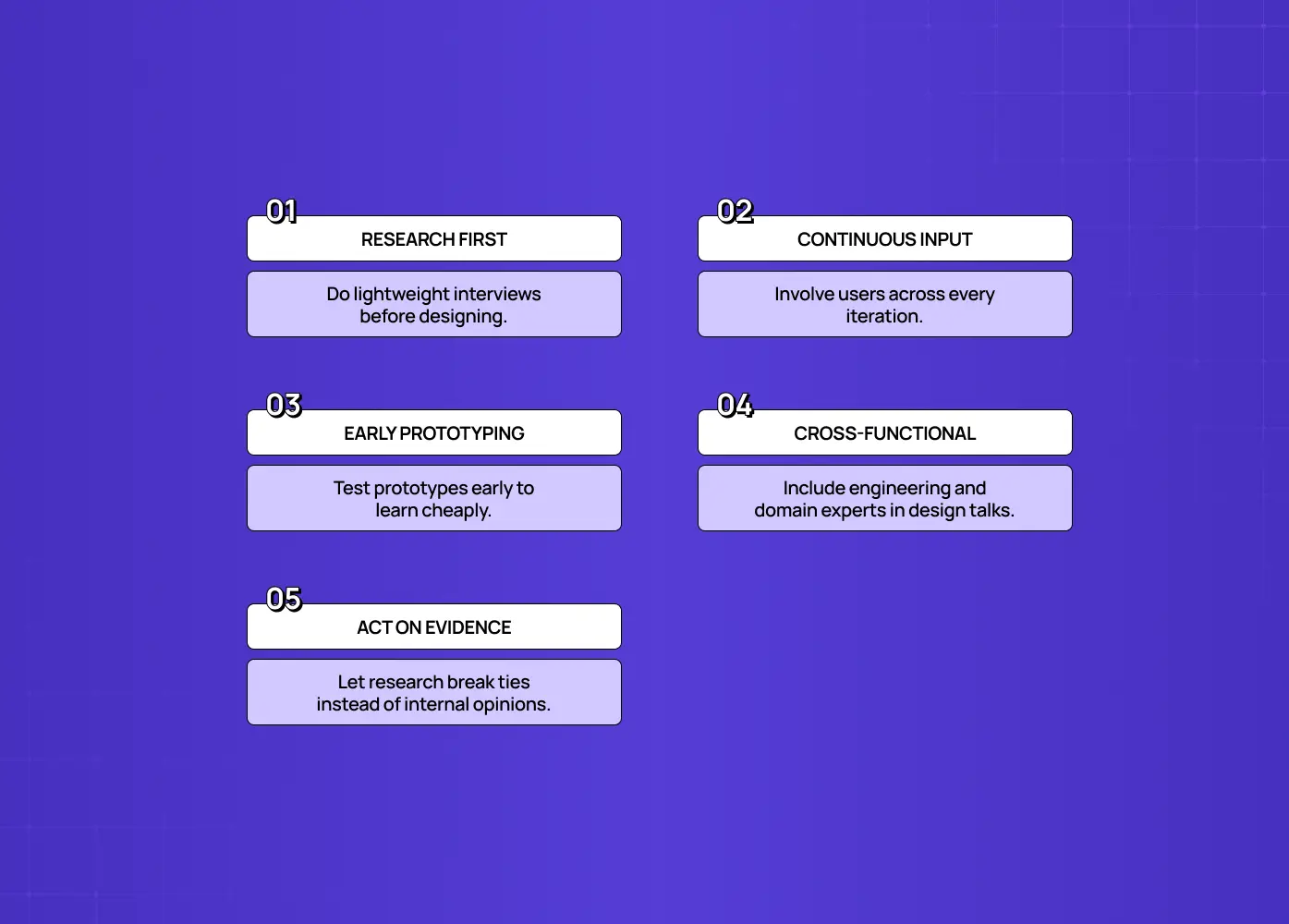
Practical recommendations such as researching first, testing early, involving users continuously, and making evidence-based design decisions.

Knowing the theory is one thing, embedding it is another:

  • Build in real user research before you design. Even lightweight interviews beat assumptions.

  • Involve users continuously, not just at a launch review. Schedule evaluation into every iteration.

  • Prototype early and test often. Treat each round as a chance to learn cheaply before committing to code.

  • Make it multidisciplinary. Bring engineering and domain experts into design conversations.

  • Actually act on what you learn. UCD fails when research is gathered and then ignored in favor of internal opinion.

The teams that get the most from it treat user evidence as the tie-breaker in decisions, not a formality. Making that stick usually requires a UX strategy rather than individual good intentions. It takes discipline, but the payoff is products that work the first time for the people who matter.

Why user-centered design matters more than ever

UCD isn't new, but the stakes around it keep rising. Users today are more demanding than ever, primed by the best apps they use daily to expect experiences that just work, and quicker than ever to abandon products that don't. Regulation is tightening too, which is what makes accessibility-first UX a 2026 baseline rather than an upgrade. Switching costs are low, alternatives are one search away, and a confusing experience rarely gets a second chance. In that environment, designing around real users isn't a differentiator so much as the price of entry.

AI adds a new dimension too. As products become more automated, generative, and personalized, the risk of designing something technically impressive but genuinely unhelpful grows, which makes the discipline of grounding decisions in real user needs more important, not less. AI can accelerate research synthesis and prototyping, but it can't decide for you what your specific users actually need. That still requires the understanding, involvement, and evaluation at the heart of UCD. The teams that pair modern tools with genuine user-centeredness will build products that feel effortless. The ones that let speed replace understanding will ship faster versions of the wrong thing. UCD is how you make sure velocity serves users instead of outrunning them.

Conclusion

User-centered design is, at its heart, a commitment. Here's what that commitment looks like in practice:

  • Understand real users before designing anything.

  • Involve them throughout the process, not just at the end.

  • Evaluate every solution against their actual needs.

  • Iterate until the product genuinely serves them, grounded in the ISO principles and its four-phase loop.

  • Replace expensive guesswork with evidence, producing products that are more usable, more loved, and cheaper to build right.

In a market where users compare you to the best experience they've ever had, that's not a nice-to-have. It's how you compete.

If you want a research-led, genuinely user-centered design partner to build products people actually want to use, book a discovery call with Groto. We put real users at the center of every decision, so what you ship works the first time. Let's design around the people who matter most.

User-centered design puts real people, not assumptions, at the heart of every product decision. This guide breaks down its ISO-backed principles, four-phase process, common methods, frequent mistakes, and why it matters more than ever in an AI-driven product landscape.

Understand user-centered design: its principles, process, methods, and why it matters.

Illustration of people interacting with a mobile interface, representing collaborative and user-focused product design.

TL;DR

  • User-centered design (UCD) puts real users, not assumptions, at the center of every design decision.

  • ISO 9241-210 defines six core principles and a four-phase iterative loop: understand, specify, design, evaluate.

  • UCD improves usability, accessibility, retention, and long-term cost, while reducing avoidable design errors.

  • It differs from human-centered design and design thinking in scope, though all three share the same core discipline.

  • The same principles apply whether you're building a startup MVP or an enterprise system.

User-centered design is the practice of building products around real people instead of internal guesswork. It shows up in how a checkout form is laid out, how a scheduling app handles interruptions, and how a dashboard decides what to show first. For teams shipping SaaS, AI, or any digital product, understanding what user-centered design actually involves, not just as a buzzword but as a defined, testable process, is what separates products people stick with from products they abandon after one confusing session.

Most failed products aren't failures of engineering. They're failures of assumption. A team builds what it thinks users want, ships it, and discovers too late that real people wanted something else, or found it confusing, or never understood the point. Most bad UX design examples start exactly there. User-centered design exists to prevent exactly that. Instead of designing for an imagined user and hoping, it puts actual users at the center of every decision, from the first research session to the final usability test.

This guide explains user-centered design clearly and completely: what it is (including how the ISO standard defines it), its core principles, the iterative four-phase process, the methods that bring it to life, and the business benefits that make it worth the investment. Whether you're a designer formalizing your practice or a founder deciding how to build your product, here's how designing with users, not just for them, leads to products people actually want to use.

What is user-centered design?

User-centered design (UCD) is a design and development approach that focuses on the needs, behaviors, and context of real users at every stage of the process, in order to create products that are genuinely usable. The international standard ISO 9241-210 defines it as an approach to systems design that makes interactive systems more usable by focusing on the use of the system and applying human-factors, ergonomics, and usability knowledge.

The core idea is simple but demanding: don't guess what users need, find out, involve them throughout, and keep testing your assumptions against reality. UCD treats the user not as someone to persuade at the end, but as the source of truth that shapes the product from the beginning. Everything else, the interface, the features, the flows, follows from a genuine understanding of the people who will use it. If the underlying vocabulary is new, UI UX design basics are worth covering first.

The UX/UI checklist top SaaS teams actually use

15 essential checks covering onboarding, conversions, and retention. Spot quick wins and fix friction before it costs you signups.

No Spam. Free Lifetime

The 6 principles of user-centered design

Six core principles covering context, user involvement, evaluation, iteration, holistic thinking, and collaboration.

ISO 9241-210 lays out six principles that define what it really means to be user-centered. A process that skips these isn't UCD, no matter what it's called.

  • The design is based on an explicit understanding of users, tasks, and environments. You start by genuinely understanding who your users are, what they're trying to do, and the context they do it in.

  • Users are involved throughout design and development. Not consulted once at the end, but part of the process, their input shapes decisions from the start.

  • The design is driven and refined by user-centered evaluation. Real users evaluate the work (prototypes, betas), and that feedback drives what you change.

  • The process is iterative. You cycle through understanding, designing, and evaluating repeatedly, improving each time, rather than moving in one straight line.

  • The design addresses the whole user experience. UCD considers the entire experience, not just the interface, but everything around it that affects how the product feels to use.

  • The design team includes multidisciplinary skills and perspectives. Good UCD is collaborative, bringing together design, research, engineering, and domain expertise, which is why UX design vs product design boundaries matter less than shared ownership.

Together these principles keep the user genuinely at the center, rather than as a label a team applies to its own assumptions.

The user-centered design process

Four-phase framework showing context research, requirement definition, solution design, and usability evaluation in a continuous loop.

ISO 9241-210 describes UCD as an iterative loop of four phases, repeated until the product meets user requirements.

Phase 1: Understand the context of use

Learn who the users are, what tasks they need to accomplish, and the environment and conditions in which they'll use the product. This is where UX research lives, interviews, observation, and data that build a real picture of your users.

Phase 2: Specify the user requirements

Translate that understanding into clear requirements: what users need, what problems must be solved, and what success looks like. This defines what the product must do to serve its users, grounded in evidence rather than assumption, and it is usually where a UX design brief gets written.

Phase 3: Produce design solutions

Design solutions that meet those requirements, from concepts and wireframes to interactive prototypes, with user flows mapping the path between screens. Because the process is iterative, these start rough and get more refined as they're tested.

Phase 4: Evaluate against requirements

Put the designs in front of real users and evaluate how well they meet the requirements, which in practice means structured UX testing rather than informal feedback. The findings feed back into the loop: you refine your understanding, adjust requirements, improve the design, and evaluate again.

The magic is in the loop. Rather than betting everything on a single linear pass, UCD keeps cycling, each iteration reducing risk and getting closer to something that genuinely works for users. In day-to-day practice most teams run this as a longer UX design process with more granular steps.

The benefits of user-centered design

UCD isn't just a philosophy, it delivers measurable value. Because products are shaped by real user needs, they tend to be more usable and deliver these outcomes:

  • Higher productivity. More usable products reduce the time and effort users spend completing tasks.

  • Fewer errors. Usability issues get caught and fixed before launch instead of after.

  • Higher satisfaction and retention. People stick with products that work well for them.

  • Better accessibility. UCD pushes teams to make products usable by a wider range of people, which is why accessibility in UI UX design and user-centeredness tend to arrive together.

  • Lower long-term cost. Catching problems early through research and testing is far cheaper than fixing them after launch, and it simplifies future maintenance and redesign, which is the core of calculating the ROI of UX design.

  • Improved user wellbeing. Usable systems reduce the risk of stress or harm during use.

In short, designing around users pays back in productivity, loyalty, lower cost, and better outcomes, which is why it's become the default standard for serious product teams.

Where user-centered design applies

Although UCD grew up in software and digital product design, the approach applies anywhere people interact with a product, service, or system:

  • Web and app design, the most common and obvious application.

  • Physical products, where usability and ergonomics matter just as much as software.

  • Service design, how a whole experience flows across touchpoints.

  • Enterprise tools, where complexity makes usability even more critical.

  • Healthcare and safety-critical systems, where usability directly affects outcomes.

  • AI-powered products, where understanding real user needs is what keeps automation genuinely helpful.

It's relevant at every company stage, too. A startup uses lightweight UCD to validate an MVP before building it, while an enterprise uses it to reduce risk on large, complex systems. The common thread is that whenever the success of something depends on people being able to use it effectively, user-centered design is the discipline that makes that success likely rather than accidental. If humans touch it, UCD applies.

Common user-centered design methods

Overview of research, requirement specification, design, and evaluation methods supported by real user evidence.

UCD is put into practice through a toolkit of methods, chosen to fit each phase:

  • Understanding users: user interviews, contextual inquiry (observing users in their real environment), surveys, and analytics, often synthesized into personas and empathy maps.

  • Specifying requirements: user journey mapping, problem statements, and defined success criteria. Worth knowing the user journey vs user flow distinction before you map either.

  • Designing solutions: information architecture techniques like card sorting, plus wireframing and prototyping at increasing fidelity.

  • Evaluating solutions: usability testing (watching real users attempt real tasks), supplemented by A/B testing and heuristic evaluation.

The specific methods matter less than the principle behind them: every one exists to keep real users, and real evidence, at the center of the decisions. A UX research cheat sheet helps when you are picking between them for the first time.

User-centered design vs. human-centered design vs. design thinking

These related terms cause confusion, so here's the quick distinction:

  • User-centered design focuses specifically on the end users of a product and their usability.

  • Human-centered design (HCD) is broader. It centers all the humans affected by a solution, including stakeholders and communities, and is often applied to services and systems beyond software. It is a similar widening to the one between user experience vs customer experience.

  • Design thinking is a broader innovation methodology, a mindset and process (empathize, define, ideate, prototype, test) for solving problems creatively, of which user-centered practices are a key part.

In practice they overlap heavily and share the same DNA: understand people, involve them, iterate. UCD is best understood as the rigorous, usability-focused core of that family, and it sits alongside the other UX design methodologies teams choose between.

Examples of UCD in action

To make it concrete, here are three scenarios showing what user-centered design looks like at each phase, across very different product types.

A scheduling app for busy clinics. A non-UCD approach would design what the team assumes clinics need and ship it. A user-centered approach looks different at every phase. In understanding the context, the team observes front-desk staff during a real workday and discovers they're constantly interrupted and rarely have both hands free. UX storyboards are how that kind of context gets communicated back to the rest of the team. In specifying requirements, that insight becomes concrete: the core booking task must be completable in a few taps and survive interruptions without losing data. In designing solutions, they prototype a streamlined flow with autosave and large touch targets. In evaluating, they watch actual clinic staff use it and find one step still causes confusion, so they iterate before a single line of production code is finalized.

A checkout flow for an ecommerce site. A non-UCD approach ships whatever payment fields the team assumes are standard. A user-centered approach starts by watching real shoppers attempt checkout, and finds many abandon the process the moment they hit an unexpected shipping cost or a password requirement they can't meet from memory. Requirements get rewritten to show all costs upfront and to allow guest checkout. The redesigned flow gets tested against the same task before it ships, not after.

An onboarding flow for a B2B SaaS tool. A non-UCD approach walks every new user through every feature in one long tour, regardless of their role. A user-centered approach starts by researching what different user types (an admin versus an end user, for instance) actually need to do in their first session, the same work UX persona examples capture. Requirements narrow the onboarding to just the tasks relevant to each role. The prototype is tested with new sign-ups, and the team finds the admin flow still buries a critical setup step, so they resurface it before general release.

The result, across all three, is a product shaped by how the work actually happens, not how the team imagined it. That's the whole point: the same feature, designed with users, ends up meaningfully different, and meaningfully better, than one designed from assumptions. Every UCD success story follows this shape: real observation changing a real decision.

Common user-centered design mistakes

List of frequent user-centered design pitfalls, including ignoring research, testing too late, and relying on assumptions instead of evidence.

Even teams that believe in UCD stumble in familiar ways:

  • Treating research as a checkbox. Running a study, then ignoring it when it contradicts an internal preference.

  • Involving users too late. Showing them a nearly finished product for validation rather than shaping the work with them from the start, which is really just seeking approval, not doing UCD.

  • Confusing themselves for their users. Assuming that because the team understands the product, real users will too.

  • Skipping iteration. Doing a single research-design-build pass and calling it user-centered when the whole method depends on looping.

  • Over-indexing on what users say versus what they do. Self-reported preferences are useful, but observed behavior in usability testing is more reliable.

Avoiding these comes down to one discipline: let real user evidence, gathered continuously, actually drive decisions. For products already built on assumptions, a UX audit is where the damage gets mapped.

How to actually apply user-centered design

Practical recommendations such as researching first, testing early, involving users continuously, and making evidence-based design decisions.

Knowing the theory is one thing, embedding it is another:

  • Build in real user research before you design. Even lightweight interviews beat assumptions.

  • Involve users continuously, not just at a launch review. Schedule evaluation into every iteration.

  • Prototype early and test often. Treat each round as a chance to learn cheaply before committing to code.

  • Make it multidisciplinary. Bring engineering and domain experts into design conversations.

  • Actually act on what you learn. UCD fails when research is gathered and then ignored in favor of internal opinion.

The teams that get the most from it treat user evidence as the tie-breaker in decisions, not a formality. Making that stick usually requires a UX strategy rather than individual good intentions. It takes discipline, but the payoff is products that work the first time for the people who matter.

Why user-centered design matters more than ever

UCD isn't new, but the stakes around it keep rising. Users today are more demanding than ever, primed by the best apps they use daily to expect experiences that just work, and quicker than ever to abandon products that don't. Regulation is tightening too, which is what makes accessibility-first UX a 2026 baseline rather than an upgrade. Switching costs are low, alternatives are one search away, and a confusing experience rarely gets a second chance. In that environment, designing around real users isn't a differentiator so much as the price of entry.

AI adds a new dimension too. As products become more automated, generative, and personalized, the risk of designing something technically impressive but genuinely unhelpful grows, which makes the discipline of grounding decisions in real user needs more important, not less. AI can accelerate research synthesis and prototyping, but it can't decide for you what your specific users actually need. That still requires the understanding, involvement, and evaluation at the heart of UCD. The teams that pair modern tools with genuine user-centeredness will build products that feel effortless. The ones that let speed replace understanding will ship faster versions of the wrong thing. UCD is how you make sure velocity serves users instead of outrunning them.

Conclusion

User-centered design is, at its heart, a commitment. Here's what that commitment looks like in practice:

  • Understand real users before designing anything.

  • Involve them throughout the process, not just at the end.

  • Evaluate every solution against their actual needs.

  • Iterate until the product genuinely serves them, grounded in the ISO principles and its four-phase loop.

  • Replace expensive guesswork with evidence, producing products that are more usable, more loved, and cheaper to build right.

In a market where users compare you to the best experience they've ever had, that's not a nice-to-have. It's how you compete.

If you want a research-led, genuinely user-centered design partner to build products people actually want to use, book a discovery call with Groto. We put real users at the center of every decision, so what you ship works the first time. Let's design around the people who matter most.

Have a project in mind?

Let’s talk through your idea and see what makes sense.

Harpreet Singh

Founder at Groto

Have a project in mind?

Let’s talk through your idea and see what makes sense.

Harpreet Singh

Founder at Groto

FAQ

Everything you were going to ask (and a few things you didn’t know to)

What is the difference between UX and UCD?

User experience (UX) describes how someone feels while using a product, the end result of an interaction. User-centered design (UCD) is the methodology used to get there: a structured, research-driven process of understanding users, defining requirements, designing, and evaluating. UX is the outcome. UCD is the process that produces it.
What are the 5 stages of user-centered design?

Some frameworks, particularly design thinking, describe a five-stage version (empathize, define, ideate, prototype, test) rather than the four-phase ISO model covered in this guide. Both describe the same underlying loop of understanding users, framing the problem, generating solutions, and testing them. The five-stage version simply splits the "understand" phase into empathize and define.

What is the golden rule of UX design?

There is not one single official rule, but the idea most designers agree on is that you are not your user. Design decisions should be grounded in evidence about how real users think and behave, not in what feels intuitive to the person building the product. This is essentially user-centered design stated as a single sentence.

What is Jakob's Law in UX?

Jakob's Law, named after usability researcher Jakob Nielsen, states that users spend most of their time on other products, so they expect new products to work the way familiar ones already do. It is a practical argument for user-centered design: understanding what your users already know and expect prevents you from designing something technically clever but genuinely confusing.

What are the 5 elements of UX design?

Author Jesse James Garrett describes UX as five stacked planes: strategy, scope, structure, skeleton, and surface, moving from the most abstract business and user goals down to the concrete visual interface. Each plane depends on the one below it, which is why user-centered design starts with research and requirements rather than jumping straight to visuals.

What is the difference between UX and CX?

UX (user experience) focuses on a person's experience within a specific product or interface. CX (customer experience) is broader, covering every touchpoint a customer has with a company, including support, billing, and marketing, not just the product itself. User-centered design principles apply to both, but UCD as a formal process is most commonly applied at the product and interface level.

What is the difference between UX and UCD?

User experience (UX) describes how someone feels while using a product, the end result of an interaction. User-centered design (UCD) is the methodology used to get there: a structured, research-driven process of understanding users, defining requirements, designing, and evaluating. UX is the outcome. UCD is the process that produces it.

What are the 5 stages of user-centered design?

Some frameworks, particularly design thinking, describe a five-stage version (empathize, define, ideate, prototype, test) rather than the four-phase ISO model covered in this guide. Both describe the same underlying loop of understanding users, framing the problem, generating solutions, and testing them. The five-stage version simply splits the "understand" phase into empathize and define.

What is the golden rule of UX design?

There is not one single official rule, but the idea most designers agree on is that you are not your user. Design decisions should be grounded in evidence about how real users think and behave, not in what feels intuitive to the person building the product. This is essentially user-centered design stated as a single sentence.

What is Jakob's Law in UX?

Jakob's Law, named after usability researcher Jakob Nielsen, states that users spend most of their time on other products, so they expect new products to work the way familiar ones already do. It is a practical argument for user-centered design: understanding what your users already know and expect prevents you from designing something technically clever but genuinely confusing.

What are the 5 elements of UX design?

Author Jesse James Garrett describes UX as five stacked planes: strategy, scope, structure, skeleton, and surface, moving from the most abstract business and user goals down to the concrete visual interface. Each plane depends on the one below it, which is why user-centered design starts with research and requirements rather than jumping straight to visuals.

What is the difference between UX and CX?

UX (user experience) focuses on a person's experience within a specific product or interface. CX (customer experience) is broader, covering every touchpoint a customer has with a company, including support, billing, and marketing, not just the product itself. User-centered design principles apply to both, but UCD as a formal process is most commonly applied at the product and interface level.

More Articles

Extreme close-up black and white photograph of a human eye

Let’s bring your vision to life

Tell us what's on your mind? We'll hit you back in 24 hours. No fluff, no delays - just a solid vision to bring your idea to life.

Profile portrait of a man in a white shirt against a light background

Harpreet Singh

Founder and Creative Director

Get in Touch

Extreme close-up black and white photograph of a human eye

Let’s bring your vision to life

Tell us what's on your mind? We'll hit you back in 24 hours. No fluff, no delays - just a solid vision to bring your idea to life.

Profile portrait of a man in a white shirt against a light background

Harpreet Singh

Founder and Creative Director

Get in Touch

Extreme close-up black and white photograph of a human eye

Let’s bring your vision to life

Tell us what's on your mind? We'll hit you back in 24 hours. No fluff, no delays - just a solid vision to bring your idea to life.

Profile portrait of a man in a white shirt against a light background

Harpreet Singh

Founder and Creative Director

Get in Touch