Most design systems don't fail because of bad components, they fail from neglect. This guide breaks down what makes an enterprise design system different, the real ROI, governance models that work, and the practices that keep systems alive past 18 months.
What it actually takes to build an enterprise design system that scales and lasts.

TL;DR
What it is: a centralized, governed set of design tokens, components, patterns, and guidelines used consistently across many teams and products.
Only about 40% of design systems are still active beyond 18 months. Most die from unclear ownership, not bad components.
Governance, not tooling, is the decision that determines whether a system survives: centralized, federated, or community-driven.
Done well, the payoff is real: 30 to 40% lower development costs, faster delivery, and one coherent brand across a sprawling product portfolio.
Groto helps organizations build and govern design systems that last. Book a discovery call to get started.
An enterprise design system is the shared set of design tokens, components, patterns, and rules that keep a large organization's products looking and working like one brand, instead of a dozen disconnected ones. It's built for organizations running many teams, products, and sometimes multiple brands at once, where a small component library isn't enough to hold everything together. Done well, it becomes the single reference point that designers, engineers, and product teams all build from. Done poorly, or without real ownership, it quietly falls apart. Here's what separates the two outcomes.
Most design systems don't die from bad components. They die from neglect. The sobering statistic: only about 40% of design systems are still active beyond 18 months. Teams launch a shiny component library, celebrate, and then watch it quietly fragment as products multiply, ownership blurs, and every team starts building its own slightly different button. At enterprise scale, dozens of teams, multiple brands, hundreds of screens, that drift isn't a minor annoyance. It's millions in duplicated effort and a customer experience that feels like it came from five different companies.
This is what stands between a large organization and that chaos, but only if it's built and governed for scale from the start. This guide covers what makes it different from a basic component library, the real ROI, the governance models that make or break it, the challenges to plan for, and the best practices for building one. If your portfolio is software, it all sits inside the wider discipline of SaaS UX design, the challenges to plan for, and the best practices for building one that survives past that brutal 18-month mark. Whether you're justifying a system to leadership or scaling one that's straining, this is what actually matters.
What is an enterprise design system?
It's a centralized, governed set of reusable design standards, components, patterns, and code that keeps product experiences consistent and efficient across many teams, products, and platforms within a large organization. It's the single source of truth that lets a company with dozens of products still feel like one coherent brand, from design tokens and UI components to usage guidelines, accessibility standards, and the code developers actually ship.
The word doing the heavy lifting is enterprise. Design systems for SaaS products typically serve one product and a handful of designers. This kind of system has to serve many teams building different products, often across web, mobile, and internal tools, sometimes across multiple brands, all while staying consistent, accessible, and maintainable. That scale changes everything about how it must be structured and governed.
How it differs from a regular design system
A basic design system and an enterprise one share the same building blocks but operate in different worlds. The difference isn't the components, it's the scale and the coordination required to keep them coherent. So what a design system is at its most basic level: the same building blocks described above (tokens, components, patterns, guidelines) just serving one product and a small team instead of many.
Aspect | Basic design system | At enterprise scale |
Scope | One product / small team | Many products, teams, platforms |
Governance | Informal, one owner | Formal model + dedicated team |
Theming | Single brand | Often multi-brand / white-label |
Adoption | Easy (everyone knows it | A major, ongoing challenge |
Biggest risk | Falling out of date | Fragmenting across teams |
In other words, a small system is mostly a design problem. An enterprise one is a design problem and an organizational one, and the organizational half is usually what determines success.
What's inside the system: tokens, components, patterns, and governance
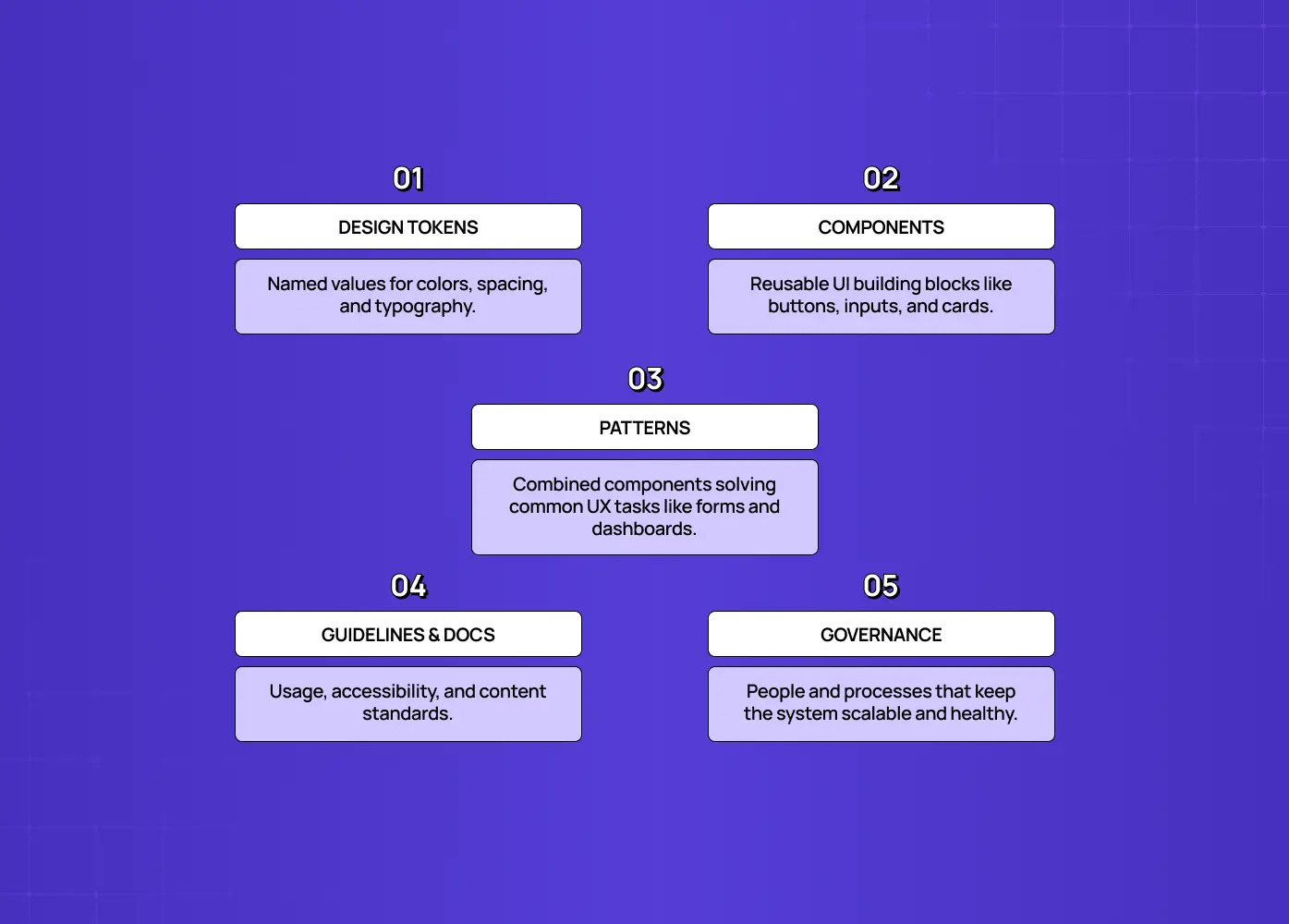
Enterprise systems are layered, from the most granular decisions up to the rules that govern them:
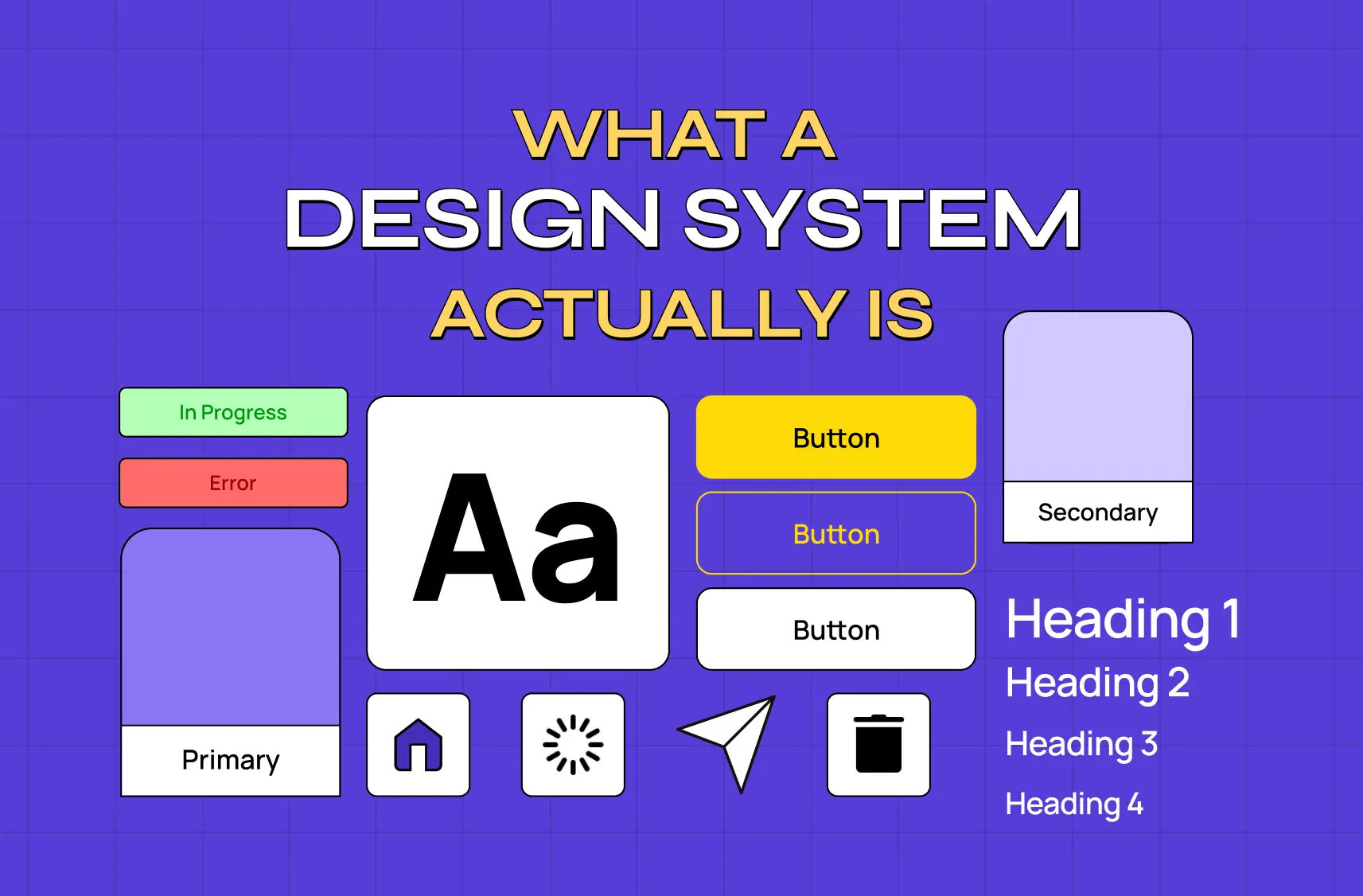
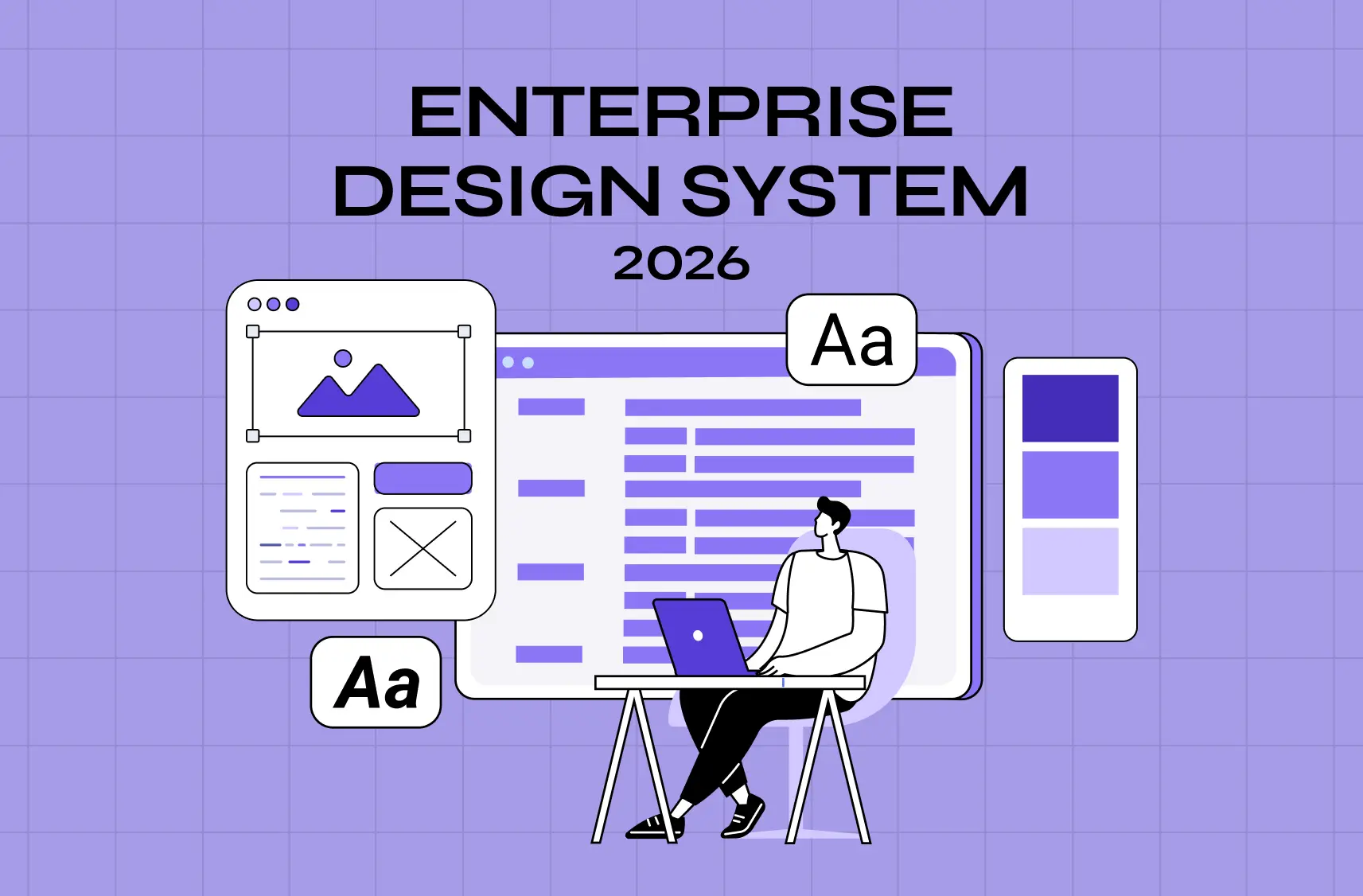
Design tokens, the named values for color, spacing, typography, and more that keep every decision consistent and themeable. This is the foundation everything else sits on, and it only holds up if the visual design principles underneath it are sound.
Components, the reusable UI building blocks (buttons, inputs, cards) in both design and code, usually structured using atomic design so they compose predictably.
Patterns, proven solutions for common problems like forms, navigation, and data tables, built by combining components. Dashboards are where that reuse pays off fastest, which makes dashboard UX best practices worth codifying early.
Guidelines and documentation, how and when to use each element, plus accessibility and content standards.
Governance, the people, processes, and decisions that keep the system healthy as it grows.
Miss any layer and the system weakens. Skip governance, and it eventually collapses.
Signs your organization needs one
Not sure whether you've outgrown ad-hoc design? A few symptoms are reliable tells:
Duplicated work. Different teams keep rebuilding the same components, three versions of a date picker, five shades of "primary" blue, and you're paying for the same work repeatedly.
Fractured brand feel. Your products look and feel like different companies made them, which means brand coherence has already fragmented.
Slow, error-prone handoff. The design handoff process drags because there's no shared source of truth, and you're leaking time at every sprint.
Long onboarding. New designers or developers take weeks to ramp up because nothing is documented or reusable, so tribal knowledge becomes a bottleneck.
Inconsistent quality. Accessibility and quality vary wildly across products because every team is re-solving problems that were already solved elsewhere, which is why accessibility-first UX is now a leading reason enterprises centralize components at all.
Any two of these signals mean the cost of not having a system is already higher than the cost of building one. You're just paying it invisibly, spread across every team.
The business case: design system ROI and what it delivers
Design systems are one of the rare design investments with a clear, quantifiable return, which is exactly how you justify one to leadership. If you need to build the case from scratch, start with how the ROI of UX design gets calculated. The numbers are compelling: streamlined systems cut roughly 30 to 40% of development costs by eliminating duplication and technical debt, and most enterprises report positive ROI within the first year, with benefits compounding as adoption grows. Concrete outcomes back this up: one enterprise cut component design time by 40% and improved developer onboarding by 25% within six months of adopting a system.
Beyond the hard numbers, the strategic benefits are just as real:
Faster delivery cycles, because teams assemble instead of reinventing.
Stronger consistency, so a sprawling product portfolio feels like one trustworthy brand.
Accessibility and quality baked in once, rather than re-litigated per team.
For 2026, the question leaders ask is no longer why build a design system, but how fast they can evolve theirs into an adaptive, well-governed ecosystem.
Governance: the decision that makes or breaks it
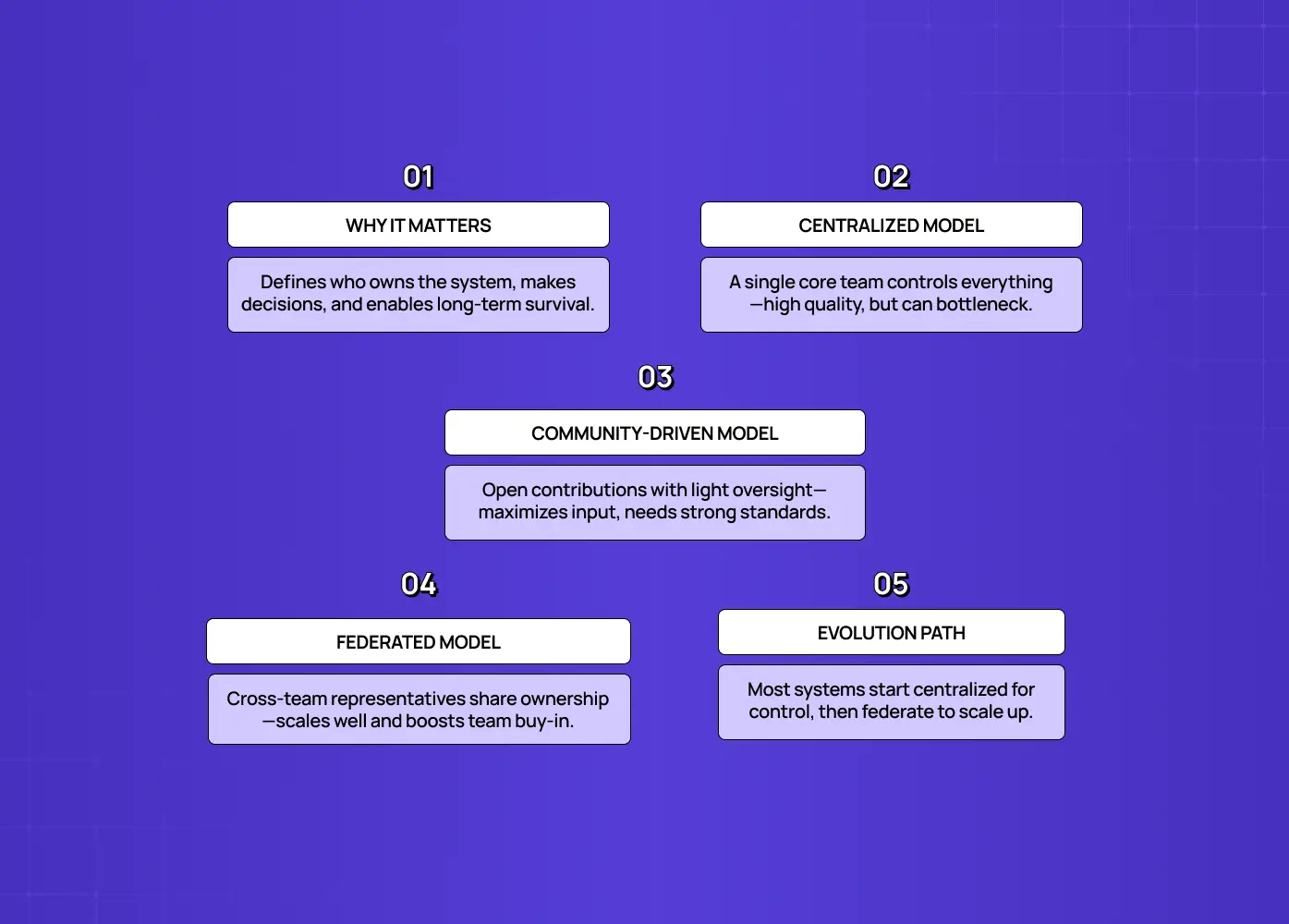
If there's one thing to get right, it's design system governance. It matters more than any tool. Governance is who owns the system, who can contribute, and how decisions get made, and it's the single most consequential choice for long-term health. There are three common models, and the right one shifts as your organization grows.
Centralized governance. A single dedicated team is in charge of the system: they build, maintain, and approve everything. It produces high consistency and quality but can become a bottleneck as demand grows. It's often the right starting point.
Federated governance. Ownership is distributed across representatives from multiple teams who contribute and make decisions together, usually coordinated by a small core team. It scales better and drives adoption because teams have a stake, but it requires strong process to stay coherent.
Community-driven governance. Any team can contribute openly, with lightweight oversight. It maximizes contribution and buy-in but needs mature standards and review to avoid fragmentation.
Most enterprises evolve along this path, starting centralized for control, then federating as scale demands. The failure mode is having no clear model: without defined ownership, systems fragment, which is precisely why so many don't survive past 18 months.
The challenges you'll face
These systems fail in predictable ways, so plan for them:
Fragmentation from unclear ownership. This is the number-one killer. When no one is accountable, teams drift and build one-off "snowflake" components until the system is a system in name only.
Weak adoption. A system only delivers value if teams actually use it, which means making it easier to adopt than to ignore.
Cross-team inconsistency. Decisions go undocumented across the many groups handling design, development, QA, compliance, and training.
Difficulty keeping pace with scale. New products, platforms, and brands strain a system that wasn't architected to flex.
Trouble proving ongoing value. Systems that can't demonstrate impact lose funding.
None of these are design problems, exactly. They're organizational ones, which puts them squarely in the domain of design strategy rather than component specs.
7 best practices for a design system that scales
Choose a governance model deliberately, and evolve it
Decide who owns and contributes to the system, and revisit the model as you grow. This is the most important decision you'll make.
Assign clear ownership
A dedicated team or accountable owner is what keeps a system alive past 18 months. Fund it as ongoing product work, not a one-time project.
Build on design tokens
Tokens are the foundation for consistency, theming, and multi-brand support, and your spacing scale should map to the grid systems your layouts actually use. Get them right before scaling components.
Make adoption easy
Invest in great documentation, easy access, and tooling that makes using the system the path of least resistance. Adoption is earned, not mandated.
Keep design and code in sync
The system must serve both designers and developers from a single source of truth, or drift creeps in at the handoff. In practice that means a working Figma to code pipeline carrying tokens straight into production.
Treat it as a living product
Version it, gather feedback, maintain a roadmap, and iterate. A design system is never "done."
Measure and communicate impact
Track adoption, time saved, and consistency, and report the ROI to leadership so the system keeps its mandate and its funding.
Who owns and runs it? Roles and accountability
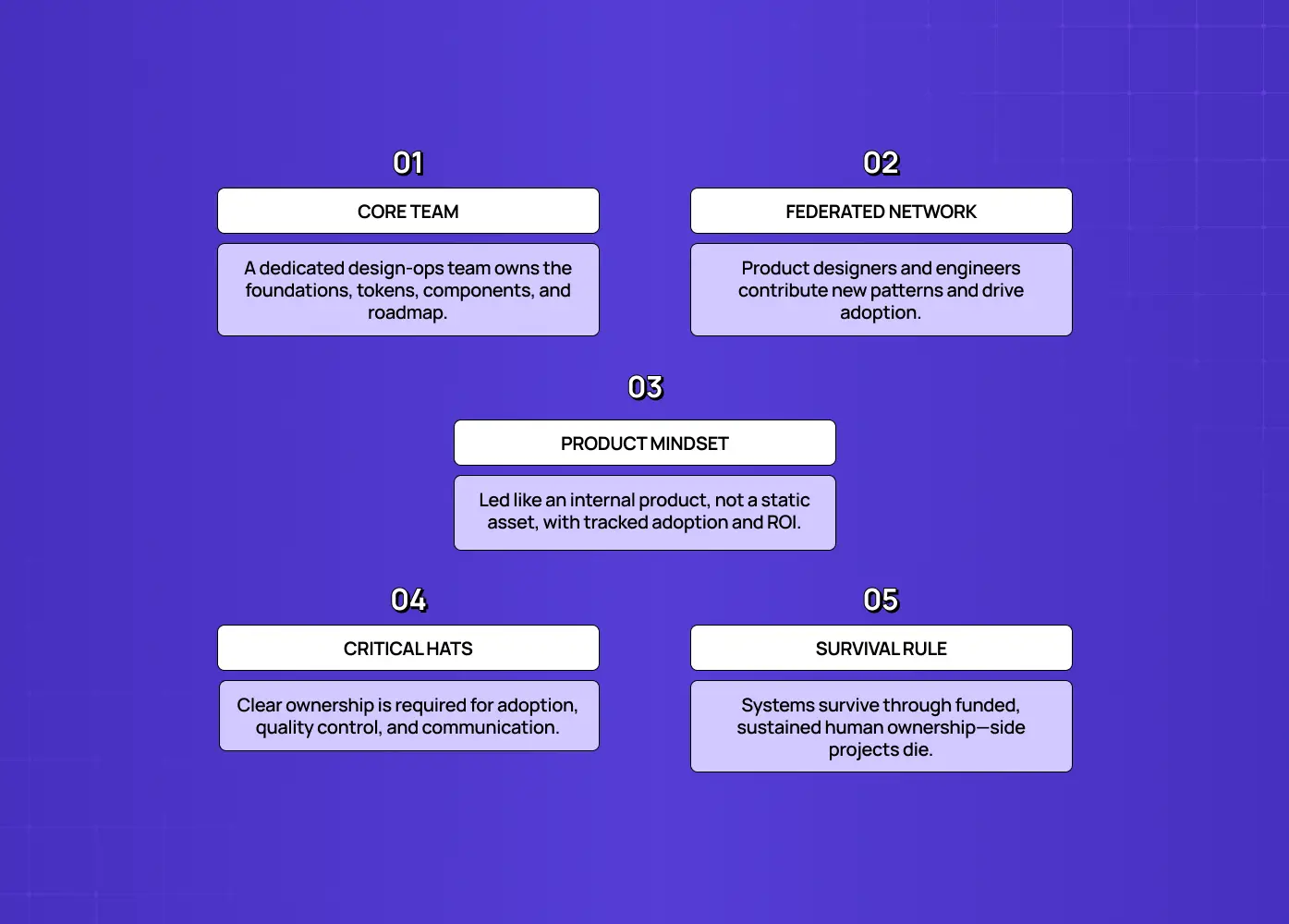
A system this important needs people accountable for it. "Everyone's job" quickly becomes no one's. Most successful enterprise systems have a dedicated core team (sometimes called a design-system or design-ops team) staffed by at least one design system specialist and responsible for the foundations: tokens, core components, documentation, and the roadmap. Around that core, a federated network of contributors, designers and engineers embedded in product teams, propose new patterns, surface needs, and adopt the system in their work. A design-system lead or product manager owns priorities, adoption, and reporting impact to leadership, treating the system as a product with users (its own internal teams) rather than a static asset.
The roles that matter most are the ones organizations tend to skip:
Someone accountable for adoption, making teams want to use it.
Someone for quality and consistency, reviewing contributions and catching drift.
Someone for communication, docs, release notes, and evangelism.
On smaller enterprises, one person may wear several hats, but each responsibility must be consciously owned. The recurring lesson from systems that survive is simple: the technology is rarely the hard part, sustained human ownership is. Fund the team, give it a mandate, and the system endures. Whether that team is agency vs in-house designers is a separate call, but the funding has to be real either way. Treat it as a side project, and it becomes another entry in the 60% that quietly die.
Design systems in 2026: the AI shift
In 2026, AI agents increasingly lint designs and code against the system's tokens, automatically detect "snowflake" components that deviate from standards, and flag drift before it compounds across teams. Instead of catching inconsistency in a manual audit months later, teams catch it the moment it's introduced. This doesn't replace governance, it enforces it at a scale humans can't match, which is exactly what large organizations need. The systems that thrive will be the ones that pair strong human governance with AI that keeps the whole ecosystem honest automatically.
Conclusion
It's far more than a component library. It's the governed, scalable foundation that lets a large organization move fast and stay coherent.
The components are the easy part. Governance, ownership, and adoption are what determine whether your system delivers 30 to 40% cost savings or joins the 60% that quietly die within 18 months.
Build for scale, govern deliberately, and treat it as a living product, and the payoff compounds for years.
If you're building, scaling, or rescuing an enterprise design system, it's worth comparing enterprise UX design agencies before you commit. Book a discovery call with Groto. We help organizations design systems that are coherent, adopted, and built to last: components, governance, and all. Let's build a system your teams actually use.