
Your site now does most of your selling before a prospect ever talks to sales. This guide breaks down what website redesign services include, why quotes differ so much, and how to choose a partner without losing traffic.
How to scope, price and hire a website redesign partner in 2026.
TL;DR
Website redesign services range from a $10K–$30K visual refresh to $80K–$200K+ for a rebuild with a platform migration.
Quotes differ mainly on three things: strategy and copy, content migration, and who owns SEO continuity.
Google advises keeping redirects in place for at least a year after a URL change.
94% of B2B buying groups rank vendors before first contact, so the site is doing sales work you can't see.
Website redesign services are one of the hardest things for a SaaS leader to compare. Three proposals arrive for the same brief, and the numbers read $18,000, $65,000 and $140,000. Each proposal lists "discovery, design, development and launch", and none explains why the price is seven times higher at the top.
The stakes are higher than the budget line suggests. In 6sense's 2025 Buyer Experience Report, 94% of B2B buying groups had already ranked their preferred vendors before they first contacted a seller. For most SaaS companies, the website is where that ranking happens.
This guide is for CTOs, founders and marketing leaders at SaaS and AI companies who are about to hire a redesign partner. It covers what the work includes, why quotes vary, the engineering risks that rarely appear in a proposal, how four frequently shortlisted agencies compare, and when you shouldn't redesign at all.
What Website Redesign Services Actually Include
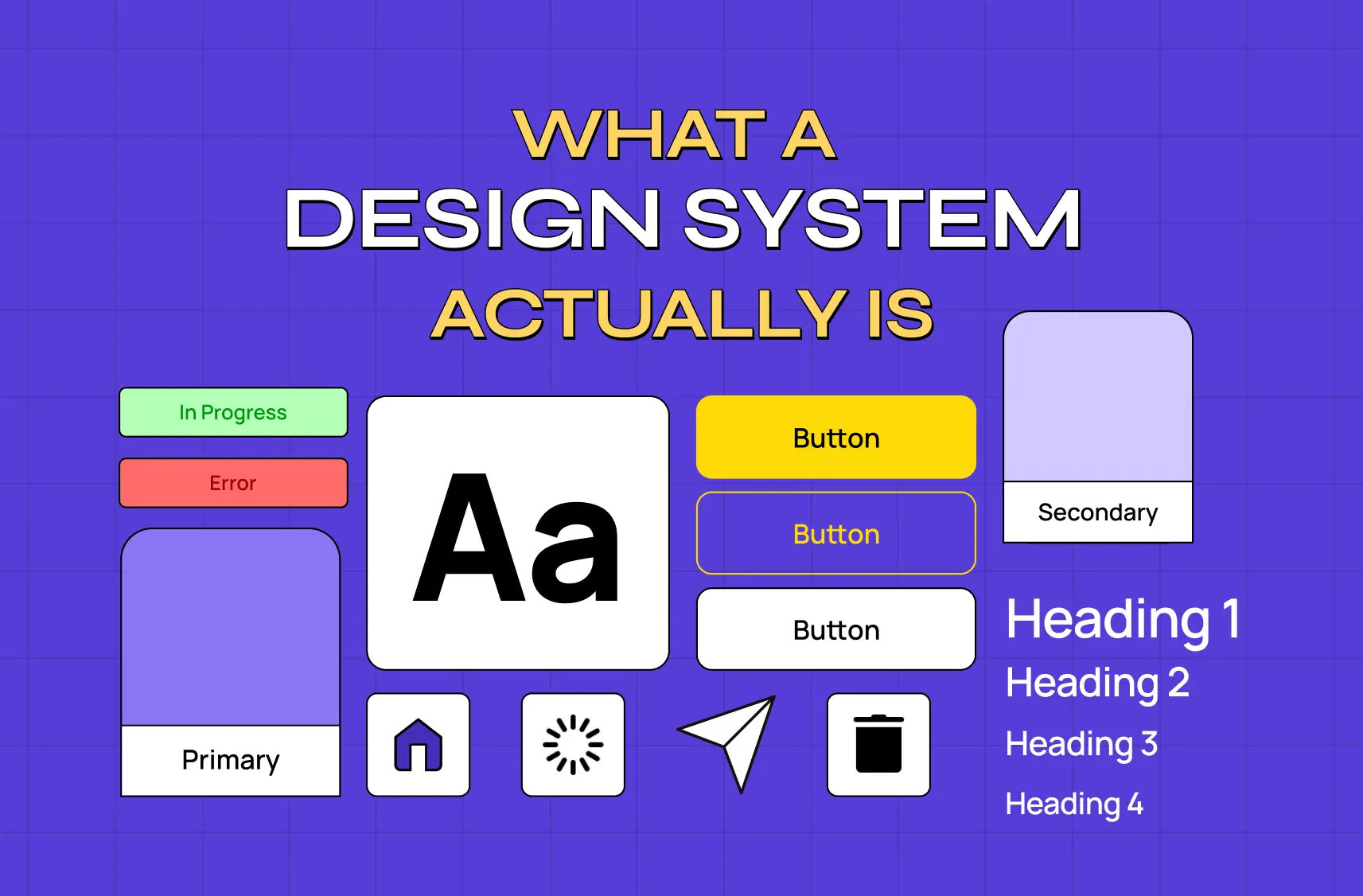
Website redesign services cover five layers of work: strategy (positioning, audience, goals), information architecture, copy, visual design, and the build, including content migration and SEO continuity. A cheap quote usually covers only visual design and the build. A full-scope quote covers all five, which is why prices vary so widely.
When you compare proposals, check each layer explicitly. Vendors describe the same deliverables with different words, so ask what each one produces and who writes it.
Layer | What it produces | Often missing from low quotes |
|---|---|---|
Strategy | Positioning, audience priorities, conversion goals, success metrics | Yes |
Information architecture | Sitemap, page hierarchy, navigation, URL plan | Partly |
Copy | Page messaging, headlines, CTAs written for your buyers | Yes |
Visual design | Design system, page templates, responsive layouts | No |
Build and migration | CMS setup, integrations, content transfer, redirects, QA | Partly |
The copy layer causes the most disputes. If the agency designs around placeholder text and your team writes copy later, your launch date depends on your marketing team's calendar, not the agency's.
Action check: ask every vendor who writes the copy, who maps old URLs to new ones, and who fixes rankings if they drop after launch.
Why Website Redesign Quotes Vary by 5x or More
Website redesign quotes vary because vendors price different scopes, not because some are overcharging. A $15K quote usually reskins existing pages on your current CMS. A $120K quote usually includes new positioning, rewritten copy, a platform migration and SEO protection. Compare scope line by line before you compare prices.
Agency minimums give you a floor. On Clutch, Huemor lists a $25,000 minimum project size and Webstacks lists $10,000, with hourly rates between $150 and $300. The ranges below are directional for US-market agencies in 2026.
Scope | Typical cost | Timeline | What you get |
|---|---|---|---|
Visual refresh | $10K–$30K | 3–6 weeks | New design on existing pages and CMS |
Marketing site redesign | $30K–$90K | 8–14 weeks | New IA, copy, design system, 20–60 pages |
Redesign plus replatform | $80K–$200K+ | 12–20 weeks | All of the above plus CMS migration, integrations, 100+ pages |
For a deeper breakdown by page count and integrations, see our guide to how much a website redesign costs.
Questions for your next vendor call:
Which of the five layers does this price include, and which do you expect us to supply?
How many rounds of revisions are included per template?
What happens to the price if our page count grows by 30% during discovery?
The Engineering Side: Platform, Migration and SEO Risk
Most redesign failures show up after launch, and they land on engineering.
A new CMS changes who can edit pages, how forms reach your CRM, and whether your analytics still fire. A new URL structure puts years of search equity at risk.
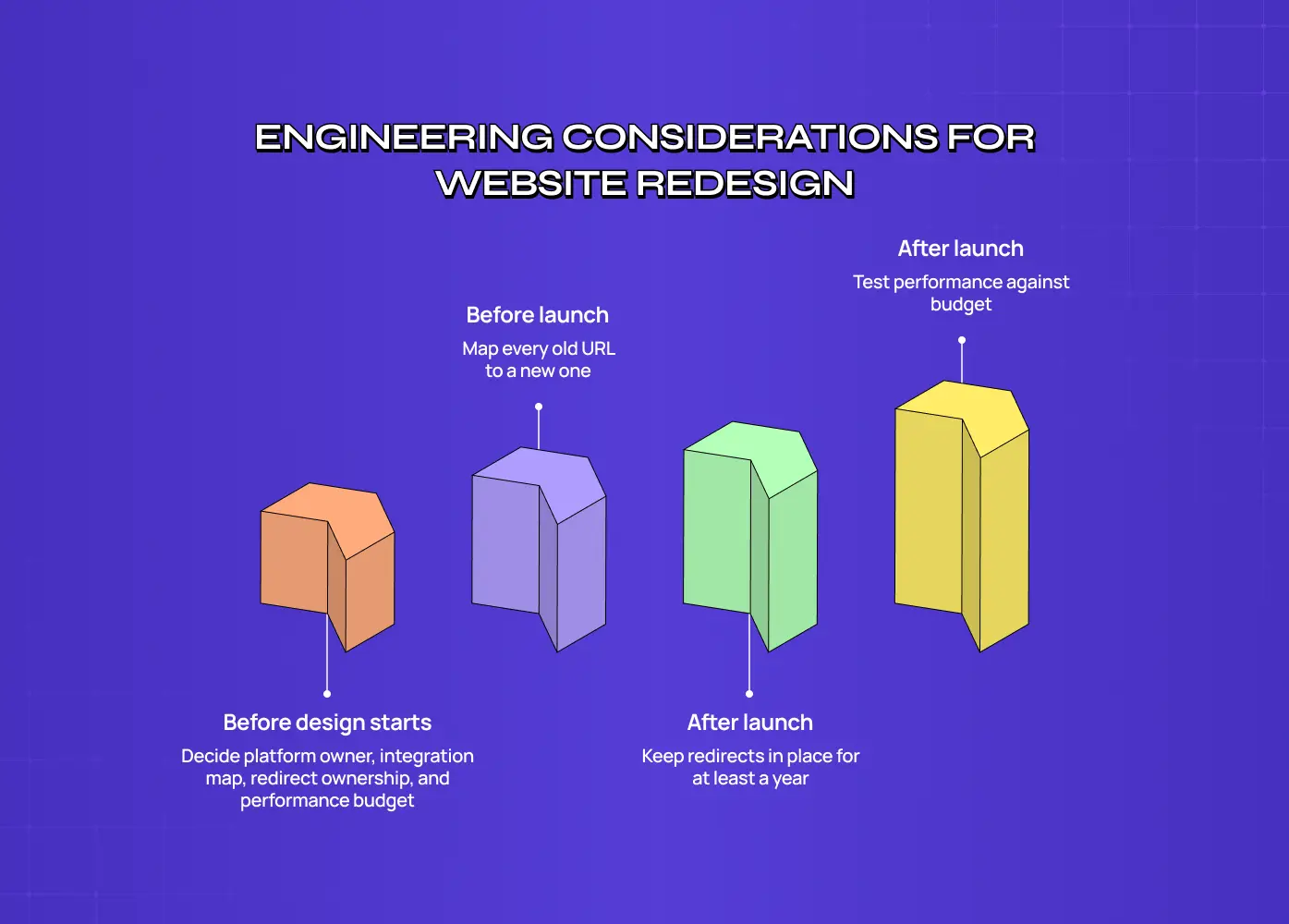
Google's guidance on site moves is direct about this. Expect rankings to fluctuate while Google recrawls, map every old URL to a new one before launch, and keep redirects in place for at least a year. For a medium-sized site, it can take weeks for Google to show the new URLs.
Performance deserves a line in the contract too. A study by Deloitte for Google across 37 brand sites found that a 0.1-second improvement in mobile speed lifted lead-generation form progression by 21.6%.
Heavy animation looks good in a pitch. It can also slow the page your pipeline depends on.
Decide these four things before design starts:
Platform owner. Who chooses the CMS (Webflow, Framer, WordPress or headless), and who maintains it after launch?
Integration map. Which forms, CRM fields, product analytics and marketing tools must keep working on day one?
Redirect ownership. Who builds the redirect map, and who checks it against Search Console for 90 days after launch?
Performance budget. What load-time target will you accept on mobile, and who tests it before sign-off?
Website Redesign Services Compared: 4 Agencies B2B Buyers Shortlist
These four agencies come up repeatedly when B2B and SaaS buyers ask for website redesign services on Reddit and in peer threads. Each fits a different stage, stack and budget. Facts below come from each agency's own site and Clutch profile, checked on 28 September 2026. Groto wrote this guide and is included, so weigh our entry accordingly.
1. Webstacks
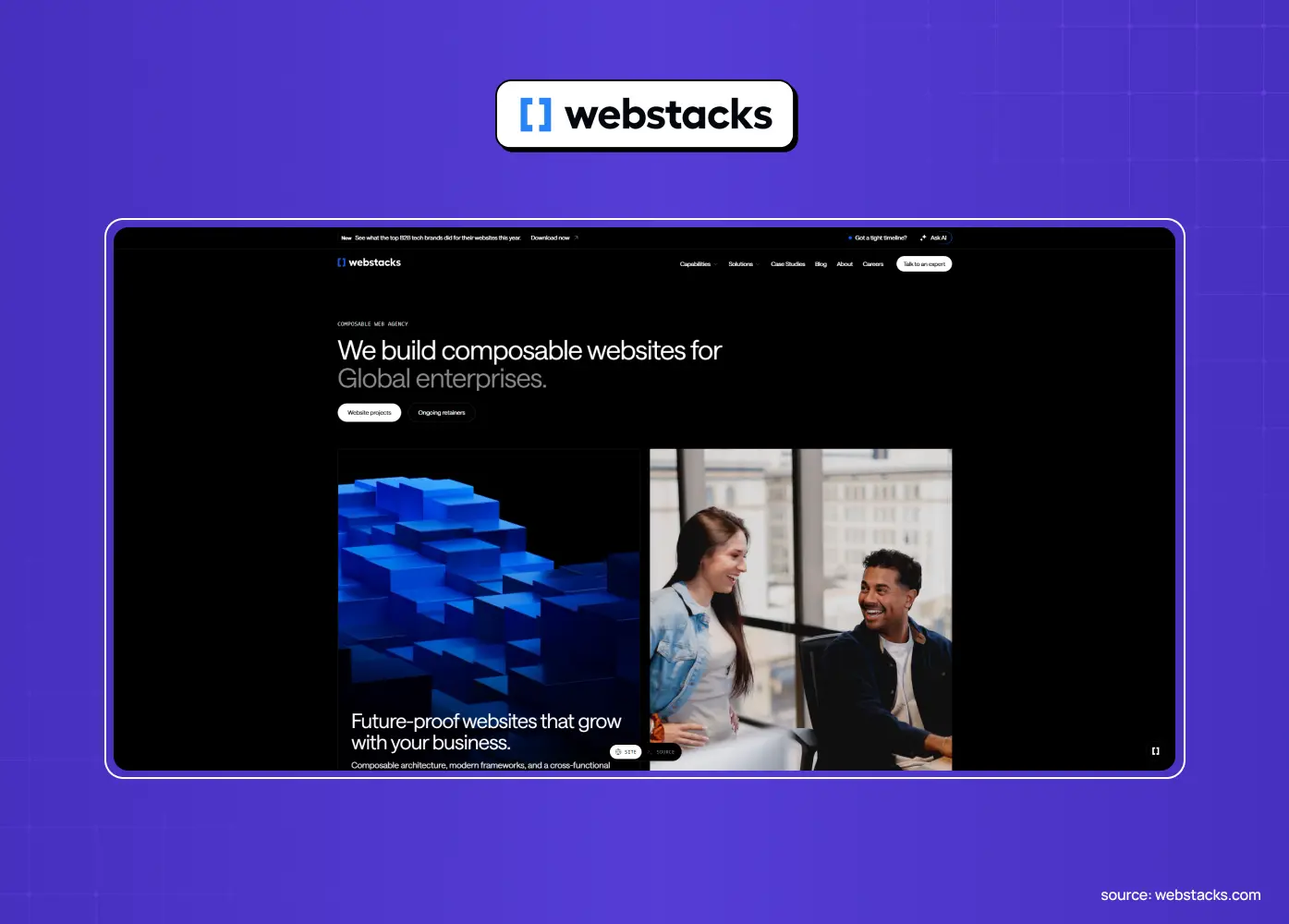
Based: San Diego, founded 2020. Clients include: Cribl, FieldPulse.
Webstacks builds composable marketing sites on headless CMSs such as Sanity and Contentful with Next.js, and works as an ongoing web team. Its Clutch profile lists $200–$300 per hour and a $10,000 minimum.
Best for: Series B+ SaaS teams moving to a headless stack. Not right for: teams that want marketing to edit everything in a visual no-code builder.
2. Groto

Based: design studio working with US AI and SaaS companies.
Groto brings product UX, brand and web together, so the site explains a complex product the way the product works. Our website redesign agency service builds in Framer, Webflow or full-stack, with full marketing sites typically taking 3–8 weeks.
Best for: AI and SaaS teams whose site has to explain a technical product to buyers. Not right for: enterprise sites with thousands of pages across many languages.
3. Takeoff
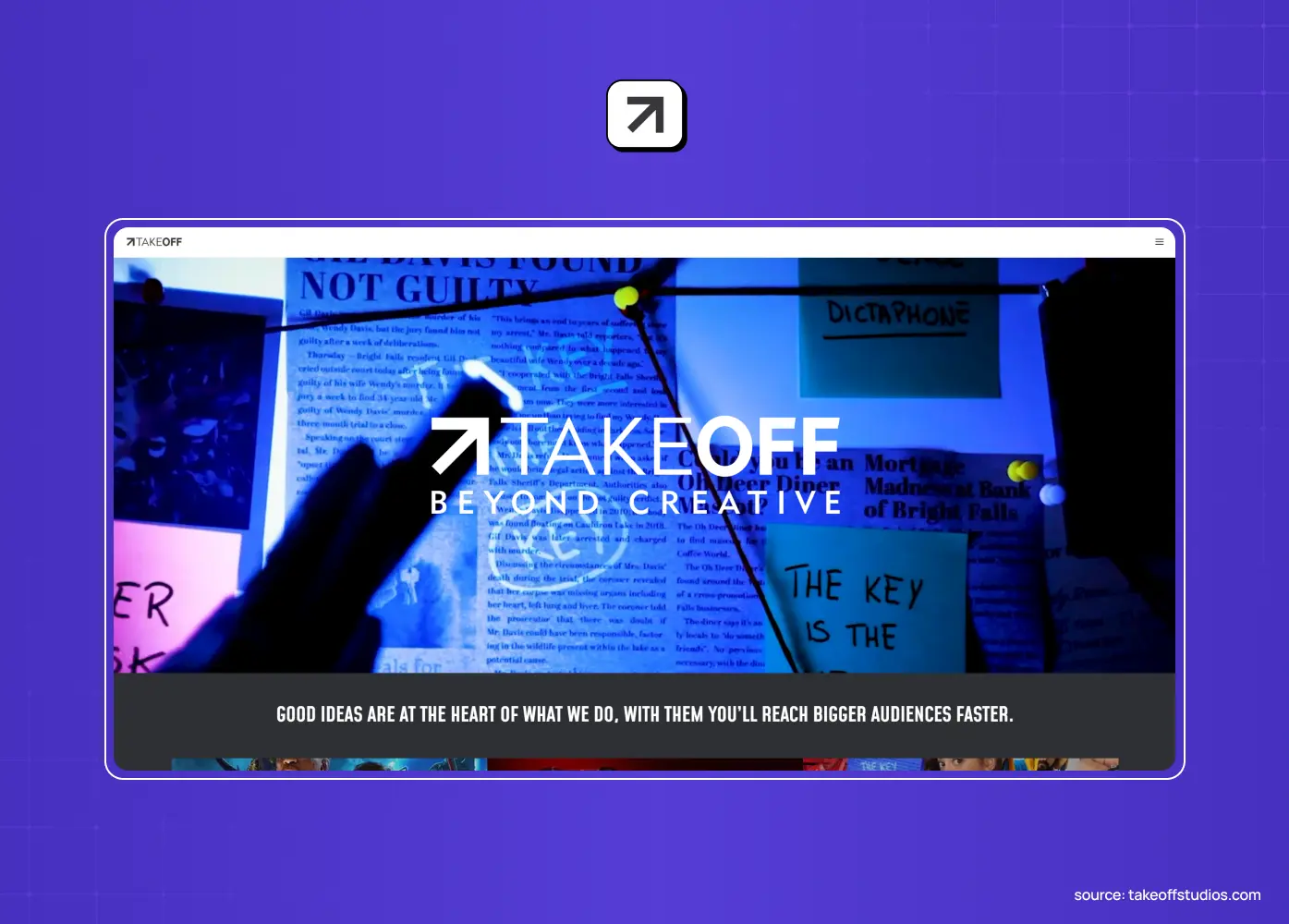
Based: New York. Clients include: FiscalNote, Duck Creek.
Takeoff runs a strategy-first process with three independent design concepts and builds on WordPress, Webflow, HubSpot CMS, Craft or Drupal. Its redesign page quotes 12 to 16 weeks for a standard project.
Best for: SEO-heavy B2B sites where migration planning matters most. Not right for: teams that need to launch in under two months.
4. Huemor
Based: Pittsburgh, founded 2011, 16–20 people.
Huemor focuses on web design and development for mid-market B2B companies, mostly on WordPress, with 72 reviews averaging 4.8 on Clutch.
Best for: mid-market B2B companies staying on WordPress. Not right for: SaaS products that need product-level UX work alongside the site.
How to Run a Redesign Without Stalling Pipeline
The old site freezes, approvals drag on, and demo requests dip for a quarter.
That pattern is avoidable with sequencing and ownership. Keep publishing on the old site until launch week, and assign one decision-maker who can approve copy and design without a committee.
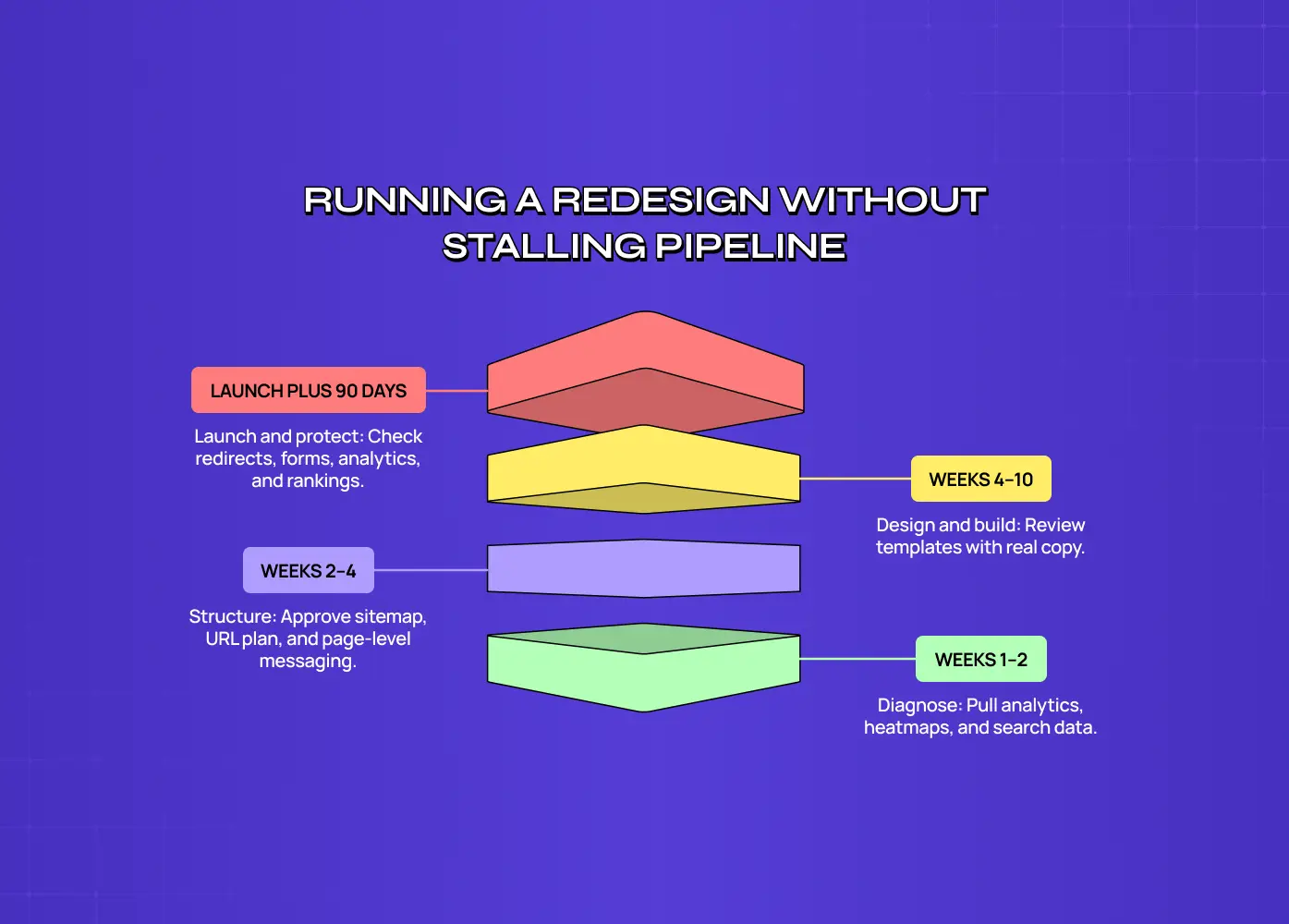
Run the project in four phases, each with a named owner on your side:
Diagnose (weeks 1–2). Pull analytics, heatmaps and search data before anyone opens a design tool. Owner: marketing lead.
Structure (weeks 2–4). Approve the sitemap, URL plan and page-level messaging. Owner: CMO or founder.
Design and build (weeks 4–10). Review templates with real copy, not placeholders. Owner: marketing lead, with engineering on integrations.
Launch and protect (launch plus 90 days). Check redirects, forms, analytics and rankings weekly. Owner: engineering or web ops.
At Groto, the diagnosis often changes the brief. When we redesigned the Meydan Free Zone website, heatmaps showed that nearly 62% of visitors never scrolled past the second section. That finding moved the cost calculator to the center of the new site. The build was delivered by one designer and one project manager on a tight deadline, and it passed a government compliance review.
When You Shouldn't Buy a Redesign
You shouldn't buy website redesign services when the problem is one page, one form or one message. If traffic is healthy and one funnel step leaks, targeted conversion fixes are faster and cheaper. A full redesign makes sense when positioning has changed, the CMS blocks your team, or the site can't scale with your product line.
Use this test with your leadership team:
Signal | Likely fix |
|---|---|
Pricing or demo page converts poorly, rest of the site is fine | Page-level CRO |
Positioning changed after a pivot or new product line | Full redesign |
Marketing needs a developer for every page edit | Replatform |
Site loads slowly on mobile, design is still current | Performance work |
Brand looks older than competitors in sales calls | Redesign or visual refresh |
If most of your signals point to conversion, start with our guide to improving website conversion without a redesign.
Conclusion: Choosing a Website Redesign Partner
Decide scope before you compare prices. Confirm which of the five layers you need, name one approver on your side, and give engineering ownership of migration, integrations and redirects. For a SaaS marketing site, plan for roughly 8–14 weeks and $30K–$90K, more if you're changing platforms.
If your team is weighing a redesign against targeted fixes, a second opinion before the RFP saves weeks. Book a 30-minute call and we'll look at your analytics and current site with you, then tell you whether a redesign is the right call.