What Is a Design Brief? Definition, Elements, and How to Write One

A design brief prevents scope creep, rework, and budget blowouts. Learn what it includes, why it matters, and how to write one before your next project.

What Is a Design Brief? Definition, Elements, and How to Write One

A design brief prevents scope creep, rework, and budget blowouts. Learn what it includes, why it matters, and how to write one before your next project.

Most design projects don't fail because of bad design — they fail because nobody defined the problem, the scope, or what success looked like before work began. A design brief fixes that. Here's everything you need to know.

Skip the brief, pay the price. Here's how to write one that actually works.

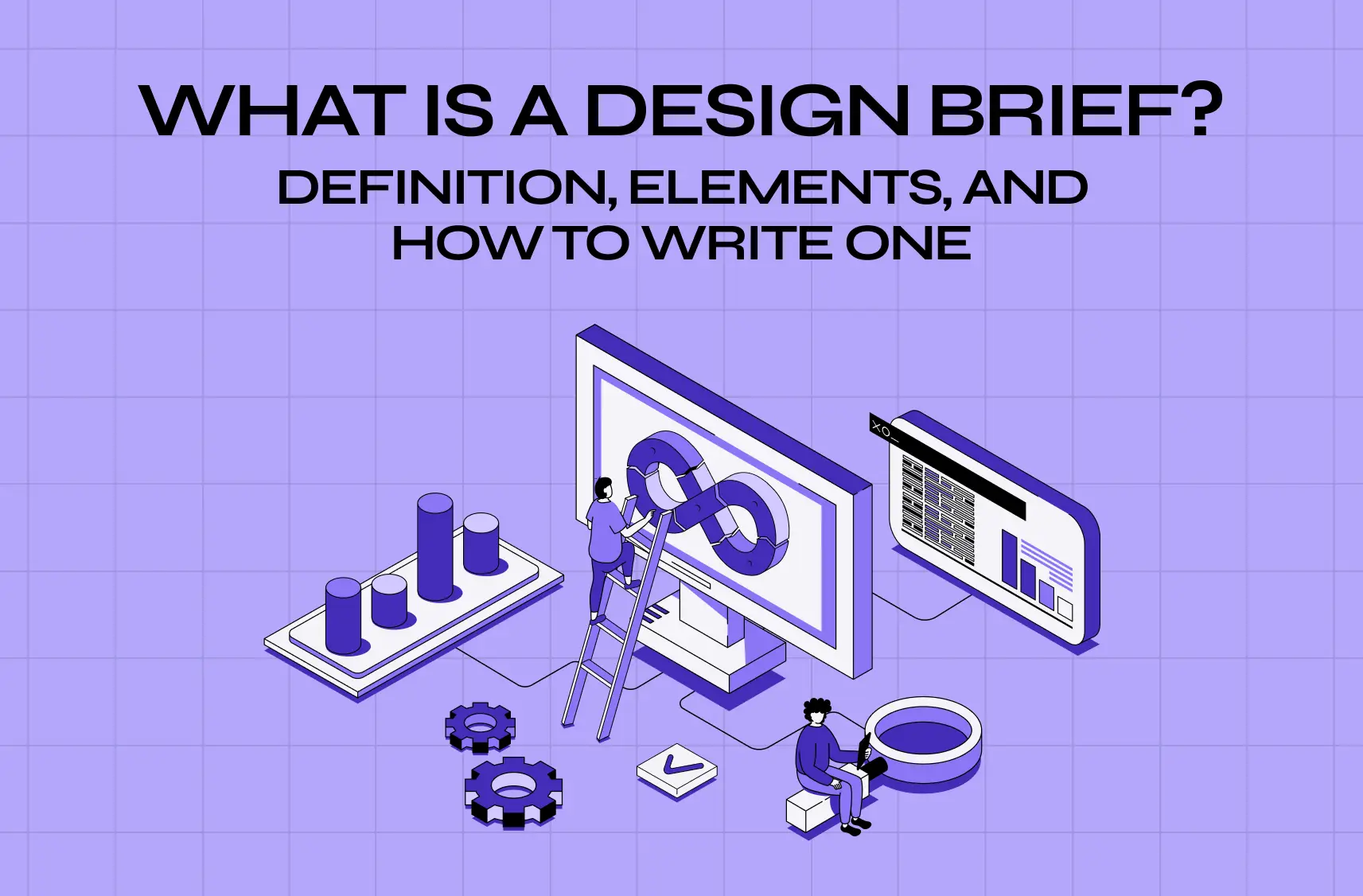
Illustration of product optimization with charts, tools, and users improving system performance.

Three months into a product redesign, something familiar happens: the designs don't match what you had in mind, the timeline has doubled, and a third of the budget is already gone. The team is frustrated. The designer is confused. Everyone is pointing at different documents trying to figure out where the project went sideways.

It went sideways at the beginning — before a single pixel was placed — because nobody wrote a design brief.

This isn't a designer problem or a project management problem. It's a communication problem, and a design brief is the simplest tool available to solve it. For product teams building or redesigning digital products, it's also one of the most consistently skipped steps — which is precisely why so many design projects run late, run over, and deliver something nobody quite wanted.

What Is a Design Brief?

A design brief is a shared document that defines what a design project is trying to accomplish, who it's for, what constraints it operates within, and how success will be measured — written before design work begins.

That definition sounds simple. What makes it hard in practice is that most teams either skip the brief entirely or write one that's too vague to be useful. Generic guides describe it as a "project overview" or a "communication tool." Both are technically true and practically useless descriptions, because they don't explain what's actually at stake.

Here's the more useful framing: a design brief is a contract against misalignment. Every revision cycle, every scope debate, every "that's not what I meant" moment in a design project is a symptom of two parties operating from different assumptions — often because no one made the underlying design philosophy explicit before work began.

The brief exists to surface and resolve those assumption gaps before they become expensive.

For brand and marketing projects, where brand experience design shapes how customers perceive and emotionally relate to a company across every touchpoint, a misaligned brief might mean redoing a banner ad. For digital product teams, a misaligned brief can mean:

  • Months of development built on the wrong design direction

  • A feature launch that fails to move activation metrics

  • A redesign that solves a problem nobody actually had

The stakes are different. So the brief needs to be different too — and generic templates designed for advertising campaigns don't cut it for product work.

Design Brief vs. Creative Brief vs. Product Spec: What's the Difference?
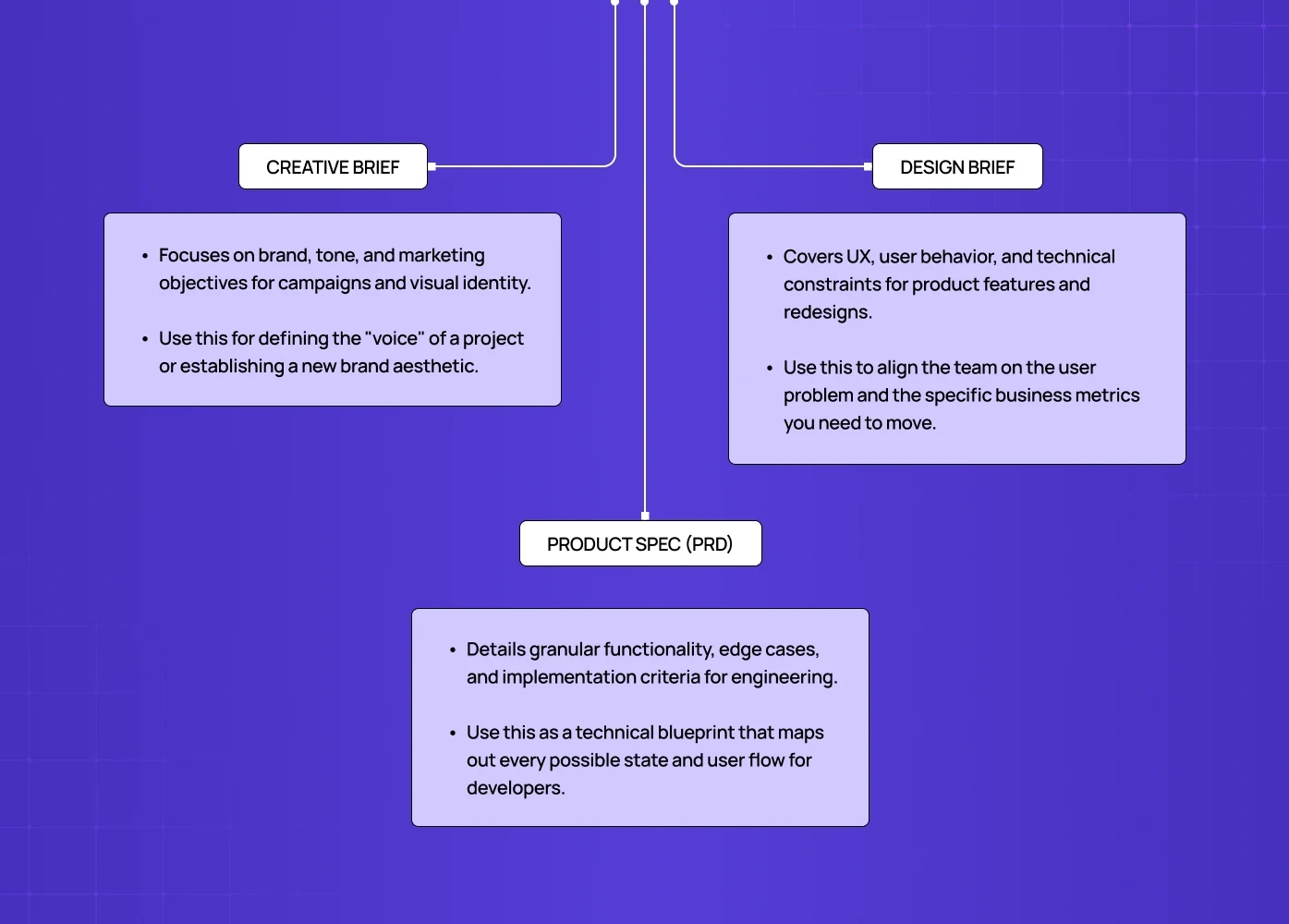

Diagram explaining differences between creative brief, design brief, and product spec (PRD).

These terms are often used interchangeably. They shouldn't be.

A creative brief is typically used for brand, marketing, and advertising work — campaigns, visual identity, content. It focuses on tone, audience, and communication objectives. It doesn't typically include technical constraints, user behavior data, or handoff requirements relevant to digital product design — the core concerns of UI UX design that make product briefs fundamentally different documents.

A design brief (in the product context) is used for UX and product design work — new products, feature development, redesigns. It includes technical constraints, behavioral user context, product metrics, and handoff requirements that a creative brief never addresses.

A product spec (or PRD) is more granular than a design brief and lives downstream of it. A spec describes how a feature should function — user flows, states, edge cases, acceptance criteria. The brief answers "what problem are we solving and what does success look like?" The spec answers "what exactly does the solution do?"

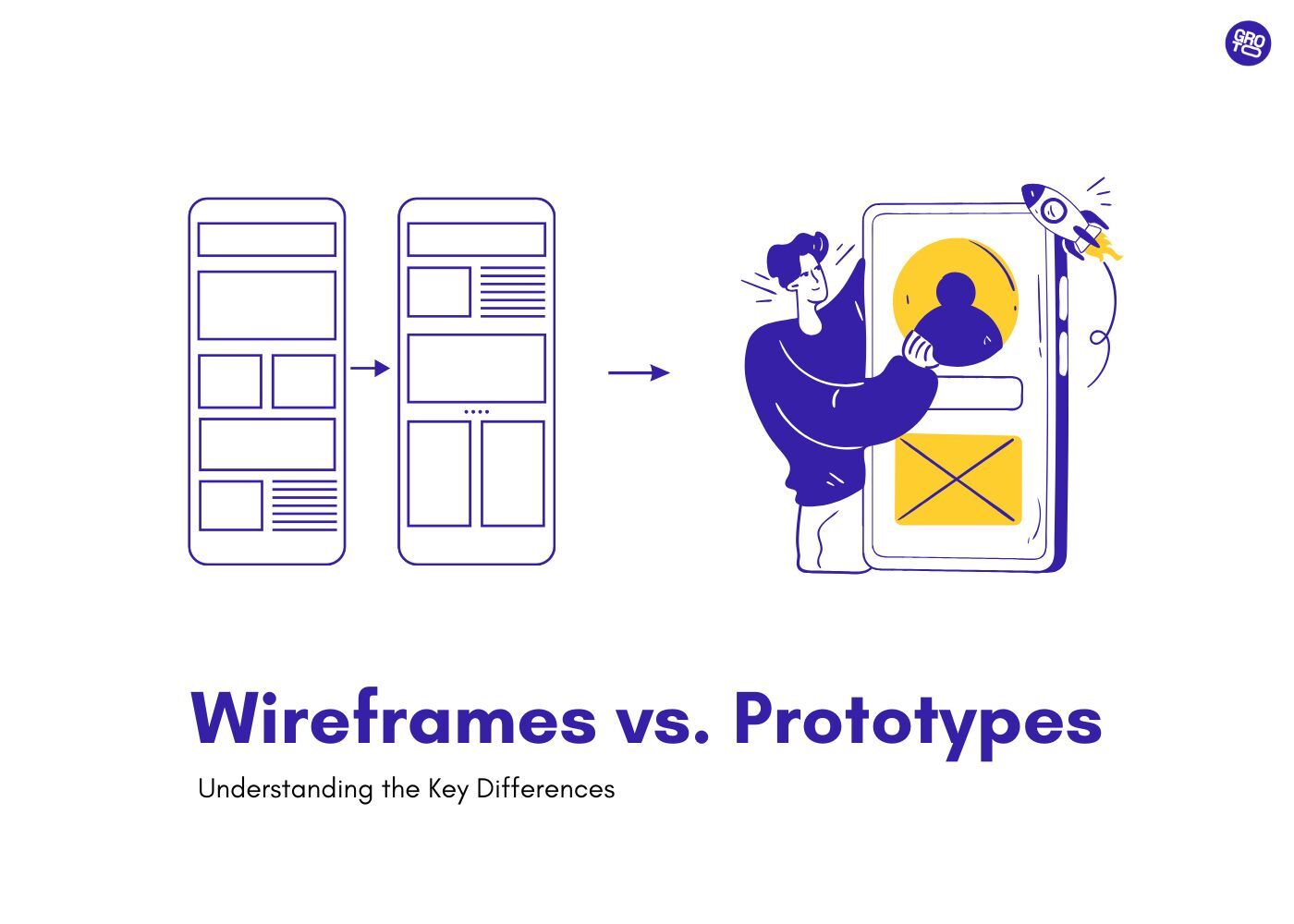
For most product design work, you need both. The brief comes first and drives alignment on direction. The spec comes later and drives alignment on implementation. Between them, low-fidelity wireframes translate the brief's direction into early visual form — fast enough to test assumptions before committing to spec-level detail. Once that direction holds up, the wireframe-to-prototype process converts it into something testable with real users before any spec-level decisions are locked.

Why Every Project Needs a Design Brief

Most projects don't fail because of bad design. They fail because of misalignment that nobody caught early enough. A strong brief is the earliest intervention available.

Here's what a well-written brief actually prevents:

  • Revision loops that repeat the same misalignment two and three times over — each cycle costing roughly as much as doing the work right the first time

  • Scope creep that turns a 6-week project into a 14-week one, because nobody wrote down what was out of scope

  • Deliverables that miss the metric — polished work that doesn't move the outcome it was supposed to

  • Relationship friction between client and designer, when expectations were never made explicit

When Groto worked on the PolicyBazaar insurance shopping experience, the brief kept the entire project anchored to one clear goal: reduce drop-offs in the sign-up flow. Without that written scope, a redesign of that scale could easily have expanded into a full platform overhaul. The brief prevented that — and the outcome stayed measurable.

The 7 Elements Every Product Design Brief Must Include
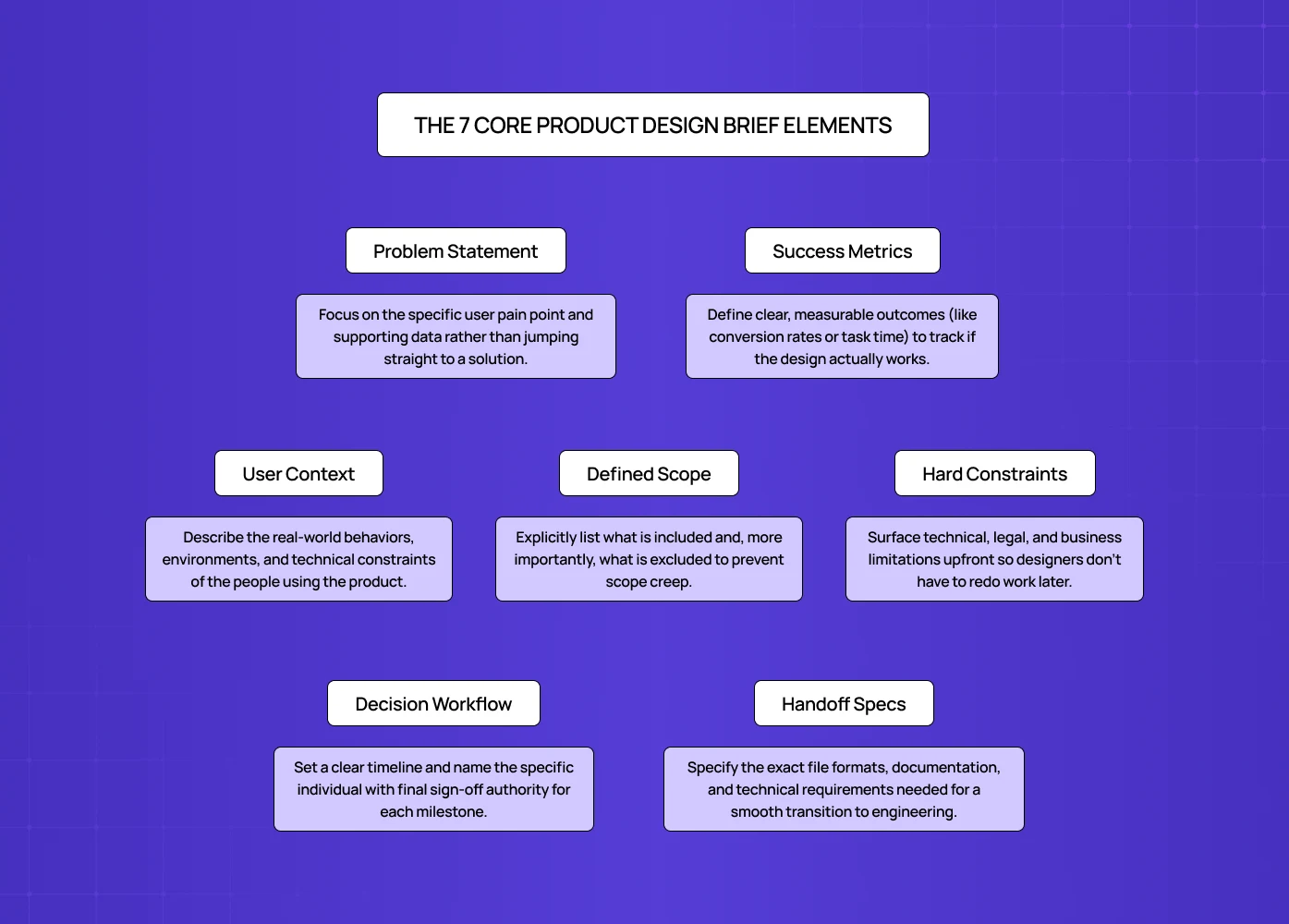

Overview of seven core product design brief elements including problem, metrics, scope, and constraints.

Not everything in a standard design brief template transfers cleanly to digital product design. Here's what actually matters when you're building or redesigning a product.

1. The Problem You're Solving — Not the Solution You've Decided On

This is the most common mistake in product design briefs: writing the solution where the problem should go.

  • "Redesign the onboarding flow" → this is a solution

  • "New users aren't reaching the activation milestone within 7 days, and session recordings show they're abandoning at the integration step" → this is a problem

When the brief leads with a solution, designers optimize for the stated output rather than the underlying goal. When it leads with a problem, designers have the context to propose better solutions — or validate that the stated solution is the right one. This is the core of what product designers actually do in development: translate validated problems into designed solutions, rather than execute on assumed ones.

A well-written problem statement should include:

  • What isn't working

  • Who is affected

  • What data or evidence you have

  • What you believe is causing it — labeled as a hypothesis, not a fact

2. Goals and Success Metrics

Every design brief should answer: how will we know if this worked?

  • Tie design goals to measurable outcomes — activation rate, task completion rate, time-to-value, support ticket volume, trial-to-paid conversion, NPS

  • Vague success criteria ("improve the user experience," "make it more intuitive") make it impossible to evaluate outcomes

  • If you can't articulate a metric that the design is supposed to move, that's a signal the problem definition needs more work before design begins

3. User Context — Who Uses This and How

A brief should describe the actual users of the product — not a marketing persona, but a behavioral description of how people interact with the product today.

  • What's their technical proficiency?

  • What device and environment are they typically in?

  • What task are they trying to accomplish, and what do they do when they get stuck?

Context of use is as important as user demographics. An enterprise admin completing a monthly task in a browser has completely different design requirements than a field worker completing a task on mobile in 30-second windows.

4. Scope — What's In and What's Explicitly Out

Scope should define not just what the project includes, but what it does not include. This is the part most briefs omit entirely — and it's where scope creep begins.

  • "Redesign the onboarding flow" will inevitably expand to include the email sequence, in-app tooltips, the help center, and the settings page — unless the brief explicitly says it doesn't

  • "This project covers screens 1–6 of the onboarding flow. It does not cover email touchpoints, the admin panel, or mobile view" is the kind of specificity that prevents three months of unplanned work

5. Design Specifications and Constraints

Design doesn't happen in a vacuum. The brief should surface the constraints that will shape every design decision:

  • Tech stack and any design system or component library in use

  • Accessibility requirements

  • Legal or compliance considerations

  • Existing integrations that can't be changed

  • Hard constraints on the timeline

Design systems for SaaS products govern how every component scales across the product — surfacing these constraints in the brief prevents designers from building in directions the system can’t support. Designers who discover constraints mid-project are forced to redo work that could have been done right the first time. Surfacing constraints in the brief isn’t limiting creativity — designers who understand digital product design principles know the best work happens within well-defined constraints. It’s respecting everyone’s time.

6. Timeline and Decision-Making Process

The brief should include milestones, a review schedule, and — critically — a clear description of who has sign-off authority at each stage.

  • Design projects run late for many reasons, but one of the most common is unclear decision-making: work is completed, reviews happen, and nobody has authority to approve

  • Defining this upfront requires two things: an agreed milestone structure, and a named person who can say "yes, this is approved, move forward"

7. Deliverables and Handoff Requirements

Be specific about what format the final work should take.

  • "Designs" isn't a deliverable

  • "Figma files with component documentation, annotated handoff specs, and a clickable prototype for stakeholder review" is a deliverable

  • Also address handoff requirements: does engineering need designs in a specific file structure? Are there naming conventions for design tokens? Will the designer be available for handoff questions?

How to Write a Design Brief

Writing a strong brief doesn't require a specialist or a week of preparation. Here's a practical structure that can be completed in a single working session.

Step 1 — Define the problem, not the solution. 

Start with data: session recordings, analytics, support tickets, user interview notes. Write a problem statement before anyone proposes a design direction.

Step 2 — Set measurable goals. 

One or two specific metrics are better than a list of aspirations. Tie them to user behavior — not aesthetic outcomes.

Step 3 — Describe users in behavioral terms. 

Who uses this? How, and in what context? Where do they struggle today? Skip the persona template and write what's actually observed.

Step 4 — Set scope boundaries explicitly. 

Write what the project includes. Then write what it excludes. Both matter equally. The exclusions are what prevent scope creep.

Step 5 — Document all constraints. 

Brand guidelines, design system, tech stack, budget, accessibility standards, timeline — everything that will shape design decisions should be visible from day one.

Step 6 — Define deliverables and approval authority. 

Name the format of final deliverables. Name the person who can approve each milestone. Without this, projects sit in review loops indefinitely.

Step 7 — Share it and get alignment before work begins. 

A brief only works if every stakeholder has read it and agreed to it. Surface disagreements now — before a single screen is designed — not during revision round three.

When Do You Actually Need a Design Brief?

The short answer: every time significant design work begins. Here are the scenarios where teams most commonly skip the brief — and pay for it later.

Starting a new product or MVP 

The energy around a new product creates pressure to build fast that often skips the brief entirely. But this is exactly when a brief is most valuable — before development begins, before assumptions calcify into code, and before the team has invested enough that changing direction feels expensive. The brief is step one of the UX design process — the document that sets the frame for everything that follows, including the product design roadmap that carries those decisions through to build.

Beginning a redesign 

Redesigns are some of the most brief-resistant projects because teams tend to define the work as "fix the design" — which isn't a brief, it's a complaint. Before any redesign begins, the brief should define:

  • What specific failures the redesign is addressing

  • What metrics the new design must improve

  • What constraints the redesign must operate within

Without this, redesigns frequently deliver aesthetically updated products that still fail to move the metrics that prompted them. When Groto worked on the PolicyBazaar insurance shopping experience, a clearly scoped brief kept the entire project anchored to reducing sign-up drop-offs — preventing a scoped redesign from quietly expanding into a full platform overhaul.

Briefing an external design agency 

Choosing the right web design agency and briefing them well are two different skills — but the brief is what makes the engagement worth having. When you bring in an external design partner, the brief becomes the primary mechanism for transferring context.

Agencies work on multiple products simultaneously — and when they cover multiple UX disciplines, from research and content strategy to interaction and visual design, each discipline may be interpreting the brief through a different lens. They don't have the institutional knowledge your team has built over months or years. A thorough brief compresses that context transfer and dramatically reduces early-stage revision cycles that exist simply because the agency was optimizing for the wrong thing.

Adding a major feature or integration 

Feature work that spans multiple surfaces, touches multiple teams, or has significant user-facing complexity benefits from the same upfront alignment a full redesign requires. The problem statement, success metrics, and scope boundaries should always be written down before design begins.

The Real Cost of Skipping the Brief

The case for writing a design brief is usually framed positively: alignment, efficiency, faster delivery. The more persuasive case is the negative one — what actually happens when teams skip it.

Revision loops that compound Each revision cycle addressing a misalignment costs roughly the same as doing the work right the first time. When a project runs three or four extra revision cycles because the original direction wasn't adequately specified, you've effectively paid for the project twice. A brief that takes a day to write will eliminate more revision cycles than any other single intervention.

Scope creep that's impossible to control Without a written scope, every stakeholder review becomes an opportunity for the project to grow. "Can we also do X?" is an innocent question with no good answer when there's no document defining what the project is. With a scope definition in the brief, the answer becomes "that's out of scope for this project — we can log it for a future sprint" rather than "sure, we can add that" — which is how 8-week projects become 20-week projects.

Designs that don't move metrics The most expensive outcome of a missing brief is shipping a beautiful design that doesn't improve the business metric it was supposed to address. This happens when the brief didn't connect design decisions to measurable outcomes — so the designer optimized for aesthetics and usability without understanding what specific behavior the design needed to change.

Relationship damage with design partners Designers — internal or external — work best when they understand the context, goals, and constraints of a project. Briefing designers poorly, then critiquing their output based on standards that were never shared, is one of the most reliable ways to strain a working relationship and produce consistently mediocre results.

Conclusion

Every design project is a bet — that a specific design intervention will change specific user behavior in a way that produces a measurable business outcome. A design brief is what you write to make sure everyone on the team is placing the same bet.

  • It's not a bureaucratic formality, and it's not a box to check before the "real" work begins

  • The brief is the work — the work of getting aligned before you invest in building the wrong thing

  • If your team has a pattern of redesigns that don't move metrics, features that launch to silence, or projects that run over time and budget — the fix is rarely a better designer

  • It's a better brief

  • A brief that takes one day to write can save months of rework, revision loops, and relationship friction

Ready to start a design project and get the brief right from day one? Book a discovery call with Groto — we run a structured kickoff process that turns your goals into a brief before design work begins.

Most design projects don't fail because of bad design — they fail because nobody defined the problem, the scope, or what success looked like before work began. A design brief fixes that. Here's everything you need to know.

Skip the brief, pay the price. Here's how to write one that actually works.

Illustration of product optimization with charts, tools, and users improving system performance.

Three months into a product redesign, something familiar happens: the designs don't match what you had in mind, the timeline has doubled, and a third of the budget is already gone. The team is frustrated. The designer is confused. Everyone is pointing at different documents trying to figure out where the project went sideways.

It went sideways at the beginning — before a single pixel was placed — because nobody wrote a design brief.

This isn't a designer problem or a project management problem. It's a communication problem, and a design brief is the simplest tool available to solve it. For product teams building or redesigning digital products, it's also one of the most consistently skipped steps — which is precisely why so many design projects run late, run over, and deliver something nobody quite wanted.

What Is a Design Brief?

A design brief is a shared document that defines what a design project is trying to accomplish, who it's for, what constraints it operates within, and how success will be measured — written before design work begins.

That definition sounds simple. What makes it hard in practice is that most teams either skip the brief entirely or write one that's too vague to be useful. Generic guides describe it as a "project overview" or a "communication tool." Both are technically true and practically useless descriptions, because they don't explain what's actually at stake.

Here's the more useful framing: a design brief is a contract against misalignment. Every revision cycle, every scope debate, every "that's not what I meant" moment in a design project is a symptom of two parties operating from different assumptions — often because no one made the underlying design philosophy explicit before work began.

The brief exists to surface and resolve those assumption gaps before they become expensive.

For brand and marketing projects, where brand experience design shapes how customers perceive and emotionally relate to a company across every touchpoint, a misaligned brief might mean redoing a banner ad. For digital product teams, a misaligned brief can mean:

  • Months of development built on the wrong design direction

  • A feature launch that fails to move activation metrics

  • A redesign that solves a problem nobody actually had

The stakes are different. So the brief needs to be different too — and generic templates designed for advertising campaigns don't cut it for product work.

Design Brief vs. Creative Brief vs. Product Spec: What's the Difference?


Diagram explaining differences between creative brief, design brief, and product spec (PRD).

These terms are often used interchangeably. They shouldn't be.

A creative brief is typically used for brand, marketing, and advertising work — campaigns, visual identity, content. It focuses on tone, audience, and communication objectives. It doesn't typically include technical constraints, user behavior data, or handoff requirements relevant to digital product design — the core concerns of UI UX design that make product briefs fundamentally different documents.

A design brief (in the product context) is used for UX and product design work — new products, feature development, redesigns. It includes technical constraints, behavioral user context, product metrics, and handoff requirements that a creative brief never addresses.

A product spec (or PRD) is more granular than a design brief and lives downstream of it. A spec describes how a feature should function — user flows, states, edge cases, acceptance criteria. The brief answers "what problem are we solving and what does success look like?" The spec answers "what exactly does the solution do?"

For most product design work, you need both. The brief comes first and drives alignment on direction. The spec comes later and drives alignment on implementation. Between them, low-fidelity wireframes translate the brief's direction into early visual form — fast enough to test assumptions before committing to spec-level detail. Once that direction holds up, the wireframe-to-prototype process converts it into something testable with real users before any spec-level decisions are locked.

Why Every Project Needs a Design Brief

Most projects don't fail because of bad design. They fail because of misalignment that nobody caught early enough. A strong brief is the earliest intervention available.

Here's what a well-written brief actually prevents:

  • Revision loops that repeat the same misalignment two and three times over — each cycle costing roughly as much as doing the work right the first time

  • Scope creep that turns a 6-week project into a 14-week one, because nobody wrote down what was out of scope

  • Deliverables that miss the metric — polished work that doesn't move the outcome it was supposed to

  • Relationship friction between client and designer, when expectations were never made explicit

When Groto worked on the PolicyBazaar insurance shopping experience, the brief kept the entire project anchored to one clear goal: reduce drop-offs in the sign-up flow. Without that written scope, a redesign of that scale could easily have expanded into a full platform overhaul. The brief prevented that — and the outcome stayed measurable.

The 7 Elements Every Product Design Brief Must Include


Overview of seven core product design brief elements including problem, metrics, scope, and constraints.

Not everything in a standard design brief template transfers cleanly to digital product design. Here's what actually matters when you're building or redesigning a product.

1. The Problem You're Solving — Not the Solution You've Decided On

This is the most common mistake in product design briefs: writing the solution where the problem should go.

  • "Redesign the onboarding flow" → this is a solution

  • "New users aren't reaching the activation milestone within 7 days, and session recordings show they're abandoning at the integration step" → this is a problem

When the brief leads with a solution, designers optimize for the stated output rather than the underlying goal. When it leads with a problem, designers have the context to propose better solutions — or validate that the stated solution is the right one. This is the core of what product designers actually do in development: translate validated problems into designed solutions, rather than execute on assumed ones.

A well-written problem statement should include:

  • What isn't working

  • Who is affected

  • What data or evidence you have

  • What you believe is causing it — labeled as a hypothesis, not a fact

2. Goals and Success Metrics

Every design brief should answer: how will we know if this worked?

  • Tie design goals to measurable outcomes — activation rate, task completion rate, time-to-value, support ticket volume, trial-to-paid conversion, NPS

  • Vague success criteria ("improve the user experience," "make it more intuitive") make it impossible to evaluate outcomes

  • If you can't articulate a metric that the design is supposed to move, that's a signal the problem definition needs more work before design begins

3. User Context — Who Uses This and How

A brief should describe the actual users of the product — not a marketing persona, but a behavioral description of how people interact with the product today.

  • What's their technical proficiency?

  • What device and environment are they typically in?

  • What task are they trying to accomplish, and what do they do when they get stuck?

Context of use is as important as user demographics. An enterprise admin completing a monthly task in a browser has completely different design requirements than a field worker completing a task on mobile in 30-second windows.

4. Scope — What's In and What's Explicitly Out

Scope should define not just what the project includes, but what it does not include. This is the part most briefs omit entirely — and it's where scope creep begins.

  • "Redesign the onboarding flow" will inevitably expand to include the email sequence, in-app tooltips, the help center, and the settings page — unless the brief explicitly says it doesn't

  • "This project covers screens 1–6 of the onboarding flow. It does not cover email touchpoints, the admin panel, or mobile view" is the kind of specificity that prevents three months of unplanned work

5. Design Specifications and Constraints

Design doesn't happen in a vacuum. The brief should surface the constraints that will shape every design decision:

  • Tech stack and any design system or component library in use

  • Accessibility requirements

  • Legal or compliance considerations

  • Existing integrations that can't be changed

  • Hard constraints on the timeline

Design systems for SaaS products govern how every component scales across the product — surfacing these constraints in the brief prevents designers from building in directions the system can’t support. Designers who discover constraints mid-project are forced to redo work that could have been done right the first time. Surfacing constraints in the brief isn’t limiting creativity — designers who understand digital product design principles know the best work happens within well-defined constraints. It’s respecting everyone’s time.

6. Timeline and Decision-Making Process

The brief should include milestones, a review schedule, and — critically — a clear description of who has sign-off authority at each stage.

  • Design projects run late for many reasons, but one of the most common is unclear decision-making: work is completed, reviews happen, and nobody has authority to approve

  • Defining this upfront requires two things: an agreed milestone structure, and a named person who can say "yes, this is approved, move forward"

7. Deliverables and Handoff Requirements

Be specific about what format the final work should take.

  • "Designs" isn't a deliverable

  • "Figma files with component documentation, annotated handoff specs, and a clickable prototype for stakeholder review" is a deliverable

  • Also address handoff requirements: does engineering need designs in a specific file structure? Are there naming conventions for design tokens? Will the designer be available for handoff questions?

How to Write a Design Brief

Writing a strong brief doesn't require a specialist or a week of preparation. Here's a practical structure that can be completed in a single working session.

Step 1 — Define the problem, not the solution. 

Start with data: session recordings, analytics, support tickets, user interview notes. Write a problem statement before anyone proposes a design direction.

Step 2 — Set measurable goals. 

One or two specific metrics are better than a list of aspirations. Tie them to user behavior — not aesthetic outcomes.

Step 3 — Describe users in behavioral terms. 

Who uses this? How, and in what context? Where do they struggle today? Skip the persona template and write what's actually observed.

Step 4 — Set scope boundaries explicitly. 

Write what the project includes. Then write what it excludes. Both matter equally. The exclusions are what prevent scope creep.

Step 5 — Document all constraints. 

Brand guidelines, design system, tech stack, budget, accessibility standards, timeline — everything that will shape design decisions should be visible from day one.

Step 6 — Define deliverables and approval authority. 

Name the format of final deliverables. Name the person who can approve each milestone. Without this, projects sit in review loops indefinitely.

Step 7 — Share it and get alignment before work begins. 

A brief only works if every stakeholder has read it and agreed to it. Surface disagreements now — before a single screen is designed — not during revision round three.

When Do You Actually Need a Design Brief?

The short answer: every time significant design work begins. Here are the scenarios where teams most commonly skip the brief — and pay for it later.

Starting a new product or MVP 

The energy around a new product creates pressure to build fast that often skips the brief entirely. But this is exactly when a brief is most valuable — before development begins, before assumptions calcify into code, and before the team has invested enough that changing direction feels expensive. The brief is step one of the UX design process — the document that sets the frame for everything that follows, including the product design roadmap that carries those decisions through to build.

Beginning a redesign 

Redesigns are some of the most brief-resistant projects because teams tend to define the work as "fix the design" — which isn't a brief, it's a complaint. Before any redesign begins, the brief should define:

  • What specific failures the redesign is addressing

  • What metrics the new design must improve

  • What constraints the redesign must operate within

Without this, redesigns frequently deliver aesthetically updated products that still fail to move the metrics that prompted them. When Groto worked on the PolicyBazaar insurance shopping experience, a clearly scoped brief kept the entire project anchored to reducing sign-up drop-offs — preventing a scoped redesign from quietly expanding into a full platform overhaul.

Briefing an external design agency 

Choosing the right web design agency and briefing them well are two different skills — but the brief is what makes the engagement worth having. When you bring in an external design partner, the brief becomes the primary mechanism for transferring context.

Agencies work on multiple products simultaneously — and when they cover multiple UX disciplines, from research and content strategy to interaction and visual design, each discipline may be interpreting the brief through a different lens. They don't have the institutional knowledge your team has built over months or years. A thorough brief compresses that context transfer and dramatically reduces early-stage revision cycles that exist simply because the agency was optimizing for the wrong thing.

Adding a major feature or integration 

Feature work that spans multiple surfaces, touches multiple teams, or has significant user-facing complexity benefits from the same upfront alignment a full redesign requires. The problem statement, success metrics, and scope boundaries should always be written down before design begins.

The Real Cost of Skipping the Brief

The case for writing a design brief is usually framed positively: alignment, efficiency, faster delivery. The more persuasive case is the negative one — what actually happens when teams skip it.

Revision loops that compound Each revision cycle addressing a misalignment costs roughly the same as doing the work right the first time. When a project runs three or four extra revision cycles because the original direction wasn't adequately specified, you've effectively paid for the project twice. A brief that takes a day to write will eliminate more revision cycles than any other single intervention.

Scope creep that's impossible to control Without a written scope, every stakeholder review becomes an opportunity for the project to grow. "Can we also do X?" is an innocent question with no good answer when there's no document defining what the project is. With a scope definition in the brief, the answer becomes "that's out of scope for this project — we can log it for a future sprint" rather than "sure, we can add that" — which is how 8-week projects become 20-week projects.

Designs that don't move metrics The most expensive outcome of a missing brief is shipping a beautiful design that doesn't improve the business metric it was supposed to address. This happens when the brief didn't connect design decisions to measurable outcomes — so the designer optimized for aesthetics and usability without understanding what specific behavior the design needed to change.

Relationship damage with design partners Designers — internal or external — work best when they understand the context, goals, and constraints of a project. Briefing designers poorly, then critiquing their output based on standards that were never shared, is one of the most reliable ways to strain a working relationship and produce consistently mediocre results.

Conclusion

Every design project is a bet — that a specific design intervention will change specific user behavior in a way that produces a measurable business outcome. A design brief is what you write to make sure everyone on the team is placing the same bet.

  • It's not a bureaucratic formality, and it's not a box to check before the "real" work begins

  • The brief is the work — the work of getting aligned before you invest in building the wrong thing

  • If your team has a pattern of redesigns that don't move metrics, features that launch to silence, or projects that run over time and budget — the fix is rarely a better designer

  • It's a better brief

  • A brief that takes one day to write can save months of rework, revision loops, and relationship friction

Ready to start a design project and get the brief right from day one? Book a discovery call with Groto — we run a structured kickoff process that turns your goals into a brief before design work begins.

More Articles

FAQ

Everything you were going to ask (and a few things you didn’t know to)

What is a design brief, and what should it include?

A design brief is a document written before design work begins that defines the problem being solved, goals and success metrics, the users affected, project scope, technical and business constraints, timeline, and deliverables. For digital product teams, a strong brief connects design decisions to measurable outcomes — activation rate, conversion, support volume — rather than just describing aesthetic preferences. The most important elements are a clear problem statement, explicit scope boundaries including what's out of scope, and defined success criteria.

What makes a good design brief?

A good brief is specific, agreed upon, and referred back to throughout the project. It contains a problem statement grounded in evidence, behavior-tied success metrics, written scope exclusions, surfaced constraints, and named approval authority at each stage. The length matters less than the specificity — and the single most important quality is that every stakeholder has read and aligned on it before design begins.
What makes a good design brief?

A good brief is specific, agreed upon, and referred back to throughout the project. It contains a problem statement grounded in evidence, behavior-tied success metrics, written scope exclusions, surfaced constraints, and named approval authority at each stage. The length matters less than the specificity — and the single most important quality is that every stakeholder has read and aligned on it before design begins.

What is the difference between a design brief and a creative brief?

A creative brief is used for brand, marketing, and advertising work — it focuses on tone, communication objectives, and target audience. A design brief is used for UX and product design work — it includes technical constraints, behavioral user descriptions, product metrics, and handoff requirements. The two documents serve different project types and should not be used interchangeably. Using a creative brief template for product design work is like navigating with the wrong map.

What is the difference between a design brief and a creative brief?

A creative brief is used for brand, marketing, and advertising work — it focuses on tone, communication objectives, and target audience. A design brief is used for UX and product design work — it includes technical constraints, behavioral user descriptions, product metrics, and handoff requirements. The two documents serve different project types and should not be used interchangeably. Using a creative brief template for product design work is like navigating with the wrong map.
How to start writing a design brief?

Start with the problem, not the solution. Before proposing any design direction, write a problem statement grounded in data — user behavior, analytics, session recordings, or support tickets. Once the problem is clear, establish success metrics, describe the users behaviorally, define scope boundaries, and document constraints. The brief works best when written collaboratively between the client and the design team — briefs written by only one side consistently miss critical information.

How to start writing a design brief?

Start with the problem, not the solution. Before proposing any design direction, write a problem statement grounded in data — user behavior, analytics, session recordings, or support tickets. Once the problem is clear, establish success metrics, describe the users behaviorally, define scope boundaries, and document constraints. The brief works best when written collaboratively between the client and the design team — briefs written by only one side consistently miss critical information.

Do I need a design brief if I already have a product spec?

Yes — they serve different purposes. A product spec describes how a feature should function: user flows, edge cases, acceptance criteria. A design brief answers the upstream question: what problem are we solving, and what does success look like? The brief drives alignment on direction; the spec drives alignment on implementation. For any meaningful design project, you need both — and the brief always comes first.

Do I need a design brief if I already have a product spec?

Yes — they serve different purposes. A product spec describes how a feature should function: user flows, edge cases, acceptance criteria. A design brief answers the upstream question: what problem are we solving, and what does success look like? The brief drives alignment on direction; the spec drives alignment on implementation. For any meaningful design project, you need both — and the brief always comes first.

Do I need a design brief when working with an in-house designer?

Yes — and it's arguably more important with in-house designers than with agencies. In-house designers are often assumed to have sufficient context because they work in the same team, but this assumption regularly produces misalignment. In-house designers are context-rich about the product's history but may not have visibility into the specific business goals or constraints driving a particular project. A brief written for every meaningful project — not just external engagements — creates a repeatable alignment ritual that consistently produces better outcomes than working from verbal summaries and Slack threads.

Do I need a design brief when working with an in-house designer?

Yes — and it's arguably more important with in-house designers than with agencies. In-house designers are often assumed to have sufficient context because they work in the same team, but this assumption regularly produces misalignment. In-house designers are context-rich about the product's history but may not have visibility into the specific business goals or constraints driving a particular project. A brief written for every meaningful project — not just external engagements — creates a repeatable alignment ritual that consistently produces better outcomes than working from verbal summaries and Slack threads.

Extreme close-up black and white photograph of a human eye

Let’s bring your vision to life

Tell us what's on your mind? We'll hit you back in 24 hours. No fluff, no delays - just a solid vision to bring your idea to life.

Profile portrait of a man in a white shirt against a light background

Harpreet Singh

Founder and Creative Director

Get in Touch

Extreme close-up black and white photograph of a human eye

Let’s bring your vision to life

Tell us what's on your mind? We'll hit you back in 24 hours. No fluff, no delays - just a solid vision to bring your idea to life.

Profile portrait of a man in a white shirt against a light background

Harpreet Singh

Founder and Creative Director

Get in Touch

Extreme close-up black and white photograph of a human eye

Let’s bring your vision to life

Tell us what's on your mind? We'll hit you back in 24 hours. No fluff, no delays - just a solid vision to bring your idea to life.

Profile portrait of a man in a white shirt against a light background

Harpreet Singh

Founder and Creative Director

Get in Touch